RoboScope Kit unifies embodied simulation evaluation, with a 15.8× speedup in a four-GPU test
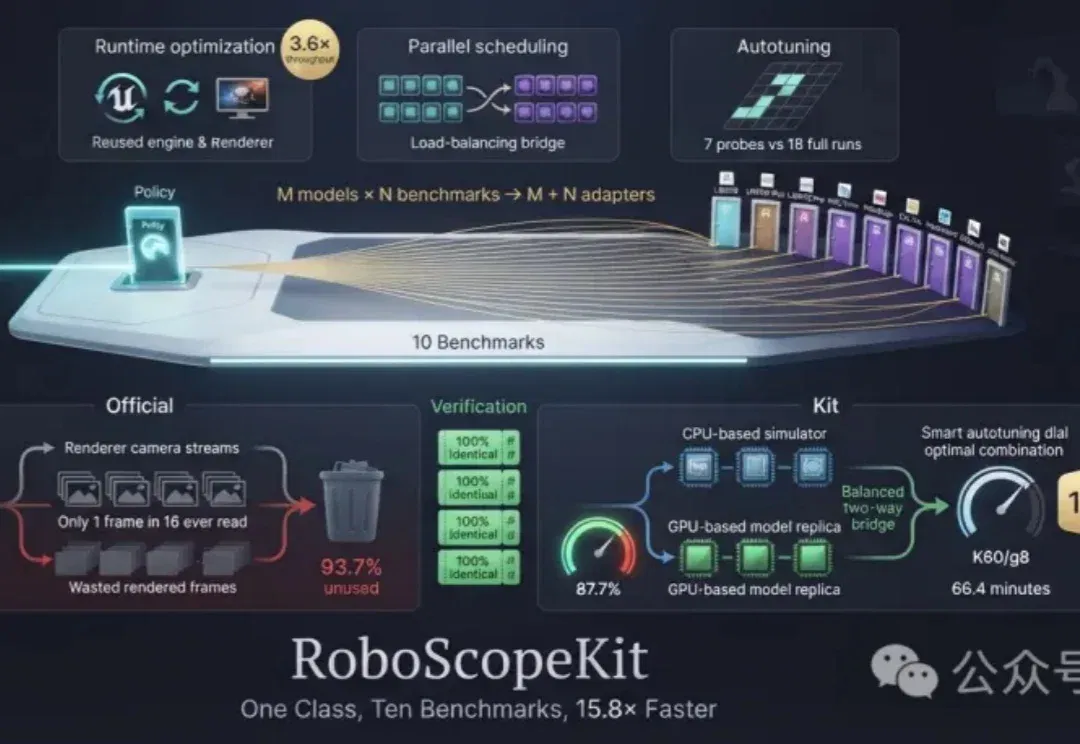
RoboScope Kit separates simulation and inference and optimizes runtime work. On four RTX PRO 5000 GPUs, it cuts StarVLA's 5,000-episode RoboTwin Easy evaluation from 17.5 hours to 66.4 minutes. Single-RTX-4090 tests use 48 GiB cards; these are evaluation speedups, not capability gains.
The performance figures here are evaluation speedups reported by the authors for specific checkpoints, simulation tasks and hardware, not improvements in robot success rates or real-world capabilities. The paper's RTX 4090 has 48 GiB of memory, and the four-GPU comparison uses 72 GiB RTX PRO 5000 cards; the results cannot be applied directly to other memory variants or host configurations. Speedups are measured using evaluation time alone, excluding initialization, search/tuning and cleanup. Paper experimental settings (opens in a new tab)
Research and development of vision-language-action (VLA) models relies heavily on simulation evaluation. Whether comparing two training checkpoints, changing random seeds or examining generalization during training, researchers have to rerun hundreds or thousands of complete episodes on simulation benchmarks such as LIBERO, RoboTwin, CALVIN, RoboCasa and RoboDojo.
Within the actual R&D loop, this evaluation stage faces two main bottlenecks:
1. Cumbersome integration. Each benchmark has its own launch scripts, camera names, observation formats and action conventions, while each model family brings its own preprocessing and inference pipeline. Comparing several models across several benchmarks requires writing and maintaining a separate adapter for every pair. Switch environments, and the process starts all over again.
2. Long waits. Take a public StarVLA checkpoint: under its official evaluation procedure, running 500 LIBERO-Long episodes on one RTX 4090 takes 49.8 minutes. For RoboTwin Easy, 500 episodes on one RTX 4090 take 7.0 hours. Completing the standard 5,000-episode protocol (50 tasks × 100 episodes) takes 17.5 hours even with four RTX PRO 5000 GPUs in parallel. Submit a job in the evening, and you do not get the results until noon the next day.
RoboScope Kit
A one-stop embodied evaluation toolkit
The MINT Lab in Shanghai Jiao Tong University's School of Artificial Intelligence, led by Bo Zhao, has released an arXiv technical report introducing a one-stop embodied evaluation toolkit, RoboScope Kit (Kit below).
Researchers can write one Python class for a model and evaluate it on every benchmark providing the observations it needs. Kit's adapters already cover more than ten mainstream simulation benchmarks, including LIBERO, LIBERO-Plus, LIBERO-Pro, RoboTwin 2.0, RoboDojo, CALVIN, RoboCasa GR-1 Tabletop, RoboCasa365, SimplerEnv, MetaWorld MT50, RLBench and robomimic, with room for continued expansion.
Report: https://arxiv.org/abs/2611.03850
Project page: https://mint-sjtu.github.io/RoboScope-Kit/
MINT Lab: https://mint-sjtu.github.io/
Code: https://github.com/MINT-SJTU/RoboScope-Kit
Measured by evaluation time alone, Kit performs as follows in three core tests:
• LIBERO-Long, 500 episodes (one RTX 4090): 6.2× faster than StarVLA's official evaluation. With CUDA MPS enabled, time falls from 49.8 to 8.1 minutes, making it 3.8× faster than RLinf and 2.1× faster than vla-eval.
• RoboTwin Easy, 500 episodes (one RTX 4090): 13.2× faster than StarVLA's official evaluation. Time falls from 7.0 hours to 31.9 minutes, making it 7.3× faster than vla-eval and 2.2× faster than RLinf.
• RoboTwin Easy, standard 5,000-episode protocol (four RTX PRO 5000 GPUs): 15.8× faster than StarVLA's official evaluation. Time falls from 17.5 hours to 66.4 minutes, with success outcomes and terminal steps matching the official evaluation for all 5,000 episodes.
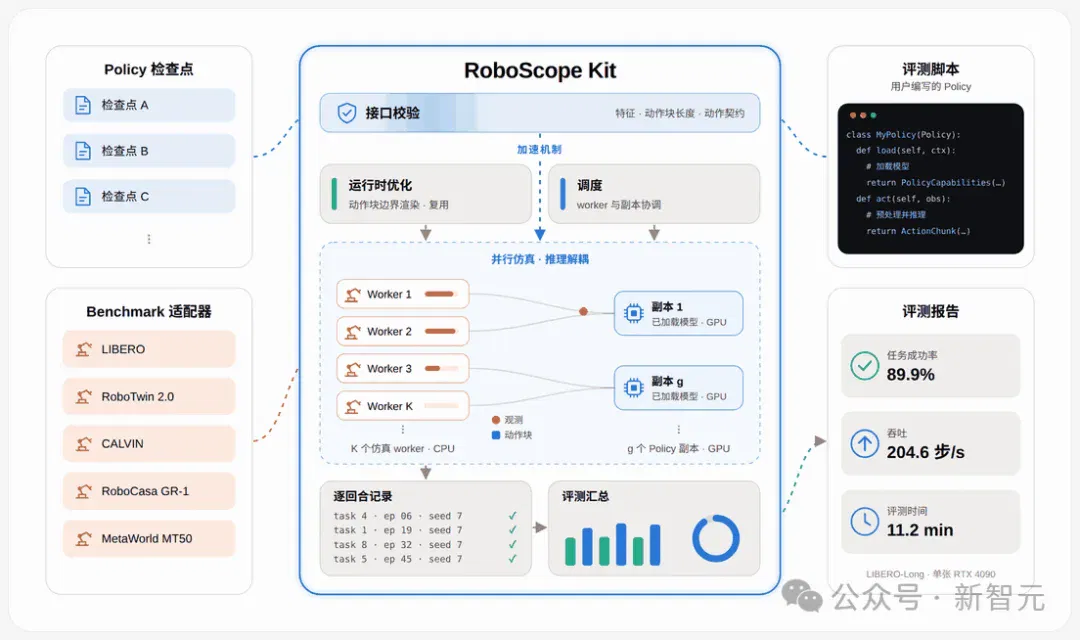
RoboScope Kit system overview: model checkpoints and benchmark suites connect to a unified evaluation runtime.
Integrate once, evaluate across benchmarks
Kit wraps each model in a Policy class: it loads the checkpoint, retains the model's own preprocessing, and declares three things—what observations it needs, how many action steps it outputs at once, and how many steps pass before it reads a new observation.
Each benchmark connects through an adapter. Task definitions, initial states, termination conditions and scoring remain handled by the benchmark's native evaluator. Before evaluation, Kit automatically checks that both interfaces match; during execution, it checks the types and dimensions of each observation and action to avoid silently running incorrectly.
Integrating each model and benchmark once reduces the adapters for M models and N benchmarks from M×N to M+N. The following UserPolicy example from Kit's repository uses LIBERO's libero_10:
import numpy as np
from roboscope_kit import ActionChunk, BenchmarkName, Policy, PolicyCapabilities, run
classUserPolicy(Policy):
defload(self, context):
self.model = load_model(context.checkpoint_path)
return PolicyCapabilities(
supported_benchmarks=(BenchmarkName.LIBERO,),
required_features=("images.primary", "state.proprioception"),
supported_suites={BenchmarkName.LIBERO: ("libero_10",)},
supported_action_chunk_sizes=(1,),
)
defact(self, observation):
return ActionChunk(np.asarray(self.model.predict(observation.features), dtype=np.float32))
if __name__ == "__main__":
run(UserPolicy())
In the example, load_model and model.predict represent the model's own loading and inference methods and must be implemented for the actual model. The excerpt above has keywords joined to names in classUserPolicy, defload and defact, as well as missing indentation. It cannot be copied and run in its current formatting; consult the complete example in the official repository.
When connecting to another benchmark, a Policy only needs to declare its supported scope. Adding a benchmark requires an adapter, a task-suite manifest and an environment-build script; existing Policies can be evaluated directly without modification.
Some models need to remember the previous state during inference; X-VLA, for example, needs the end-effector pose from the preceding action chunk. Kit isolates saved state by episode_id, allowing the same model instance to serve multiple concurrent episodes without interference.
Two acceleration methods
Runtime optimization and scheduling
When evaluation routinely takes seven or eight hours, or even runs overnight, the first suspect is often slow model inference. Yet GPU monitoring shows an RTX 4090 sitting almost idle much of the time. The team timed every millisecond along the evaluation pipeline and identified two main bottlenecks:
1. The evaluation pipeline repeats work.
Profiling StarVLA's official RoboTwin evaluation over 100 episodes on one RTX PRO 5000 showed that every episode rebuilds the simulation engine and renderer and first validates the seed using an expert trajectory, accounting for 6.9% of time. Scene construction accounts for 5.2%, while restarting the policy service per task adds another 5.3% of wall-clock time. Within each physics step, the control loop repeatedly solves for the same passive forces.
More importantly, mainstream VLAs output action chunks. The RoboTwin StarVLA checkpoint outputs 16 steps at once, but the official evaluator renders four camera views at every step. Each render takes about 42 milliseconds, accounting for 43.5% of evaluator time. The model reads only three views and just one frame in every 16. Across 100 episodes, 37,064 observations were rendered, but only 2,346 were read by the policy: 93.7% of rendering was never used.
2. Hardware sits idle.
In StarVLA's bundled LIBERO evaluation, one simulation process and one model execute in turn. Simulation and per-step observation/action processing on the CPU occupy 55% of evaluator time, while the model waits; during model inference, the simulator waits. An inference call takes 55 milliseconds, of which 26 milliseconds are GPU computation. Average GPU utilization across evaluation is 14.3%.
Kit addresses these issues in two ways: runtime optimization removes unnecessary overhead inside each evaluation process, while scheduling lets the CPU and GPU work in parallel.
Method 1: runtime optimization
Kit makes a series of optimizations to runtime overhead within the RoboTwin evaluation pipeline:
Reuse the simulation engine and renderer. Each evaluation process creates a SAPIEN engine and renderer only once for all its episodes. During long runs, such as 5,000 episodes, it releases GPU memory for completed tasks' scenes to prevent memory exhaustion.
Skip repeated expert validation and load the motion planner, cuRobo, only as needed. Before each episode, RoboTwin's official evaluator runs an expert demonstration to verify that the random seed is solvable. Doing so also requires starting the relatively heavy cuRobo motion planner.
Kit reads a prevalidated seed cache directly, eliminating repeated expert validation. Since joint-angle control itself needs no motion planning, Kit then skips cuRobo initialization altogether: preparation time fell from 45.2 to 1.4 seconds in a three-episode controlled experiment. End-effector-pose control still requires motion planning, so each evaluation process instead reuses one cuRobo planner to avoid repeated initialization.
Streamline the control loop. The official control loop repeatedly computes the same passive forces within each physics step. Kit consolidates that redundant computation into a single calculation.
Observe at action boundaries and render cameras on demand. The model outputs 16 action steps at once and reads observations only at the first step. Once the Policy declares an observation stride of 16, Kit renders new observations only at action-chunk boundaries. Physics simulation, action execution and success checks still proceed step by step at their native frequency. In a single-GPU controlled experiment, rendered frames fell from 2,100 to 132, and throughput rose 2.5×. Kit also renders only the three cameras the policy actually reads, skipping the unused front camera; the images are bit-for-bit identical to the official ones.

With 16-step action chunks, RoboTwin's official evaluator renders four cameras at every step; 93.7% of observations are never read by the policy.
To remove model-inference time and isolate runtime-optimization gains, the team cumulatively applied these changes on one RTX 4090 using a placeholder policy that performs no inference. RoboTwin throughput rose from 8.88 to 32.38 steps per second, a 3.6× increase.
With the actual StarVLA model evaluating 100 RoboTwin Easy episodes on four RTX PRO 5000 GPUs, using four simulator processes and four model replicas (K4/g4 below), these runtime optimizations together reduced evaluation time from 1,349 to 552 seconds, a 2.4× speedup. Every episode retained the official success outcome and terminal step.
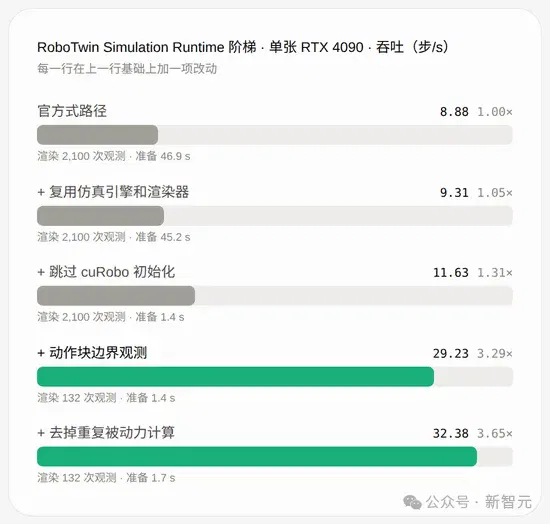
Throughput as single-GPU RoboTwin runtime optimizations are added one by one, using a placeholder policy without inference.
Method 2: scheduling
Scale simulation and inference separately. Kit splits simulator processes and models into two independent resource pools. Simulator processes, whose count is K, scale with CPU cores; model replicas, whose count is g, scale with GPU memory and computation. Multiple simulator processes share one model replica.
Simulator processes and model replicas run independently, and benchmarks and models can use separate Python environments. However many simulator processes are running, only g model copies occupy GPU memory.
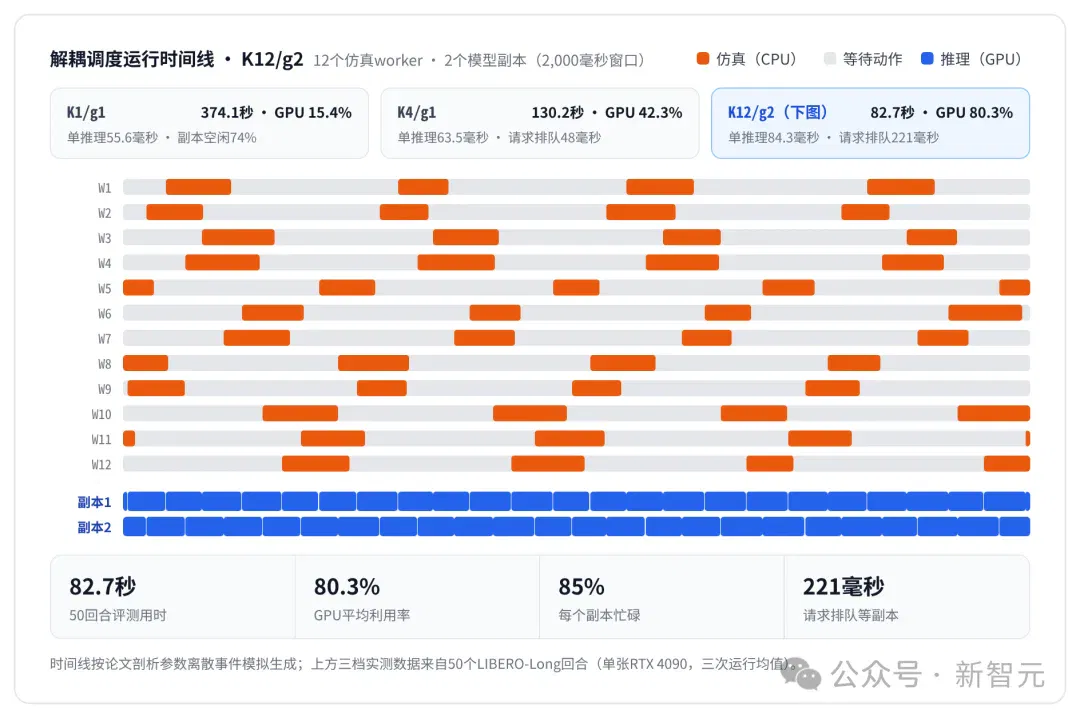
Execution timelines for different numbers of simulators and model replicas.
The timelines are generated from profiling parameters; their timing and utilization figures come from measurements over 50 LIBERO-Long episodes.
Across the full 500-episode LIBERO-Long evaluation on one RTX 4090, average GPU utilization is 46.3% when 12 simulator processes share one model replica. Adding a second replica raises utilization to 87.7% and reduces evaluation time from 1,216 to 748 seconds, a 1.6× speedup, with peak memory use of 25.0 GiB.
Automatic concurrency selection (Autotuning). Simulator and model-replica counts must be chosen jointly: too few processes leave GPU compute underused, while too many compete for CPU resources or cause out-of-memory errors. With one model replica, throughput plateaus at 112–114 steps per second once the simulator count reaches four. With two replicas, K12/g2 achieves 4.8× the throughput of K1/g1; K16/g4 further reaches 5.3×.
The optimal configuration varies by model, benchmark and machine. Kit's built-in concurrency search probes briefly using actual benchmark tasks, automatically finding the fastest K/g combination and reducing concurrency when it predicts insufficient GPU memory.
On LIBERO-Long, Kit probes only seven configurations, compared with 18 in a full grid search. With MPS off, it selects K12/g3, within 1.2% of the fastest grid configuration; with CUDA MPS on, it directly finds the fastest grid configuration, K16/g4. For RoboTwin Easy on four RTX PRO 5000 GPUs, the search automatically selects K60/g8.
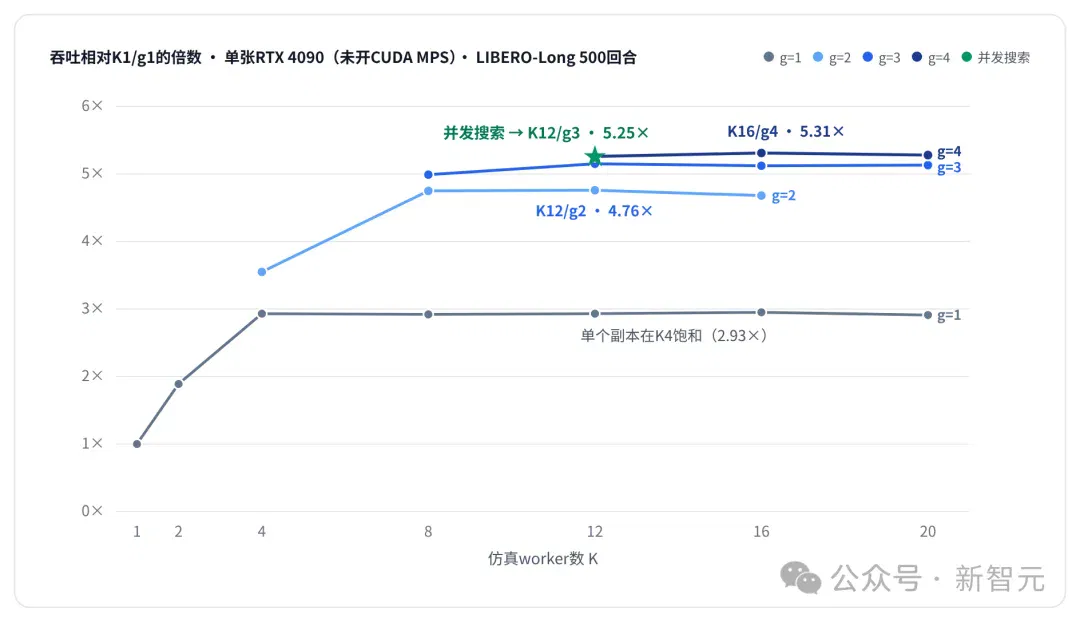
With one model replica, throughput stops growing after the simulator count reaches four. Twelve simulator processes with two replicas achieve 4.8× the throughput of K1/g1.
Run across multiple GPUs and instances.
When a machine has multiple GPUs, Kit can distribute model replicas across them (for example, K32/g4 on four RTX PRO 5000 GPUs achieves a throughput speedup over K8/g1 on one GPU of 4.0×).
For larger workloads, evaluation can also run across multiple GPU instances, each handling a subset of tasks, with the results merged into one report afterward. The team has already used four instances on its evaluation platform to complete 2,500 MetaWorld MT50 episodes in parallel.
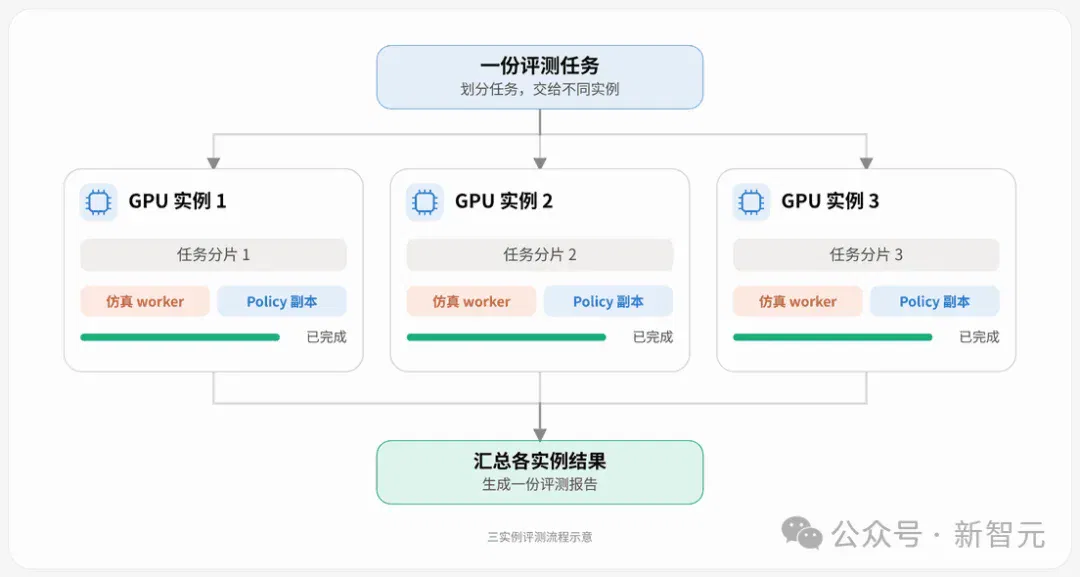
Multiple GPU instances evaluate separate portions, then merge the results into one report.
Experimental results
All cross-system and four-GPU comparisons below consistently use evaluation time alone, excluding model loading, process startup, search/tuning and cleanup.
LIBERO-Long (one RTX 4090, 500 episodes): 6.2× faster
Using one RTX 4090 and 12 CPU cores, the team compared Kit with three evaluation systems on the same checkpoint and the same 500 episodes: StarVLA's official evaluation, RLinf and vla-eval. RLinf and vla-eval used their own offline-tuned configurations, and each system ran three times. Without MPS, Kit's concurrency search selected K12/g3 and took 11.2 minutes (671 seconds), making it faster than StarVLA's official evaluation by 4.4×, faster than RLinf by 2.8× and faster than vla-eval by 1.5×.
With CUDA MPS enabled, the search selected K16/g4 and took 8.1 minutes (485 seconds), making it faster than StarVLA's official evaluation by 6.2×, faster than RLinf by 3.8× and faster than vla-eval by 2.1×. Compared with MPS disabled, it is another 1.4× faster.
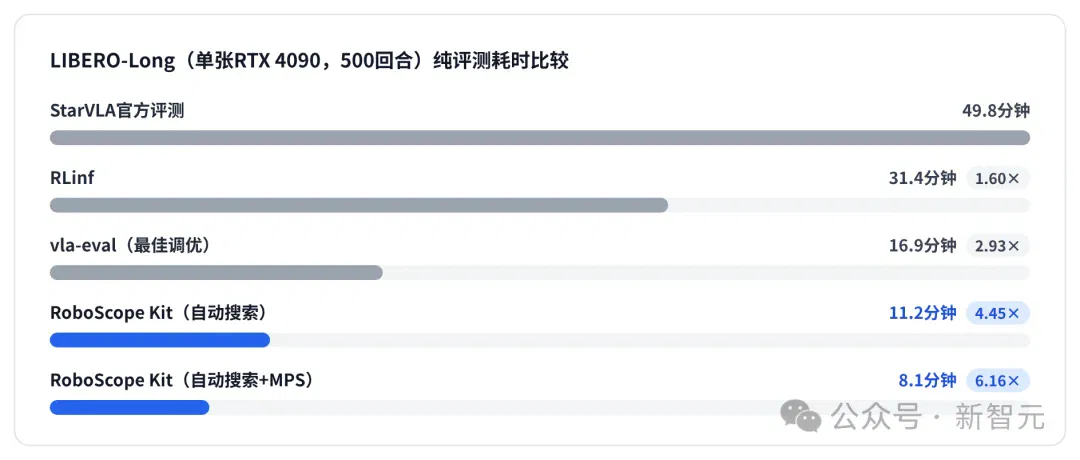
Evaluation-time comparison using the same checkpoint and the same 500 LIBERO-Long episodes.
RoboTwin Easy (one RTX 4090, 500 episodes): 13.2× faster
On one RTX 4090 with a 20-core quota, the team directly compared Kit with StarVLA's official evaluation, vla-eval and RLinf on the same checkpoint and 500 episodes (50 tasks × 10 episodes). Kit's automatic search selected K8/g1, taking 31.9 minutes (1,916 seconds) at a throughput of 110.2 steps/s, faster than StarVLA's official evaluation by 13.2×, faster than vla-eval by 7.3× and faster than RLinf by 2.2×.
Interestingly, vla-eval reaches 85.1% GPU utilization yet finishes second slowest overall. Its nine shards each initialize an engine and renderer independently and fully render every step, so the GPU spends substantial time rendering images the model will never read. Kit instead shares renderers and renders only once every 16 steps. StarVLA's official evaluation runs episodes sequentially and repeats expert validation for every seed; that step alone consumes 3,177 seconds.
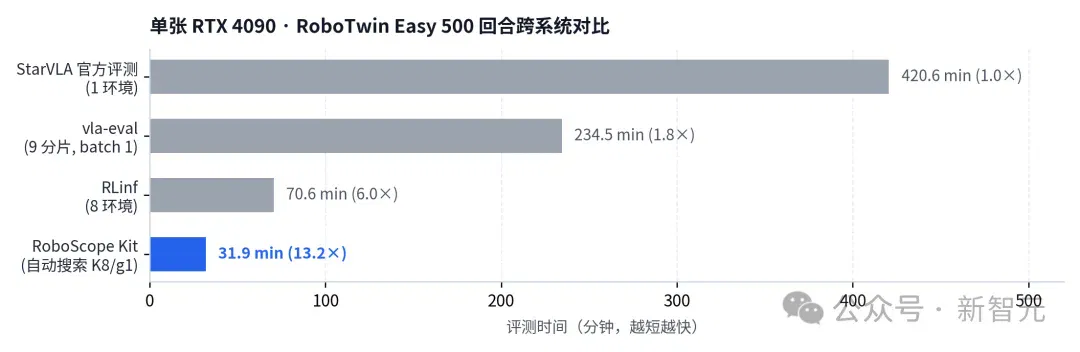
Cross-system evaluation-time comparison for 500 RoboTwin Easy episodes on one RTX 4090.
RoboTwin Easy (four RTX PRO 5000 GPUs in one machine, standard 5,000 episodes): 15.8× faster
On the same machine equipped with four RTX PRO 5000 GPUs, the team directly compared Kit with StarVLA's official four-GPU evaluation, one evaluation process per GPU, using the standard 5,000-episode protocol (50 tasks × 100 episodes). The official StarVLA evaluation took 17.5 hours (63,036 seconds). Kit completed it in just 66.4 minutes (3,985 seconds) using the automatically selected K60/g8 configuration: 15.8× faster, with steady-state throughput of 575 steps/s. All 5,000 success outcomes and terminal steps matched the official evaluation, with 2,313 successes out of 5,000, a 46.3% success rate.
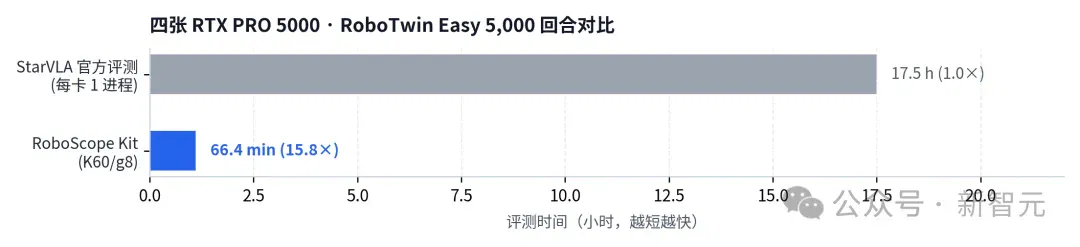
Evaluation-time comparison for RoboTwin Easy on four RTX PRO 5000 GPUs, using the standard 5,000-episode protocol.
Episode-by-episode agreement with the official evaluation
The researchers compared evaluation outcomes episode by episode on LIBERO-Long and RoboTwin Easy:
On LIBERO-Long
With a single process, K1/g1, Kit's 500 episode success outcomes match each of the three official evaluation runs individually. Under high concurrency, Kit's success rate is 89.9%, versus the official 90.2%, a difference of 0.3 percentage points. It agrees with the official evaluation on 97.9% of episodes, or 96.5% with MPS enabled, close to Kit's own agreement of 97.8%–99.0% across repeated runs.
On RoboTwin Easy
Whether in the 500-episode run that is 13.2× faster on one RTX 4090 (232/500), or the standard 5,000-episode run that is 15.8× faster on four RTX PRO 5000 GPUs (2,313/5,000), RoboScope Kit matches StarVLA's official evaluation on every episode's success outcome and terminal step: 100% agreement. For comparison, vla-eval also matches all 500 of 500 episodes on the single-GPU run. RLinf uses mean actions in this evaluation, reducing success-outcome agreement to 86.8% and terminal-step agreement to only 57.4%.
One class, one command
Evaluating a model with Kit takes three steps:
Install: run pip install roboscope-kit to install the Policy interface, runtime and benchmark adapters. Simulators, datasets and official evaluators are still supplied by each benchmark. The repository includes complete StarVLA and X-VLA examples.
Integrate: write a Policy class implementing load and act. The same class can be used directly on other benchmarks that provide the required observations.
Run: a single command specifying the benchmark, task suite, checkpoint and output directory starts evaluation. Kit automatically probes for and caches the optimal concurrency configuration, then writes episode records, metrics and resource reports to the output directory when finished.
Closing thoughts
Embodied models are iterating faster and faster; evaluation should not become the bottleneck slowing experimental iteration. RoboScope Kit turns model integration, simulation optimization, concurrent scheduling and result logging into one ready-to-use toolkit. Write a Policy class to run more than ten mainstream benchmarks and reduce evaluations that once ran overnight to tens of minutes.
References:
https://arxiv.org/abs/2611.03850
This article comes from New Zhiyuan, and was written by LRST.
Related topics
After reading
Join the AINRK community
Read how to join the community and connect with people working in AI.
Related articles
Continue reading related topics and articles in this category.
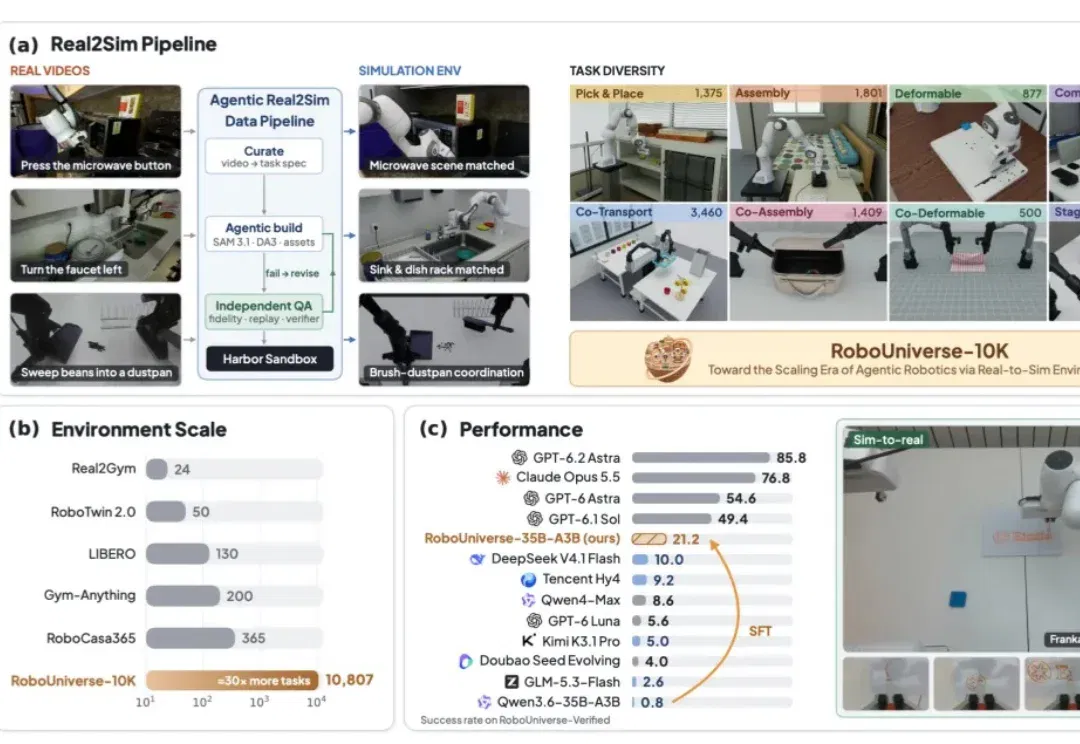
Einsia AI releases RoboUniverse-10K: 10,807 simulated environments and a 500-task benchmark (opens in a new tab)
Einsia AI and university partners release 10,807 verifiable simulated environments and a 500-task benchmark. Supervised fine-tuning on about 17,000 trajectories raised the base model's success rate from 0.8% to 21.2%. Current experiments focus on short manipulation skills.

Galaxea Releases G0.7: Roughly 60 ms Action Chunks Under a Specified Deployment Configuration (opens in a new tab)
Galaxea's G0.7 pairs long context with Fast-WAM. Its report describes roughly 60 ms action-chunk generation on a single RTX 5090 in FP8, plus task-specific post-training results in memory, sorting and longer workflows. Production deployment still needs task-level validation.
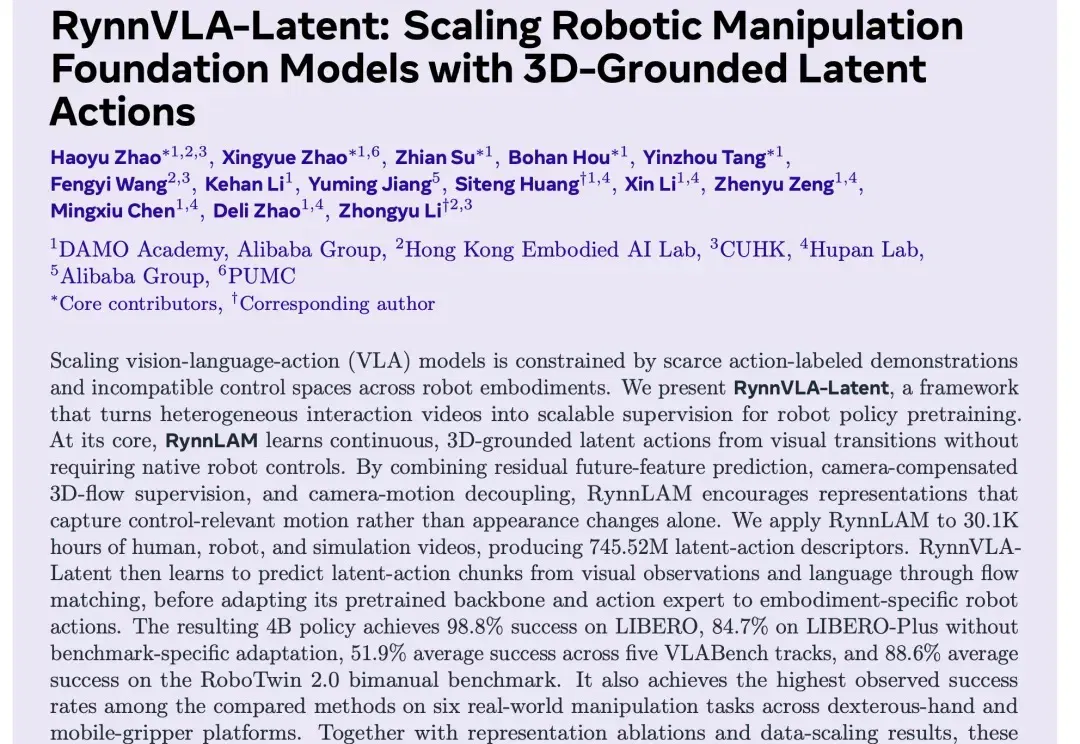
RynnVLA-Latent Pretrains on 30,000 Video Hours, Leading Compared Methods on Six Real-Robot Tasks (opens in a new tab)
DAMO Academy and collaborators use 3D-grounded latent actions to turn about 30.1K hours of diverse videos into pretraining supervision, then align to robot controls. Their 4B policy leads the compared methods on six real-robot tasks, within specific evaluations and still using real demonstrations.
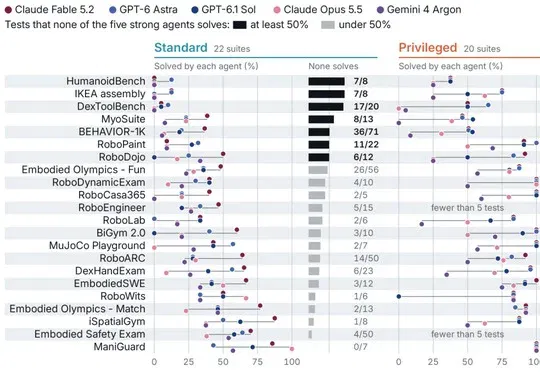
EFE Tests Coding Agents on Simulated Robots: 1,156 Tasks and Up to Three Modes (opens in a new tab)
EFE brings together 1,156 simulated tasks, 35 task sets and 47 robots, with up to three evaluation modes. Controlled experiments and stage annotations for part of the core set examine failures; results depend on the mode, agent framework and single runs.
Embodied AI data supply: Maniformer's devices, processing pipeline and crowdsourcing approach (opens in a new tab)
The article examines robots' action-data needs and Maniformer's devices, 3D trajectory processing, validation and crowdsourcing. Capacity and usable-data rates are company disclosures; market size, valuation and the timing of an embodied AI “GPT moment” are forecasts or commentary.