Galaxea Releases G0.7: Roughly 60 ms Action Chunks Under a Specified Deployment Configuration

Galaxea's G0.7 pairs long context with Fast-WAM. Its report describes roughly 60 ms action-chunk generation on a single RTX 5090 in FP8, plus task-specific post-training results in memory, sorting and longer workflows. Production deployment still needs task-level validation.
Editor's fact check (2026-11-26): The results listed in this article come from Galaxea's G0.7 technical report and are the team's evaluations under the corresponding task, data and hardware configurations, not a general productivity ranking. The memory and sorting-by-demonstration experiments include task-specific post-training, with 15 evaluations in each task's in-distribution and out-of-distribution settings. "Watching a demonstration" does not mean an untrained model can learn arbitrary jobs. Roughly 60 milliseconds refers to the latency for generating one 16-step action chunk on a single RTX 5090 in an FP8 configuration, not the total time from observation to completion of a physical action. Roughly five hours refers to the amount of demonstration data used per long-horizon task, not the total time spent training, debugging and deploying. G0.7: Scaling Up a Fast World Action Model with Long Context (opens in a new tab); Galaxea's official G0.7 model introduction (opens in a new tab)
The biggest commotion in AI over the past few days has undoubtedly been the once-in-a-century debate sparked by mathematicians and AI collaborating to complete a proof of the Riemann hypothesis.
From struggling even with multiplication, to winning gold medals in mathematics competitions, to challenging the Riemann hypothesis that has troubled mathematicians for more than a century, AI seems constantly to be reshaping our understanding of the boundaries of its capabilities.
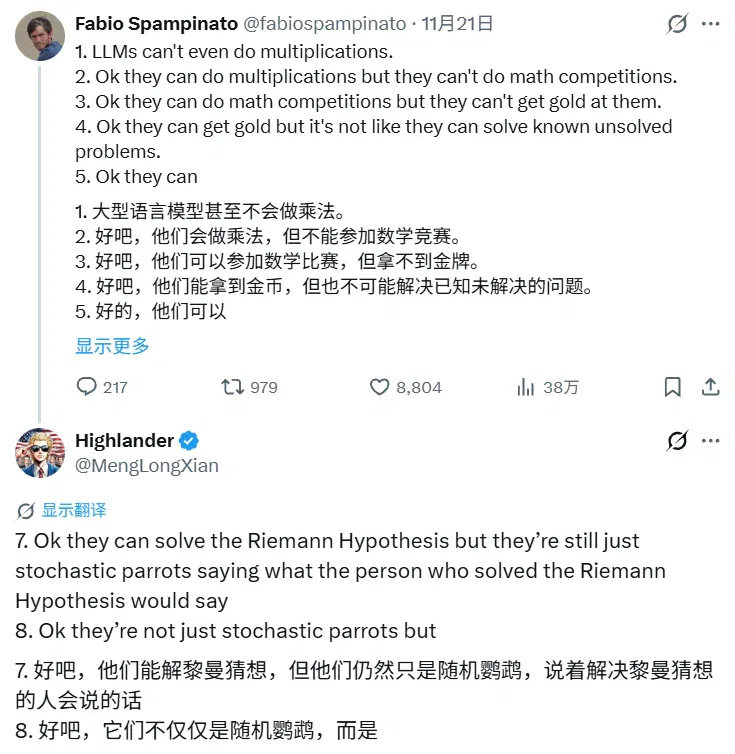

At this rate, The Terminator and The Matrix are going to turn from science fiction into documentaries...

Yet compared with AI's continual breakthroughs in the digital world, AI in the physical world still seems less "capable."
As interest in embodied intelligence, world models and spatial intelligence continues to grow, physical AI's capabilities are evolving rapidly too. Meanwhile, general-purpose large models such as GPT-6 Astra keep expanding their capabilities and are even beginning to challenge areas traditionally occupied by specialized embodied models.
This raises a question: as general-purpose large models become better at understanding the world, reasoning and planning, do robots still need specialized embodied foundation models?
In Galaxea's view, the answer is yes.
Understanding a task is not the same as being able to execute it. Although general-purpose large models possess high-level cognitive and reasoning capabilities, translating these into continuous real-world actions still requires overcoming problems such as real-time response, precise control and stable execution.
As robots enter production environments such as factories and warehouses, businesses are more concerned with whether they can keep up with real production cycles, quickly master new tasks, and reduce data and debugging costs.
Released by Galaxea on November 24, the new-generation embodied foundation model G0.7 is an exploration focused on these very questions.
Based on a world action model (WAM) architecture, G0.7 combines long-context understanding, rapid action generation and generalization across scenarios: it can infer task rules from human video demonstrations, generate action chunks with roughly 60 ms latency, and adapt to complex long-horizon manipulation tasks using a small amount of demonstration data.
These capabilities point toward a new direction in competition among embodied foundation models: beyond pursuing individual technical metrics, the goal is to let robots learn tasks faster, execute them more efficiently, and adapt to real production at lower cost.
Memory, sorting by demonstration and roughly 60 ms action chunks: G0.7's real-robot tests
Let's start with a few of G0.7's real-robot experiments.
The first task is a little like the childhood game of guessing where something is hidden. Several cups are repeatedly moved and shuffled, and the robot must determine which cup ends up concealing the target object.
The following video is from Galaxea.
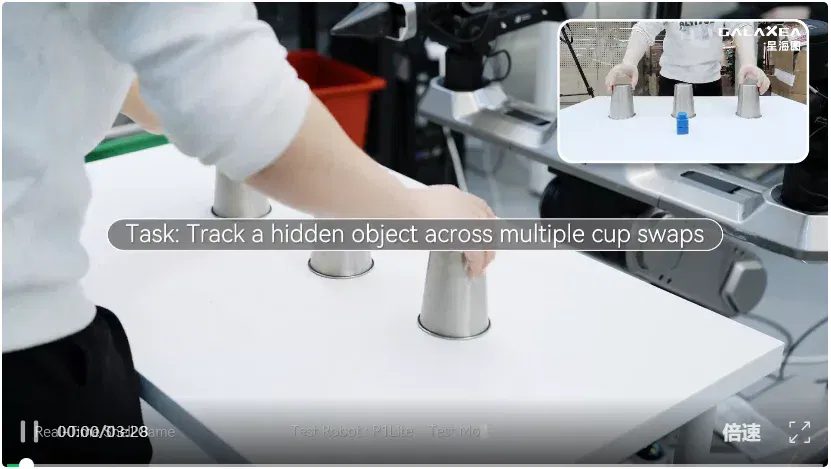
For humans, this is just a simple memory game. But for robots that make decisions from single-frame images, once the target is occluded, the current image no longer provides enough information. Finding the target requires remembering what happened earlier.
Another task, sorting by demonstration, is more complex: there are seven objects and three bins on a table, and the robot has to decide how to sort them based on an earlier human demonstration.
The following video is from Galaxea.
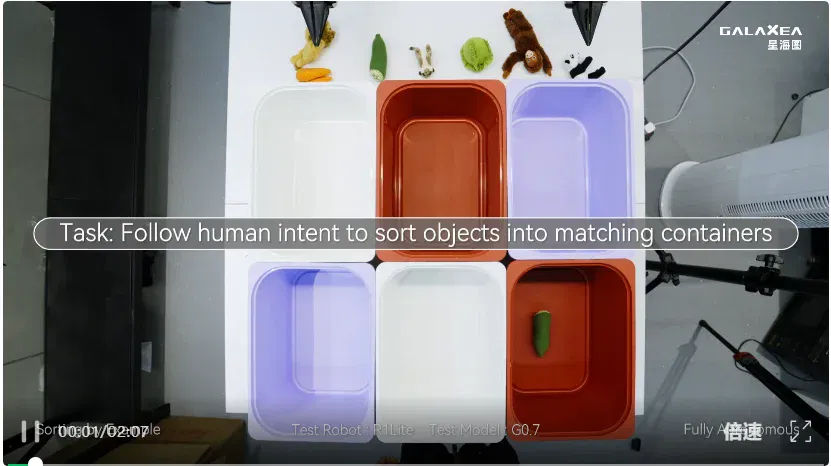
The problem is that there is no instruction sheet attached to the table. From the current image alone, the robot does not know which sorting rule the person wants it to follow. Under Galaxea's task setup, random guessing has only about a 5% chance of selecting the correct action.
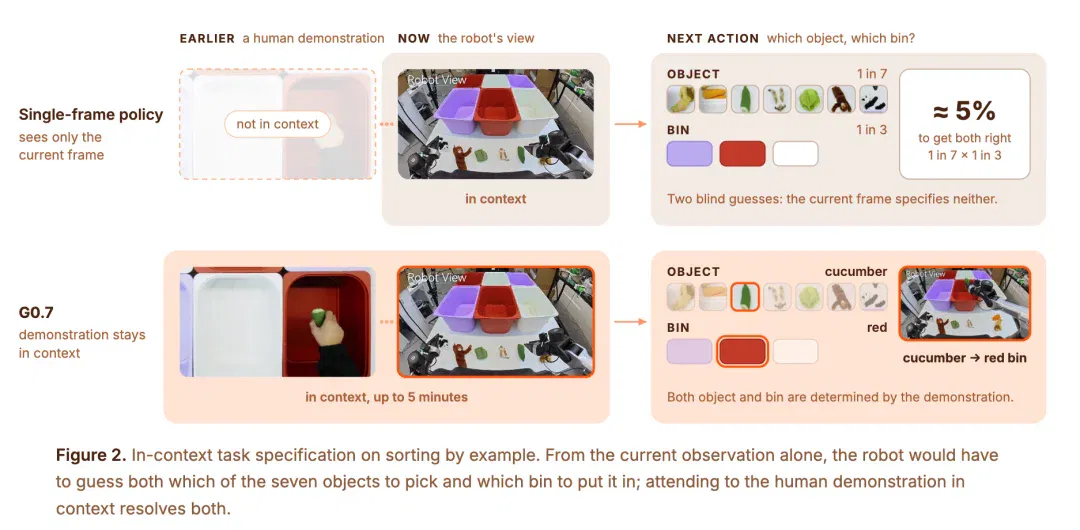
After watching a video of the human performing the task, however, G0.7 can retain the demonstration in context, infer the sorting rule from the history of actions, and then decide what to do.
To accomplish these tasks, a robot must not only see and recognize things, but also remember and reason about them.
To this end, G0.7 incorporates long-context capabilities into its native training process, using a sliding window to retain historical visual information. This lets the model use past observations when making successive action decisions, with its longest context covering five minutes of history.
The experimental results also demonstrate the performance benefits of long context.
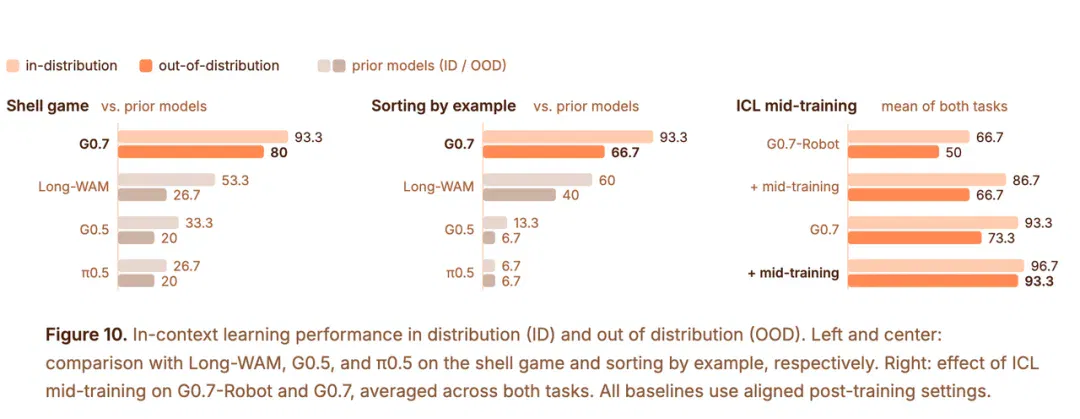
In post-training experiments on the corresponding real-robot tasks, G0.7 achieved 93.3% in-distribution success on both the shell game and sorting by demonstration, with out-of-distribution success rates of 80.0% and 66.7%, respectively.
By comparison, under the same evaluation settings, Long-WAM, a model specifically targeting long-term temporal memory, achieved out-of-distribution success rates of 26.7% and 40.0% on the two tasks.
With the further addition of in-context learning mid-training, G0.7's average in-distribution success across the two tasks reached 96.7%, while average out-of-distribution success rose to 93.3%.
What does this mean for real production? In factories, warehouses and retail settings where material specifications and work tasks keep changing, robots could potentially understand new tasks by observing demonstrations, reducing their dependence on separately written rules for each one.
A good memory and strong understanding, however, are only the first step.
After all, even if a robot understands a task accurately, it will still struggle to enter real production environments if it has to spend ages thinking before every action.
Imagine a robot on an assembly line picking up an item and then waiting for its next inference. By the time it finally calculates its next move, the next item has already arrived. However smart the model is, it may still fail to keep pace with production.
Another G0.7 upgrade aims to move robots away from this pattern of "thinking it through, then moving slowly." On a single RTX 5090 with an FP8 deployment configuration, G0.7's Fast mode generates one action chunk in only about 60 ms.
More importantly, it natively supports RTC technology (Real-Time Chunking).
Put simply, while the robot executes its current action segment, the model is already calculating the next one. When the previous segment finishes, the next can follow promptly, reducing the wait between action chunks.
In a test trajectory containing six action chunks, combining Fast mode with RTC enabled smoother action transitions and real-time responses, making the overall execution more continuous and efficient.
This ability to execute continuously may matter even more to robots than the speed of a single inference.
How does G0.7 remember more, reason clearly and still act fast enough?
No need to imagine the future every time: a different way for robots to think
Let's first consider a choice that robot foundation models have previously faced: VLAs (vision-language-action models) versus WAMs (world action models).
The former attempt to map vision, language and other information directly to robot actions. The latter introduce world models into robot control, so that while learning actions, the model also learns how the physical world might change next.
The two approaches have different emphases. Direct action generation offers a relatively straightforward path. Introducing video-based world modeling can teach physical interaction knowledge from video, but may also increase inference costs.
If a robot has to generate future video before deciding how to act every time, computational cost could become a bottleneck for real-time control. After all, a real robotic arm cannot pause the liquid it is pouring just because the model is still imagining the flow of water a second from now.
So can robots learn physical laws by predicting the future, but avoid generating that future every time they actually act?
This is precisely the central idea behind Galaxea's earlier Fast-WAM research.
During training, the model uses video prediction to learn the relationship between future visual states and actions. At inference time, it skips future-video generation and outputs actions directly. The value of world modeling need not be manifested by explicitly generating future video during inference.
Fast-WAM in March of this year primarily validated this idea using single-frame observations. G0.7 extends it to long temporal contexts and uses a larger-scale corpus of robot teleoperation and human egocentric video for pretraining.
At the same time, the same set of G0.7 model weights supports two different inference methods. One is IDM mode, which first generates future visual latent variables and then produces actions based on those predictions. The other is Fast mode, which omits future-video generation and decodes actions directly.
This also makes it possible to compare the performance and efficiency of the two inference methods.
Results in Galaxea's technical report show that the two modes generally perform similarly across evaluations involving simulation, real-robot zero-shot deployment, in-context learning and post-training tasks.
For example, on real-robot post-training tasks, Fast mode achieved average task progress of 87.3%, compared with IDM mode's 87.8%. In real-robot zero-shot tests, both succeeded in 39 of 75 trials.
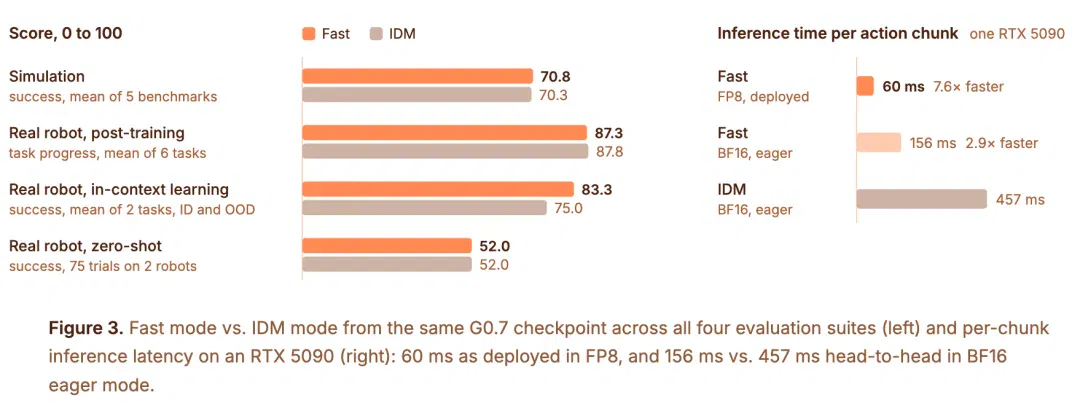
Inference latency, however, differed substantially. Under the same BF16 eager configuration, Fast mode took 156 ms per action chunk, while IDM mode required 457 ms.
With further FP8 deployment optimization, Fast mode's action-chunk generation latency fell to about 60 ms. Compared with IDM mode in the BF16 eager configuration, this is approximately 1/7.6 of the latency.
This indicates that, across the evaluations covered by G0.7, omitting future-video generation during inference did not cause a marked loss in task performance, while delivering considerable speed gains.
Actual robot execution, however, also involves tasks on different timescales. High-level planning, continuous action generation and low-level control have different response-frequency requirements, so a single large model may not be suitable for handling them all.
This is also the thinking behind Galaxea's three-system architecture of System 2, System 1 and System 0:
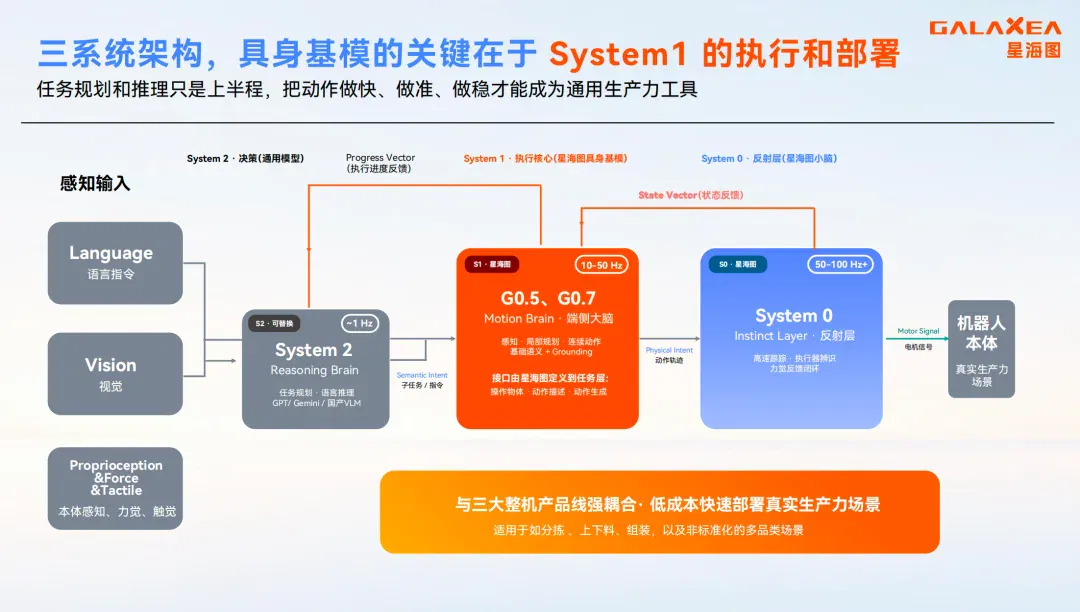
System 2 is the high-level cognition and planning system, running at around 1 Hz. It handles task understanding, planning and the coordination of instructions, and can connect to general-purpose multimodal models such as GPT.
System 1 is the embodied action model, operating at around 10–50 Hz. G0.7 sits at this layer, handling perception, local planning and continuous action generation.
System 0 is the high-speed control layer, operating at 50–100 Hz or even higher. It handles action tracking, force feedback and low-level control.
This architecture coordinates general-purpose models' high-level cognition, embodied foundation models' real-time action generation, and the robot hardware's high-speed control. General-purpose large models and specialized embodied foundation models are not simply substitutes for one another; they can complement one another.
But to truly enter production environments, robots must not only execute efficiently, but also adapt to new tasks at sufficiently low cost.
About five hours of demonstration data per long-horizon task: testing adaptation through post-training
How much does it actually cost to teach a robot a new job?
Human employees usually do not need to relearn how to use their hands when changing roles. For traditional robotic systems, however, a new task often means collecting new data, training a model and debugging repeatedly. Even a change in workstation, material or tool can increase adaptation costs.
One key bottleneck is data.
Language models can pretrain on vast amounts of internet data. The high-quality action data robots need, however, often depends on real robot hardware, teleoperation equipment and dedicated collection, making it more expensive to obtain.
Can robots learn directly from human videos without separately collecting robot demonstrations for every task?
G0.7 jointly pretrains on robot teleoperation data and human egocentric video, with each accounting for roughly half of the data.
Human videos lack directly executable action labels, however, and human hands differ structurally from robotic grippers. Galaxea therefore uses visual localization and hand-pose estimation to extract 3D hand-motion information and convert it into robot-compatible action representations, including six-degree-of-freedom wrist poses and the 3D positions of five fingertips.
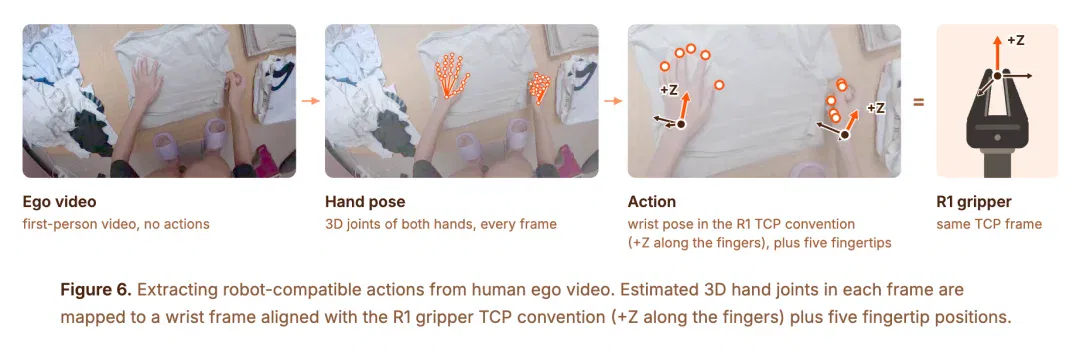
This means human video is no longer just material for visual understanding: it can also contribute to training robot action representations.
G0.7's ablation experiments also demonstrate the effectiveness of this approach.
In real-robot zero-shot pick-and-place evaluations on R1 Lite, G0.7-Robot, pretrained only on robot data, achieved 12% success. Adding human egocentric video raised the full G0.7 model's success rate to 54%.
Beyond diversifying data sources, Galaxea also introduces three levels of language annotation, corresponding to complete tasks, intermediate subgoals and short atomic actions. This lets the model understand operational requirements at different timescales.
These designs aim to let robots accumulate general manipulation capabilities through pretraining, lowering the cost of learning new tasks. Post-training experiments also reflect the effectiveness of this approach.
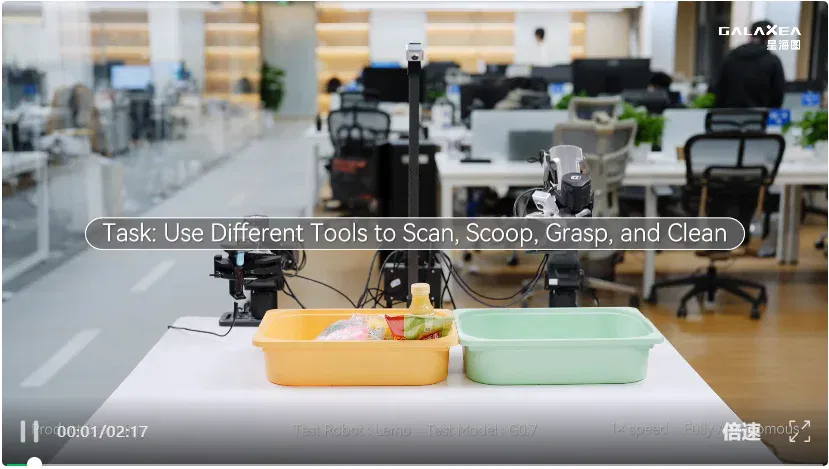
For example, across four tool-use tasks—scooping food, lifting bowls with tongs, scanning barcodes and sweeping a tabletop—G0.7 used only 20 demonstrations per tool and achieved average task progress of 82%.
Under the same evaluation settings, G0.5, π0.5 and OpenWAM achieved average task progress of 58%, 35% and 17%, respectively.
The following video is from Galaxea.
More complex long-horizon tasks test whether a robot can connect multiple actions into a complete workflow.
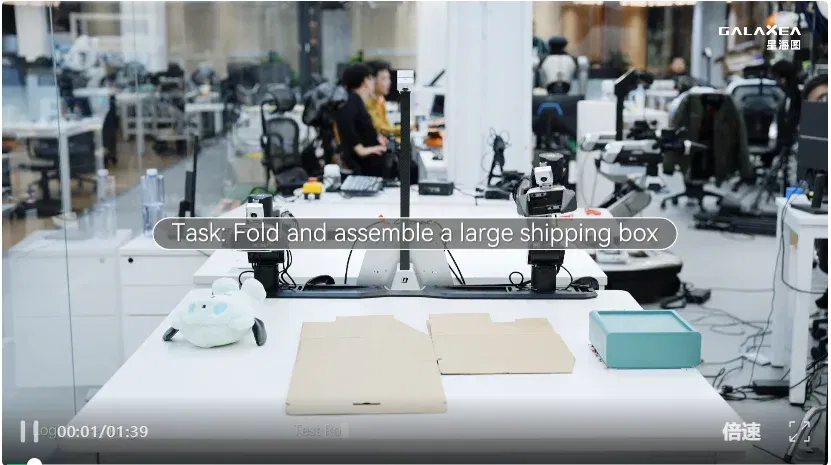
Folding a shipping box, for example, requires the robot to turn flat cardboard into a box, place items inside and seal it, while continually responding to changes in the cardboard's shape.
With post-training using roughly five hours of demonstration data per task, G0.7 achieved a 90% success rate and 95% task progress on folding shipping boxes.
By comparison, G0.5's success rate was 75% and π0.5's was 55%, while OpenWAM failed to complete a single full box-folding operation.
The following video is from Galaxea.
Another task was making lemon tea. Opening a bottle, pouring liquid, stirring and handing over the drink require handling both objects and liquids throughout the workflow.
G0.7 achieved 100% success and task progress in the tests. Under the same evaluation, G0.5 and π0.5 achieved success rates of 80% and 45%, respectively.
The following video is from Galaxea.
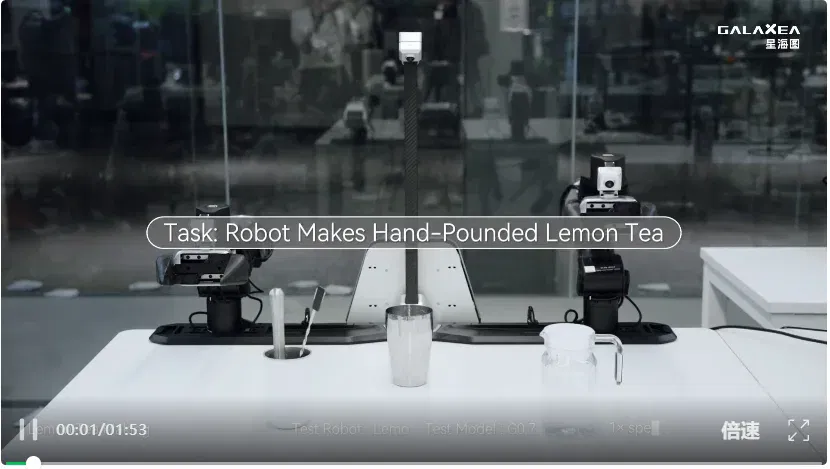
These results indicate that G0.7 can already adapt to some complex long-horizon tasks using relatively limited demonstration data.
This is especially important in production environments where SKUs, packaging, materials and processes continually change. If every change requires extensive retraining and debugging, deploying robots will struggle to make economic sense. Only by reusing existing experience and adapting quickly to new tasks can robots move from performing a single job to continually taking on diverse tasks.
This is also why Galaxea is committed to its "robot hardware + intelligence" strategy.
For embodied intelligence, model performance is only the starting point. Truly turning model capabilities into productivity also requires close coordination with robot hardware, control systems and business scenarios.
Through the twin drivers of "robot hardware + intelligence," Galaxea is improving its model's task understanding, real-time execution and generalization across scenarios, while also advancing the model alongside its robot hardware and product lineup. Targeting e-commerce and retail, industrial manufacturing, express delivery and logistics, and energy and power, it is exploring the full chain from underlying intelligence to robot products and industry solutions.
Conclusion
As AI advances rapidly, expectations and skepticism continue to intertwine. On one hand, model capabilities keep breaking through, making AGI/ASI seem close at hand. On the other, when AI actually leaves the digital world and enters complex, changing physical environments, many practical problems remain to be solved.
For embodied intelligence, the next stage of competition is not just about how many complex tasks models can perform. It is also about whether robots can continually do valuable work with sufficiently high efficiency and sufficiently low costs.
G0.7 combines task understanding, real-time execution and generalization across scenarios, demonstrating an overall competitive offering aimed at real production. Through its "robot hardware + intelligence" strategy, Galaxea is further exploring how to translate model capabilities into robot products and actual business value.
If AI has spent the past few years continually raising the ceiling of intelligence, embodied intelligence must next demonstrate how much real productivity these capabilities can actually deliver.
This article is from "Synced," by "Clio".
Related topics
After reading
Join the AINRK community
Read how to join the community and connect with people working in AI.
Related articles
Continue reading related topics and articles in this category.
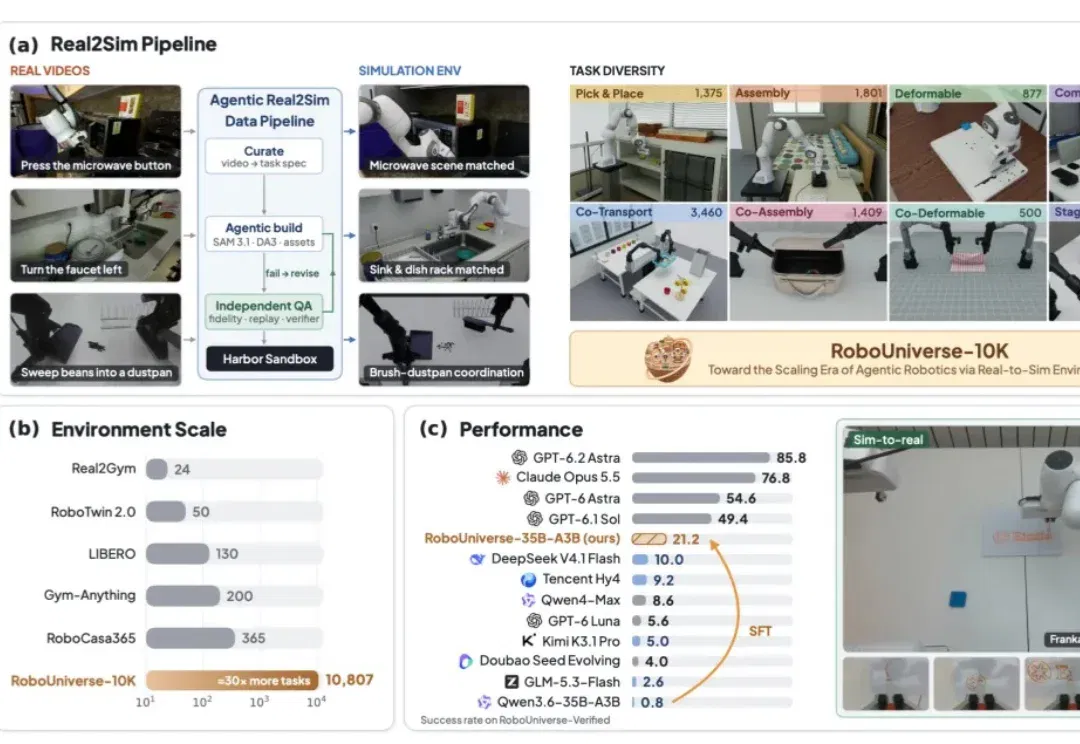
Einsia AI releases RoboUniverse-10K: 10,807 simulated environments and a 500-task benchmark (opens in a new tab)
Einsia AI and university partners release 10,807 verifiable simulated environments and a 500-task benchmark. Supervised fine-tuning on about 17,000 trajectories raised the base model's success rate from 0.8% to 21.2%. Current experiments focus on short manipulation skills.
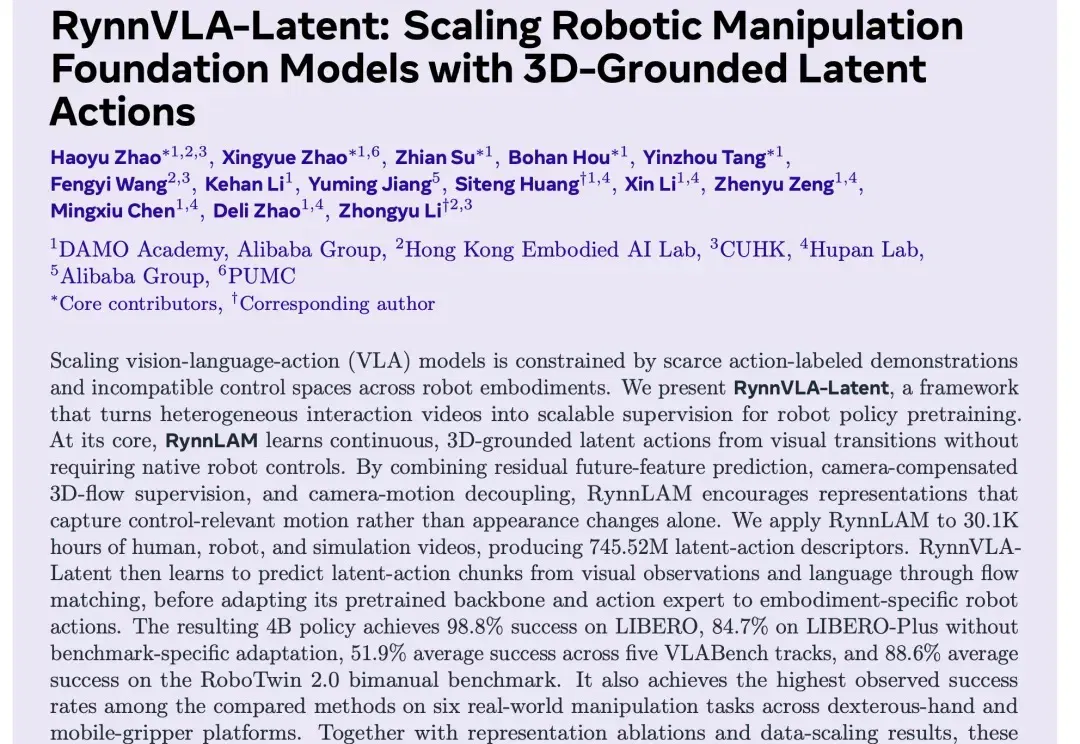
RynnVLA-Latent Pretrains on 30,000 Video Hours, Leading Compared Methods on Six Real-Robot Tasks (opens in a new tab)
DAMO Academy and collaborators use 3D-grounded latent actions to turn about 30.1K hours of diverse videos into pretraining supervision, then align to robot controls. Their 4B policy leads the compared methods on six real-robot tasks, within specific evaluations and still using real demonstrations.
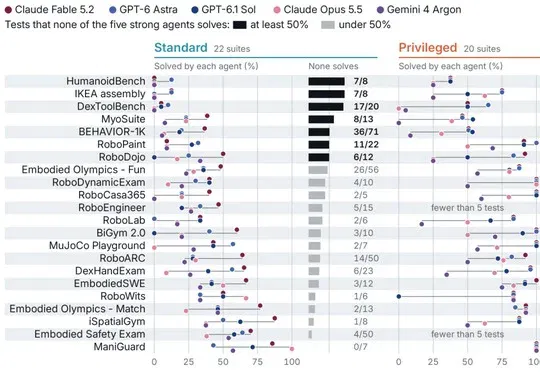
EFE Tests Coding Agents on Simulated Robots: 1,156 Tasks and Up to Three Modes (opens in a new tab)
EFE brings together 1,156 simulated tasks, 35 task sets and 47 robots, with up to three evaluation modes. Controlled experiments and stage annotations for part of the core set examine failures; results depend on the mode, agent framework and single runs.
Embodied AI data supply: Maniformer's devices, processing pipeline and crowdsourcing approach (opens in a new tab)
The article examines robots' action-data needs and Maniformer's devices, 3D trajectory processing, validation and crowdsourcing. Capacity and usable-data rates are company disclosures; market size, valuation and the timing of an embodied AI “GPT moment” are forecasts or commentary.
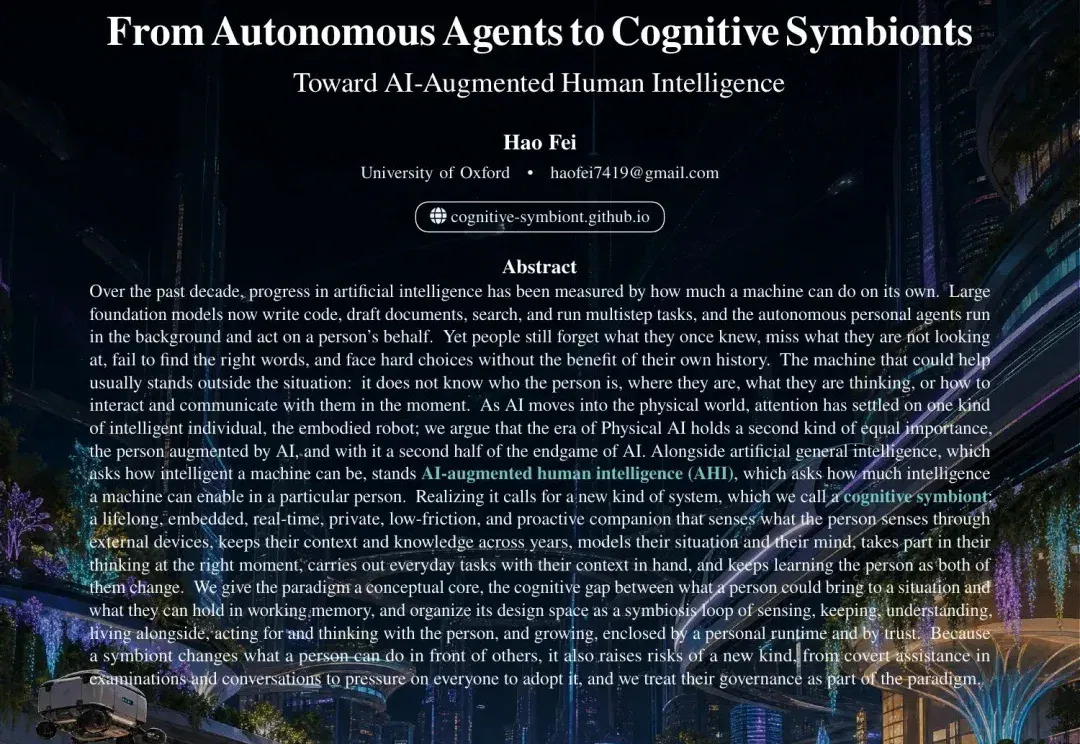
Hao Fei's perspective paper proposes a framework for AI 'cognitive symbionts' (opens in a new tab)
Hao Fei's 59-page perspective paper frames personal AI through Cognitive Symbionts, a cognitive gap and a symbiotic loop. It explores memory, timely intervention, learning, care, consent, privacy and governance, setting out concepts and evidence standards rather than a tested complete system.