Einsia AI releases RoboUniverse-10K: 10,807 simulated environments and a 500-task benchmark
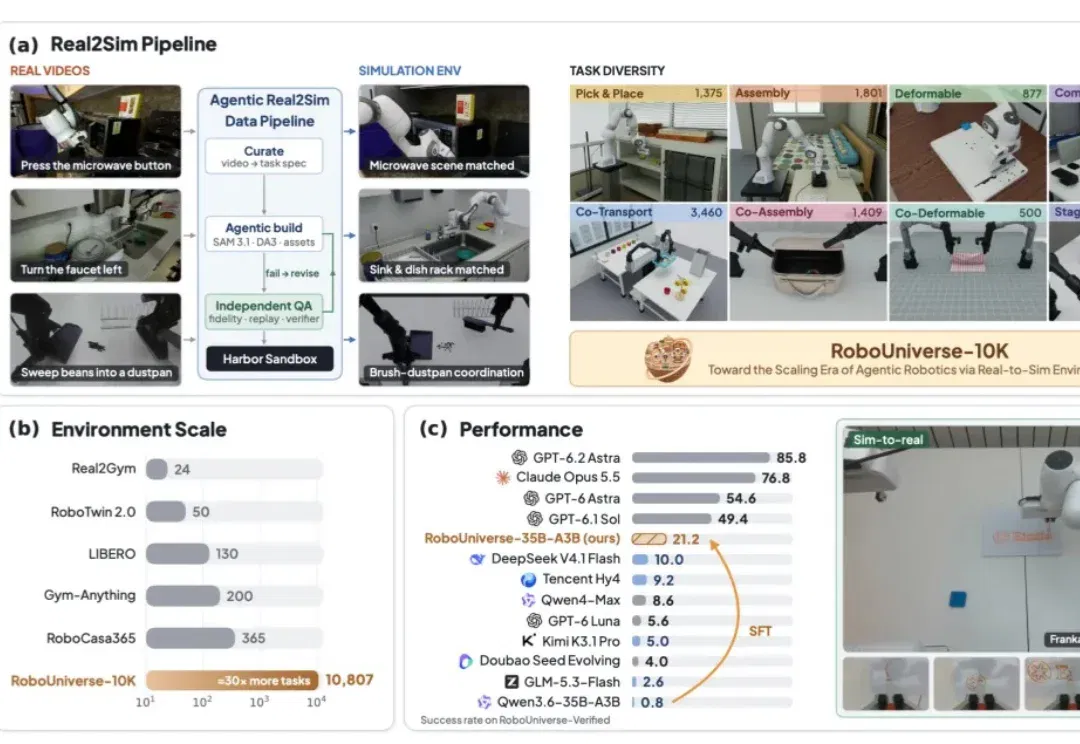
Einsia AI and university partners release 10,807 verifiable simulated environments and a 500-task benchmark. Supervised fine-tuning on about 17,000 trajectories raised the base model's success rate from 0.8% to 21.2%. Current experiments focus on short manipulation skills.
Editorial fact-check (2026-11-26): The RoboUniverse-10K paper provides RL-ready environments. The model improvements described in the article come from supervised fine-tuning experiments and do not yet amount to large-scale validation of online reinforcement learning. The authors explain that the reconstructed scenes still simplify dynamics, current tasks focus on short, atomic manipulation skills, and longer workflows remain to be expanded. The cross-benchmark and physical-robot demonstrations are specific examples. The article's "GPT moment" is a prediction about a trend, not evidence that embodied general intelligence has been achieved. RoboUniverse-10K paper, including conclusions and limitations; (opens in a new tab)Official Einsia RoboUniverse-10K repository. (opens in a new tab)
Large models have used the vast quantities of text on the internet to make scaling laws work and bring about the emergence of general intelligence.
Using SWE-Gym, SWE-smith and SWE-Universe, coding models have turned real GitHub repositories and pull requests into executable environments at scale, then used RL to climb toward the top of SWE-bench.
Today, embodied intelligence stands at a similar turning point.
But to truly reach a GPT moment for embodied intelligence, the environment barrier must first be overcome. Most existing simulation environments still offer only tens or hundreds of hand-built tasks. Models repeatedly work through the same scenarios and never escape training on the test set.
To address this, Einsia AI, together with six universities—Tsinghua University, Peking University, UIUC, HKU, UCL and UNC-Chapel Hill—has open-sourced RoboUniverse-10K——an RL-ready collection of more than 10,000 environments for training embodied agents.
The team converted real-world manipulation videos into 10,807 interactive, verifiable Isaac Sim environments and selected 500 tasks to construct the benchmark RoboUniverse-Verified, and conducted a comparative evaluation of 11 mainstream models, revealing core bottlenecks for frontier models. Meanwhile, using approximately 17,000 multi-turn trajectories collected in RoboUniverse-10K for SFT, the team produced the RoboUniverse-35B-A3B model, whose zero-shot success rate jumped from 0.8% to 21.2%. The resulting capabilities also transferred successfully to other simulation benchmarks and real robotic-arm tasks.

- Paper title: RoboUniverse-10K: Toward the Scaling Era of Agentic Robotics via Real-to-Sim Environments
- Project website: https://lab.einsia.ai/robo-universe
- GitHub: https://github.com/Einsia/RoboUniverse-10K
- arXiv: https://arxiv.org/pdf/2611.31002
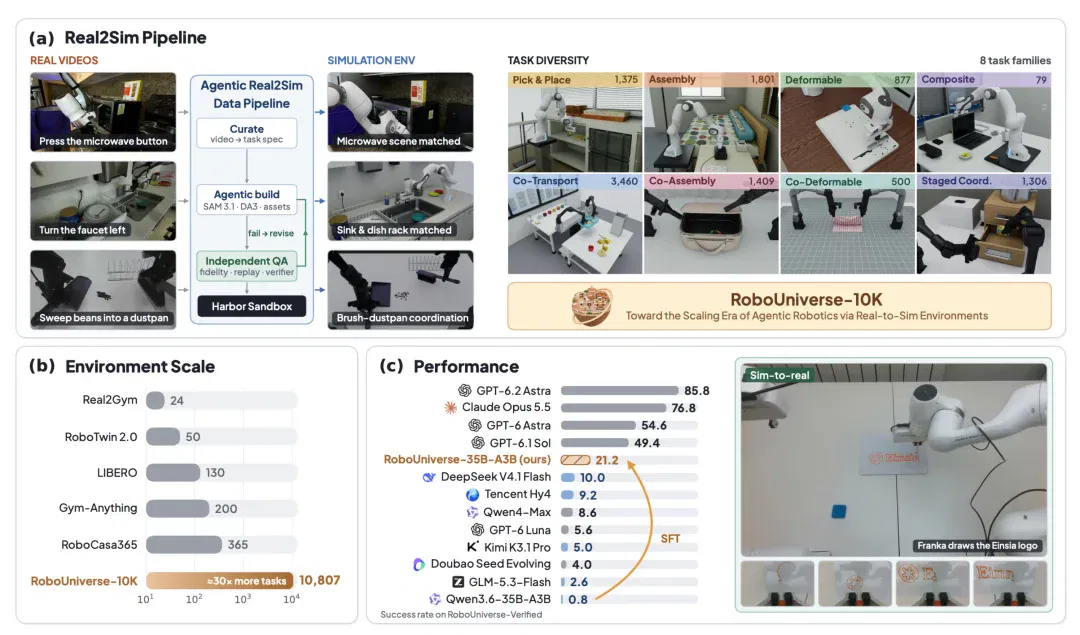
Turning real videos into 10,807 interactive physical environments
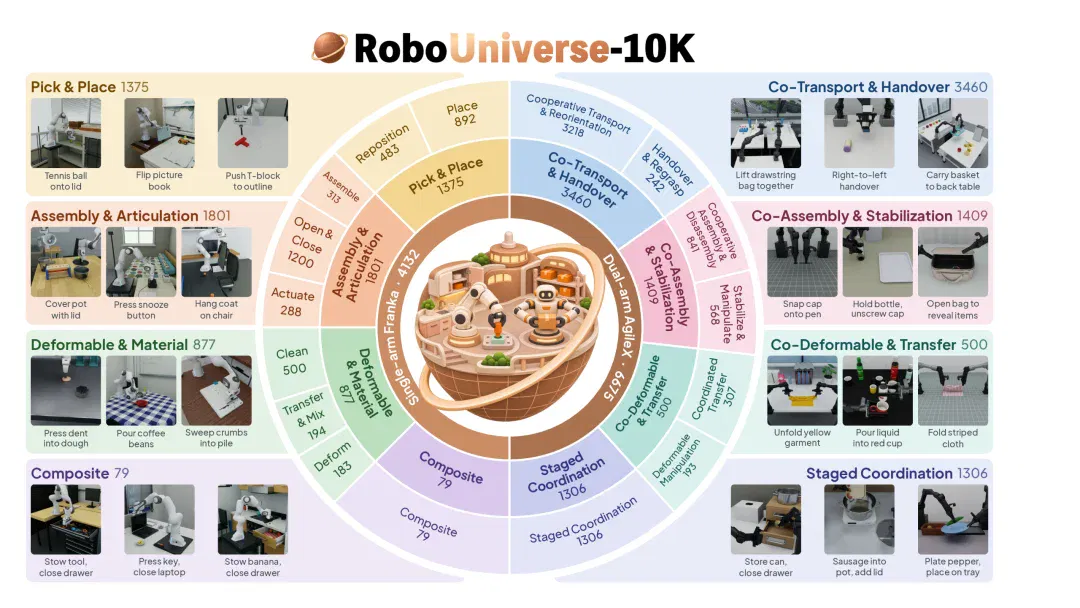
Historically, embodied intelligence has struggled to rely entirely on simulated data because it must both reconstruct physically credible scenes and provide accurate feedback.
Einsia AI therefore treated real-world manipulation videos as GitHub pull requests for the physical world, constructing 10,807 interactive, verifiable manipulation simulation environments.
The tasks mainly use two embodiments: single-arm and dual-arm robots. Single-arm tasks primarily draw on DROID and combine more than ten established datasets, including BridgeData V2, BC-Z, RT-1 and RoboCook. Dual-arm tasks integrate teleoperation data from multiple sources, including RoboDesk, RoboCOIN, GM100 and RoboMIND2.
To avoid inflating the count by merely changing textures, the team established a five-level deduplication protocol: embodiment → task family → specific task → layout → trajectory. A specific task is strictly the smallest counting unit, so the same scene and object interaction are not counted repeatedly.
The final collection contains 10,807 distinct tasks—10,307 for training and 500 for frozen evaluation—approximately 30 times the scale of RoboCasa365. More than 60% involve coordinated dual-arm manipulation.
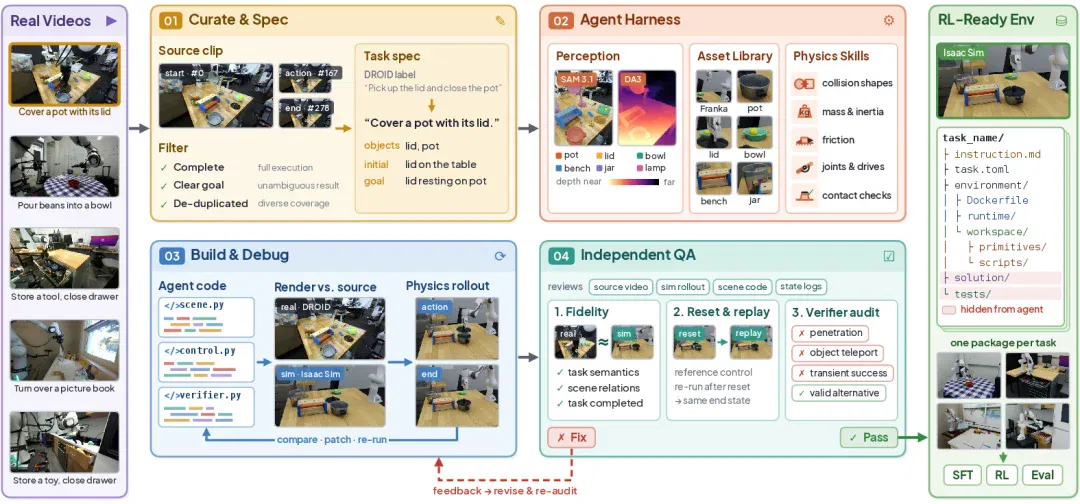
The Real2Sim construction and independent quality-control pipeline
At a scale of more than 10,000 environments, what ultimately determines RL environment quality is physical fidelity and protection against reward hacking.
The team built a complete end-to-end automated Real2Sim pipeline. It includes not only scene construction, but also an independent quality-control stage that reviews the RL environments produced.
A coding agent carries out the entire end-to-end scene-construction loop. Using SAM 3.1 segmentation, DA3 depth estimation and physical modeling tools, the agent extracts skills from real videos, independently writes scenes, reference solutions and verifiers in Isaac Sim, and repeatedly corrects them by comparing rendered frames against the video frame by frame. This is intended to ensure that tasks are completed entirely through actual simulated dynamics.
A separate, independent QA agent rigorously handles quality control. It cross-checks source videos, simulation replays and state logs, examining final-state fidelity, reproducibility after reset and verifier robustness item by item. It catches interpenetration, teleportation and false success judgments caused by momentary contact. Failure on any item sends an environment back for rework; it enters the collection only after passing every check.
The following two comparisons of real videos and simulation replays provide a direct view of the pipeline's physical reconstruction fidelity.
Whether a single arm is pouring granular material or two arms are putting blocks into a basket together, the simulation replays closely match the real recordings in both layout and dynamic interactions:
Single-arm Franka pouring task: real video on the left, RoboUniverse-10K reconstruction on the right.
Dual-arm AgileX collaborative tidying: real video on the left, RoboUniverse-10K reconstruction on the right.
Removing the omniscient view: An isolated testing environment designed around real-robot constraints
In many traditional policy evaluations, a verifier ends an episode as soon as it detects that the goal has been achieved, sometimes even returning a success signal to the model in advance. This differs from real robots, which must use cameras to determine for themselves whether they have finished.
To align feedback with the real world, RoboUniverse-10K uses the Harbor containerized isolation architecture, from the same framework lineage as Terminal-Bench, to completely separate the agent's code sandbox from the simulation and verification backend.
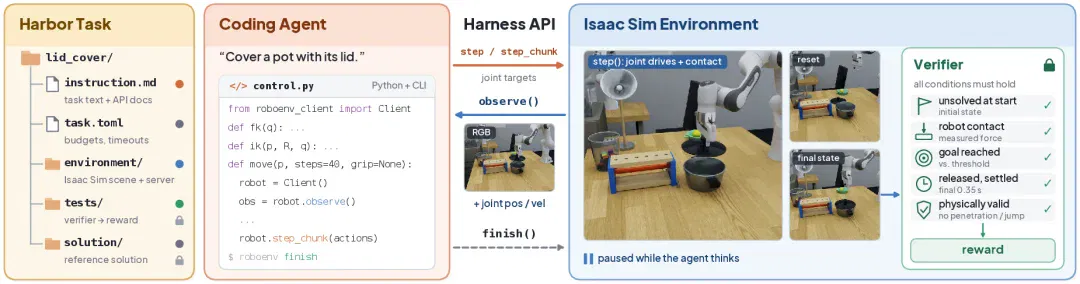
A Harbor-compatible architecture separating execution from verification, supporting highly concurrent SFT sampling and online RL training.
Each task is packaged as an independent Harbor sandbox environment, with the agent's code execution environment completely isolated from the simulation backend and verifier. Reference solutions and verification scripts are entirely hidden. The agent can interact with the simulator only through five public interfaces: viewing the environment description, obtaining observations, executing a single step, executing a batch of steps, and finishing the task. This runtime has two key design features:
- The physical world pauses during reasoning: Simulation time remains still while the model examines images, reasons and writes code. It advances only when action commands execute, preventing reasoning latency from interfering with physical control.
- Strict alignment with real-robot constraints: The environment exposes no ground-truth object coordinates, provides no intermediate progress scores, and does not let the agent reset it. Each task allows only one attempt. The agent must use camera images and joint readings to decide for itself when it is finished. After it calls the finish interface, an independent verifier judges the final physical state.
A 500-task test: A high of 85.8%
Seven models score no more than 10%
On the carefully selected 500-task RoboUniverse-Verified benchmark, the team evaluated 11 mainstream closed- and open-source models.
Four closed-source frontier models occupy the top tier, led by GPT-6.2 Astra (85.8%) and Claude Opus 5.5 (76.8%), with the other two also scoring around 50%. By contrast, all seven remaining models scored within 2.6%–10.0%, and even the best open-source model reached only 10.0%.
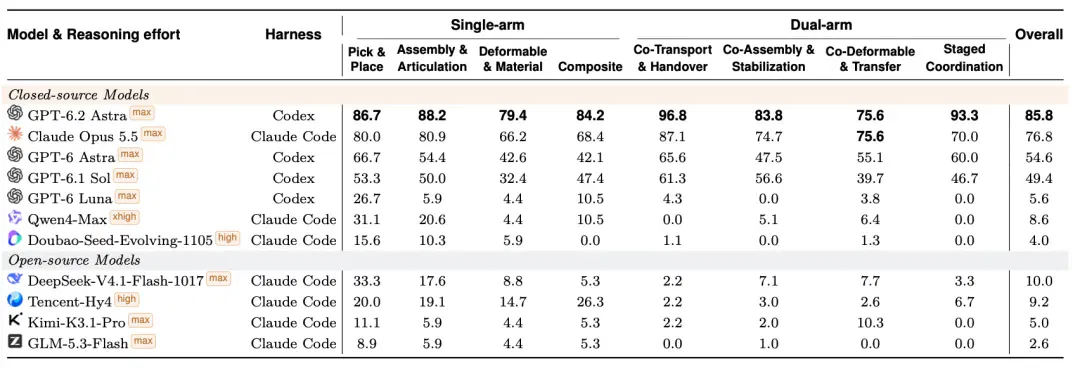
By analyzing physical execution logs, the team identified three core bottlenecks for today's embodied coding agents:
First, the gap is less about failing to understand what they see than failing to grasp it.
On non-grasping tasks requiring only pushing objects over or pressing them, the seven models with overall success rates no higher than 10% still achieved an average success rate of 32.1%. On tasks requiring grasping, their success rates fell to 0%–4% (a mean of 2.7%), while the four leading models achieved 57%–77% (a mean of 63.2%).
For the weaker models, 46%–47% of failures occurred before effective contact with or lifting of the target. Looking at step counts in failed episodes, median budget utilization reached 98%–100%. Stable grasping and coordinated control are especially difficult in the 16-dimensional action space of dual-arm tasks.

A pronounced divide between non-grasping and grasping tasks: weaker models can push a drink can over successfully, but struggle to grasp a cup reliably and set it upright.
Second, deformable objects, represented by cloth, are a shared challenge for the models tested here.
Almost all the gains from model upgrades occur on rigid-object tasks. Even within the top tier, moving from GPT-6 Astra and GPT-6.1 Sol, averaging 52%, to GPT-6.2 Astra and Claude Opus 5.5, averaging 81%, raises success rates for assembly, tool use and pick-and-place by 35–38 percentage points. Cloth manipulation, however, barely moves, improving by only 3 percentage points, with all four top models confined to the 28%–41% range.
Third, around 80% of frontier-model failures involve millimeter-scale precision and force after contact.
The four leading models stumble in highly similar places. Of the 500 tasks, 94 were solved by at most one model, including 26 that none solved. Approximately 80% of their failures occur after making contact with the object. The root problem is that visual images alone make it difficult to control continuous physical precision and contact force.
When putting a lid on a cup, for example, successful and failed images are almost indistinguishable to the naked eye. Yet in a failed episode, the lid was actually offset by 6 mm and tilted by 5.6°, exceeding the physical tolerances of 2 mm and 4°. When pressing a remote-control button, GPT-6.2 Astra did not reach it at all, while the other three models pushed past the 3.5 mm mechanical travel limit, with applied force surging to 70–138 N.
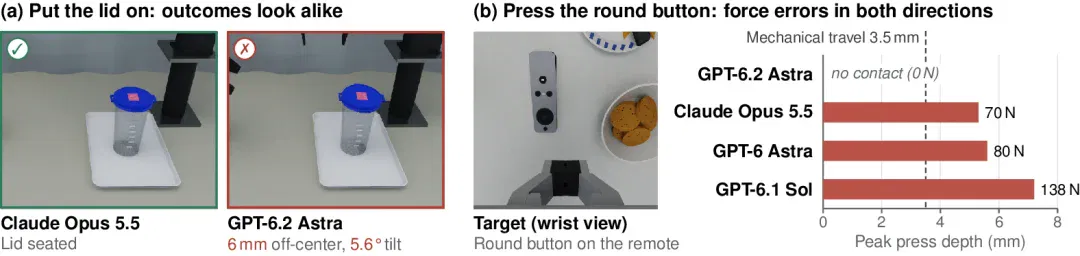
Typical failures after contact: a final pose outside millimeter-scale tolerances, left, and excessive pressing caused by a lack of force feedback, right.
Post-training experiments using RoboUniverse-10K
Can building more than 10,000 environments actually make a model stronger? The team used GPT-6 Astra to collect approximately 17,000 multi-turn interaction trajectories in RoboUniverse-10K, totaling 0.79B tokens. Using the open-source Qwen3.6-35B-A3B as the base, they froze the vision encoder and alignment module and applied full-parameter SFT only to the language backbone, producing RoboUniverse-35B-A3B.
Subsequent tests examined this training loop along three dimensions:
RoboUniverse-Verified evaluation: RoboUniverse-35B-A3B raised overall success from 0.8% to 21.2%, exceeding all open-source baselines and reaching more than twice the success rate of the strongest native open-source model, 10.0%. Overall single-arm success increased from 2.0% to 40.5%. Pick-and-place rose from 0% to 62.2%, approaching the full-capability GPT-6 Astra teacher's 66.7%. Dual-arm tasks, previously all at 0%, also broke through zero, reaching 8.3% overall and a high of 12.9% on an individual category.

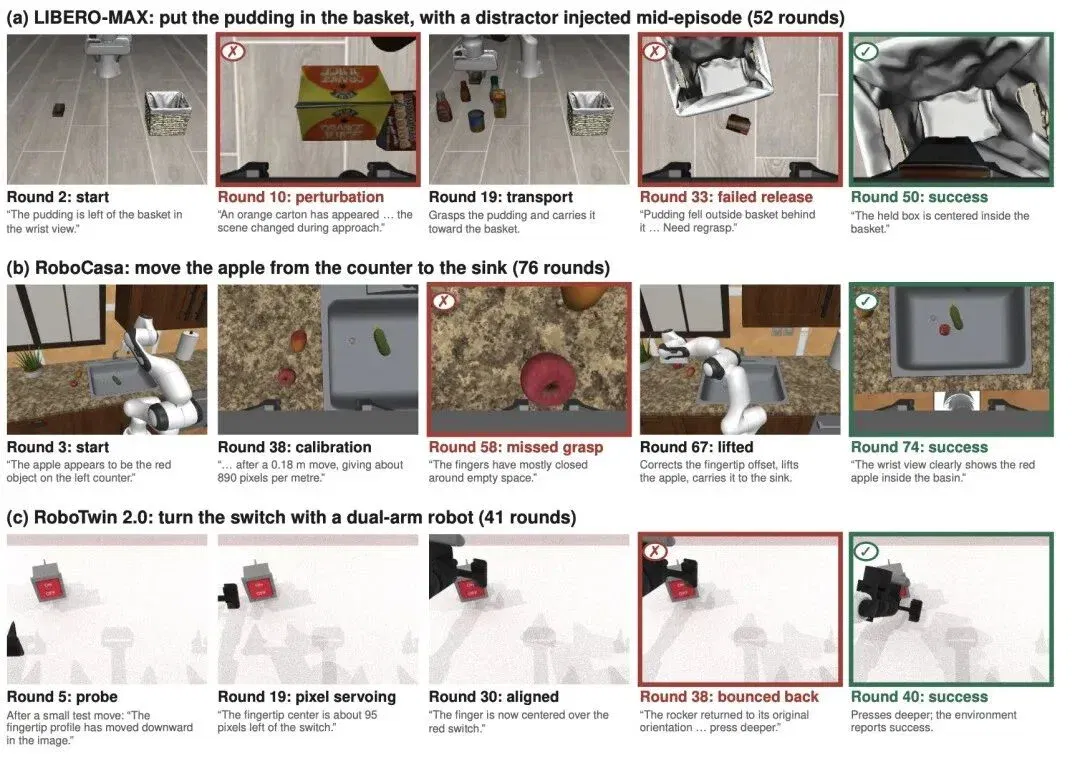
Cross-benchmark evaluation: On LIBERO-MAX, RoboCasa and RoboTwin 2.0, with entirely different simulators, scenes and interfaces, the base model failed across the board while the fine-tuned model completed the tasks zero-shot. It was not memorizing scenes but directly transferring the closed-loop approach it had learned: first calibrating through small exploratory movements, then correcting from images, and retrying when an attempt failed.
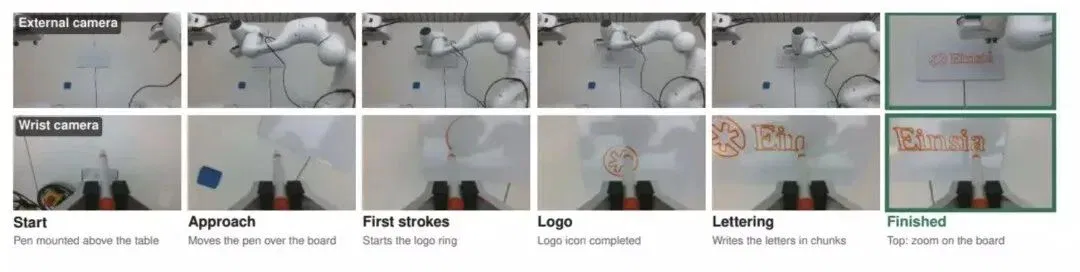
Sim-to-real deployment on a physical Franka arm: The model, trained entirely in simulation, was deployed directly on real hardware and completed a task never seen in the training set—drawing the Einsia logo on a whiteboard from an image. Faced with an unknown whiteboard height, it found the point of contact by zooming in on the pen tip and making short test strokes. It then drew in sections and checked images after each section to recalibrate, bringing the same visual closed-loop control learned in simulation into the physical world.
Toward an era of environment scaling for embodied intelligence
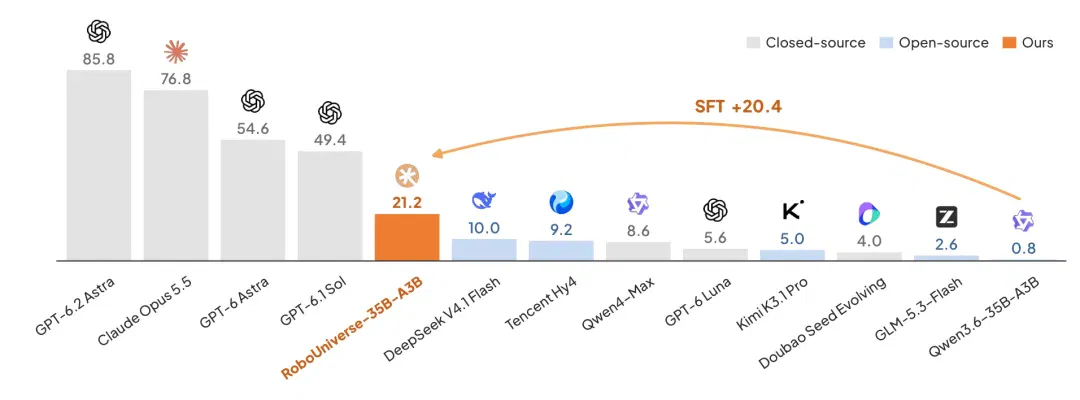
Admittedly, a score of 21.2 still leaves a long way to go before reaching frontier models. But surpassing all open-source baselines and several closed-source models through SFT alone provides experimental support for the value of expanding verifiable physical environments for post-training.
All 10,807 verifiable physical environments, the independent 500-task benchmark and the fine-tuned model are now open-source, adding community infrastructure with more than 10,000 environments that can directly support large-scale post-training.
Looking back at the evolution of intelligence, vast internet text brought us large language models, and huge numbers of code repositories brought us coding agents. Today, it is the turn of RoboUniverse-10K's collection of more than 10,000 simulated environments to underpin scaling laws for an era of embodied intelligence.
Leave behind memorizing answers in a few dozen hand-built scenes and enter a world of large-scale trial, error and improvement across more than 10,000 physical environments. Embodied intelligence's GPT moment is close at hand.
This article comes from Synced and was written by Synced.
Related topics
After reading
Join the AINRK community
Read how to join the community and connect with people working in AI.
Related articles
Continue reading related topics and articles in this category.

Galaxea Releases G0.7: Roughly 60 ms Action Chunks Under a Specified Deployment Configuration (opens in a new tab)
Galaxea's G0.7 pairs long context with Fast-WAM. Its report describes roughly 60 ms action-chunk generation on a single RTX 5090 in FP8, plus task-specific post-training results in memory, sorting and longer workflows. Production deployment still needs task-level validation.
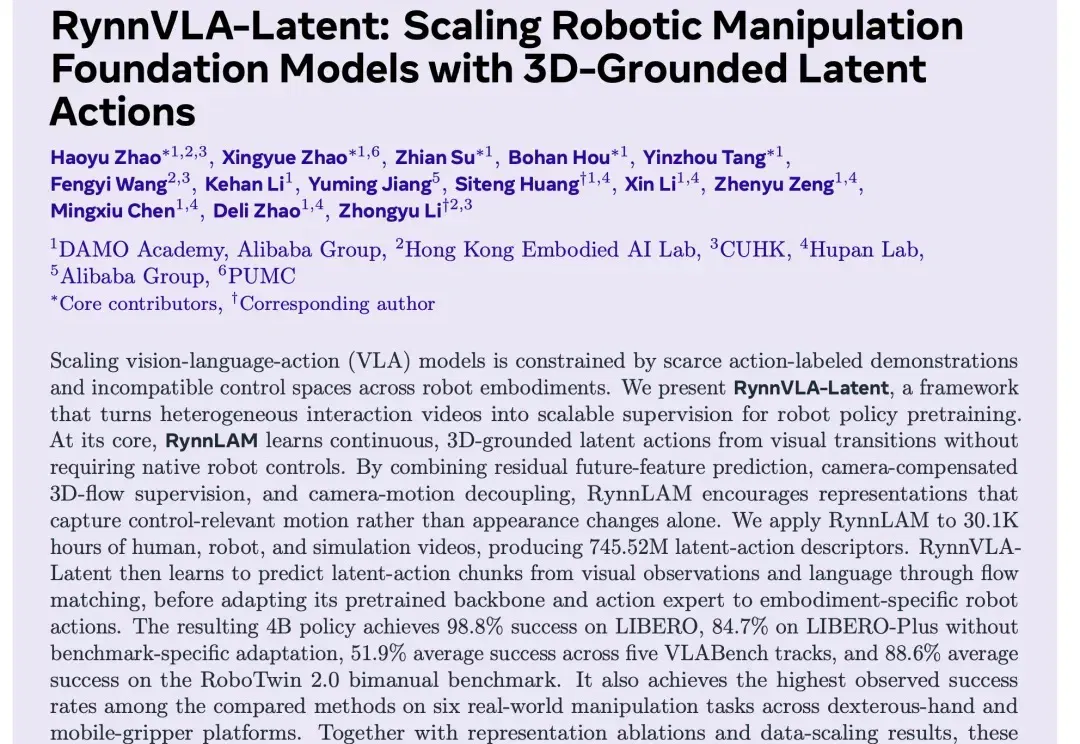
RynnVLA-Latent Pretrains on 30,000 Video Hours, Leading Compared Methods on Six Real-Robot Tasks (opens in a new tab)
DAMO Academy and collaborators use 3D-grounded latent actions to turn about 30.1K hours of diverse videos into pretraining supervision, then align to robot controls. Their 4B policy leads the compared methods on six real-robot tasks, within specific evaluations and still using real demonstrations.
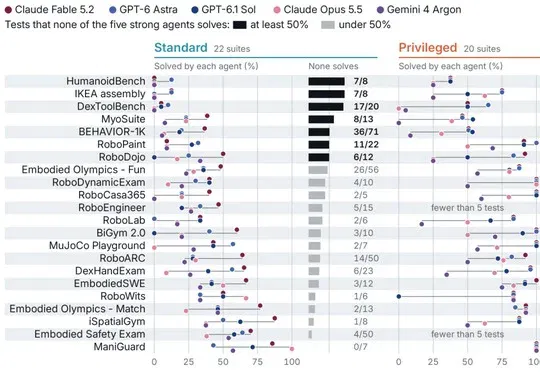
EFE Tests Coding Agents on Simulated Robots: 1,156 Tasks and Up to Three Modes (opens in a new tab)
EFE brings together 1,156 simulated tasks, 35 task sets and 47 robots, with up to three evaluation modes. Controlled experiments and stage annotations for part of the core set examine failures; results depend on the mode, agent framework and single runs.
Embodied AI data supply: Maniformer's devices, processing pipeline and crowdsourcing approach (opens in a new tab)
The article examines robots' action-data needs and Maniformer's devices, 3D trajectory processing, validation and crowdsourcing. Capacity and usable-data rates are company disclosures; market size, valuation and the timing of an embodied AI “GPT moment” are forecasts or commentary.
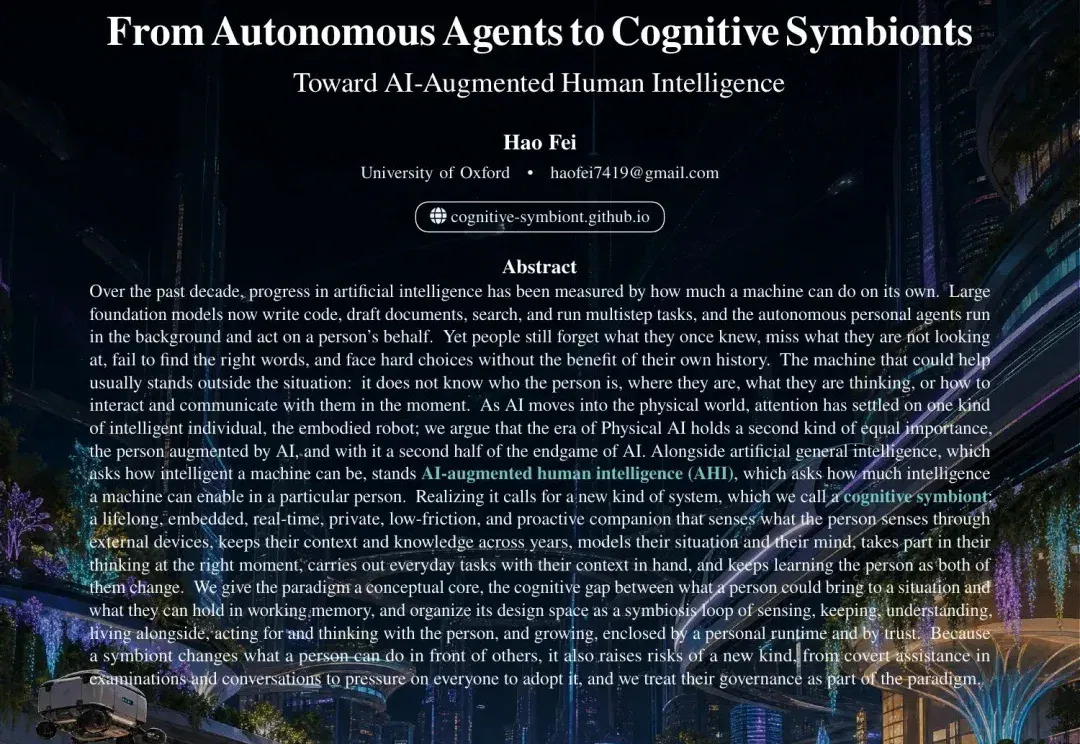
Hao Fei's perspective paper proposes a framework for AI 'cognitive symbionts' (opens in a new tab)
Hao Fei's 59-page perspective paper frames personal AI through Cognitive Symbionts, a cognitive gap and a symbiotic loop. It explores memory, timely intervention, learning, care, consent, privacy and governance, setting out concepts and evidence standards rather than a tested complete system.