RynnVLA-Latent Pretrains on 30,000 Video Hours, Leading Compared Methods on Six Real-Robot Tasks
DAMO Academy and collaborators use 3D-grounded latent actions to turn about 30.1K hours of diverse videos into pretraining supervision, then align to robot controls. Their 4B policy leads the compared methods on six real-robot tasks, within specific evaluations and still using real demonstrations.
Human videos can show a rich range of actions, such as picking up cups and wiping plates, but lack the joint and gripper commands needed for robot learning.
Demonstration data from different hardware is also difficult to place directly into a single action space.
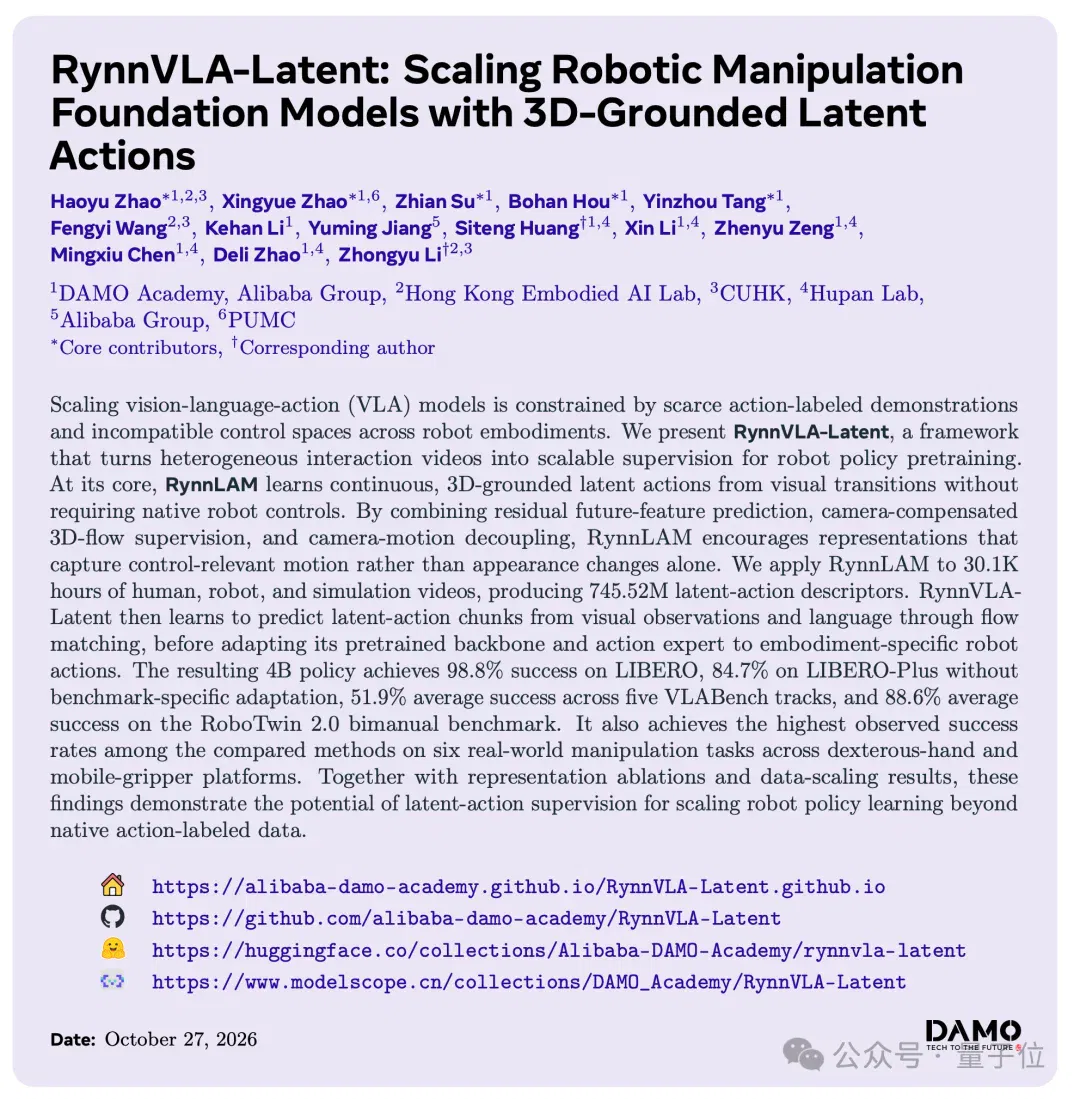
To address this problem, researchers from Alibaba DAMO Academy, the Hong Kong Embodied AI Lab and other institutions propose RynnVLA-Latent, extracting latent actions with three-dimensional geometric constraints from visual transitions and turning around 30,100 hours of heterogeneous video into policy supervision.
First learn shared motion experience, then adapt to a specific robot: this is the work's core approach.
Background: The Gap Between Video Experience and Native Controls
Vision-language-action models must connect observations and instructions to executable controls, but collecting robot demonstrations is expensive, and joint dimensions, coordinate systems and action semantics vary across platforms. Human and web videos offer broader coverage but lack the corresponding robot commands.
The study proposes using latent actions as a shared supervision interface: describing the changes between earlier and later observations rather than directly encoding a particular robot's control vector. This lets videos from multiple sources participate first in unified motion learning, leaving native-action alignment to the target robot's post-training stage.
Technical Approach: From Motion Representation to Policy Generation
Residual Prediction Preserves Change in a Compact Representation
The latent-action model RynnLAM takes earlier and later frames and outputs motion tokens, a global action latent and a camera latent, assembling them into a 608-dimensional continuous descriptor. Training does not require native robot-control labels, but does use supervision from visual features and geometric pseudo-labels.
Reconstructing future images alone may let a model rely on appearance information. The study uses residual future-feature prediction to encourage the compact motion representation to retain changes relative to the current observation. The learning focus moves further from "what is in the image" to "what happened between observations."
3D Geometric Constraints Distinguish Spatial Motion from Image Changes
The same pixel displacement in an image can correspond to different depths and spatial movements. RynnLAM introduces camera-compensated 3D scene-flow supervision, combined with feature-warping alignment, to add spatial constraints to latent actions.
The model also includes a camera branch. Through camera-pose prediction and a gradient-reversal objective, it encourages manipulation cues and camera changes to be represented separately, reducing confusion between "the camera is moving" and "the object is being manipulated." These geometric constraints come from estimated signals; they do not mean a completely accurate physical state has been recovered.
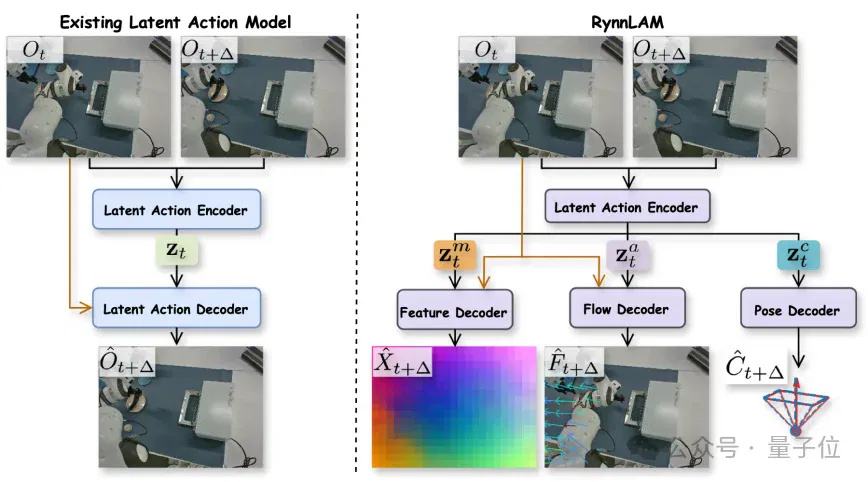
△RynnLAM architecture. Future-feature prediction, 3D-motion supervision and camera-motion decoupling jointly shape continuous latent actions.
Offline Annotation Organizes Heterogeneous Video into Unified Targets
The team gathers videos from 25 sources spanning human interaction, real robots and simulation, totaling about 30,100 hours and 3.057 billion frames. Offline extraction produces approximately 745.52 million latent-action descriptors.
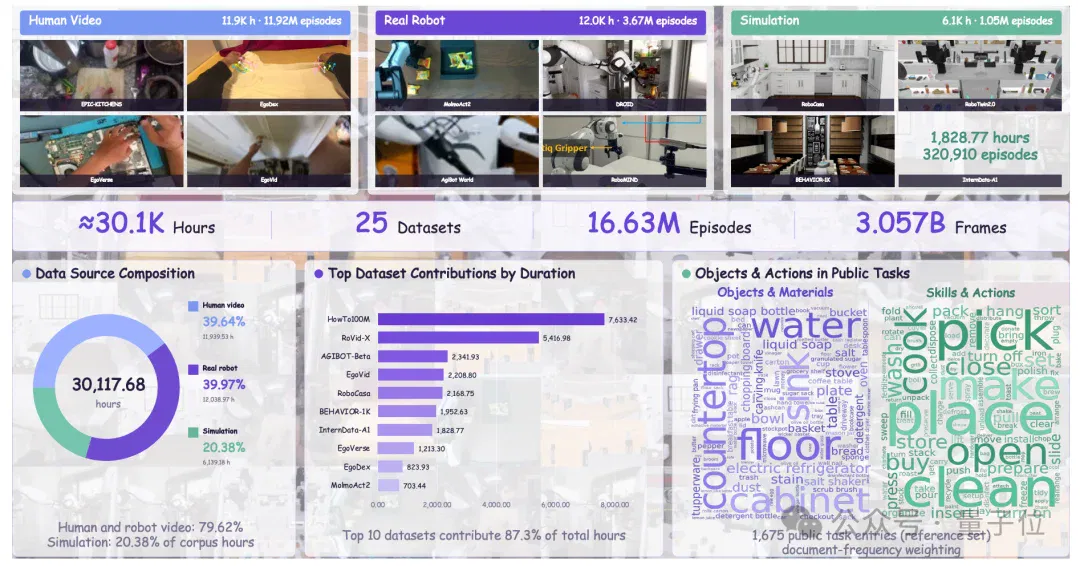
△The pretraining dataset.
What is shared is the form of supervision extracted from visual transitions, not every robot's joint definitions. This design lets videos without native control labels enter policy pretraining too, broadening the data sources robot models can use.
Pretrain the Action Expert, Then Align Robot Commands
The policy uses the RynnBrain vision-language backbone and a narrower action expert, exchanging information through joint attention at each layer. During pretraining, it predicts latent-action chunks through flow matching from multiview observations and language instructions, without relying on native actions or proprioceptive states as the supervision interface.
Post-training for the target robot retains the main backbone and action expert, introduces proprioceptive state, and adapts the output projection to the native action dimensions. Video provides shared motion experience; real demonstrations connect that experience to concrete execution.
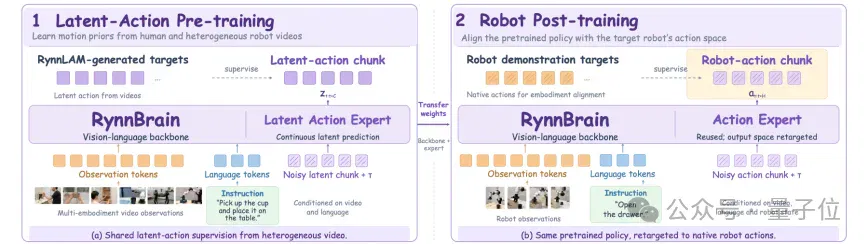
△The two stages of policy training. The left predicts shared latent actions; the right outputs native controls through robot-specific post-training.
Experimental Results: Are the Representations Useful, and Can the Policy Execute?
Examining Control Information in Latent Actions
The study freezes the representations on LARY and uses a lightweight regressor to predict low-level controls. The relative-action setting focuses more on displacement from the initial observation. RynnLAM's average mean squared error is 0.38, below the paper's listed results for DreamDojo at 0.55, Moto at 0.77 and LAPA at 0.93. Removing 3D-flow supervision raises the error to 0.50, supporting the role of geometric constraints in control predictability.
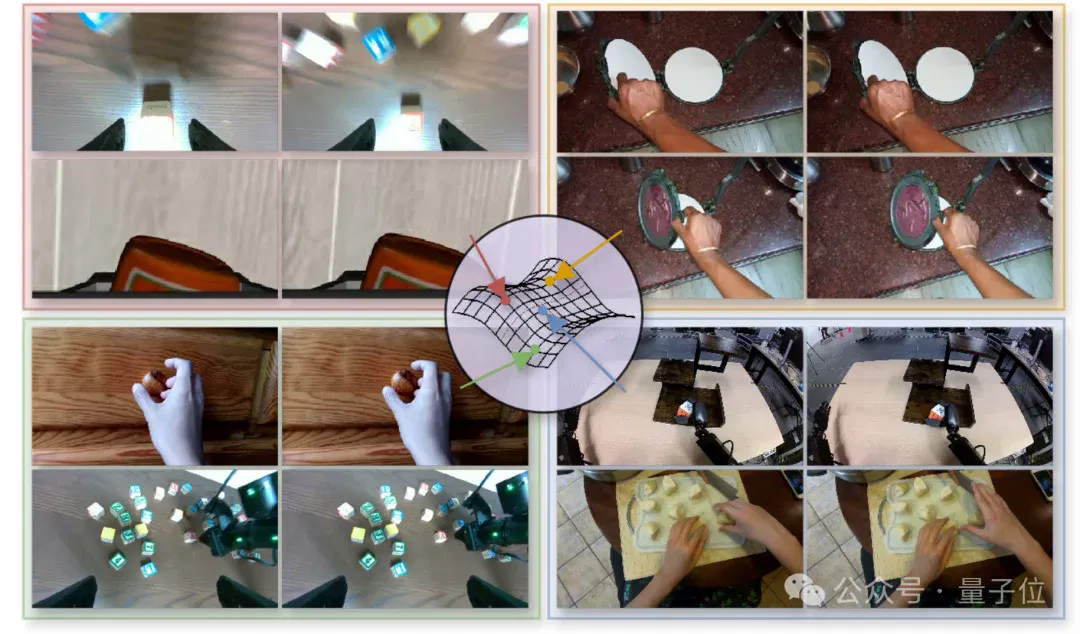
△Visualization of latent-action similarity in feature space
Covering Manipulation, Robustness and Bimanual Tasks
The 4B model achieves an average success rate of 98.8% on LIBERO, 84.7% on LIBERO-Plus, 51.9% across five VLABench tracks, and 88.6% under RoboTwin 2.0's Native protocol. LIBERO-Plus receives no additional benchmark-specific adaptation; RoboTwin training includes randomized demonstrations.
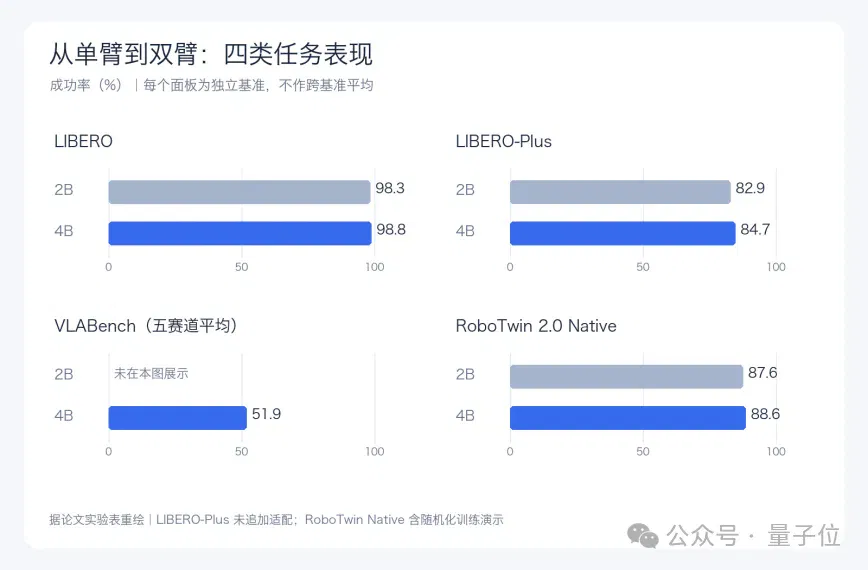
△Results on four benchmark categories. Each panel corresponds to a separate evaluation; results from different benchmarks are not combined into an overall success rate. Redrawn from the paper's experimental tables.
Real-world experiments cover a fixed bimanual dexterous-hand platform and a mobile bimanual gripper platform, with 35 trials per task in each setting. After robot-specific post-training, the 4B model achieves the highest observed success rate among the listed methods on all six tasks. For example, serving steak reaches 57.14%, and table clearing reaches 40.00%.
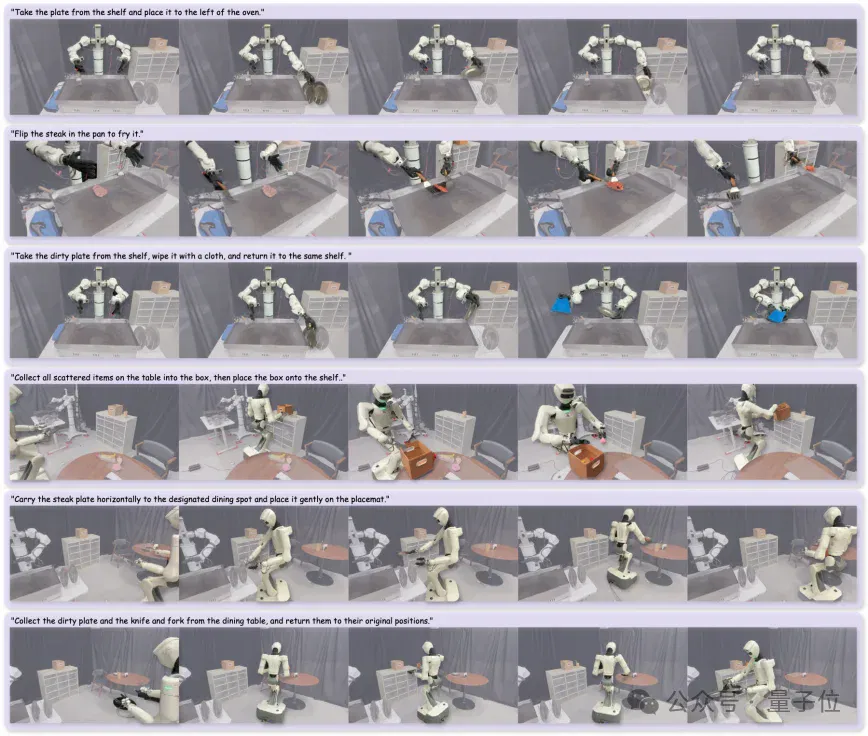
△Six real-world tasks: plate placement, steak flipping, plate wiping, table clearing, serving and tableware collection.
Project Value: Broadening the Data Interface for Robot Learning
Experiments using different fractions of the corpus show that both the 2B and 4B models achieve their respective highest LIBERO-Plus scores with the full pretraining data, supporting the value of scaling video supervision. However, improvement is not strictly monotonic for every model.
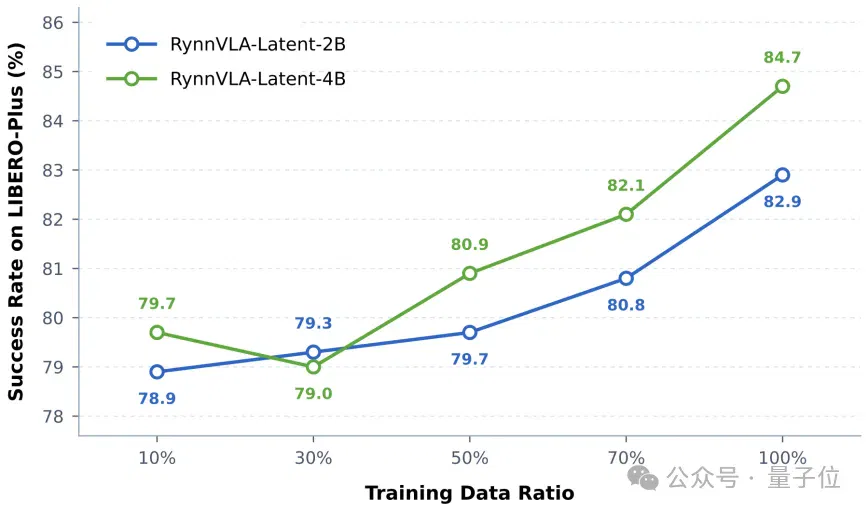
△Data-scaling experiments for latent-action pretraining. Both models achieve their highest observed scores with the full corpus.
RynnVLA-Latent demonstrates a feasible route for turning heterogeneous interaction experience into policy supervision. It does not eliminate real action data; instead, it lets real demonstrations focus more specifically on execution alignment, allowing human, robot and simulation videos to participate together in training robot foundation models.
Paper: https://arxiv.org/pdf/2610.34356v1 Project page: https://alibaba-damo-academy.github.io/RynnVLA-Latent.github.io GitHub: https://github.com/alibaba-damo-academy/RynnVLA-Latent Hugging Face: https://huggingface.co/collections/Alibaba-DAMO-Academy/rynnvla-latent ModelScope: https://www.modelscope.cn/collections/DAMO_Academy/RynnVLA-Latent
This article comes from "QbitAI," written by the "RynnVLA-Latent Team."
Related topics
After reading
Join the AINRK community
Read how to join the community and connect with people working in AI.
Related articles
Continue reading related topics and articles in this category.
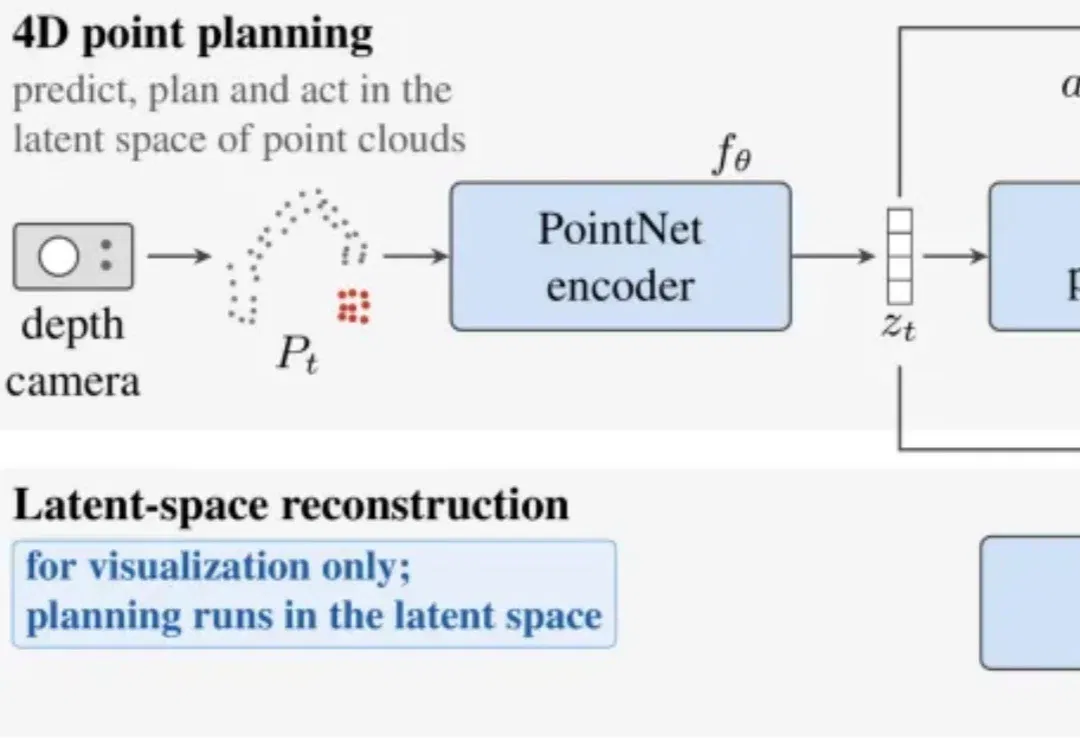
From 2D to 3D: How Much Can Robot Manipulation Improve? Peking University and Partners Introduce JEPA4R (opens in a new tab)
JEPA4R learns a world model from point clouds, trains policies on frozen representations and transfers simulation-trained models to tested real robots. MetaWorld/Adroit Relocate success rates are 98.4%/88.0%; 1.1 cm over 200 steps refers to simulated point-cloud prediction.
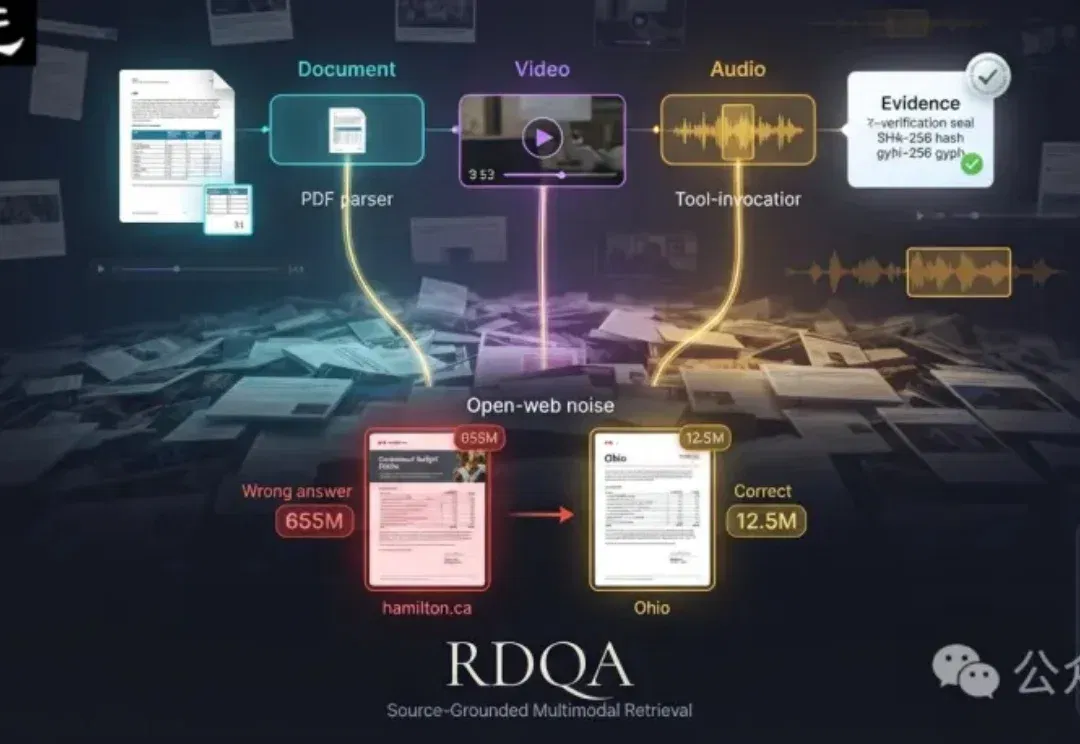
RDQA Raw-File Retrieval Test: Best Adjusted Accuracy among 12 General-Purpose Agents Is 24% (opens in a new tab)
RDQA asks agents to find and parse sources for 1,350 document, video and audio questions. The best of 12 general configurations scores 24.0% PLR-adjusted accuracy, versus 57.5% for humans and 41.1% for a reference baseline. Failing specified-source verification does not establish memorization.
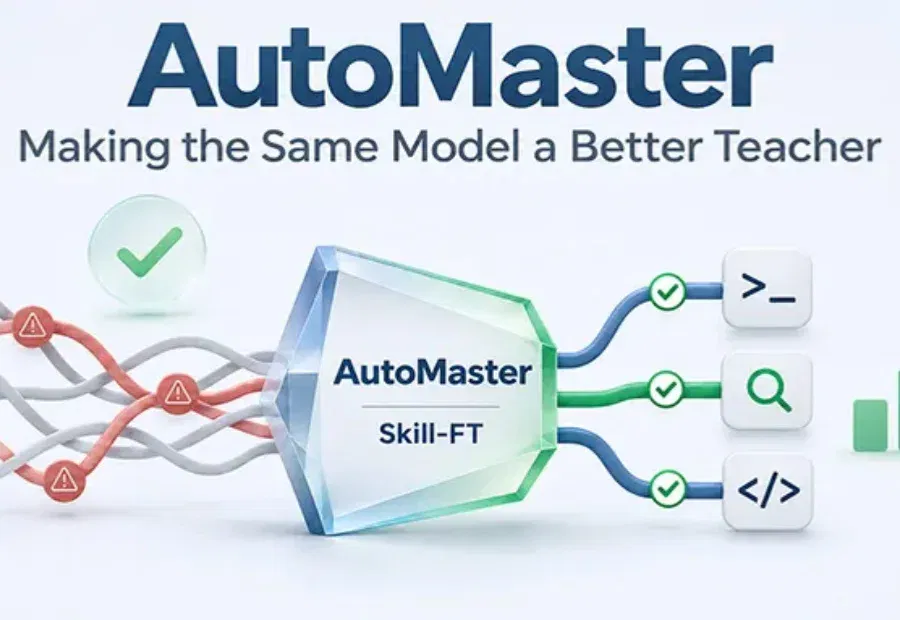
RUC open-sources AutoMaster: Skill guidance and trajectory selection for agent post-training (opens in a new tab)
RUC introduces Skill-FT and AutoMaster. Across six settings with a fixed teacher, task pool, 512 selected trajectories per round and SFT recipe, gains over Vanilla SFT are 1.42–8.99 percentage points. Multiple rounds require extra sampling, training and evaluation.
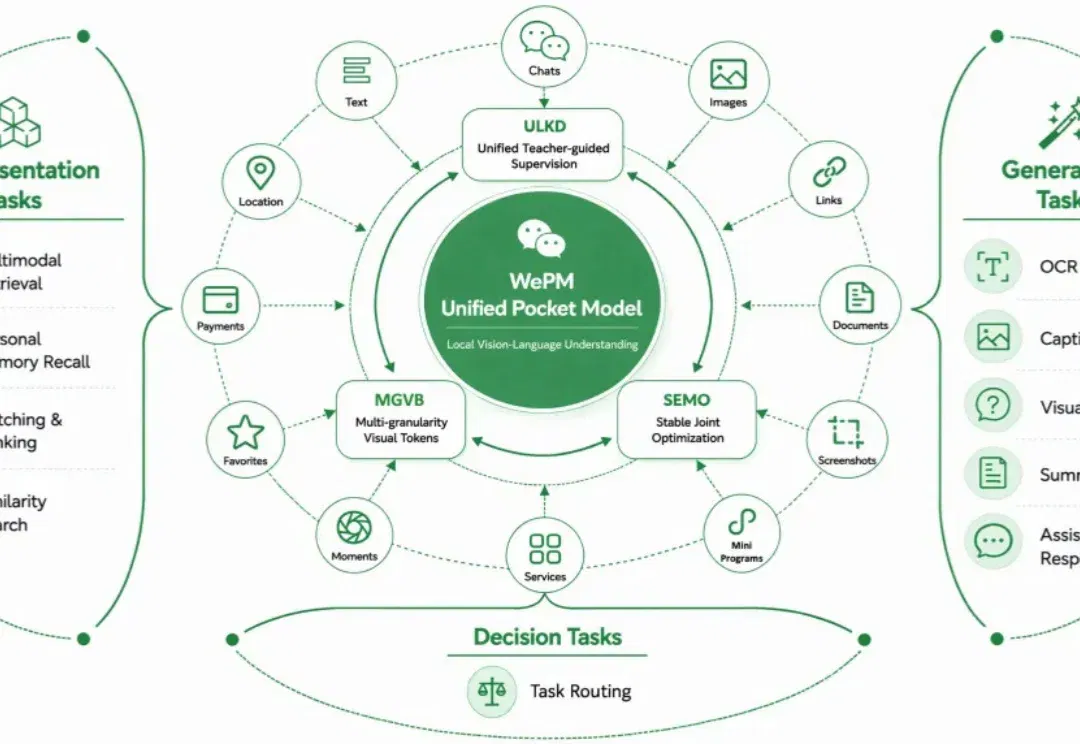
WeChat open-sources WePocketModel, unifying representation, generation and decision with one backbone (opens in a new tab)
Tencent's WeChat team releases WePocketModel, sharing one backbone across representation, generation and decision. WePM-4B uses 61.9% less resident weight memory than the selected specialist stack. Its roughly 8GB is BF16 weights, not total runtime memory; demos use an M5 Mac.
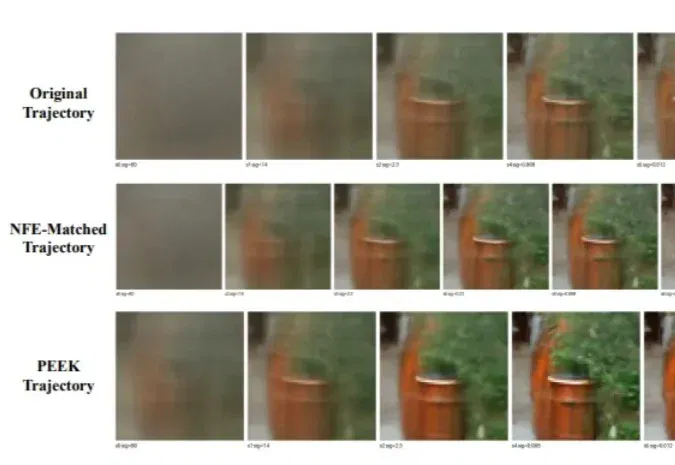
PEEK cuts FID by 49.3% in a specified ImageNet-EDM diffusion-sampling experiment (opens in a new tab)
NUS’s training-free PEEK adjusts deterministic diffusion sampling with look-ahead predictions. At an equal denoising-call budget, one ImageNet-EDM experiment lowers FID from 19.71 to 9.99. Results and one-time search costs depend on the setup.