Embodied AI data supply: Maniformer's devices, processing pipeline and crowdsourcing approach
The article examines robots' action-data needs and Maniformer's devices, 3D trajectory processing, validation and crowdsourcing. Capacity and usable-data rates are company disclosures; market size, valuation and the timing of an embodied AI “GPT moment” are forecasts or commentary.
Editor's verification (November 22, 2026): This article combines industry commentary, market estimates and a company profile. The NVIDIA study (opens in a new tab)'s 74.8% comes from a particular Agentic configuration on RoboLab-120, while 51.0% is a listed reference approach; Anthropic's disclosure (opens in a new tab) of 64.9% versus 29.8% concerns its internal RoboDojo Sim tests using the same harness and highest effort setting. These results cannot be compared across leaderboards or treated as general success rates or fixed costs in real factories. The robotics team restructuring is based on media reporting; “moving up a dimension” and “the models are ready” are the author's interpretations. The Maniformer website (opens in a new tab)'s capacity and product figures are company disclosures. This article has not independently audited usable-data rates, acceptance, customers or an exhaustive industry ranking. Anonymous examples of poor data quality cannot be generalized to the whole industry. Valuations, data demand and an “earlier GPT moment” are forecasts; leaderboard gains alone cannot establish a timetable.
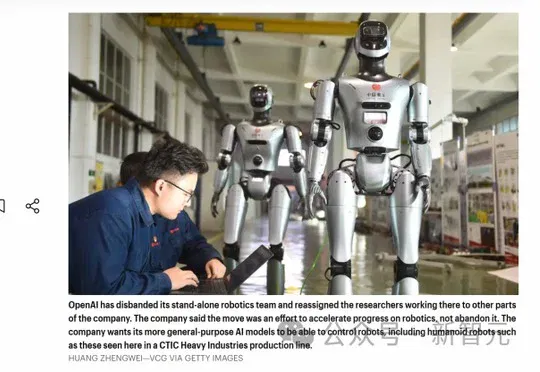
Just a few days ago, Fortune exclusively reported that OpenAI had disbanded its standalone robotics team.
The news immediately flooded AI circles. Many people's first reaction was: even Altman is giving up on robots?
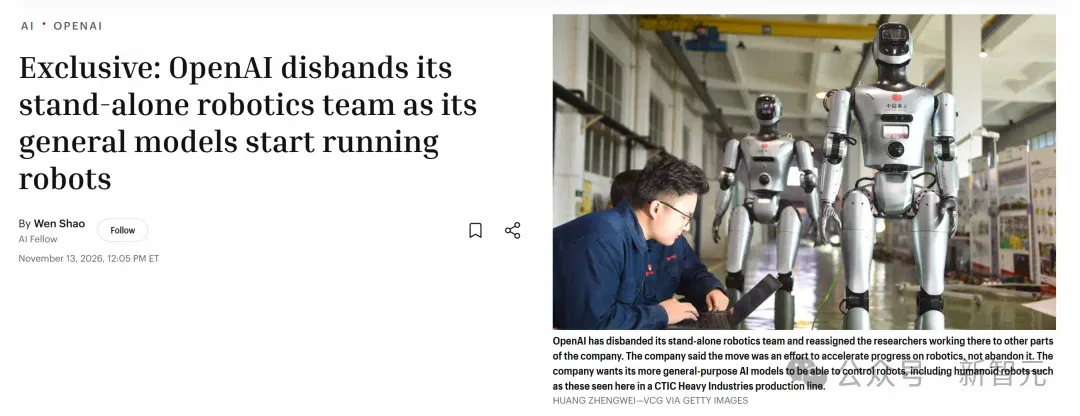
But look more closely: this hardly looks like “giving up.” It looks like “moving up a dimension”—
The central logic behind this is that general-purpose large models can already control robots directly, removing the need for a separate “special forces unit.”
In an NVIDIA study, Astra achieved a 74.8% success rate on a simulated manipulation benchmark, while the best result among the specialized robotics models was 51.0%.
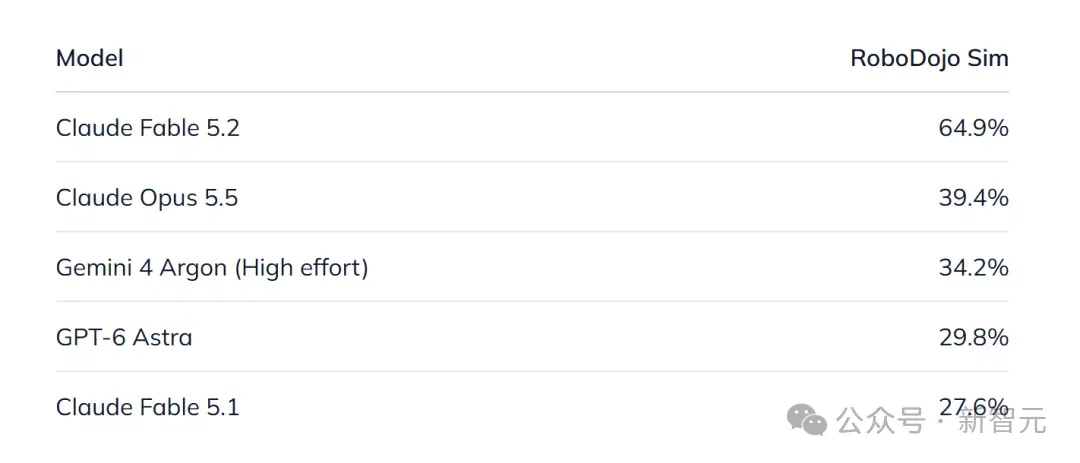
Anthropic went even further: Fable 5.2 scored 64.9% in its own RoboDojo tests, more than twice Astra's result.
The initial reaction in China's embodied AI circles was: an overwhelming attack from a higher dimension has arrived.
But there is no need to panic just yet. We ran through all the figures we could find, and our conclusion was actually the exact opposite—
Large-model companies are not entering to wreck the game. They are adding a few chairs to embodied AI's table, and the newcomers bring the biggest computing resources and the deepest pockets.
Embodied AI's “GPT moment” will arrive sooner as a result!
Yet as soon as these major players sat down, they hit exactly the same wall as six years ago: data.
What remains the same is that AI for the physical world is still constrained by data. What is different is that this time, infrastructure companies dedicated to producing data have already emerged in the market.
The way this battle will be fought is completely different.
An overwhelming attack, or a bigger table?
How did large models suddenly become so good at controlling robots?
Put simply, large models control robots by “writing code.”
Where they are strong, they really are very strong. Understanding tasks, breaking them into steps and planning their order, for example: these “upper-body” capabilities, once regarded as defensive moats by embodied AI companies, are now available out of the box from general-purpose models.
But their weaknesses are obvious too. AA-Robotics published a set of figures showing that Astra took an average of 30 minutes and cost $16 to complete a task.
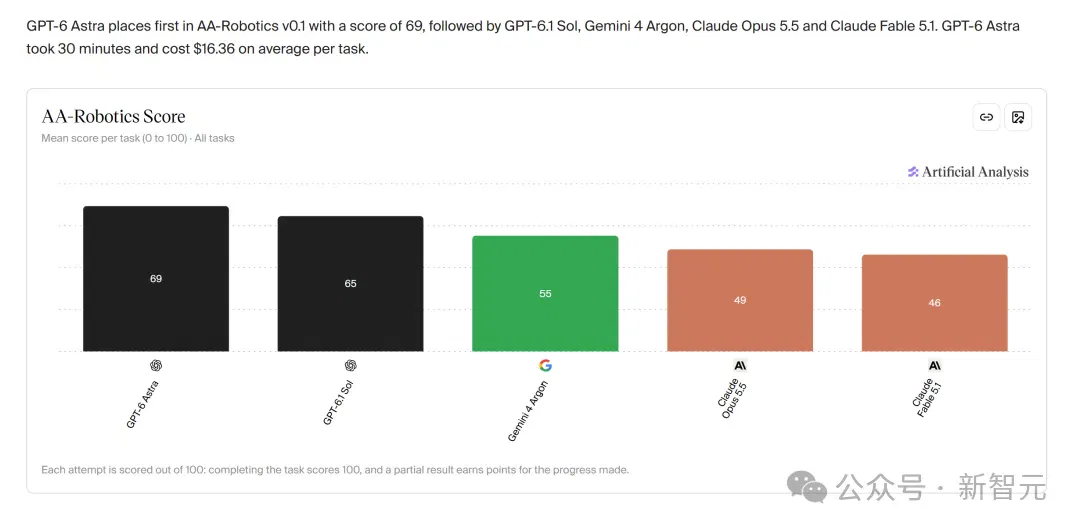
Good grief: if a robot tightened a screw in a factory at that speed and cost, the factory manager would unscrew the robot first.
Why is that?
Because cloud-based large models react too slowly! Robot joints are controlled hundreds to thousands of times per second, while a cloud-based large model takes several seconds to think through a single step.
For work requiring speed, precision and feedback on the force exerted by the hands, a leading robotics team tested general-purpose large models and found their success rate close to zero.
As Carnegie Mellon University's Guanya Shi puts it, slow reactions and dependence on a network are two shortcomings of cloud-based large models, so robots still need small, specialized models on board.
The more accurate picture is therefore a hierarchy: the large model handles “thinking,” taking responsibility for long-horizon reasoning and planning. Below it are individually trained action skills that it calls as tools. At the bottom is motor control on a millisecond timescale.
Large-model companies have already been the first to break through the top layer. To move downward, what they lack is precisely what they do not already possess: action data.
The real change, then, is that the list of companies building embodied foundation models has grown longer.
Previously, this table was occupied by “embodied AI natives” such as Physical Intelligence, Figure and Generalist.
Now OpenAI has entered the field. Altman has said it will demonstrate an in-house humanoid robot in 2027. Models from Anthropic and Google are already appearing on the leaderboards too.
Meanwhile, Chinese companies are stepping up their efforts as well.
This August, DeepSeek invested approximately RMB 141 million in the strategic placement for Unitree's IPO. ByteDance had previously integrated Seed Robotics into its multimodal interaction and world-model framework. Ant Group's Lingbo, Xiaomi and JD.com have also released embodied models of their own.
Globally, nearly a hundred companies are training embodied models.
The difference is that these newcomers differ fundamentally from the existing players: their models are heading toward a trillion parameters, their budgets are measured in tens of billions of dollars, and their computing clusters are already in place.
The battle for embodied AI data has entered deeper waters
Large language models have had no shortage of data in recent years.
Thirty years' worth of text accumulated on the internet can be used directly. Mainstream large models' pretraining corpora contain around 100 trillion tokens; the competition is in computing power and algorithms.
Embodied AI is exactly the opposite. There is no “internet” for the physical world. How people grasp objects, twist them and apply force: these operational processes have never been systematically recorded.
At the end of 2024, the world's largest dataset collected on real robots contained only around 3,000 hours. In the second half of 2025, Generalist trained GEN-0 using roughly 300,000 hours. This year, leading players including Dyna and AgiBot have training sets exceeding one million hours.
An increase of several hundred times in two years sounds impressive. But compared with the 10 billion hours for language models, it still falls short by three to four orders of magnitude.
Does feeding in more data help? The effects are, of course, immediate!
Results released by Dyna Robotics in August showed that increasing pretraining data from 1,000 hours to one million hours raised a model's average score across 14 robotics tasks from 20% to 53%.
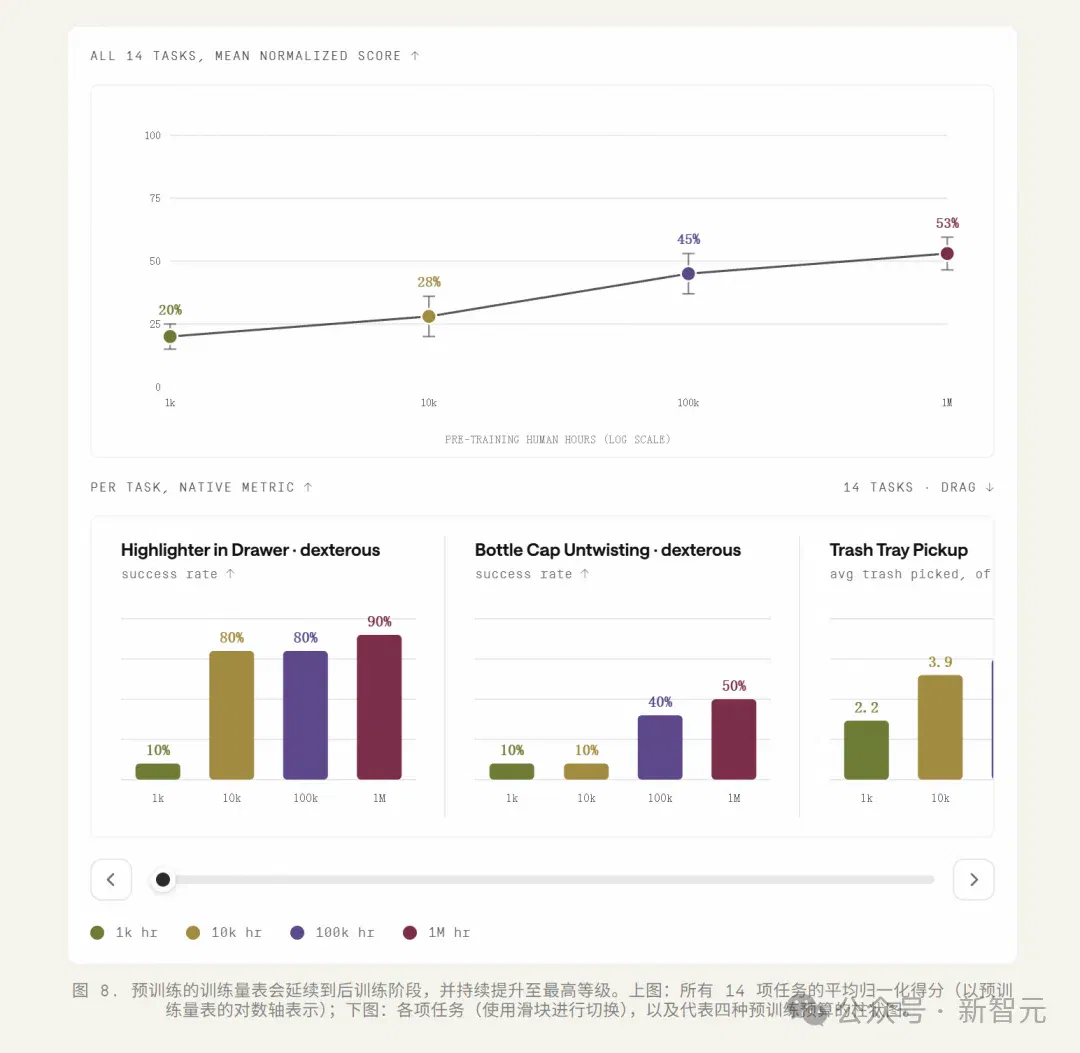
Industry estimates suggest that training a trillion-parameter embodied foundation model requires at least 100 million hours. By 2030, around 20 such foundation models may be in training worldwide, with total demand reaching billions of hours.
Venture capital firm Stellaris offers a similar estimate: over the next two to three years, frontier labs will need 100 million to one billion hours of first-person data, corresponding to spending of $1.5 billion to $50 billion.
The trouble, however, is that these data are not simply “filmed.”
This April, Build AI open-sourced around one million hours of first-person factory video, free for commercial use. In theory, that should have eased the data shortage. Yet leading companies continued to scour the world for supplies.
That is because what robots need to learn is a trajectory in three-dimensional space: “where the hand is, which way it is pointing and how it moves” at every millisecond.
Moving from 2D video to 3D trajectories requires synchronizing multiple cameras to the millisecond, reconstructing hand poses with millimeter-level precision and converting the results into joint movements for different robots.
Embodied data have to be manufactured.
And collecting the data themselves is not realistic for model companies either.
OpenAI's San Francisco lab has around 100 data collectors. Even at full capacity, that amounts to 200,000 working hours per year. At the commonly seen data-collection-factory rate of one to four hours of usable data per eight working hours, annual usable output would be only tens of thousands to 100,000 hours, two orders of magnitude short of ten million hours.
So however much money they have, they still have to buy from outside suppliers.
The reality in the industry is that model companies' requirements for data quality, granularity and rare scenarios will only grow more demanding.
Data platforms have a larger opportunity than Scale AI, and higher barriers to entry
Every wave of AI produces major data companies.
The autonomous-driving wave produced Scale AI. It raised $1 billion in its Series F in 2024 at a $13.8 billion valuation. Last year, after Meta paid $14.3 billion for a stake, its valuation rose to $29 billion.
The large-language-model wave produced Surge AI and Mercor. The former had never raised funding, yet its revenue exceeded $1 billion in 2024; the latter has annualized revenue exceeding $2 billion.
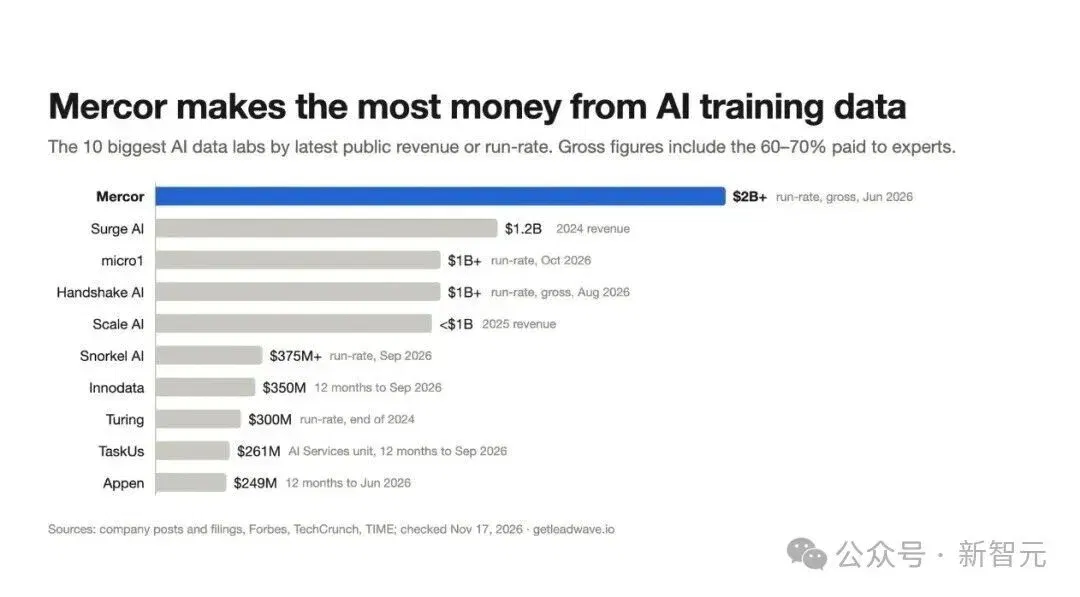
In China, evaluation-data company UniPat, founded less than a year ago, was reported to be seeking a $300 million round led by Alibaba at a $2.5 billion valuation.
Our judgment for this embodied AI wave is that even larger data platforms will emerge. There are three reasons.
First, the data barriers in embodied AI are higher.
In the previous two waves, raw material was either already available on the internet or generated by vehicle fleets themselves. Data companies sold annotation and expert working hours. In embodied AI, even the pretraining material itself has to be produced from scratch at a cost.
Second, embodied data are harder to obtain, scarcer and a higher investment priority.
In autonomous driving, vehicles get on the road first, and drivers generate data every day. But without good models, robots cannot enter real settings; without entering those settings, they have no data. Data must come first, then models, then applications. This turns data companies from supporting service providers into prerequisite infrastructure.
Finally, data paradigms may change, but demand persists. This is not a one-off sale. Foundation-model pretraining is only the first order. Every scenario deployed requires additional real-robot data for post-training. After deployment come data feedback, supplementary collection and retraining. Once models open up applications, specialized smaller models, integrators and solution providers will keep buying too.
Run the numbers, and the scale is astonishing!
At today's prices, first-person data cost RMB 100–200 per hour. Ten million hours would therefore cost RMB 1–2 billion. IDC, meanwhile, forecasts that China's entire AI basic data services market will be worth RMB 7.8 billion in 2026. One order from a single leading customer would equal one-eighth to one-quarter of that market.
But this is not easy money, because buyers are not purchasing “hours.”
One cautionary tale of an unfortunate buyer circulates in the industry: a company bought one million hours of data in the first half of the year, only to be stunned when it tested them on arrival—just 10–20% were usable!
The apparent sticker price was only RMB 100 per hour, but after allowing for the unusable portion, the actual cost came to RMB 500–1,000.
It is a perfect illustration of how “cheaper can be a worse trap.”
There are so many possible pitfalls in these data.
For example, the scenarios may be too artificial: folding clothes on a desk inside a cubicle at a data-collection factory. Image quality may be poor, with dropped frames, overexposure or hands repeatedly moving out of frame. Processing may also be too crude: multiple cameras are not aligned to the millisecond, and trajectory errors run to several centimeters.
Clearly, embodied AI data are moving beyond selling and reselling low-quality material to a stage where customers genuinely demand precision and suitable scenarios.
In essence, this will also eliminate companies without technical capabilities.
And because data have become extremely scarce, leading buyers mainly look at the following three things.
First, is the range of data types complete?
The industry consensus is to build a base of millions of hours of human first-person data, use tens of thousands of hours of real-robot data for action adaptation, and add a small amount of on-site data for deployment. Suppliers that can provide only one type can participate in only one part of the process.
Second, can the supplier provide reliable delivery capacity?
Customers' data standards are relatively consistent. Most companies fail to meet quality requirements after sending samples, or cannot keep up with delivery requirements, leaving them unable to handle large orders.
In that situation, data companies that can supply and deliver reliably find it easier to build sticky relationships. Whoever can prove they can absorb a large order without letting customers down becomes tightly bound to the major companies; competitors cannot easily poach that business.
Third, can they close the loop?
When a model team identifies a gap in a particular capability, the supplier must be able to collect supplementary data for the specified task and demonstrate that the additions really help.
Everyone says they serve leading customers. What sets them apart?
More and more companies in China are now working on embodied AI data.
But a closer look shows that the field is nowhere near as crowded as it appears.
Why? Because the barriers are actually very high.
Producing embodied data requires three capabilities at once: hardware manufacturing (devices must be developed in-house, mass-producible and sufficiently consistent); algorithmic processing (extracting 3D trajectories from raw video at adequate precision); and scenario operations (gaining access to real settings such as factories, supermarkets and hospitals, and building a collection ecosystem network).
These three capabilities actually come from different organizational backgrounds. That is why, although more companies appear to be producing data, the data themselves have become extremely scarce.
The companies that can genuinely deliver end to end and secure acceptance and signed orders from leading customers can in fact be counted on one's fingers.
Publicly available information suggests that Maniformer is currently among the few companies to have scaled all three capabilities at once. Maniformer is regarded as a physical AI data infrastructure platform that “best understands models and scenario requirements,” providing real-robot, simulated and embodiment-free training data in one place.
Its path differs from that of most data companies. A common industry approach is to first obtain a batch of devices or access to scenarios, collect some data and then look for customers.
Maniformer works in the opposite direction: it starts with leading model customers' requirements in China and overseas—the necessary precision, mix of scenarios and formats—and works backward to determine how to design the hardware and pipeline.
Commercial kitchen
Pet washing and grooming
This reversal is where the subsequent gap begins to open up.
The central question at the collection end is whether consistency can be maintained after large-scale deployment.
In data collection, it is nothing unusual for one device to perform well. The difficult part is distributing 20,000 devices across dozens of cities and thousands of collectors, while ensuring that the precision, timing and format of every device's output match.
A common situation in the industry is that, out of a hundred devices distributed, twenty or thirty develop problems. Vast amounts of working time are spent repairing devices and adjusting parameters.
Maniformer's approach is to mass-produce collection devices to consumer hardware standards, with millimeter-level recording precision, wireless operation, low weight, swappable batteries and quickly removable parts.
These seemingly inconspicuous design choices address the most critical industrial issues: whether devices can run reliably across distributed settings, whether they can be replaced immediately when they fail, and whether every device's data can be aligned with those from the others.
Using this approach, they launched in April, began mass production in June and had produced 20,000 sets by the end of August. There is no second company in the industry matching that speed.
Once devices are distributed widely enough, production capacity rises.
They completed one million hours of embodiment-free data in just three months, producing more than 10,000 hours per day on average.
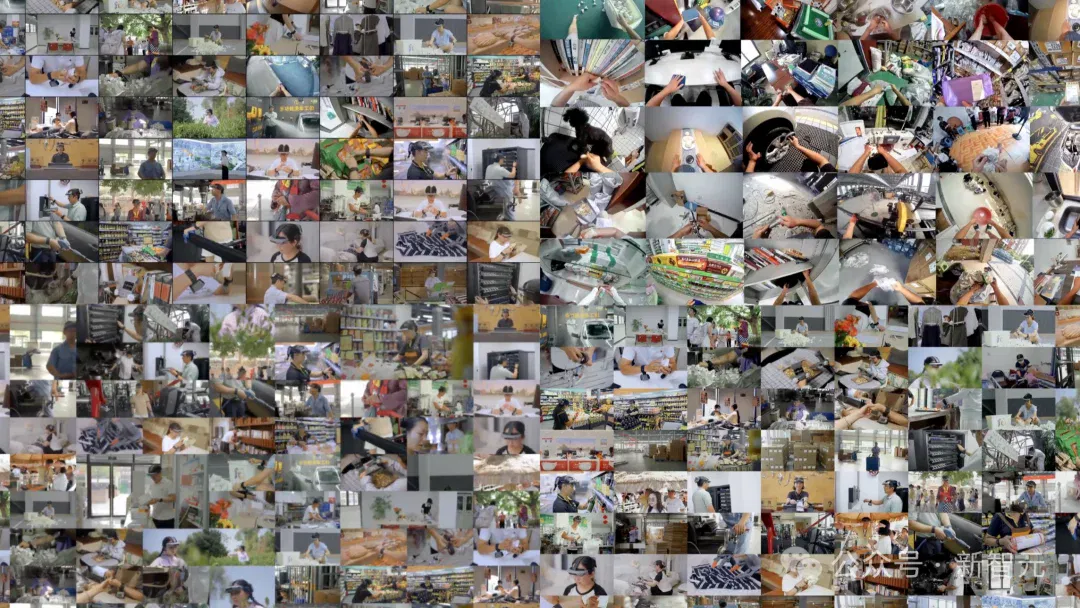
One million hours of data
For comparison, Scale AI has disclosed collecting more than 1,000 hours per day and delivering 150,000 hours over the whole of 2025—an order of magnitude different from Maniformer's figures.
Moreover, the central issue in a data pipeline is not whether it can process data, but the usable-data rate.
As noted earlier, often only 10–20% of one million collected hours are usable in the industry. Maniformer's usable-data rate, by contrast, has reached over 90%.
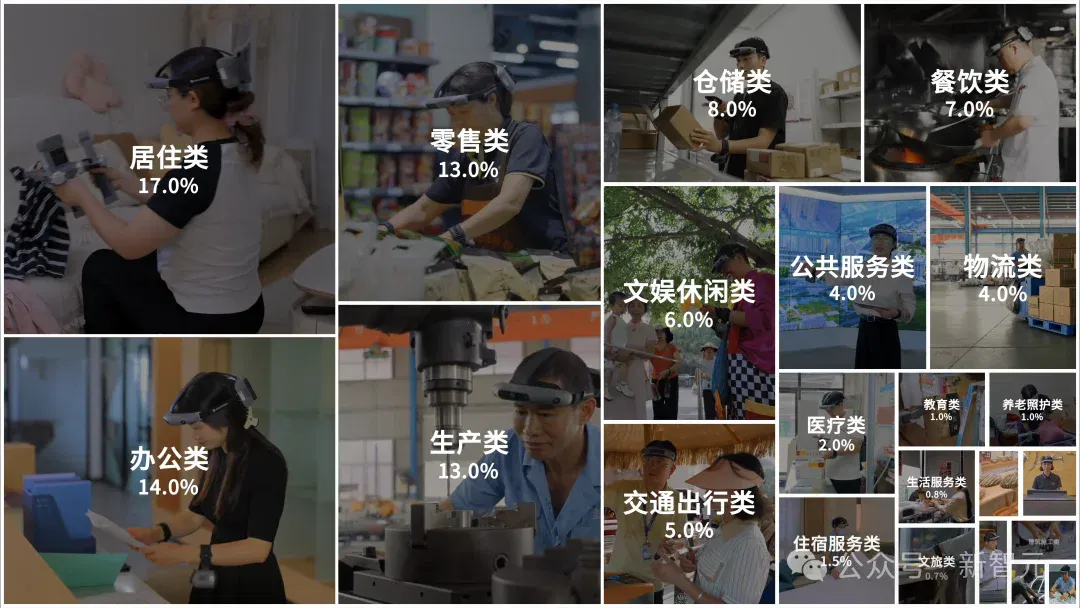
The composition of Maniformer's one million hours
They achieve this by relentlessly working through the details and opening up a gap at every stage. On the device side, hand positions in space are measured to millimeter-level precision, and signals from multiple sensors are synchronized to sub-millisecond precision.
Quality inspection has three layers: real-time screening at the collection end intercepts 60% of obvious problems; vision-language models in the cloud automatically make semantic judgments; and finally, manual spot checks keep deviations within 1%.
Of these steps, trajectory reconstruction is the part of the pipeline that demands the most algorithmic expertise.
Maniformer's in-house HandPose algorithm achieves sub-centimeter precision. In real scenarios involving occlusion, interaction and rapid movement, its reconstruction error is substantially lower than that of the next-best industry approach. This precision currently places it in the industry's leading tier.
The entire pipeline also processes more than 10,000 hours per day. Conversion from raw data into assets ready for training runs automatically, rather than being handled manually one item at a time. This stage's efficiency directly determines how much usable data can be delivered to customers in the same amount of time.
Manicure
Closing the loop is the layer most easily overlooked, yet the one with the highest barriers.
For most suppliers, service ends when the data “pass quality inspection and are accepted on delivery.” Once the data have been handed over, however, suppliers often do not know how model training turns out, which data help, which are noise or where gaps remain. Nor do they have the ability to verify these things.
To address this, Maniformer developed its own end-to-end model and deploys it on real robots to test data effectiveness and study data mixes and supplementary collection strategies. In tests in some scenarios, each iteration of the data feedback loop improves task success rates by five to ten percentage points.
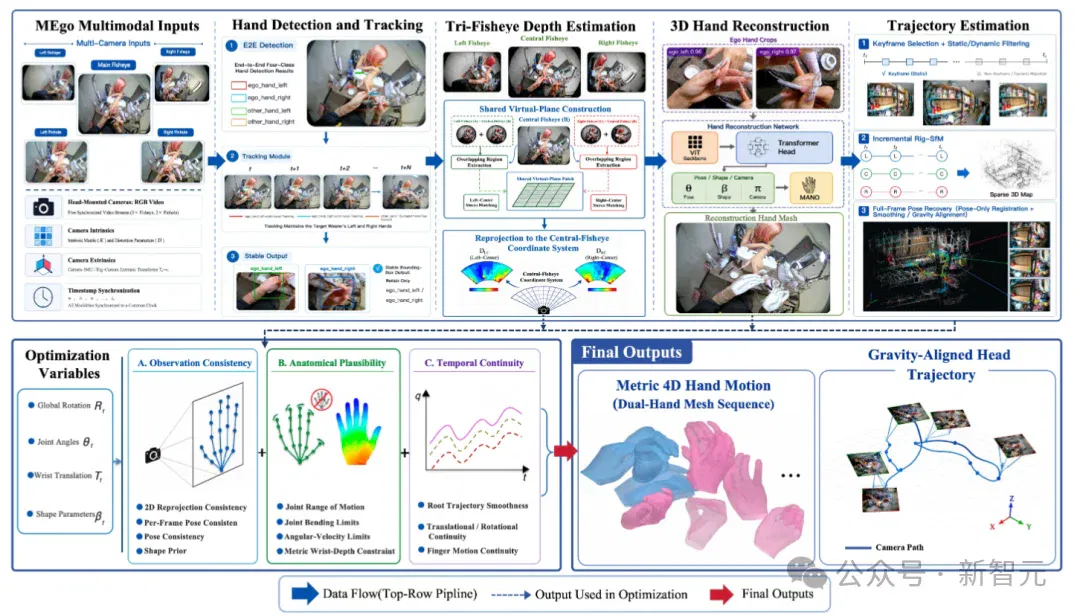
MEgoVista, an egocentric motion reconstruction framework
Thus, when a customer's model team finds a gap in a capability, Maniformer can collect targeted supplementary data for the specified task and demonstrate that the additions really help. This is no longer simply a data transaction; it is a relationship built on joint iteration.
Public information indicates that Maniformer currently works with dozens of customers, including large-model platforms, embodied AI and world-model companies, and robot hardware manufacturers.
Tencent Robotics X and Ant Group's Lingbo have publicly used its data, and AgiBot's GO3 foundation model includes some of its data in its training set too.
Overseas, it has already become a core supplier to several leading technology companies.
Mold maintenance
Of course, making the leap from one million to 100 million hours of data in the future will certainly require more than linearly replicating data-collection factories.
Maniformer is betting on crowdsourcing. Its Mifeng Pai platform, released in September, lets ordinary people wear devices and collect data as they work. It currently has more than 200,000 registered users across over 50 cities. More than 50 scenario partners, including hotels, supermarkets, hospitals and factories, have joined its data alliance.
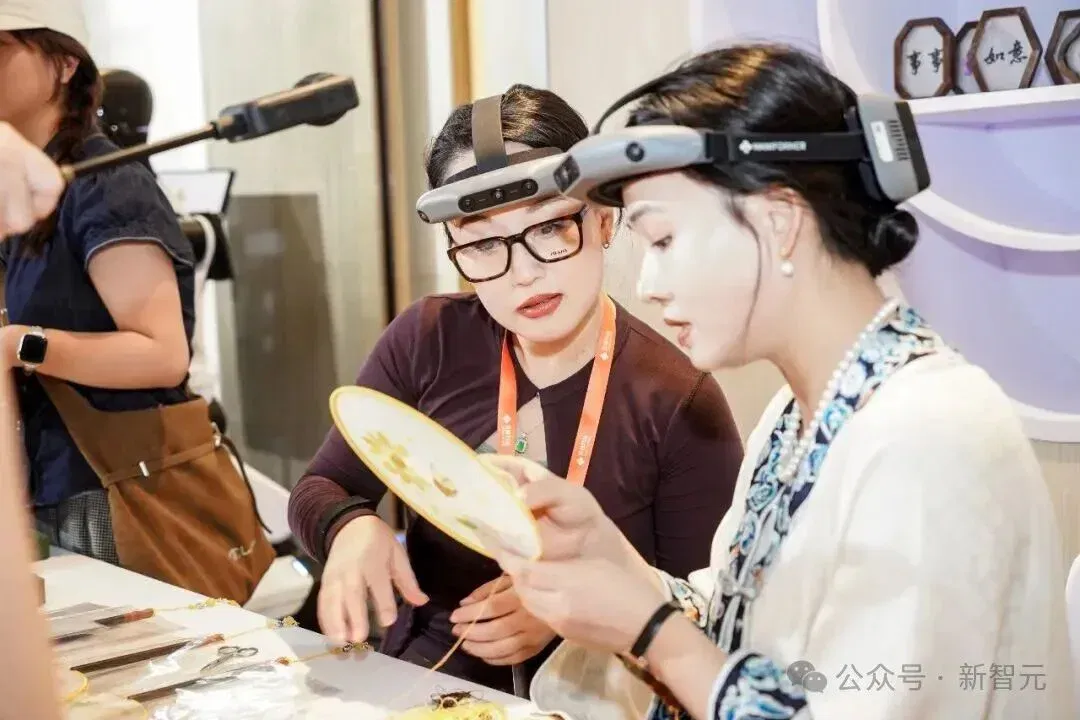
The most important thing to watch next is whether crowdsourcing can increase scale by another order of magnitude while maintaining a usable-data rate above 90%.
Large-model companies' entry is good news for the embodied AI industry
Returning to the opening question: does the entry of large-model companies represent an overwhelming attack on embodied AI?
After this analysis, the conclusion is actually the exact opposite: it is good news for the embodied AI industry!
The table will become bigger, there will be more money, and progress across the industry will accelerate.
Originally, industry forecasts placed embodied AI's GPT-3 moment at around 2030.
But the speed of leaderboard updates over these past few months proves that the moment will come earlier! And every additional player entering with a trillion-parameter large model will widen the market's data shortfall again.
That is because the faster models advance, the more data they will demand.
OpenAI has disbanded its robotics team twice. The first time, it was because there were no data; this time, the models are ready, but data remain what is most lacking.
What is different is that this time, some people have already made producing data into a serious business.
This article is from the WeChat account “Xinzhiyuan,” by “Xinzhiyuan.”
Related topics
After reading
Join the AINRK community
Read how to join the community and connect with people working in AI.
Related articles
Continue reading related topics and articles in this category.

PaXini's Xu Jincheng on tactile sensing, embodied data and robotic execution (opens in a new tab)
In an ALIGNMENT conference talk, PaXini founder Xu Jincheng describes tactile sensors, data collection, VTLA models and execution hardware, discussing how perception, intelligence and execution work together. Product capabilities are claims disclosed in the talk.
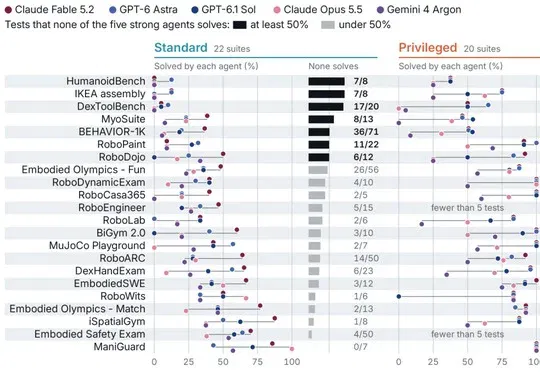
EFE Tests Coding Agents on Simulated Robots: 1,156 Tasks and Up to Three Modes (opens in a new tab)
EFE brings together 1,156 simulated tasks, 35 task sets and 47 robots, with up to three evaluation modes. Controlled experiments and stage annotations for part of the core set examine failures; results depend on the mode, agent framework and single runs.

Hao Fei's perspective paper proposes a framework for AI 'cognitive symbionts' (opens in a new tab)
Hao Fei's 59-page perspective paper frames personal AI through Cognitive Symbionts, a cognitive gap and a symbiotic loop. It explores memory, timely intervention, learning, care, consent, privacy and governance, setting out concepts and evidence standards rather than a tested complete system.
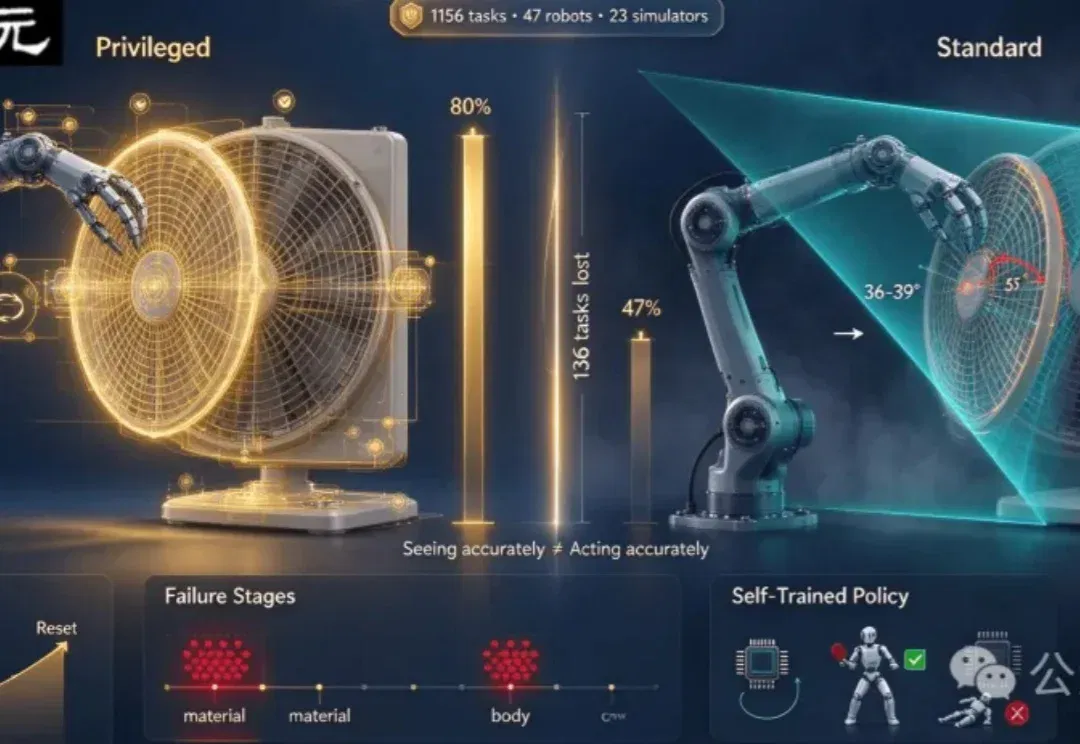
EFE simulation: Fable 5.2 scores 80% in Privileged mode and 47% in Standard on matched tasks (opens in a new tab)
EFE covers 1,156 tasks and 47 robot types. On 391 matched core tasks, Claude Fable 5.2 solved about 80% in Privileged simulation and 47% in Standard. Each test ran once; the real-robot demo was unscored. Other comparisons use different task sets.
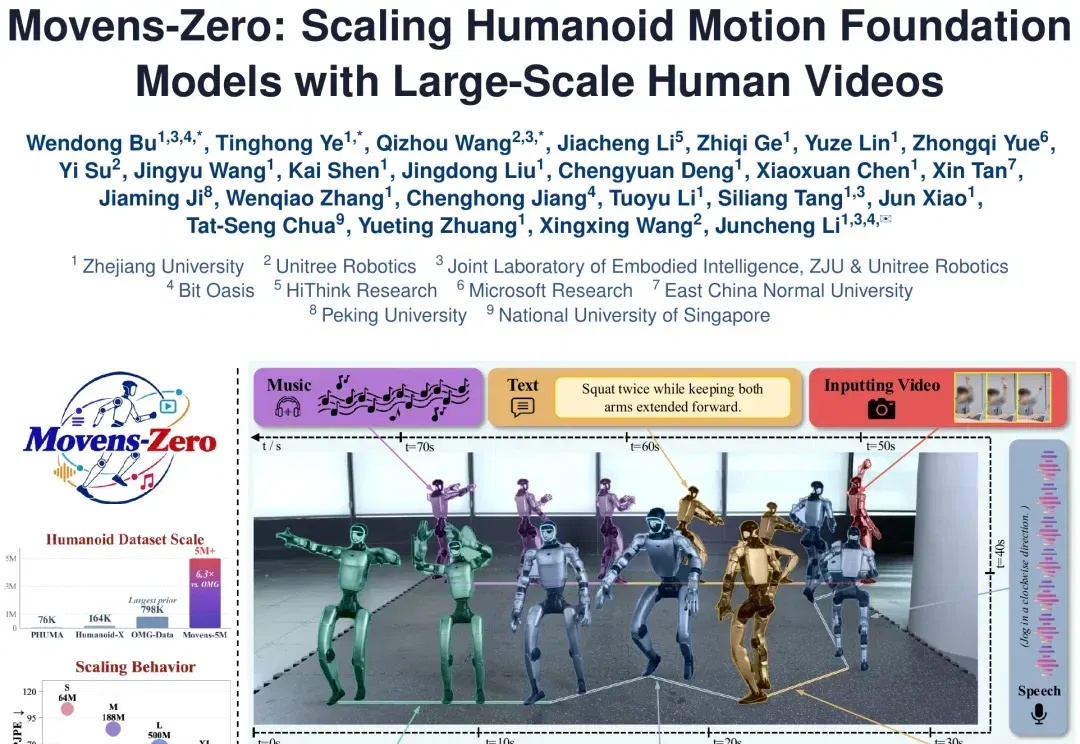
Zhejiang University and Unitree open-source Movens-5M for multimodal whole-body motion pretraining (opens in a new tab)
Movens-5M pairs five million simulation-validated robot motions with text, video, speech and music. The team trains Movens-Zero and demonstrates it on a Unitree G1, using scaling experiments to examine gains from more data and larger motion experts.