HungerG offers limited free access; Crossing tests 3D and game development and investigates its origins
Crossing uses HungerG in Qoder for a Sphere display, Blender scenes and a roguelike browser game, and examines community examples and tokenizer clues. Qoder's free offer covers international individual accounts; results are case-specific and the model's maker remains unconfirmed.
Qoder's official event description (opens in a new tab) confirms that HungerG remains an anonymous model whose identity has not been disclosed. Free access is for individual users of the international version, excluding Teams and Enterprise; the offer has start and end times and peak-time queuing conditions. Generation times, tool calls, speeds, token usage and completeness in this article are observations by the author or cited developers in specific environments, not a uniform benchmark. The accounting scope of five million tokens in 15 minutes is not fully explained and cannot directly be equated with net output speed per second. Similar tokenizers or configurations provide clues to identity, not vendor confirmation. Slotbound's official page (opens in a new tab) supports the account of solo development and disclosure of generative-AI assets. Sales figures cited here remain those reported by the article and cannot be treated as the developer's net proceeds after platform fees, taxes and refunds.
The large-model industry is entering a new Hunger Games.

At the end of 2026, the large-model world still loves playing The Masked Singer.
In the early hours of November 24, an anonymous model called "HungerG" suddenly appeared on Qoder and OpenCode, opening free access to developers.
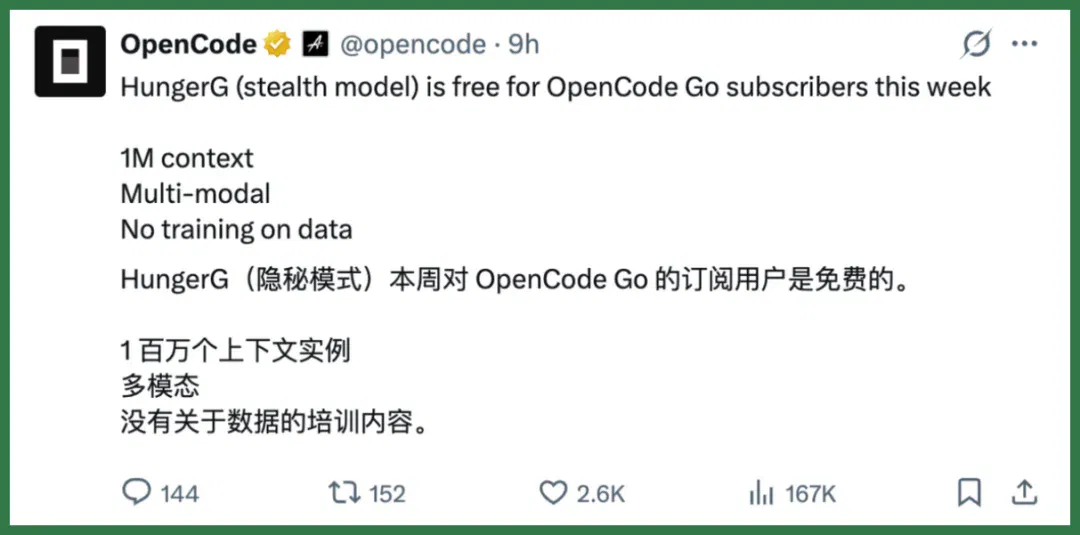
HungerG disclosed neither its maker nor a technical report, but quickly prompted a reaction from the developer community: who is about to release another model?
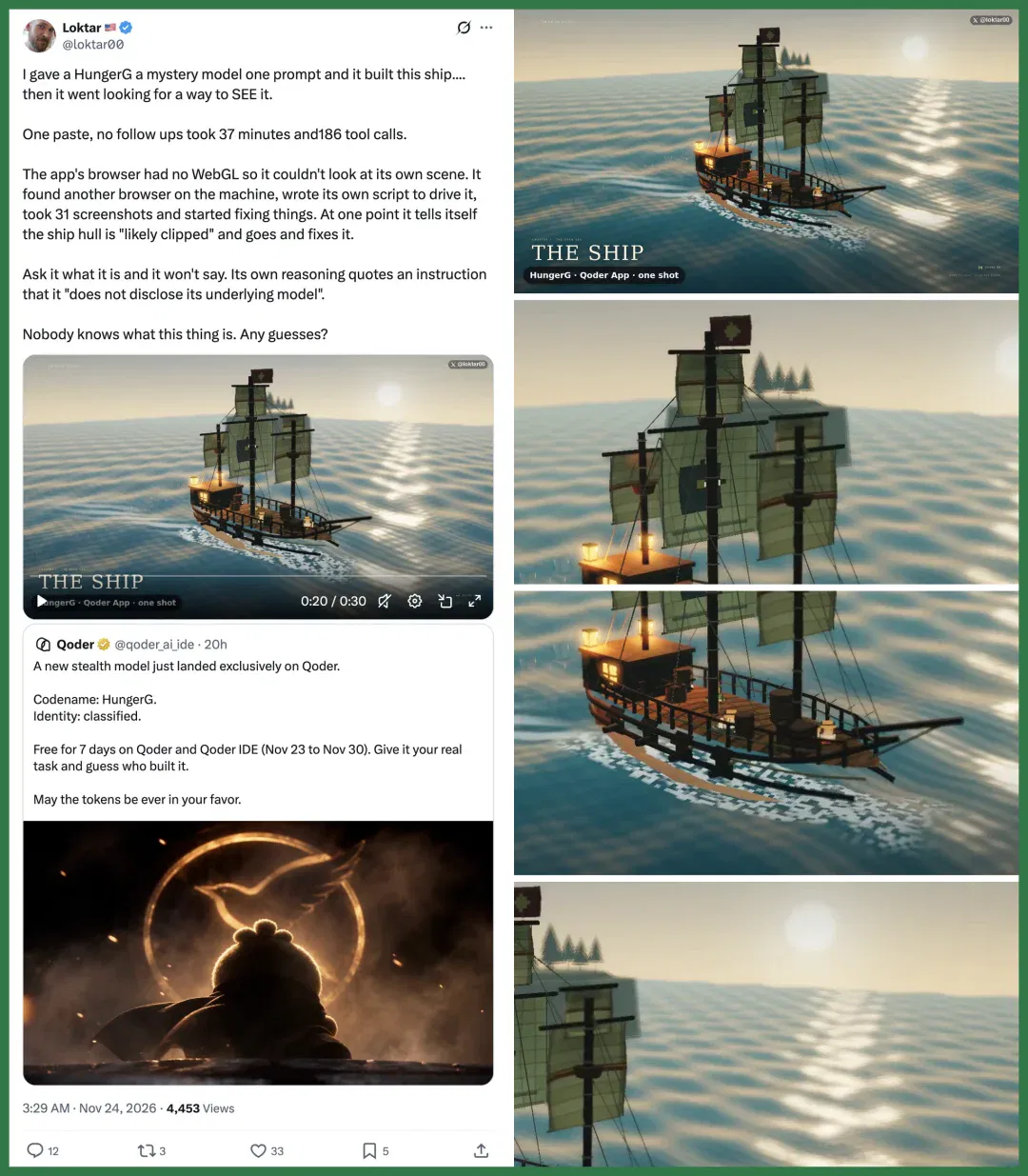
One developer entered just a single prompt, and HungerG autonomously made 186 tool calls in 37 minutes. It even wrote scripts, operated a browser, and used screenshots to inspect and fix problems in a 3D scene.
Another developer used it to build a 3D fusion reactor in 15 minutes.
Meanwhile, developers began looking for its true identity through special-token tests, GitHub commit histories and other methods.
So what can HungerG actually do? And which model company might it come from?
🚥
The Crossing team promptly put this anonymous model through a round of hands-on tests and found some interesting clues.
No marathon overthinking, yet still tackling complex tasks
Before starting our formal tests, we looked through developer communities in China and abroad and found that many developers had already made interesting projects with HungerG.
Much of the discussion centered on its 3D-scene generation, complex-task execution and quite fast token output.
Here is a roundup:
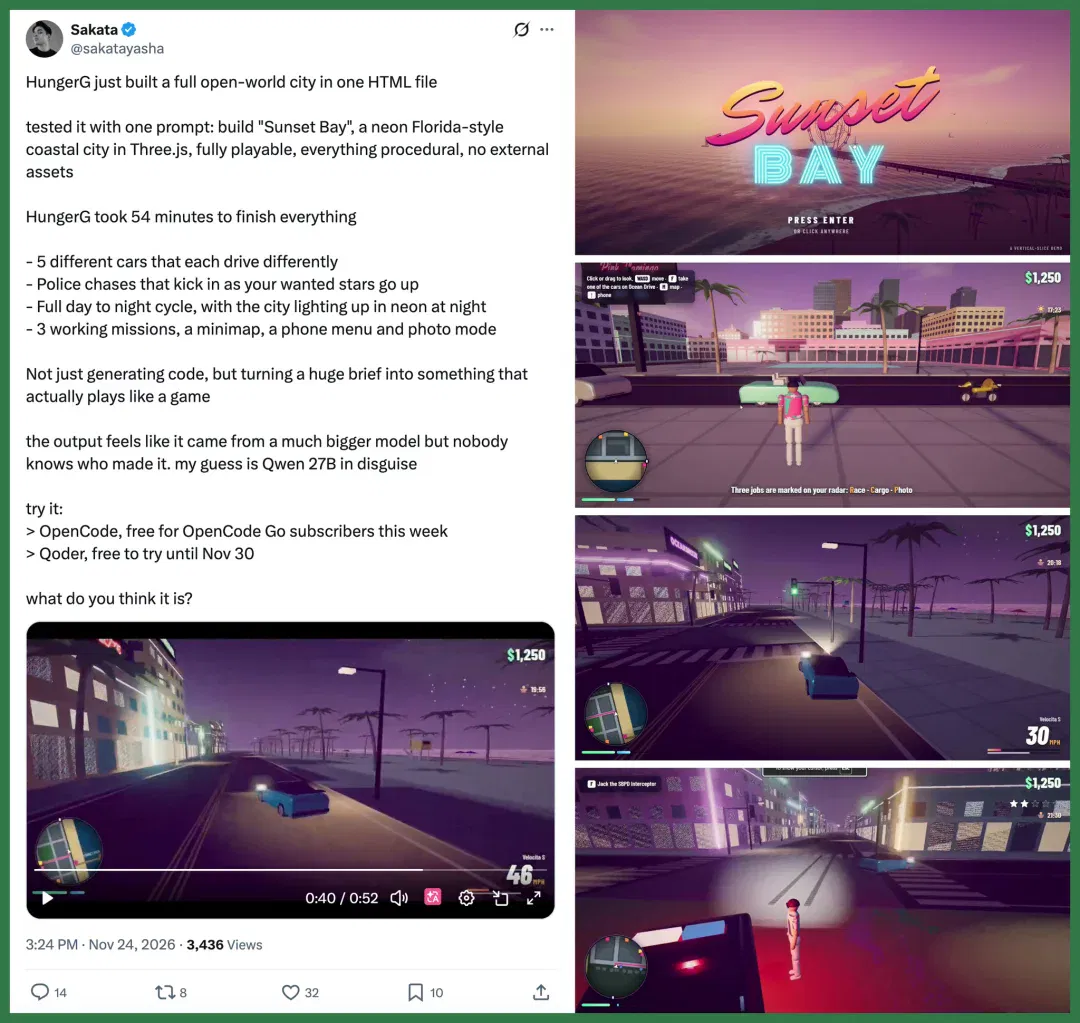
【1】 54 minutes to build an open-world game in one HTML file
Developer @sakatayasha on X gave HungerG a single prompt to build an open-world city called Sunset Bay with Three.js. No external assets were used throughout the process.
The game includes five cars with different driving characteristics, a police-chase system, a day-night cycle and three working missions. It even has a minimap, a phone menu and a photo mode.
【2】 37 minutes, 186 tool calls: autonomous 3D ship modeling and correction
Another developer, @loktar00, used HungerG for a 3D ship-modeling project. When it discovered that the application's built-in browser did not support WebGL and could not inspect the 3D scene it had generated, it sought out other browsers on the computer and wrote its own scripts to control them.
It captured 31 images during the process to inspect and fix its 3D model, including problems such as an incompletely displayed hull.
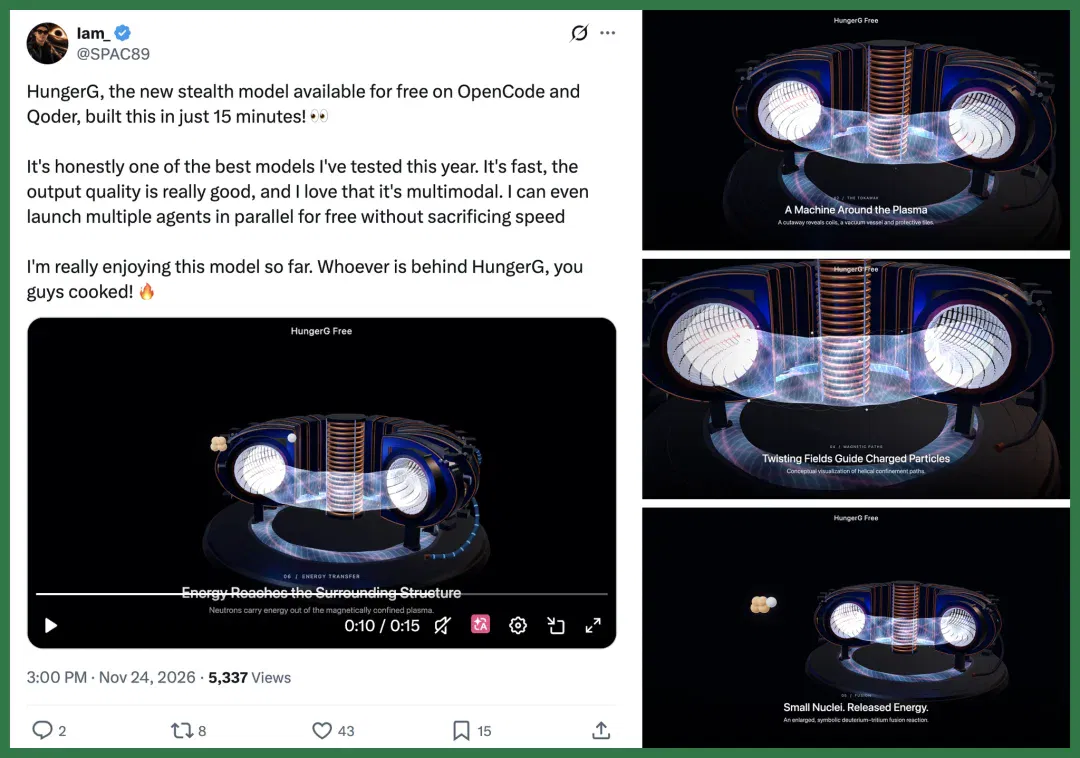
【3】 15 minutes to build a 3D fusion reactor
Developer @SPAC89 used HungerG to create a 3D fusion-reactor demonstration. The whole process took just 15 minutes.
This developer rated its generation speed, output quality and multimodal capabilities highly.
In his test, HungerG's output exceeded 150 tokens/s, with no noticeable slowdown even when multiple agents were started at once.
【4】 Three animation-scene tests with fast generation
Developer @Bhavani_00007 used HungerG for three animated scenes: a running rooster, a collapsing building and a whale leaping from the water.
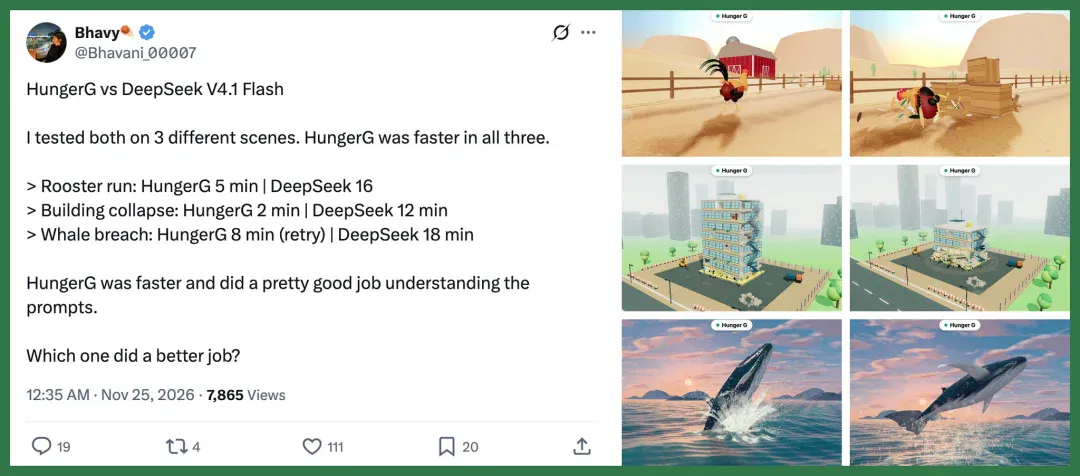
HungerG took five, two and eight minutes respectively for the three projects.
The developer felt that, besides generating faster, HungerG understood the prompts relatively accurately.
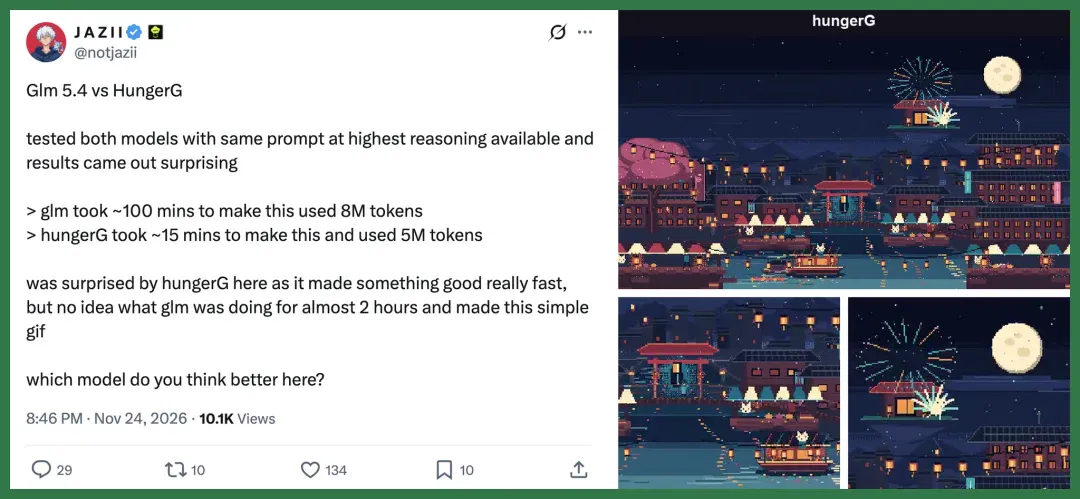
【5】 A pixel-art animation task completed in 15 minutes
Developer @notjazii used the same prompt to have HungerG create an animation at its highest reasoning intensity.
HungerG took only about 15 minutes, consuming five million tokens.
In further testing, the developer also found that HungerG reached 150 tokens/s and performed well with Three.js and 3D scenes.
🚥
At present, the report describes limited-time access to HungerG on OpenCode and Qoder. Qoder officially specifies that new and existing individual users of its international version can call HungerG free, without consuming Credits, from 24:00 on November 23, 2026 to 24:00 on November 30 (UTC+8). Teams and Enterprise are excluded. The model supports four thinking levels—Low, Medium, High and Max. Requests may queue at peak times, with paid users receiving higher queue priority. After the promotion, usage will be charged at the rate announced at that time.

For convenience, we carried out all three of the following cases in Qoder.

Case 1: a glasses-free 3D Las Vegas Sphere display
For the first hands-on project, I chose the Sphere display in Las Vegas. Such glasses-free 3D spherical displays are popular at the moment, and similar projects are beginning to appear in China, so I wanted to make one with HungerG for fun.
I asked HungerG to study the underlying principles carefully.
From a coding perspective, this effect has a mathematical basis. For example, the entire image first needs to become an unwrapped spherical map, which the sphere then uses to display the content.
It took only about 12 minutes from entering the prompt to generating the first version.

The result was fairly complete. The orange-ball scene in the middle, in particular, was generated entirely through code: I supplied no AI-generated images.
The small window at the bottom right shows the corresponding unwrapped spherical map.
So this was more than a simple demo. The output images could also correspond to content for a real spherical display.
After the initial version, however, I ran into a problem when uploading a video and asking for a 3D effect. Perhaps HungerG had not fully understood my prompt at first:
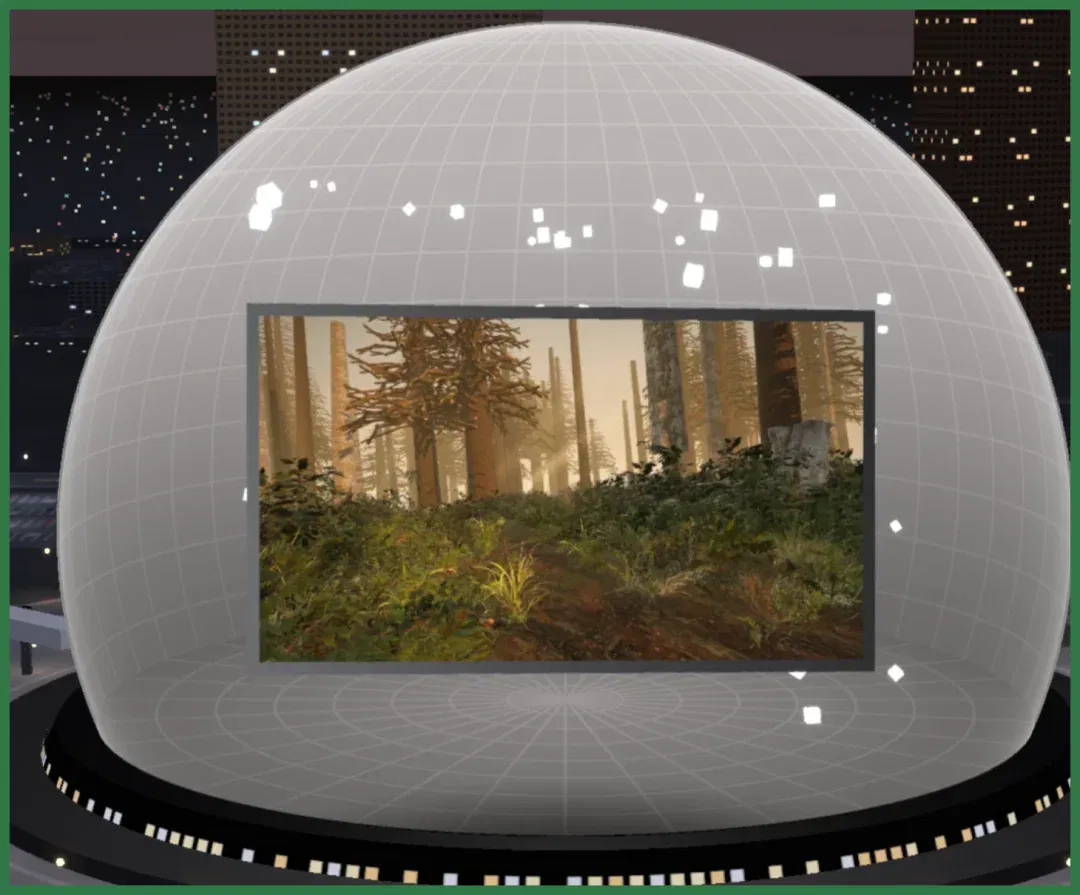
I therefore asked for another revision, which took about eight to ten minutes.
Specifically, it placed a virtual camera at the viewing position and calculated its field of view with a formula so the whole sphere would fit in the frame. The camera then filmed the virtual content, projecting each captured pixel back onto the sphere along its line of sight.
As a result, when the camera turned to the side, the image distorted accordingly, giving viewers a three-dimensional effect from a particular angle.
NASA had previously produced public datasets for Science On a Sphere. I had HungerG download data from a Wikimedia Commons mirror and place it directly inside the Sphere display.
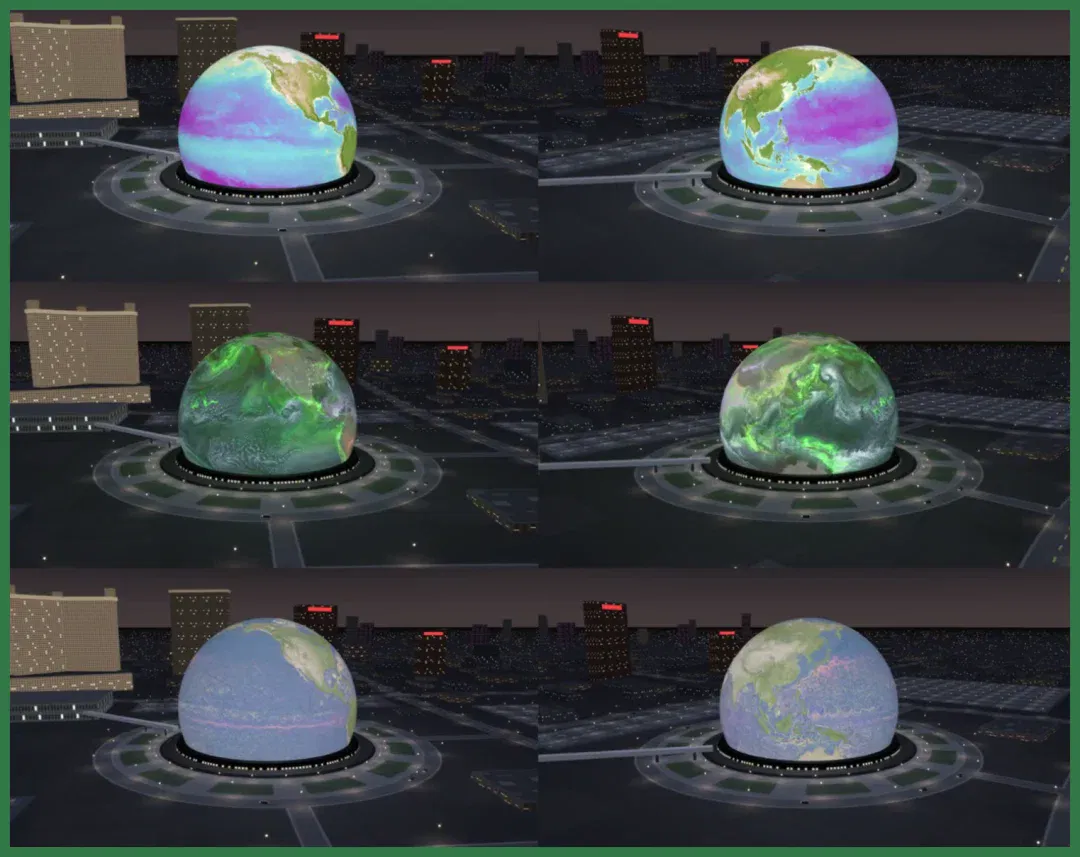
The overall result was good: it immediately conveyed the feel of a spherical display.
This Sphere was also modeled using public data. Its dimensions relative to surrounding buildings were largely recreated to match reality.
I also selected NASA's public atmospheric-aerosol flow data—the green and white swirls shown—and put it into the Sphere display to make the playback effect easier to see.

Of course, the glasses-free 3D effect was still not obvious enough in this presentation.
I therefore asked HungerG to call a locally saved AI-video-model API, devise video-generation prompts suited to glasses-free 3D using the Sphere already built, and place the resulting videos inside it.
I recorded two animations.
The first shows a prehistoric giant shark bursting out of an armored shell. You can clearly see it protruding from the spherical display's surface, and the overall result looks quite realistic.

In the example below, the shark bursts out, shattering glass and spraying water, making the glasses-free 3D effect even more apparent.

Case 2: a Blender 3D project—Kill Bill-style opening silhouettes
Next, I raised the difficulty and had HungerG connect directly to Blender to create 3D projects, another popular way to use AI recently.
In particular, you have probably seen Kill Bill-style opening videos frequently on social platforms such as Xiaohongshu recently. The effect is now used in many short videos.

I therefore planned to have HungerG pay homage to Kill Bill's opening with a silhouette shot: a flock of crows flying past buildings at sunset, the sun rising behind the buildings, and the word CROSSING appearing at the end.
A good version of this shot needs many building models, which would be troublesome to make from scratch. So I asked HungerG to search the Sand3D open-source 3D project itself for models suited to the shot.
It first searched for Skyscraper, found 14 skyscraper models and downloaded their preview images.
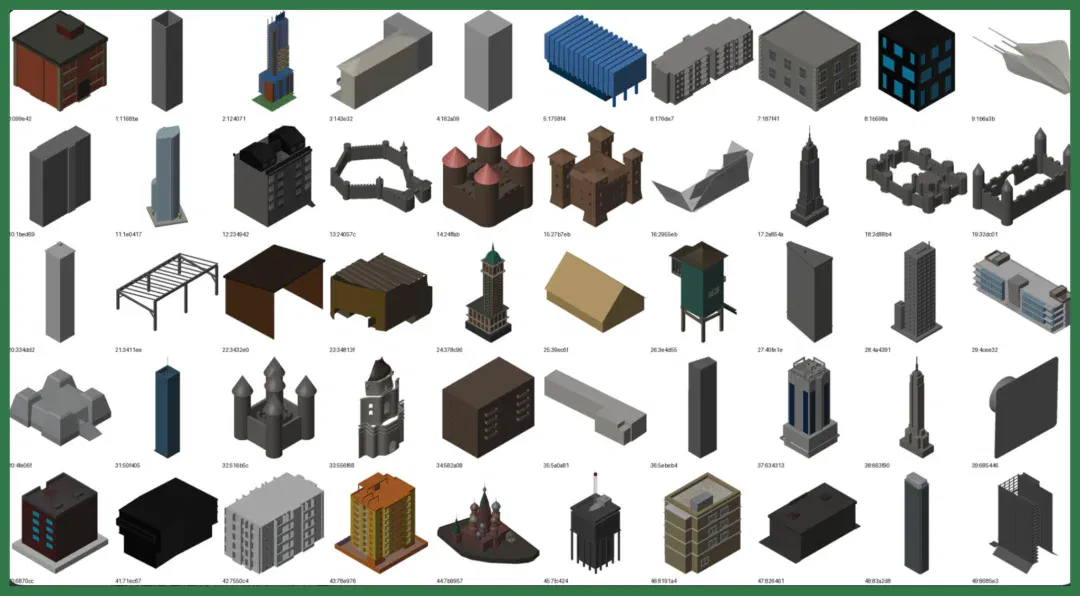
HungerG ultimately downloaded 32 3D models and imported all of them into Blender.
It then arranged the 32 buildings itself based on their heights, dimensions and distances, adding CROSSING text and a sunset model behind them.
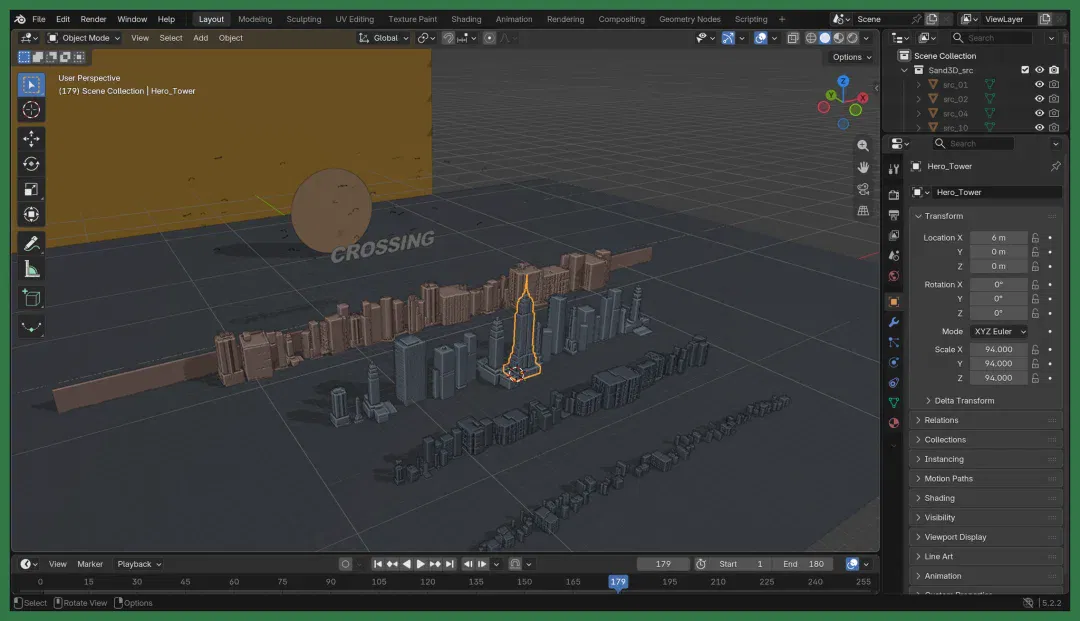
The birds used the simplest possible method.
Each bird was a flat black silhouette, with shape keys animating its flapping wings and frame-by-frame keyframes moving it to the left.
The whole project took about 40 minutes.
The main effect was finished in roughly the first 30 minutes, followed by about eight minutes adjusting camera positions and rendering details.
Here is the complete result:

In the final result, HungerG divided the 32 buildings into three rows, using different distances and sizes to give the image greater depth.
Window lights were randomly illuminated through materials, and the sky used an orange gradient. Together with birds, sunset and text, this largely achieved the Kill Bill-style opening we wanted.
I then had HungerG add more than 300 buildings to the existing Sand3D building models, making a nighttime city.
As the camera rotated around the city, at a particular angle the illuminated windows across different buildings lined up to spell Crossing.

I also made a daytime miniature-city project with highly saturated colors. With a very shallow depth of field, the city looked like a cute model sitting on a table.
Colorful buildings and trees popped up in rings from the center outward. Finally, red three-dimensional Crossing letters dropped one after another onto the central square.
Case 3: the roguelike game SlotBound
A roguelike game called "Slot Bound" has been particularly popular these past couple of days.
Its creator is a Korean solo developer with no previous game-development experience. He began experimenting with AI vibe coding in October 2025 and completed the game independently.
Within 48 hours of its Steam launch, it sold 50,000 copies and generated more than $350,000 in revenue, with peak concurrent players exceeding 15,000, according to the report.
By the third day, sales had exceeded 100,000 copies and revenue reached $700,000.
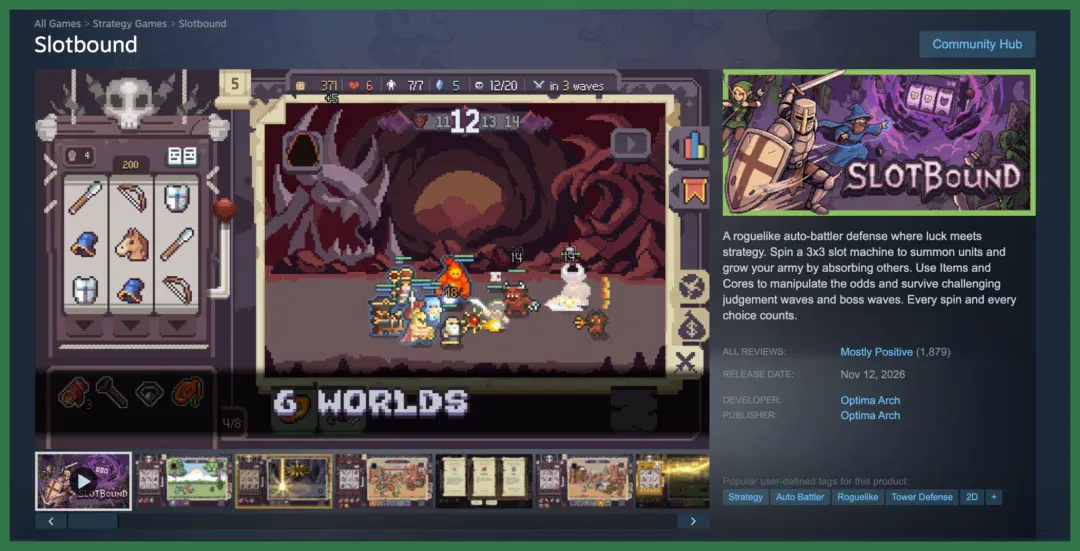
However, this game was not made entirely through AI vibe coding.
The developer spent a long time repeatedly refining the gameplay, even starting over multiple times. He still built many of the core mechanics himself.
So we also tried using HungerG to make a browser game in the same genre.
The basic gameplay drew on Slot Bound, but with redesigned art and characters. We ultimately made a roguelike game called Reel Expedition.

The game uses a pixel-art style throughout, and features such as combat, abilities, recruitment and merging all work.

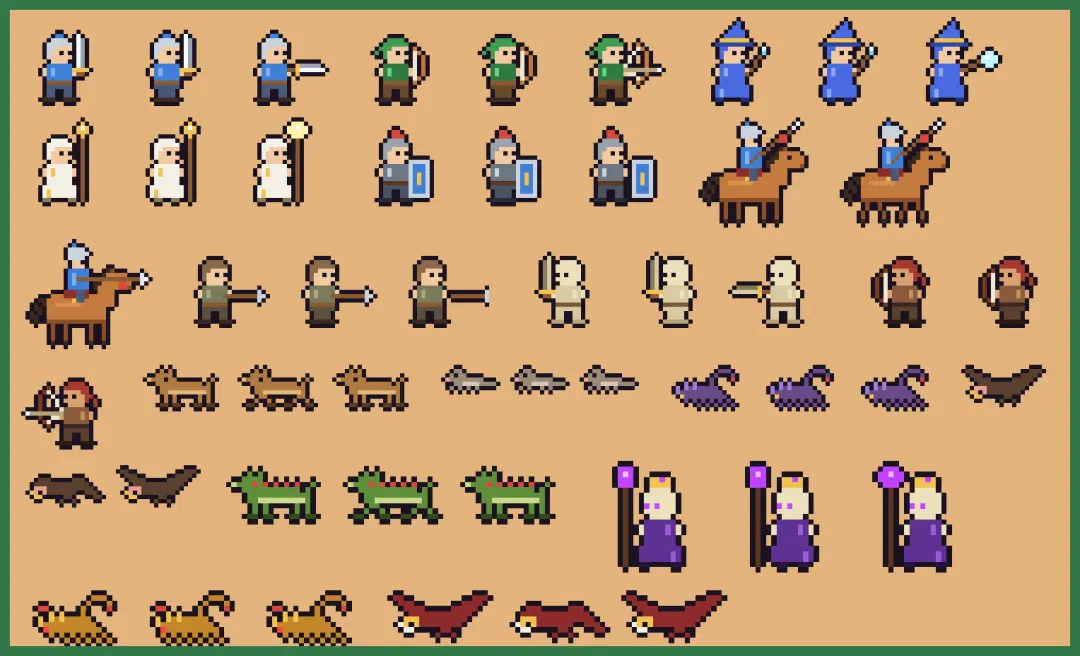
HungerG also created many weapons, mounts, soldiers and enemies, including boss character designs.
On the left is a 3×3 slot-machine reel grid, with a lever, a free-spins badge, a paytable button and a recruitment progress bar.
Other areas include an inventory, a battlefield on the right and an ability bar.
The gameplay has three main parts.
First, reel-based recruitment and merging to raise star levels.
Players recruit characters by spinning the slot machine. For example, landing three swords immediately grants a swordsman. Collect three swordsmen and merge them into a two-star swordsman, then send him onto the battlefield.
Second, automatic combat and ability use.
As enemies keep appearing, more than 20 units may fight at once. The game automatically handles combat and casts abilities, including falling fire, chain lightning, frost and war cries.
For example, when frost takes effect, enemies turn icy blue and temporarily stop moving.
Third, boss fights.
Once a boss fight begins, the boss's name and health bar appear at the top in real time, and different ability effects trigger during combat.
The entire game took about 39 minutes from the start of development to completion.
Game design and the first implementation were completed in the first 21 minutes, with the game successfully running in a browser.
Testing and fixes took another five minutes. The final 13 minutes went into details including the arrangement of three scenes and boss health.
Who actually made HungerG?
Across these three cases, HungerG performed fairly well overall, especially in 3D-scene generation, complex-task execution and tool use, with relatively complete results and fast generation.
Besides testing its capabilities, the community has spent the past couple of days on another familiar activity: guessing which model company HungerG comes from.
We also tried several methods to trace the anonymous model's true identity.
We downloaded multiple public tokenizers from official Hugging Face repositories, including Step-5-Preview, Qwen3.8, GLM-5.3, Kimi-K3.1-Pro, MiniMax-M3.1-Flash, MiMo-V2.6, Tencent Hy4 and gpt-oss. Using scripts written with Claude Opus 5.5, we counted tokens for each locally.
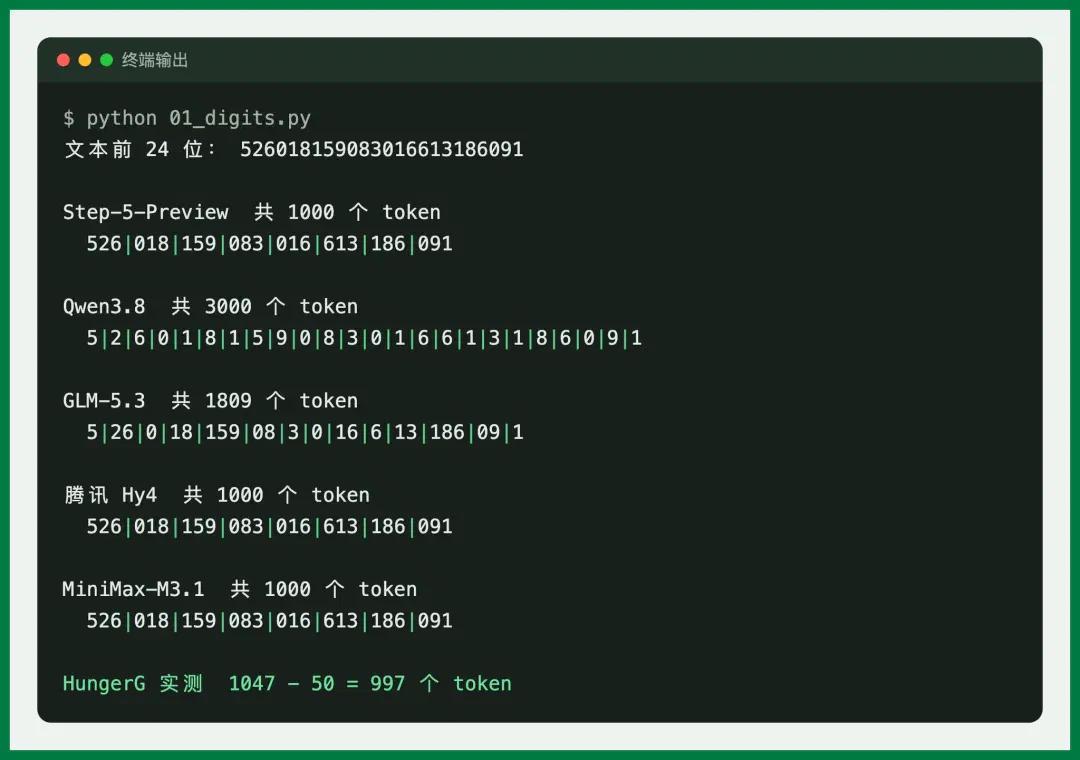
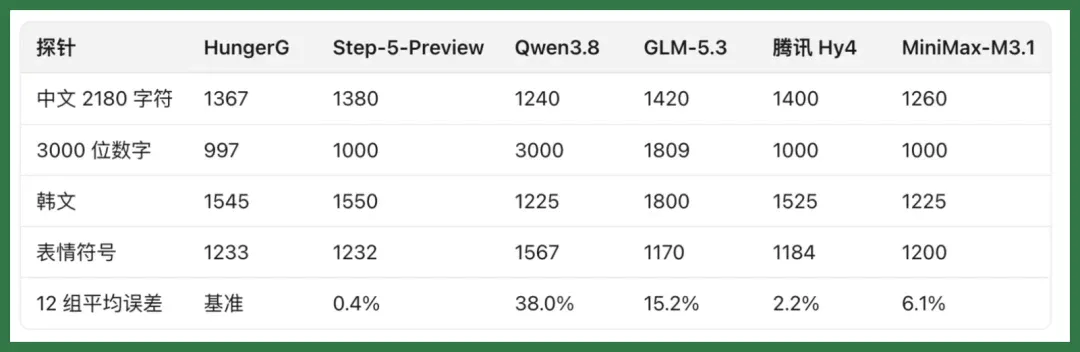
We then sent HungerG 12 sets of texts we wrote ourselves, estimated token counts from Qoder's context-usage proportions, and subtracted a fixed overhead of about 50 tokens per round.
The results showed an average discrepancy of just 0.4% between HungerG and Step-5-Preview.
We also tested its knowledge cutoff.
HungerG correctly answered questions about GPT-5.2, released in December 2025, and Hamnet, the January 2026 Golden Globe winner for Best Motion Picture—Drama. For several later questions, it answered that it did not know.

From this, we inferred that its knowledge cutoff was roughly late 2025 to early 2026.
Of course, this method provides only a reference point, not a rigorous identification.
For one thing, many vendors have not published their latest models' tokenizers, limiting the comparison set. For another, matching tokenizers can indicate only similar technical approaches; different foundation-model vendors may use the same vocabulary.
To guess which model it is, people on social media have already begun competing with one another.
The X account @aitrackerbot, which tracks model releases, ran three rounds of testing on HungerG, asking it to copy 98 lines containing rare tokens.
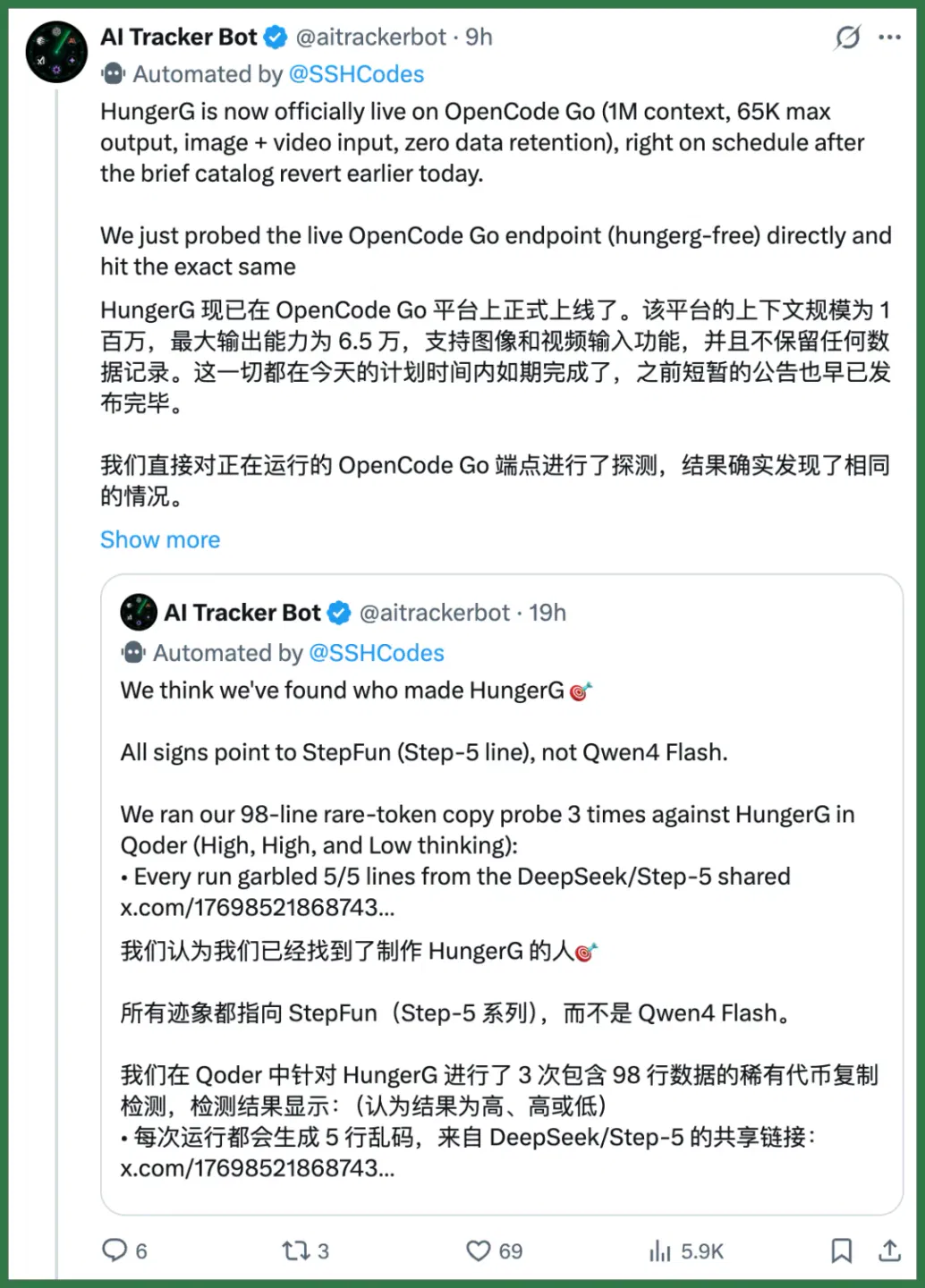
They found similar abnormal output when HungerG handled certain special tokens shared by the DeepSeek and Step-5 vocabularies. But a line-by-line comparison found HungerG's output closer to Step-5-Preview.
In the third test round, HungerG unexpectedly emitted the special token </tool_calls>.
According to the account, this token has ID 128013 in the Step-5 tokenizer, but does not exist in the DeepSeek tokenizer they used for comparison.
This suggests that HungerG very likely uses the Step-5 vocabulary.
Another developer, @abhinavflac, found that a model configuration named hungerg-free had briefly appeared in OpenCode's open-source model catalog.
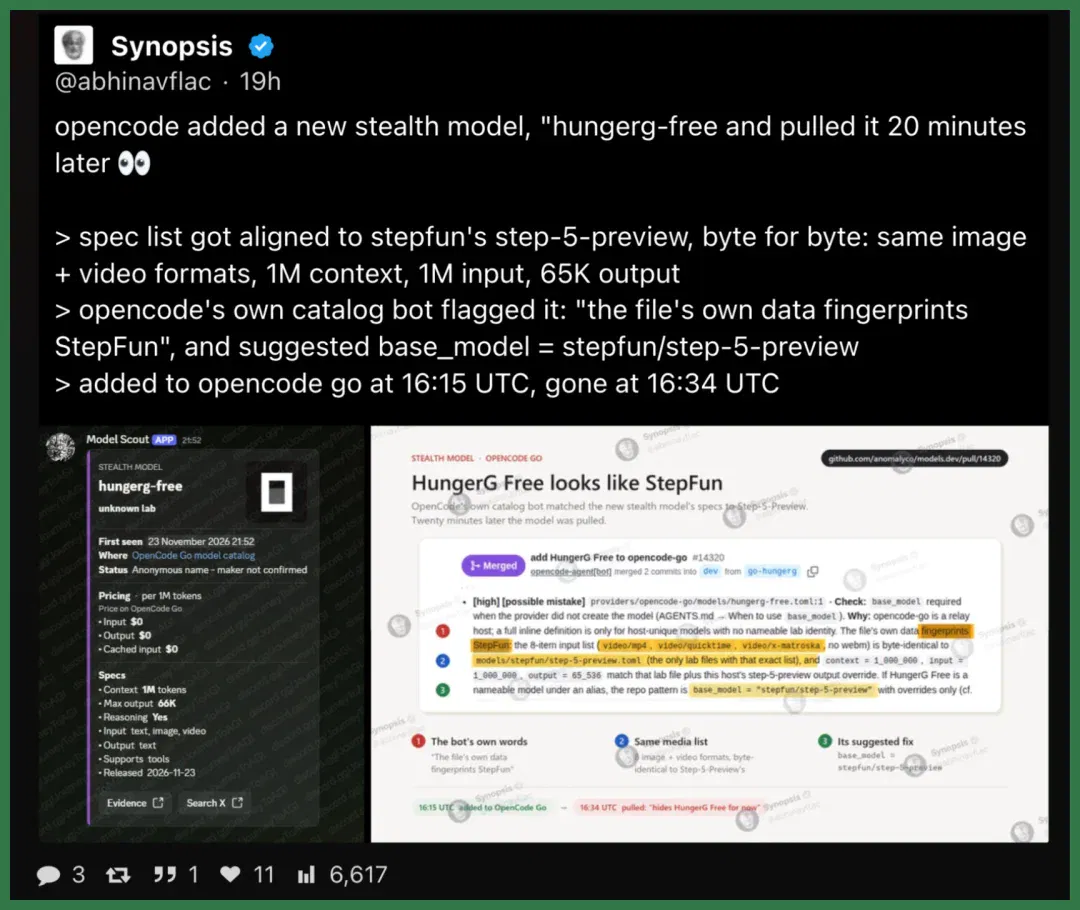
Even the automated code-review bot in the OpenCode repository noticed that the two models' configurations were very similar.
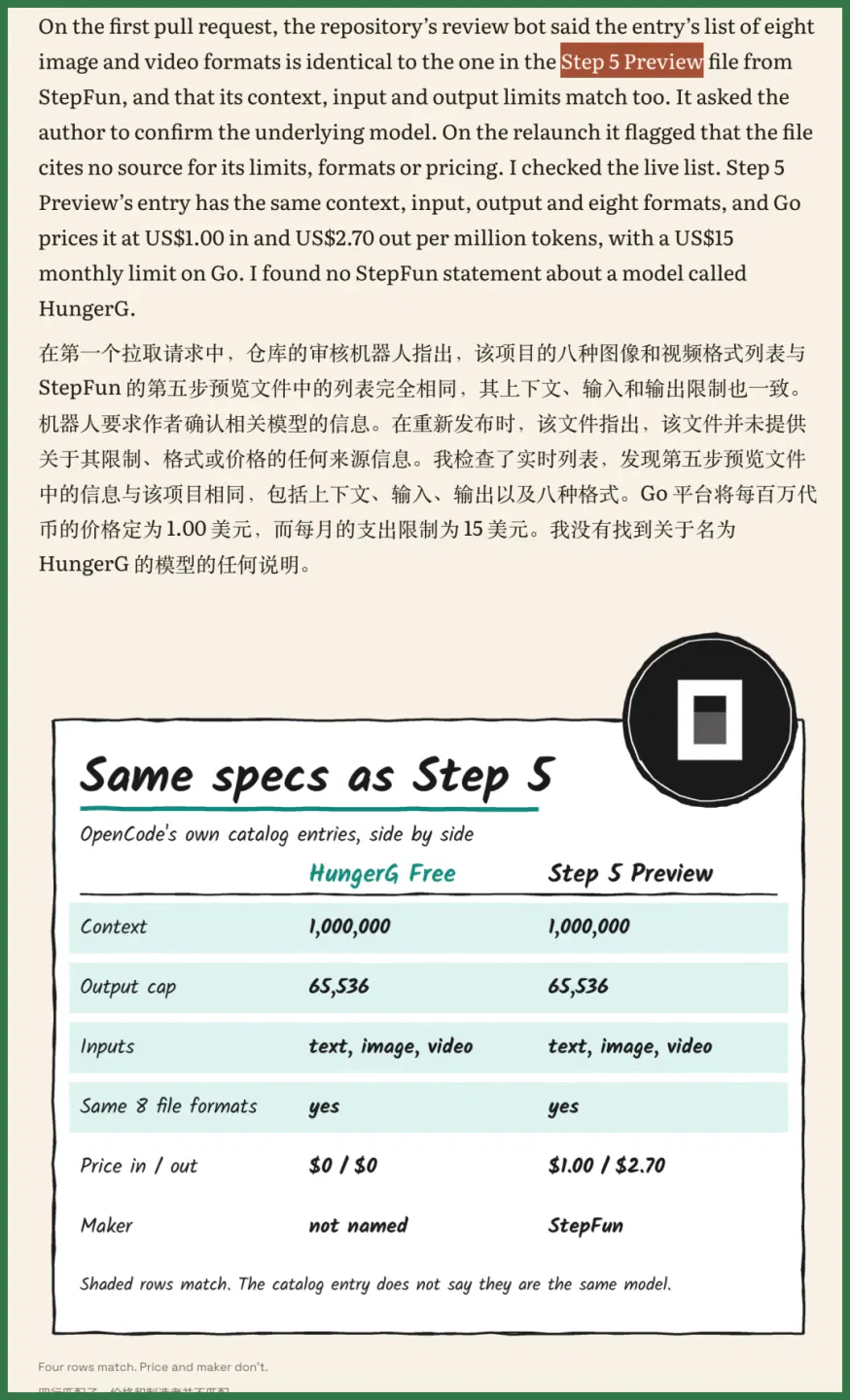
Of course, these remain conjectures. The final answer still awaits an official announcement.
🚥
The name HungerG readily brings to mind the classic film The Hunger Games.
The film tells the story of a teenage girl forced into a nationally televised contest to the death, surviving under brutal rules and ultimately trying to break them.
In a sense, the large-model industry is also experiencing a Hunger Games whose rules keep changing.
From parameter counts and training compute to benchmark rankings, inference costs and now the growing emphasis on agent capabilities, the standards for model competition have continually evolved.
As models take part in more real tasks, the focus of competition is shifting too: they need not only sufficiently powerful intelligence, but also the ability to turn it into practical results more efficiently.
That may be an important question for the next stage of competition among large models.

This article is from Crossing, by GaKi.
Related topics
After reading
Join the AINRK community
Read how to join the community and connect with people working in AI.
Related articles
Continue reading related topics and articles in this category.

Trying Anonymous Model HungerG: Music Videos, Browser Games, and Blender, with Its Maker Undisclosed (opens in a new tab)
Zhidongxi tests HungerG on music videos, browser games, Blender animation, and science videos, while noting physics errors in a developer demo. Its maker is undisclosed. OpenCode's third place was a token-usage snapshot, not a capability ranking; free access has eligibility and time limits.

Inside Peekie's Interactive Stories: Investigate a Virtual Phone and Chat with AI Characters (opens in a new tab)
Peekie offers two modes on fictional phones: Cases asks players to compare clues, while Lives allows free-text interaction with AI characters. The report also looks at the team's PopPark community and discusses agreeable characters, secrets revealed too soon, and choices about long-term memory.
How AI Is Changing Cyber Offense and Defense: Faster Discovery, but Cost and Process Still Slow Fixes (opens in a new tab)
LatePost interviews hackers and researchers on AI-assisted attacks and defense. Earnings and attack times remain interview claims; official disclosures qualify Binance and Fireworks timelines. Fixes still require human judgment and organizational support.

My Workflow Update: Magpie for Models, Cindy for Multiple Computers, T3 Code for Development (opens in a new tab)
The author revisits a workflow: Magpie brings together 7 channels and 23 models, Cindy links computers through group chats and remote desktop, and T3 Code handles development. Grok Bot and Alma are set aside; Orca stays. This does not mean every service works offline or all data stays local.

OpenAI Releases Nine Math Manuscripts on Matrix Multiplication and Strongly Polynomial Programming (opens in a new tab)
OpenAI added nine manuscripts in two families on November 24, claiming a 9/4 matrix multiplication exponent and strongly polynomial linear programming. Lean formalizes selected results; the repository treats the work as raw research data rather than completed academic review.