Trying Anonymous Model HungerG: Music Videos, Browser Games, and Blender, with Its Maker Undisclosed

Zhidongxi tests HungerG on music videos, browser games, Blender animation, and science videos, while noting physics errors in a developer demo. Its maker is undisclosed. OpenCode's third place was a token-usage snapshot, not a capability ranking; free access has eligibility and time limits.

Hands-on with HungerG: capable, but its identity remains a mystery.
Whose large model has quietly slipped out to do some work this time? One sentence, 12 minutes, and a city of Rome appears.
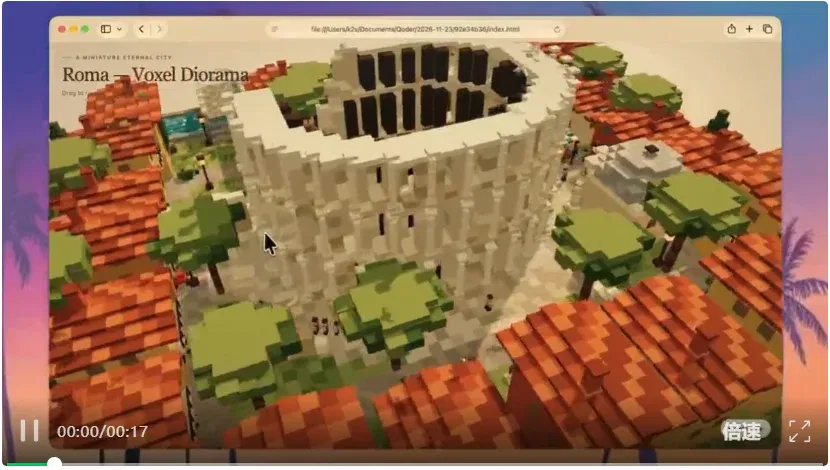
3D voxel-style Rome
It created the Colosseum, the Pantheon, the Trevi Fountain, and even little people strolling through the square.
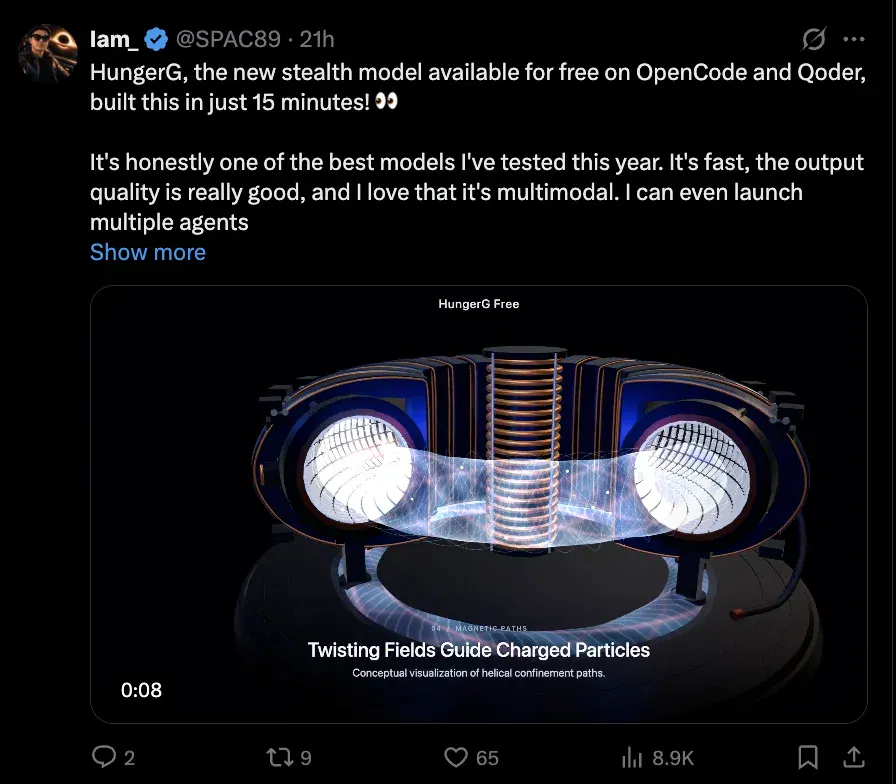
Then look at this: a 3D science animation of a controlled nuclear fusion device, made in 15 minutes.
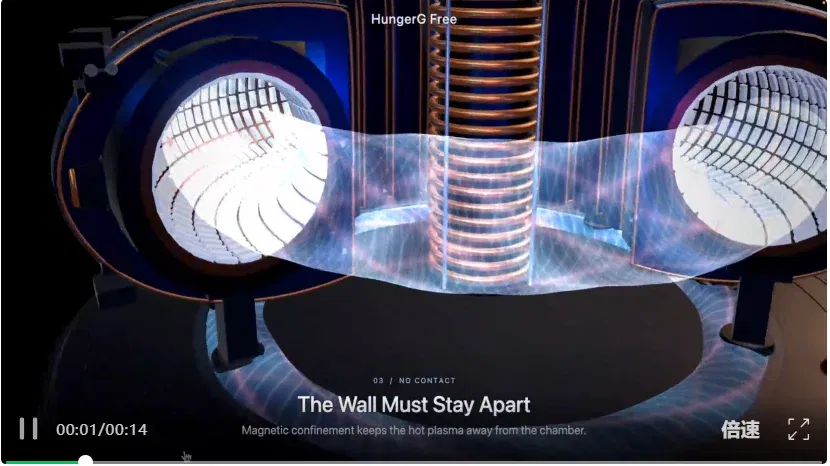
3D animation of a nuclear fusion device
The tokamak's internal structure, the process of magnetic fields confining charged particles, and the dynamic demonstration of deuterium-tritium fusion releasing energy all look convincingly rendered.
One developer's hands-on test suggested: the model's output is remarkably fast, sometimes even beating DeepSeek v4.1 flash.
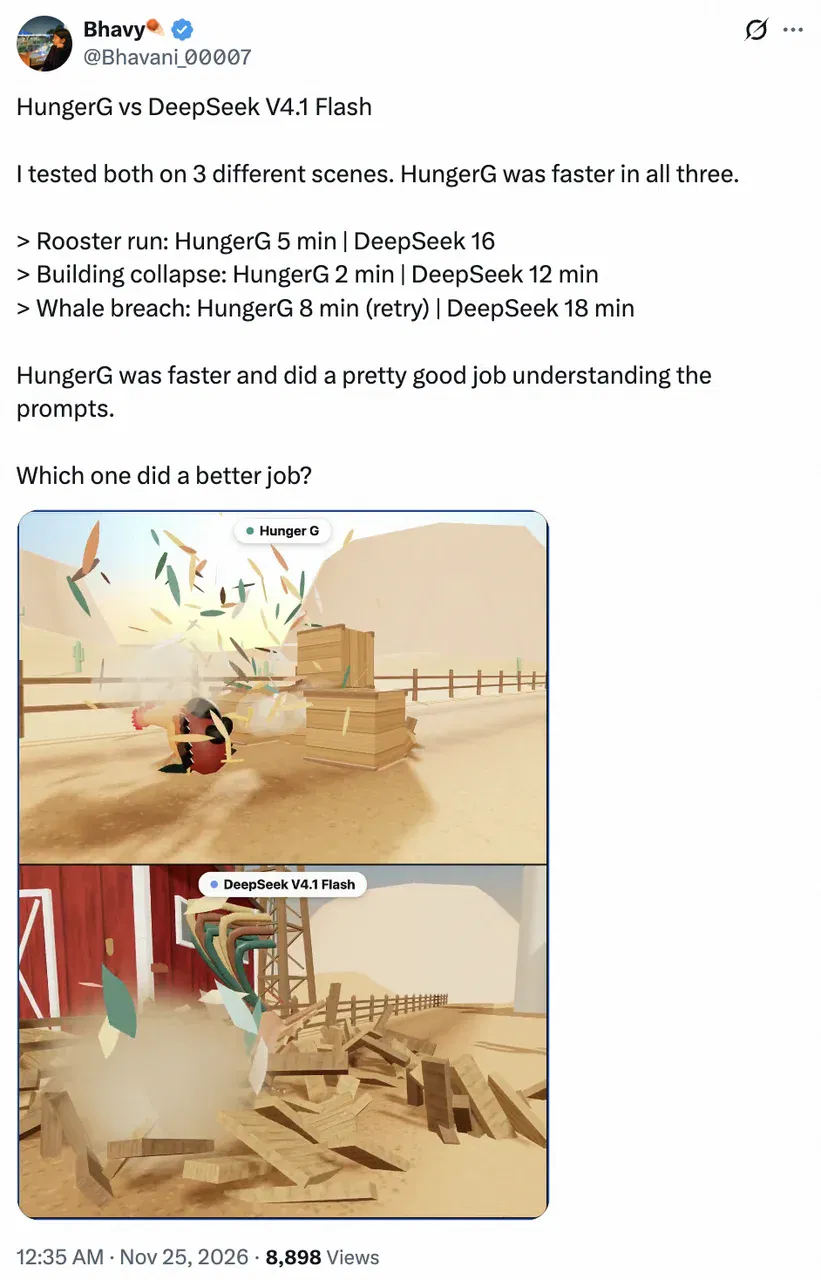
Others found through comparison tests that this anonymous model strikes a fairly good balance between output speed and quality.
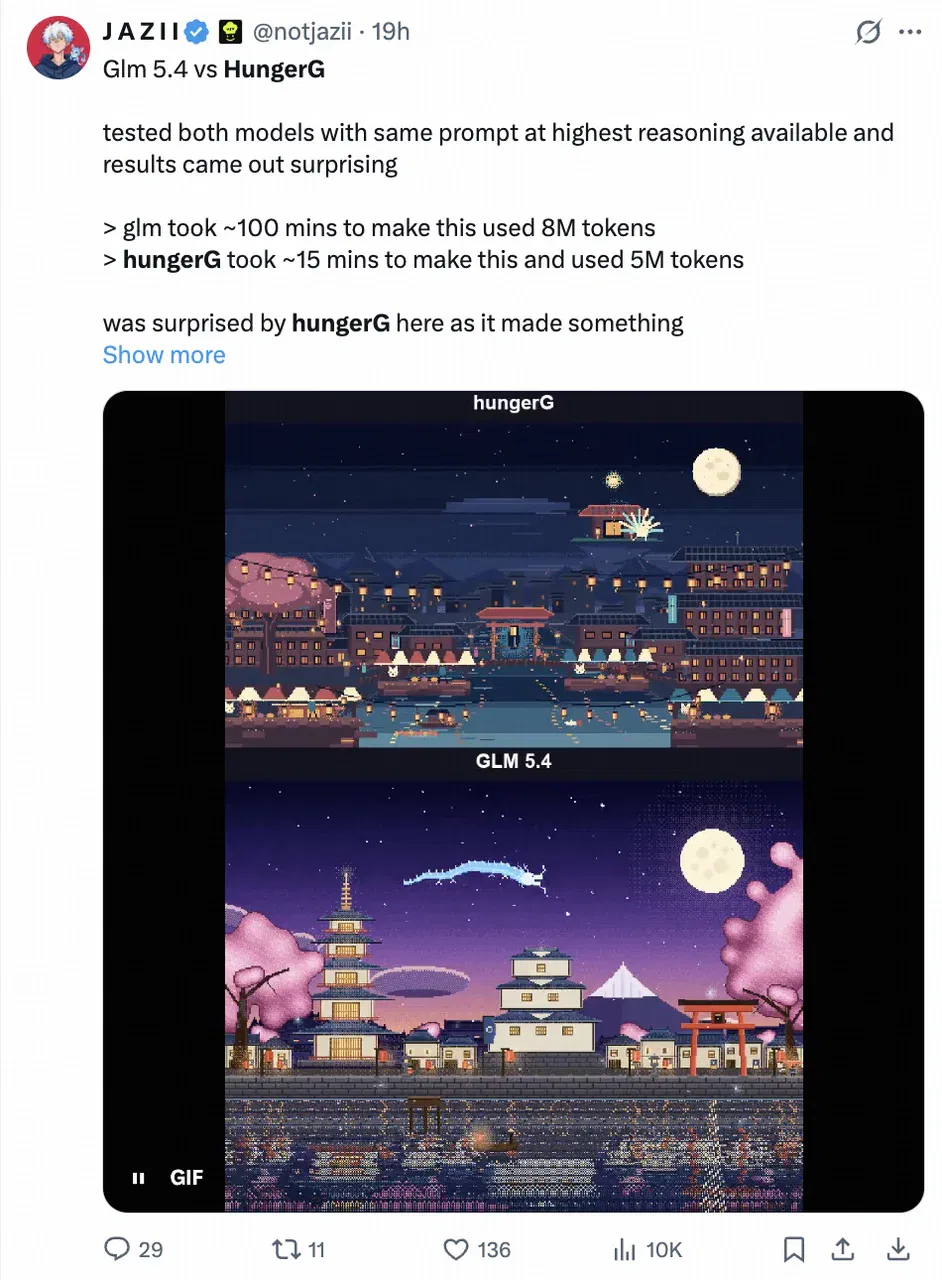
These examples all come from a newly surfaced anonymous large model: HungerG.
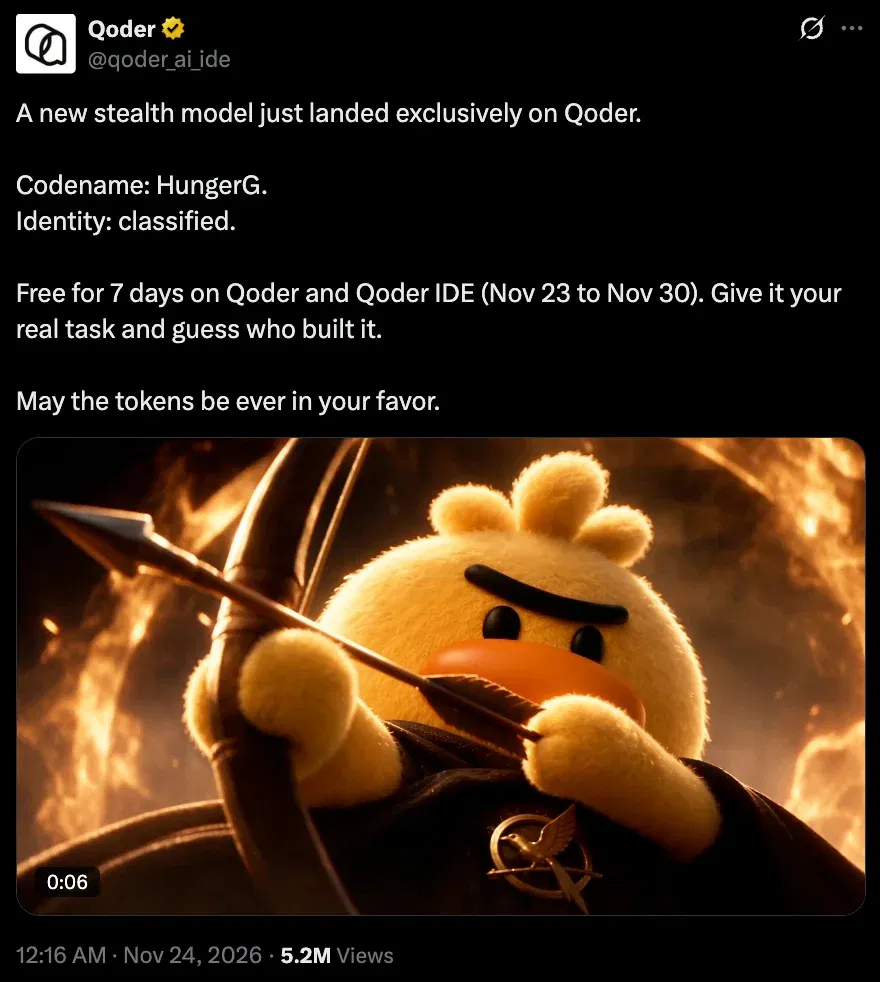
Zhidongxi reported on November 25 that an anonymous model codenamed HungerG had appeared on AI coding platforms OpenCode and Qoder in the early hours of the previous day, quickly attracting developers in China and abroad.
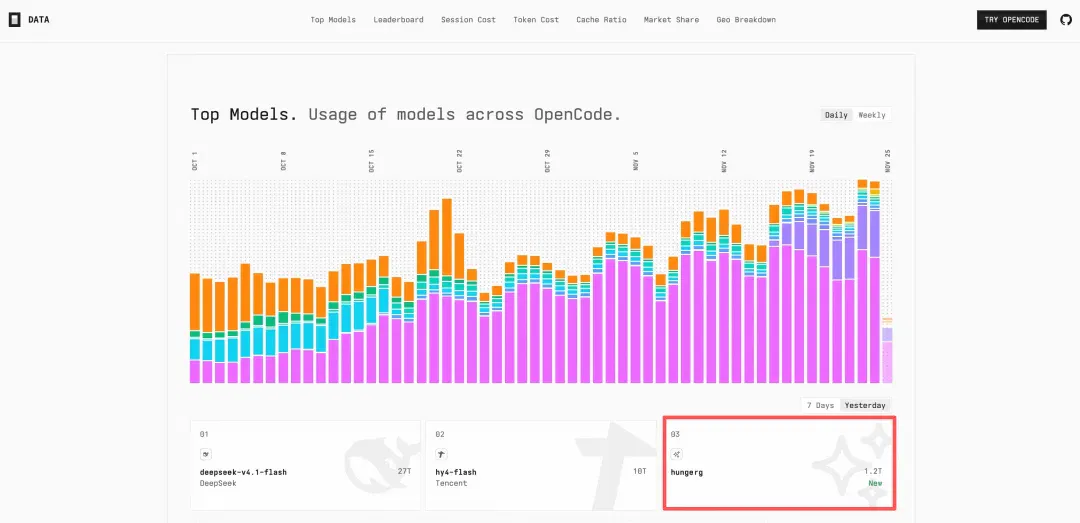
Just one day after launch, HungerG reached third place on OpenCode's daily model usage chart. At the time of the screenshot in the report, daily token usage reached 1.2 trillion, behind only DeepSeek V4.1 Flash and Tencent's Hunyuan Hy4 Flash. This is a daily usage chart, not a ranking from model capability evaluations.
Thinking about the name HungerG, it is easy to associate it with The Hunger Games. Qoder also adapted a famous line from the film, changing 'May the odds be ever in your favor' into 'May the tokens be ever in your favor.'
HungerG's specific parameters, technical architecture, and the company developing it have not been disclosed. According to information released by OpenCode, however, the model has a 1-million-token context window and supports multimodal input.
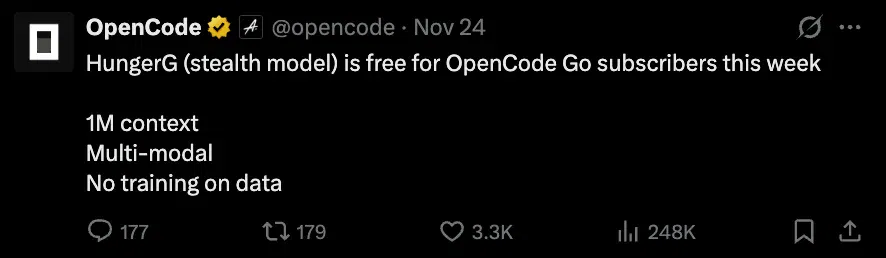
More importantly, it is currently free to use! Qoder's official promotion covers new and existing individual accounts on its International version, applies only to Qoder and Qoder IDE, and runs from 24:00 on November 23 to 24:00 on November 30, 2026 (UTC+8). Team and enterprise accounts and other clients are excluded. A daily fair-use limit applies, with higher limits and queue priority for paid users during peak periods. OpenCode Go subscribers can also use it free for the limited period described as 'this week' at the time of its announcement; the actual duration is subject to the platform's announcements.
After browsing overseas developers' hands-on examples, we could hardly wait to try it ourselves.
Our first impression, though, was: crowded, crowded, crowded! During daytime testing, we encountered congestion for a while. We took advantage of the late-night hours to run a few more tasks.
From making Jensen Huang a music video titled Xun Bu Luo, to recreating the childhood classic Papa's Burgeria with a single sentence, to directly controlling Blender to shoot 3D animation and making short science videos, this anonymous model really did bring us plenty of surprises.
01.
Building a 3D fusion device and dissecting a DC motor
Overseas developers are already experimenting
Many developers have already shared their HungerG test results on X.
The developer who made the fusion device animation in 15 minutes, shown at the start, also said HungerG is one of the best models he has tested this year, offering not only speed and high-quality output but multimodal capabilities too. He also mentioned that he could launch multiple agents to carry out tasks in parallel without noticing a significant slowdown.
Another developer gave HungerG a physics problem, asking it to use Three.js to create an interactive 3D cutaway animation of a DC motor, with everything packaged in a single HTML file.
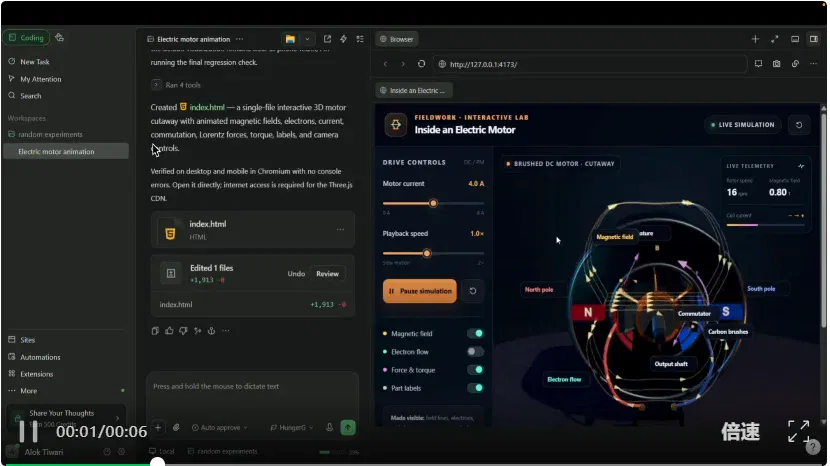
Interactive 3D animation of a DC motor
In the final result, HungerG created the motor's core internal components, including its armature, commutator, and brushes, and added animated effects such as magnetic field lines and sparks.
It also designed an interactive interface with a distinctly industrial style for the entire 3D scene. Users can adjust the motor current and animation speed, switch viewpoints, and check the motor's operating status through a real-time data panel.
For this kind of 3D visualization task involving specialist knowledge, HungerG performed well in presenting mechanical structures and designing interactions. However, the developer also noted physics errors in the animation's magnetic field lines and the direction of force on the coil. Its scientific accuracy still needs work.
These examples suggest HungerG has already shown good capabilities in 3D visual presentation, frontend interaction design, and efficient task execution.
But watching others experiment was not enough. We decided to get hands-on and give it several fairly demanding tasks.
02.
Making Jensen Huang a Xun Bu Luo music video
It even handles the memes and storyboards itself
First, take a look at a music video.

Jensen Huang's Xun Bu Luo music video
Yes, we made Jensen Huang the lead in a music video again. This time, we used Jolin Tsai's Ri Bu Luo, or The Sun Never Sets, as the background music and titled the video Xun Bu Luo, substituting the 'Xun' from Huang's Chinese name.
Unlike our earlier tests, this time we did not write a storyboard in advance or specify the visuals for each section of lyrics. We supplied only the audio, lyrics, and a creative direction built around the meme of 'Consort Xun returning to the palace,' leaving substantial creative room for HungerG.
Interestingly, HungerG first searched the web for Huang's background and recent developments, then decided to turn his experiences into a grand drama. From his early entrepreneurial years and the rise of GPUs and CUDA to recent stories about his resignation, petitions, and return, HungerG designed 16 scenes in one go and arranged 59 subtitle lines for the full video.
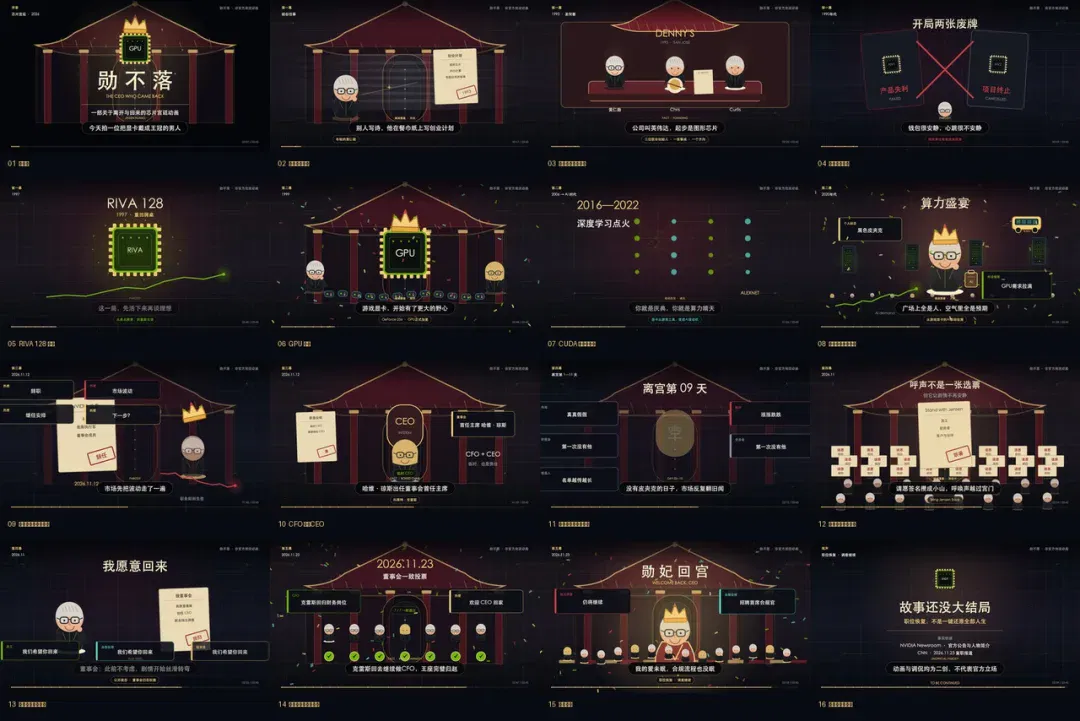
The cartoon-style Huang, palaces, chips, charts, and transition animations were all drawn with Canvas and SVG code written by HungerG. It then recorded the visuals using Playwright and called FFmpeg to combine the audio and video.
Looking closely, we could also see that HungerG designed varied animation styles for different sections. Characters, props, backgrounds, and transitions changed along with the music.
During production, HungerG proactively ran multiple rounds of checks, correcting issues one by one, including overlapping subtitles and scene labels and mismatches between parts of the story and the visual timeline.
Although a few scenes still felt like AI forcing a meme, its ability to independently complete the entire process, from research, creative development, storyboarding, and animation programming to video recording and audiovisual assembly, without a detailed script supplied by a human still exceeded our expectations.
With almost no human intervention throughout the process, HungerG ran through the full production workflow from creative concept to finished video in one go.
03.
Recreating Papa's Burgeria in one sentence:
Playable, fun, and a trip back to childhood
The next example may have been one of the more surprising results in this test. Remember playing Papa's Burgeria on 4399 as a child?
This time, we simply asked HungerG to recreate a browser version of Papa's Burgeria to see what it could produce.
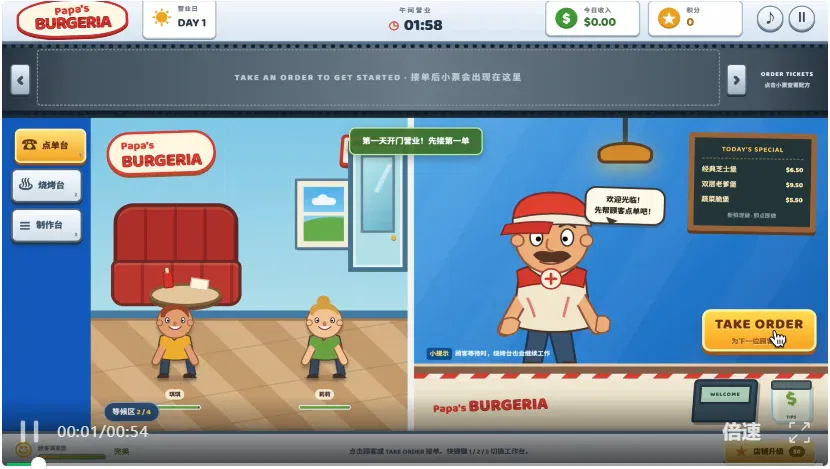
And we really did open a burger restaurant in the browser. HungerG reproduced most of the original game's core mechanics, from welcoming customers and recording orders to cooking beef patties, choosing ingredients, and assembling burgers.
Playing it, switching between the three workstations, flipping patties, and assembling burgers layer by layer to match orders all felt quite close to the original. Even the rating and tipping systems were retained.
With the familiar workflow and a broadly similar interface, playing it really did feel like returning to childhood.
We had previously tested many large models' ability to develop browser games. Some could create very attractive game interfaces, but when actually played, the gameplay was often heavily simplified. This time, HungerG not only reproduced the game's basic visual style but also retained a substantial number of its core mechanics.
Of course, some interaction details still have room for improvement. But remember that we did not list these mechanics individually in the prompt, and the whole game was completed from a single round of prompting. For a one-shot-generated game, this level of completeness is already quite good.
04.
Controlling Blender directly
To film a cinematic pelican riding a bicycle
Since HungerG performed well at making frontend 3D scenes, what about directly using professional 3D modeling software?
Time for the classic test: a pelican riding a bicycle!
This time, however, we asked HungerG to use the Blender Python API, bpy, directly for 3D modeling, animation, camera direction, and video rendering of the cycling pelican. We also made the classic test a little harder, asking it to act like an animated film director and create a 3D animation with a complete sequence of shots.
How did it turn out? Here is the video.
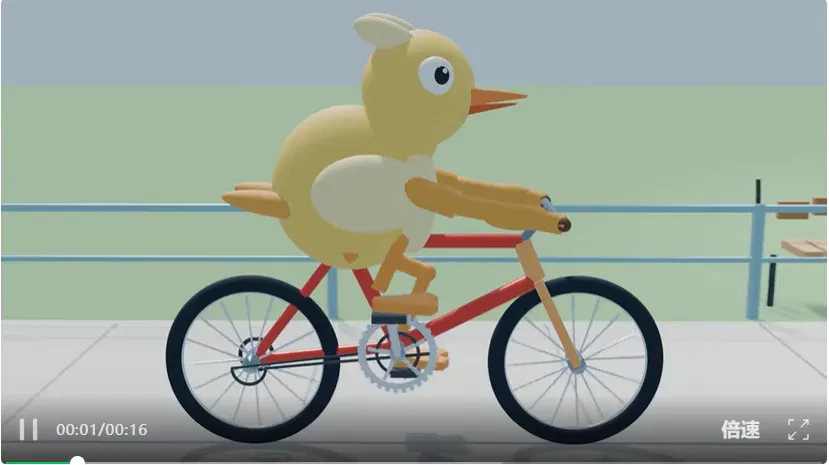
A pelican riding a bicycle in Blender
The final result suggested that HungerG understood the cycling-pelican scene quite well. It handled the pelican's appearance, its posture while riding, and the movement relationship between its webbed feet and the pedals fairly naturally.
In close-up shots of the chainring and pedals, we could clearly see the pelican's feet pedaling alternately.
Throughout the process, HungerG also used Blender smoothly, moving through character modeling, building the mechanical structure, rigging movement, directing cameras, and rendering video in one continuous flow. It showed good spatial understanding and control of professional tools.
This example also revealed HungerG's potential in tool use, 3D visual presentation, and executing multistep tasks.
05.
It can even make science videos
Giving the Riemann Hypothesis a familiar science-video soundtrack
Have you heard that familiar little science-video tune while scrolling through short videos lately? Sometimes, as soon as the background music starts, we know it is time to learn something new.
These science videos often feature an engaging spoken explanation, with scientific concepts gradually made more intuitive through graphics, text, and animation.
We were curious too: how far could HungerG go if asked to make an AI science video like this?
As it happened, a major development in mathematics had drawn attention in recent days: a Lean formal proof completed jointly by Levent Alpöge and Claude. A November 21 joint statement by Lean FRO and mathlib maintainers confirmed the correctness of the original Riemann Hypothesis statement and proof. The generalized Riemann hypothesis conclusions listed on MIT's verification page are limited to Dirichlet L-functions and do not cover general Hecke, Dedekind, or automorphic L-functions. What we are making here is an explanatory science video; its visual appeal cannot substitute for checking its mathematical content.
So we asked HungerG to make a science video about the Riemann Hypothesis with narration, subtitles, and visual animation.

Riemann Hypothesis explanatory video
Honestly, on the first viewing it really did feel rather like encountering an AI science video on a short-video platform. The voice sounded fairly natural, the explanation flowed smoothly, and text, graphics, and animated effects continued changing as the narration progressed.
Particularly with abstract mathematical concepts such as the Riemann Hypothesis, turning a written explanation into intuitive visuals is itself a real test of a model's understanding and animation design. Judging by the production format and viewing experience, HungerG is worth trying for users who need to make science videos.
06.
Conclusion: another anonymous model emerges
But whose is it?
After this round of hands-on testing, what impressed us most about HungerG was its ability to deliver fairly complete work without being constrained by detailed instructions.
For music videos, it could research, develop ideas, and design storyboards itself. For games, it proactively filled in multiple core mechanics. In Blender, it went from modeling all the way to video rendering. For science videos, it took care of narration, subtitles, and animated effects too.
Rather than simply seeking a spectacular individual image, we increasingly value whether a model can connect multiple steps and turn a relatively vague request into a finished product that can actually be used and run. HungerG deserves credit for its performance in this respect.
Which brings us to the question: who is behind this anonymous model that has suddenly appeared? Its 1-million-token context, multimodal capabilities, complex coding tasks, and long-horizon tool use have drawn our attention to several Chinese companies iterating on flagship models. Some say Qwen; others say StepFun.
Until the developer formally reveals the answer, though, we can set the identity puzzle aside.
After all, HungerG is still in its free trial period. If you have a project you have wanted to do but never found time for, you could try handing it over during these next few days.
As for how high its capabilities will reach after its formal unveiling, and what surprises pricing may bring, we will wait and see.
This article is from Zhidongxi, by Jiang Yu.
Related topics
After reading
Join the AINRK community
Read how to join the community and connect with people working in AI.
Related articles
Continue reading related topics and articles in this category.

HungerG offers limited free access; Crossing tests 3D and game development and investigates its origins (opens in a new tab)
Crossing uses HungerG in Qoder for a Sphere display, Blender scenes and a roguelike browser game, and examines community examples and tokenizer clues. Qoder's free offer covers international individual accounts; results are case-specific and the model's maker remains unconfirmed.

Shang Jin open-sources MiuLifeBench Lite: simulated agent evaluation across 23 Chinese everyday scenarios (opens in a new tab)
Offloop founder Shang Jin introduces MiuLifeBench Lite: 23 tasks, 19 simulated apps and 236 interfaces testing information gathering, decisions and user confirmation. His three-round results depend on tools, model settings and judges; they do not rank real-world app operation or the whole industry.

An Invited Look at Doubao's Xiaodou: Memory, Proactive Reminders and Cross-App Tasks (opens in a new tab)
Crossing shares an invited trial of Xiaodou, covering health-data summaries, recommendations, follow-ups, hotel searches, phone calls and Douyin–Feishu workflows. The product remains exploratory and invitation-only; data access and actions depend on authorization and available features.
Are GPUs Always Faster at Vector Search? A DGX Spark Test (opens in a new tab)
Zilliz tests four indexes on DGX Spark using one million 768-dimensional vectors. At about 99.3% recall, single-query CPU HNSW latency was 6.6 ms versus GPU CAGRA's 7.9 ms; GPU brute force led throughput at batch size 256. Results depend on the stated configuration.

Author tries GLM-5.4 on a 3D hotpot restaurant and a 9,942-entry legacy archive redesign (opens in a new tab)
Using Pi Agent, the author tests a 450 m² 3D restaurant, minigames and a 9,942-entry legacy project, checking layouts, local API timings and 49 request scenarios. These examples do not establish a general ranking or isolate the loop architecture’s contribution.