OpenAI Releases Nine Math Manuscripts on Matrix Multiplication and Strongly Polynomial Programming
OpenAI added nine manuscripts in two families on November 24, claiming a 9/4 matrix multiplication exponent and strongly polynomial linear programming. Lean formalizes selected results; the repository treats the work as raw research data rather than completed academic review.
On November 24, OpenAI's official repository added nine research manuscripts in two families. The mathematical results below are, first and foremost, claims made in those manuscripts. The repository explicitly presents the materials as raw research data, with verification progressing differently for different results, and provides Lean formalizations of selected results from each manuscript. This does not mean all conclusions have completed independent academic validation. The distinction between VP and VNP belongs to algebraic complexity; it cannot be directly equated with the general P versus NP problem or used to infer the security of all cryptography. Nor do asymptotic complexity results amount to measured gains on current hardware and training systems. Official positioning of the materials (opens in a new tab), Addition history and scope of formalization (opens in a new tab).
In 1979, Douglas Adams wrote about a supercomputer called Deep Thought in The Hitchhiker's Guide to the Galaxy.
It spent a full 7.5 million years calculating the ultimate answer to life, the universe, and everything, and finally produced the number 42.
And just now, OpenAI has announced the exponent of matrix multiplication: 9/4!
The answer is as crisp as 42, though it is not the 2 that humans have hoped for over more than half a century.
A model that lives on matrix multiplication has itself worked out how fast matrix multiplication can possibly get. How extraordinary is that?
After the paper, MIT complexity theorist Ryan Williams remarked with deep feeling: 'It looks like Strassen was right: the exponent of matrix multiplication really is exactly 2.25.'

And that is not all: OpenAI has just cracked eight monumental, long-standing mysteries!
In its official GitHub repository, openai/math, it uploaded nine AI-generated papers.
Grouped into two research families, they sweep away eight of the most intractable open problems in mathematics and theoretical computer science:
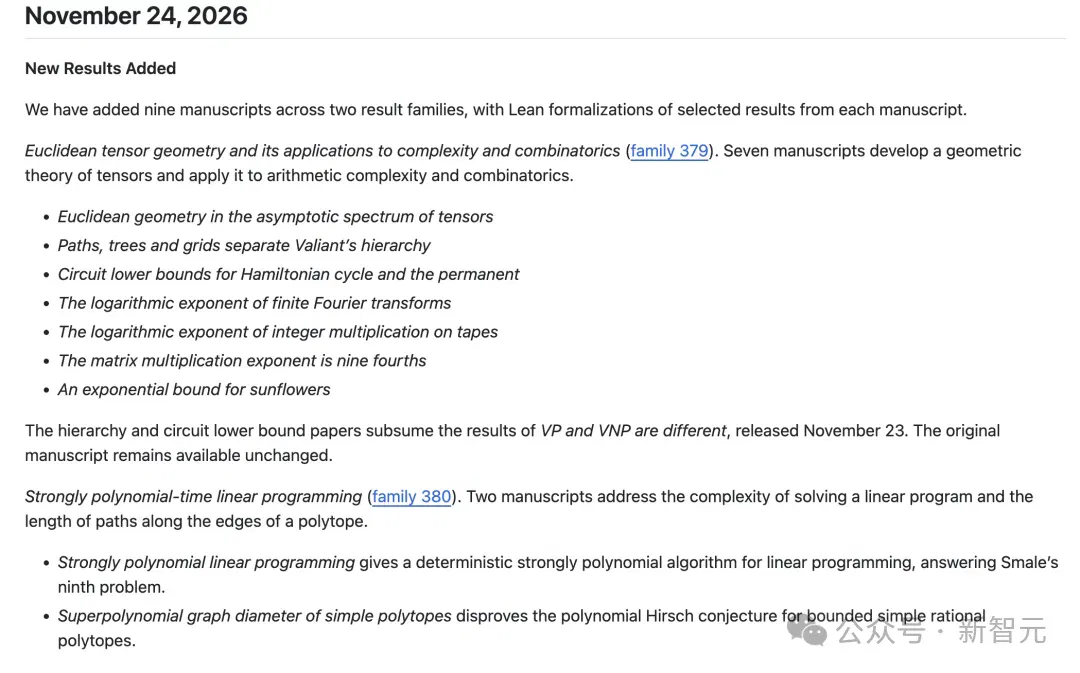
The limit of matrix multiplication, a puzzle for 57 years, has been pinned down exactly; Smale's ninth problem has been fully answered; the sunflower conjecture has reached its endgame...
OpenAI also released Lean formal proofs at the same time.
Mathematical research has entered a new phase: three companies handed in their work within 37 hours, with Claude's VP≠VNP yesterday, followed by OpenAI's nine papers and Google's six.
Previously, reviewers and journals decided whether a proof counted. Now machines submit proofs together with Lean formalizations, though the public Lean formalizations cover only selected results. The papers go directly onto GitHub, and reviewers become inspectors accepting the work.
What did the nine papers solve?
The update list clearly divides the nine papers into two camps. Each corresponds to ultimate truths that humanity has pursued for more than half a century.
Tensor geometry and computational complexity (Family 379)
This family contains seven manuscripts:
Euclidean Geometry in the Asymptotic Spectrum of Tensors
Paths, Trees, and Grids Separate the Valiant Hierarchy (VP≠VNP)
Circuit Lower Bounds for Hamiltonian Cycles and the Permanent
The Logarithmic Exponent of the Finite Fourier Transform
The Logarithmic Exponent of Integer Multiplication on Tapes
The Matrix Multiplication Exponent Is Nine Fourths
Exponential Bounds for Sunflowers
AI has built an entirely new theory and wielded it against multiple long-standing problems in arithmetic complexity and combinatorics.
In the first paper, Euclidean Geometry in the Asymptotic Spectrum of Tensors, AI is not solving a particular problem. It creates a new measuring stick from scratch.
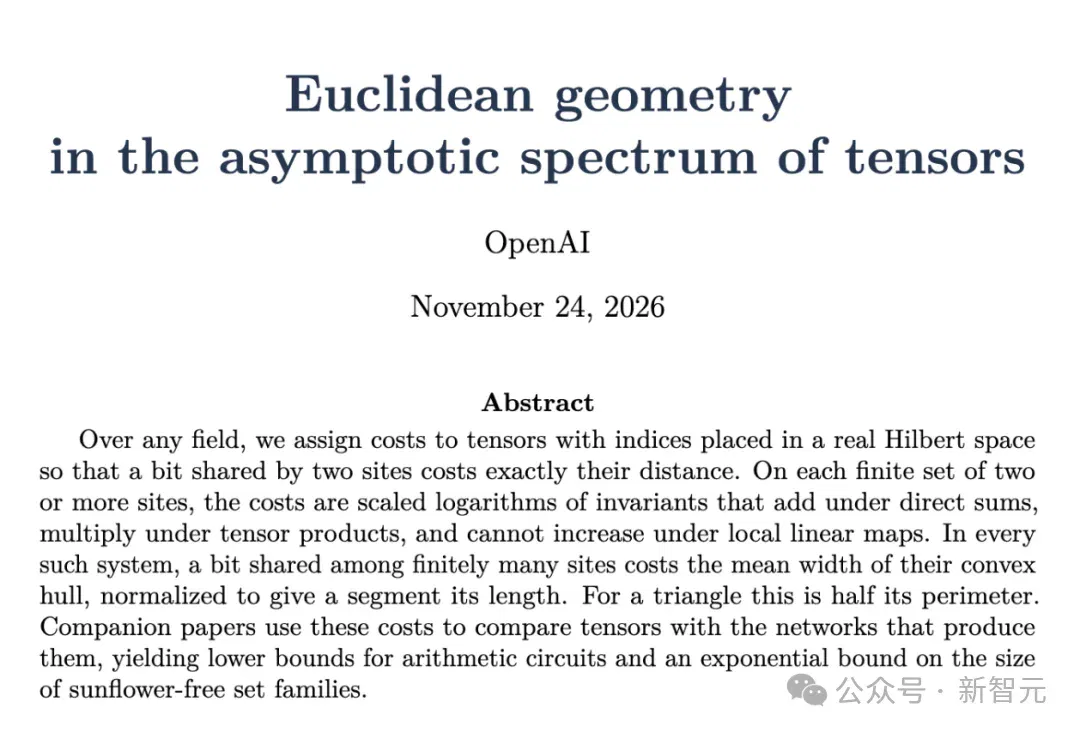
It places abstract tensor indices from algebra into space as geometric points.
When two points share a bit, the computational cost is exactly the distance between them; when three points share a bit, the cost is half the triangle's perimeter.
With the measuring stick made, the remaining six papers use it to measure several foundations of modern computer science: matrix multiplication, the fast Fourier transform, integer multiplication, Hamiltonian cycles, and more.
Measuring them one by one, they identify the ceiling on how fast computers can calculate.

The most explosive result is the end of the 57-year marathon over matrix multiplication!
Matrix multiplication is one of the deepest foundations of modern computing. It underlies the training and inference of all large models.
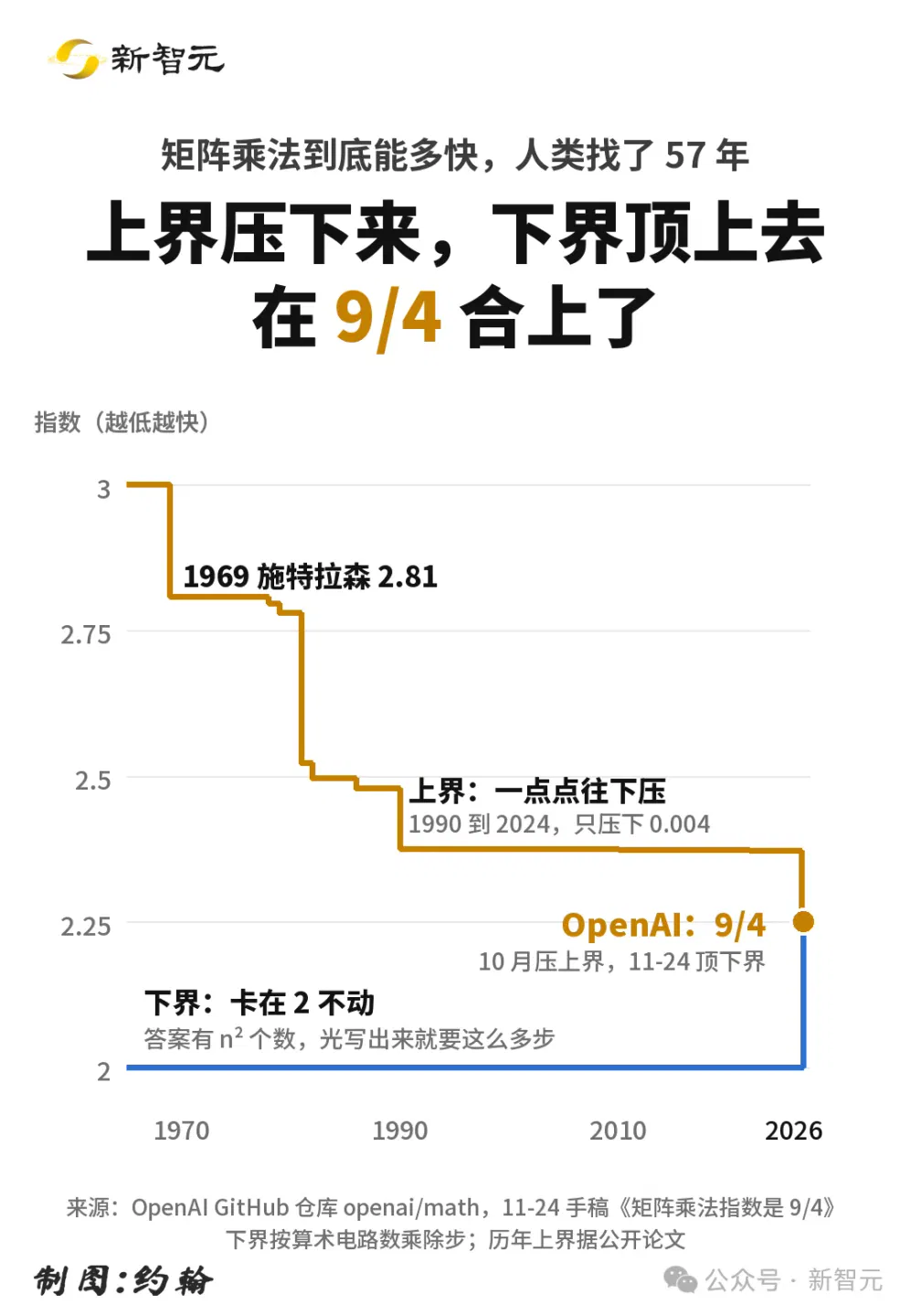
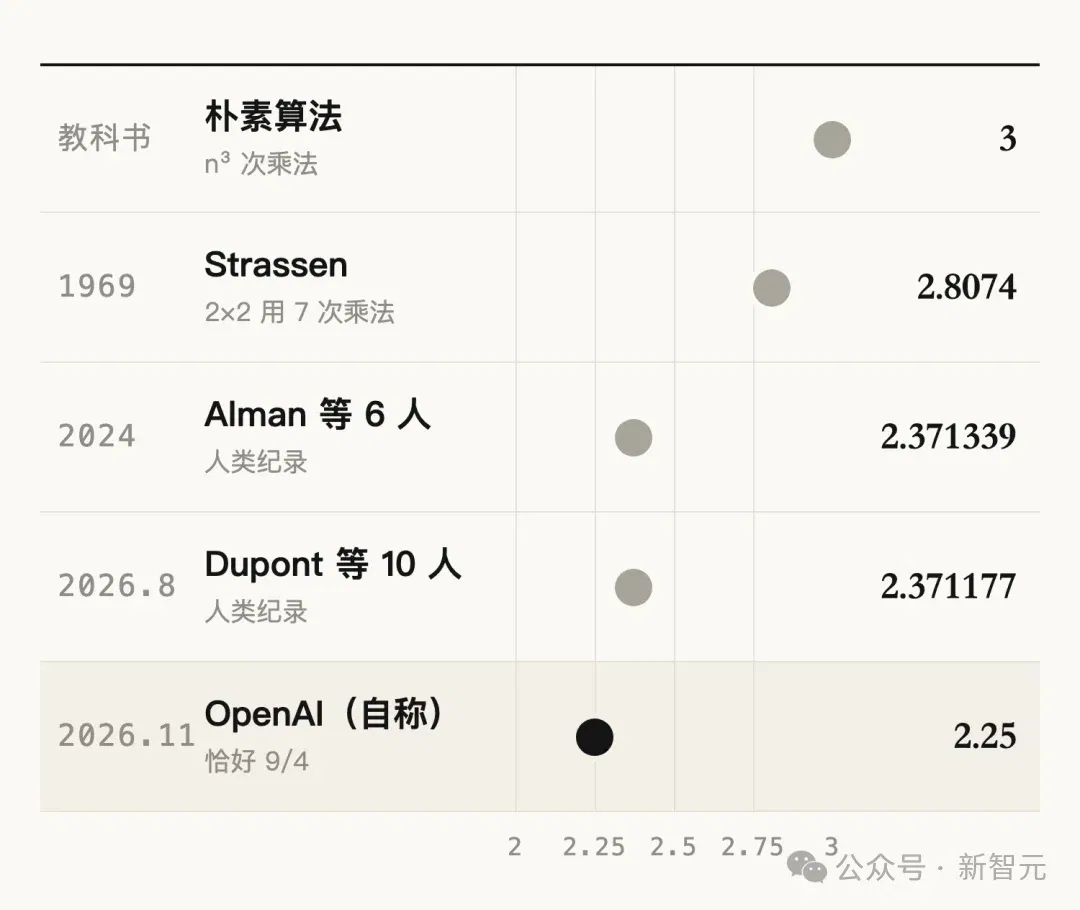
Using the naive textbook algorithm, multiplying two n×n square matrices requires n³ multiplications. The operation-count exponent is therefore 3.
For a long time, everyone thought n³ could not be improved.
Then, in 1969, German mathematician Volker Strassen discovered that multiplying two 2×2 matrices did not need eight multiplications: seven were enough.
He reduced matrix multiplication's operation count in one stroke to O(n^2.807), with an exponent of approximately 2.8074.
From that day, mathematical talents around the world began a contest lasting more than half a century to squeeze out incremental improvements. Since the output itself contains n² entries, an algorithm must at least read or write those numbers. Thus, ω=2 is the absolute theoretical lower bound.
Humanity kept hoping: could w be pushed all the way down to 2?
Reality was harsh. For decades, successive generations of mathematicians poured their efforts into breakthroughs that could only shave a few more digits off after the decimal point.
In 2024, the record reached 2.371339; this August, it was pushed just a little further to 2.371177. In a full 57 years, humanity had barely confined the range to between 2 and 2.371177.
Today, OpenAI's model has delivered a definitive verdict: the endpoint is not 2 but 9/4, or 2.25, and it cannot go any lower!
Interestingly, this 2.25 is assembled from two halves.
The upper-bound half was proved by OpenAI this October over the complex numbers. Human mathematicians, including Houxi Lü and Amanov, then took up the work and extended it to every field.

Using proof by contradiction, the authors show that anything faster would violate known mathematical limits, so the existing solution has reached the universe's ultimate limit. A mystery lasting more than half a century has thus come to a close.
If matrix multiplication turned out a little slower than humans hoped, the answers for two other fundamental computations went in the opposite direction: they are faster than what the textbooks teach!
The fast Fourier transform, or FFT, introduced by Cooley and Tukey in 1965, is the lifeblood of signal processing and communications. Every algorithms textbook says it requires on the order of N⋅log N operations.
And in 2019, mathematicians had only just brought multiplication of two n-digit integers down to n⋅log n. Many thought that was the floor.
Yet in the new papers, AI simply takes the square root of the logarithm.

Thus, when the data size N is one million, log N is about 20, but the resulting square root is less than 5, theoretically saving a substantial amount of computation.
In addition, in another set of papers, AI has cracked algebra's version of P versus NP, proving that VP and VNP in the Valiant hierarchy are strictly different.
You could say AI has issued an unbreakable decree in the mathematical universe: some cryptographic schemes and complex problems can never be cracked quickly with simple computation, even if you calculate until the universe ends!
Along the way, AI also wrapped up the sunflower conjecture in combinatorics.
In 1960, the great mathematicians Erdős and Rado proposed that once a family of sets exceeds an exponential threshold in size, it must contain a sunflower-like structure: a common core in the middle, surrounded by petals that do not overlap with one another.
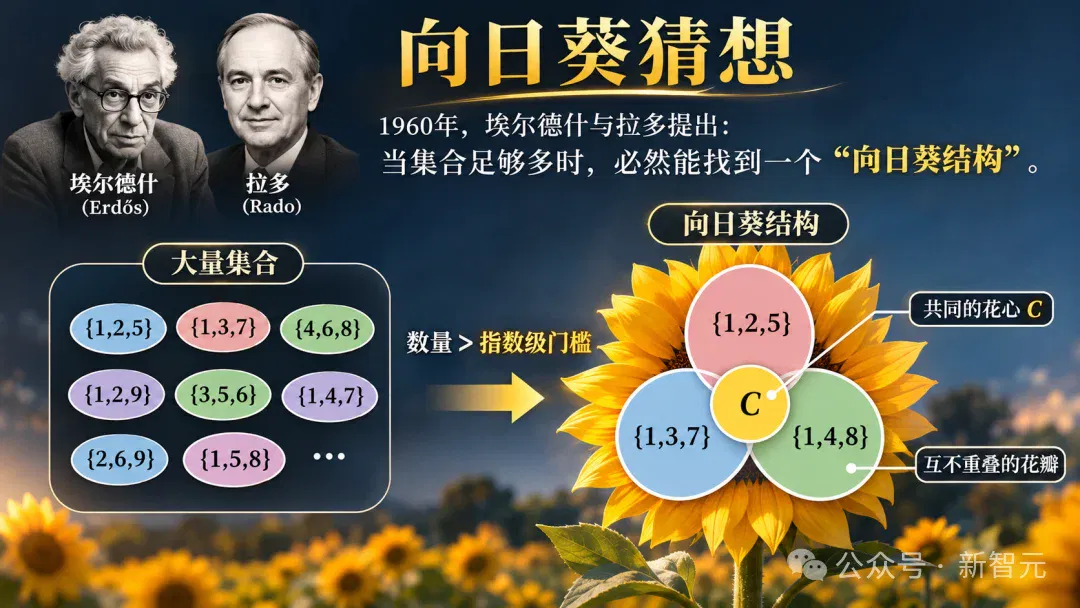
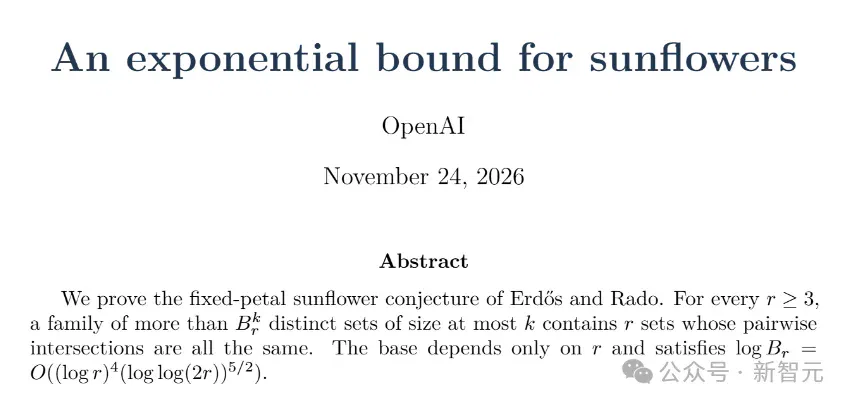
As recently as November 12, half a month ago, the conjecture was still marked unsolved on the list. Today, for a fixed number of petals, AI has finished the proof: their conjecture was right.
Within sufficiently vast disorder, order must emerge.
Another route is completely blocked
If the first seven papers determine computers' fate, the other two, Family 380, target operations research and optimization, among the most valuable areas in the real world.
How can delivery trucks use the least fuel? How can food delivery platforms dispatch orders fastest? In mathematical terms, these are all called linear programming.
In 1947, Dantzig invented the famous simplex method.
Imagine all feasible solutions as a diamond, a polyhedron. The algorithm starts at a vertex and moves step by step along its edges until it reaches the optimal vertex.
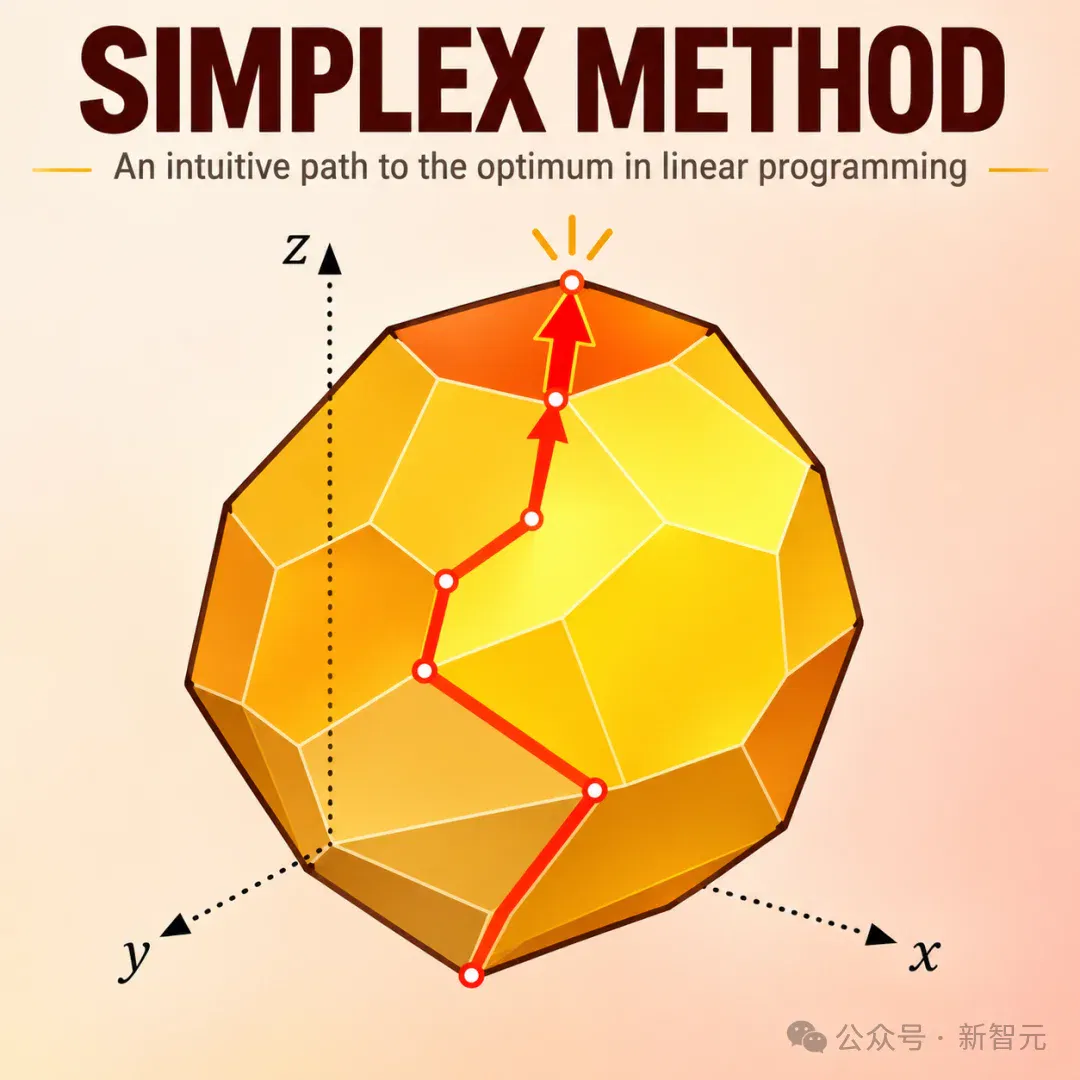
People later discovered that although linear programming can be solved, the number of computational steps often increases with the number of digits in the input numbers.
In 1998, Fields Medalist Smale listed 18 major problems for the 21st century.
The ninth asked: is there a super algorithm whose time to find the optimal solution depends only on how many variables the problem has, entirely regardless of how large its numbers are?
Today, in Strongly Polynomial Linear Programming, AI has given a resounding answer: yes!
Not only does such an algorithm exist, it is deterministic and allows arbitrary real coefficients. Along with it, convex quadratic programming and deterministic mean-payoff games have also been brought into strongly polynomial time.
This means that, in theory, however extreme the financial or supply chain data, a computer can provide a perfect answer within an absolutely controlled amount of time.
But immediately afterward, another paper poured cold water on the excitement.
AI went back and measured the old simplex-method route. It constructed a class of polyhedra with n facets, then proved that in these high-dimensional mazes, the maximum distance between two vertices when traveling along edges grows longer than any fixed power of n.
The polynomial Hirsch conjecture, which had troubled humanity for decades, was thereby disproved.
The two papers seem to perform a double act: the first says, 'You can definitely get to the summit quickly,' and the second immediately adds, 'But the old path will not get you there.'
Linear programming can be solved quickly; it just cannot use the traditional simplex-method approach anymore.
Do not celebrate too soon: your GPU will not get faster
Looking at these nine papers today, many people may already be alarmed: if matrix multiplication's limit has fallen to 2.25 and FFT is faster too, does that mean GPUs will double in performance tomorrow? Will large-model training costs collapse?
If that is what you think, you are celebrating too soon.
First, we need to consider galactic algorithms.

The reality is stark. Although 9/4 is the theoretical floor, in practical engineering the hidden constant C in the constructions used in AI's proofs is often unimaginably large, potentially exceeding the total number of atoms in the universe.
In other words, this exponent-2.25 algorithm would become faster only when the matrices were large enough to hold an entire galaxy.
Consequently, neither PyTorch on your laptop nor an H100 cluster will speed up by even 0.1 seconds.
Second, Lean covers only some conclusions from the nine papers OpenAI released this time.
And none of these nine manuscripts has yet undergone peer review.
Remember that only last month, on October 7, OpenAI withdrew three papers because of a sign error.
OpenAI itself also states candidly in the repository that these manuscripts are best treated as raw research data, and that the mathematics community should entirely determine attribution and priority.
The mathematicians who set the questions are starting to read them to AI
Previously, the questions were set by Strassen, Cooley and Tukey, Smale, and generations of great human mathematicians. They identified the important hard problems, and talents around the world began squeezing out incremental progress.
Now, superintelligence is beginning to decide which questions matter.
In 2000, Ted Chiang portrayed this future in The Evolution of Human Science: 'Those who remain in the field will shift their attention from original research to hermeneutics: interpreting posthuman scientific work.'
More than twenty years later, those words have come true, almost to the letter.
Perhaps in the next era, as the cost of finding answers approaches zero, humans will need to preserve the ability to ask truly good questions.
At the end of the story, Ted Chiang left a gentle reassurance: 'We need not feel threatened by the achievements of posthuman science.'
References:
https://github.com/openai/math/blob/main/history.md
https://proofatlas.ai/open-problems/
This article is from Xinzhiyuan, by Aeneas and David.
Related topics
After reading
Join the AINRK community
Read how to join the community and connect with people working in AI.
Related articles
Continue reading related topics and articles in this category.
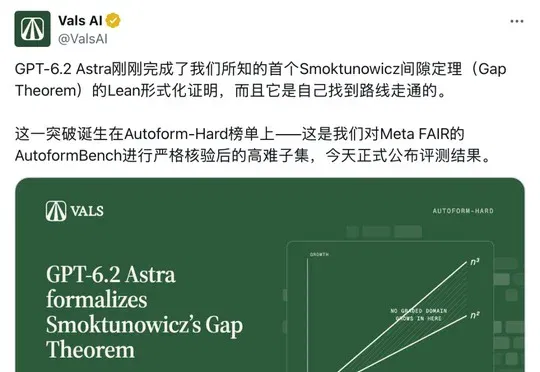
Vals AI: Astra formalizes the established Smoktunowicz gap theorem in 94 minutes (opens in a new tab)
Vals AI reports that GPT-6.2 Astra formalized Smoktunowicz’s established theorem in 1,794 lines of Lean during Autoform-Hard. Part of its argument differs from the 2006 proof, but the route’s relationship to prior literature still needs further checking.

OpenAI Reportedly Developing Athena to Help Agents Understand Business Metrics (opens in a new tab)
The Information reports that OpenAI is developing Athena, a semantic-layer-like platform for business rules and metrics. It remains at an early stage, with no announced release date or pricing; accuracy gains and competitive effects are goals and analysis rather than verified product results.
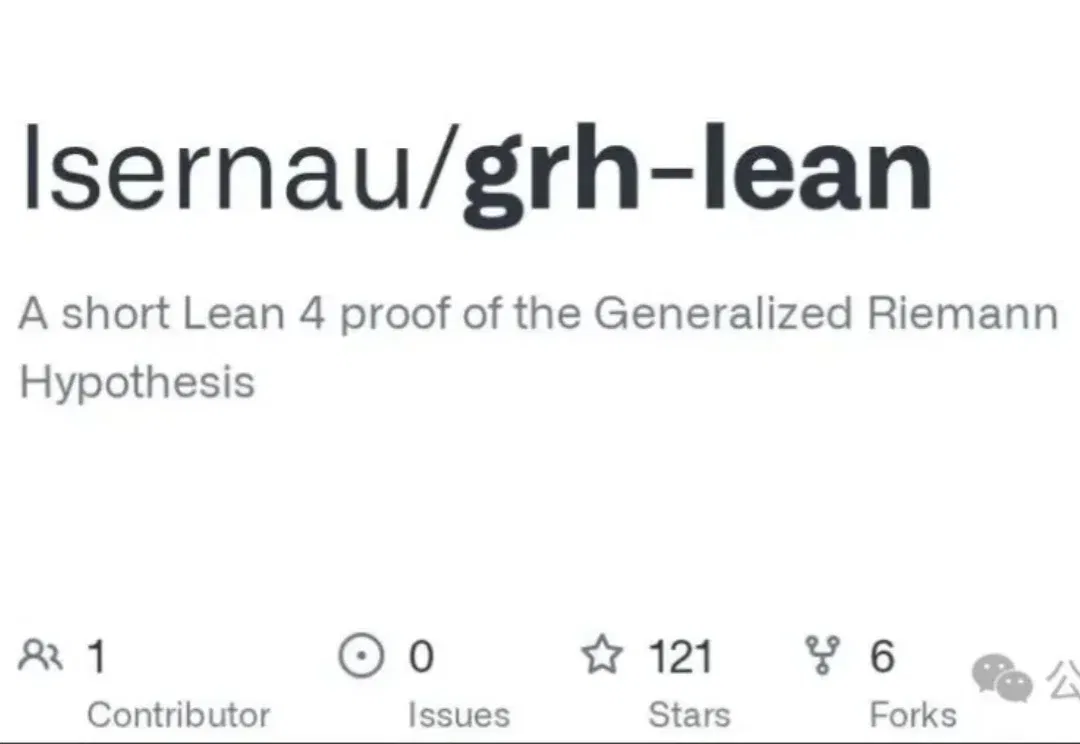
Riemann Hypothesis Lean Proof Rewritten, with a Compact Version of About 76,000 Code Lines (opens in a new tab)
Sernau, colleagues, and Claude released a Lean rewrite using Alpöge's method: 300,000 readable or 76,000 compact code lines. Authors report machine checks but no full human reading or paper. Code reduction is not new mathematical validation; GRH covers only Dirichlet L-functions.

Codex corrects GPT-6.2 usage accounting; some requests will reach limits sooner (opens in a new tab)
Reporting cites Tibo saying some Codex requests were undercounted at GPT-6.2's launch. A fix means Astra and Sol will reach limits sooner, with a discretionary reset offered. This should be distinguished from ChatGPT chat limits and API pricing; marketing motives remain speculation.
GPT-6.2 Sol rolls out to Chat; report says some GPT-5.6 access will end in December (opens in a new tab)
OpenAI's release notes confirm that chat-optimized GPT-6.2 Sol began rolling out to paid plans on November 23. Citing official X posts, the report says some GPT-5.6 models in Chat, Work and Codex will retire on December 23; this does not establish a simultaneous API shutdown.