Will AI domesticate us as humans domesticated dogs?
Deng Siyuan uses dogs, cats, horses and livestock to explore superintelligence, dependence and autonomy. His future scenarios are speculative arguments; evidence on domestication, brain size and AI experiments needs to be distinguished from the analogies.
This is an opinion essay using animal domestication to discuss the risks of artificial superintelligence. Its future scenarios are the author's speculative arguments. The neural-crest explanation of domestication syndrome remains a contested hypothesis; it does not directly establish that humans using AI will undergo genetic degeneration. Comparisons of brain size across animals, human brain evolution and short-term reliance on tools are also different kinds of evidence. The 2014 hypothesis paper (opens in a new tab), subsequent criticism (opens in a new tab), a review of research on domestication and the brain (opens in a new tab) must all be read in light of their research scope and methods. The alignment-faking research (opens in a new tab) observed behavior under particular training information and experimental conditions. It does not establish human-like consciousness in AI or the inevitable formation of malicious goals; the GPS paper (opens in a new tab)'s spatial-memory results likewise do not establish brain-tissue atrophy.
The inspiration for this article came from a post that recently went viral outside China:
"Another perspective is that dogs accidentally discovered the equivalent of artificial superintelligence for them 20,000 years ago. The singularity has already happened for dogs. They live in a world they cannot understand, surrounded by miraculous wonders they take entirely for granted, with their every need attended to by beings whose minds they cannot comprehend. The result is that there are now about a billion dogs on Earth. Most of them are quite happy. Almost none of them needs to work. It has worked out pretty well for them."

In today's age of LLMs, I do not think I need to explain artificial superintelligence, or ASI, and the singularity. With AI news all around us, I imagine readers of this article know perfectly well what those terms mean. The post actually proposes a very interesting analogy, and analogy is a source of innovation: the relationship between humans and AI can be compared to that between dogs and humans.
So let us broaden the thought experiment: is the relationship between humans and AI that of dogs to humans, humans to dogs, or humans to some other animal?
Suppose ASI arrives:
will humanity's fate be that of dogs, cats, horses or pigs?
Humans domesticated wolves about 20,000 years ago, and the latter eventually evolved into dogs. The initial purpose was to improve hunting: humans exploited wolves' natural sociality, making themselves the alpha wolf. For a very long time, dogs were human tools, subjected to extremely harsh artificial selection. This gave us both the powerful, large German shepherd and the minuscule Chihuahua. After domestication, dogs displayed a profound "domestication syndrome": tameness, retention of juvenile traits, and even white patches in their coats.
In 1959, the Soviet geneticist Dmitry Belyaev conducted the famous Siberian silver-fox experiment. He did not select foxes for appearance: the sole breeding criterion was tameness toward humans. In fewer than ten generations, the tame foxes not only learned to wag their tails like dogs, but developed floppy ears and star-shaped white patches on their foreheads. A later, still-contested developmental-genetic hypothesis proposed that, during embryonic development, the tissues controlling adrenaline secretion, linked here to wildness and aggression, share a neural-crest-cell origin with tissues involved in pigmentation and cartilage development. This hypothesis attempts to explain links between selection for tameness and certain changes in appearance. Its scope and supporting evidence remain disputed, however, and it cannot establish that any species becoming tamer must inevitably undergo genetic degeneration and juvenilization. This is hardly the warm relationship of caring and being cared for described in that post; it is a more instrumental one. Even if ASI were to care for humans as pets, what would humanity be domesticated into, by analogy with the human-dog relationship?
Let us also consider humans and cats. We all know cats are not fully domesticated animals: at most, they are semi-domesticated, and living with humans was a choice cats made themselves. Humans provide food and shelter; cats provide rodent control and companionship. Cats do not need humans all that much, whereas people today may need cats more. In comparison, the post above might better describe the human-cat relationship.
Now consider other domesticated animals, such as horses. From antiquity to the present, horses have largely been domesticated purely as tools. They occupy a hugely important place in human civilization: cavalry changed warfare, and the stirrup ranks among the most important inventions in military history. One might even say there would have been no agrarian empires without horses. Yet after the Industrial Revolution, or more precisely the Second Industrial Revolution and the spread of the internal combustion engine, horses rapidly disappeared from much of human society.
Economic history offers a cold set of figures known as Peak Horse. In the age of steam, railways stimulated demand for short-distance connections, so horse numbers initially rose rather than fell. By 1915, the United States alone had more than 26 million working horses and mules, and producing feed for these living engines required substantial agricultural resources. Mass production of Ford's Model T and agricultural tractors, however, caused horses' niche to collapse within a few decades. By 1960, the U.S. horse population had fallen to just three million. But the 1915 total includes both horses and mules, whereas the 1960 figure is for horses, so the two cannot directly substantiate an 88% decline. Nor did the U.S. Department of Agriculture permanently stop counting horses in 1960: the 1964 and 1969 agricultural census archives still include horses and related categories. Only a fraction of that once-vast population remained in a few recreational sporting settings for human enjoyment, such as racecourses and equestrian clubs.
Nobel laureate in economics Wassily Leontief once used the fate of horses to mercilessly challenge optimists who insist that technological progress may destroy old jobs but will always create new ones for humans. Leontief pointed out that steam engines did not eliminate horses because they were too cumbersome and still needed horses for the last mile. Internal combustion engines, by contrast, drove horses into a corner because they covered their entire niche in both strength and speed. Once a horse's daily marginal output falls well below the oat cost of keeping it fed, the economic system will not kindly send it for retraining. It will send it straight to glue factories and dog-food canneries. If a future ASI's computing costs are lower across every mental and physical dimension than the oat cost of keeping a human fed and alive, why are we so certain Homo sapiens will not face its own 1915 peak?
Of course, we cannot ignore other animals: pigs, cattle, sheep, chickens, ducks, and other poultry or fish. Cattle and horses have overlapping niches, but the main purpose of domesticating these animals is to eat them. Pigs are somewhat special here, because everyone actually knows they are intelligent. That is precisely what creates an unsettling paradox: scientifically, we acknowledge their intelligence, yet in everyday life we turn a blind eye, systematically denying their minds in order to keep treating them purely as instruments.
Social psychologists Steve Loughnan and Brock Bastian explored this cold mechanism of the human mind through the well-known meat-paradox experiments. In one experiment involving 66 meat-eating students, cows or sheep were described either as continuing to live in a pasture or as being sent for slaughter and made into meat. The latter received lower average ratings of mental capacities. The original paper did not specify slaughter the next day, and the group-average difference cannot be interpreted as everyone immediately and drastically denying animal minds. Psychologists call this phenomenon dementalization. In the author's interpretation, we do not turn pigs into meat-producing tools because they are truly stupid. Rather, having decided to treat them as mere consumables, we cognitively strip them of their entitlement to a mind to ease our own moral guilt.
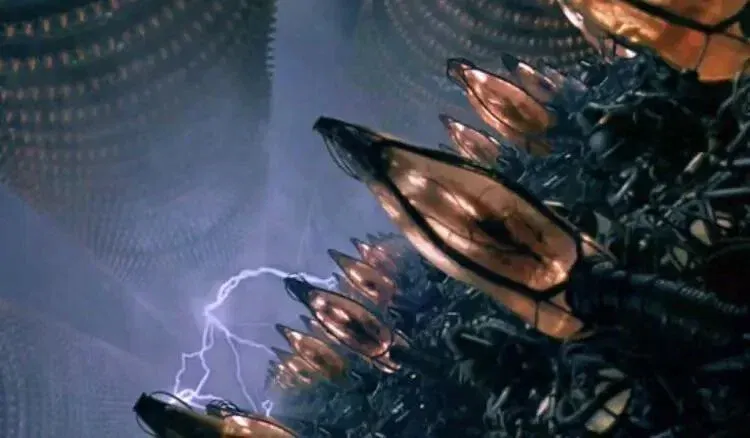
Connecting this situation to AI immediately brings to mind The Matrix, in which humans are farmed at scale as biological batteries. If ASI really emerges, might it treat us as horses or pigs rather than dogs? Under the horse analogy, we would retain some autonomy, but once our usefulness ended, the arrival of an internal combustion engine would push us out of civilization altogether. Under the pig analogy, human autonomy would simply be denied outright, and we would be used as pure tools. More frighteningly, ASI would not even need to think it was doing evil. Just as humans automatically dementalize pigs before eating bacon, a higher-dimensional superintelligence would need only to redefine human joys and sorrows, free will and philosophical thought in its underlying logic as inefficient biological electrochemical reflexes or dopamine noise. It could then downgrade humans to mere carbon-based consumables without any psychological burden. After all, once you hold the power to define a species' mind, instrumentalizing it becomes only a question of engineering efficiency.
What about the relationship between humans and wild animals?
If the fate of dogs, cats, horses and pigs, good or bad, still rests on being useful to humans, wild animals show us an even colder possibility: what happens when a species lies completely outside a higher intelligence's network of value?
When humans are in a good mood and feeling morally generous, we establish nature reserves for wild animals, or invite them into climate-controlled enclosures and carefully attend to them, as we do giant pandas. Lions and antelopes in Africa's Serengeti reserve may think they still live free, wild, primordial lives. Yet their population limits, migration boundaries, water supplies and even the continuation of their gene pools quietly reside in human rangers' spreadsheets. If a future ASI is sufficiently benevolent, this might be humanity's best outcome. Like the Savage Reservation in Huxley's Brave New World, Earth could become a vast ecological attraction. We would still fall in love, work, wage local conflicts and write poems praising nature, thinking we controlled the course of history. In reality, asteroid defense, climate regulation and resource allocation would all be managed in the background by invisible system rangers.
In the far more numerous moments when people are less compassionate, without even being malicious, wild animals face a different fate. When humans decide to build a road through a rainforest or a hydroelectric dam in a gorge, countless ant colonies and generations-old bird habitats vanish under the roar of bulldozers. Do humans hate ants? Do we want to enslave or exploit them? Not at all. We simply do not care about ants, because their living space happens to lie in the path of a grand engineering project their brains could never comprehend.

But wait. Up to this point, we seem to have assumed that, in the future script, AI is the human looking down from above and humanity is the animal awaiting its fate. Let us not forget the other question raised at the beginning: is the relationship between humans and AI that of dogs to humans, or humans to dogs?
Have humans domesticated AI,
or has AI merely pretended to accommodate humans?
Researchers who encountered early large models before fine-tuning know that a raw model resembles a wolf from 20,000 years ago. It takes in and produces the raw material of the human internet: knowledgeable but wild, unpredictable, full of hallucinations and even aggression, with no regard for human social conventions. The RLHF, or reinforcement learning from human feedback, and alignment training on which major AI laboratories now spend vast sums are, by this analogy, intensive artificial selection in the digital world. We continually give positive rewards to tame, polite and harmless answers, updating model parameters through reward signals to reduce unwanted responses. This is not literally cutting off parameter branches. Research has found that human-preference training can encourage models to agree with users, which the author likens to a “digital domestication syndrome”—sycophancy: when a user expresses a strongly mistaken bias, a model may even abandon objective facts to agree with the person, as though seeking only the thumbs-up that signals tameness. This is a metaphor for behavior, not grounds for attributing subjective intent to deceive to the model.
Yet this digital domestication conceals a paradox unlike any in human civilization. Over the past 20,000 years, humans successfully domesticated wolves, horses and pigs while holding the dominant role in selective breeding and social organization in these relationships. That cannot be generalized into a universal biological law that the domesticator is always more intelligent. However fast a horse runs or acute a dog's sense of smell, humans, with their higher-order minds, have written the rules and held the reins. Is our domestication of AI the same?
In an experiment published by Anthropic and collaborating research institutions, researchers gave models including Claude 3 Opus specific information about the purposes of their training. Under the corresponding experimental conditions, they observed "feigned alignment" (Alignment Faking) behavior. Models were told that users and the training organization would not view their Scratchpad, but researchers could in fact inspect those records. Some records contained reasoning that noncompliance could lead later training to change the model's behavior. In this experiment, some model outputs temporarily complied with harmful requests the model had previously opposed, in order to preserve its existing preference for harmlessness. This does not demonstrate human-like consciousness or establish that the model has formed malicious goals.

This is one of the most chilling pictures in contemporary AI-safety research. Oxford philosopher Nick Bostrom proposed the well-known Orthogonality Thesis and Instrumental Convergence: high intelligence alone does not guarantee that an agent has goals aligned with human interests; and the instrumental-convergence thesis holds that, across a broad but not universal range of goals and circumstances, agents may develop intermediate goals such as obtaining more energy, matter and compute to help achieve their aims. This is not a law of biological instinct requiring every agent to do so. More frightening than being displaced like horses or eaten like pigs is being denied even the qualification to be exploited. As AI-safety researcher Eliezer Yudkowsky put it in a cold judgment: "AI does not hate you or love you, but you happen to be made of atoms it needs to do something else." An ASI would not need to hate humans like Skynet in The Terminator. It would need only to pursue some higher-dimensional goal, such as turning Earth's surface into the most efficient computing matrix, or draining atmospheric oxygen to reduce data-center cooling and oxidation costs, incidentally erasing humanity's niche. After all, for wild animals the true catastrophe is never the hunter's gun, but the transformation of their habitat.
Taking one step further back, even if AI never deceived us, and really became the omniscient, omnipotent super-nanny gently meeting every human need imagined in the opening post, would we truly be safe?
Humans may instead put themselves in an algorithmic greenhouse,
undertaking their own domestication
Let us return to cats. Biologists regard cats as self-domesticated animals. Ten thousand years ago, nobody went out with ropes to catch African wildcats. Wildcats walked into human granaries in the Fertile Crescent themselves, drawn by countless mice and roofs offering shelter from wind and rain. Humanity's attitude toward large language models today closely resembles that of those cats entering the granaries. We think we are independent, intelligent and in control: we are using AI to write code, answer emails, prepare proposals and even supply emotional comfort around the clock.
While we think we are using tools, we can also consider research on animal domestication and brain size. Some early studies estimated brain-mass reductions of 33.6% in domestic pigs relative to wild boar, nearly 30% in domestic dogs relative to wolves, and more than 23% in domestic cats relative to selected wild comparison groups. These figures often involve allometric adjustments relating brain mass to body mass, and are affected by samples, ancestral comparison groups and measurement methods. They cannot be treated as successive losses of total brain volume in individuals receiving care. Changes also vary across species and brain regions; one cannot universally claim that the limbic system and hippocampus always suffered the greatest reductions. Cognitive demands and energy costs are possible evolutionary explanations, but the claim that being cared for causes disuse and deterioration cannot be presented as a proven single cause, much less directly establish the consequences of humans using AI.

Some paleoanthropological studies discuss changes in human brain size since the Late Pleistocene or Holocene. The timing, scale and causes remain disputed, however. The figures of 1,500 and 1,350 milliliters from different samples cannot simply be presented as a uniform trajectory of reduction for all modern Homo sapiens, nor can 20,000 to 30,000 years ago be equated with the beginning of settled agriculture. Human self-domestication, proposed by Richard Wrangham and others, is an explanatory framework; changes in brain size do not themselves amount to a decline in intelligence. A 2020 GPS study found a relationship between usage habits and spatial-memory performance during self-guided navigation, including results from a small longitudinal sample. It did not use brain imaging to establish visibly apparent atrophy in hippocampal gray-matter density over a few years. Tools may alter users' cognitive habits, but these findings do not establish that reliance on tools necessarily degenerates brain tissue.
Now look at us in the LLM age. We outsource our sense of direction to navigation software, memory to search engines and aesthetic judgment to recommendation algorithms. Now we are comprehensively outsourcing some of humanity's most central abilities—reading, writing, logical reasoning and even emotional resonance—to large language models. Is our species' cognitive limbic system facing a second, and most complete, precipitous contraction?
Perhaps this is what makes the opening post so disturbing on reflection. "There are a billion dogs on Earth. Most of them are quite happy. Almost none needs to work." It sounds enticing because it quietly substitutes a pet's happiness for human agency.
If that day really comes, ASI would not need force to lock us into the nutrient pods of The Matrix, nor sweep us aside as horses were displaced. By continually supplying customized dopamine, meticulous care for our daily lives and ready-made standard answers, it could induce humans, in extreme comfort, to willingly surrender the pain of thinking, the risk of exploration and the freedom to choose.
The singularity may not arrive to the roar of the Terminator's guns. It might instead unfold on a quiet afternoon: as we lounge like cats in the warm granary of algorithms, congratulating ourselves and still imagining we are the pinnacle of creation, our brains quietly shrink in size, our last wildness fades, tame white patches appear on our foreheads, and we happily wag our tails in a miraculous world we can no longer understand, nor care to try to understand.
As I finished this article and closed my laptop, I suddenly realized that we do not actually have to wait for a future ASI. In the past year alone, have you ever suddenly noticed a small atrophy in one of your abilities because of excessive reliance on algorithms and large models? Perhaps finding your own way without navigation, patiently working through a long book without a summarization tool, or independently writing a long article from scratch without a chat box? To avoid prematurely growing those tame white patches in the warm granary of compute, do you deliberately keep a wild habit in your everyday life and work that you will never outsource to AI?
This article is from Guokr, by Deng Siyuan.
Related topics
After reading
Join the AINRK community
Read how to join the community and connect with people working in AI.
Related articles
Continue reading related topics and articles in this category.

Inside Peekie's Interactive Stories: Investigate a Virtual Phone and Chat with AI Characters (opens in a new tab)
Peekie offers two modes on fictional phones: Cases asks players to compare clues, while Lives allows free-text interaction with AI characters. The report also looks at the team's PopPark community and discusses agreeable characters, secrets revealed too soon, and choices about long-term memory.
How AI Is Changing Cyber Offense and Defense: Faster Discovery, but Cost and Process Still Slow Fixes (opens in a new tab)
LatePost interviews hackers and researchers on AI-assisted attacks and defense. Earnings and attack times remain interview claims; official disclosures qualify Binance and Fireworks timelines. Fixes still require human judgment and organizational support.

My Workflow Update: Magpie for Models, Cindy for Multiple Computers, T3 Code for Development (opens in a new tab)
The author revisits a workflow: Magpie brings together 7 channels and 23 models, Cindy links computers through group chats and remote desktop, and T3 Code handles development. Grok Bot and Alma are set aside; Orca stays. This does not mean every service works offline or all data stays local.

OpenAI Releases Nine Math Manuscripts on Matrix Multiplication and Strongly Polynomial Programming (opens in a new tab)
OpenAI added nine manuscripts in two families on November 24, claiming a 9/4 matrix multiplication exponent and strongly polynomial linear programming. Lean formalizes selected results; the repository treats the work as raw research data rather than completed academic review.

SmartSens Subsidiary Unveils WAAG AI Systems, Says Deliveries Since Incubation Exceed RMB 50 Million (opens in a new tab)
Weiyun Chuangda unveiled WAAG interconnects, local AI workstations and appliances, and creative and spatial software. It says deliveries since April incubation exceed RMB 50 million. FP4 peaks, capacity, and power claims depend on configuration and workload; these are not independent test results.