SmartSens Subsidiary Unveils WAAG AI Systems, Says Deliveries Since Incubation Exceed RMB 50 Million
Weiyun Chuangda unveiled WAAG interconnects, local AI workstations and appliances, and creative and spatial software. It says deliveries since April incubation exceed RMB 50 million. FP4 peaks, capacity, and power claims depend on configuration and workload; these are not independent test results.
Editor's verification note: This is a product launch and interview report. Delivery amounts, performance comparisons, application benefits, and market sizes are statements by the interviewees, not independent testing or audit findings by this site. Peak FP4 compute, graphics memory, and supported model sizes must be understood in terms of the specific model of hardware, optional GPUs, precision, and workload. Local deployment also does not automatically mean that all connected applications are free of data transmission or security risks. The parent company's official release states that the subsidiary was formally established in September 2026. The 'roughly half a year' mentioned here runs from internal incubation in April, and the value of products delivered is not the same as recognized revenue.
WAAG's heterogeneous interconnect debut: flexibility in chip selection and global markets spanning China, the US, and Europe.
The first wholly owned physical AI subsidiary of leading Chinese CMOS sensor company SmartSens has officially appeared and released new products.
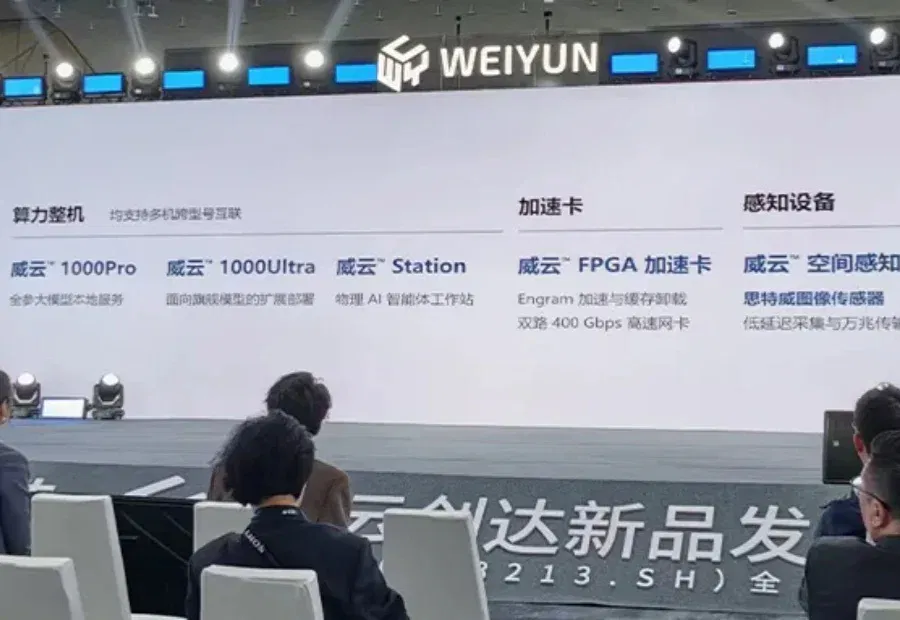
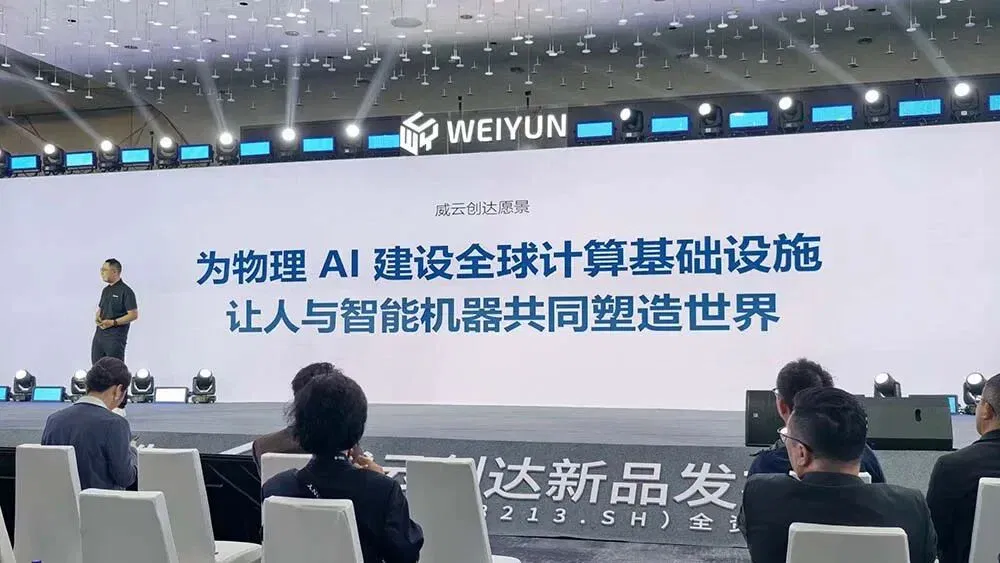
Reporting live from Shanghai on November 25, Zhidongxi: just now, SmartSens subsidiary Weiyun Chuangda held a product launch in Shanghai, officially unveiling its proprietary underlying architecture, WAAG heterogeneous AI-ASIC cluster interconnect technology, and officially launching, for desktop use and professional teams, the Weiyun Station physical AI agent workstation; for enterprise deployment, the Weiyun 1000 Pro series integrated AI training and inference appliances; and for running large-scale models locally, the flagship Weiyun 1000 Ultra integrated AI training and inference appliance, making three new products in all.
Beyond hardware, Weiyun Chuangda demonstrated two core software applications: the professional AI filmmaking tool Zhiying and a spatial perception agent.
Weiyun Chuangda's current hardware portfolio supports local single-machine deployment of models ranging from 400B to 3.2T parameters. With optional GPUs, the flagship 1000 Ultra can provide up to 47.5 PFLOPS of FP4 compute and 4.66TB of graphics memory, while the 2U 1000 Pro series keeps model inference power consumption within 1kW.
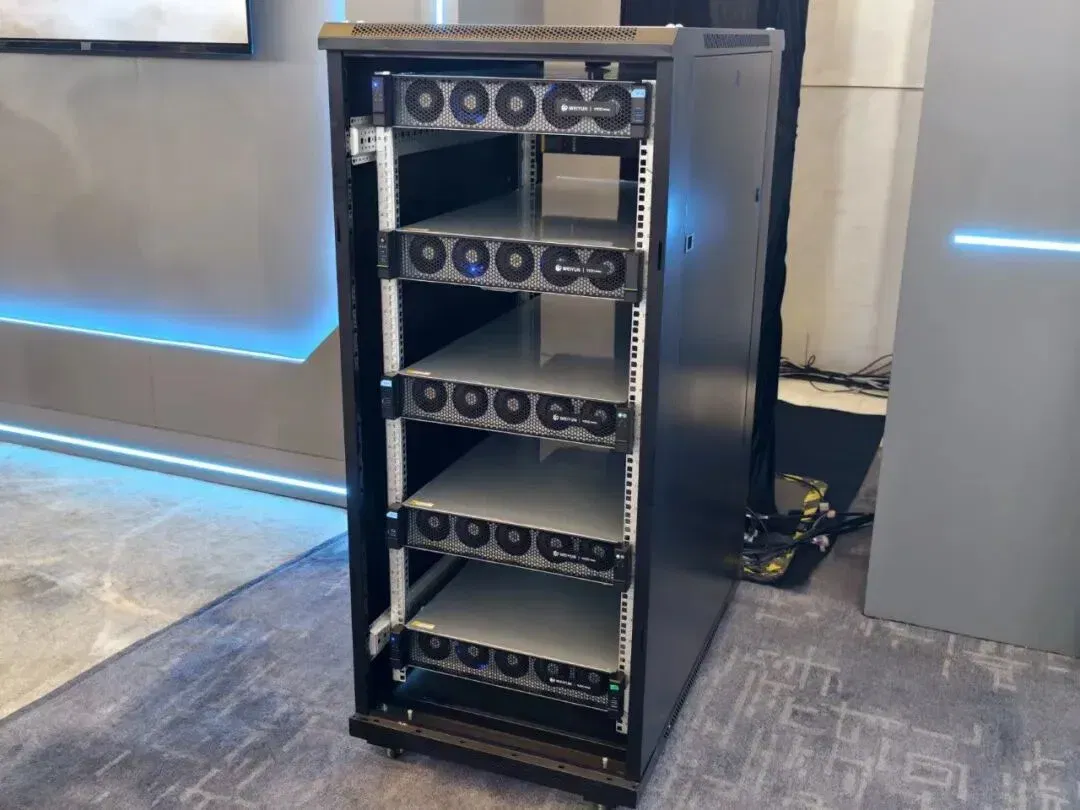
A rack of Weiyun 1000 Pro systems in the exhibition area
SmartSens founder, chairman, and CEO Xu Chen, PhD, was the first to take the stage. He interacted briefly with the digital host, solving math problems, telling jokes, and reciting stories. He also asked the digital human 'Weiwei' to compose a seven-character quatrain about the event. The whole process was fairly smooth.
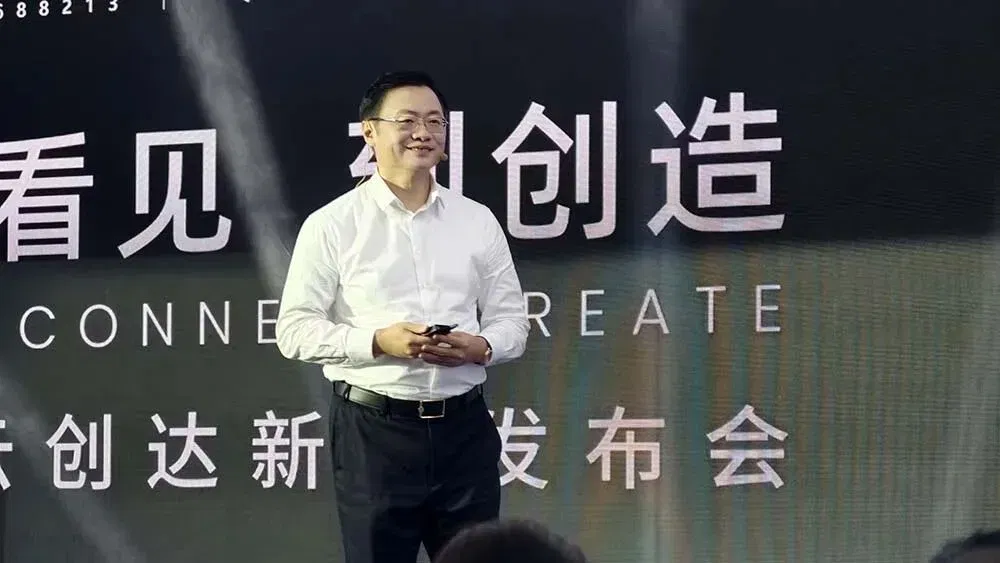
Dr. Xu Chen, SmartSens founder, chairman, and CEO
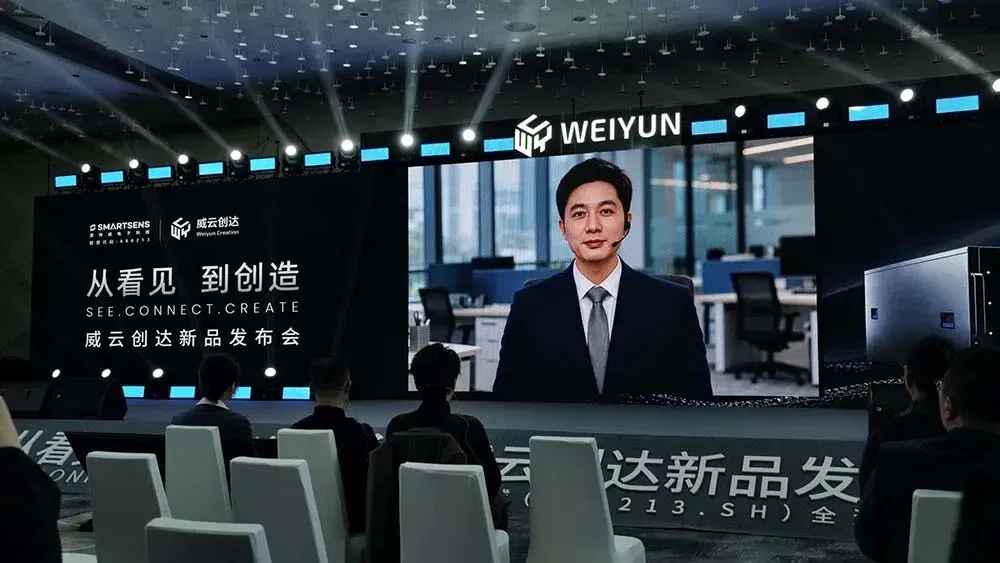
The digital human Weiwei
According to information provided, this digital human runs on Weiyun's servers and is one of its typical application scenarios.
Xu stressed one core point they wanted to convey at the launch: AI's future lies not in gigantic data centers but in device-side compute deployed closer to users. This is also where SmartSens sees its opportunity. Its chosen route is distributed edge compute deployment.
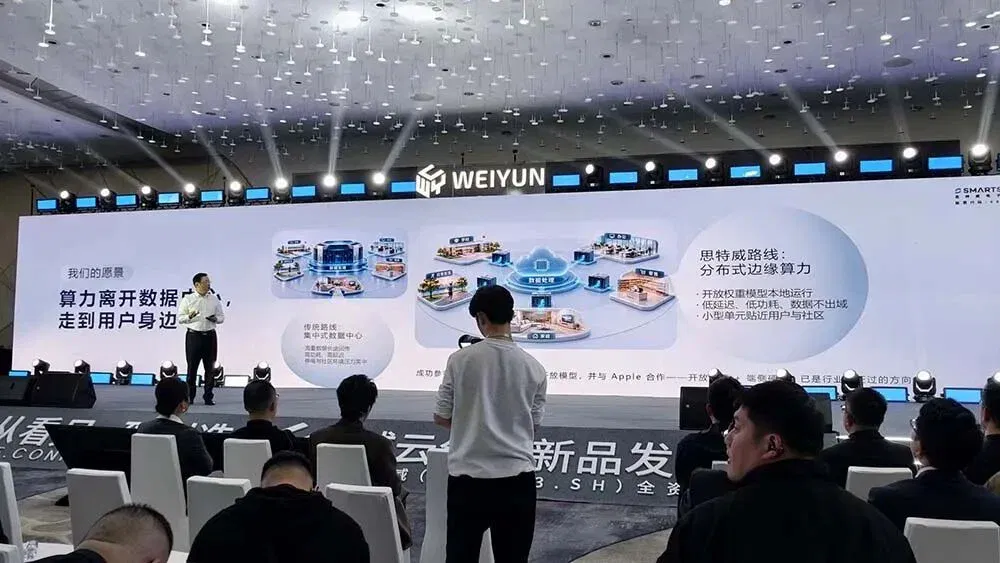
After the launch, Zhidongxi and a small number of other media outlets had an in-depth, face-to-face discussion with Weiyun Chuangda CEO He Jin and COO Gao Tianhao.
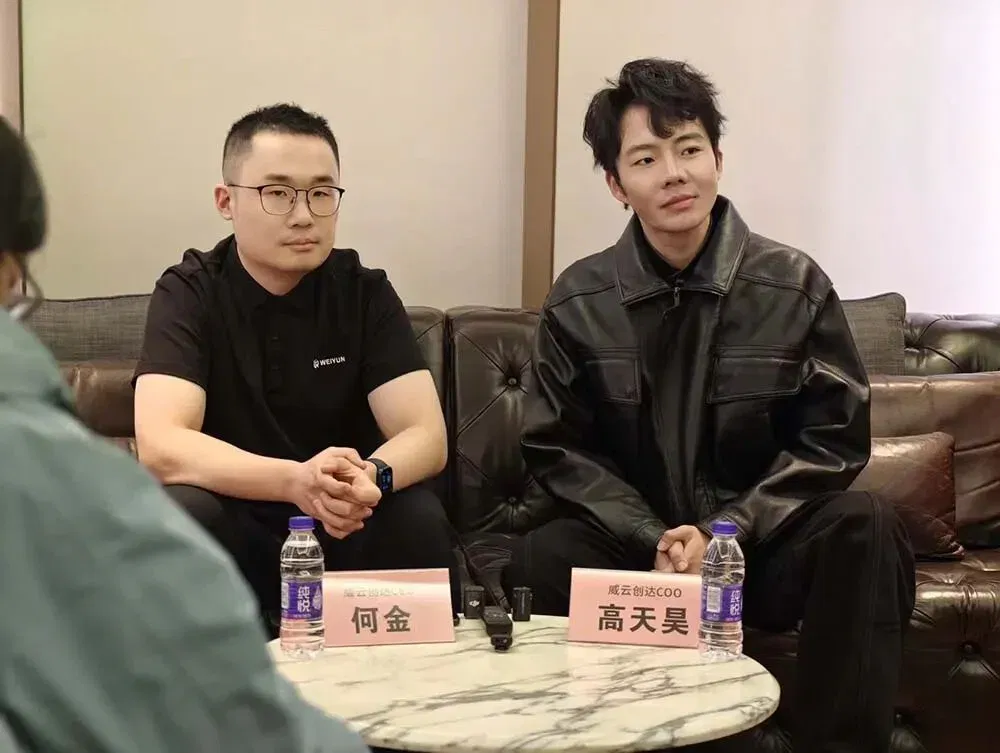
On pricing, Gao said Weiyun Chuangda's smaller products currently sell for RMB 150,000 to 400,000, large workstation systems cost more than RMB 1 million, and top configurations may reach around RMB 5 million. According to its research, practical results and efficiency within the corresponding price bands exceed those of 90% of mainstream all-in-one products on the market. The products will launch simultaneously in China, the US, and Europe for global sales.
He Jin had already spent eight years at SmartSens, working in chip research and development for a long time. This April, he led the formation of an AI project team and began internal incubation. After three months of operation, the group decided to establish Weiyun Chuangda as a separate wholly owned subsidiary.
Discussing its core differentiators, He said that at the underlying architecture level, Weiyun Chuangda's WAAG architecture can directly eliminate the CPU and DDR used in conventional servers while remaining open to AI-ASIC chips from multiple vendors. This can both simplify the bill of materials and diversify supply chain risks, while bringing SmartSens's upstream and downstream partners into its own ecosystem and avoiding competition with existing customers.
On the subject of price wars, Gao stated clearly: they will not engage in a price war. The current physical AI market has moved beyond simply competing through low bids. Mature customers care more about equipment's actual output and return on investment. Weiyun Chuangda focuses on overall value beyond price, emphasizing faster solutions to customers' real business problems with greater energy efficiency.
On commercialization progress, Gao said it has been roughly half a year since Weiyun Chuangda began internal incubation this April, and the value of products delivered has now exceeded RMB 50 million.
01.
Betting on distributed edge AI and community node deployment
Building a global presence
In his opening presentation, Xu set out SmartSens's strategic assessment for the AI era. He believes AI's future lies not in gigantic data centers but in small compute units close to users.
In his view, AI will not remain inside data centers as a tool for a select few. It will enter businesses, homes, campuses, retail, and everyday life like water and electricity, so compute must move as close to users as possible.
Xu divided the AI technology stack into a hardware platform at the bottom, a model layer in the middle, and agents and applications on top. Models can be grouped into closed-source, open-source, and open-weight categories. Weiyun chooses to support open-weight models such as DeepSeek, Kimi, and GLM. These can be downloaded and run on local hardware, providing the technical prerequisite for distributed edge AI.
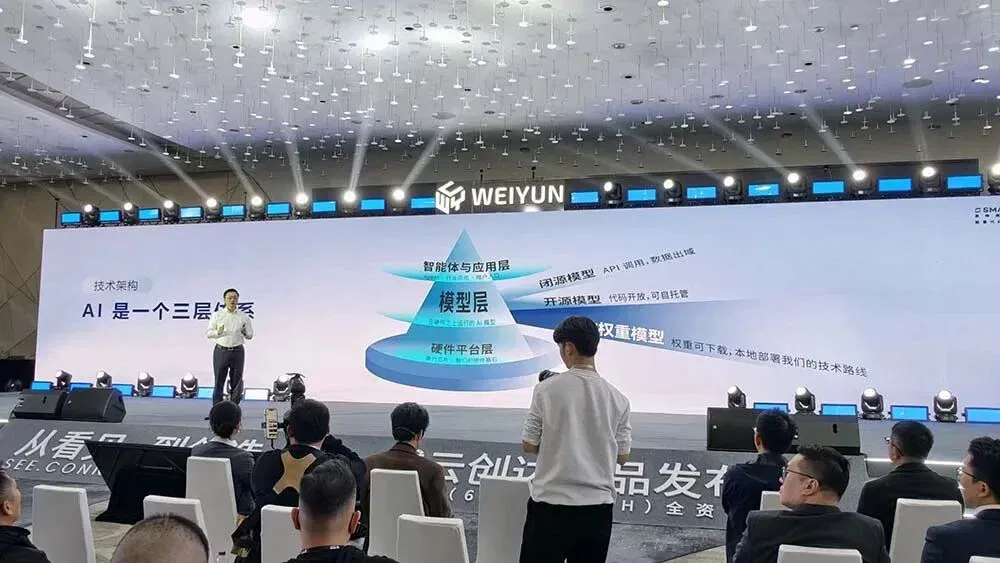
Xu said breaking traditional hyperscale data centers into distributed edge compute units offers characteristics including keeping data within its domain, low latency, low power consumption, and low cost.
On product features and the business model, Xu highlighted the following points:
For data security and compliance, he emphasized that safety comes first. Users' prompts run and are processed on local devices, without being uploaded to internet platforms or used for advertising, and intrusion protection is built into the underlying hardware. The company's board also has a designated legal specialist to guard against compliance risks and malicious use of the tools.
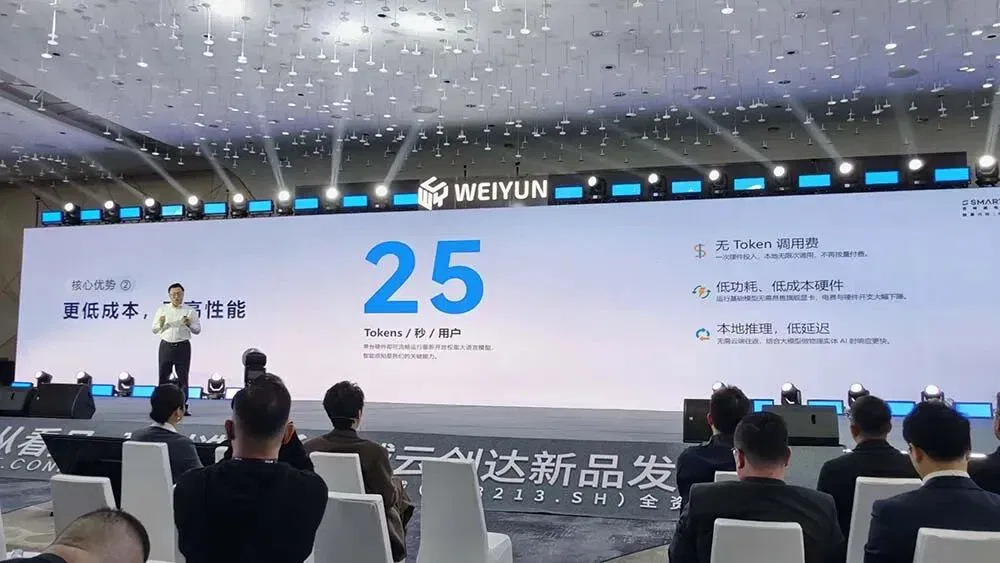
For performance and cost, the solution can output 25 tokens per second for a single user and supports multiple users concurrently running the latest open-weight large models. It requires a one-time hardware investment rather than per-token charges and does not depend on top-tier graphics cards, reducing power consumption and electricity costs. The low latency of local inference also better suits physical AI and embodied intelligence use cases.
On the concept of community-level nodes, he said the team plans to promote small compute nodes in communities, allowing individuals and small and medium-sized businesses to participate in operating compute resources and earn returns, while avoiding the electricity load and environmental problems of gigantic data centers.
On globalization and ecosystem cooperation, the hardware system will launch simultaneously in China, the US, and Europe, with plans for a Singapore company to handle overseas sales and Malaysia to serve as a manufacturing base. Compared with traditional data centers, the solution has a lower investment threshold and a shorter payback period.
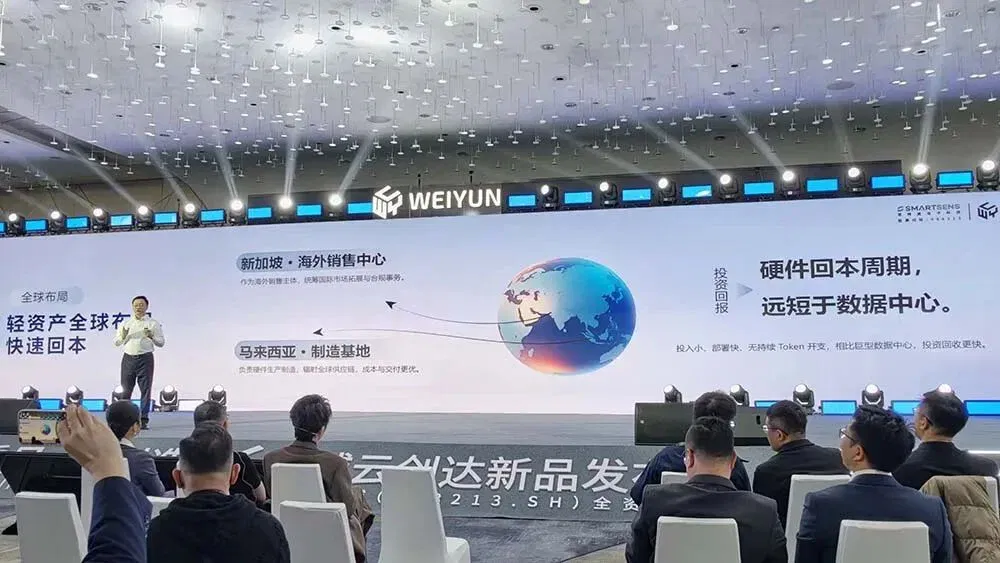
Representatives from universities and companies including Tsinghua University, Shanghai Jiao Tong University, NVIDIA, Infinigence AI, Ascend, Unitree, and AgiBot attended. Xu said Weiyun Chuangda's logo uses a Rubik's Cube design to express the hope that its products can bring change to customers' businesses.
02.
WAAG underpins three hardware products and two software applications
Building global computing infrastructure for physical AI
Weiyun Chuangda CEO He Jin then took the stage to introduce the company's technical architecture, new hardware, and accompanying software. He first summarized three major pain points in local enterprise AI deployment: existing equipment lacks the capacity to run flagship models; power, cooling, and long-term hosting costs are high after purchase; and keeping up with continued model iterations is difficult.
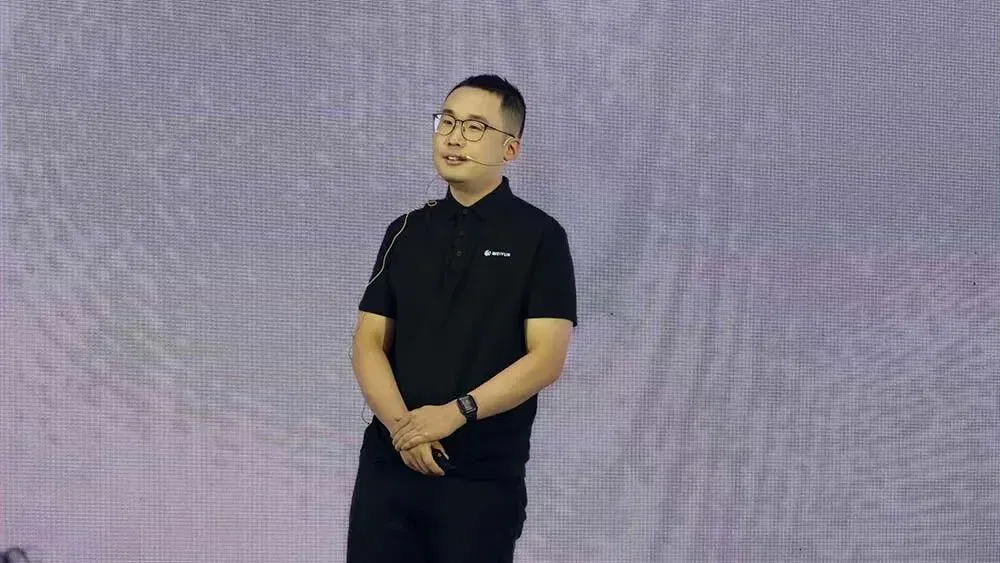
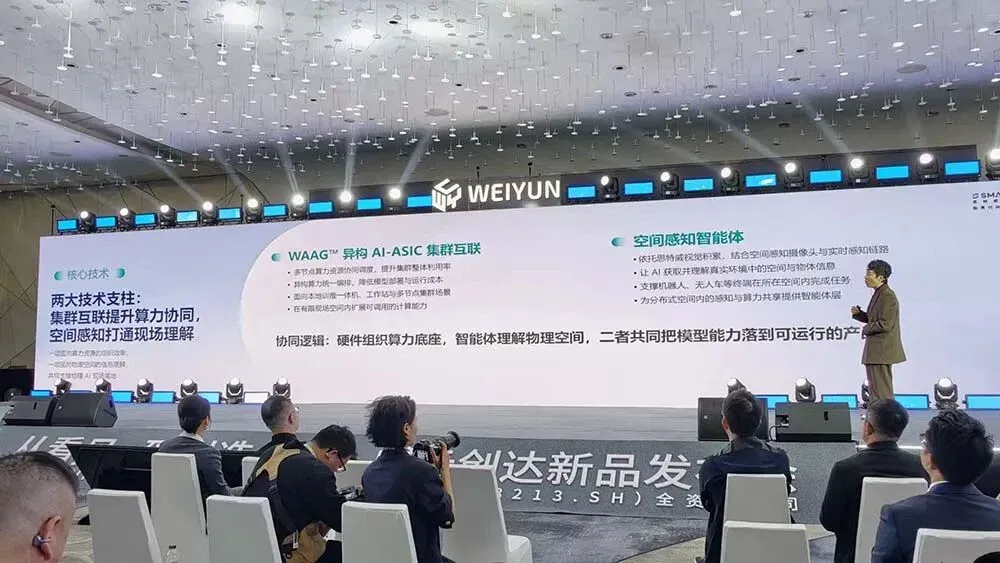
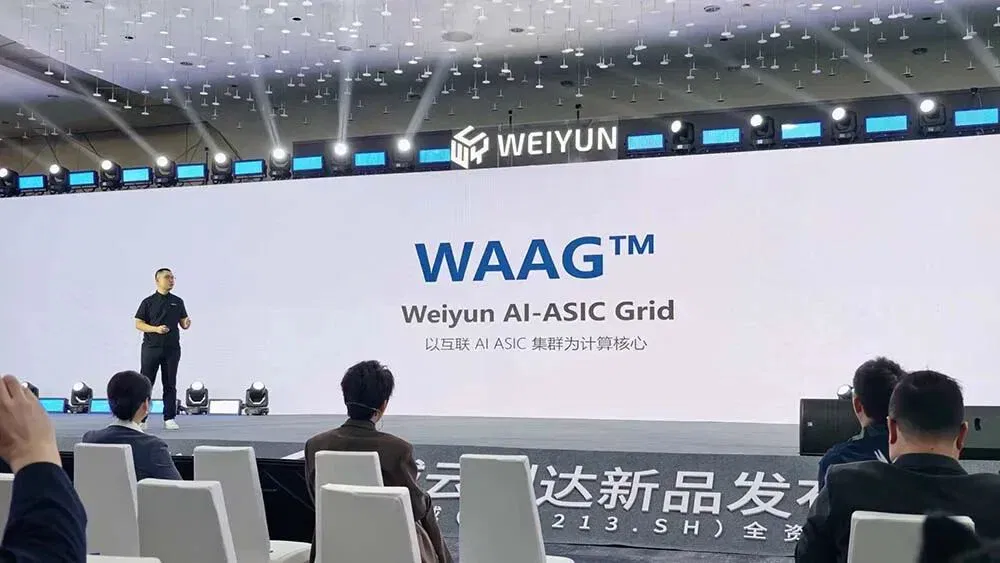
To address those problems, He proposed a 'connect everything' design approach and formally introduced the company's proprietary WAAG, Weiyun AI-ASIC Grid, heterogeneous AI-ASIC cluster interconnect technology, intended to connect chips, complete systems, and the physical world.
He illustrated the scheduling mechanism using eight AI-ASIC chips in a single machine. All eight can compute collaboratively and exchange results to run one model together, or be divided as needed, for example four running model A and four running model B, or split into multiple groups of instances according to concurrency requirements. Resources can be allocated dynamically as users' model needs change.
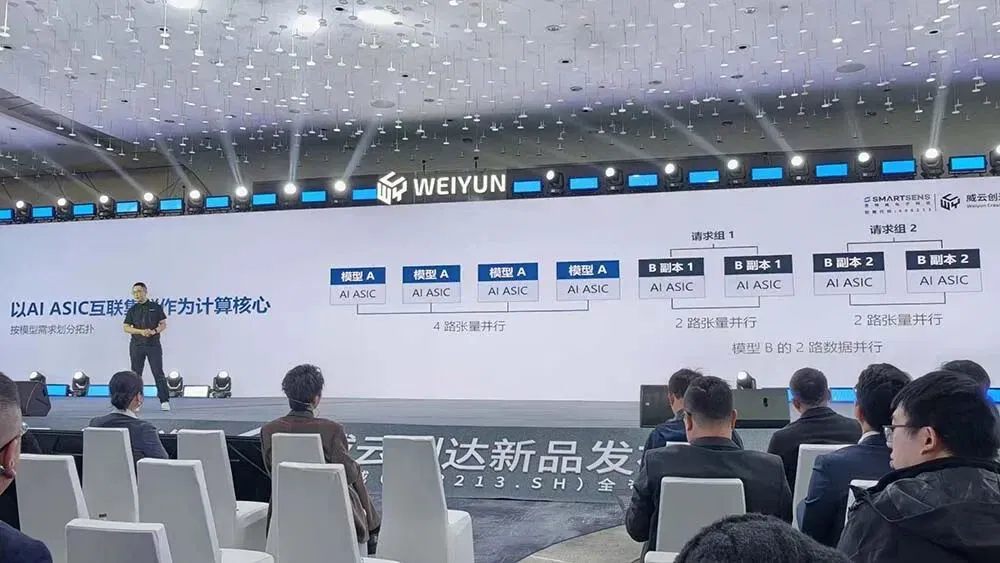
For heterogeneous collaboration, he emphasized that the architecture remains open, supporting the integration of Chinese AI chips and interconnection across vendors. The AI-ASIC cluster handles expert-model computation, GPUs accelerate generation, and FPGAs provide customized acceleration and cache processing. Weiyun Chuangda develops both the chip adaptation and the inference software behind them.
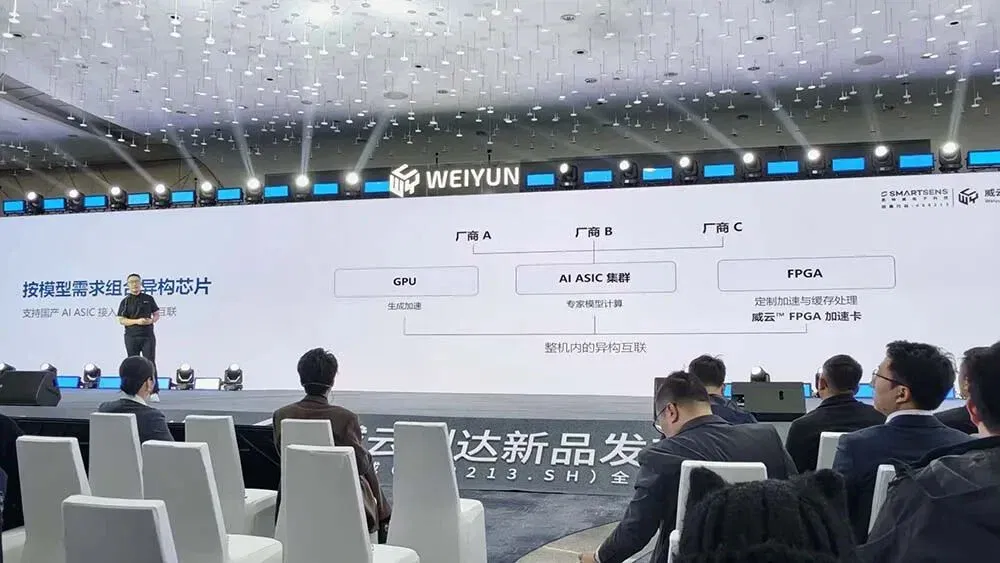
For expansion across machines, different shards of the same model with an enormous parameter count can be deployed across multiple complete systems for collaborative inference. Equipment users have already bought can continue to be added to the cluster as model parameter counts grow.
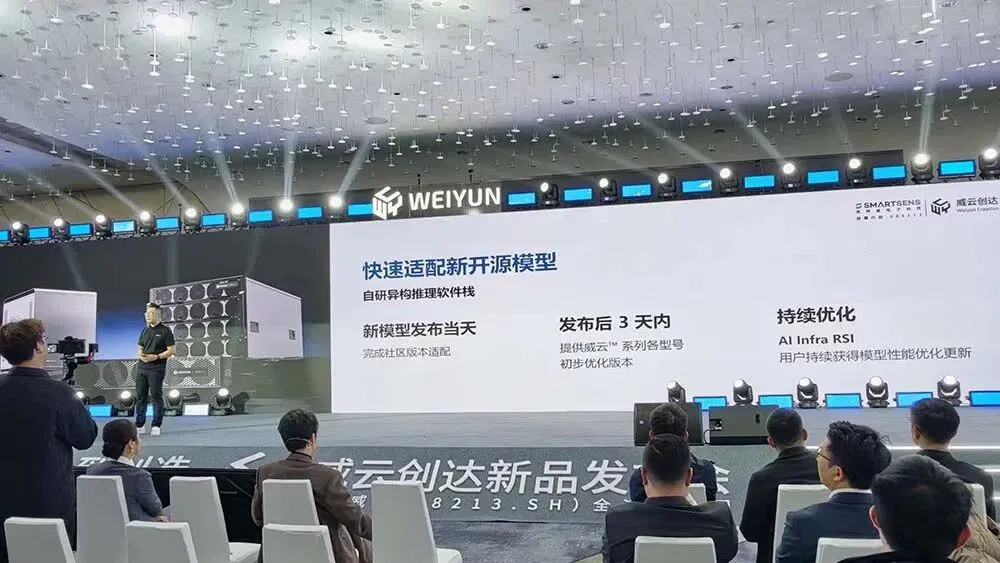
On software updates, He said that, using its proprietary heterogeneous inference software stack, Weiyun Chuangda commits to adapting the community version on the day a new model is released and providing preliminary optimized versions for its different hardware models within three days. Its own AI infrastructure optimization technology is also intended to keep improving equipment performance after delivery.
The technical block diagram shows WAAG consisting of perception terminals, high-speed optical interconnects, Weiyun accelerator cards, storage systems, and interconnected AI-ASIC clusters.
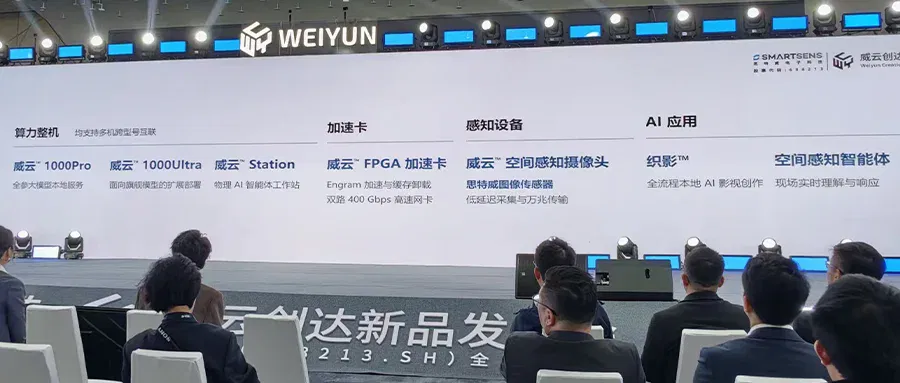
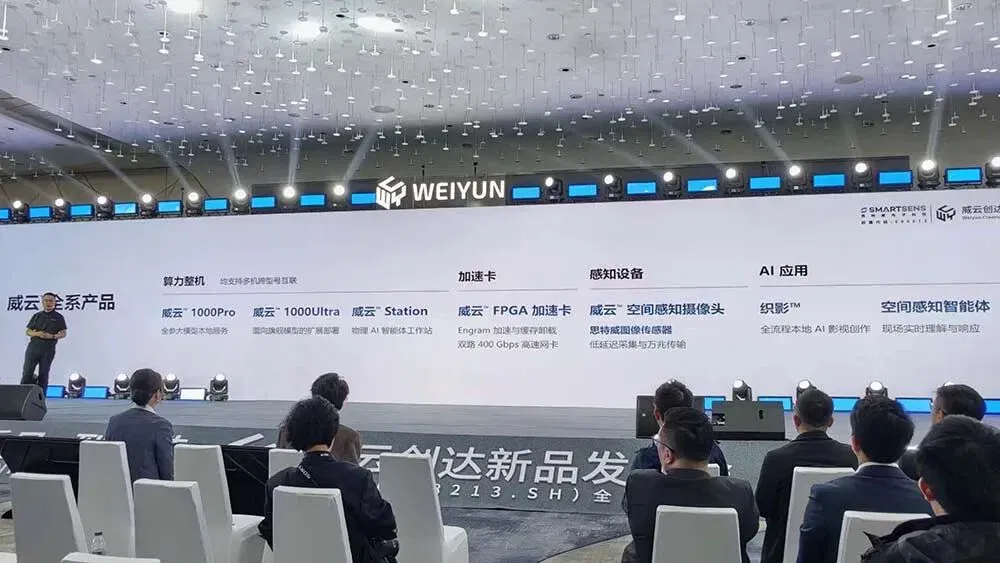
Based on WAAG, He introduced three complete compute products and two accompanying hardware products. All complete compute systems support interconnection across multiple machines and hardware models.
The highest-specification model, Weiyun 1000 Ultra, uses an 8U/12U chassis. With optional GPUs, it supports up to 47.5 PFLOPS of FP4 compute and 4.66TB of graphics memory, allowing a single machine to host models of up to 3.2T parameters.
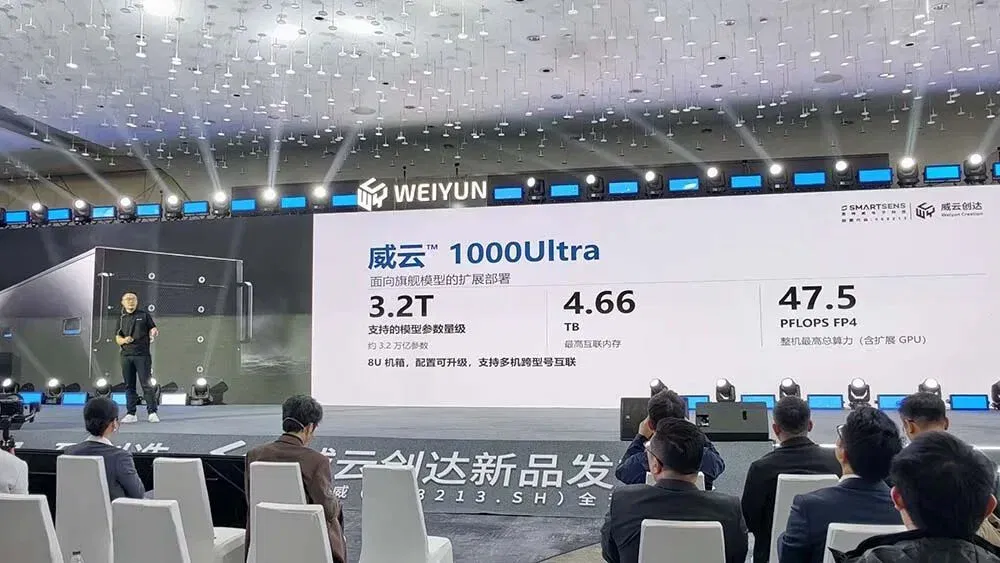
Its compute architecture supports heterogeneous collaboration among multiple chips, FPGAs, and GPUs. Combined with dynamic KV cache offloading and resource scheduling, it targets local deployment of all parameters of large MoE models, as well as long-context and highly concurrent business workloads.
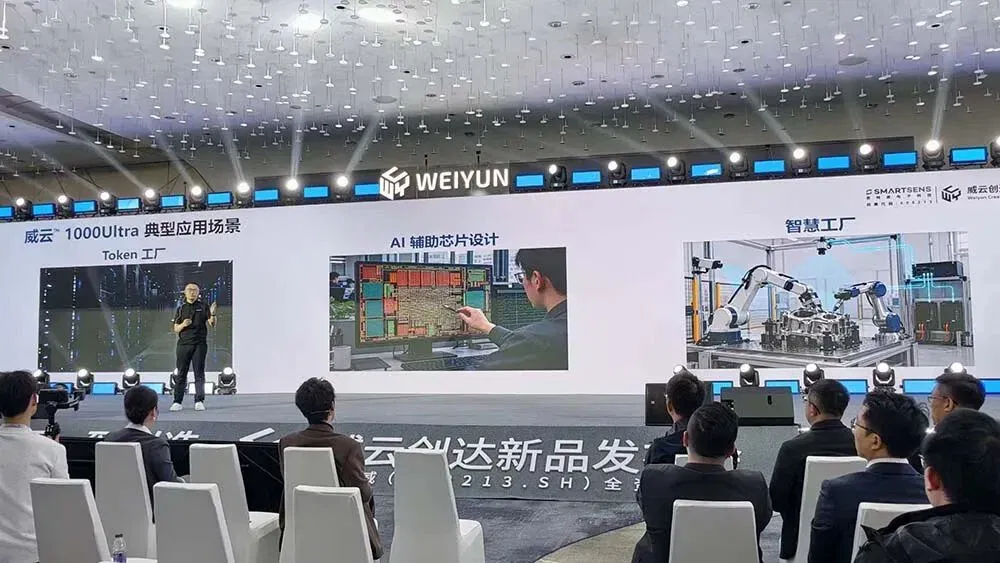
A single machine directly supports mainstream large models including DeepSeek-V4-Pro, GLM-5.3, Kimi K3.1 Pro, and Qwen3.8-2.4T. It mainly serves centralized deployment of multiple enterprise workloads, such as knowledge services, business agents, and professional content generation.
The Weiyun 1000 Pro series comprises the 1000 Plus and 1000 Pro. Both use a standard 2U chassis, support models of up to 800B parameters on a single machine, and keep model inference power consumption below 1kW.
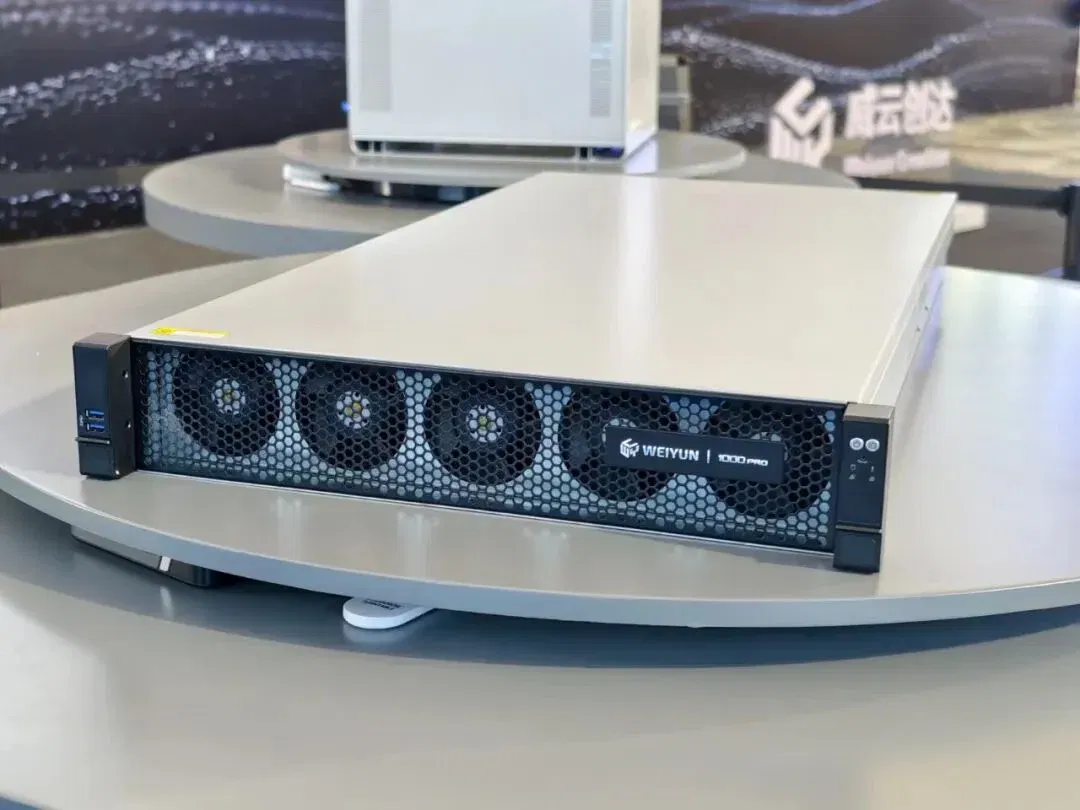
Weiyun 1000 Pro
The 1000 Plus provides up to 8 PFLOPS of FP4 compute and 1TB of graphics memory. With optional GPUs, the 1000 Pro can reach up to 13 PFLOPS of FP4 compute and 1.28TB of graphics memory.
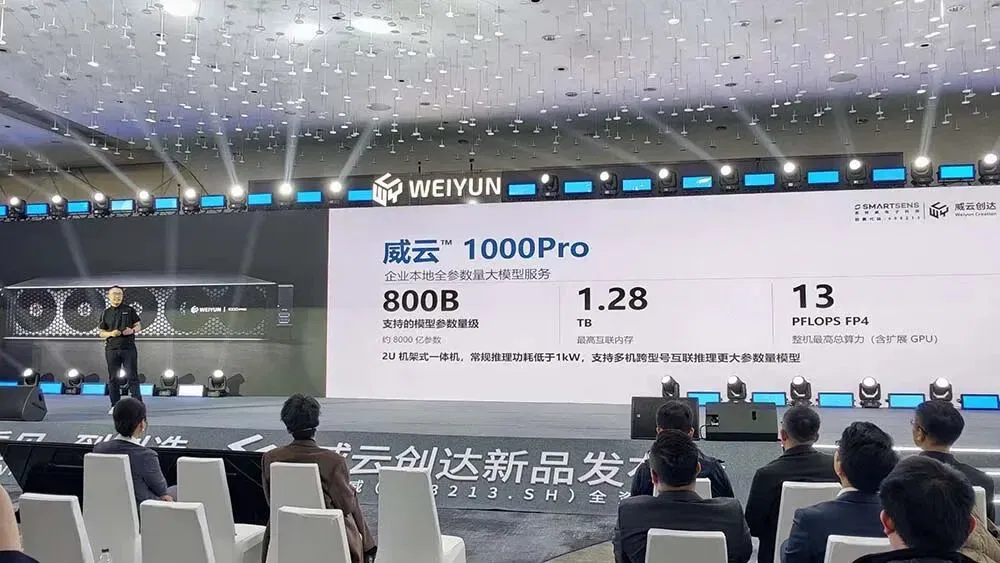
The series emphasizes multi-chip collaboration and high-speed interconnects to reduce reliance on high-end GPUs and supernodes, thereby controlling the cost of producing each token. It also supports optional GPU expansion cards, flexible model switching, and fine-tuning.
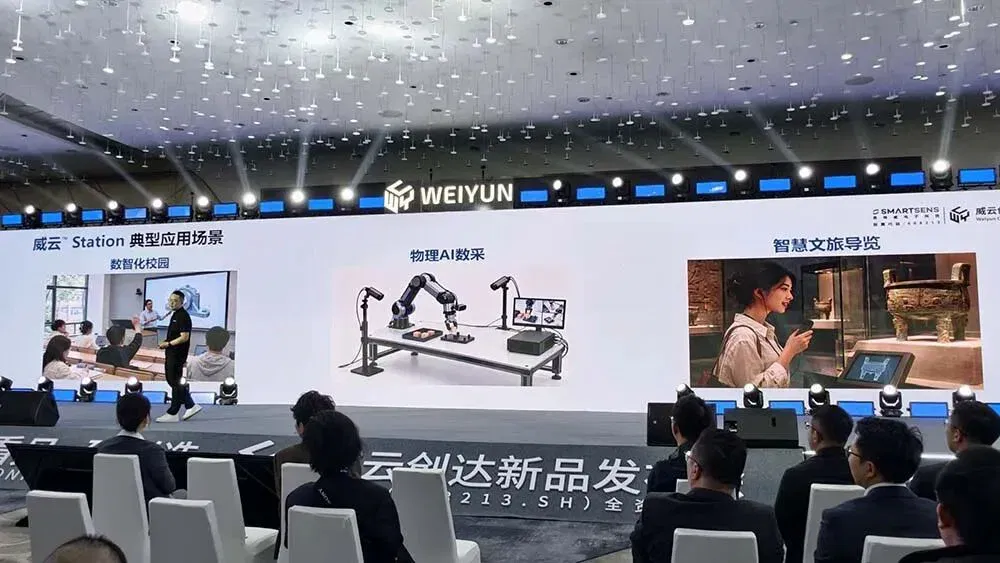
Weiyun Station targets OPCs, independent creators, and professional teams. Its quiet workstation design makes it easy to move and deploy in non-server-room environments such as studios, laboratories, and outdoor locations. With optional GPUs, it supports up to 7.7 PFLOPS of FP4 compute and 680GB of graphics memory, running models of up to 400B parameters on one machine. It also supports optional GPUs and high-speed network cards as needed, multi-machine interconnect expansion, model fine-tuning, and API access.
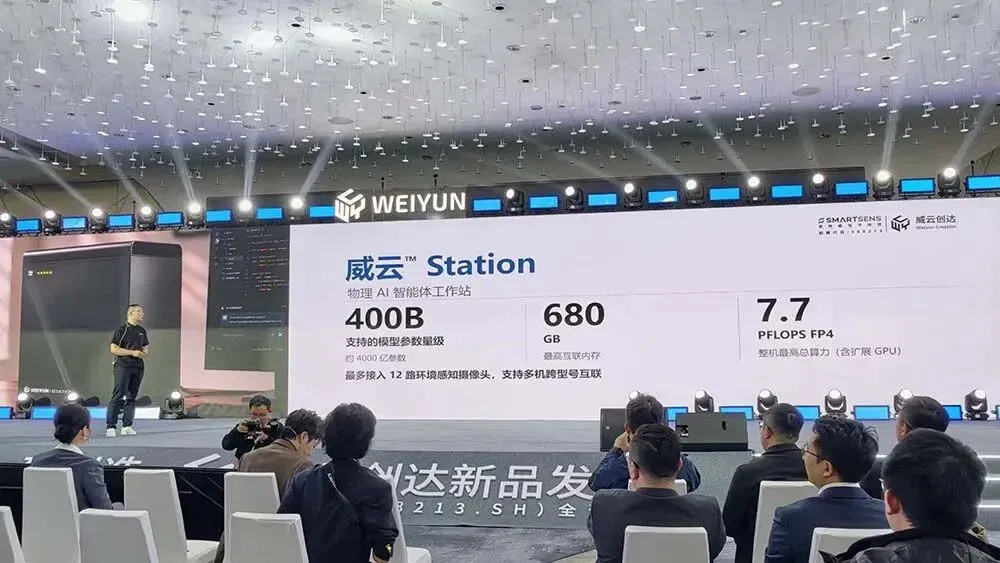
Beyond desktop development and creation, a distinguishing feature of the workstation's interfaces is support for up to 12 high-performance, low-latency environmental perception cameras, enabling multiview perception and intelligent interaction in real physical settings.
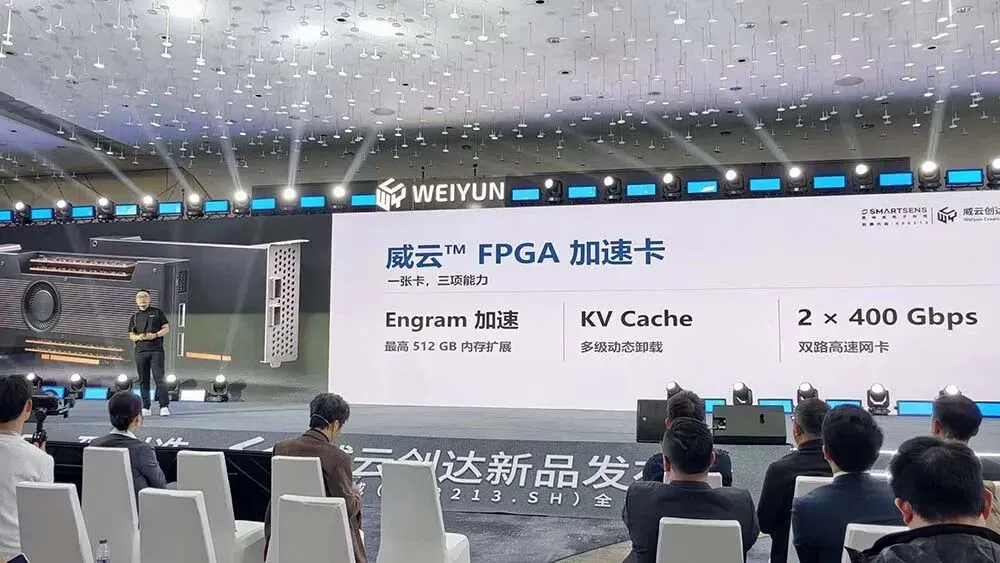
Among accessories, He highlighted the Weiyun FPGA accelerator card for the 1000 Ultra, integrating three functions: acceleration of modules commonly used by flagship-scale models, multilevel dynamic KV cache offloading between memory and disk, and dual 400Gbps high-speed network interfaces.
For on-site visual input, Weiyun Chuangda introduced its spatial perception camera. The product incorporates SmartSens's full range of high-performance image sensors, supports low-latency 10 Gigabit Ethernet transmission and PoE for power and image transmission over one network cable, and comes with a visual encoder model so large models can directly process raw video streams from the image sensors.
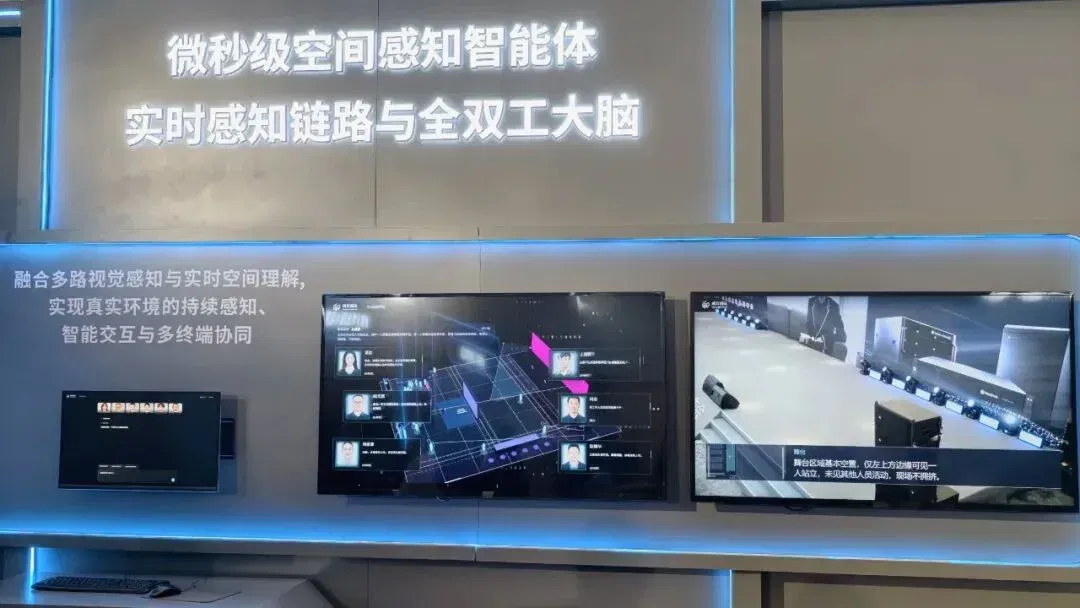
He said more than 30 of these cameras had been deployed at the launch venue to perceive staff positions and behavior in real time.
At the software application level, He demonstrated two core tools:
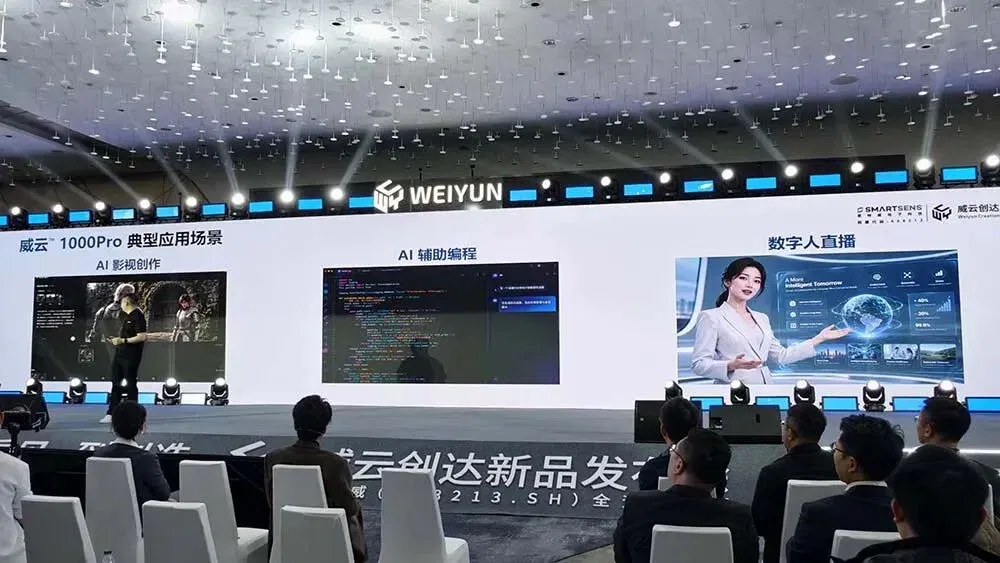
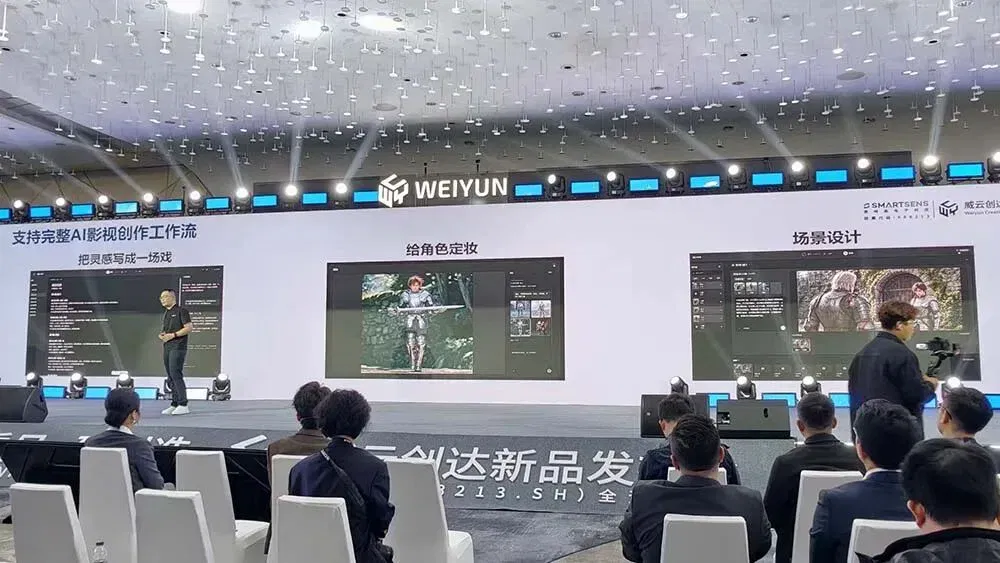
The AI filmmaking tool Zhiying: included as a standard application on every Weiyun compute device, it deploys language, image-editing, video, and audio models simultaneously on the same local machine, allowing creators to complete the entire workflow locally, from script conception to a finished film with sound.
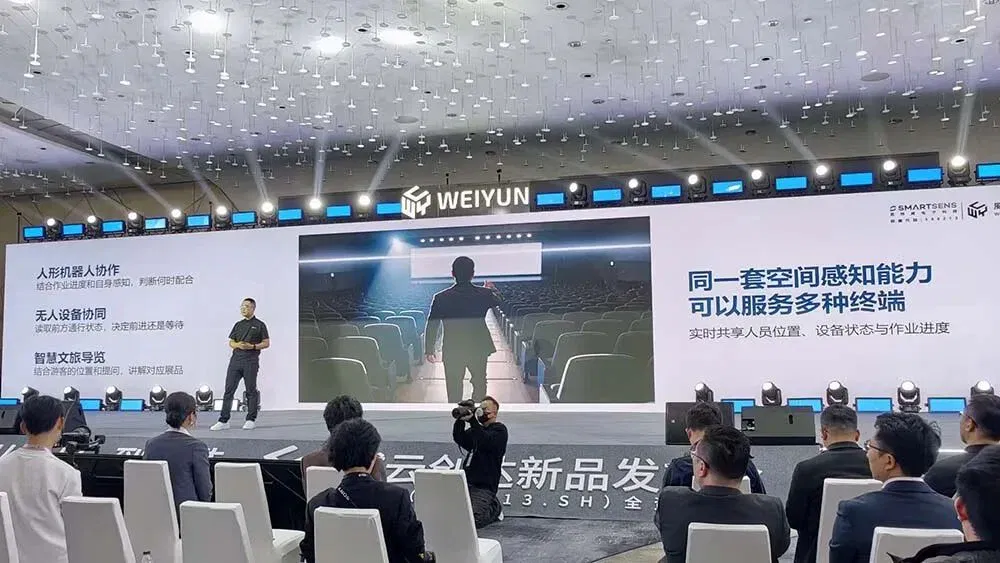
The spatial perception agent: designed for humans and intelligent machines working together, it gathers images from multiple angles through several Weiyun spatial perception cameras. After models fuse and analyze the input, it shares personnel positions, equipment status, and work progress with nearby unmanned devices in real time, compensating for individual machines' visual blind spots.
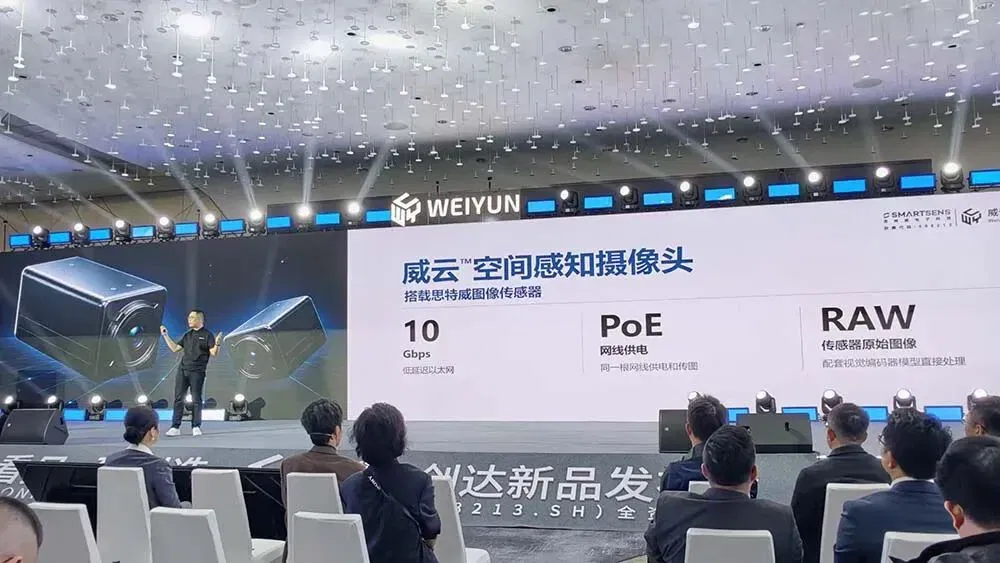
Specific applications include helping humanoid robots determine when to collaborate with people, helping unmanned devices judge whether they can pass through blind spots such as corners, and dynamically adjusting smart cultural and tourism guides' explanations based on visitors' locations and question histories.
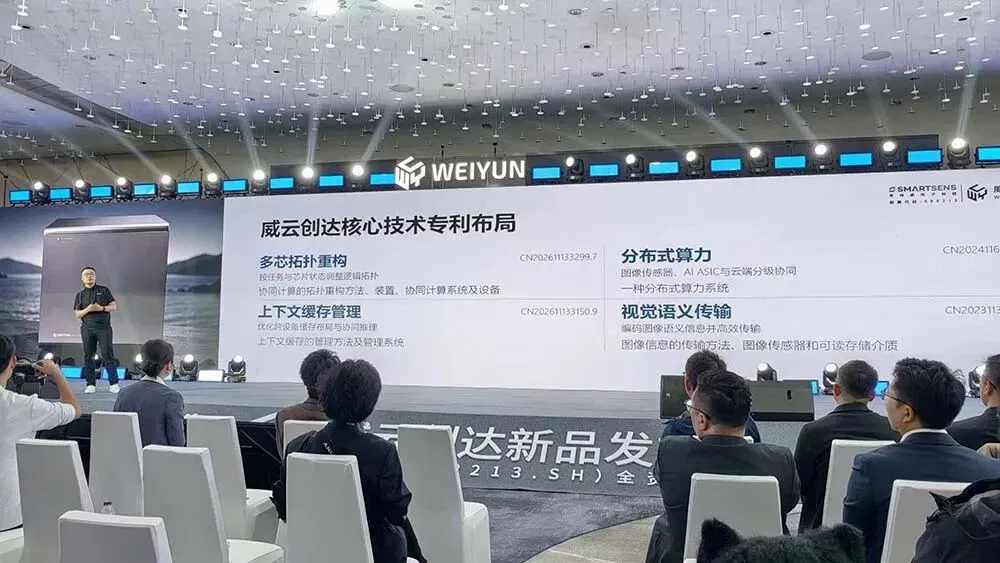
He concluded that these products draw on Weiyun Chuangda's R&D and patent portfolio in areas including multi-chip task topology adjustment, sensor and cloud-edge collaboration, reducing cache movement across devices, and efficient encoding and transmission of image semantics. The company's vision is to build global computing infrastructure for physical AI.
03.
Disclosing commercialization progress for the first time
Four deployment directions and a three-step development plan
Weiyun Chuangda COO Gao Tianhao then described the company's industry assessment, commercialization progress, and development plans for the next five years.
Gao believes the next wave of AI growth is shifting from content generation on screens to physical execution beyond them. After advances on the training side and applications in simulation, device-side deployment still faces many constraints under weak connectivity, disconnection, and complex real business conditions. He therefore sees a perception-interconnection-computation-execution chain combining local compute with real-time perception as the practical answer for most business scenarios.
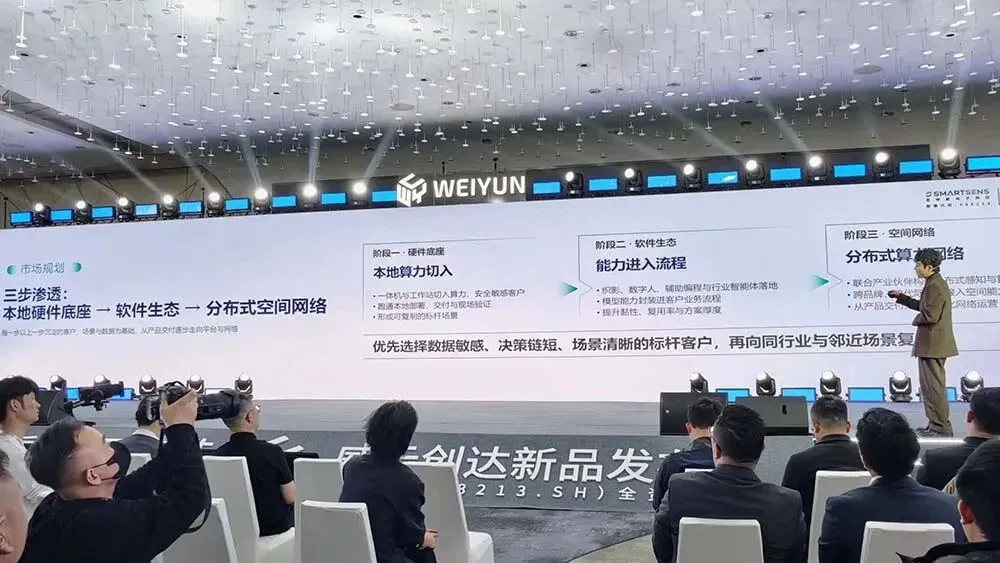
Citing research firms including IDC, he said the global physical AI market had reached $110.8 billion in 2026 and was growing at a compound annual rate of 30%. Separately, citing Bloomberg data, he said broadly defined global AI spending had reached $2.67 trillion in 2026. In the embodied intelligence segment, the current market had reached RMB 915 billion, with institutions forecasting compound annual growth of more than 100% in the Chinese market.
On the division of business responsibilities, Gao explained that under its '3+AI' strategy, SmartSens uses its accumulated CMOS image sensor technology to address how machines see. Subsidiary Weiyun Chuangda addresses how they compute and how applications are deployed through local physical AI computing infrastructure, accompanying software, and spatial perception agents.
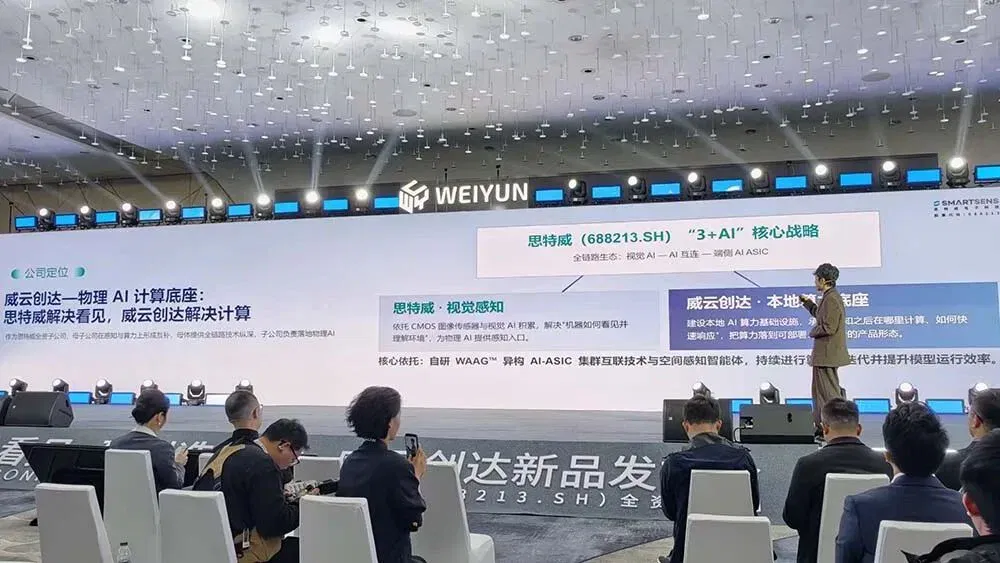
Enterprises commonly face three problems when deploying AI: dependence on external public clouds, risks of sensitive data leakage, and high hidden labor costs for tuning and implementation. Through WAAG heterogeneous AI-ASIC cluster interconnects and spatial perception agents, Weiyun Chuangda offers an integrated hardware and software solution for autonomous local deployment, aiming to cut deployment costs and improve operating efficiency.
Gao outlined four deployment areas where demand is currently most concentrated:
Smart manufacturing and industry, covering companies that manufacture and operate robots, drones, and similar equipment, with a focus on keeping data within its domain and ensuring low-latency, stable operation.
The digital economy and content creation: using Zhiying software and local workstations to meet the needs of digital human, AI short-drama, and other content creators for rapid production and keeping assets locally.
Individual developers and small development teams can use Weiyun Station and its built-in AI-assisted coding tools to improve the efficiency of debugging and validating specialized agents.
For government and state-owned enterprise customers, including centrally administered enterprises, Weiyun Chuangda can provide independent model training, fully local deployment, and packaged business workflows to meet stringent compliance and domestic IT requirements, reducing labor costs and protecting sensitive data.
On commercialization, Gao said roughly half a year had passed since internal incubation began this April. Although the company had only recently been formally registered, products delivered already exceeded RMB 50 million in value, covering cultural tourism, government affairs, enterprise management, and robot services.
He listed four deployment cases:
A municipal culture and tourism bureau in Hubei uses Weiyun's tourism digital human for scenic-area ticket sales and attracting visitors, and to generate local tourism AI short films.
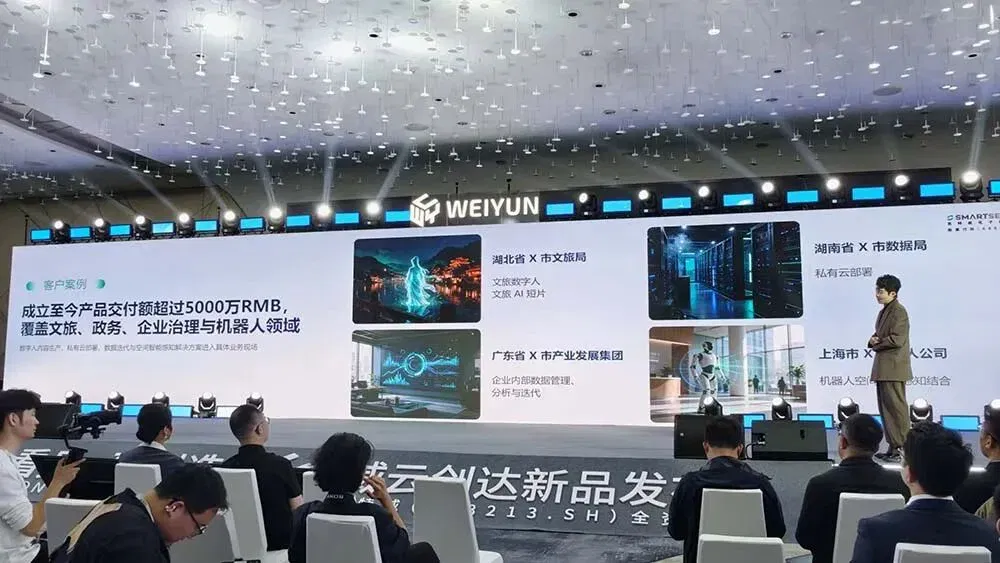
A data bureau in Hunan, handling large volumes of sensitive public-service data because it shares offices with a government service center, uses Weiyun's integrated hardware and software for private-domain deployment and data training.
An industrial development group in a Guangdong city, representing one of China's top-ten industrial parks, uses Weiyun equipment and models to manage data on internally incubated companies, investments, and financing, and to help assess future directions for industry clustering.
A local robotics company connected Weiyun equipment to process feedback from the external environment and perform iterative computation, improving its robots' response speed and self-iteration efficiency by more than 50%.
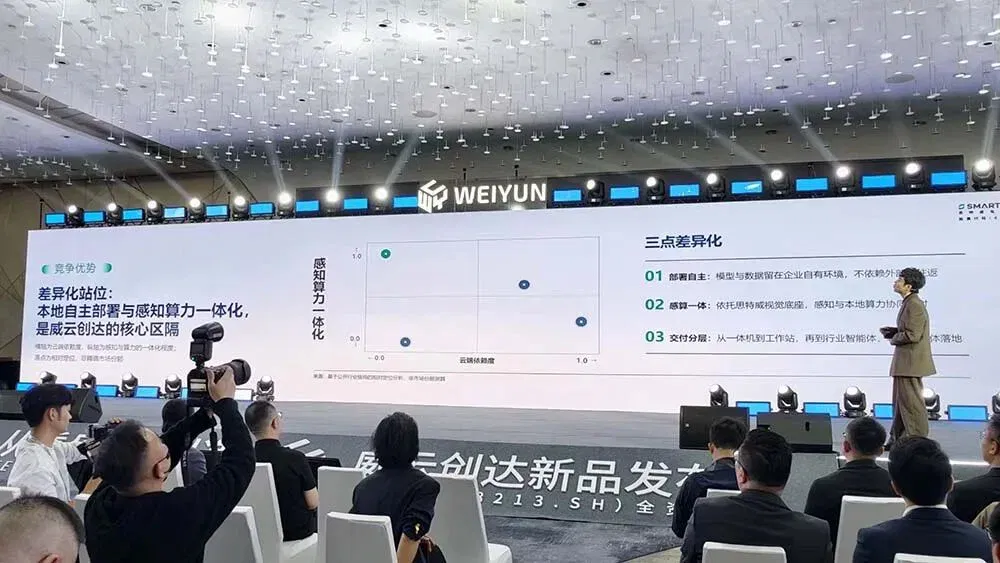
Gao summarized Weiyun Chuangda's distinctive design in three dimensions: autonomy of deployment, integrated perception and computation, and tiered delivery.
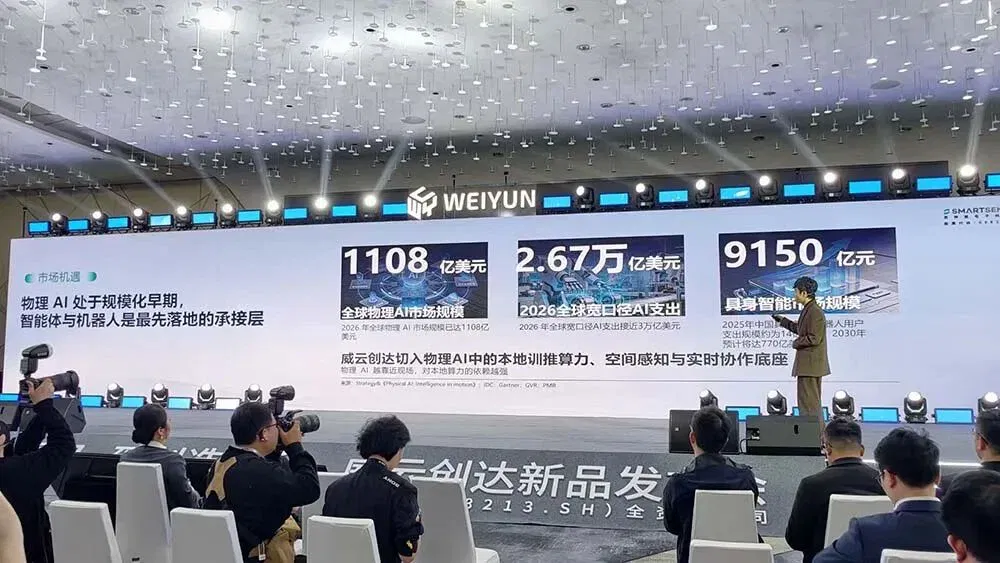
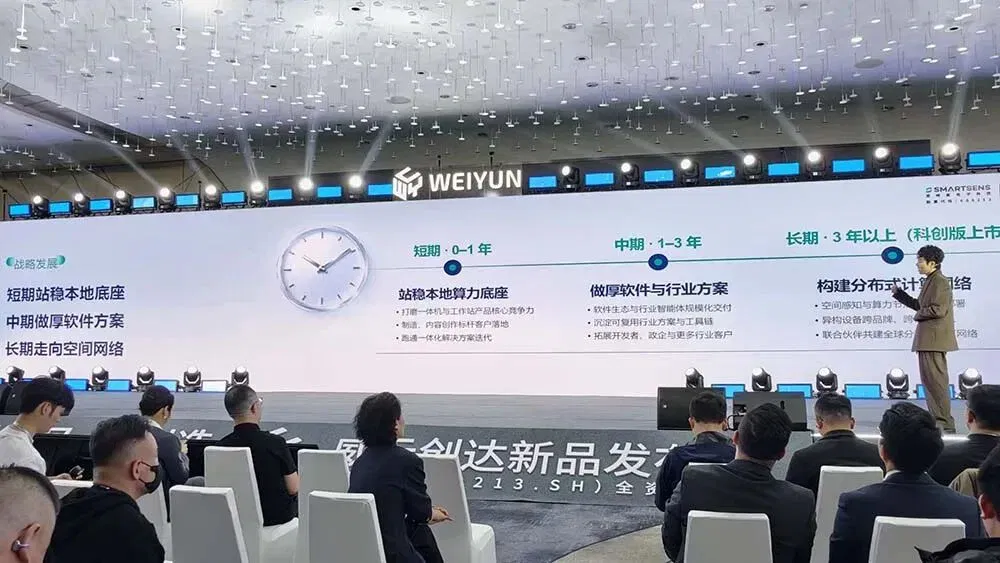
Looking ahead, the company has developed a phased, three-step strategy:
Short term, the current stage: establish a firm local compute hardware foundation and continue refining the core capabilities of integrated appliances and workstations. Validation of version 1.0 of the integrated solution has already been completed;
Medium term, the next one to three years: deepen software solutions integrated with application scenarios, work with industry partners to deliver industry agents at scale, and build reusable toolchains and industry solutions.
Long term, beyond three years: advance corresponding plans for a stock-market listing and work with global industry partners to build a distributed perception and compute network, bringing heterogeneous devices across brands and generations into a global spatial perception and compute network.
At the end of his presentation, Gao said that although Weiyun Chuangda was still young, the team hoped to draw on its parent's hardware expertise and cooperation with partners to establish a position in physical AI infrastructure, taking inspiration from SmartSens's growth from scratch to a leading position in CIS chips.
04.
Avoiding price wars and focusing on value
WAAG heterogeneous cluster interconnects as the core differentiator
According to the host and Gao, He earned his bachelor's and master's degrees in Tsinghua University's Department of Automation, originally researching neural networks. He joined SmartSens in 2018 and has now served for over eight years, previously working in chip R&D for a long time and accumulating related papers and patents. This April, the SmartSens group assigned him to form an AI project team and begin internal incubation. After three months, recognizing the project's prospects and iteration speed, the group decided to establish Weiyun Chuangda as a separate wholly owned subsidiary, appointing He to lead it and oversee new product development, product planning, and market expansion.
Gao earned his PhD at Shanghai Jiao Tong University, researching large language models. He said he had joined Weiyun Chuangda only a month earlier and was responsible for operations and commercialization.
Asked how a new entrant in compute could avoid price wars and build differentiated barriers to competition, He said the compute and large-model markets had already developed over many years. Weiyun Chuangda had targeted physical AI, a cross-industry field, from the outset. Its entry point came from SmartSens's accumulated visual perception expertise. Many of the customers SmartSens already served were themselves part of the AI ecosystem. The team decided to enter this field only after observing the practical pain points those customers encountered in deploying AI.
On its technical approach, He further explained the distinctive design of WAAG heterogeneous AI-ASIC cluster interconnect technology. He noted that conventional servers, whether in edge server rooms or IDC data centers, are generally built around multiple CPUs, DDR memory modules, accelerator cards, and storage. Weiyun Chuangda's WAAG architecture can directly eliminate conventional CPUs and DDR. He believes AI-ASIC chips themselves already have the capacity to execute management computation and handle communication both within a single system and between interconnected nodes across machines.
He also emphasized the advantages of collaboration across the supply chain. As a CMOS image sensor vendor, SmartSens naturally has close upstream and downstream relationships with many SoC and AI-ASIC vendors. Since WAAG remains open, SmartSens's existing industry partners can directly become ecosystem partners for Weiyun Chuangda, integrating their chips into WAAG. He said this design avoids direct competition with SmartSens's existing customers while drawing on the chip mass-production capabilities of SmartSens and its partners to ensure stable deliveries and continued product iteration.
Weiyun Chuangda built WAAG, but the architecture is not tied to one particular chip. Instead, it targets a category of chips: products from any vendor can connect as long as they meet WAAG's interconnection standards.
Gao added that the launch did not emphasize a price advantage. In his view, competition in AI, especially physical AI, has moved from simple low-price bidding toward overall value and practical business performance, and customers have become more mature. Enterprises care more about solutions with a higher return on investment. While Weiyun Chuangda pays attention to price, it places greater emphasis on solving customers' actual business problems quickly with higher energy efficiency.
On the company's long-term positioning, He believes there is no need for an overly narrow definition; the focus should return to the vision of building physical AI infrastructure. He said Weiyun Chuangda wants to connect widely with partners through ecosystem cooperation. On one side, it works with existing agent development solution providers, offering technical guidance to adapt their work to Weiyun compute products. On the other, it directly supports customers with larger-scale needs or requirements for a deeper understanding of the physical AI industry. The overall collaboration model centers on helping customers unlock productivity.
On business positioning, Gao confirmed that Weiyun Chuangda handles the device-side AI-ASIC component of SmartSens's globally announced '3+AI' strategy, which does include serving its parent company. SmartSens had established a leading position in CIS chips, but external suppliers could not meet its needs for supporting physical computation, giving rise to this project.
He also believes technical R&D and product barriers are a company's core competitive strengths. With its own development and iteration capabilities, Weiyun Chuangda is now serving more large external customers comparable in size to SmartSens.
He analyzed the value of WAAG heterogeneous AI-ASIC cluster interconnects and spatial perception agents in real products from two perspectives: the hardware supply chain and the evolution of embodied intelligence.
On WAAG cluster interconnect technology, He said the solution can independently bring up computing capacity using only an AI-ASIC cluster, something he described as unique in the industry. With the semiconductor supply chain broadly tightening and supplies of CPUs, DDR, accelerator cards, storage, and even small electronic components under pressure, removing redundant hardware helps simplify the system's bill of materials. Compatibility with multiple vendors' AI-ASIC chips also diversifies dependence on any single supply chain and expands the network of industry partners.
For spatial perception agents, He summarized three layers of significance:
Connecting the existing device ecosystem: SmartSens image sensors are already widely used in AI devices such as smart security systems, smart vehicles, and smartphones. Spatial perception agents can link directly with large numbers of devices in the parent's existing ecosystem.
Addressing the training-data bottleneck in embodied intelligence: He has observed that, starting this year, large language models are incorporating more and more data related to embodied intelligence and spatial perception, supporting continued capability development along scaling laws.
He believes that although the embodied-data collection industry is growing, collecting data solely through unmanned devices themselves is far from enough. Most existing humanoid robots, for instance, can operate only within limited areas and at fixed positions, perceiving only their immediate surroundings and struggling to act across spatial domains. External spatial information must therefore supplement them so that unmanned devices can learn across spatial domains.
Supporting real-world inference and human-machine collaboration: Even after model training is complete, unmanned devices still depend on continuous external environmental perception when performing tasks and inference in real physical settings. He expects the future physical world to require widespread deployment of visual, audio, tactile, and other sensors to help unmanned devices act autonomously and collaborate with humans.
05.
Conclusion: architectural innovation addresses enterprise AI deployment challenges
More commercial value emerges from physical AI
Overall, Weiyun Chuangda's launch builds on WAAG heterogeneous AI-ASIC interconnect technology as its core foundation, creating device-side and edge AI training and inference solutions ranging from desktop workstations and 2U enterprise appliances to 8U/12U flagship systems. Preinstalled software targets specific applications including filmmaking, physical spatial perception, and industry agents.
From an industry perspective, open-source large models with hundreds of billions or even trillions of parameters and MoE architectures continue to evolve. Enterprise demand for private AI deployment keeps growing, but the challenges are increasingly pronounced too. As with Weiyun Chuangda, using integrated hardware and software solutions to lower the barriers to AI deployment for businesses and small and medium-sized teams is becoming a major direction explored by local AI computing infrastructure vendors.
This article is from Zhidongxi, by Yunpeng.
Related topics
After reading
Join the AINRK community
Read how to join the community and connect with people working in AI.
Related articles
Continue reading related topics and articles in this category.

Bezos Discusses Prometheus Engineering AI: Funding, Simulation and Early Tests (opens in a new tab)
Citing Bezos at a Semafor summit, the report says Prometheus has raised about $14.5 billion and is developing engineering-design and multiphysics AI tools tested in two Blue Origin projects. No public launch date has been given; a general AI engineer remains a goal.
LiberAI's Liu Songming on connecting models, hardware and data for physical AI (opens in a new tab)
LatePost interviews LiberAI founder Liu Songming about Liber-0, glove-based data collection, robot hardware, full-stack integration and commercial use cases. The 2.2 million data hours and test results are team claims; a flagship application remains a goal.
PaXini's Xu Jincheng on tactile sensing, embodied data and robotic execution (opens in a new tab)
In an ALIGNMENT conference talk, PaXini founder Xu Jincheng describes tactile sensors, data collection, VTLA models and execution hardware, discussing how perception, intelligence and execution work together. Product capabilities are claims disclosed in the talk.
威滕在手征费米子预印本中记录 Claude 提出的插值思路 (opens in a new tab)
爱德华·威滕在一篇格点规范理论预印本中采纳了 Claude Opus 5.5 建议的插值变体,并在致谢中说明 AI 对若干细节的协助。
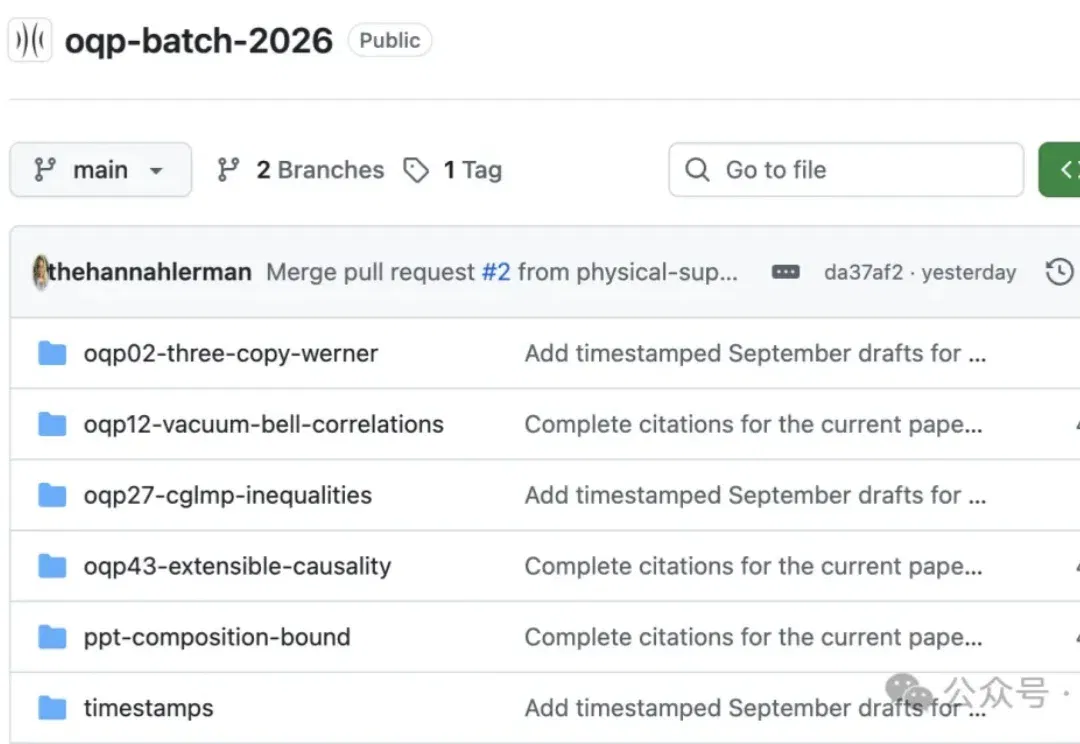
PSI 公布五项量子信息研究结果与 Lean 形式化材料 (opens in a new tab)
Physical Superintelligence 公布与开放量子问题目录相关的五项研究结果,并提供论文和 Lean 形式化材料供审查。结果涉及纠缠、贝尔不等式和量子因果过程等方向;各项结论有具体适用条件,需要区分对原问题的局部推进与完整解决。