PEEK cuts FID by 49.3% in a specified ImageNet-EDM diffusion-sampling experiment
NUS’s training-free PEEK adjusts deterministic diffusion sampling with look-ahead predictions. At an equal denoising-call budget, one ImageNet-EDM experiment lowers FID from 19.71 to 9.99. Results and one-time search costs depend on the setup.
Editorial fact-check (November 24, 2026): The paper compares equal numbers of denoising-model function evaluations (NFE), rather than simply equal numbers of ordinary sampling steps. In the reported ImageNet-EDM setting, FID falls from 19.71 to 9.99: a relative reduction of 49.3% and an absolute reduction of 9.72 points, not 49 points. Look-ahead calls are included in the budget. The maximum search time of 2.2 minutes is the one-time calibration time under the paper’s experimental conditions, not a fixed cost for every model and hardware configuration. PEEK paper v2: Table 3 and calibration costs (opens in a new tab)
Drawing with a diffusion model is like finding an image in noise. Taking a few more sampling steps will usually make the picture clearer. But if it goes off track at the beginning, even detailed work later on can make matters worse.
PEEK, proposed by a team at the National University of Singapore, aims to solve this problem by “peeking one step ahead.” Accepted at NeurIPS 2026, the research requires no model retraining. It changes only how deterministic diffusion models are sampled: look ahead first, then decide how to move at the current step.
Why can an image drift further off course?
During training, different levels of noise are added to the same real image, but the denoising target is always the original image.
During generation, the process starts from pure noise, and the result of one step becomes the input for the next. Especially early on, the “clean image” predicted by the model is often still blurry and its shapes inaccurate.
This is exposure bias: training inputs come from “real images with added noise,” whereas generation requires handling “intermediate results the model generated itself, which may be wrong.” Errors can accumulate from one round to the next.
With a fixed model and sampler, conventional approaches mainly improve generation quality by increasing the number and density of sampling steps. That is not necessarily optimal at the same sampling cost. The team reasoned that as sampling progresses, the input becomes less noisy and the model’s output image generally becomes clearer. If the next prediction may be clearer, higher quality and closer to the real images used in training, why not use it as a model input to improve the current step’s output?
Sketch first, then commit the stroke
Imagine a painter: ordinary sampling means making a stroke and inspecting it. PEEK first rehearses the next stroke mentally, checks how the result could improve further, then returns to the original position and draws the improved version directly.
Specifically, it first temporarily advances to the next step, predicts a clean image again at a less noisy position, then returns to the current state and uses the look-ahead prediction as input to recompute and commit the current step’s output.
The mathematical logic is consistent, too: during training, different noise levels correspond to the same clean target. Thus, in a deterministic sampling update, swapping a later step’s output forward to serve as a model input does not conflict with the sampling logic of diffusion generative models.
Rather than simply adding ordinary sampling steps and dividing the trajectory more finely, PEEK has an opportunity to correct a deviation earlier and prevent further errors from accumulating.
- Paper: https://arxiv.org/abs/2611.05407
- Project website: https://dachengruoque.github.io/PEEK-Video/
- Video introduction: https://dachengruoque.github.io/PEEK-Video/PEEK.mp4
- Code: https://github.com/DaChengRuoQue/PEEK
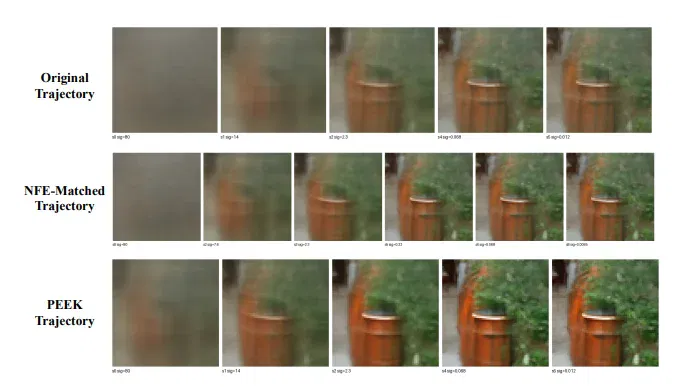
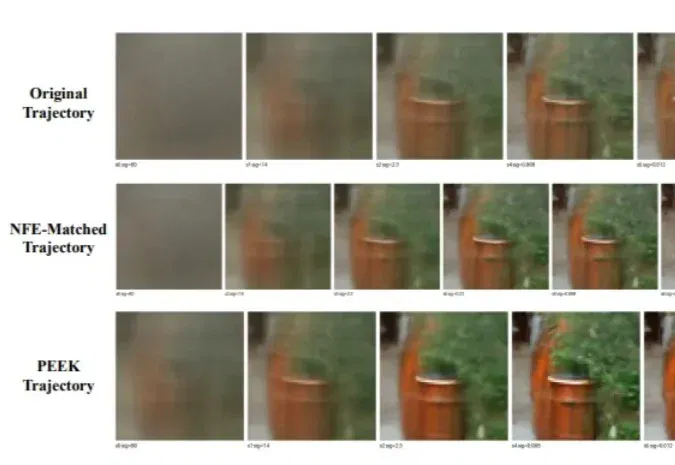
Figure 1 from the paper: trajectories for ordinary sampling, sampling with the same NFE, and PEEK
Which steps are worth a “peek”?
Each extra look consumes another model evaluation. If the look-ahead prediction is also biased, it may amplify the error. Different models also benefit from peeking at different positions.
To address this, PEEK can optionally use greedy search to identify useful positions incrementally. A look-ahead is retained only if it improves the result and outperforms ordinary sampling with denser steps and the same number of model evaluations. FID is the default measure: a lower value indicates that the overall distribution of generated images is closer to that of real images. The search can also optimize other metrics, such as diversity measures or combinations of several metrics.
The search computation itself is also optimized with caching. The team designed two caches: a prefix cache stores noise states that have already been computed; a noise-remapping cache allows ordinary sampling to reuse existing results when time positions are adjusted.
In a nine-step search, the number of function evaluations falls from 225 to 78, a reduction of 65.3%. For a given model, sampler, number of sampling steps and optimization metric, the search is needed only once in advance, rather than for every image. The longest search time reported in the paper is just 2.2 minutes; a nine-step search on CIFAR-10 takes about 20 seconds. This one-time search is PEEK’s only additional cost.
The team also proposes PEEK-G: PEEK mainly chooses which step’s “clean image prediction” to use, whereas PEEK-G mixes the current and one-step-ahead sampling directions in proportion, offering a more flexible way to correct deviations for DPM-Solver-type samplers.
How well does it work? Both the numbers and images offer evidence
The team tested different models on datasets including CIFAR-10, LSUN Bedroom, ImageNet and MS-COCO, covering different resolutions, pixel and latent spaces, and unconditional and text-to-image generation. It also evaluated multiple samplers.
Under the same model-evaluation budget, ImageNet-EDM’s FID falls from 19.71 to 9.99, a reduction of 49.3%; LSUN Bedroom EDM falls from 22.89 to 11.77, a reduction of 48.6%; and one nine-step experiment on CIFAR-10 falls from 25.80 to 20.23, a reduction of 21.6%. PEEK-G also achieves a 26.0% reduction in FID on MS-COCO.
In the paper’s image comparisons, bedding and curtain details in bedrooms are more distinct, and cyclists’ outlines are clearer. PEEK tries to improve the image while following the original direction of generation.
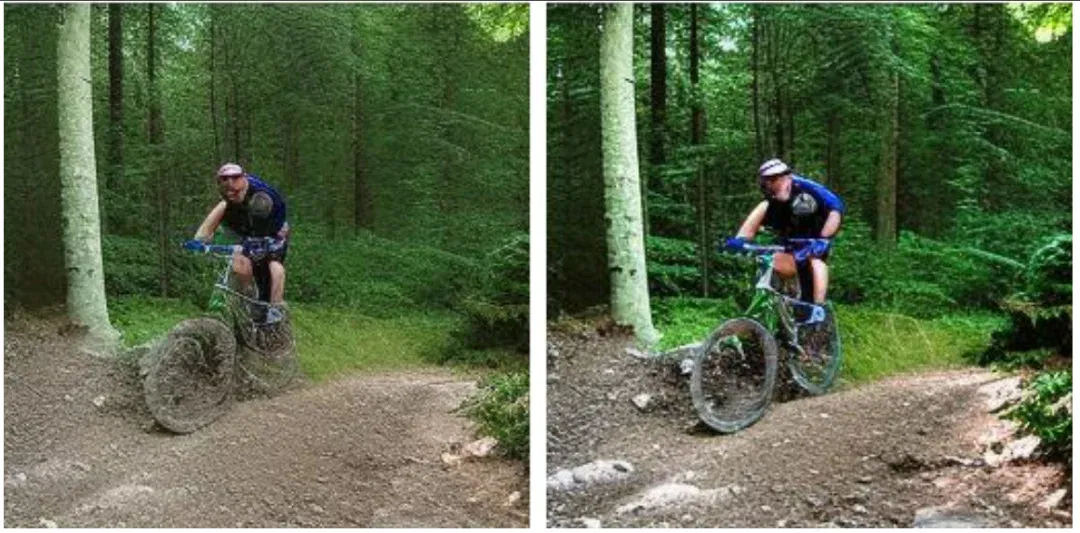

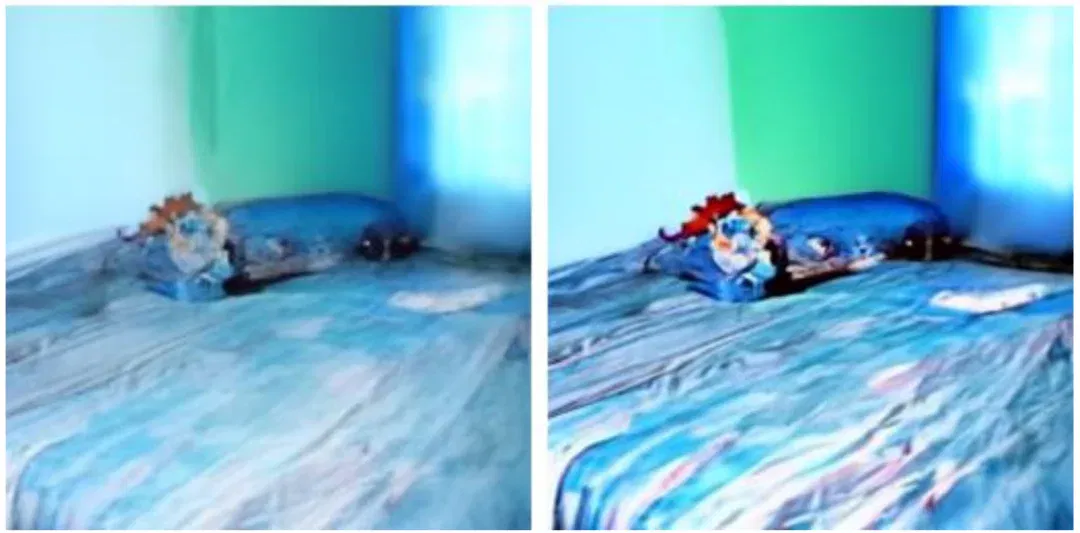
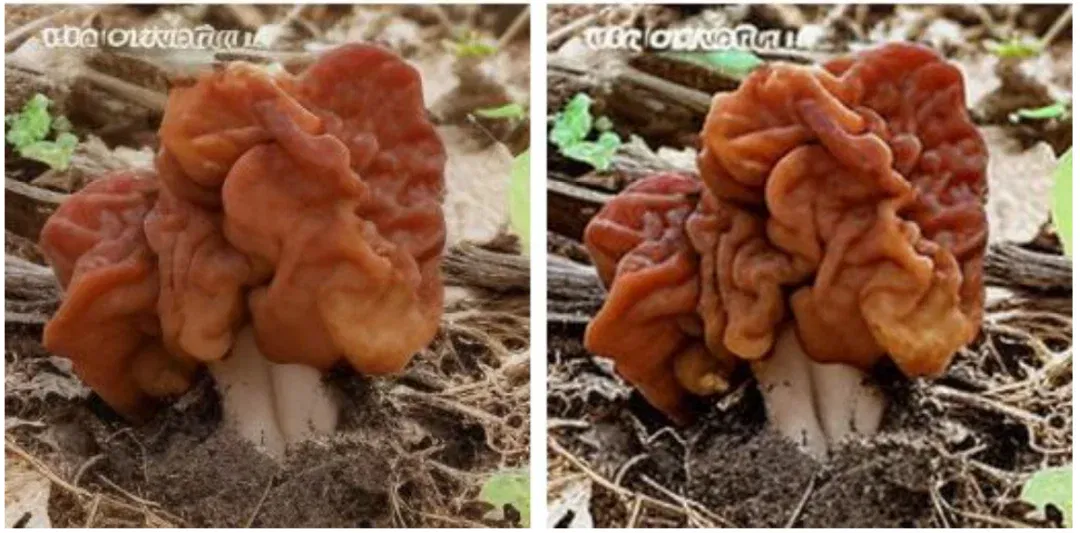
Comparison of results with the same number of computational steps
However, results differ across models, and PEEK cannot guarantee the same magnitude of improvement for every model. Still, the research offers a new perspective: computing power need not all go toward taking more steps; checking the direction in advance matters, too.
To summarize its advantages, PEEK can substantially improve sampling results for some models, with a relative FID reduction of up to 49.3% in the specified ImageNet-EDM experimental setting. The model itself requires no retraining; the only additional cost is an optional one-time search, and the method is not restricted to a particular model or sampler.
About the authors
First author Bai Yunwei earned his bachelor’s and doctoral degrees in computing at the National University of Singapore. His research mainly concerns multimodal learning, large language models and model generalization. Second author Tan Ying Kiat received a full undergraduate scholarship and graduated from Stanford University with a double major in electrical engineering and sociology, then earned a doctorate in computing at the National University of Singapore. He previously worked for the Singapore Armed Forces and the government, and currently focuses on large language models and recommender systems. The first and second authors’ adviser is Professor Tsuhan Chen, a former deputy president of the National University of Singapore.
This article comes from Synced, written by Bai Yunwei.
Related topics
After reading
Join the AINRK community
Read how to join the community and connect with people working in AI.
Related articles
Continue reading related topics and articles in this category.

RUC open-sources AutoMaster: Skill guidance and trajectory selection for agent post-training (opens in a new tab)
RUC introduces Skill-FT and AutoMaster. Across six settings with a fixed teacher, task pool, 512 selected trajectories per round and SFT recipe, gains over Vanilla SFT are 1.42–8.99 percentage points. Multiple rounds require extra sampling, training and evaluation.
WeChat open-sources WePocketModel, unifying representation, generation and decision with one backbone (opens in a new tab)
Tencent's WeChat team releases WePocketModel, sharing one backbone across representation, generation and decision. WePM-4B uses 61.9% less resident weight memory than the selected specialist stack. Its roughly 8GB is BF16 weights, not total runtime memory; demos use an M5 Mac.
Peking University Open-Sources PipeLink to Make GPU Kernel Optimizations Reusable (opens in a new tab)
Peking University's PipeLink declares interfaces, synchronization and resource needs for GPU stages, checks contracts and links stages into fused kernels. Examples span toolchains, attention variants and communication-compute fusion; gains depend on components, workloads and hardware.
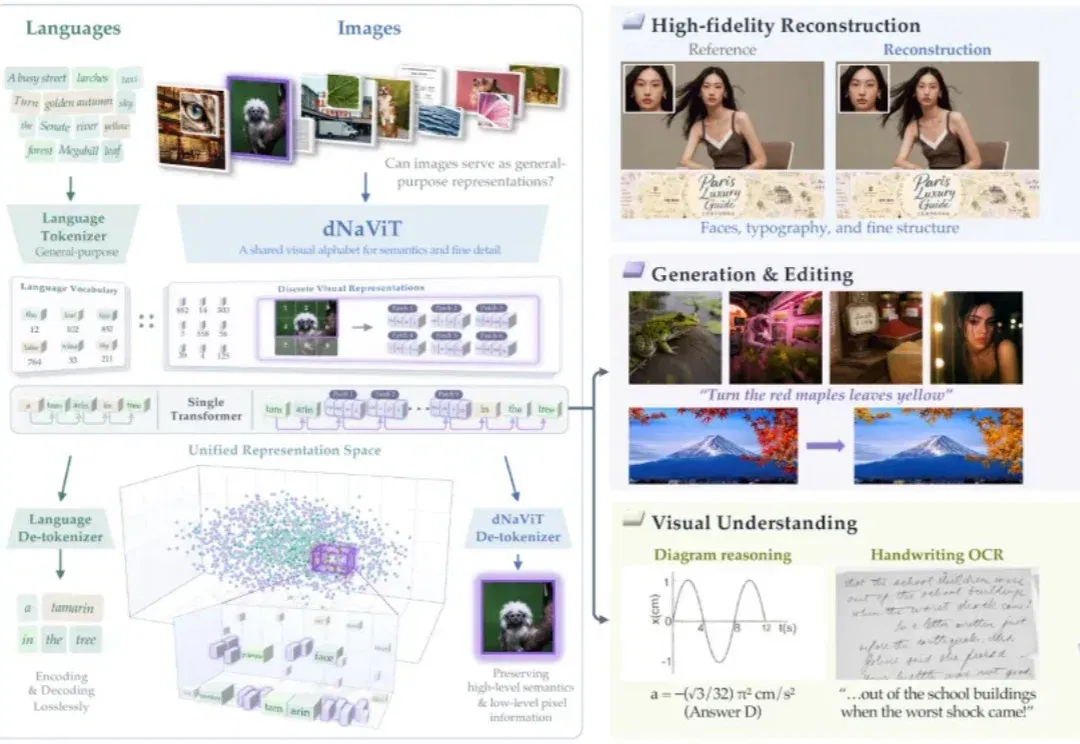
Can Discrete Codes Become a General Visual Representation? Meituan LongCat Open-Sources dNaViT (opens in a new tab)
Meituan LongCat's dNaViT combines a frozen visual encoder, residual modulation and grouped quantization to retain semantics and pixel detail. The team reports reconstruction, understanding, generation and editing through one encoding interface, with task-specific models and decoding branches.
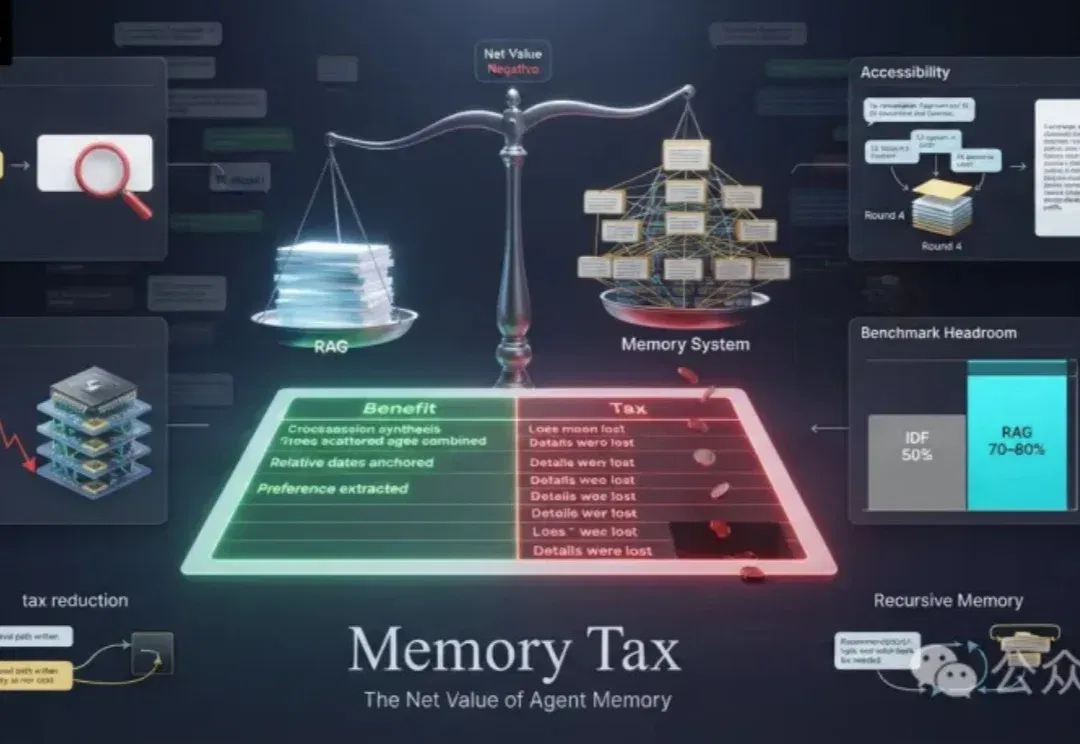
Memory Tax study compares 11 agent-memory systems with naive RAG on net value (opens in a new tab)
Researchers compare 11 memory systems with naive RAG across three main benchmarks and three backbone models. Benefits and memory tax depend on configuration, retrieval scope and tasks; the findings do not imply long-term memory is universally useless.