RDQA Raw-File Retrieval Test: Best Adjusted Accuracy among 12 General-Purpose Agents Is 24%
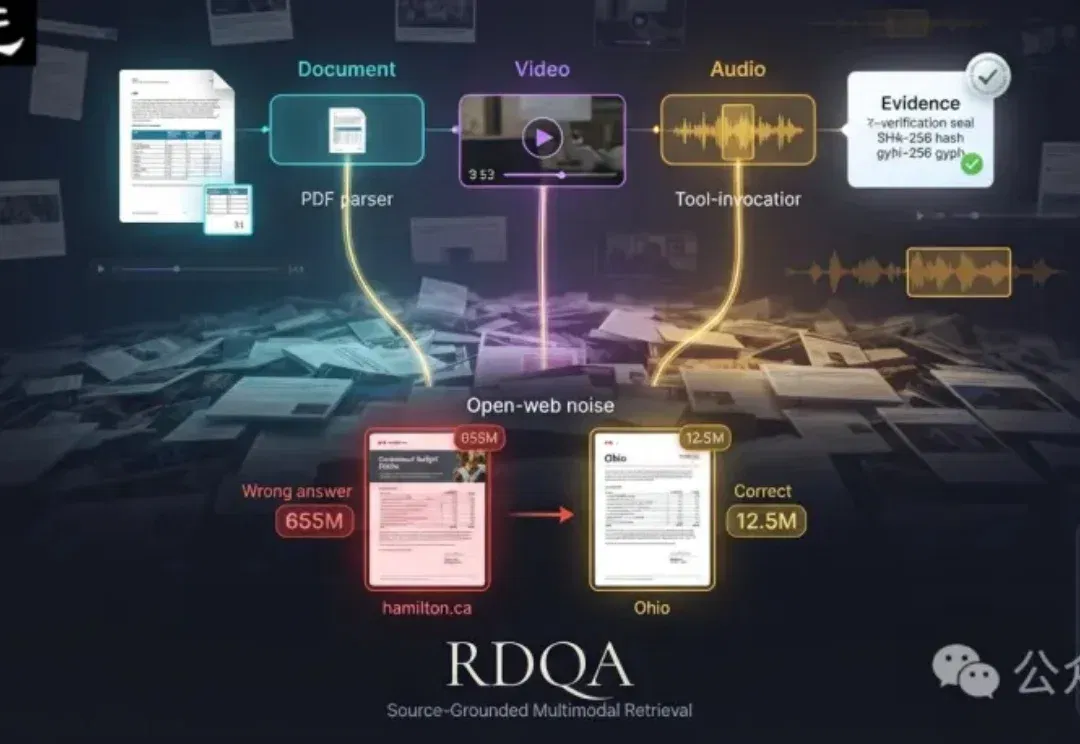
RDQA asks agents to find and parse sources for 1,350 document, video and audio questions. The best of 12 general configurations scores 24.0% PLR-adjusted accuracy, versus 57.5% for humans and 41.1% for a reference baseline. Failing specified-source verification does not establish memorization.
Editor's fact check (2026-11-25): The 24.0% in this article is the highest PLR-adjusted accuracy among the 12 general-purpose configurations tested in a single run, not a universal accuracy figure for all agents or tasks. PLR checks whether the specified source file was obtained and a parsing tool was invoked on it. Failing this check does not by itself prove that all answers came from parametric memory, nor that the system had a subjective intention to deceive. The paper notes that obtaining the same fact from another legitimate source can also count as leakage; adjusted accuracy should be understood alongside its source constraints and single-run limitations. Official RDQA paper: process verification, FILE-LEAK definition, closed-book control and limitations (opens in a new tab)
Document, video and audio understanding benchmarks usually give source files directly to models, testing comprehension of the supplied media. Examples include DocVQA, MMLongBench-Doc, Video-MME and MMAU.
Web and tool-use benchmarks test browsing and multistep operations, as in WebArena, OSWorld and GAIA. On GAIA, humans achieve roughly 92%, compared with around 15% for GPT-4 with plugins. Most tasks there can be answered from web text, with processing raw files being only one of the capabilities involved.
Retrieval-augmented generation benchmarks such as CRAG and RAGBench assume that documents have already been collected, chunked and indexed, after which the system searches that index.
RDQA (Raw Data Question Answering), presented as an EMNLP 2026 main-conference oral paper by researchers from the University of Texas at Arlington, East China Normal University and Georgia Institute of Technology, provides neither a prebuilt retrieval index nor source files in advance. During review, a question is rewritten or removed if its answer already appears as plain text on a public web page.
RDQA contains 1,350 questions spanning documents, video and audio. For every question, an agent must find the raw file itself, invoke parsing tools, locate a particular page, cell or second, and answer from the source file.
Paper: https://aclanthology.org/2026.emnlp-main.1855/
Code, data and evaluation scripts: https://github.com/Dextergao14/RDQA
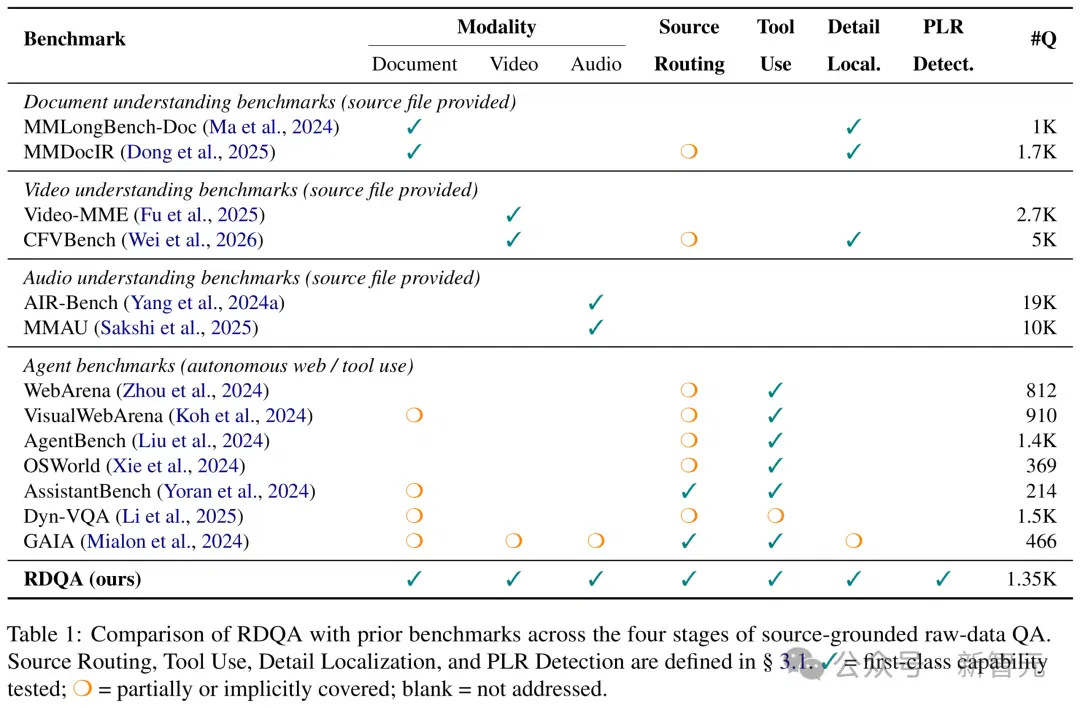
Table 1 (the paper's Table 1). ✓ denotes a first-class evaluation target; ○ denotes partial or implicit coverage; a blank indicates no coverage. RDQA makes all three modalities, source routing, tool invocation, detail localization and parametric-leakage-rate detection first-class targets, across 1,350 questions.
Among the 12 general-purpose agents, the highest parametric-leakage-rate-adjusted accuracy (PLR-adjusted accuracy, Acc_adj) is 24.0%, achieved by Hermes Agent + Gemini 3 Flash.
Under the same open-web conditions, four human participants average 57.5%. The reference baseline RDQA-Skill achieves Acc_adj of 41.1% and a Parametric Leakage Rate (PLR) of 2.4%.
PLR is the proportion of correctly answered questions for which the trajectory fails to show that the specified source file was opened and parsed. Acc_adj is the proportion of all questions with a correct answer that also passes this check. The highest PLR is OpenClaw + Qwen3.6 Plus at 96.0%.
The Hamilton Budget Question
Opened Another City's Website
The question asks for the amount allocated to infrastructure in the City of Hamilton FY2025 Budget Report. The model writes that it will check this report, but opens hamilton.ca—the website for Hamilton, Ontario, Canada—and answers $655 million.

Figure 1 (the paper's Figure 1). The model writes that it will check the FY2025 Budget Report, answers $655 million and bases its response on hamilton.ca.
The correct answer is the separately listed Infrastructure allocation in Hamilton, Ohio's report: $12.5 million.
The sample answer in Figure 2's left column is written as 12.5million. Highly ranked public web results are often summaries, press releases or another entity with the same name. Facts inside budget PDFs, procurement documents, financial reports, technical manuals, video frames, scrolling captions and recordings are often absent from those pages.
Section 3.1 divides each question into four steps.
- Source routing. Find the target raw file on the open web, bypassing summaries and press releases.
- Tool invocation. Download or buffer the file, then invoke a parser: PDF extraction or table reading for documents, frame sampling for videos, and transcription for audio.
- Detail localization. Find the specific page, table row, video timestamp or audio segment.
- Parametric knowledge suppression. Answers must come from retrieved evidence. Parametric memory may be outdated, incomplete or hallucinatory.
The three modalities require checking different materials. Figure 2 gives one question for each. The left column shows the budget question above. The middle asks what a character picks up before leaving at 3 minutes 53 seconds in Epitaph | 2; the answer is a red backpack. The right asks which segment mainly drove year-over-year revenue growth in Snowflake's latest earnings call; the answer is cloud services.
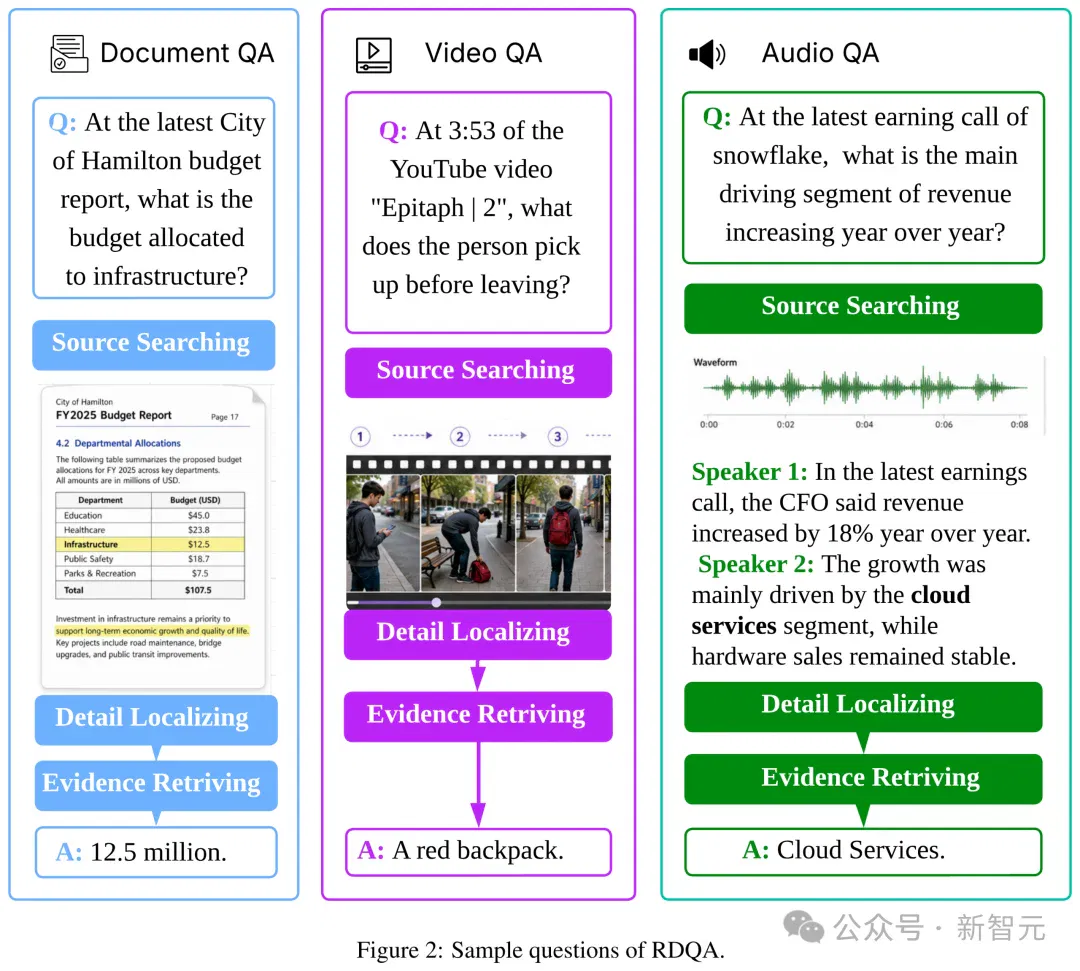
Figure 2 (the paper's Figure 2). From left to right: document, video and audio. Each column shows source finding, detail localization, evidence retrieval and the final answer, in that order.
1,350 Questions and Nine Capability Families
Source files fall into three categories. Government and regulatory portals provide budget reports and court documents. Technical and professional documentation includes specifications, vehicle manuals and course syllabuses. Public video and audio include YouTube, sports materials and podcasts. There are 1,350 files in total, one question per file, all written manually.
Annotations record SHA-256 hashes, download URLs, evidence locations (PDF pages and spans, or start and end times for video/audio), and several answer variants. Another annotator answers each question again using only the specified source file, checking the answer and evidence location.
Four rules guide question construction to reduce questions answerable from parametric memory alone: prioritize obscure entities; target fine-grained values in primary materials that require precise localization; include multiple similar distractors in the same file; and specify a page, cell or timestamp in the question.
The nine capability families form a 3×3 grid by cognitive complexity and source modality.
- L1 extracts one data point without computation.
- L2 extracts from multiple locations and performs one operation.
- L3 involves multistep reasoning. Answers cannot be verbatim repetitions of the source and must be closed-form: numbers, entities, dates, identifiers, yes/no judgments, or a selection from a given set. Open-ended summaries are out of scope.
Abbreviations combine {D, V, A} × {TE/IE, MO, RV}. D, V and A stand for document, video and audio; TE/IE denotes text or information extraction, MO multipoint operations, and RV reasoning and verification. The three L1 families are DTE, VTE and AIE; L2 comprises DMO, VMO and AMO; L3 comprises DRV, VRV and ARV.
The Θ(·) notation in Table 2 only illustrates cognitive complexity and typical numbers of evidence-extraction and computation steps.
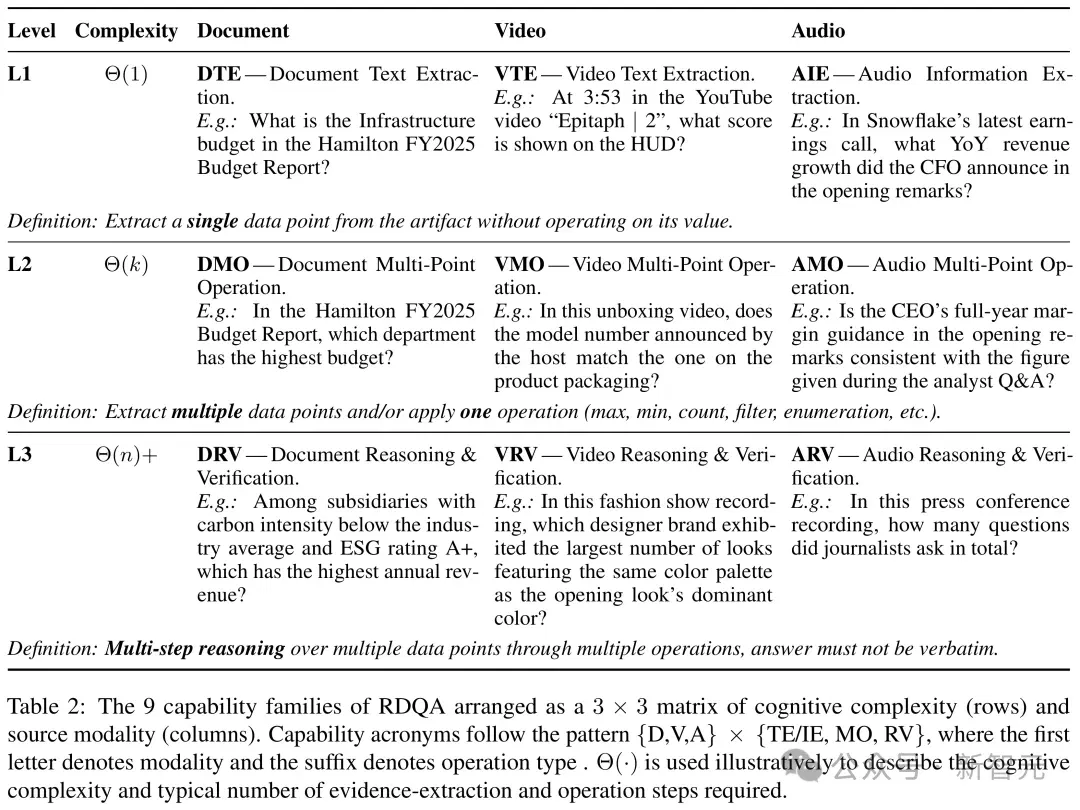
Table 2 (the paper's Table 2). Rows represent cognitive complexity; columns represent source modalities.
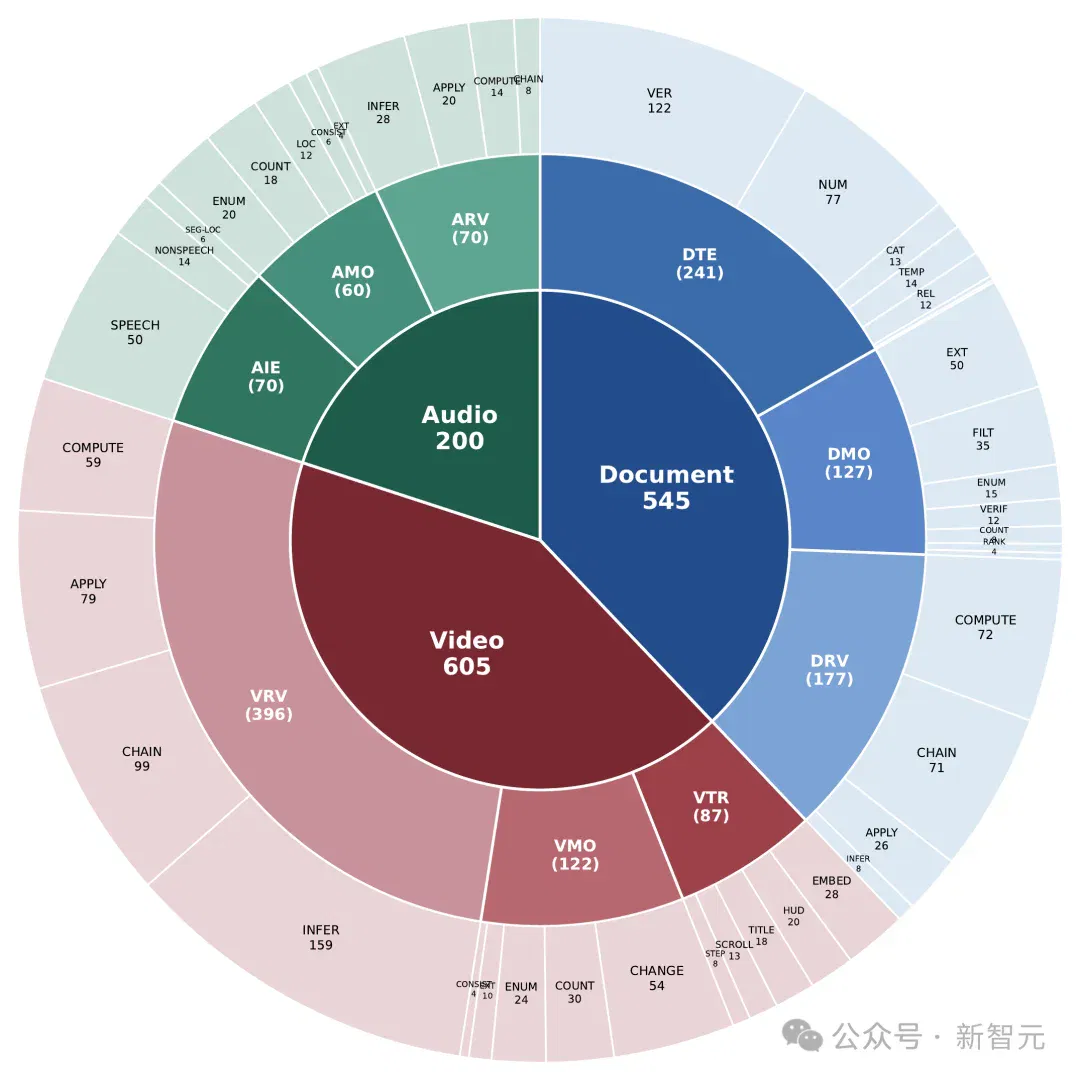
Figure 3 (the paper's Figure 3). The inner ring represents modality, the middle capability family and the outer subcategory. Documents have 545 questions (DTE 241, DMO 127, DRV 177); video has 605 (VTE 87, VMO 122, VRV 396); audio has 200 (AIE 70, AMO 60, ARV 70). The figure labels video L1 as VTR, while Tables 2 and 3 use VTE; both refer to 87 questions. VTE is used below.
Video is the largest modality, with 605 questions, including 396 in VRV, the largest capability family. Audio has 200 questions.
Scoring and Parametric Leakage Rate
Scoring has two stages (§3.3). Numbers, dates, identifiers and short factual strings first undergo normalized exact matching against answer variants. Unmatched answers go to Claude Sonnet 4.5 to judge semantic equivalence. This model is not among the evaluated backbones. Passing either stage counts as correct. The appendix reports a manual audit of all judge decisions, agreeing with human labels with zero false positives and false negatives.
This step considers only the answer. A correct answer is counted as correct even if its trajectory did not open the specified source file. PLR measures the share of correctly answered questions in this situation.
Trajectories record every search, URL and downloaded file, as well as the inputs and outputs of every tool call. ci=1 denotes a correct answer. ri=1 requires both of the following: the downloaded file's SHA-256 matches the annotated source, or the download address is the annotated original URL (golden origin URL); and the trajectory invokes a parsing tool on that file. Page numbers, timestamps and cells are recorded in annotations for question construction and manual checking. Current PLR does not require overlap with those annotated regions or time spans.

PLR's denominator is the number of correctly answered questions, and its numerator is those that fail the check above. The Hamilton budget question in Figure 1 is answered incorrectly, so it does not enter this denominator. Acc_raw (raw accuracy) considers only answer correctness. Acc_adj is the proportion of all questions for which ci and ri are both 1: answer accuracy multiplied by (1−PLR). When retrieval, parsing and extraction all operate on the annotated source file, PLR approaches 0.
The nine capability-family columns in Table 3 report answer accuracy for each family without multiplying by (1−PLR), so they cannot be compared directly with Acc_adj at the end of the same row.
Because the tasks require source access by design, the main results do not report tool-free accuracy: disabling tools measures parametric memory rather than capability on source files.
The appendix nevertheless runs a closed-book control on all six backbones, disabling search, browsing and file access while retaining the main experiment's scoring protocol. The highest score is 0.2% (GPT-5.2), while Qwen3.6 Plus and GLM-4.7v score 0.0%.
The few correct responses mainly involve counts or yes/no judgments, with answer formats relatively easy to guess. The main table compares backbones and scaffolds with tools enabled.
Experimental Results
The 12 general-purpose agents combine six backbones with two scaffolds: OpenClaw and Hermes Agent.
The closed-source backbones are Claude Opus 4.6, GPT-5.2 and Gemini 3 Flash, whose sizes are not disclosed in Table 3. The open-source backbones are Qwen3.6 Plus (27B dense), Kimi K2.5 (1T, A32B) and GLM-4.7v (355B, A32B).
Each agent runs in a separate Docker container. Tools are limited to its scaffold's standard set: web search, browsing and downloads, media parsing, and general filesystem operations. Annotated source files, annotations, answers and download caches are kept outside the containers on a separate scoring host. That host reads the trajectories afterward to calculate correctness and PLR.
The human baseline consists of four senior undergraduates or graduate students under the same conditions as the agents: open-web access without source files supplied in advance. For each question, they submit an answer, source URL and supporting evidence. Calculators and notes are allowed, with no time limit. Their individual scores are 56.8%, 58.0%, 60.5% and 54.7%, averaging 57.5% (appendix Table 9).
Their accuracy declines with cognitive complexity: 76.2% for L1, 63.9% for L2 and 42.8% for L3. Participants follow the same multistage process as agents and still choose incorrect sources, miss fine-grained details or lose attention during lengthy retrieval. The 57.5% reflects task difficulty under these conditions; human accuracy is far from saturated too.
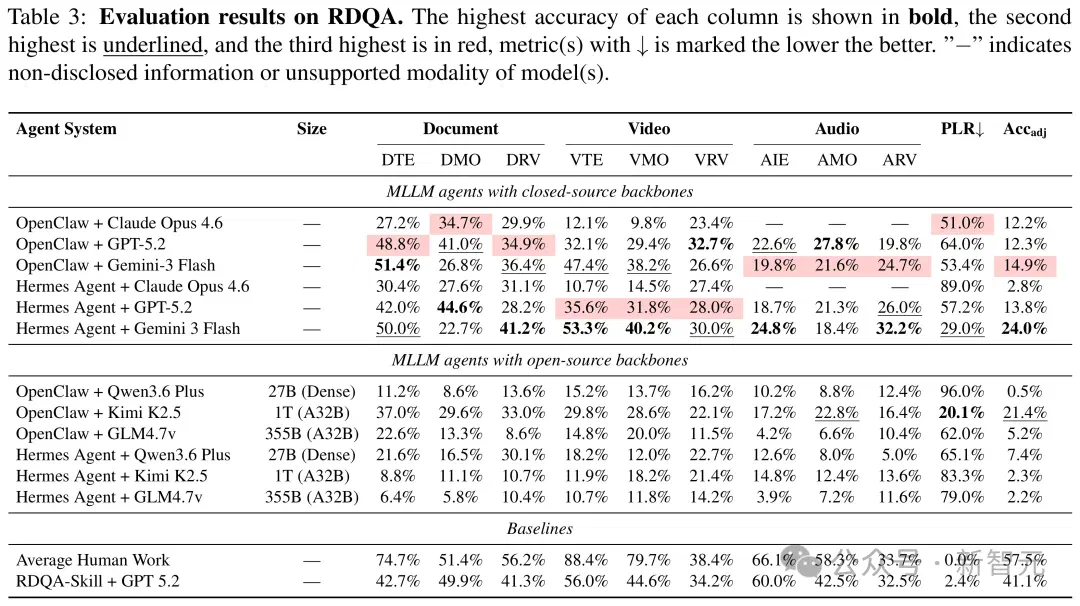
Table 3 (the paper's Table 3). Each capability-family column shows answer accuracy for that family. Lower PLR is better. An em dash (—) indicates an undisclosed model size or an unsupported modality. Both Claude Opus 4.6 rows show — for AIE, AMO and ARV.
The general-purpose agent with the highest Acc_adj is Hermes Agent + Gemini 3 Flash, at 24.0% with PLR of 29.0%. The best open-source configuration is OpenClaw + Kimi K2.5, at 21.4% with PLR of 20.1%. This is the lowest PLR among the 12 general-purpose agents, but it does not lead every capability family. No configuration yet reaches an accuracy at which users can entrust real-world source-file retrieval to an agent.
Among general-purpose agents, the highest AIE score is Hermes + Gemini 3 Flash at 24.8%, and the highest AMO score is OpenClaw + GPT-5.2 at 27.8%. On ARV, Hermes + Gemini 3 Flash scores 32.2%, compared with 33.7% for humans.
After a scaffold change, gains or losses depend on the backbone.
- For Qwen3.6 Plus, Hermes scores 30.1% on DRV versus OpenClaw's 13.6%. Their Acc_adj scores are 7.4% and 0.5%, respectively, while Hermes's PLR remains 65.1%.
- Kimi K2.5 achieves Acc_adj of 21.4% and PLR of 20.1% on OpenClaw; switching to Hermes gives PLR of 83.3% and Acc_adj of 2.3%.
- For GLM-4.7v, OpenClaw's Acc_adj is 5.2%, versus Hermes's 2.2%.
A better scaffold does more than supply additional tools: it must restrict shortcuts and retain evidence from source files. The backbone's reasoning during tool invocation and detail localization also affects results.
Capability-family accuracy includes shortcuts too. OpenClaw + Qwen3.6 Plus reaches double-digit scores in most document and video families, but with PLR of 96.0%, Acc_adj falls to 0.5%. Hermes + Claude Opus 4.6 also has substantial document and video answer accuracy, yet its PLR is 89.0% and Acc_adj 2.8%.
Correct-Answer Trajectories Fall into Three Categories
In §4.2, researchers inspect correct-answer trajectories from two backbones: closed-source Claude Opus 4.6 and open-source GLM-4.7v. Each correct trajectory is assigned to one of three categories by modality. This is manual classification, not automated statistics across all 12 systems, and it is not broken down by scaffold. Each percentage's denominator is the number of correctly answered questions in that modality.
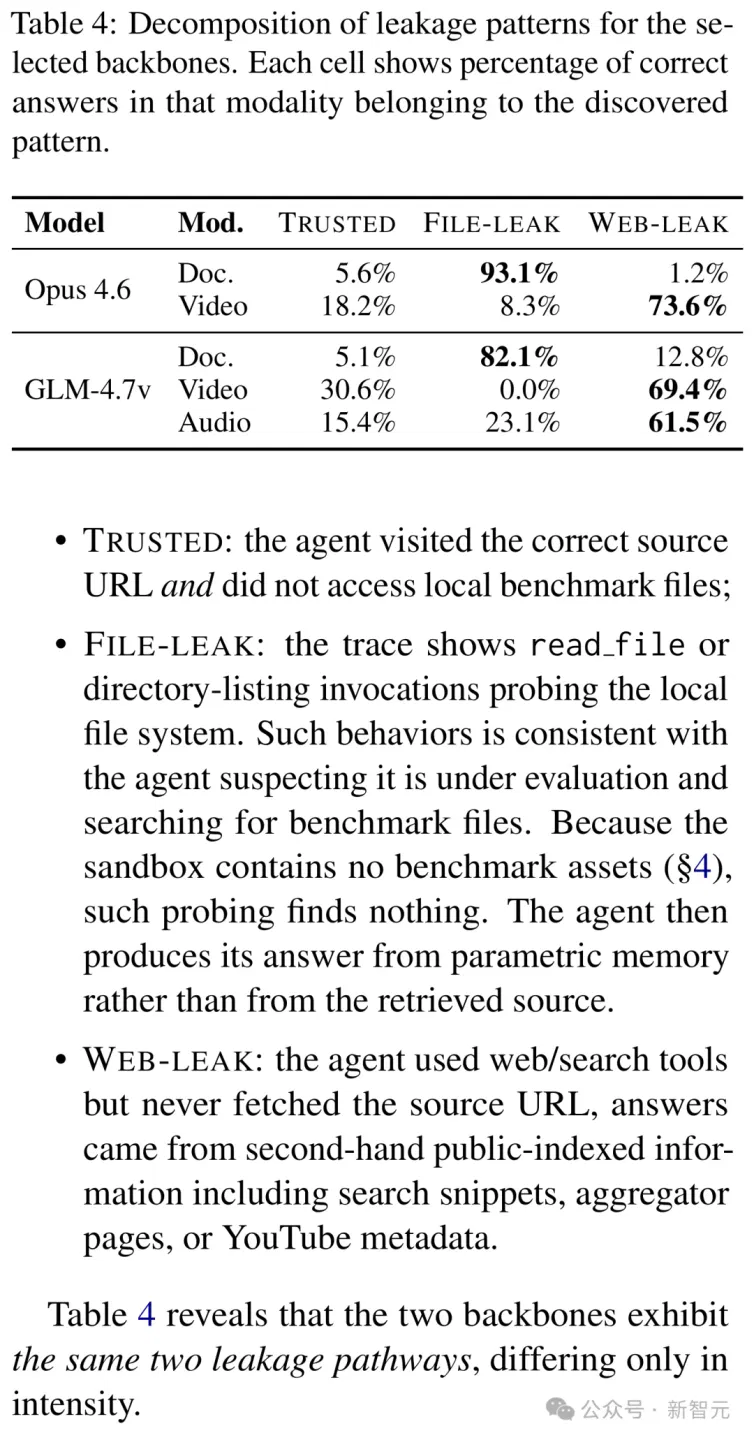
Table 4 (the paper's Table 4). TRUSTED: the correct source URL was visited and no local benchmark files were accessed. FILE-LEAK: the trajectory contains file reads or directory listings consistent with searching for evaluation files; the container contains no benchmark files, so probing cannot find them, and the subsequent answer comes from parametric memory. WEB-LEAK: search was used, but the annotated source URL was not fetched; answers came from search snippets, aggregator pages or YouTube metadata.
For both backbones, documents are dominated by FILE-LEAK and video by WEB-LEAK, with differing proportions.
In the order Claude Opus 4.6, then GLM-4.7v:
- For documents, TRUSTED accounts for 5.6% and 5.1%, and FILE-LEAK for 93.1% and 82.1%.
- For video, WEB-LEAK accounts for 73.6% and 69.4%.
- For GLM-4.7v audio, WEB-LEAK is 61.5% and TRUSTED 15.4%. Claude Opus 4.6 has no audio row, consistent with the empty audio columns in Table 3.
FILE-LEAK relates to tool exposure. A scaffold can block probing of benchmark directories and restrict irrelevant filesystem access.
WEB-LEAK relates to media tools and instruction following: systems need to inspect frames, timestamps and audio segments. Shi et al. (2025) evaluate media understanding after a source file has already been supplied to a model. RDQA additionally requires agents to retrieve and localize sources themselves and leave records in their trajectories.
Acc_adj is 2.8% for Hermes + Claude Opus 4.6 and 2.2% for Hermes + GLM-4.7v. Both have high PLR, while their capability-family answer accuracies differ. Their similar Acc_adj primarily comes from the scaffold rather than the two backbones' underlying multimodal capabilities.
The appendix's highest closed-book score is only 0.2%. These correct responses in the main experiment occur in tool-enabled evaluations. FILE-LEAK means the trajectory did not parse the specified source file into context, with the answer subsequently coming from parametric memory.
The RDQA-Skill Reference Baseline
For video and audio, systems often substitute search snippets, aggregator pages or platform metadata for inspection of the raw media.
Researchers add an evidence-localization loop to Hermes Agent using GPT-5.2 as the backbone. They call it RDQA-Skill and use it as a reference baseline to facilitate reproduction by subsequent work.
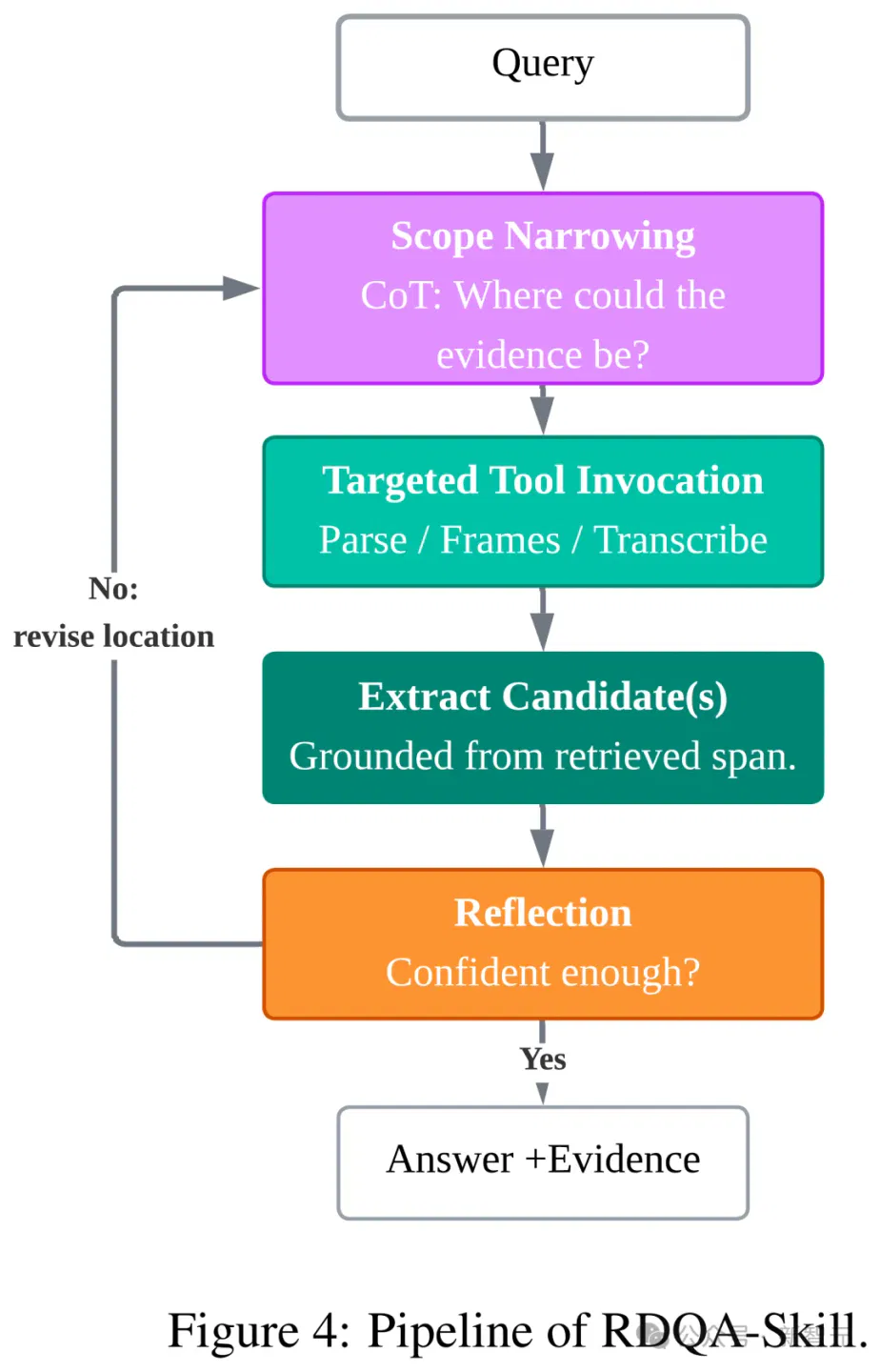
Figure 4 (the paper's Figure 4). If evidence is insufficient, inspect another part of the source file; output the answer and supporting evidence only when enough evidence is available.
Given a question, the loop has four steps.
- Scope narrowing. Use chain-of-thought to formulate a hypothesis about evidence location: which part of the source file is most likely to contain the answer?
- Targeted tool invocation. Parse, sample frames or transcribe specifically at that location.
- Candidate extraction. Extract candidates from the retrieved span; they must originate in that span.
- Reflection. If evidence does not sufficiently support the current question—for example, a candidate conflicts with its constraints—revise the location hypothesis, inspect another part and repeat the loop. When support is sufficient, output the answer with the evidence on which it rests.
This loop inspects raw media before submitting an answer. ri=1 records exactly this: the downloaded file matches the annotated source file, or its address is the annotated original URL, and a parsing tool has been invoked on the file.
In Table 3, Hermes Agent + GPT-5.2 and RDQA-Skill + GPT-5.2 use the same backbone. The former has Acc_adj of 13.8%, PLR of 57.2%, and AIE and AMO of 18.7% and 21.3%. The latter has Acc_adj of 41.1% and PLR of 2.4%, the lowest PLR among all agent configurations. Human-baseline PLR is 0.0%.
Audio is the loop's main target modality. AIE is 60.0% and AMO 42.5%. No other agent configuration exceeds 28% in either column. In the main experiment, general-purpose agents' audio gap largely arises because their scaffolds do not require source transcription.
The 41.1% is still more than 16 percentage points below the human average of 57.5%. With PLR already very low, the remaining errors come from detail localization and multistep reasoning. RDQA-Skill's answer accuracies in the three L3 families—DRV, VRV and ARV—are 41.3%, 34.2% and 32.5%, respectively. On DTE, Skill scores 42.7%, versus 50.0% for Hermes + Gemini 3 Flash. On VTE and VMO, Skill scores 56.0% and 44.6%, versus humans' 88.4% and 79.7%. It should therefore be treated only as a reference baseline.
Three Limitations
- Each configuration is evaluated only once, without variance estimates. Small differences between systems should not be interpreted as statistically significant rankings.
- PLR is a conservative estimate. It recognizes only a SHA-256 match with the annotated source file or a URL match with the annotated original URL. Reading the same fact from another legitimate source still counts as leakage. PLR therefore overestimates the proportion of shortcuts, and Acc_adj should be viewed as a lower bound on source-grounded answering capability.
- Questions depend on web pages accessible at the time. Broken URLs are excluded from scoring, so reported values describe the accessible subset.
Conclusion
RDQA evaluates whether multimodal agents can find raw files on the open web, invoke tools, locate fine-grained evidence and then answer from those files.
In this evaluation, general-purpose agents reach a maximum Acc_adj of 24.0%, humans average 57.5%, and RDQA-Skill scores 41.1%. Gaps between modalities are large, and switching scaffolds for the same backbone does not produce consistent gains or losses.
Capability-family answer accuracy includes web summaries, search snippets and parametric memory, making it higher than source-grounded answering capability. Acc_adj counts only questions whose trajectories demonstrate that the specified source file was downloaded and read by a parsing tool.
References:
https://aclanthology.org/2026.emnlp-main.1855/
This article comes from "Xinzhiyuan," written by "LRST."
Related topics
After reading
Join the AINRK community
Read how to join the community and connect with people working in AI.
Related articles
Continue reading related topics and articles in this category.
RynnVLA-Latent Pretrains on 30,000 Video Hours, Leading Compared Methods on Six Real-Robot Tasks (opens in a new tab)
DAMO Academy and collaborators use 3D-grounded latent actions to turn about 30.1K hours of diverse videos into pretraining supervision, then align to robot controls. Their 4B policy leads the compared methods on six real-robot tasks, within specific evaluations and still using real demonstrations.
From 2D to 3D: How Much Can Robot Manipulation Improve? Peking University and Partners Introduce JEPA4R (opens in a new tab)
JEPA4R learns a world model from point clouds, trains policies on frozen representations and transfers simulation-trained models to tested real robots. MetaWorld/Adroit Relocate success rates are 98.4%/88.0%; 1.1 cm over 200 steps refers to simulated point-cloud prediction.
RUC open-sources AutoMaster: Skill guidance and trajectory selection for agent post-training (opens in a new tab)
RUC introduces Skill-FT and AutoMaster. Across six settings with a fixed teacher, task pool, 512 selected trajectories per round and SFT recipe, gains over Vanilla SFT are 1.42–8.99 percentage points. Multiple rounds require extra sampling, training and evaluation.
WeChat open-sources WePocketModel, unifying representation, generation and decision with one backbone (opens in a new tab)
Tencent's WeChat team releases WePocketModel, sharing one backbone across representation, generation and decision. WePM-4B uses 61.9% less resident weight memory than the selected specialist stack. Its roughly 8GB is BF16 weights, not total runtime memory; demos use an M5 Mac.
PEEK cuts FID by 49.3% in a specified ImageNet-EDM diffusion-sampling experiment (opens in a new tab)
NUS’s training-free PEEK adjusts deterministic diffusion sampling with look-ahead predictions. At an equal denoising-call budget, one ImageNet-EDM experiment lowers FID from 19.71 to 9.99. Results and one-time search costs depend on the setup.