From 2D to 3D: How Much Can Robot Manipulation Improve? Peking University and Partners Introduce JEPA4R
JEPA4R learns a world model from point clouds, trains policies on frozen representations and transfers simulation-trained models to tested real robots. MetaWorld/Adroit Relocate success rates are 98.4%/88.0%; 1.1 cm over 200 steps refers to simulated point-cloud prediction.
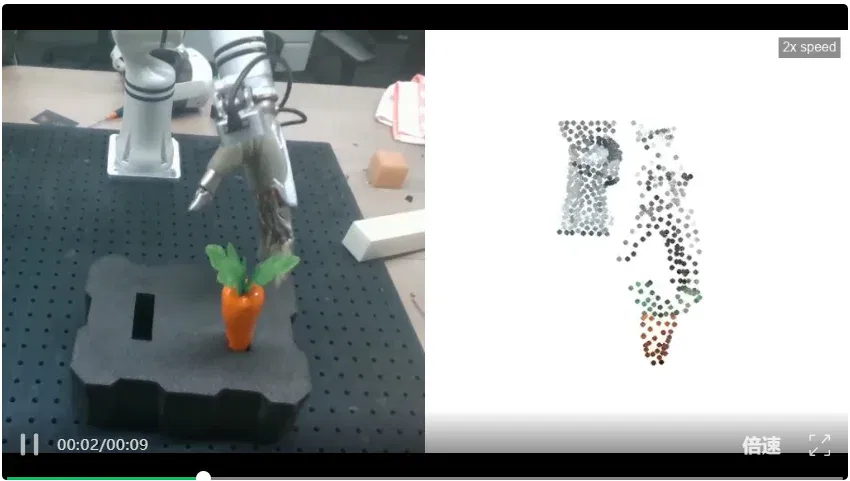
A parallel gripper picks up a carrot from a table and pushes blocks; a dexterous hand removes a bottle and a banana from fixed slots.
The world model and action-policy heads behind these operations were trained only in simulation, then deployed directly on a real robotic arm without fine-tuning on real-robot data.
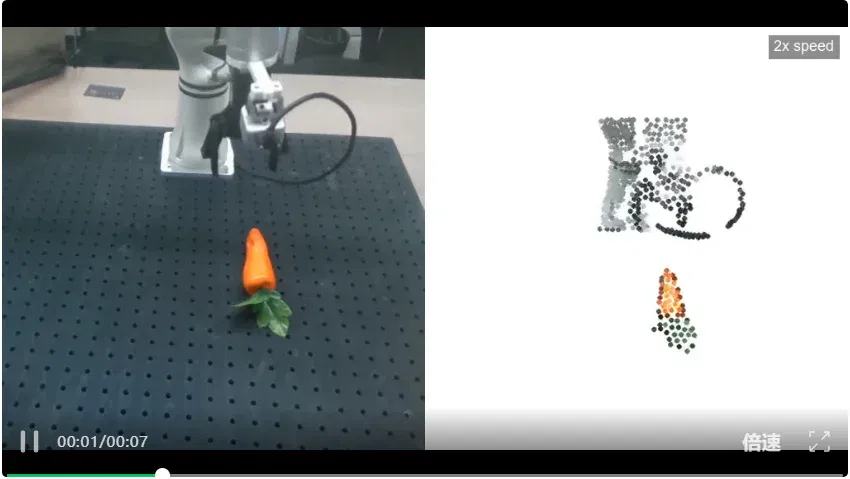
Real-robot demonstration video (2× speed)
This is a joint proposal from researchers at Peking University, UC Berkeley BAIR, Brown University and the University of Oulu in Finland, called JEPA4R. The work introduces 3D point clouds from a single depth camera into a JEPA world model, learning action-induced changes in key scene factors in a latent representation space and controlling robots through policy heads that read these representations. Across several 3D manipulation tasks, its policy success rates exceed those of image-based JEPA methods.
Beyond controlling robots, the team decodes the model's predicted future representations into a sequence of 3D point clouds, making imagined future scenes previously hidden in latent space directly observable. In OGBench Cube simulation tests, predictions extend to 200 environment steps, with mean point error remaining within 1.1 centimeters.
- Paper: https://arxiv.org/abs/2611.19771
- Project: https://aigeeksgroup.github.io/JEPA4R
- Code: https://github.com/AIGeeksGroup/JEPA4R
- Models: https://huggingface.co/AIGeeksGroup/JEPA4R
Why Give World Models Point-Cloud Inputs for Robotic Manipulation?
JEPA world models learn environmental dynamics by predicting future latent representations, without reconstructing every pixel of future images during training.
But real-world manipulation such as grasping and placement requires concrete geometric information for control: where an object is, or how far the gripper is from its target. Most existing embodied JEPA world models obtain this information from 2D images. Spatial relationships in images, however, are entangled with perspective and texture, requiring the model to learn to infer depth and scale. Point clouds directly record the 3D coordinates of visible surfaces, supplying spatial information with real geometric scale.
JEPA4R uses one fixed depth camera, converts depth maps into world coordinates, and applies workspace cropping, background removal and sampling to obtain observations containing 1,200 points. Each point carries both 3D coordinates and color.
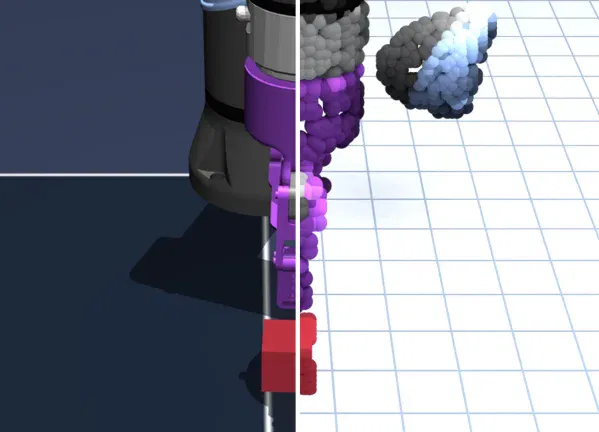
Image-input vs. point-cloud-input comparison
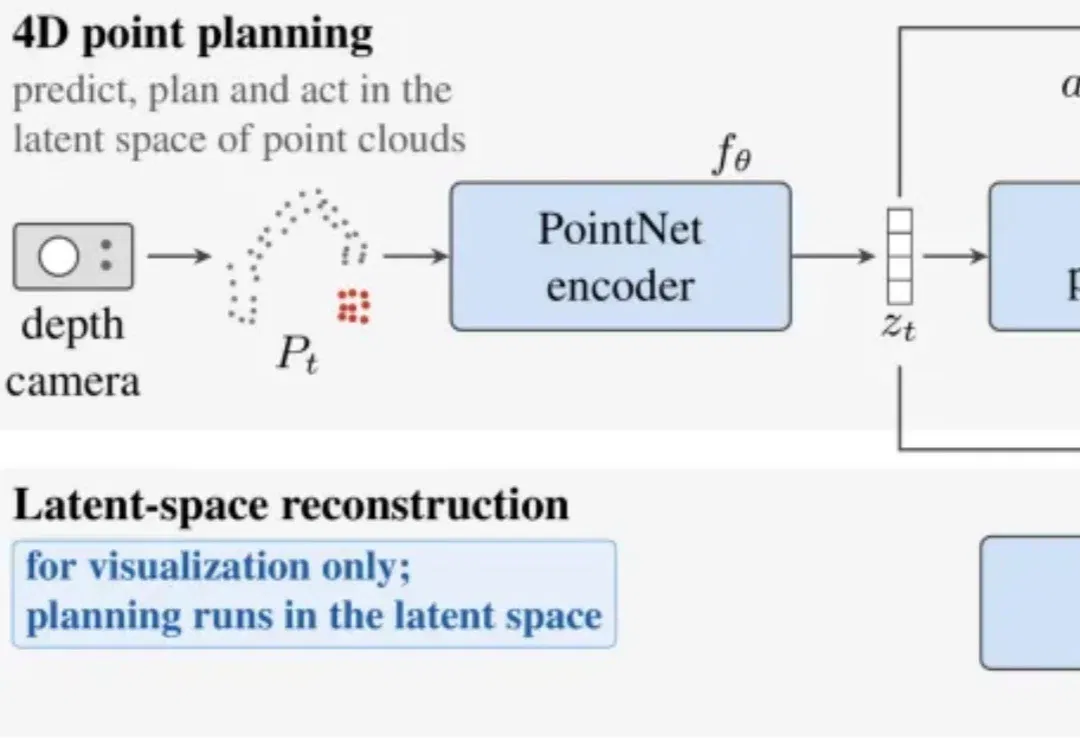
PointNet first encodes these point clouds into latent representations, which are then passed to an action-conditioned Transformer that combines historical observation representations and actions to predict future representations. The study calls prediction, planning and policy control in point-cloud latent space 4D Point Planning, with time forming the fourth dimension beyond three-dimensional space.
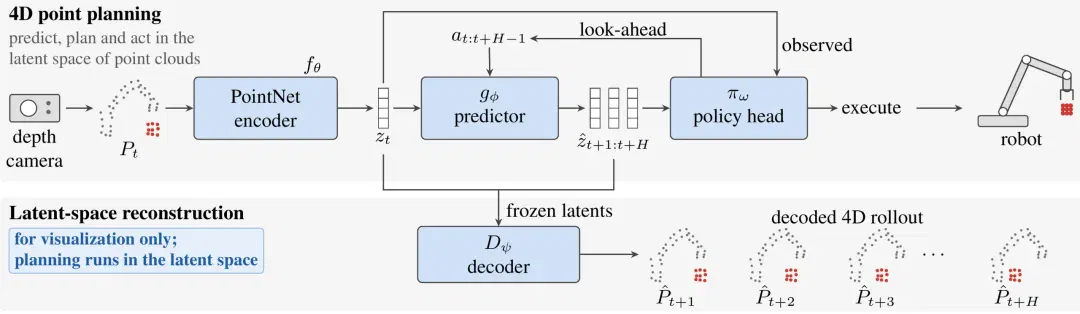
Overall JEPA4R architecture
To compare 2D images and 3D point clouds more accurately, the team constructs paired data using the same simulation trajectories and camera views, while keeping the encoder parameter counts of the two model types approximately equal. Under this setup, it further compares different visual-input representations on robotic manipulation tasks.
Freeze the World Model to Test Whether Point-Cloud Representations Support Manipulation
One focus of JEPA4R is to assess whether representations learned by a world model can train robot policies, and to compare 3D point-cloud and 2D image representations on the tested manipulation tasks.
The team freezes the representation encoder and trains policy heads on its outputs, adding robot proprioceptive state or goal information as required by the task to produce the next action. OGBench Cube and puzzle use offline goal-conditioned reinforcement learning, while MetaWorld and Adroit Relocate follow CortexBench's imitation-learning protocol.
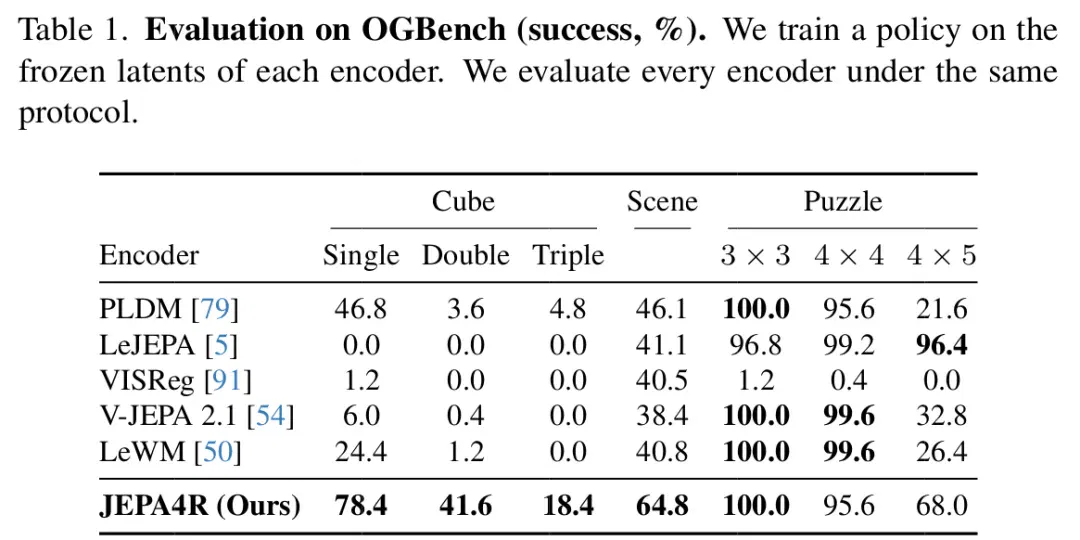
OGBench test results
On OGBench's 3D manipulation tasks, JEPA4R outperforms the paper's compared 2D image JEPA methods on Cube-Single, Cube-Double, Cube-Triple and Scene. For example, Cube-Single policy success rises from the runner-up's 46.8% to 78.4%; Scene rises from 46.1% to 64.8%. These results come from policy-learning evaluations on frozen representations.
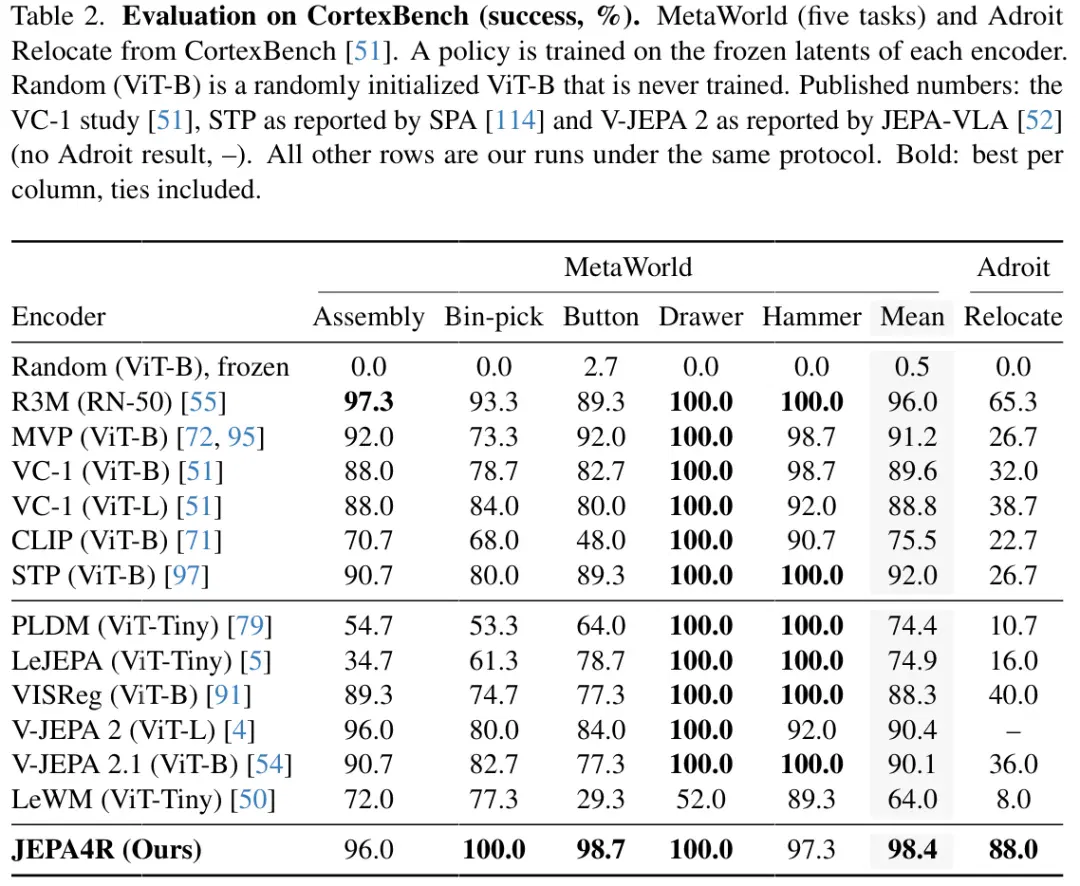
CortexBench test results
Across the five MetaWorld tasks used by CortexBench, JEPA4R achieves an average success rate of 98.4%, above the runner-up's 96.0%. On Adroit Relocate, which requires a dexterous hand to grasp an object and move it to a target position, success reaches 88.0%, an improvement of 22.7 percentage points over the runner-up's 65.3%.
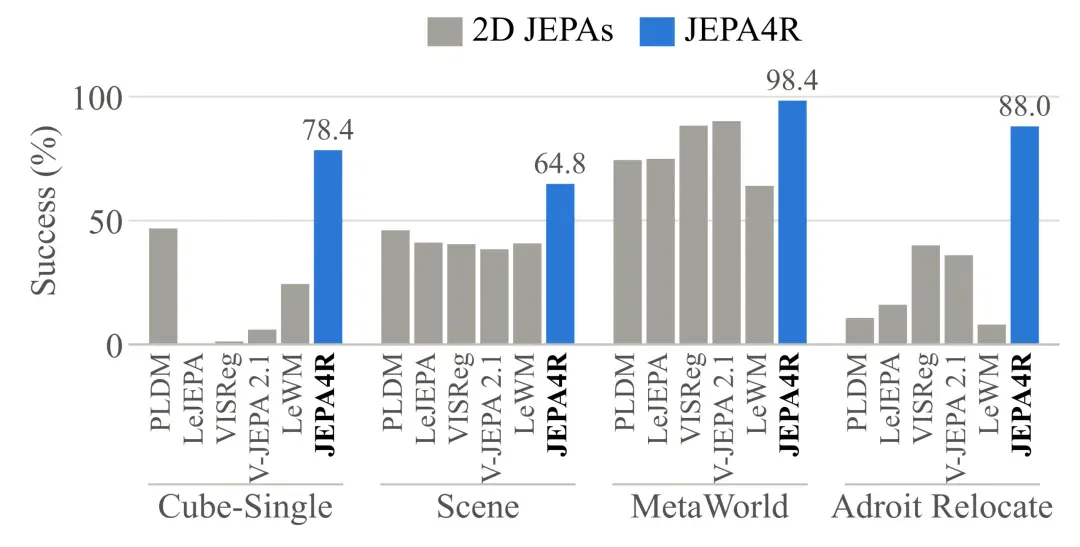
Simulation manipulation-task success rates for JEPA-family model representations
Can Representations Trained in Simulation Support Real-World Robot Control?
After achieving high success rates in simulation tasks, another question remains: can these representations continue to support manipulation when transferred to a real robotic arm and camera observations?
To test this, the team deploys the simulation-trained JEPA4R world model and policy heads directly on a real RealMan RM75-B robotic arm, using a parallel gripper and a dexterous hand respectively, without fine-tuning on real-robot data at deployment. A single depth camera continuously supplies point clouds, and the model produces actions from current observations, forming closed-loop control.
In real-robot demonstrations, the parallel gripper picks up carrots and pushes blocks, while the dexterous hand removes bottles and bananas from fixed slots. These demonstrations show that, for the tested tasks and robot configurations, point-cloud representations and policies learned in simulation can directly support manipulation by a real robotic arm.
After 200 Environment Steps, Is the Model's Imagined 3D Scene Still Accurate?
Latent representations can support prediction and control, but cannot directly show how objects move. To inspect the world model's predictions, the researchers attach a 3D decoder to the trained JEPA4R.
Built on PAGE-4D, the decoder restores each latent representation to a single-frame point cloud. The world model stays frozen while the decoder is trained, so 3D reconstruction does not feed back to modify the representations the world model has already learned.
In prediction experiments, the model first receives three historical observation frames, then predicts autoregressively from a given action sequence, continuously using its own predicted representations to roll forward. The decoder restores this prediction into a time-varying point-cloud sequence, showing blocks being grasped, moved and placed.
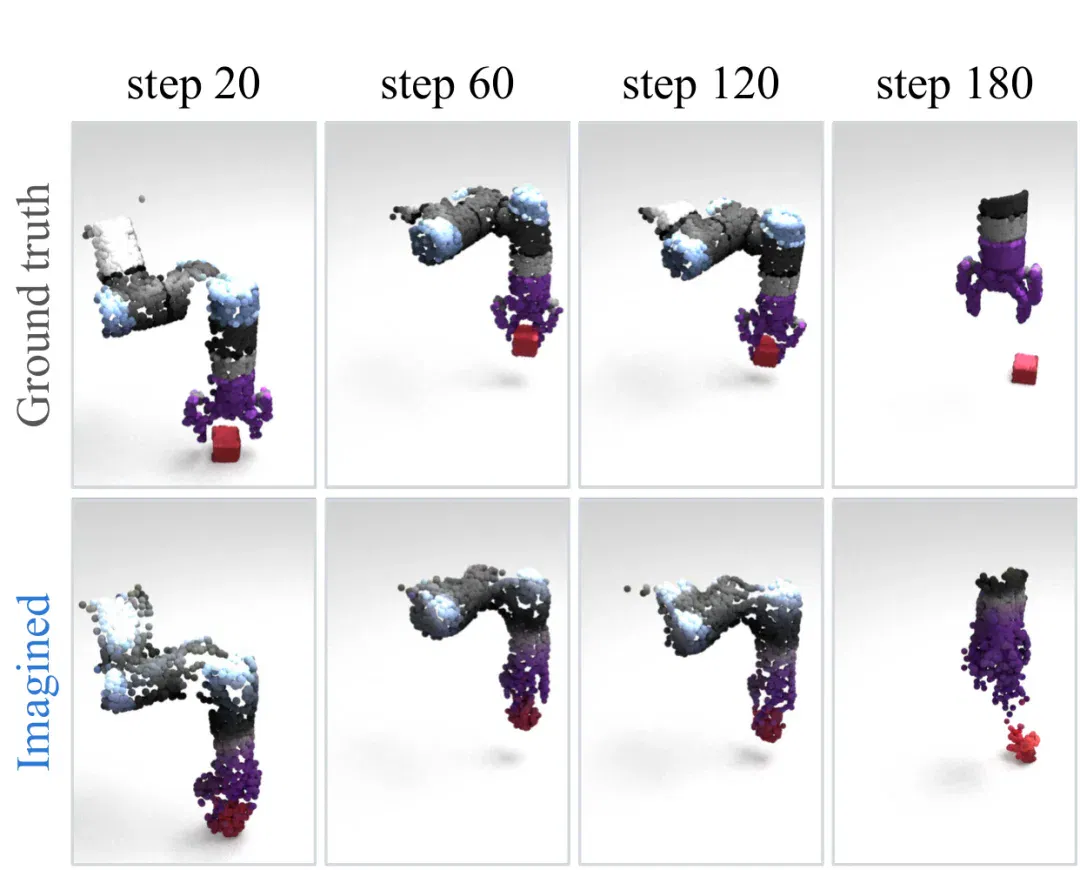
Decoded point-cloud visualization
Against simulated observation point clouds as a reference, the mean nearest-neighbor distance between predicted point clouds and actual simulation observations remains below 1.1 centimeters throughout 200 environment steps across 64 test trajectories.
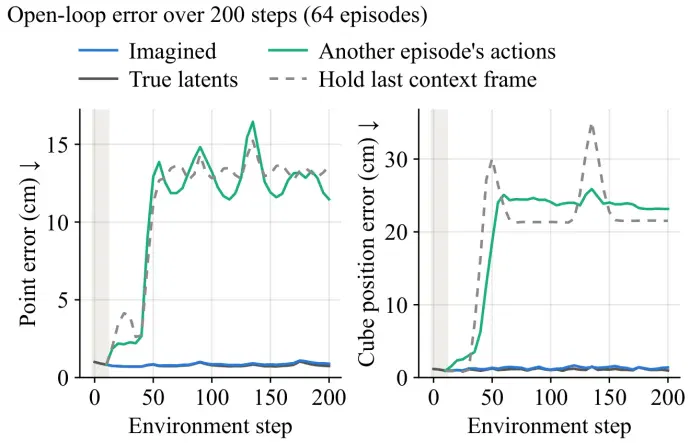
Decoded point-cloud error curve
To test the model's dependence on action information, the team also replaces the input with an action sequence from another trajectory. At environment step 200, the mean bidirectional nearest-neighbor distance rises from 0.89 centimeters to 11.46 centimeters, showing that the model's imagined future predictions are closely tied to the input actions.
The Author Team
Team members are from Peking University, UC Berkeley BAIR, Brown University and the University of Oulu in Finland.
This article comes from "Synced," written by "Synced."
Related topics
After reading
Join the AINRK community
Read how to join the community and connect with people working in AI.
Related articles
Continue reading related topics and articles in this category.
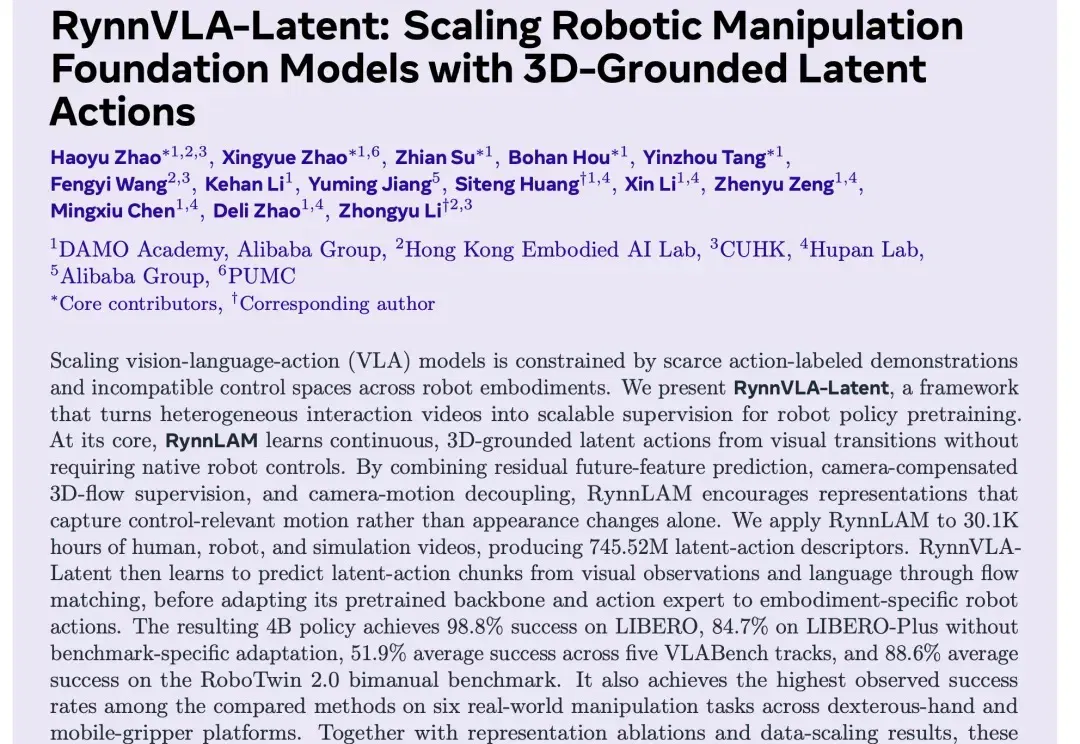
RynnVLA-Latent Pretrains on 30,000 Video Hours, Leading Compared Methods on Six Real-Robot Tasks (opens in a new tab)
DAMO Academy and collaborators use 3D-grounded latent actions to turn about 30.1K hours of diverse videos into pretraining supervision, then align to robot controls. Their 4B policy leads the compared methods on six real-robot tasks, within specific evaluations and still using real demonstrations.
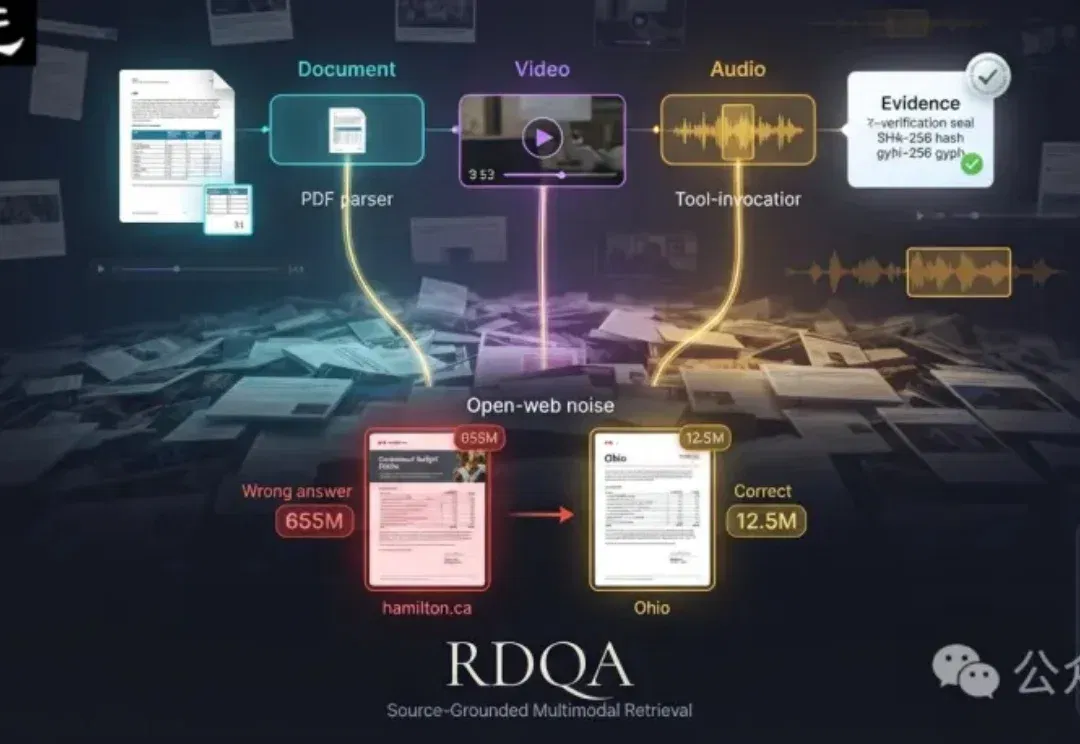
RDQA Raw-File Retrieval Test: Best Adjusted Accuracy among 12 General-Purpose Agents Is 24% (opens in a new tab)
RDQA asks agents to find and parse sources for 1,350 document, video and audio questions. The best of 12 general configurations scores 24.0% PLR-adjusted accuracy, versus 57.5% for humans and 41.1% for a reference baseline. Failing specified-source verification does not establish memorization.
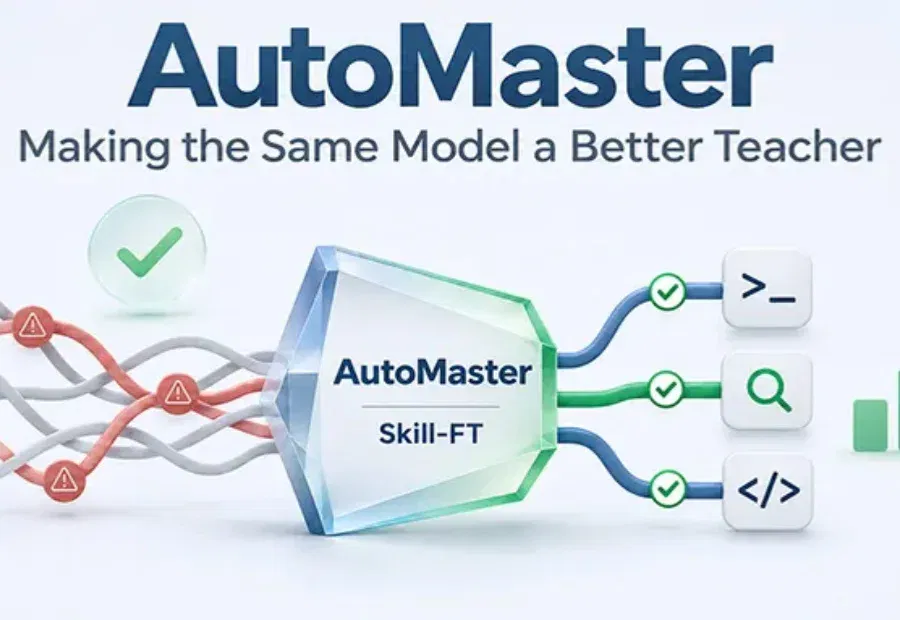
RUC open-sources AutoMaster: Skill guidance and trajectory selection for agent post-training (opens in a new tab)
RUC introduces Skill-FT and AutoMaster. Across six settings with a fixed teacher, task pool, 512 selected trajectories per round and SFT recipe, gains over Vanilla SFT are 1.42–8.99 percentage points. Multiple rounds require extra sampling, training and evaluation.
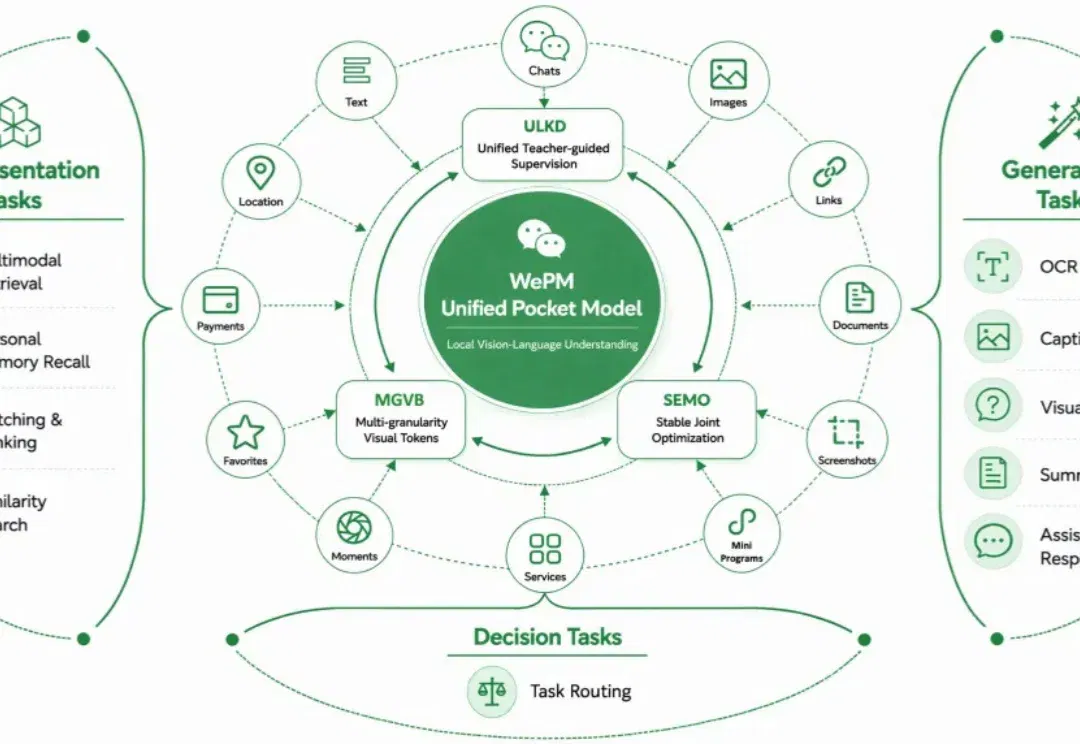
WeChat open-sources WePocketModel, unifying representation, generation and decision with one backbone (opens in a new tab)
Tencent's WeChat team releases WePocketModel, sharing one backbone across representation, generation and decision. WePM-4B uses 61.9% less resident weight memory than the selected specialist stack. Its roughly 8GB is BF16 weights, not total runtime memory; demos use an M5 Mac.
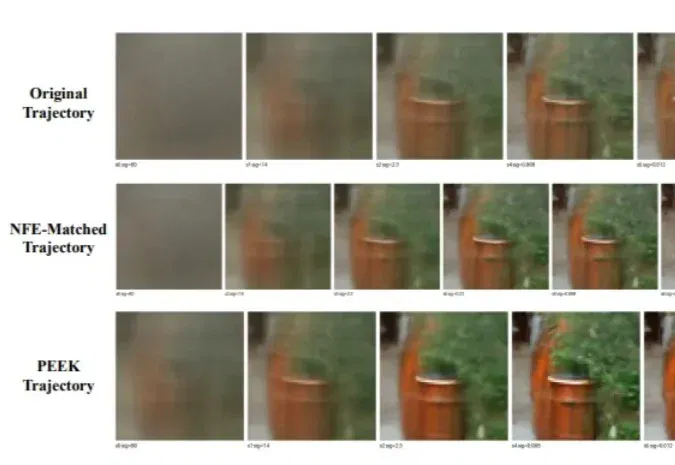
PEEK cuts FID by 49.3% in a specified ImageNet-EDM diffusion-sampling experiment (opens in a new tab)
NUS’s training-free PEEK adjusts deterministic diffusion sampling with look-ahead predictions. At an equal denoising-call budget, one ImageNet-EDM experiment lowers FID from 19.71 to 9.99. Results and one-time search costs depend on the setup.