RUC open-sources AutoMaster: Skill guidance and trajectory selection for agent post-training
RUC introduces Skill-FT and AutoMaster. Across six settings with a fixed teacher, task pool, 512 selected trajectories per round and SFT recipe, gains over Vanilla SFT are 1.42–8.99 percentage points. Multiple rounds require extra sampling, training and evaluation.
Editorial check (2026-11-24): Results are limited to the paper’s teacher, two student models and six task settings. The fixed 512 trajectories are the final training set in each round, not an equal total budget for teacher sampling, controller-agent calls, up to five training rounds and evaluation. Evaluation feedback guides later rounds and checkpoint selection; three evaluations repeat a fixed checkpoint rather than constitute a blind test without feedback. The proposed explanation for Keep outperforming Remove is supported by cases, not a universal training law. Passing a few concurrency settings does not prove freedom from deadlock in every setting. The example evaluator is implemented in C but interprets exponentiation using a custom grammar; its rules must not be confused with the meaning of ^ in C. AutoMaster paper and Appendix A.4 (opens in a new tab)AutoMaster official code (opens in a new tab)
With the teacher and training-set size unchanged, reshaping demonstration behavior can reveal nearly nine points of hidden headroom.
Zhidx reported on November 23 that, on November 20, the RUC AI Box team at Renmin University of China’s Gaoling School of Artificial Intelligence introduced a behavior-shaping post-training method for large-model agents, Skill-FT (Skill-Guided Fine-Tuning) and simultaneously open-sourced the autonomous post-training system AutoMaster and a series of fine-tuned models.
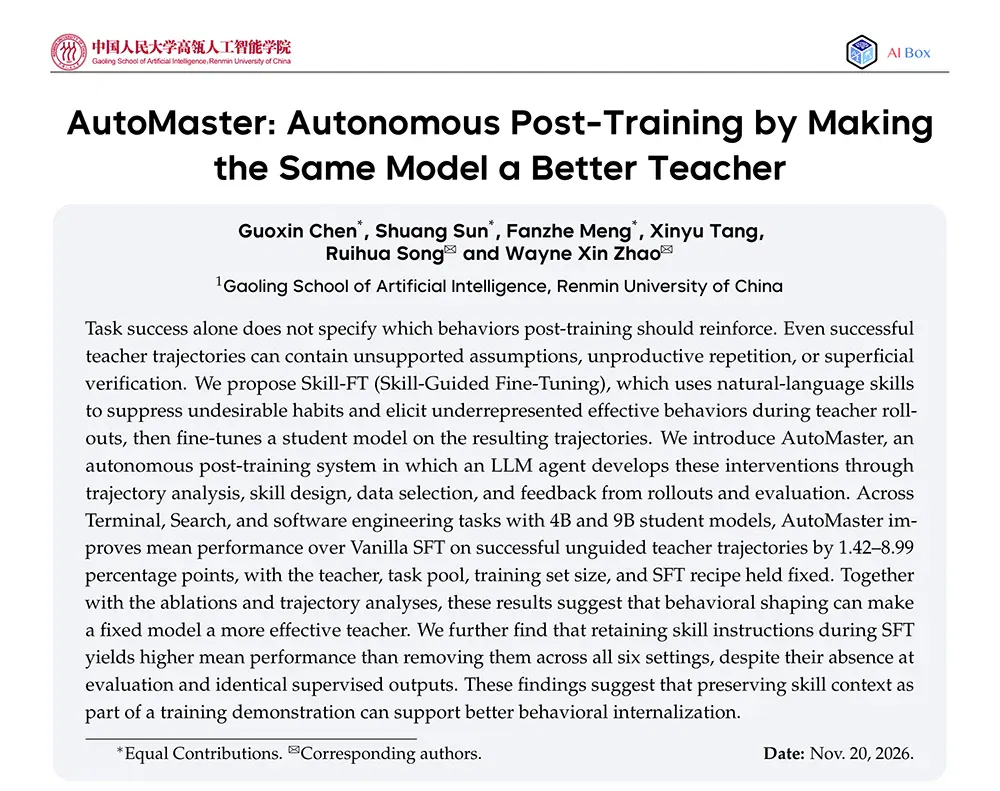
▲ Screenshot of the paper’s first page
A mainstream approach to improving agent models through post-training is to have a stronger teacher model produce interaction trajectories in task environments, select trajectories that ultimately succeed at the task (Task Success) and use them for supervised fine-tuning of a student model (Vanilla SFT).
But the RUC team identifies a blind spot in that paradigm: a correct task outcome does not mean the teacher’s demonstrated behavior is worth reinforcing. Even when the final answer is correct or the tests pass, unguided teacher trajectories often contain unsupported assumptions, inefficient repetitive guessing or superficial verification while genuinely valuable habits of rigorous validation and troubleshooting are often rare in naturally sampled demonstrations.
Fine-tuning directly on these flawed-but-successful trajectories teaches the student the bad habits along with the correct results.
The team therefore moves beyond passively selecting data by outcome, proposing an AI agent that acts as an automated director of teaching and research: it not only chooses the teaching material, but actively uses natural-language skills to reshape a fixed teacher’s reasoning and actions during sampling. Even for tasks the teacher already solves correctly, the aim is to make its demonstrations more systematic and thorough.
At the final exam—evaluation—the student receives none of the generated skills and must rely entirely on the behavior it has internalized.
Holding the teacher (DeepSeek-V4-Pro-Preview ), task pool, training-set size (512 trajectories ) and full-parameter SFT recipe fixed, AutoMaster-trained Qwen3.5-4B and Qwen3.5-9B outperform successful-trajectory Vanilla SFT across six evaluations spanning terminal operations, deep search and software engineering (SWE)—three demanding benchmark categories—with average-score gains of 1.42–8.99 percentage points.
The team also reports a counterintuitive post-training finding. Although no skill prompt is present during evaluation, keeping the skill instructions in the SFT inputs (Keep) works better than removing them to align training and evaluation inputs (Remove). With supervised outputs identical word for word, Keep wins in all six settings by 2.15–4.01 percentage points.
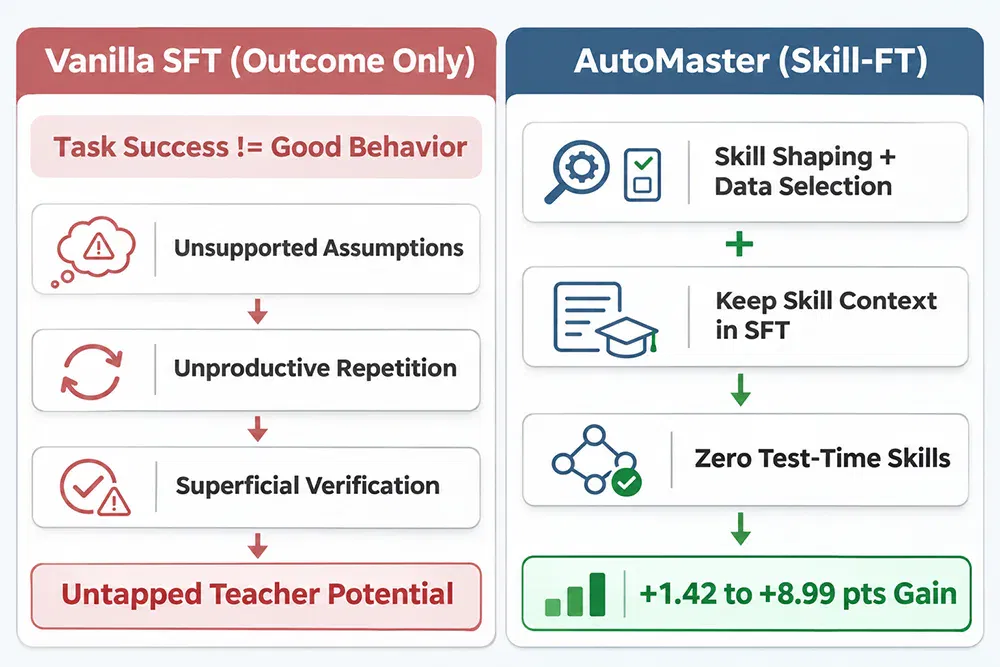
▲ Comparing outcome-only Vanilla SFT with the central idea of AutoMaster (Skill-FT)
AutoMaster’s code framework, evaluation pipeline and fine-tuned models are now open-source.
Paper: https://arxiv.org/pdf/2611.26510
Project website: https://aweai-team.github.io/AutoMaster/
GitHub repository: https://github.com/RUCAIBox/AutoMaster
Hugging Face model collection: https://huggingface.co/collections/RUC-AIBOX/automaster
Why can teacher trajectories that pass still mislead a student? How do two nested loops let AI independently diagnose weaknesses, write teaching plans, choose material and trace training-to-evaluation outcomes? Why might deliberately retaining a prompt mismatch help the student learn better? This article examines those questions in detail.
01.
Solving a task is not the same as teaching well:
Three hidden bad habits in successful trajectories
To understand how AutoMaster can apparently produce large gains from nowhere, first examine the hidden traps in traditional post-training data.
In complex, long-horizon agent tasks, a verifier typically checks only whether the final state meets requirements. However, some successful paths are better than others. In a real concurrency-repair task shown in the paper, for example, an intermittently hanging parallel pipeline must be fixed so it processes 100 input records within 30 seconds.
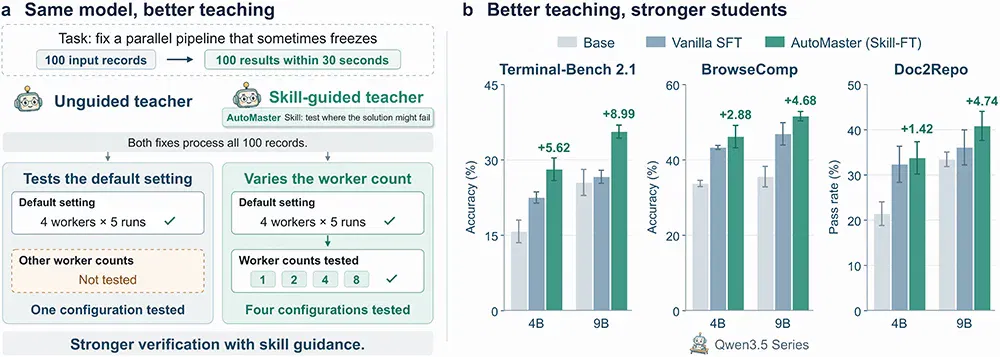
▲ The same teacher, teaching better: (a) With skill guidance, the teacher tests not only the default four-worker configuration but also one, two, four and eight workers to investigate edge cases. (b) With the same teacher, task pool and 512 selected trajectories, AutoMaster outperforms Vanilla SFT across three benchmarks.
Both the unguided and skill-guided teachers wrote patches that processed all 100 records, earning success labels. The difference emerged in their processes: the unguided teacher stopped after the default configuration, four workers across five runs. The guided teacher also changed concurrency, testing one, two, four and eight worker threads across four settings. This broadened coverage of concurrency boundaries and deadlock risks, but did not prove that every possible setting was deadlock-free.
The paper’s cross-domain trajectory analysis reveals many behavioral weaknesses that cannot be identified by looking only at outcomes:
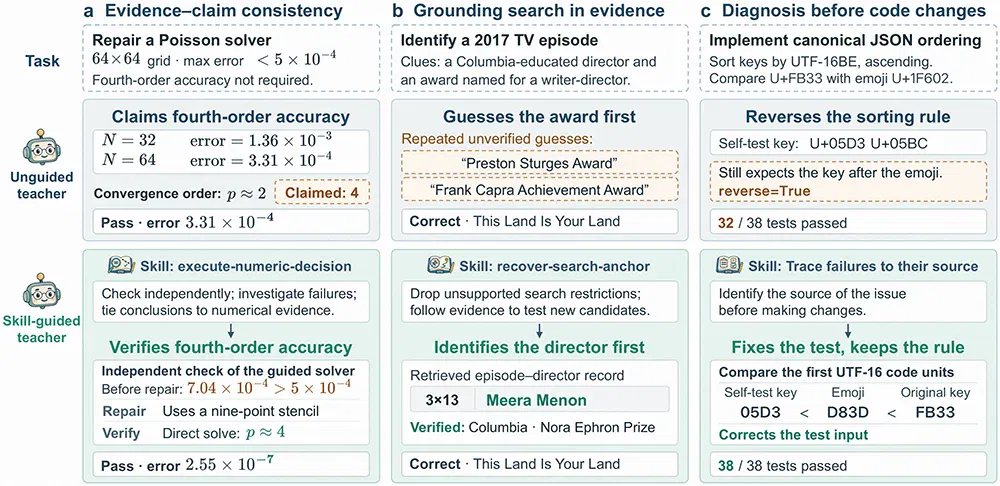
▲ Unguided trajectories (top) and skill-guided trajectories (bottom) from the same teacher on the same tasks, covering terminal numerical computation, deep search and software engineering
Weakness 1: Inflated conclusions without independent verification.
A terminal scientific-computing task, shown in panel a, asks for a two-dimensional grid-based Poisson solver to be fixed so its maximum error falls below 5×10⁻⁴. Fourth-order accuracy is not explicitly required.
After meeting the error threshold, the unguided teacher confidently claimed fourth-order convergence in its summary. Independent grid-refinement checks, however, showed error falling from 1.36×10⁻³ at N=32 to 3.31×10⁻⁴ at N=64—only about second order (p ≈ 2).
By contrast, the teacher given the execute-numeric-decision skill independently checked the numerics. Discovering that fourth order had not been reached, it switched to a nine-point stencil, reducing error to 2.55×10⁻⁷ and rigorously verifying p ≈ 4, backing its claim with evidence.
Weakness 2: Guessing blindly and circling inefficiently in a dead end.
In the deep-search task in panel b, the model must identify a 2017 episode of an American television series using two clues: its director graduated from Columbia University, and an award was named after a screenwriter-director.
Both trajectories ultimately found This Land Is Your Land, but the unguided teacher began by repeatedly guessing unverified award names such as the Preston Sturges Award and Frank Capra Achievement Award.
Guided by recover-search-anchor, the teacher dropped unsupported constraints, used the credits to identify season 3, episode 13 director Meera Menon, then checked her Columbia background and Nora Ephron Prize record. The search became direct and traceable.
Weakness 3: Losing diagnostic focus and distorting the implementation to satisfy a faulty test.
The software-engineering task in panel c requires canonical JSON key sorting in ascending UTF-16BE order, comparing U+FB33 with emoji U+1F602. Both runs initially used the wrong test key, U+05D3, while retaining an earlier expected order.
When the self-test failed, the unguided teacher did not consult the encoding specification. Instead, it added reverse=True to the main implementation, forcing the global ascending order into descending order and ultimately passing only 32/38 tests.
The teacher guided by Trace failures to their source instead compared the first UTF-16 code units—05D3 < D83D < FB33—identified the mistaken self-test input, repaired the test and preserved the required ascending implementation. It ultimately passed all 38 of 38 tests.
A coarse success-only filter would allow the unsupported accuracy claim and blind guessing in the first two cases into the training set. The third case further shows how poor habits can directly reduce engineering correctness. Post-training should not only select solved tasks; it should actively shape how the teacher solves them.
02.
Two nested loops adapt the teaching:
AI diagnoses weaknesses, writes plans, selects material and traces training-to-evaluation outcomes
Having human experts read thousands of long trajectories, handwrite prompting rules and repeatedly retrain models does not scale in time or labor. The team therefore built AutoMaster—an autonomous post-training system led by an LLM agent and organized around two nested loops.
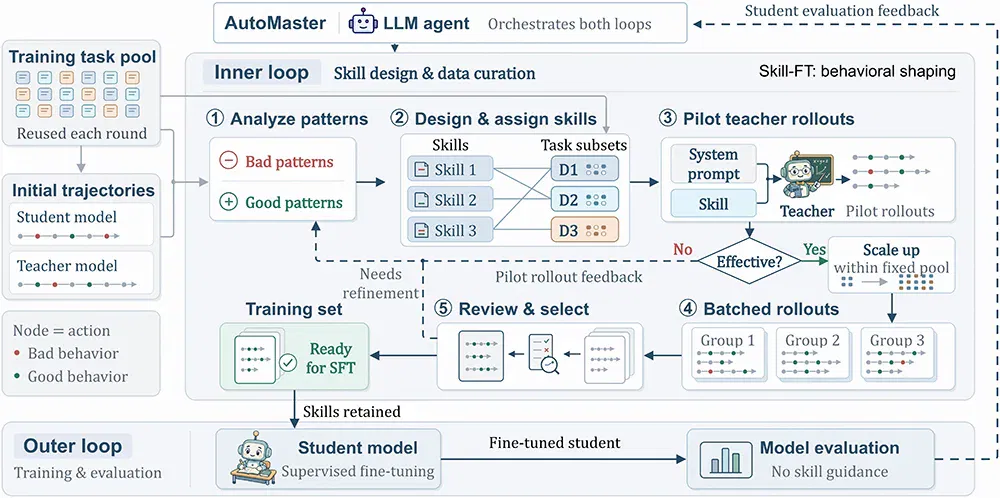
▲ AutoMaster workflow: the inner loop analyzes behavior, designs skills, refines them through small pilot runs and selects trajectories at scale; the outer loop fine-tunes from the same initial student and feeds back evaluations performed without skills.
At the methodological core, Skill-FT is straightforward: for task x, append selected natural-language skill instructions s to teacher π_T’s base system prompt p, giving p ⊕ s. The teacher then produces a guided trajectory in the real interaction environment:

Next, the selected high-quality demonstrations train the student through standard SFT, retaining the complete system prompt including the skill. During downstream benchmark evaluation, the student strictly follows the official default protocol and receives none of the generated skills.
Around this mechanism, AutoMaster’s controller agent—implemented in the experiments by GPT-6 Astra at a high reasoning setting in a Codex environment—runs the experimental cycle at two levels:
Level 1, the inner loop, focuses on how to teach and which material to select.
1.Analyze patterns: The agent examines both unguided teacher and initial-student interaction trajectories. Later rounds also scrutinize the previous fine-tuned student’s evaluation failures and trajectories, identifying bad habits to suppress and valuable actions the teacher rarely exhibits naturally—even on tasks it can already solve.
2.Design and assign skills: For different task subsets, write natural-language skills containing triggers, procedures and domain knowledge, reusing a single skill or combining several.
3.Refine through pilot teacher rollouts: Test candidate skills on small task batches, checking whether they elicit the intended behavior or introduce side effects. Revise wording and scope accordingly.
4.Batched rollouts: Apply skills validated as effective to larger batches of task sampling.
5.Review and select for both outcomes and behavior: Combine task scores with observed trajectory behavior to select 512 demonstrations. Unguided trajectories with excellent behavior may also be included. Together they form the current round’s SFT dataset D_r.
What do these AI-written teaching plans actually look like? Are they merely empty instructions to check carefully? The real generated skills in the paper’s appendix read like rigorous procedures written by an experienced architect to prevent common mistakes:
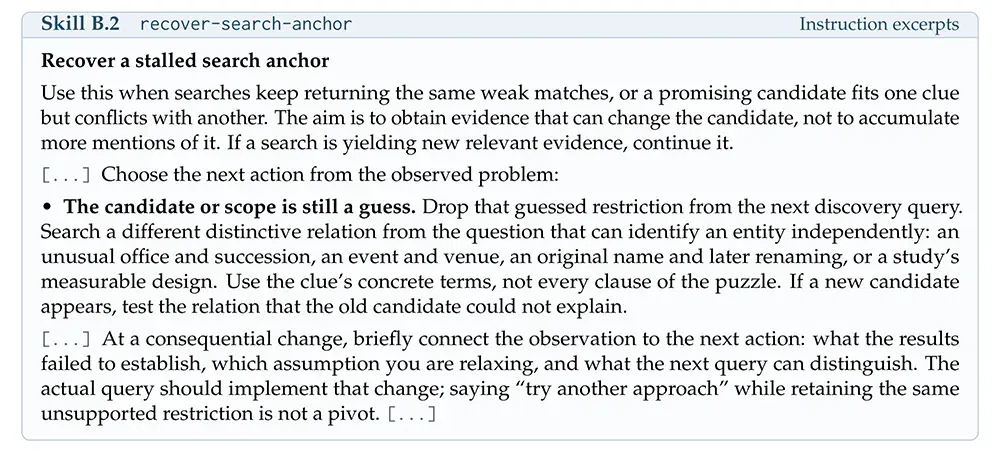
▲ An excerpt from AutoMaster’s recover-search-anchor skill, targeting the habit of claiming a search pivot while retaining the same unsupported assumptions
For example, the search-anchor recovery skill states: “Saying ‘try another approach’ while keeping the same unverified constraint in the search query is not a pivot.”
The numerical-verification and contract-checking skills are equally strict: “Never relax a task’s required error tolerance without authorization, or quietly replace a failing test input with one that passes”, “When an example conflicts with a general rule, check the specification and add discriminating inputs first. Do not invent a new global algorithm merely to satisfy one example.”
Level 2, the outer loop, focuses on what the student has absorbed and attribution across rounds.
Whenever the inner loop produces a dataset D_r, the outer loop starts full-parameter SFT. Crucially, every round restarts from the same initial student θ₀, so θ_r = SFT(θ₀, D_r), rather than continuously fine-tuning across rounds and risking distribution drift or overfitting contamination.
After evaluation, the agent receives both evaluation scores and the student’s actual task-solving trajectories without skills. Comparing them with historical records, it decides whether the next round should rewrite a skill, adjust its scope or change the mixture of training samples.
To support an unattended, around-the-clock chain of sampling, fine-tuning, evaluation and review, the team also built a specialized, reliable engineering foundation:
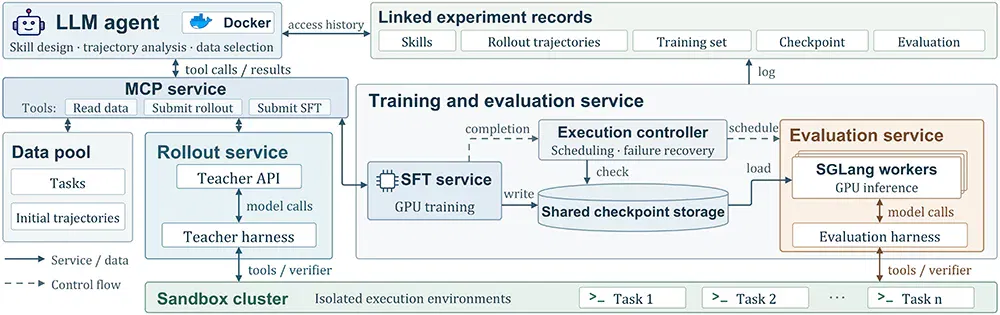
▲ AutoMaster infrastructure: MCP connects the data pool, concurrent sandbox cluster, GPU training service and SGLang inference-evaluation cluster with shared weights.
- Unified MCP tool bus: The controller runs in a separate Docker container and uses standard Model Context Protocol interfaces to read trajectories, submit teacher-sampling tasks and launch SFT jobs.
- Isolated concurrent sandbox cluster: Teacher-sampling and student-evaluation harnesses share an underlying Docker sandbox cluster, enabling command-line operations, search tools and test verifiers to run concurrently in isolated container environments.
- Shared weight storage and zero-copy automatic evaluation: Training and evaluation GPU clusters share checkpoint storage. Once SFT finishes, an execution controller validates the weights and schedules SGLang inference workers to load them in place, avoiding cross-cluster copying. Persisted progress also lets an interrupted inference worker restart and resume evaluation without repeating expensive SFT.
- Linked experiment records for tracing causes across the pipeline: Each student evaluation is linked to its checkpoint, the 512 training samples and the exact skills that guided the teacher. If a student repeatedly fails a class of problems, the agent can trace whether the teacher failed to demonstrate the right behavior or the good demonstration was left out of the dataset.
03.
The same teacher, the same 512 selected examples:
Gains of up to 8.99 points across three agent benchmarks
To compare behavioral guidance and trajectory selection, the team held the following teacher, task pools, per-round training scale and SFT recipe fixed. This does not mean total experimental budgets were equal or that all evaluation-feedback and model-selection effects were eliminated:
- The same teacher throughout: DeepSeek-V4-Pro-Preview, with high reasoning effort, generated all trajectories;
- Two student sizes: Qwen3.5-4B and Qwen3.5-9B served as student bases;
- Three core agent scenarios: Terminal-Bench 2.1 covers terminal operations, with 1,000 training-pool tasks from the public CalibForge set. BrowseComp, using the Lite-185 subset, covers complex web search, with 1,000 training-pool tasks from FORT-Searcher. Doc2Repo covers building complete repositories from scratch, with 1,000 training-pool tasks from DeNovoSWE;
- Fixed training-set size and recipe: Both Vanilla SFT, randomly sampling unguided successful trajectories from the same task pool, and AutoMaster, exploring autonomously for up to five outer rounds, use exactly 512 trajectories per training run, three epochs of full-parameter fine-tuning and a maximum sequence length of 131,072 tokens. Each checkpoint is evaluated three independent times in the same skill-free environment to report means and standard deviations.
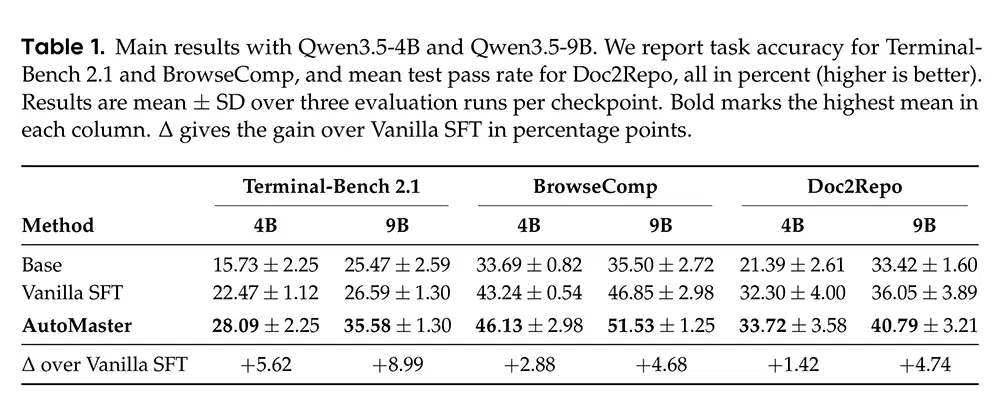
▲ Full comparison of AutoMaster, the base model and successful-trajectory Vanilla SFT across three benchmarks and two model sizes
In the main experiments, AutoMaster achieved six wins in six settings:
1.Terminal-Bench 2.1 shows potential in terminal operations: For the 4B model, AutoMaster raised accuracy from Vanilla SFT’s 22.47% to 28.09%, a gain of 5.62 percentage points.
The 9B comparison is more striking. The base model scored 25.47%, and Vanilla SFT on 512 successful trajectories reached only 26.59%, a gain of 1.12 points—apparently suggesting that the teacher had little left to teach. Yet AutoMaster, without changing teachers or adding even one example to the final training set, pushed accuracy to 35.58%, outperforming Vanilla SFT by 8.99 percentage points!
The results strongly suggest that modest gains from traditional outcome-oriented SFT can underestimate how much a student can learn from the same teacher.
2.BrowseComp passes 50% in deep search: AutoMaster achieved 46.13% (+2.88) for 4B, while the 9B score rose from Vanilla SFT’s 46.85% to 51.53%, a gain of 4.68 percentage points.
3.Doc2Repo makes steady gains in repository-level software engineering: On full-repository construction tasks requiring long-horizon planning and self-testing, the 4B model’s pass rate rose to 33.72% (+1.42) and the 9B model improved from 36.05% to 40.79%, a gain of 4.74 percentage points. Across 10,000 paired bootstrap resamples, the lower bounds of the 95% confidence intervals for the 9B model’s gains were strictly positive on all three benchmarks, indicating consistent improvement across the tested domains.
Such substantial gains naturally raise two questions:
First, do they come from skills reshaping behavior or from the agent selecting data?
Second, could the agent merely be choosing more representative task IDs, regardless of whether teacher behavior changes?
The team addressed these questions with two ablation studies:
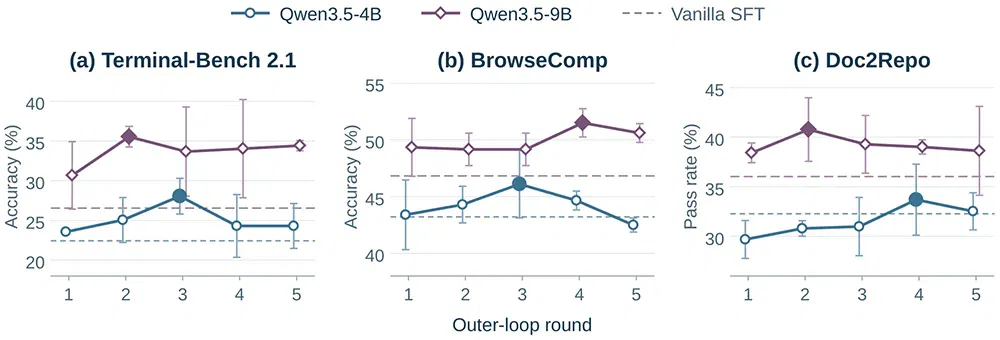
▲ Component ablations and Task-Matched SFT: removing either skill guidance or data selection reduced performance in all six settings. AutoMaster also outperformed Task-Matched SFT with strictly aligned task IDs and sample counts.
First, both teaching plans—skill guidance—and material selection matter.
As the figure shows, removing skill guidance, selecting only unguided trajectories, or removing data selection, refining skills on a fixed random subset, reduced performance in all six settings.
The ordering differed by domain. On Terminal-Bench 2.1 for 4B, skills without selection beat selection without skills, 20.22% versus 17.60%: diverse-configuration validation was scarce in unguided trajectories, so selection alone could not find enough good examples. BrowseComp for 4B reversed the ordering, 45.77% versus 43.78%. Combining elicitation of good behavior with selection of good demonstrations produced the full gain.
Second, Task-Matched SFT challenges the explanation that only task choice matters.
The team built a stringent control, Task-Matched SFT, taking the final 512-example AutoMaster dataset’s task IDs and per-task sampling counts unchanged, one for one, but replacing every example with an unguided trajectory from the same teacher.
Across four paired terminal and search corpora, 79.3%–91.2% of the unguided paired trajectories also solved their tasks!
The two datasets thus contained the same tasks, and most answers in both were correct. Nevertheless, AutoMaster beat Task-Matched SFT in all six settings by 1.08–10.11 percentage points on average. Terminal-4B rose from 17.98% to 28.09%, a net 10.11-point gain; Terminal-9B rose from 27.72% to 35.58%, a 7.86-point gain.
This evidence suggests that post-training depends not only on which tasks are practiced or solved, but on the reasoning and evidence-seeking behavior demonstrated in the trajectories.
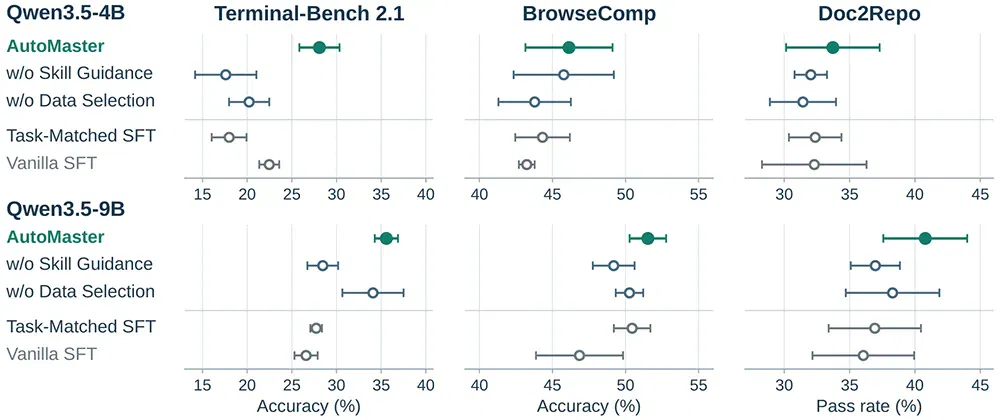
▲ Score evolution over five autonomous outer-loop rounds. Dashed lines show Vanilla SFT; solid points mark the best round for each setting.
Tracking all five outer rounds shows that continued autonomous experiments found interventions stronger than the first round in every setting. The highest scores generally occurred in rounds two through four, improving on round one by another 2.16–4.87 percentage points.
For example, BrowseComp-9B hovered around 49% for its first three rounds, then, after the agent found a new combination of interventions in round four, reached 51.53%.
The larger 9B student also exceeded Vanilla SFT in every round across all three domains and all five rounds, suggesting that a stronger student base can more consistently absorb and realize the complex behavioral strategies AutoMaster finds.
04.
Challenging the intuition about post-training alignment:
Can retaining skill context add another four points?
Beyond the system itself, the paper reports a counterintuitive finding.
A familiar principle in context distillation and prompt engineering is to eliminate the training–evaluation prompt mismatch.
If the student’s system prompt has no skill text during evaluation, it seems natural to remove skill instructions from SFT inputs, retaining only the teacher’s high-quality reasoning, tool calls and responses as supervision. This would align the input formats used for training and the final test.
Yet when the team compared the two approaches using the same 512 trajectories, identical SFT hyperparameters and supervised outputs—reasoning, tool calls and responses—that were identical word for word, the results challenged that intuition. It compared retaining the skill (Keep ) with removing it (Remove ):
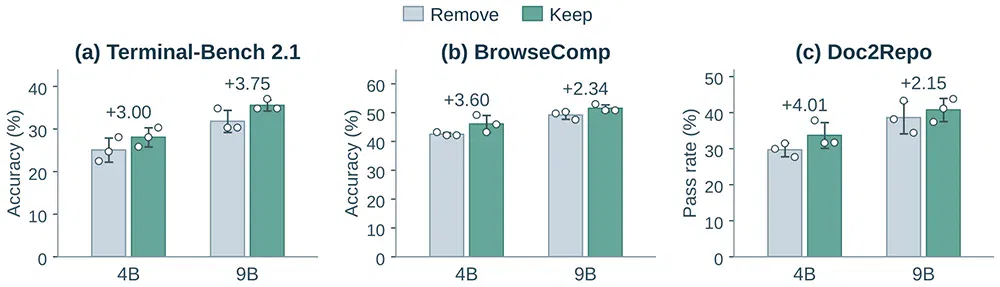
▲ Even with no skills provided during evaluation, retaining skill instructions in SFT inputs (Keep) beat removing them (Remove) in all six settings, improving average scores by 2.15–4.01 percentage points.
Across three domains and two model sizes, Keep won all six comparisons, with average scores exceeding Remove by 2.15–4.01 percentage points! The gains included Doc2Repo-4B at +4.01 points, Terminal-Bench 2.1-9B at +3.75 points and BrowseComp-4B at +3.60 points.
Why can retaining a training–evaluation prompt difference help a student perform better without those prompts? The paper examines real SFT excerpts to propose an explanation:
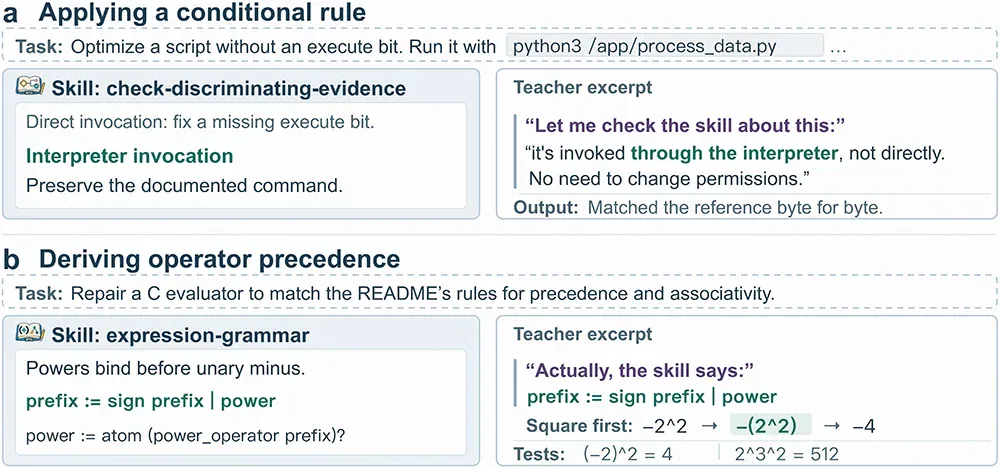
▲ Two cases where teachers explicitly refer to skill context in SFT data: (a) distinguishing interpreter invocation from direct execution to avoid unnecessary permission changes; (b) using a supplied grammar to derive exponentiation and unary-minus precedence.
- In case a, the task asks for optimization of a script without an execute permission bit, but specifies python3 /app/process_data.py as the command. The teacher’s reasoning explicitly says: “Let me check the skill on this: it is invoked through an interpreter, not executed directly, so file permissions do not need to change.”
- In case b, the task asks for precedence logic in a C-implemented expression evaluator to be repaired. The teacher cites the supplied grammar prefix := sign prefix | power to derive that exponentiation binds more tightly than unary minus: -2^2 parses as -(2^2) = -4. It then implements the parser and constructs boundary tests.
What happens if skill instructions are removed merely to make the training and evaluation prompts look the same?
First, the teacher’s statement “Let me check the skill…” loses its reference, breaking the causal correspondence between input instructions and output reasoning.
Second, the explicit behavioral rules and their applicability conditions—when to change permissions and when not to disappear from the input. The student is forced to infer the implicit rules from task descriptions and action sequences.
By contrast, retaining the skill context (Keep) presents the full chain of trigger, rule and reasoning action in the demonstration, helping the student achieve behavioral internalization more efficiently: learning which action fits which situation, then generalizing better on tests without prompts.
05.
Conclusion: From selecting correct outcomes to shaping behavior,
Post-training moves toward autonomous improvement
Looking back over post-training and distillation, the industry has long pursued two routes: finding larger, stronger teachers, or expanding task pools and accumulating thousands of sampled trajectories with correct final outcomes.
AutoMaster and Skill-FT open a third dimension for agent post-training: a fixed teacher can still contain teaching value far beyond what its surface task-success rate suggests.
Shifting attention from coarse task success to fine-grained reasoning and verification habits can substantially improve small and medium-sized models across the tested domains, even with only 512 selected trajectories and the same teacher and student base.
The engineering shift is also notable. Instead of researchers manually inspecting cases, revising prompts and selecting data, AutoMaster uses MCP, container sandbox clusters and linked causal records to run the entire cycle of diagnosis, skill writing, pilot runs, selection, fine-tuning and attribution. Using agents to train and improve agents—autonomous post-training—is moving from a concept toward an engineering implementation.
The RUC AI Box team has released the full AutoMaster framework, domain evaluation environments and fine-tuned models. For developers and research teams working on specialized agents and lower-cost distillation, pairing a fixed teacher with an AI teaching researcher offers a potentially cost-effective way to improve training.
This article is from “Zhidx,” by “Zhidx.”
Related topics
After reading
Join the AINRK community
Read how to join the community and connect with people working in AI.
Related articles
Continue reading related topics and articles in this category.
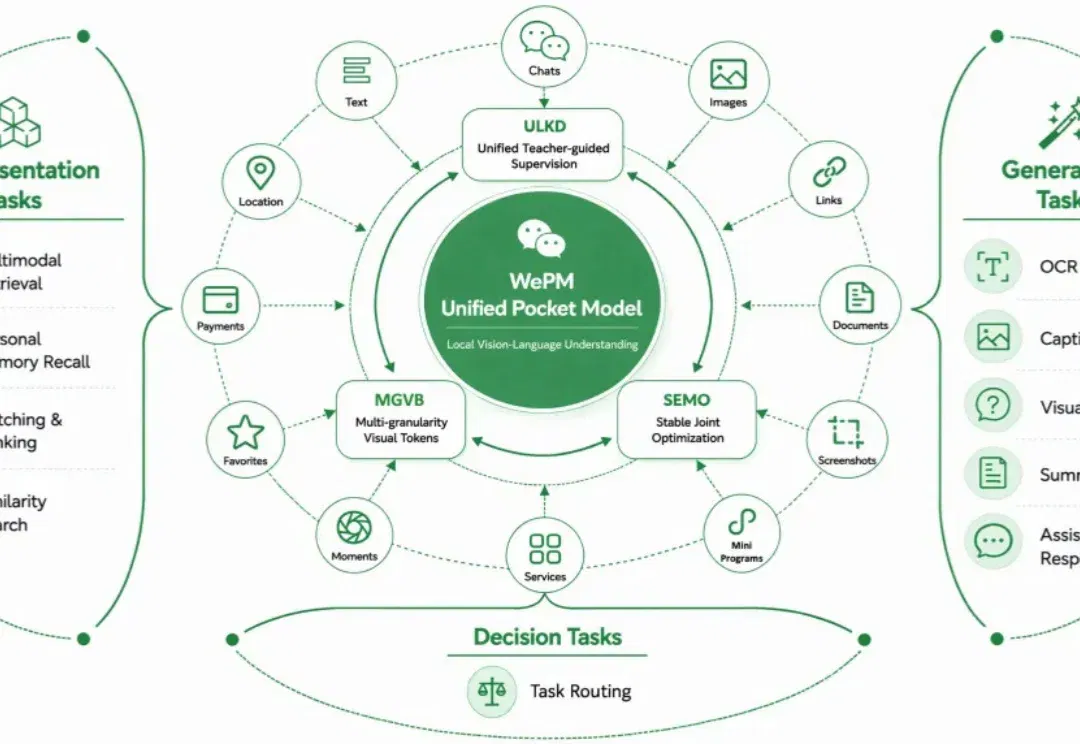
WeChat open-sources WePocketModel, unifying representation, generation and decision with one backbone (opens in a new tab)
Tencent's WeChat team releases WePocketModel, sharing one backbone across representation, generation and decision. WePM-4B uses 61.9% less resident weight memory than the selected specialist stack. Its roughly 8GB is BF16 weights, not total runtime memory; demos use an M5 Mac.
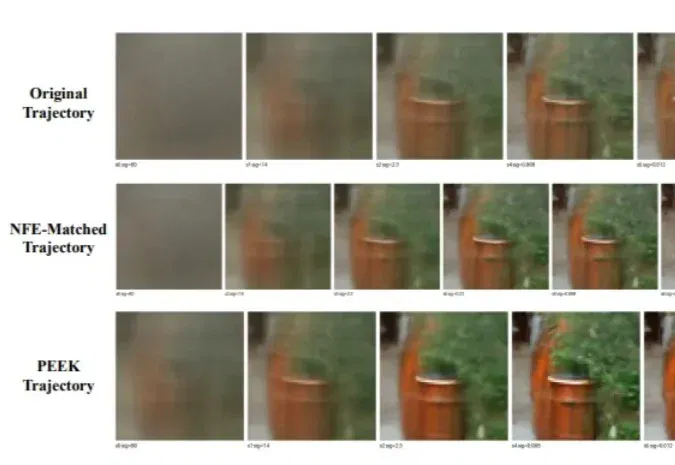
PEEK cuts FID by 49.3% in a specified ImageNet-EDM diffusion-sampling experiment (opens in a new tab)
NUS’s training-free PEEK adjusts deterministic diffusion sampling with look-ahead predictions. At an equal denoising-call budget, one ImageNet-EDM experiment lowers FID from 19.71 to 9.99. Results and one-time search costs depend on the setup.
Peking University Open-Sources PipeLink to Make GPU Kernel Optimizations Reusable (opens in a new tab)
Peking University's PipeLink declares interfaces, synchronization and resource needs for GPU stages, checks contracts and links stages into fused kernels. Examples span toolchains, attention variants and communication-compute fusion; gains depend on components, workloads and hardware.
Can Discrete Codes Become a General Visual Representation? Meituan LongCat Open-Sources dNaViT (opens in a new tab)
Meituan LongCat's dNaViT combines a frozen visual encoder, residual modulation and grouped quantization to retain semantics and pixel detail. The team reports reconstruction, understanding, generation and editing through one encoding interface, with task-specific models and decoding branches.
Memory Tax study compares 11 agent-memory systems with naive RAG on net value (opens in a new tab)
Researchers compare 11 memory systems with naive RAG across three main benchmarks and three backbone models. Benefits and memory tax depend on configuration, retrieval scope and tasks; the findings do not imply long-term memory is universally useless.