HearWell Says It Raised Tens of Millions of Yuan, Plans Magnetic AI Meeting Assistant
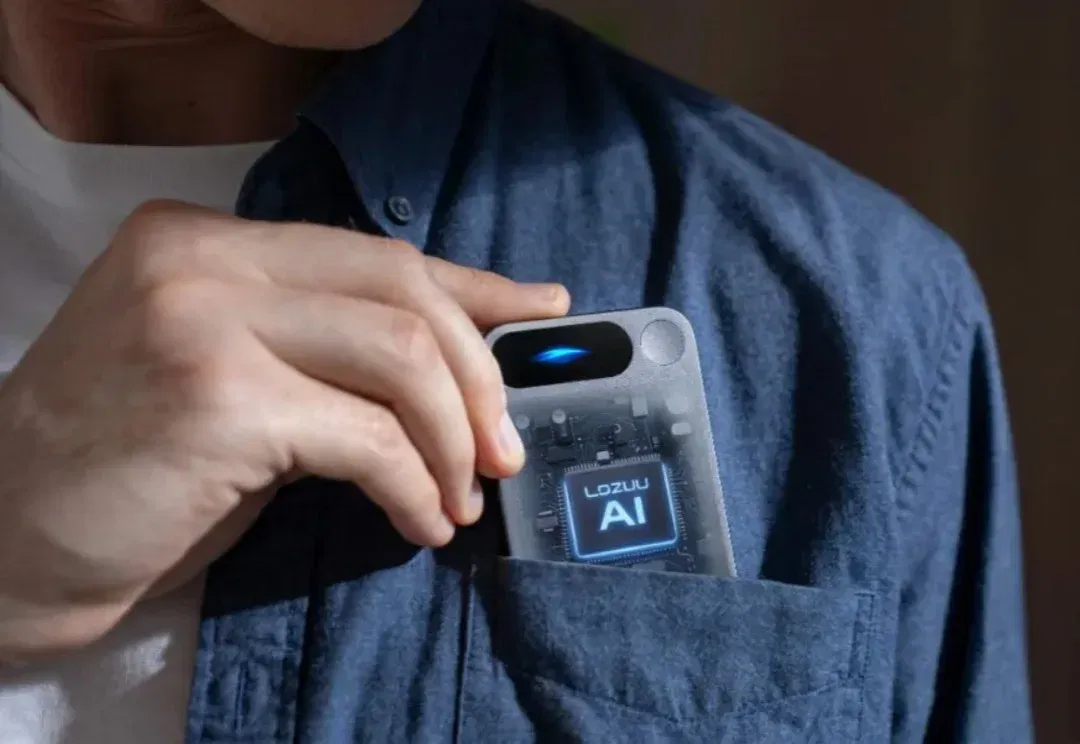
HearWell, founded by former Anker Smart Audio head Wang Zhijun, says two rounds raised tens of millions of yuan. It plans crowdfunding and a CES debut for magnetic meeting speaker Palmo Meet. Earmind is in development, with an acoustic perception platform the longer-term direction.
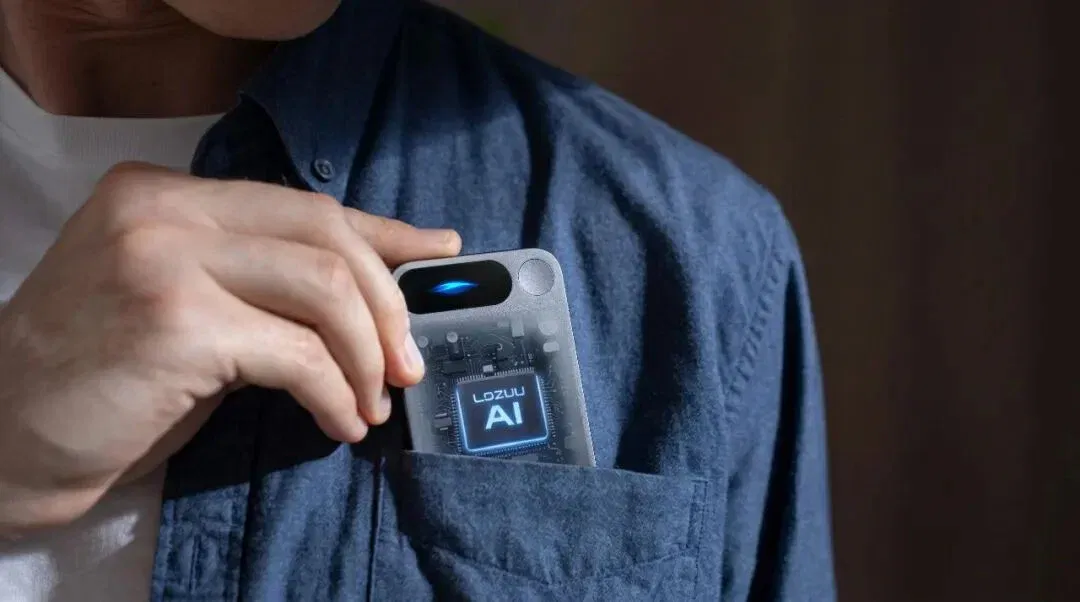
As competition turns AI recording into a basic standard feature, what comes next for AI hardware?
GeekPark has learned that HearWell, an AI acoustic perception technology company founded by Wang Zhijun, former head of Anker's Smart Audio business, has completed two funding rounds totaling tens of millions of yuan. Investors include Boyu Venture Capital, Cuican Capital, Meihua Venture Capital, and Xiuyuan Capital, spanning financial and strategic investors. Xiangyang Capital serves as its long-term exclusive financial adviser.
Wang Zhijun's career has tracked almost the entire evolution of consumer smart audio hardware.
He spent nearly five years in charge of the voice recorder business at iFlytek, experiencing the early efforts to bring speech recognition to consumer markets and overseas. At Anker Innovations, he headed the Smart Audio business, leading a team of about 150 people that launched over 30 products and brought annual revenue into the billion-plus-yuan range. He also created two products that reached Amazon's global Best Seller Top 10 in audio-related categories. One of them, an AI spatial audio speaker, sold about 150,000 units of a single SKU annually, generating approximately $30 million in annual revenue.
Unlike the path taken by many executives leaving big companies to start on their own, trying out a single product first, Wang has set a more ambitious goal for HearWell: rather than making a single AI hardware product, he wants to build a real-time acoustic perception application platform, moving from Speech-to-Text to Sound-to-Understand, so audio products progress from hearing the real world to understanding it.
Leading his product roadmap is Palmo Meet, which is set to launch on overseas crowdfunding platform Kickstarter and make its formal debut at CES. It is a palm-sized AI meeting speaker and end-to-end meeting assistant that attaches magnetically to the back of a phone.
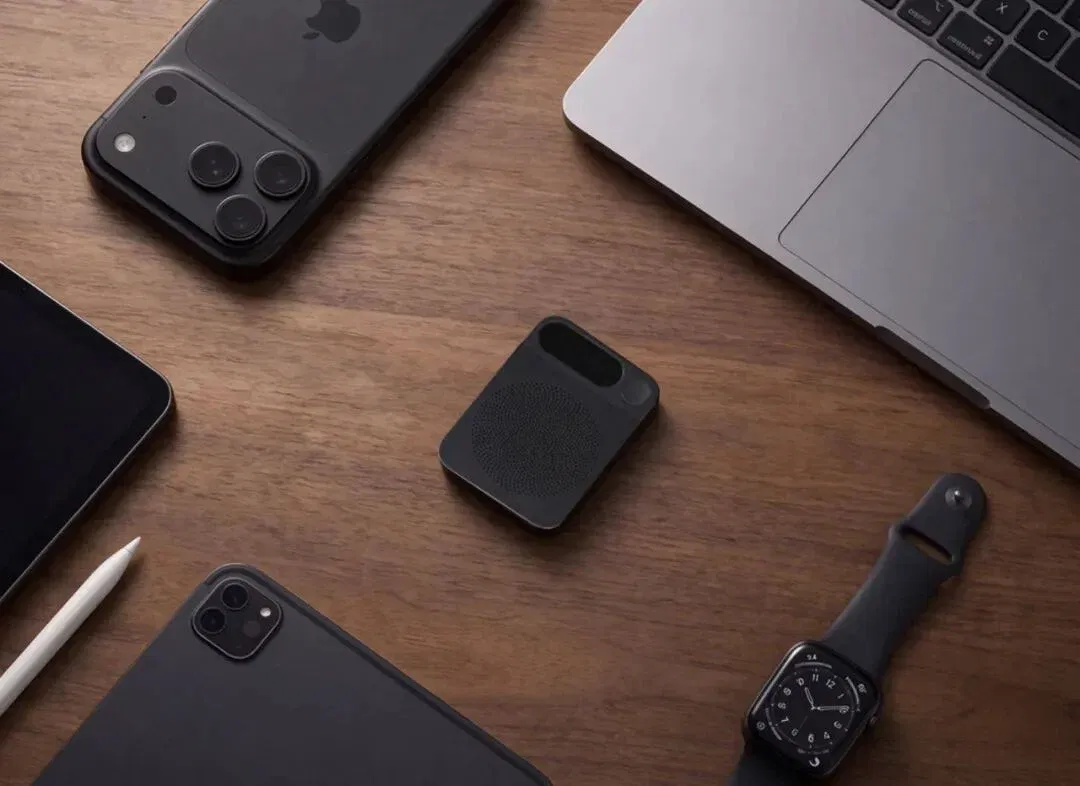
The small device in the center is Palmo Meet | Image: HearWell
Following it is Earmind, now in development and expected to debut next year. Positioned as an 'exoskeleton for the ears,' this super digital ear aims to help people hear farther, more clearly, and with better understanding, and remember more reliably in a noisy physical world.
In Wang's view, the arrival of the AI era creates a major opportunity for acoustic products: 'Audio products used to be hardware-focused and changed little over many years. But AI can not only extend them into entirely new use cases; it can also reshape noise reduction and voice recognition through algorithms and large models.'
We recently spoke with Wang about why he chose to bypass the familiar single-product route and build an AI acoustic perception platform for which there is no ready-made blueprint.
When meetings no longer happen in meeting rooms
Wang's approach to the problem began with an interesting observation.
While running Smart Audio at Anker, Wang also managed the AnkerWork meeting speaker line for enterprise collaboration. He noticed that meeting equipment originally intended mainly for corporate settings was increasingly being bought by individuals for working from home.
'This shows that people's work and meeting environments have changed profoundly,' Wang told GeekPark. In the past, attending a meeting meant entering a room fitted with fixed audiovisual equipment, or at least a relatively quiet meeting room.
Now, however, remote work, hybrid work, and open-plan workstations have become normal, and more and more business communication takes place in small, fluid settings of 1 to 5 people: at home, in a roadside cafe, in a moving car, or in front of a whiteboard in the office.
Yet hardware has evolved far more slowly than the settings in which people use it have changed.
Traditional meeting speakers or camera-equipped soundbars are bulky and relatively fixed, serving rooms with multiple participants. First-generation AI recorder cards and small recorder devices emphasize easy recording anytime, anywhere, solving the question of whether a record can be kept for later, but not whether people can hear and speak clearly during the conversation itself. As for using a phone or computer's speaker directly, in noisy environments it can easily miss speech and struggle to strip out background noise cleanly.
A deeper pain point lies in people's psychological and social thresholds.
He gave an example: when preparing for a meeting at home, someone often has to go into a study, close the door, and even tell family members and children in advance not to interrupt. 'That is actually an extremely high physical and social barrier,' Wang said. People are forced to find a quiet corner to suit the device, rather than simply joining a meeting while making coffee in the living room or breakfast in the kitchen.
Even with in-ear headphones, two or three hours of continuous meetings a day can cause unbearable pressure and pain in the ear canals. Wearing headphones for meetings in a car's cockpit also poses safety risks.
HearWell developed its first product, Palmo Meet, around these small but real moments.
Palmo Meet weighs only about 76 grams and has a slim 8.5-millimeter body. Its built-in magnetic module lets it attach to the back of a phone, a refrigerator door, a whiteboard, or a magnetic car mount, or simply sit flat in the center of a table.
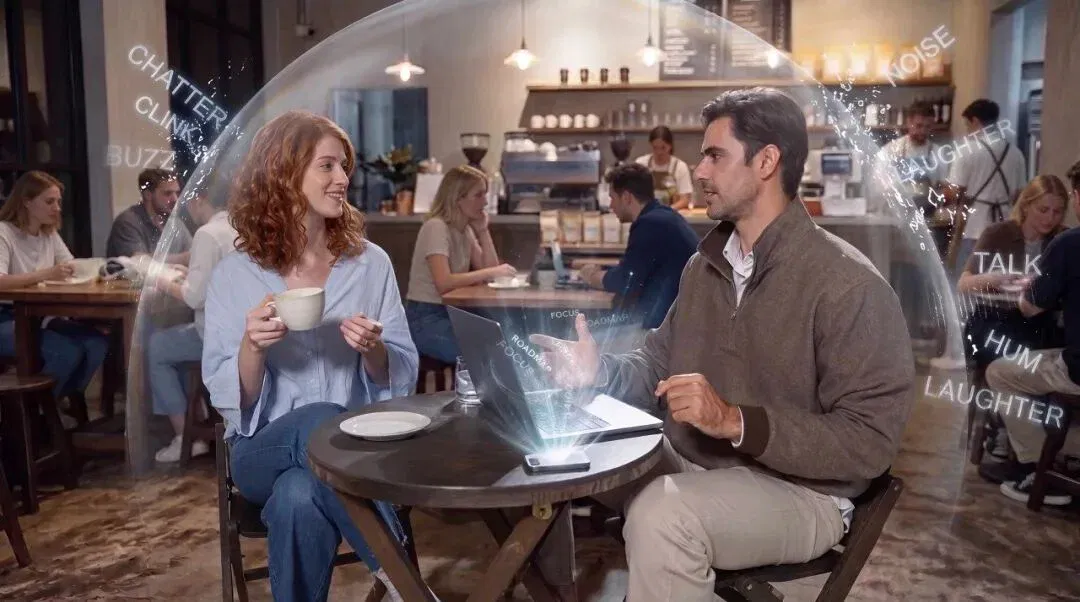
Even in a noisy open space, Palmo Meet can create an online meeting space with AI noise reduction | Image: HearWell
Acoustically, it combines long-range, omnidirectional pickup with bidirectional AI noise reduction, suppressing ambient sound at the local end while also processing background noise at the other end of the call.
But Wang is not satisfied with making it merely a more portable meeting speaker or an AI voice recorder that can handle meetings. He is trying to connect the before, during, and after of meetings into a continuous experience:
Five minutes before a meeting, a reminder would provide a briefing explaining whom the user is meeting, what they discussed previously, and the main agenda for today. During the meeting, a mechanism resembling a memory capsule would quickly fill in the context when someone zones out for a minute or two from information overload. Afterward, the minutes would become inputs for subsequent agent actions, such as editing files directly by voice, sending emails, or carrying out further analysis.
Wang told GeekPark that Palmo Meet aims to help individuals build a personal knowledge asset that travels with them across communication software and settings.
AI recording is only a transition:
AI needs to understand the scene
If HearWell stopped at improving meeting efficiency, it might still be seen as an AI hardware startup with solid engineering and an understanding of overseas markets. What really led Wang to spend six months thinking after leaving Anker before settling on a direction was his assessment of an underlying paradigm shift taking place in acoustics in the AI era.
'Audio products used to be mainly about acoustics and hardware, with little change over many years.' Wang believes the wave of large models sparked by ChatGPT brought the first set of benefits.
Those benefits drove the explosion of AI recorder cards over the past two years. But the limitations of this paradigm are also obvious. He sees it as a typical Speech-to-Text paradigm.
When sound is rapidly converted into one-dimensional text, vast amounts of physical information carried by it are ruthlessly discarded: the speaker's direction and distance from the device, whether the surroundings are an open street or an enclosed room, how many people are talking at once, whether a speaker sounds anxious or calm, or even a sudden car horn or the sound of shattering glass.
Wang gave an example: if someone tells a robot, 'A glass broke over there; go around it,' text-only understanding struggles to determine which direction 'over there' means, and cannot directly perceive the sound event and distance of breaking glass acoustically. In real environments with multiple people and noise sources, relying solely on text-based large models for speaker separation or semantic correction consumes large numbers of tokens, while accuracy also struggles to keep breaking through its ceiling.
Therefore, HearWell has established a technical roadmap from Speech-to-Text toward Sound-to-Understanding, aiming to build a real-time acoustic perception platform.
In their architectural design, this platform does not seek to train a huge general-purpose model. Instead, it takes a hybrid approach combining a cloud foundation model with specialized acoustic perception models on the device.
The team has deployed lightweight specialized models on device-side chips, retaining sound's original multidimensional acoustic signals to build two core capabilities:
- Real-time situational perception: Identify the device's physical environment and changes within it, providing context for subsequent speech processing and AI understanding.
- Selective listening: Combine techniques such as sound source localization, voiceprint-based noise reduction, and target speaker extraction to filter for and focus on key sound sources in complex acoustic environments, rather than indiscriminately recording everything.
Wang said that once this acoustic perception platform becomes powerful enough, it could incubate a second, third, or even fourth product for different specialized use cases.
Earmind, for instance, is the second product they are pursuing. Wang calls it an AI digital ear, an 'exoskeleton for the ears,' helping people hear farther, more clearly, and with better understanding, and remember more reliably in noisy environments.
Between a single product and a platform,
where does the moat for AI hardware really lie?
Why not follow the path of many founders leaving big companies, concentrating first on one product to break into the market, instead of wanting to build a platform from the outset?
As a seasoned operator who has overseen hit products on the hundred-million scale at both iFlytek and Anker Innovations, Wang takes an unusually cool-headed view of this wave of enthusiasm for AI hardware.
In his view, the first wave of AI hardware benefiting from large models is essentially a spillover of software capabilities. General-purpose large models have put speech transcription and summarization on the same starting line, and that technological dividend has produced many AI recording products.
'Everyone is working on the things that are visible. Once everyone piles in, it becomes more a contest of commercial efficiency: who has stronger channels, lower supply chain costs, and greater token purchasing volumes.'
He concluded that a hardware lead often lasts only about six months before intense market competition arrives.
That is also an important reason why, from his first day as a founder, he refused to build a single-product company and insisted on positioning HearWell as a product-driven AI acoustic perception platform company.
In Wang's view, AI acoustic perception is long-term work that depends heavily on engineering experience and accumulated data. General-purpose large models provide infrastructure for text data, with no absolute differentiation in calling them; but acoustic environments in the physical world vary enormously. Coffee grinders in cafes, keyboards in open-plan offices, and tire noise inside cars each require the collection of real acoustic environment data, targeted annotation, and post-training of device-side models.
This is not something a team that understands only software, or only hardware, can replicate in a short time.
For its business model, HearWell will combine hardware sales with subscription services. Wang believes users' willingness to pay will ultimately be limited if subscriptions merely cover the token consumption of speech-to-text. 'Only after the platform has accumulated users' cross-platform meeting histories and communication context, enabling specialized agents that truly understand the business and the setting, can it build longer-term value.'
Wang appeared quite relaxed about potential competition from meeting software giants making hardware themselves.
'The big companies provide infrastructure for meetings and collaboration. We focus on the best possible experience at the device end, connecting personal data fragmented across major platforms and turning it into an asset belonging to the user. In terms of our place in the ecosystem, these roles complement each other rather than compete.'
Ultimately, allowing products not only to hear the literal meaning of sound, but also to perceive its spatial setting, relationships, and significance, sounds like a promising path, whether for helping people or for the more distant prospect of embodied intelligence.
This is an original Hardwire article. To request republication, please leave a message in the comments below the article.
This article is from GeekPark, by Su Zihua.
Related topics
After reading
Join the AINRK community
Read how to join the community and connect with people working in AI.
Related articles
Continue reading related topics and articles in this category.
JLC Connects EDA with Manufacturing: Its Hardware Platform and the AI Opportunity (opens in a new tab)
JLC links EDA, components, PCB, assembly and mechanical services. Its first-nine-month 2026 report lists RMB 11.998 billion revenue and RMB 1.866 billion attributable profit. The article explores order density and AI design; the hardware-GitHub analogy and future value still need validation.

Qianyi Zhigan Raises Over 10 Million Yuan in Seed Funding for North American Pet Health Collars (opens in a new tab)
Z Potentials reports seed funding led by Shuimu Venture Capital with GHIC participation. Qianyi Zhigan is preparing a pet collar for North America using hardware sales and subscriptions. Reported errors and user alerts are team tests and anecdotes, not canine clinical validation.

Yujie Liu's Extra: Turning Hackathon Photos into Personal AI Newspapers (opens in a new tab)
SUSTech student Yujie Liu built Extra to turn event photos into personal AI newspapers. The interview traces a shutdown, a contest loss and queues for a prototype, distinguishing interest from market validation. Reported million-level funding has no disclosed currency, investors or closing details.
Qianxing Intelligence Raises Tens of Millions of Yuan for Boxing Sparring and Home-Fitness Devices (opens in a new tab)
Qianxing Intelligence says it raised tens of millions of yuan in a round solely led by Kunlun Capital. It is testing R1 humanoid sparring and R2 home-fitness prototypes with users and plans a CES 2027 debut; training-speed and survey claims apply to its specific tests and respondents.
CyboPal ONE’s 27-inch display on a six-axis arm tops US$1.3 million in crowdfunding (opens in a new tab)
CyboPal ONE combines a 27-inch 4K display with a six-axis arm and voice, gesture and preset-position controls. Crowdfunding topped US$1.3 million at reporting. Fully automatic sit/stand/recline detection and tracking remain in internal development and are not publicly available.