Yujie Liu's Extra: Turning Hackathon Photos into Personal AI Newspapers

SUSTech student Yujie Liu built Extra to turn event photos into personal AI newspapers. The interview traces a shutdown, a contest loss and queues for a prototype, distinguishing interest from market validation. Reported million-level funding has no disclosed currency, investors or closing details.

Something may be worth paying for without being difficult to build.
Applause does not necessarily mean an answer, nor rejection a verdict.
Surfing Wave, Build the Great.
Founder Yujie Liu, born in 2003, currently studies at Southern University of Science and Technology. He has won multiple hackathon championships and founded Shenzhen's Shenkesong hackathon community. Now, he has turned a real problem he discovered while organizing hackathons into his team's first interactive hardware product: the Extra AI newspaper machine.
When an event produces hundreds or thousands of photographs, why do people so often never even see their own moments in the spotlight?
Extra hopes to turn photographs scattered through cloud albums into a personal story you can take away. AI searches a mass of event photographs for a participant's highlights, organizes their experiences that day into a personal story, lays it out and prints a newspaper starring that person. When the event ends, users can take home their memorable moments from the entire occasion.
Extra's prototype stands nearly 1.5 meters tall. To let investors see the product in person at an investment committee meeting, Yujie and co-founder Xiangkang Meng built a demo version by hand in a single day in Changsha. On the afternoon they landed, they went straight to a contract manufacturer to place an order. Before the meeting, they delivered a caseless prototype with the camera, screen and lights attached directly to an acrylic board, successfully demonstrated it and ultimately secured committee approval.
From contestant to event founder, from shutting down his first product to continuing to seek users for a machine that failed to win a prize, Yujie Liu has traveled a road that stretches beyond a hackathon's award ceremony.
Two years in which hackathons took China by storm; two years in which a university student became an entrepreneur recognized by investors.
In this edition of Surfing Founders, SurferGarage wants to share how, after a hackathon ends, a young person turns a passion ignited by creation into a product and a venture they can keep pursuing.

@Extra AI newspaper machine
Into Shenkesong: Standing at the Center of the Crowd
The day after the Douyin hackathon ended, Yujie Liu and co-founder Xiangkang Meng decided to do two things: organize a hackathon themselves, and immediately establish a company to turn their hackathon project into a startup product.
At the Douyin AI Innovators Program's 2025 hackathon, they won first place among 3,000 participants and a prize of RMB 100,000. The money was barely enough to cover establishing the company, launching the product and its early operating costs.
The two first met on Douyin. Xiangkang Meng was preparing to apply for postgraduate study at SUSTech and sought advice from Yujie Liu, who had already secured recommended admission there. Later, they entered the same hackathon. One studied mechanical engineering and the other the Internet of Things; both were willing to get hands-on and turn ideas into reality.
For the first time, he discovered how quickly an idea could become a product in the AI era. In the lab, he had been used to improving technical accuracy from 95% to 98%. At a hackathon, technology had to confront a problem directly, and also the people using it. He met a group of young people who had already started businesses or were preparing to. Setting up a company, fundraising and operations—things that had once felt somewhat remote—now came with people he could talk to about them.
In Shenzhen, Yujie and Xiangkang founded a local hackathon brand: Shenkesong.
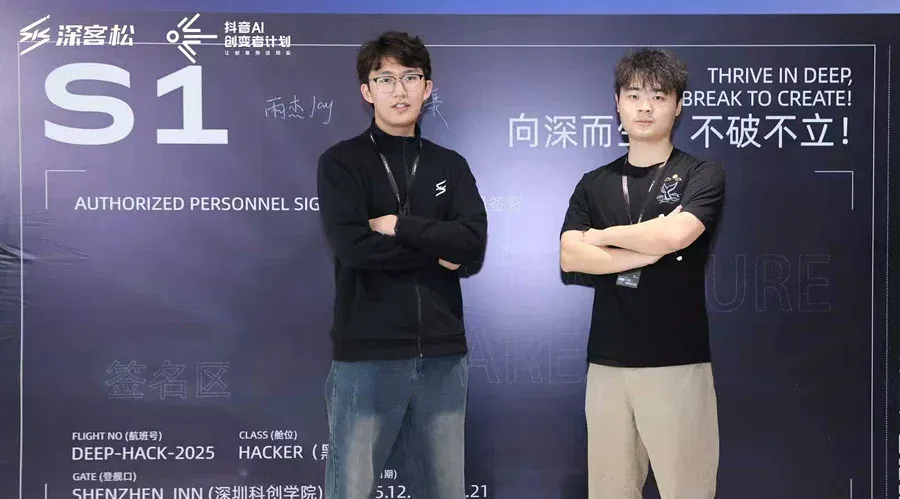
@Yujie and Xiangkang at Shenkesong S1.
For Yujie, standing at the center of a crowd was not something that had come naturally since childhood.
In primary school, he was the one who raised his hand the least high in class. Even in his first year at university, he still felt nervous pushing open his adviser’s office door. He might rehearse what he wanted to say several times in his head and still struggle to express it when he spoke.
Yujie believes people can reshape themselves. To develop himself, he volunteered to be class monitor from middle school onward; at university, he repeatedly practiced pitching through entrepreneurship competitions. After about three years, he could finally deliver prepared material fluently, but realized that he still struggled with impromptu speaking. So he began observing and learning how others expressed themselves. Through repeated practice, he gradually became able to handle different situations calmly and express his views confidently and clearly. His ability to stand at the center of a crowd came from repeatedly placing himself in environments he had not been good at handling.
Yujie says the fastest way to grow is to do something once first. Only by actually doing it do you discover where the difficulties lie and what genuinely interests you.
Today, the young man who once could not walk naturally into an office is inviting more people into the community he founded. Later, some people made the same decision after attending his events.
At the after-party following Shenkesong S1, contestants asked them: how do you organize a hackathon? Could we organize the next one together?
So Yujie projected the group-chat entry link onto the big screen, and dozens of people joined at once. That evening, groups for different regions, including Guangzhou, Dongguan, Zhaoqing and Zhuhai, were established one after another. Some of these people later founded hackathons or co-creation communities in other cities.
He had originally wanted to organize a hackathon for Shenzhen, but participants took the question elsewhere: could our city have a hackathon too?
A single spark can start a prairie fire. With their passion for creating, young people in China are planting hackathons across the country.
The Real Challenges Lie Beyond the Code
Meanwhile, he and Xiangkang pursued another track: turning their post-competition product idea into a business.
Their first product attempt was called Haoyun Kacha. It began with a somewhat playful question: if someone is having a rough time at work, might they want to check their workstation's feng shui?
At the time, they noticed that projects involving mystical beliefs easily attracted social-media discussion. They initially wanted to analyze feng shui for an entire home, but felt the scope was too broad. Later, they narrowed their focus to the place where they spent the most time every day: the workstation.
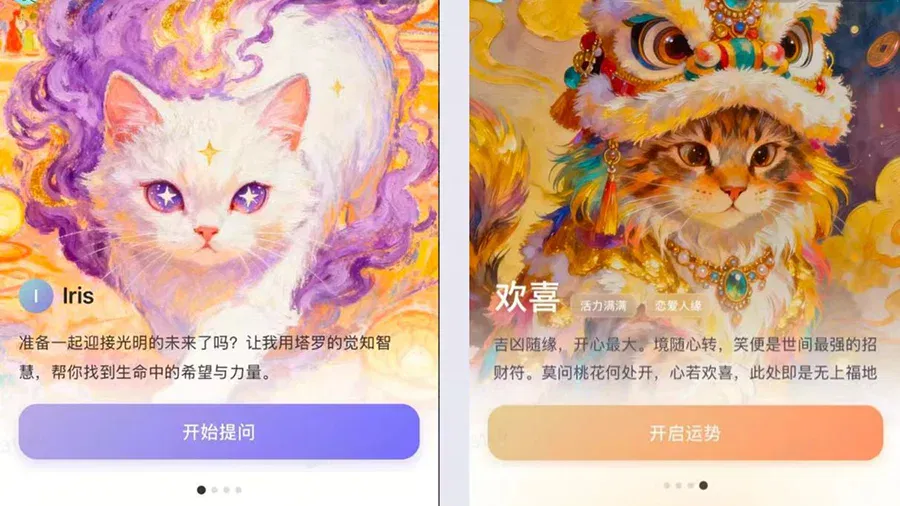
@Some features of Haoyun Kacha
Searching Xiaohongshu, they found that people were already posting photographs of their workstations and asking other users to take a look. In the comments, people discussed desk orientation and the placement of objects, as well as troubles at work. Before a product existed, the conversation around it had already begun.
So they made a Douyin mini-program: take a workstation photo, and AI generates a feng shui analysis using concepts such as the Azure Dragon, White Tiger, Vermilion Bird and Black Tortoise. For example, being reprimanded by your boss recently might be attributed to "something misplaced in the Azure Dragon position."
It turned workplace frustrations into something people could joke about. Users could also receive a comic-style picture of their workstation to share with friends and compare their rankings. The team built regional and friends' leaderboards, hoping to turn one photo into participation by more people. The beta-testing group gradually grew to nearly a thousand members.
They had also envisioned the commercial path: users would encounter content on Douyin, enter the mini-program to take a photograph and view the analysis, then buy recommended "good-luck items". From discovering the product to placing an order, everything could stay on the same platform.
Over several months, they completed the development work piece by piece. To young first-time entrepreneurs, the path now looked fairly clear: the product was built, people were willing to use it, and the next step was to bring it to more people.
But only when they actually reached this point did they realize that things were nowhere near as simple as they had imagined. Because of the product's subject matter and content direction, issues they had not fully considered began to emerge. The next step, which had seemed natural, remained out of reach.
They discussed it repeatedly, trying to find a way forward, neither willing to give up easily. But the further they went, the more they discovered that some constraints could not be resolved through technical optimization. For them, lacking entrepreneurial experience, this sense of powerlessness was even harder to accept than the difficulties encountered during development.
It was also the first time they truly realized that building a product and actually bringing it to market are two different things. Some real-world boundaries reveal how difficult they are to cross only when you reach them yourself.
After about a week of analysis, they decided to shut down Haoyun Kacha.
"If we had been too experienced from the start, perhaps we would never have begun once we saw the risks."
Then the story that followed could never have happened.
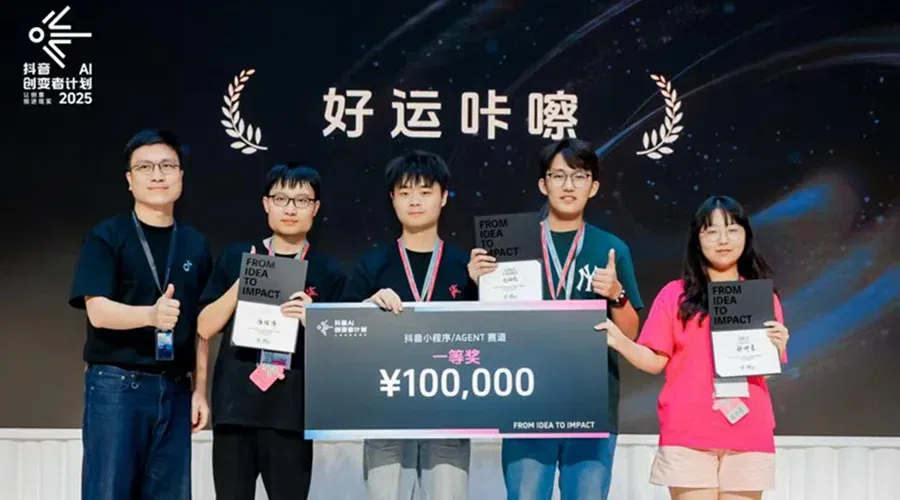
@Haoyun Kacha wins first place at a hackathon with 3,000 participants
During the uncertainty after shutting down Haoyun Kacha, Douyin, with which Yujie had close ties, extended an offer: "Organize 50 hackathons across China together with the Douyin Innovators Program."
As hackathons took place one after another around the country, organizing them and talking to developers became part of his daily work. Today, he and Xiangkang are still Douyin Campus community presidents.
This internship gave him the opportunity to encounter more mature ways of working as a team. How to divide responsibilities, communicate progress and move things forward together—he gradually learned all of this through concrete work. Things he had previously needed to figure out on his own now came with methods he could refer to while working with colleagues. These everyday experiences also helped him when he later continued his startup journey.
What left the deepest impression on Yujie Liu during his six months at Douyin was the eventual champion.
After the final selection received around a thousand projects from across the country, the championship went to a young first-time hackathon participant from a fourth-tier city and an undergraduate institution outside China's "Double First-Class" university program.
Yujie was puzzled at first: why had first place not gone to someone from Tsinghua, Peking, Fudan or Shanghai Jiao Tong, in the major cities of Beijing, Shanghai, Guangzhou or Shenzhen?
Later, he felt that this was precisely a reason to keep organizing hackathons: in terms of the total number of awards, leading elite universities still had a clear advantage. A five-day hackathon cannot completely erase differences in regions and resources either, but at least we give people who previously struggled to attract the world's attention a chance to be seen.
Real Recognition Is More Than a Championship
Extra is a product that grew out of a community and its needs.
In April 2026, Yujie Liu and his team organized the Qing-Bei-Ha Hackathon Finals with 300 participants. It was Shenzhen's largest in-person hackathon at the time. For the event, they rented a traditional newspaper machine. Unexpectedly, people formed long queues in front of it just to receive a souvenir newspaper printed with their own photograph. With his technical background, Yujie initially did not understand: a template, a photograph and a printout did not involve complicated technology. Why could it sell at that price, and why were people willing to wait?
A hackathon participant told Yujie that every event produces a huge number of photos, but often all that happens afterward is a cloud-album link sent to everyone, leaving participants to search for themselves. Some have no time; others never open it. Photographs have been taken, but the people recorded in them may never have seen them. Yujie remembered this problem.
While working on autonomous driving for agricultural machinery at university, he had believed that entrepreneurship required achieving an industry-leading level in the lab and building a technical advantage before you could sell a product to others. The long queue at the hackathon reminded him that something may be worth paying for without being difficult to build.
Through continued contact at events, he gradually discovered that people were strongly interested in AI art installations and willing to take part in interactions that connected with them personally. The souvenir newspaper was just one concrete example. People also cared about what they had experienced at an event and whether they could preserve that feeling.
"What if we connected cloud albums with newspapers?" The photographs already contained a person's experiences that day. After AI recognized them, it could organize those experiences into text and lay them out. At the end of an event, participants would receive a newspaper starring themselves, recording the day's highlights and stories.
"We have to build it this weekend."
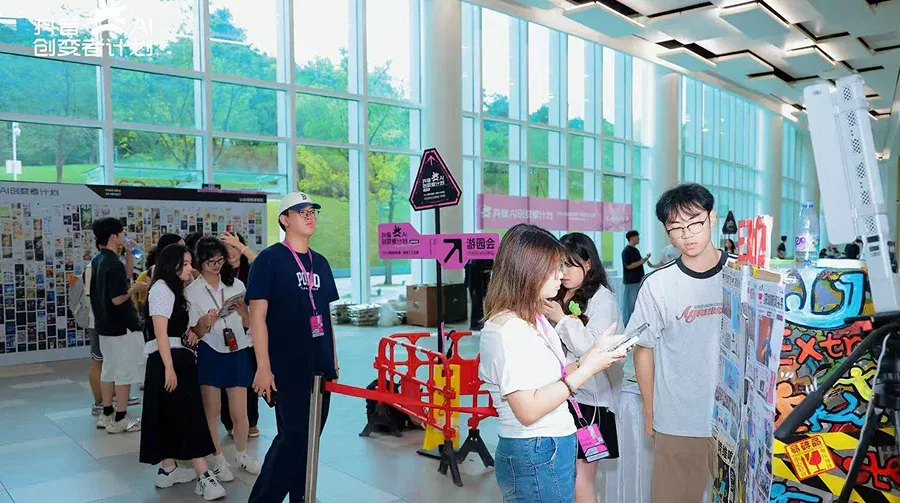
@The newspaper machine that drew long queues at the hackathon
He was still interning at Douyin then. In one weekend, he built a prototype with photographs, text and a layout already on screen. He still wanted to print it out and hold it in his own hands.
He cycled to a print shop. Throughout the ten-minute ride, he was excited: something that had previously been only a thought was finally about to become a newspaper he could hold.
During his months organizing hackathons at Douyin, he had seen many hundreds of projects. These works were not necessarily mature; sometimes just one small detail stayed with him. Now those details were beginning to find a common destination. For the first time, the experiences accumulated in the community were being expressed as the value of a product.
After printing the newspaper, the team had another problem to solve: how to turn the on-screen process into a machine that could be used at an event.
Yujie chose the place he knew best for Extra's birth: a hackathon.
During the early hours in Hangzhou at AdventureX2026, Yujie's team built Extra's prototype in four days: a device almost as tall as a person. A frame, printer and screen, plus eye-catching lights—to bring all their ideas to life, they spent nearly RMB 10,000 of their own money.
It was a product that was hard to miss. At the exhibition's most prominent entrance, investors and judges kept approaching. Most gave positive feedback after looking: a clear commercialization path and selling points. He heard almost no suggestions for improvement. Team members told him they would definitely win a major prize that night, perhaps more than one.
At his first hackathon, Yujie had won the championship and RMB 100,000. Since then, he had founded Shenkesong himself and experienced a product's development, launch and shutdown. Now, returning to the competition with these experiences, he was once again met with continuous praise. The team's expectations of prizes had not come out of nowhere.
They waited until all the audience had left, without ever hearing the host call their name. The after-party band began playing and the crowd began celebrating. Yujie quietly left the venue, taking the somewhat unwieldy prototype, as tall as a person, away from the venue with him.
That evening, Yujie had a late-night meal with the team and kept reassuring everyone. But when he woke the next day, it was his turn to think through the question alone, and he began to wonder whether he really had got it wrong.
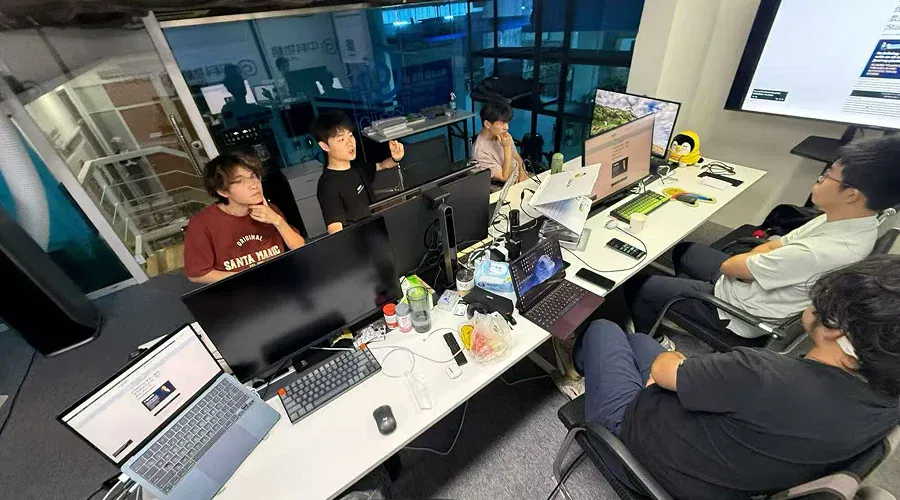
@Yujie and his team
They were not unfamiliar with such a gap between expectation and reality. Before Haoyun Kacha shut down, there had also been many reasons to keep it going.
Perhaps what people find hardest to recognize is a world that happens to match their own expectations. When applause rings out, we want to believe it is the answer; when it stops, we easily mistake silence for a verdict.
Yujie did not want to judge solely by the judges' scores. Two days later, on July 31, another Douyin Campus hackathon was taking place in Shenzhen, and he wanted to put Extra there.
Douyin Campus supported him in bringing this still-evolving product to the event, giving the team a chance to face real use. The product still needed refinement, and actual use let the team see problems and hear participants' feedback.
People waiting in front of Extra formed a long queue. The machine was still unstable, taking two minutes to produce one newspaper and printing only 30 an hour. Some knew they would have to wait an hour and still stayed.
"Users do not lie."
Yujie also understood that this was not enough to prove they had made the right bet. Perhaps any sufficiently novel art installation would also attract people willing to queue. But at least he had seen a reason to keep testing.
At first, Yujie found his starting point for entrepreneurship at a hackathon; later, he became Shenkesong's founder, giving more people's work a chance to be seen. Now, when his own creation had not received the recognition he expected, people in the hackathon community gave it a chance to be genuinely used.
A competition determines first place, but a crowd can choose another kind of champion.
We Want to Find You
Because we have seen it, we believe in it deeply.
SurferGarage is an innovative media outlet and community documenting those who dare to seize the rhythm of their times, feel the speed, risks and opportunities amid the waves, and define their own course through action—Surfing Founders.
We hope to find more Surfing Founders and record their stories of innovation and adventure, turning the Surfing Founder spirit of innovation and adventure into a spark that inspires more young wave riders.
Perhaps you are in a garage, perhaps still in a university dormitory, perhaps the waves keep knocking you down—but you can still be the first to stand up when the next wave rises.
If you feel that fire inside, let us see you. You deserve to be heard by the world.
Surfing Wave, Build the Great.
This article comes from "SurferGarage," written by "Edison Xu."
Related topics
After reading
Join the AINRK community
Read how to join the community and connect with people working in AI.
Related articles
Continue reading related topics and articles in this category.
Qianxing Intelligence Raises Tens of Millions of Yuan for Boxing Sparring and Home-Fitness Devices (opens in a new tab)
Qianxing Intelligence says it raised tens of millions of yuan in a round solely led by Kunlun Capital. It is testing R1 humanoid sparring and R2 home-fitness prototypes with users and plans a CES 2027 debut; training-speed and survey claims apply to its specific tests and respondents.
CyboPal ONE’s 27-inch display on a six-axis arm tops US$1.3 million in crowdfunding (opens in a new tab)
CyboPal ONE combines a 27-inch 4K display with a six-axis arm and voice, gesture and preset-position controls. Crowdfunding topped US$1.3 million at reporting. Fully automatic sit/stand/recline detection and tracking remain in internal development and are not publicly available.
EmotionX Gets Decent Capital Angel Backing; Feel Wearables Planned for CES 2027 (opens in a new tab)
EmotionX says it has angel backing from Decent Capital and has listed its fine AI app. Five hardware products remain in development, with Feel planned for CES 2027. Its proposed emotional-regulation loop still requires third-party validation.
General AI models enter hardware development, from files to prototypes (opens in a new tab)
Youxin reviews hardware-design examples involving OpenAI, Anthropic and engineering tools, spanning circuits, enclosures, firmware and CAD. Some prototypes were built and tested, but digital checks, engineering review and physical reliability remain distinct hurdles.
Suisheng raises tens of millions of yuan for Memoket wearable AI memory (opens in a new tab)
Zhidx interviews Suisheng founder Wang Shiyuan about the Memoket Gem wristband, KITE long-memory engine and software subscriptions. Funding, battery life, early user results and benchmark figures are company statements; long-term use remains to be tested.