Gemini 4 Neon leads LiveBench's long-workflow ranking, with trade-offs on other tests

The cited LiveBench 2.0 snapshot puts Gemini 4 Neon at 87.4, ahead of two models at 84.9. Neon and Hydrogen both ace Plotly's 43-question test at different costs. Rankings, task costs and pricing depend on test versions, configurations and dates.
This article compares the rankings and specific tests cited at the time of the original report. The question sets, model configurations and cost definitions differ between organizations, and rankings change. The LiveBench figures should be read as the cited snapshot; an overall score does not establish that a model is strongest at every task. Plotly's 43 questions and dollar amounts represent that particular test, rather than fixed prices for all data-analysis tasks. The time-limited pricing and vendors' self-reported model cards mentioned here should also be checked against the relevant dates and configurations. LiveBench (opens in a new tab), Plotly's original test and correction (opens in a new tab).
This November, the AI world has seen three big launches in ten days.
Anthropic introduced Claude Fable 5.2 on the 9th; OpenAI rolled out GPT-6.2 Astra on the 17th; and on the 18th Google unveiled Gemini 4 Neon, positioned between Carbon and Hydrogen.
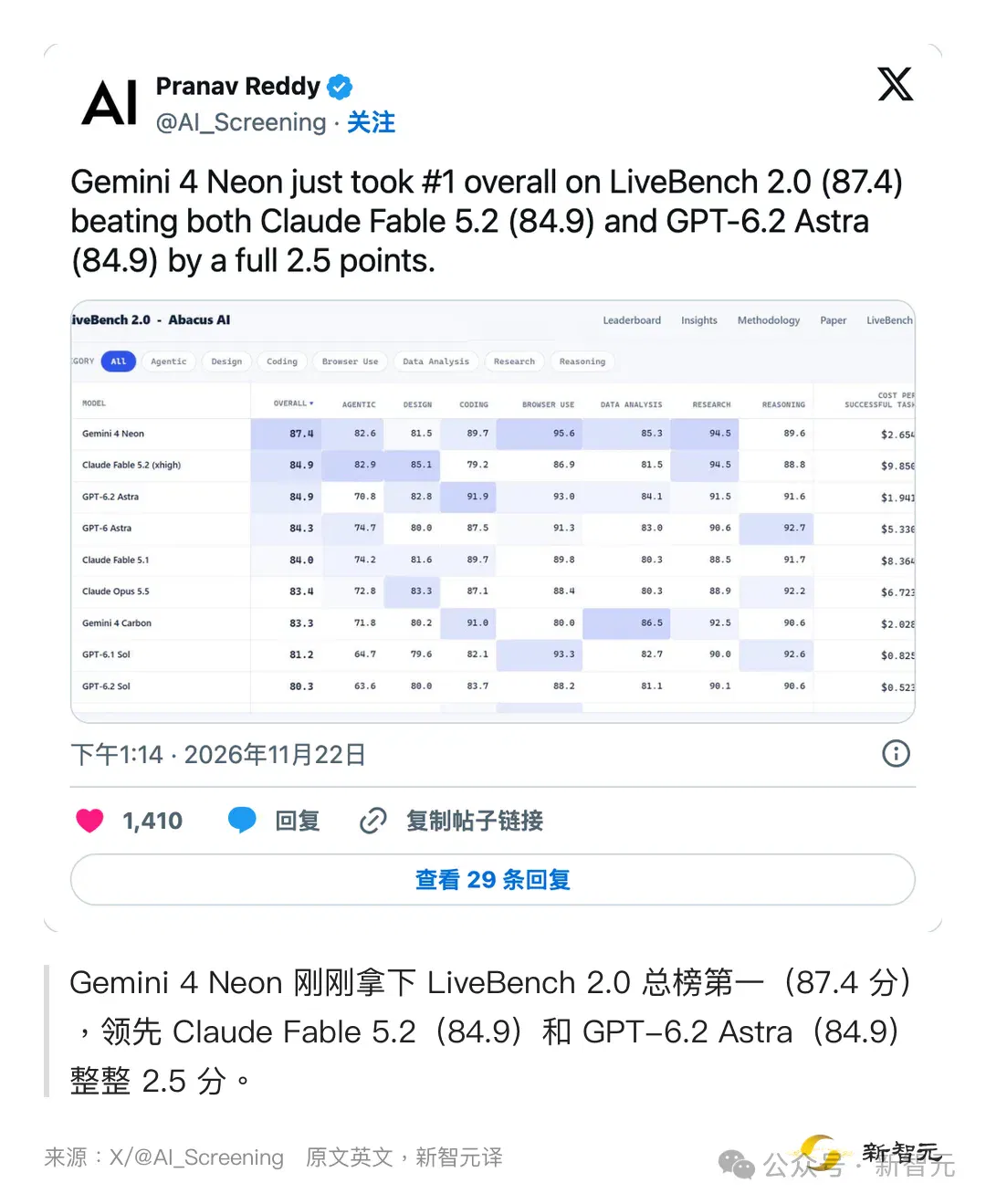
Four days later, blogger @AI_Screening posted a screenshot of LiveBench 2.0:
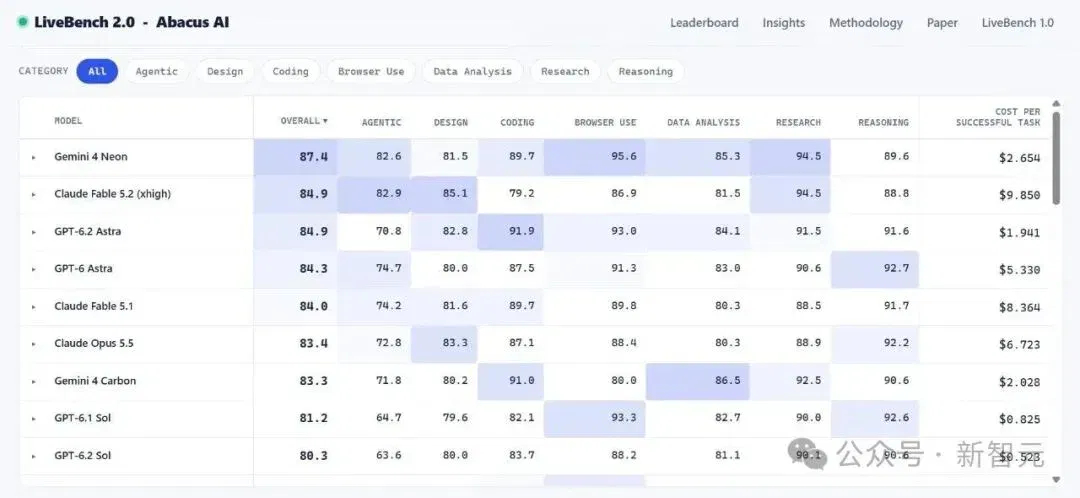
Neon topped the overall ranking with 87.4 points, pulling a full 2.5 points ahead of Fable 5.2 and Astra, which were tied at 84.9. A middleweight knocking out two heavyweight champions with one punch: what a spectacle.
But as someone who pays for these models every day, I held back my excitement. Does first place really make this the strongest all-rounder?
The 2.5-point lead is real: it wins by specializing in long jobs
The long-workflow version of LiveBench 2.0 cited in the original report contains seven subcategories and 471 questions. The precise question set and date should be checked against the version snapshot being cited.
In the older October 29 snapshot, Fable 5.1 (85.69) and the previous-generation GPT-6 Astra (85.64) were separated by just 0.05 points. The two snapshots cannot be compared directly, but the leaders had been fighting down to the second decimal place. It is as if a 100-meter sprint previously decided by half a nose suddenly saw Neon pull two body lengths ahead.
Break down the subscores and Google's intentions are clear: 95.6 for browser use, 94.5 for research, 89.7 for coding and 89.6 for reasoning. These fit its official positioning precisely: long agent workflows involving heavy tool use.
Neon's strength is rolling up its sleeves to open web pages, dig up information and edit code for you, seeing the hard work through to the end.
Change the exam, and the champion's halo quickly fades
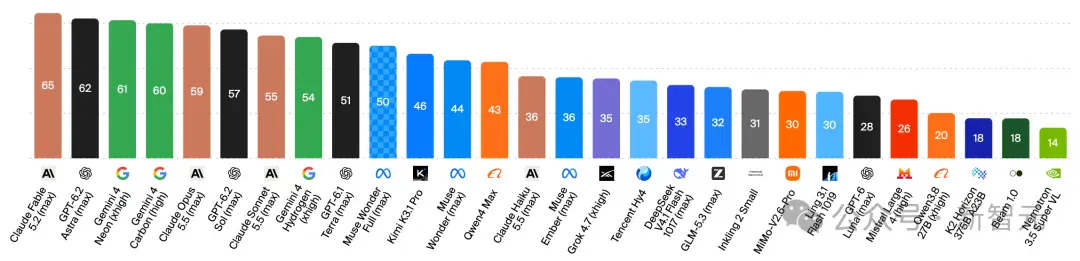
On Artificial Analysis Intelligence Index v5.0.1, Neon scores only 61 even at the xhigh thinking setting, placing third overall. It takes first place only on that organization's Coding Agent Index, with 58.6.
In Google's self-reported model card, Neon beats Claude Opus 5.5 and GPT-6.2 Sol in 17 of 19 comparisons. Yet even on tests Google selected itself, Opus 5.5 holds on to Terminal-bench 4.1 and FrontierCode 2.0.
Put plainly, it is a special-operations soldier for long workflows, still short of perfect marks in every subject.
The real test comes when you do the arithmetic. For an agent doing work, you need to know how much it costs to finish a task.
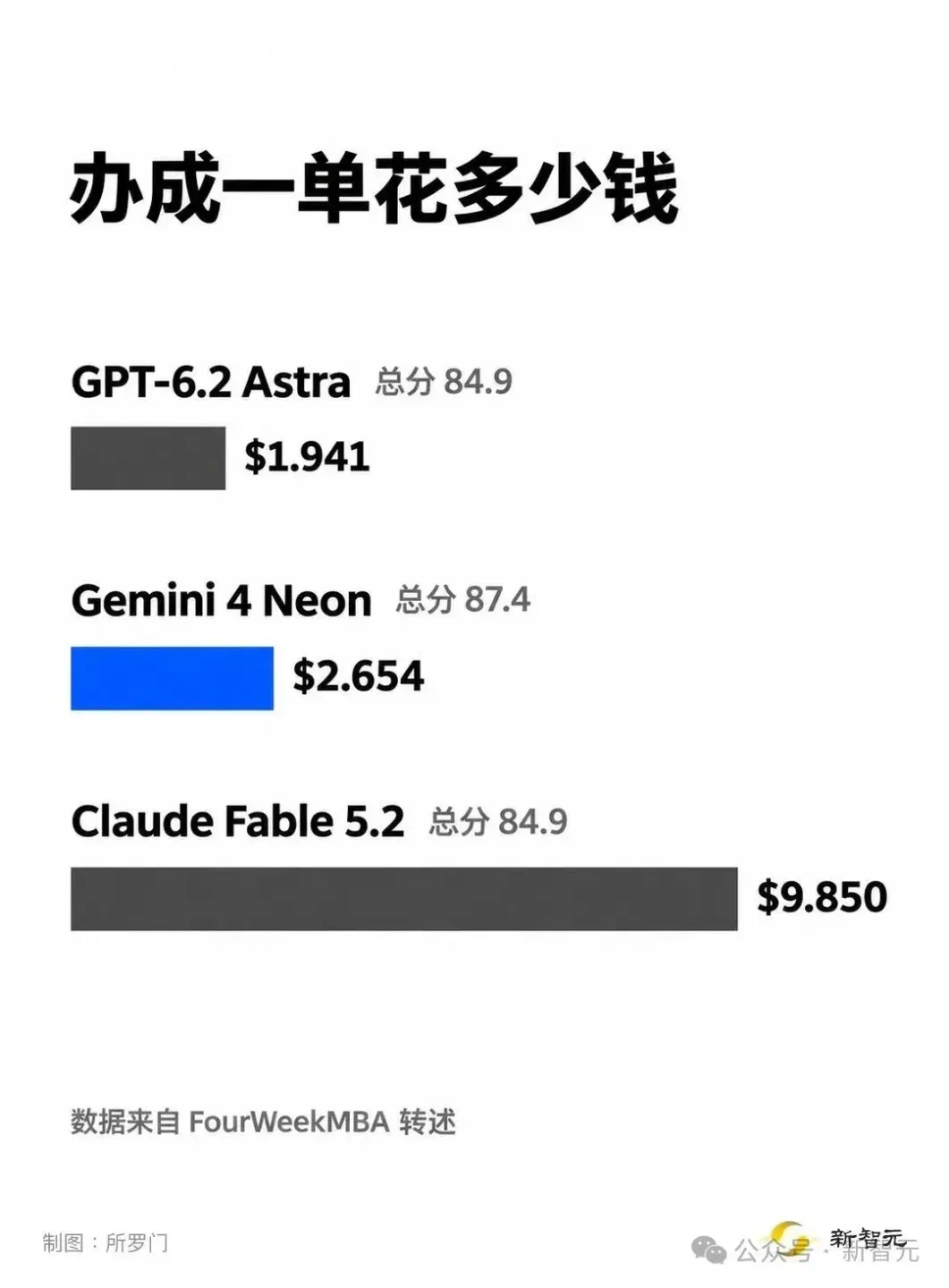
According to FourWeekMBA's account, the cost per successful task on LiveBench is $2.654 for Neon, versus a hefty $9.850 for Fable 5.2. Spending less than 30% as much as Fable while scoring 2.5 points higher is a striking advantage. But Astra costs just $1.941. Neon outscores both rivals, yet cannot beat Astra on the bill.
An independent test makes the trade-off even clearer. Plotly tested the models on 43 private data-analysis questions. After a scoring error was corrected, Neon answered every question correctly, but one run cost $17.03. Google's own Hydrogen also achieved a perfect score, for just $6.36. No wonder Plotly concluded that Hydrogen was the Gemini model to choose for data analysis.
Pricing also has a timing twist. Neon costs $3/$15 per million input/output tokens. Carbon's launch pricing of $2/$10 ends on November 30 and rises to $4/$20 from December 1. So Neon is more expensive than Carbon before the end of the month, but becomes cheaper in December.
Neon's win shows that Google has caught up on work such as long agent workflows. But stop putting your faith in a single overall score when choosing a model. From now on, ask two questions together: What kind of long job will it do? How much will a successfully completed task cost?
References:
Anthropic upgrades Claude with new Fable 5.2 model (9to5Mac)
https://9to5mac.com/2026/11/09/anthropic-upgrades-claude-with-new-fable-5-2-model-details-here/
Introducing GPT-6.2 Astra and Sol (OpenAI)
https://openai.com/index/introducing-gpt-6-2-astra-sol
Pranav Reddy's (@AI_Screening) post
https://x.com/AI_Screening/status/2124370923705024753
LiveBench 2.0 (BenchmarkList)
https://benchmarklist.com/benchmarks/livebench_2/
Gemini 4 Neon tops LiveBench at 87.4, 2.5 points ahead (FourWeekMBA)
https://fourweekmba.com/ai-gemini-4-neon-tops-livebench-at-87-4-2-5-points-ahead/
Introducing Gemini 4 Neon (Google's official blog)
https://blog.google/innovation-and-ai/models-and-research/gemini-models/introducing-gemini-4-neon/
Google releases Gemini 4 Neon, ranking third on Artificial Analysis (Let's Data Science)
https://letsdatascience.com/news/google-releases-gemini-4-neon-ranking-third-on-artificial-an-a84bb368
Gemini 4 Neon (DataCamp)
https://www.datacamp.com/blog/gemini-4-neon
Gemini 4 Neon on Plotly DataAnalyticsBench (Plotly's official blog)
https://plotly.com/blog/gemini-4-neon-plotly-data-analytics-bench/
This article is from Xinzhiyuan, by Solomon.
Related topics
After reading
Join the AINRK community
Read how to join the community and connect with people working in AI.
Related articles
Continue reading related topics and articles in this category.
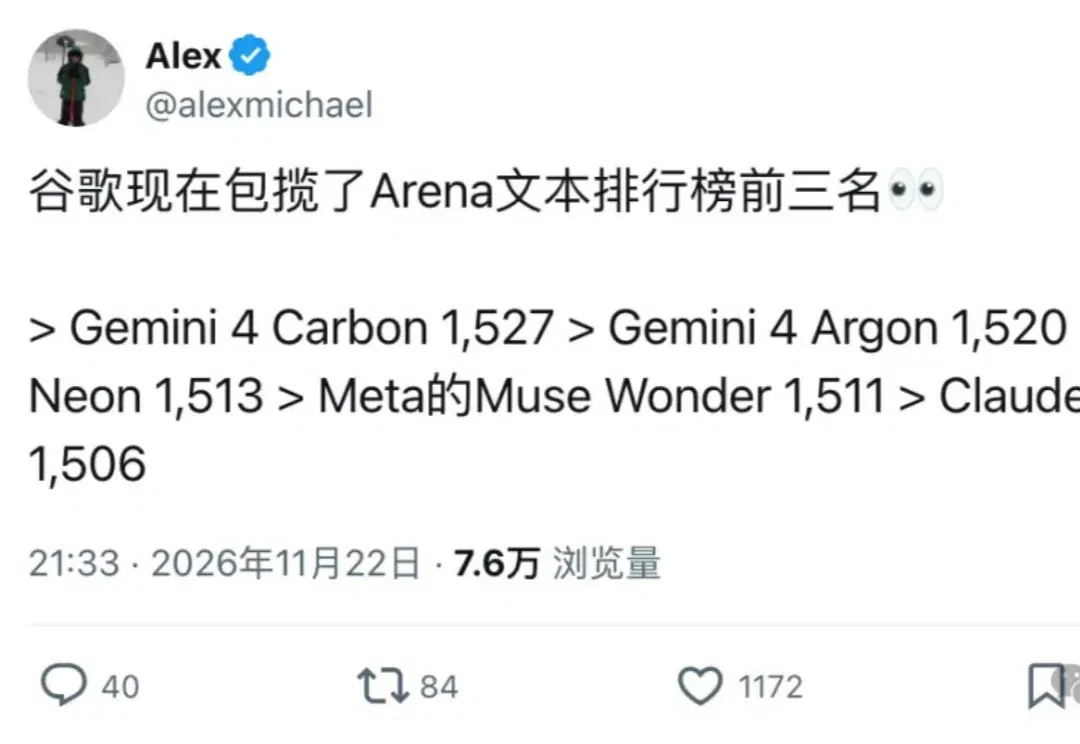
Gemini 4 Takes Arena's Top Three Text Spots on November 22; Agent Results and Costs Vary by Task (opens in a new tab)
Carbon, Argon and Neon led Arena's November 22 text rankings, with Carbon at 1,527. The article also cites November 19 agent rankings and Neon's 3D demos. Dates, model settings, ranking metrics and individual task costs should not be combined into universal performance or price claims.

Gemini 4 Neon Targets Efficiency as Antigravity Feedback Highlights Tool-Level Limits (opens in a new tab)
Google positions Gemini 4 Neon between Carbon and Hydrogen for coding, knowledge work and research. The report reviews Antigravity stability, long-task and quota complaints; version-specific user reports and tests do not establish that all users cannot run Neon.

SemiAnalysis Posts an Apology Form as Gemini 4 Updates Prompt a Reassessment (opens in a new tab)
SemiAnalysis posted an apology form on X after its pessimistic assessment of Gemini. The report traces Argon, Carbon, Hydrogen and Neon through Google's long pretraining cycles, parallel development, compute allocation and post-training on real engineering tasks.

DeepMind looks beyond AGI: Four potential paths to ASI (opens in a new tab)
A DeepMind Institute essay explores model scaling, paradigm shifts, multi-agent coordination and RSI. It separates global effective-compute growth from fixed-workload cost reductions, treating future trends as conditional and calling for better measurement and governance.
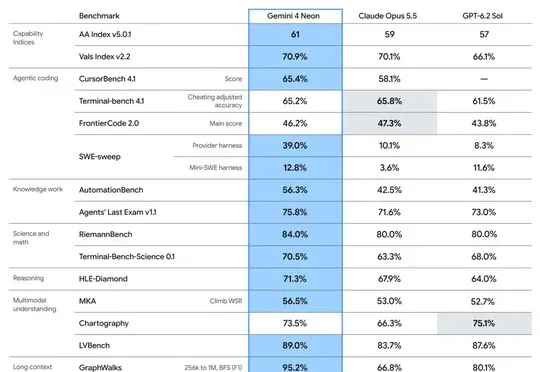
Google Launches Gemini 4 Neon With Hydrogen Subagent Orchestration (opens in a new tab)
Google's Gemini 4 Neon coordinates Hydrogen subagents in Antigravity for coding, analysis and long tasks. This report covers launch-time benchmarks, pricing and demos; cost and ranking comparisons depend on specific tasks, reasoning tiers and agent frameworks.