DeepMind looks beyond AGI: Four potential paths to ASI
A DeepMind Institute essay explores model scaling, paradigm shifts, multi-agent coordination and RSI. It separates global effective-compute growth from fixed-workload cost reductions, treating future trends as conditional and calling for better measurement and governance.
Editor’s verification: The ten-year cost projection and routes to ASI are scenarios conditional on trends continuing. Global effective compute also includes additional hardware investment; the projected cost of a fixed cognitive workload considers only hardware and inference efficiency. These are different measures. Original DeepMind Institute essay (opens in a new tab)
Google DeepMind Institute recently published What Comes After AGI?, discussing technological development beyond artificial general intelligence (AGI) and possible paths toward artificial superintelligence (ASI).
- Essay: https://institute.deepmind.com/essays/what-comes-after-agi/
The essay argues that AGI need not be AI’s endpoint, but a stage on a continuum. Improvements in model capabilities, compute efficiency and multi-agent coordination could take AI beyond human experts’ cognitive abilities, perhaps even accelerating its own technological progress.
DeepMind analyzes the issue from several perspectives: the boundaries of intelligent capability, cognitive industrialization, technological development paths and recursive self-improvement. It proposes four potential technical routes to ASI, emphasizing that the challenge is not only how to build stronger AI, but how to measure, forecast and govern that progress.
1. AGI is not the endpoint—how far is ASI?
For decades, AI research has pursued AGI: systems matching humans across nearly all cognitive tasks.
DeepMind argues human-level intelligence is only one point on a continuum, with substantial capability space above it.
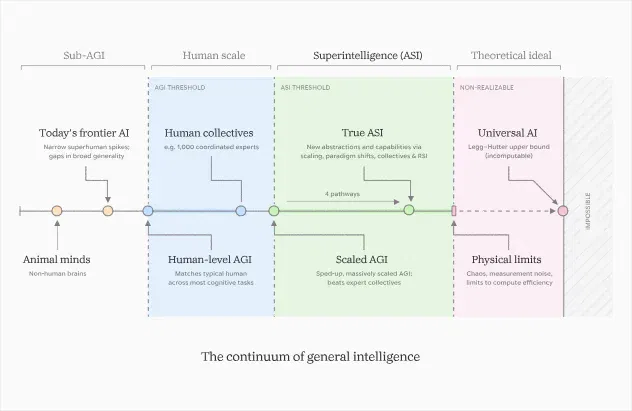
The essay describes ASI as AI that consistently outperforms large teams of human experts across virtually all tasks of human interest.
It might, for example, achieve a research field’s years of progress in very little time, or match a major technology company’s year of chip-design and R&D achievements with fewer resources.
In fact, current AI systems have already demonstrated superhuman capabilities in chess, Go, protein-structure prediction and some mathematical-proof tasks. These are nevertheless breakthroughs in specific domains, and a clear gap remains between them and comprehensive superintelligence.
DeepMind emphasizes that, although mathematical and physical approaches let us study the theoretical limits of intelligence, we still have not adequately explored how much capability space lies between human-level AGI and those limits.
Beyond capability breakthroughs, growing compute capacity and falling operating costs could also drive progress toward superintelligence.
This introduces “cognitive industrialization”: as AI computing becomes more efficient, more cognitive work might become standardized, automated and industrially scalable, much like physical labor during industrialization.
The essay identifies three drivers of effective-compute growth over the past decade:
- Hardware improvements: compute purchased per dollar has grown at roughly 1.5 times per year over the long term.
- Algorithmic efficiency: training compute needed for fixed performance keeps falling, while inference algorithms also improve rapidly.
- More infrastructure investment: rapidly growing AI-hardware investment has expanded global computing resources over the past decade.
Together, these factors produce roughly tenfold or greater annual growth in global effective computing resources.
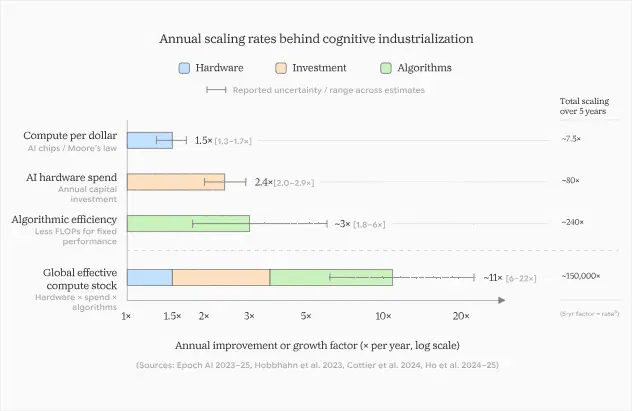
DeepMind separately considers continued hardware and inference-software efficiency gains that reduce a fixed workload’s cost to roughly one-quarter each year. Work costing US$1 billion in AI compute today could then cost about US$1,000 in ten years. That scenario excludes additional hardware investment and must not be confused with roughly tenfold annual growth in the global effective-compute stock.
This projection assumes efficiency trends continue; it does not guarantee costs will fall at that rate.
More importantly, even if there is no major breakthrough in the underlying capabilities of AI models, lower operating costs, faster processing and a larger population of agents alone could substantially change knowledge work and the structure of society and the economy.
In that scenario, billions of fast-running, continuously collaborating agents could have productive capacity far beyond any individual human or AI system.
Moving from AGI to ASI may therefore not depend entirely on one disruptive model breakthrough. More agents, greater speed and larger-scale collaboration could also enable capability leaps.
2. From AGI to ASI:
DeepMind’s four potential technical paths
More agents and faster execution cannot resolve every cognitive limitation. DeepMind believes key technical breakthroughs are still needed for genuine ASI.
The essay summarizes four potential paths.
First: scaling models and data.
The current main approach expands training data, model size, training compute and inference-time resources to improve capabilities. It faces scarce high-quality data, diminishing returns from scale, and infrastructure limits involving energy and chips.
High-fidelity simulations, synthetic data, reinforcement learning and inference-time compute could help overcome these bottlenecks.
Second: technological paradigm shifts.
Today’s mainstream large models are built chiefly on the Transformer architecture and sequence prediction. Although this paradigm has achieved considerable success, models still have limitations that differ from human intelligence in areas including continual learning, world modeling, decision-making and sample efficiency.
Whether ASI requires only continued improvements to current methods, or fundamentally new architectures and learning paradigms, remains disputed.
Third: better multi-agent coordination.
An individual AI system may have limited capabilities, but a collaborative system comprising many agents could produce stronger collective intelligence. Just as companies, research institutions and markets solve problems beyond a single human, thousands of AGI agents could use specialization, shared information and cooperation to complete more complex cognitive tasks.
Bigger groups are not automatically better. Communication costs, coordination, distorted information and group behavior can all constrain performance.
Fourth: recursive self-improvement.
This is a particular focus of the essay.
RSI means AI becomes a participant in developing the next generation, rather than merely a tool humans develop and improve.
As AI’s own research and development capabilities improve, it could make model-architecture design, algorithm optimization, chip design and training-data generation more efficient, accelerating subsequent iterations. If that feedback loop can continue, the pace of AI progress may no longer depend entirely on the efficiency of human researchers.
DeepMind further explains that this process could work at three levels. First, code and design optimization could improve architectures, training algorithms and chip designs. Second, data-driven improvement could generate higher-quality training data through simulation, reasoning and experimentation, as AlphaZero illustrates. Third, collective improvement could use specialized agents working together to increase R&D efficiency.
It compares these mechanisms to genetic, cultural and social evolution, respectively.
The essay also emphasizes that RSI does not necessarily cause uncontrolled exponential growth. On one hand, discovering effective new improvements may become harder as technology matures. On the other, without reliable evaluation and feedback mechanisms, the self-improvement process could stall or even regress.
Automatically verifiable areas such as mathematical proofs might therefore achieve higher levels of RSI first, while tasks requiring complex real-world judgment may progress more slowly.
The four paths are not independent; they may reinforce each other. Bottlenecks on one need not halt progress on others.
Restricting a single factor such as training compute may therefore fail to control overall AI progress. Removing a bottleneck could even cause a sudden capability jump. Governance must consider model scale, algorithmic efficiency, multi-agent coordination and automated R&D together.
3. New measurement and forecasting systems
The essay ends with a practical question: how should humanity respond if AI surpasses human intelligence?
Its central recommendation is to model, measure, forecast and keep iterating.
Superintelligence may have capabilities beyond human experts’ ability to evaluate, challenging existing tests. More reliable benchmarks, automated verification mechanisms and forecasting models will therefore be needed to track AI development continuously. This requires participation not only from frontier AI laboratories, but also interdisciplinary cooperation among research institutions and policymakers.
DeepMind argues that continued rapid AI development over the next decade deserves serious consideration. Progress from expert-level AGI toward superintelligence could accelerate breakthroughs in medicine, materials and clean energy. Even without rapid ASI arrival, cognitive industrialization could profoundly reshape knowledge work and the global economy.
AGI is not necessarily AI’s endpoint. Beyond asking how to achieve it, humanity needs to understand the possible development paths, pace and social consequences of what follows.
Originally published by the WeChat account “Jiqizhixin,” by Jiqizhixin.
Related topics
After reading
Join the AINRK community
Read how to join the community and connect with people working in AI.
Related articles
Continue reading related topics and articles in this category.

被谷歌下架的哈萨比斯,对AGI改口了 (opens in a new tab)
Alphabet首席科学家兼DeepMind董事长哈萨比斯在《华尔街日报》专访中将AGI到来预测提前至2至3年,称真正AGI须具备原创思考能力,并应以治愈疾病等实际价值化解公众焦虑。

Neon identifiers surface in Gemini web code; model and subscription positioning remain unconfirmed (opens in a new tab)
A source report recounts developers finding Neon model and subscription identifiers in Gemini web code, alongside discussion of element naming. Code strings and online guesses do not establish a release, plan features or access date.

Karpo Decision goes open-source; 31B model ties first on a specified Decision Index version (opens in a new tab)
MachinePulse releases 0.8B–31B decision models that score options in one forward pass. The 31B model ties first at 73.9 in the November 12 Decision Index 0.4.1 snapshot. Latency and costs depend on test configuration; single decisions differ from full workflows.

Tongxin Intelligence raises seed and angel funding for AGI inference-chip design (opens in a new tab)
The BIGAI-incubated team outlines Vector, Tensor and AGI Core units, planning FPGA validation before further design, tapeout and production. The proposed architecture's commercial efficiency remains to be demonstrated.

Google expands TPU system sales as software adaptation and inference economics draw attention (opens in a new tab)
QbitAI discusses complete-system deliveries, TorchTPU and agent-inference tests using filings and sources. Revenue, unfulfilled contracts and model-specific token-per-dollar comparisons are distinct measures; optimization rounds can change results.