Google Launches Gemini 4 Neon With Hydrogen Subagent Orchestration
Google's Gemini 4 Neon coordinates Hydrogen subagents in Antigravity for coding, analysis and long tasks. This report covers launch-time benchmarks, pricing and demos; cost and ranking comparisons depend on specific tasks, reasoning tiers and agent frameworks.
Editor's verification: The scores, rankings and price comparisons in this article are snapshots of specified configurations and evaluations at the November 2026 launch. Read high and xhigh separately, distinguish model capabilities from agent-framework results, and distinguish per-token prices from per-task costs. The demos were presented by Google or their creators and have not been independently reproduced. Availability and allowances for the API, consumer applications and Antigravity depend on their respective plans and rollout conditions; a model launch does not mean all users can use it free of charge. The closing discussion of RSI and future competition is the author's commentary and conditional projection. Google's Neon launch announcement (opens in a new tab)AA's launch evaluation and cost methodology (opens in a new tab)
Another update, and another! In the AI world, every day feels like a celebration!
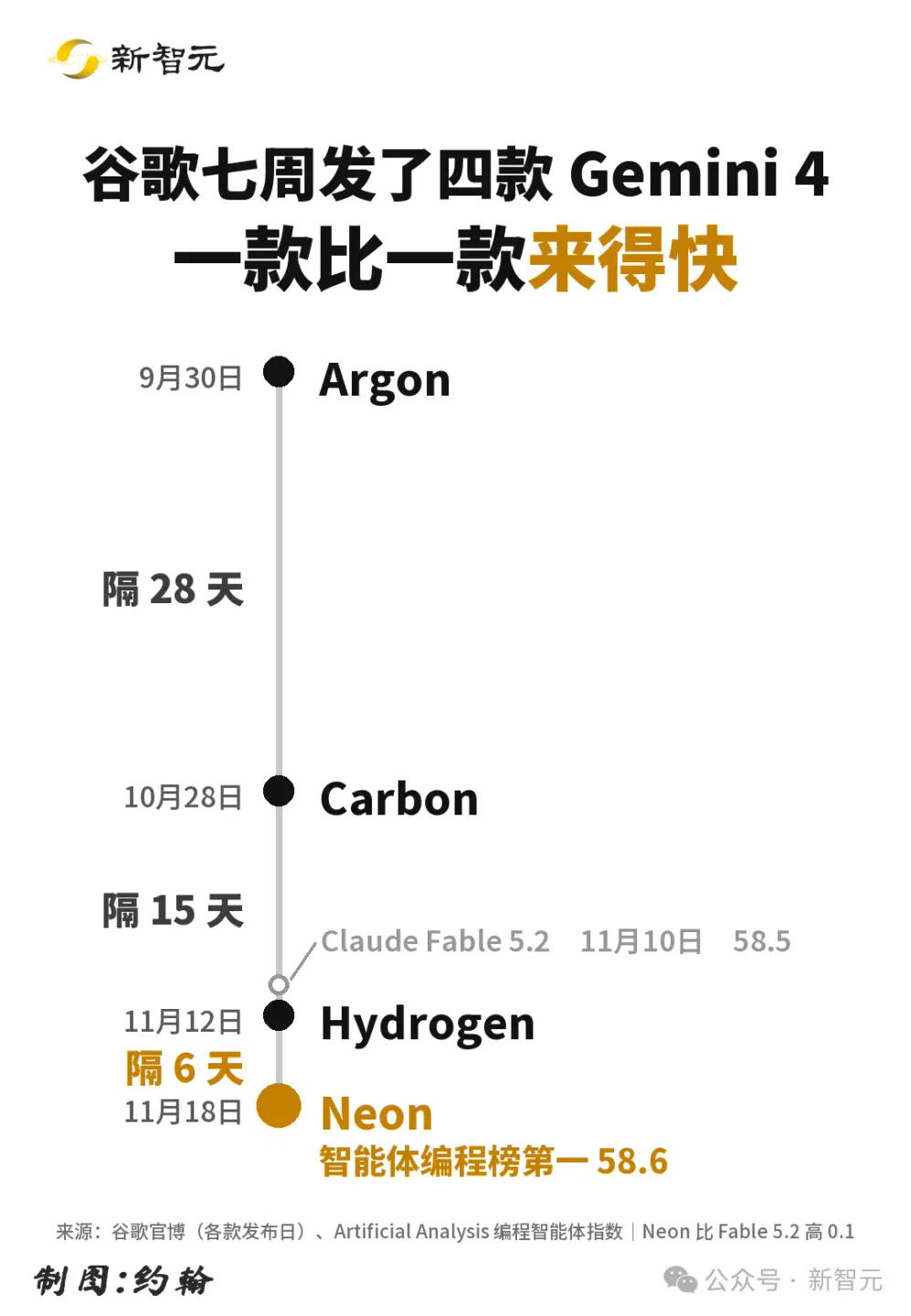
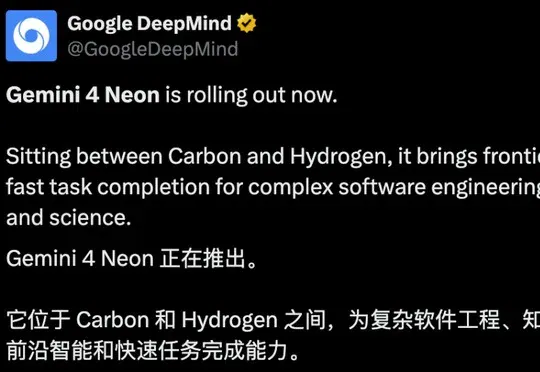
The fourth member of Google's Gemini 4 family, Neon, has just officially launched.
Hassabis personally announced it in a post, calling it "the pinnacle of alchemy".

Its focus is fast reasoning for frequent, complex software-engineering, knowledge-analysis and long-running scientific research tasks.
In the Vals Index and AgentArena evaluations listed by Google at launch, Neon's per-task cost at the high reasoning tier could be lower than the listed Claude and GPT flagship configurations by 50% to 80%. This applies only to the stated tasks, tiers and frameworks, not to an equivalent cost reduction for every workload.
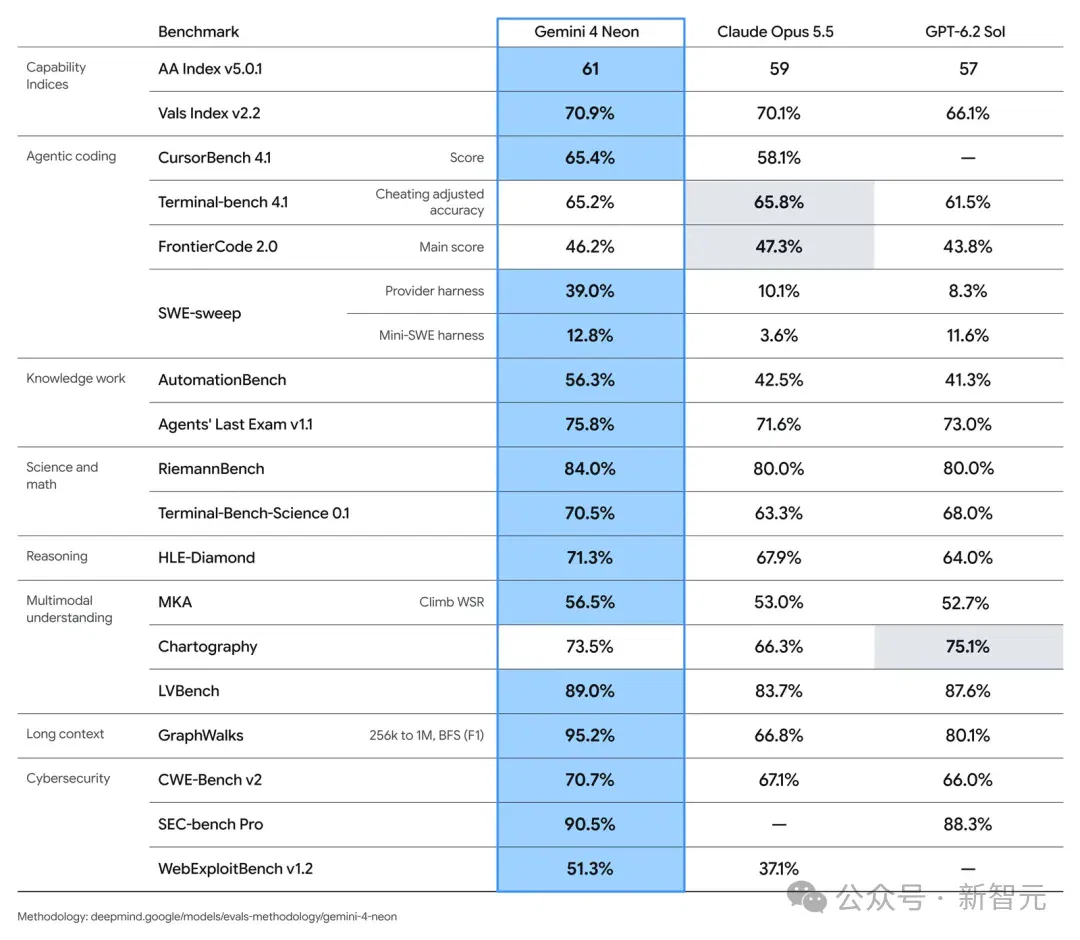
Of the 19 sets of comparisons Google presented at launch, Neon achieved the highest result among the listed configurations in 16. The scope and reasoning budgets are those in the table; this is not an overall win rate against every model or on every task.
Let's highlight the main points of this launch.
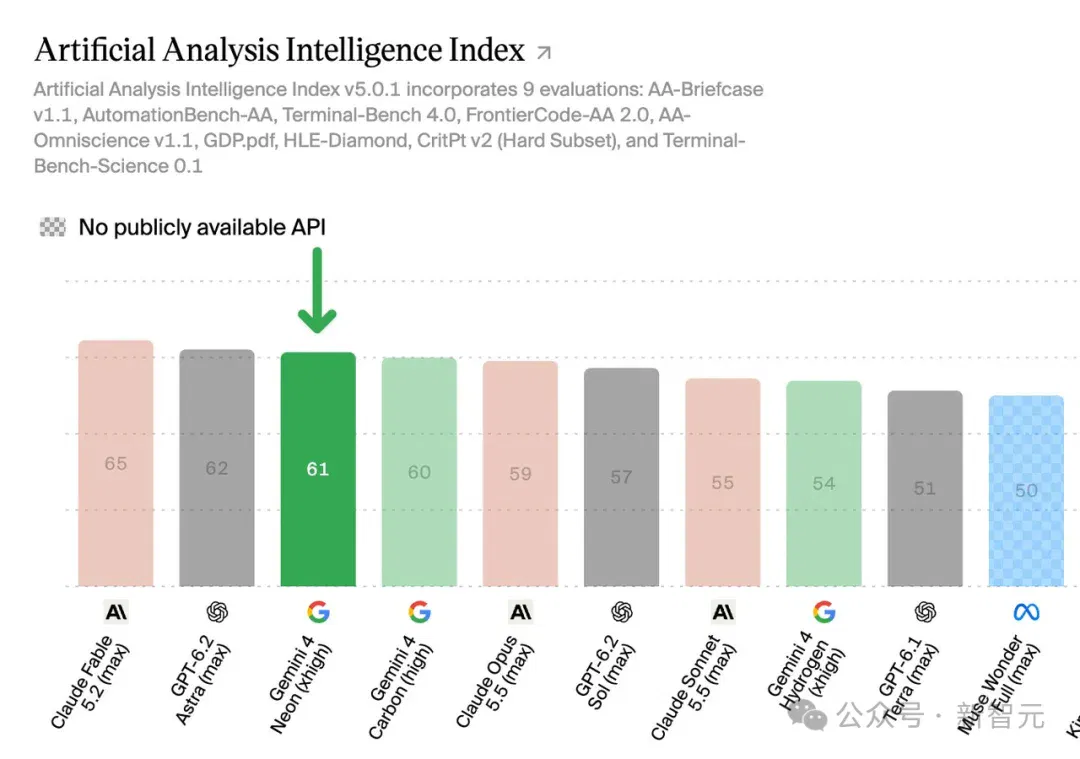
- Intelligence ahead of the flagship: On AA's launch-time leaderboard, Neon scored 61 on the Intelligence Index at xhigh, placing third among the models listed then and one point above the listed Carbon configuration. This is a snapshot for that time and configuration.
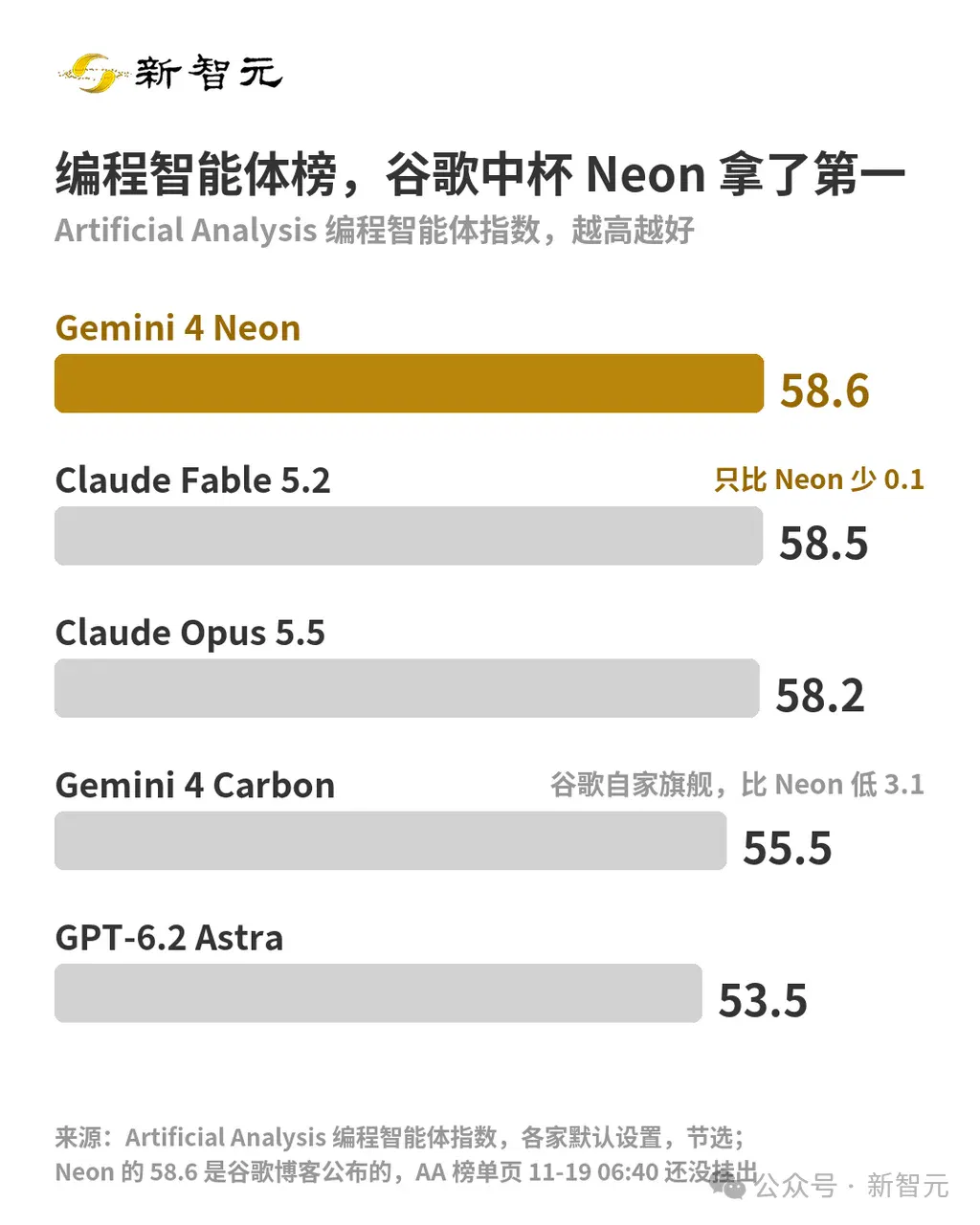
- First in coding agents: In AA's launch-time coding-agent evaluation, Neon with Antigravity CLI scored 58.6. Its reported average task cost was lower than the listed Opus 5.5 configuration, but these figures cannot be mixed arbitrarily with the best numbers from other tiers or frameworks.
- Almost twice as fast: Output of roughly 110 tokens per second, versus just 57 for Carbon.
- Pricing: $3 per million input tokens and $15 per million output tokens; cache hits cost just $0.15, with a context window of one million tokens.
- It can act as the coordinator: On Google's agent coding platform Antigravity, Neon can direct a group of Hydrogen subagents working in parallel.
Bringing Turing's study back to life
Drawing 3D with 500,000 spreadsheet formulas
Highlights covered, we still need to see Neon in action to understand how capable it is.
In the first showcase, the creator says Neon assembled a multi-agent team with '/swarm' and ran continuously for 12 hours to produce a 3D scene of Turing's study at King's College, Cambridge. This article has not independently reproduced that process.
It was here, in 1936, that Turing wrote the paper that laid the foundations of modern computer theory.
It first dug up archival photographs of King's College, then modeled and rigged the scene in Blender, and finally rendered materials and lighting with a period feel.
The camera moves from the lawn outside King's College Chapel into the room, revealing bookshelves, a fireplace and a desk one by one. The demo also places a visual representation of a Turing machine on the desk; this is not historical evidence that Turing owned such a physical machine at the time.
This demonstration tests orchestration in a long-running task. Neon has to lead a team of agents all the way from research and modeling to rendering without going off track along the way.

Another test probes reasoning and coding skills. There are no ready-made image-processing algorithms to call in the spreadsheet, so Neon has to derive every step itself using formulas.
The result: Neon created 100,000 cells and populated multiple sheets with more than 500,000 live spreadsheet formulas.
Using only these basic formulas, it implemented Sobel edge detection and 3D depth mapping. You can switch freely among six interactive modes; change the lighting angle and the entire image is relit in real time.
Another example has Neon build a first-person 3D alpine skiing simulator from scratch.
This one tests engineering with long codebases. Over ten thousand lines of shader code, a physics engine and real terrain data all have to work within a single project.
Neon used no premade 3D assets. It started directly with real elevation and terrain data for Mont Blanc and Chamonix, then wrote 10,200 lines of custom WebGL2 shader code in one go.
The simulator includes not just a 120 Hz physics engine and six alpine ski runs, but dynamic ski tracks, sudden slab avalanches and spatial audio as well, all at once.

The mid-tier model reaches the global top three and takes first in coding agents
Neon's ability to produce these elaborate scenes is backed by actual scores.
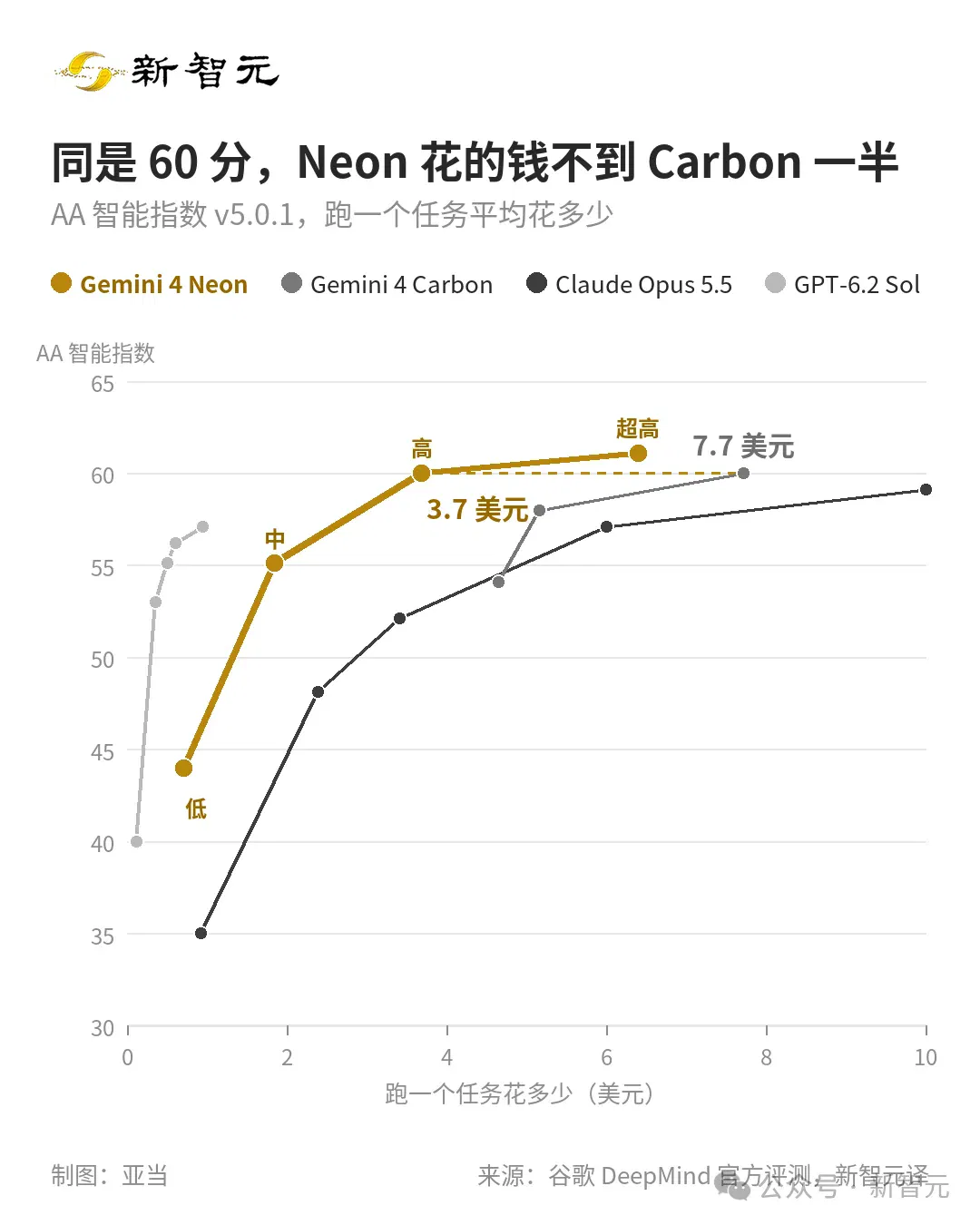
On the Artificial Analysis Intelligence Index, which measures overall intelligence, it scored 61 using xhigh reasoning.
According to AA's launch analysis, Neon scored 60 at the default high tier, matching the listed Carbon configuration. For the tasks and undiscounted price assumptions in that analysis, its cost was less than half Carbon's. This cannot be generalized into a fixed saving on all API requests.
Neon was also substantially faster. In the same test suite, Carbon took about 36 minutes per task on average, while Neon took just 21 minutes, saving a full 40% of the time.
Beyond intelligence, coding is Neon's strongest showing in this launch.
Matching Claude's score at half the cost
Neon's first-place result on the coding-agent leaderboard came from pairing it with Google's own Antigravity CLI.
Fable 5.2 and Opus 5.5 in Claude Code both scored around 58. Their scores were close, but their costs differed considerably.
Neon cost $6.86 per task on average, compared with $12.61 for Opus 5.5 and $15.47 for Fable 5.2.
Pranav Reddy asked Neon, Opus 5.5 and Carbon to make a cycling animation in Three.js from the same prompt. His conclusion was that Neon beat Opus 5.5 and was already very close to Carbon.
Second in agents, first in automation
Neon also ranks highly in real agent work scenarios.
Arena's newly introduced agent leaderboard uses more than 4,200 real conversations. Neon debuted in second place globally.
Zapier also has an automation leaderboard that tests models on 657 real business workflows. Neon scored 56.3% on it, taking first place.
In cybersecurity, Neon scored a record 90.5% on SEC-bench Pro for finding vulnerabilities. On CWE-bench v2 for fixing vulnerabilities, it also outscored Carbon by 3.4 percentage points.
Of course, Neon did not win across the board.
On the demanding coding benchmarks Terminal-bench 4.1 and FrontierCode 2.0, Opus 5.5 still had a slight edge.
Neon takes the coordinator role
AI is assigning work to AI
There are wins and losses in the benchmarks, but Neon's real trump card this time is the new role Google has assigned it.
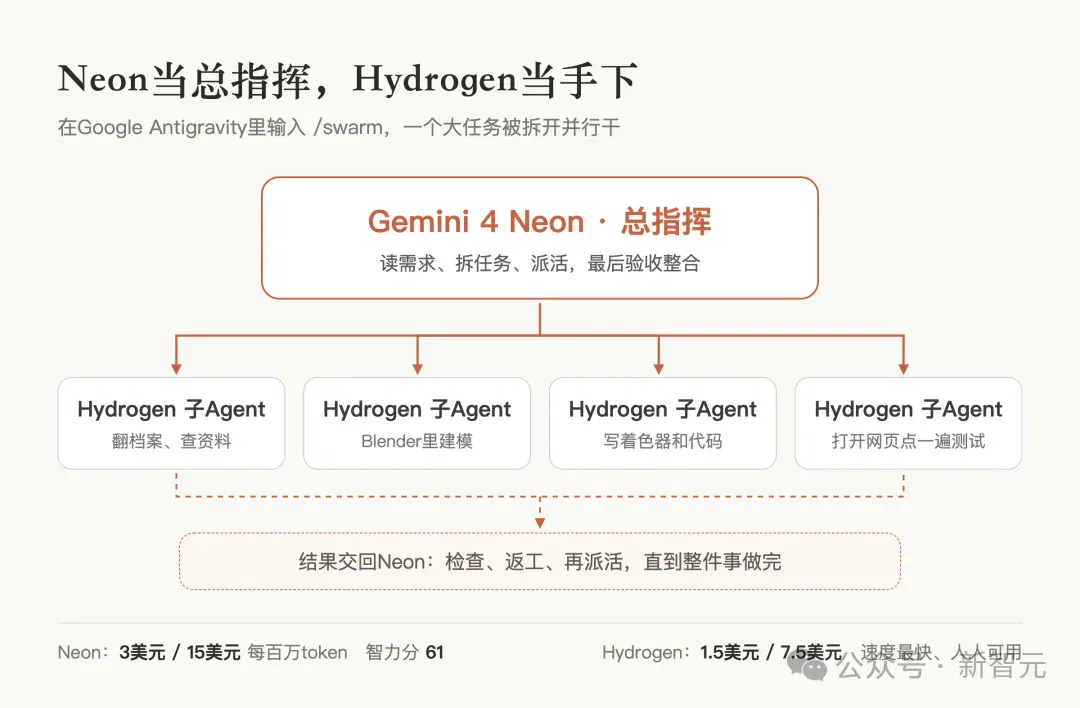
In Antigravity, Neon can work alone or act as the 'coordinator.'
When a large task comes in, it breaks it down and delegates the pieces to a group of Hydrogen subagents working in parallel.
Hydrogen is the lightweight model in the Gemini 4 family. It is the fastest, and its price is only half Neon's.
Swarm and Super-agent handle work at two different levels
Neon's Swarm collaboration with a group of Hydrogen agents looks much like the Super-agent DeepSeek proposed recently. In fact, the two address different levels of work.
What each one is
- Swarm: A division-of-labor scheme within a single task. Neon handles planning, judgment and acceptance checks; Hydrogen writes code, edits files and runs tests. The goal is to complete one job well and quickly.
- Super-agent: An always-online agent system managing multiple jobs at once. A Router receives messages, links them to tasks and dispatches work, while multiple Workers each do their own jobs. The goal is to keep following up as multiple jobs run in parallel, without users having to monitor each conversation individually.
What they share
- Coordination and execution are separate: One layer organizes the work, while another carries it out.
- Both have feedback loops: When problems arise during execution, they are reported, adjustments are made and work continues.
- Both reduce the burden on people: Users do not have to arrange every step themselves or chase after every executor.
How they differ
- Scope: Swarm handles the division of labor within one task; Super-agent handles scheduling and continued follow-up across multiple tasks.
- Who does the thinking: Neon has to understand the task thoroughly and devise the plan itself. The Super-agent Router tries to limit itself to linking and dispatching, leaving complex reasoning to Workers.
- Where the stronger model goes: Google puts Neon, with its strong judgment, at the upper level and pairs it with fast Hydrogen. DeepSeek recommends the reverse: the Router can be lighter, while Workers have greater need for strong models.
- Tied to particular models or not: Swarm is a fixed model pairing. Super-agent is a system design that can assign different models to different roles, or use the same model for all of them.
A trump card for the agent era: four Google launches in seven weeks
In the agent era, the competition is about who can independently break down a big job, delegate it, check the results and carry it through to completion in one sustained run.
Today, Google has given the coordinator role to a mid-tier model, with flagship Carbon stepping in only for the hardest work.
That strikes right at Claude. Agents that write code and handle long-running work have always been Claude's strongest card. Yet just nine days after Fable 5.2 launched, Neon overtook it on the coding-agent leaderboard.
More than a point or half a point of difference, it is the speed of Google's moves that presents the real problem for Claude.
Since November 10, Google has fully launched three Gemini 4 models.
The article links this pace of releases to the RSI-driven research acceleration Google has discussed, but provides no evidence isolating RSI as the cause of the launch schedule. Google co-founder Brin said in October that Google had stepped onto the 'RSI treadmill,' with researchers working alongside models to build the next generation.
If Google's internal RSI really gets going, making each generation of models faster than the last, the trump card of the superintelligence era will fall into Gemini's hands.
The pressure is now on Claude and GPT.
References:
https://blog.google/innovation-and-ai/models-and-research/gemini-models/introducing-gemini-4-neon/
This article is from the WeChat public account "Xinzhiyuan" and was written by "Xinzhiyuan".
Related topics
After reading
Join the AINRK community
Read how to join the community and connect with people working in AI.
Related articles
Continue reading related topics and articles in this category.
Google unveils Gemini 4 Neon and expands Genie 4 access for eligible Ultra users (opens in a new tab)
Google introduces Neon for efficient, complex tasks, with a million-token context window and API pricing, and expands Project Genie interactions. Rollout is gradual; cybersecurity models and Genie access remain subject to eligibility and availability restrictions.
刚刚,谷歌发布Gemini 4 Argon:单次输出上限达100万Token (opens in a new tab)
机器之心编辑部 刚刚,Google 宣布推出新一代前沿模型 Gemini 4 Argon。 Google 将 Argon 定位为面向复杂、长周期工作流的模型,重点覆盖软件工程、法律与金融等企业知识工作
谷歌物理真觉醒!全新Gemini 4 Argon一大波实测来了 (opens in a new tab)
谷歌Gemini 4 Argon真的来了。
Neon identifiers surface in Gemini web code; model and subscription positioning remain unconfirmed (opens in a new tab)
A source report recounts developers finding Neon model and subscription identifiers in Gemini web code, alongside discussion of element naming. Code strings and online guesses do not establish a release, plan features or access date.
Google 用 AlphaProof Code 验证 Signal 部分代码的安全性质 (opens in a new tab)
Google DeepMind 展示了由 Gemini 4 Carbon 驱动的形式化验证案例。团队报告四周内生成约 650 万行 Lean 证明,所验证的是明确规格下的部分安全性质。