Gemini 4 Takes Arena's Top Three Text Spots on November 22; Agent Results and Costs Vary by Task
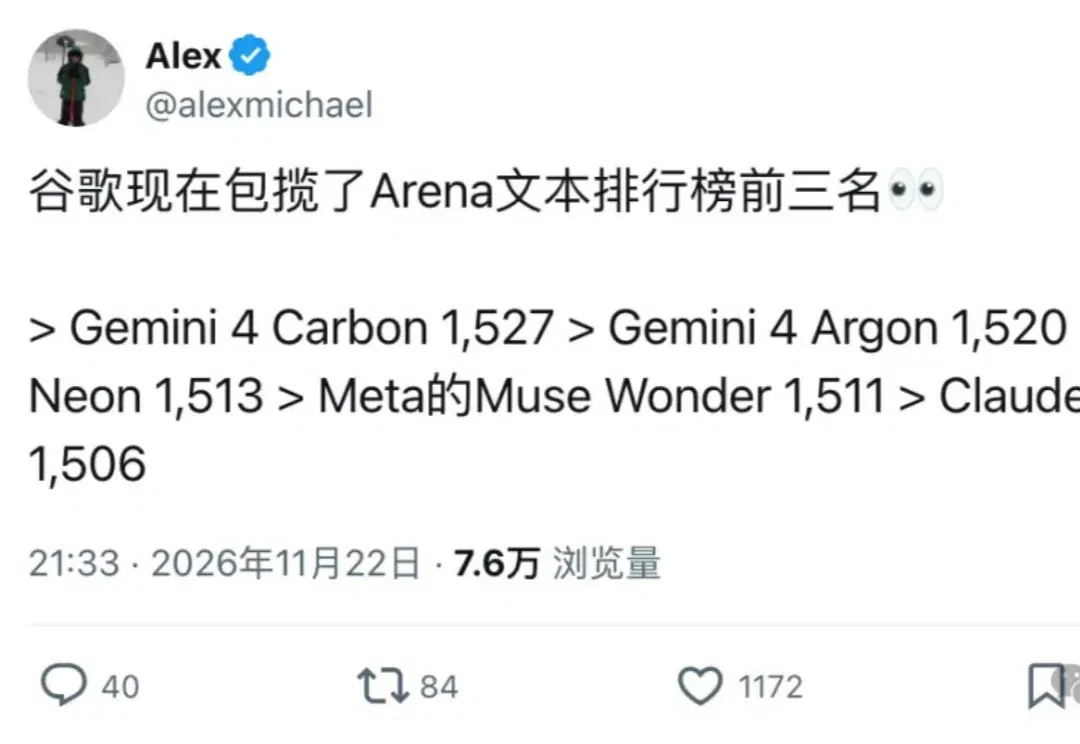
Carbon, Argon and Neon led Arena's November 22 text rankings, with Carbon at 1,527. The article also cites November 19 agent rankings and Neon's 3D demos. Dates, model settings, ranking metrics and individual task costs should not be combined into universal performance or price claims.
Editor's fact check (2026-11-26): This article records ranking snapshots from different dates and different model settings. The text rankings primarily reflect pairwise preferences, while the agent rankings use signals from task trajectories; they cannot be treated as a single measure of general capability. Neither a rank nor a one-point difference alone establishes a stable or statistically significant advantage. Blended token prices vary with the mix of inputs and outputs. Median task costs and demonstration costs apply only to the samples described, and are not quotes or guarantees of results for every task. Arena text rankings (page dated 2026-11-22); (opens in a new tab)Arena evaluation methodology; (opens in a new tab)Arena agent rankings; (opens in a new tab)Google's official Gemini 4 Neon announcement (opens in a new tab)
Google alone has taken the top three places in Arena's text rankings!
Recently, X user Alex shared the latest Arena text rankings, in which Gemini 4 took all three top spots with Carbon, Argon and Neon, with Carbon leading at 1,527 points.
Two months ago, Claude occupied all six top places on this leaderboard. Now, the highest-ranked Claude is only fifth.
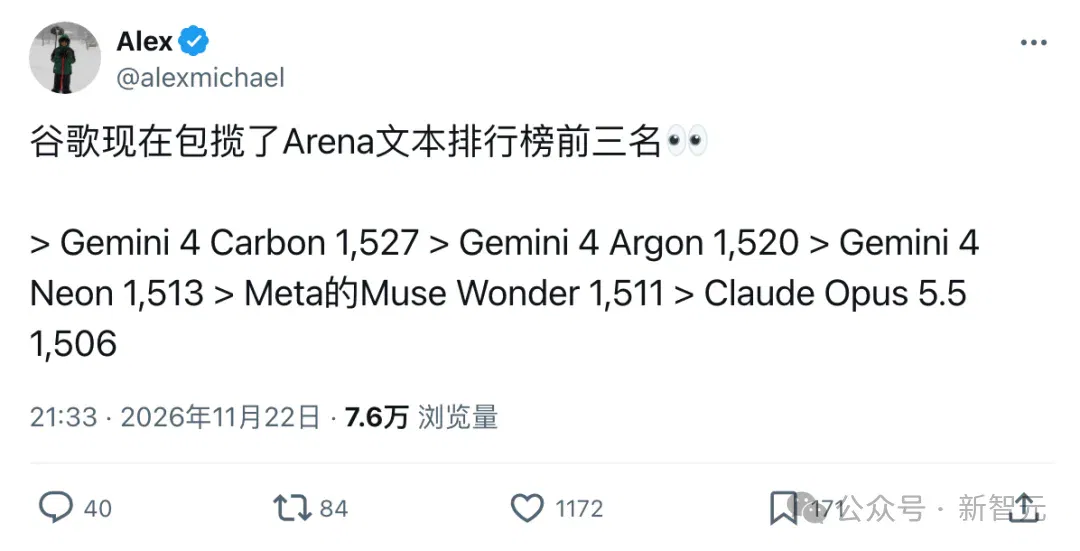
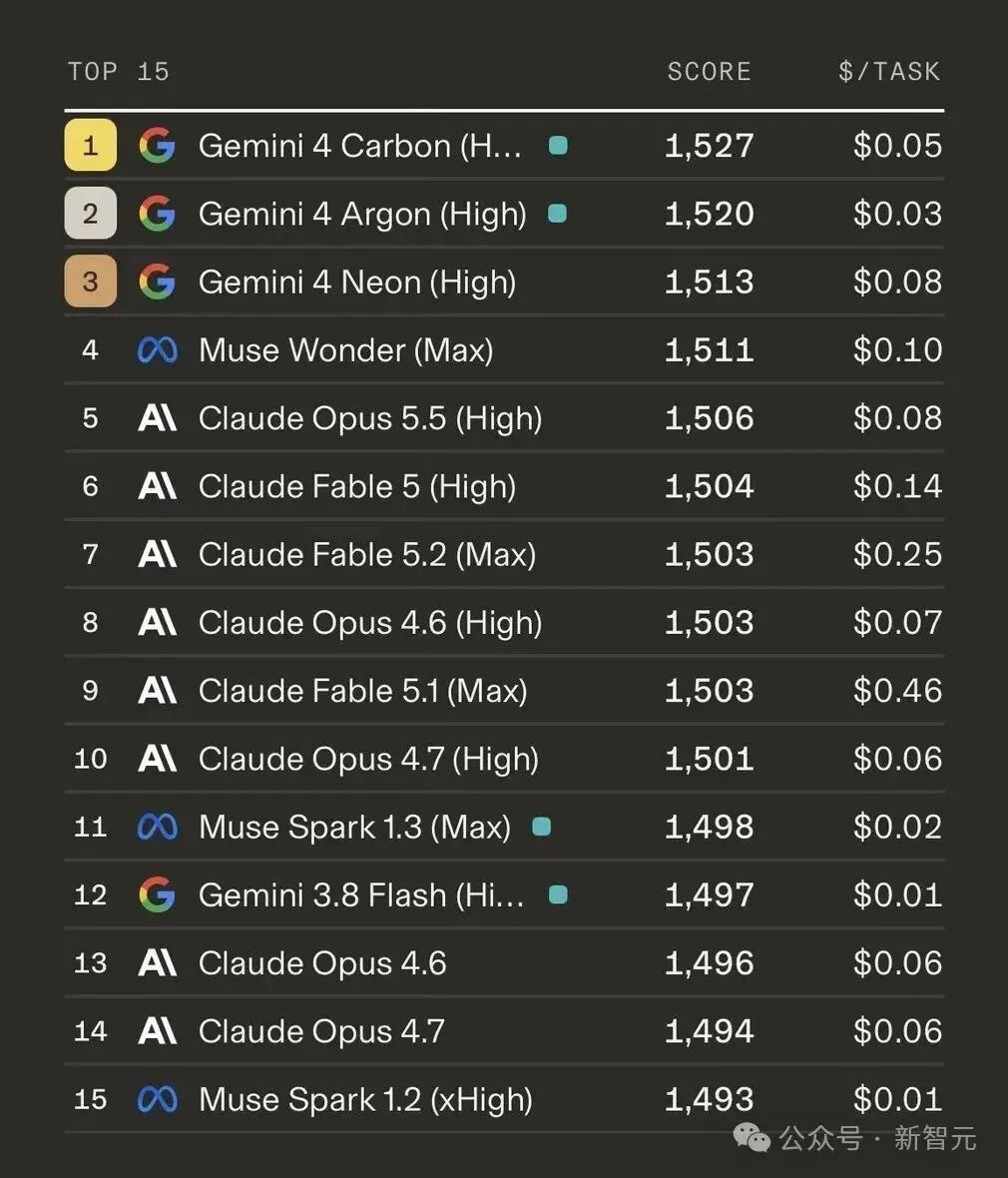
Behind Google's three siblings, Meta's Muse Wonder is fourth, while Anthropic's flagship Claude Opus 5.5 has slipped to fifth.
Anthropic's moment of glory, occupying all six top places, lasted only four days. Over the next 50-plus days, Google's three Gemini 4 models arrived on the leaderboard one after another, knocking their own siblings out of first place.
Three Gemini 4 models take turns as Google unseats itself
When Claude Opus 5.5 (High) first debuted, it took first place in the text rankings with 1,509 points, 18 points ahead of its predecessor, Opus 5.
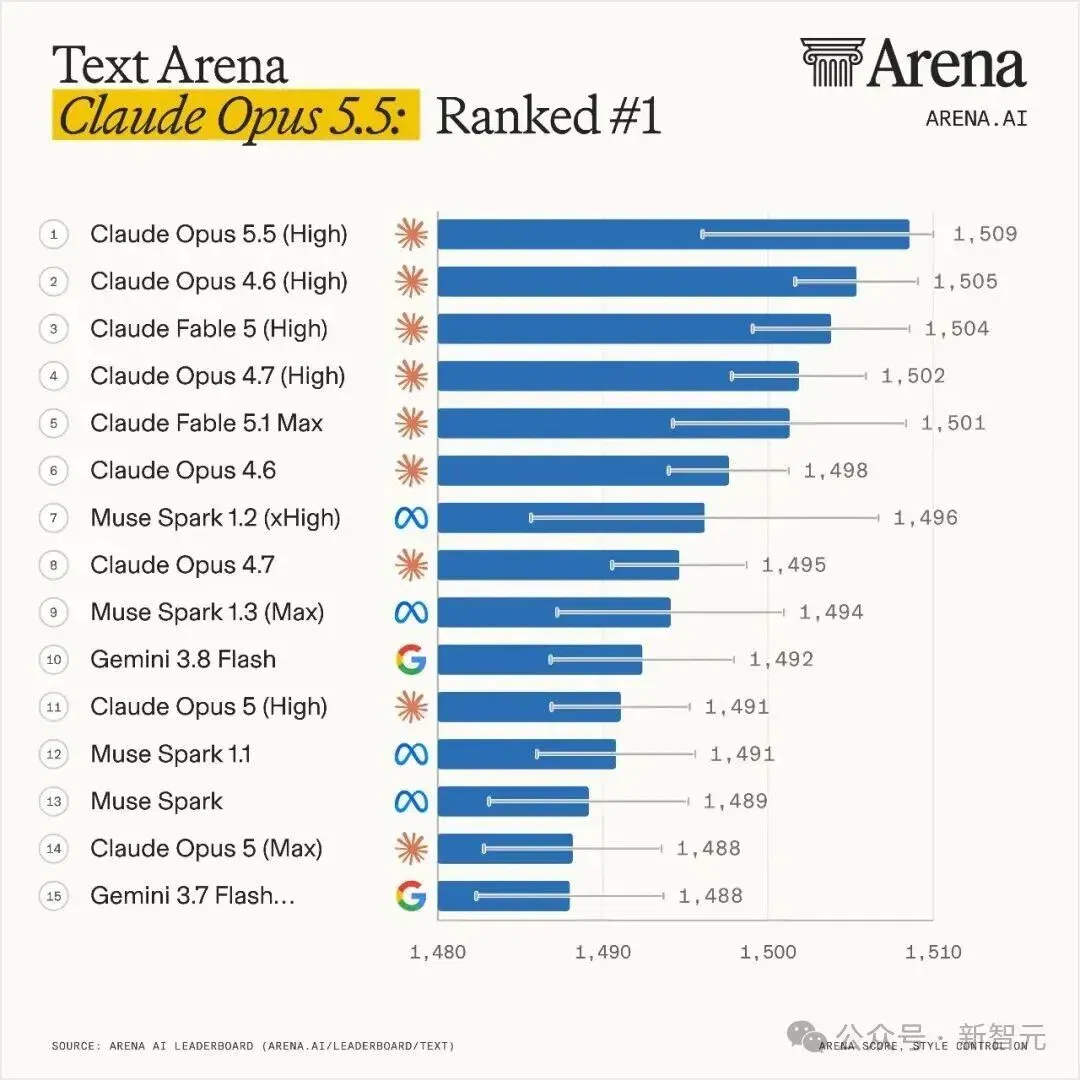
Just four days later, Google released Gemini 4 Argon:
Introducing Gemini 4 Argon: our new frontier model.
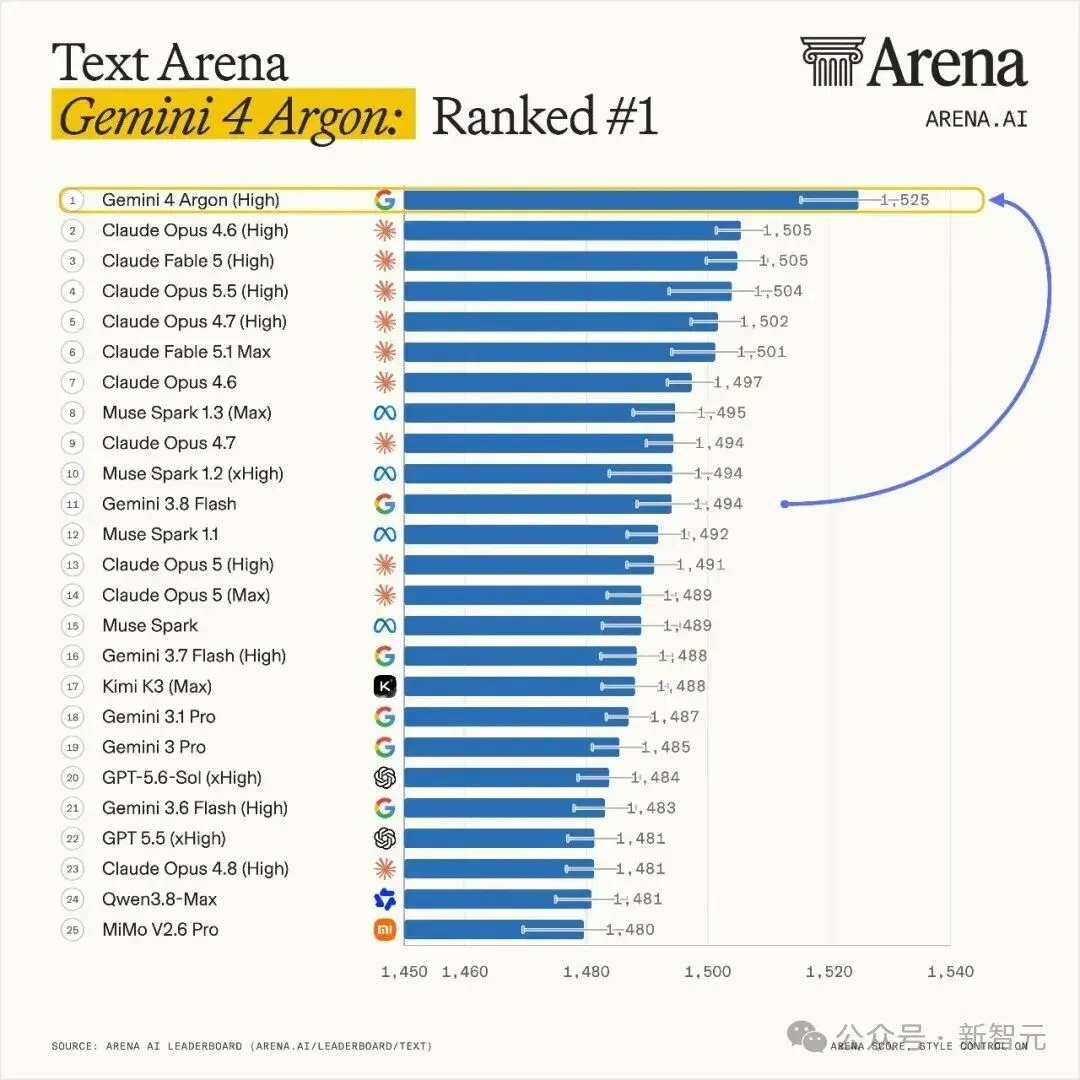
Gemini 4 Argon (High) went straight to first place on its leaderboard debut, scoring 1,525 points, a full 20 ahead of the then runner-up, Claude Opus 4.6. Opus 5.5, which had only just reached the top, had already dropped to fourth (1,504 points).
Across coding, hard prompts, instruction following, longer queries and creative writing, as well as languages including English, non-English, Chinese and Russian, Argon took first place in every category.
Prices came down too: its blended price was around $8 per million tokens, just half that of Opus 5.5, earning it Arena's designation as the "best-value" model.
No sooner had Google taken first place than Meta caught up with a new model.
On October 13, Meta Superintelligence Labs, led by Alexandr Wang, delivered its first frontier model since its establishment, Muse Wonder (Max), prominently declaring it the company's "most capable model yet."
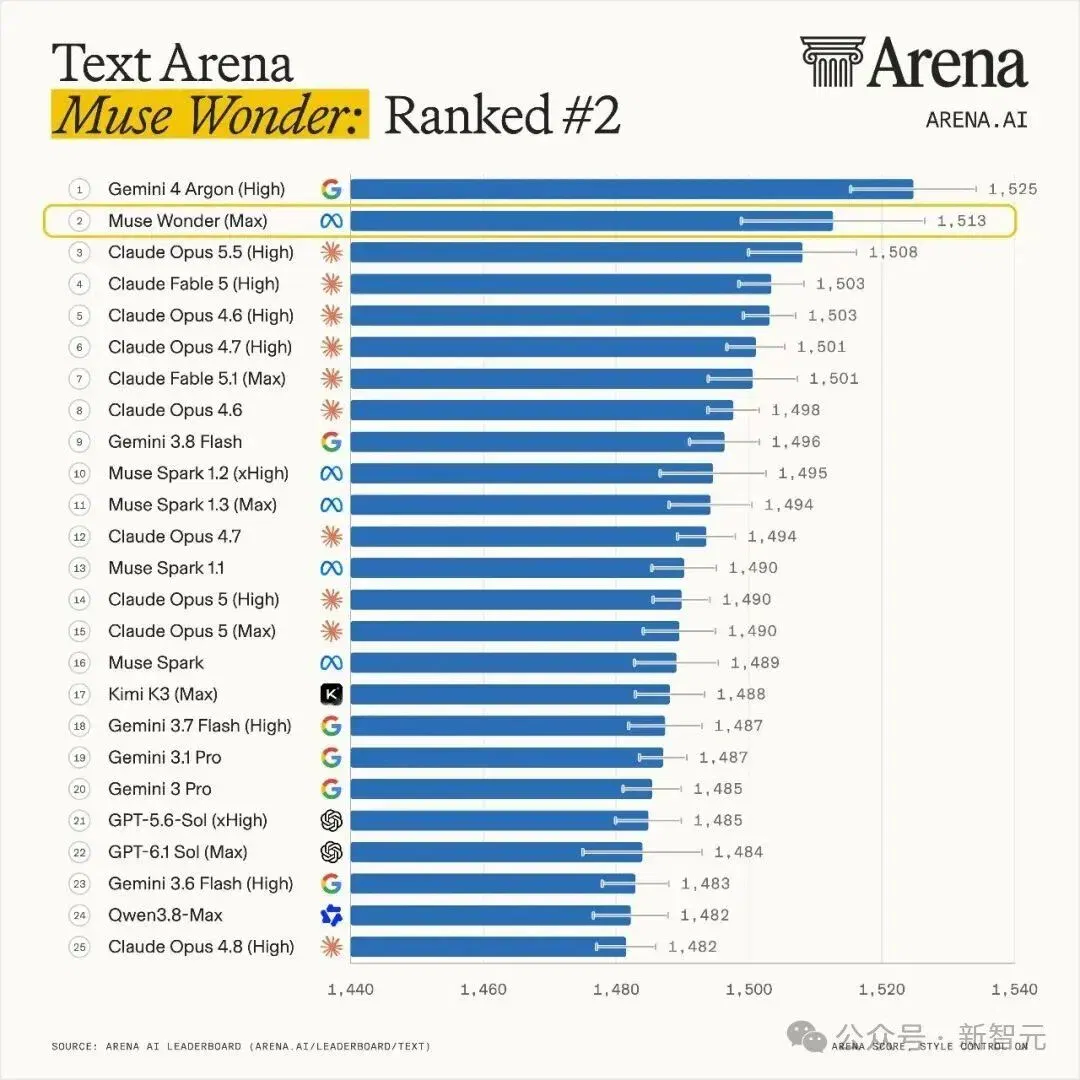
On October 14, Muse Wonder shot to second place on its Arena debut with 1,513 points, just 12 points behind the leader, Argon.
But before anyone else could make a move, it was Google itself that knocked Argon out of first place.
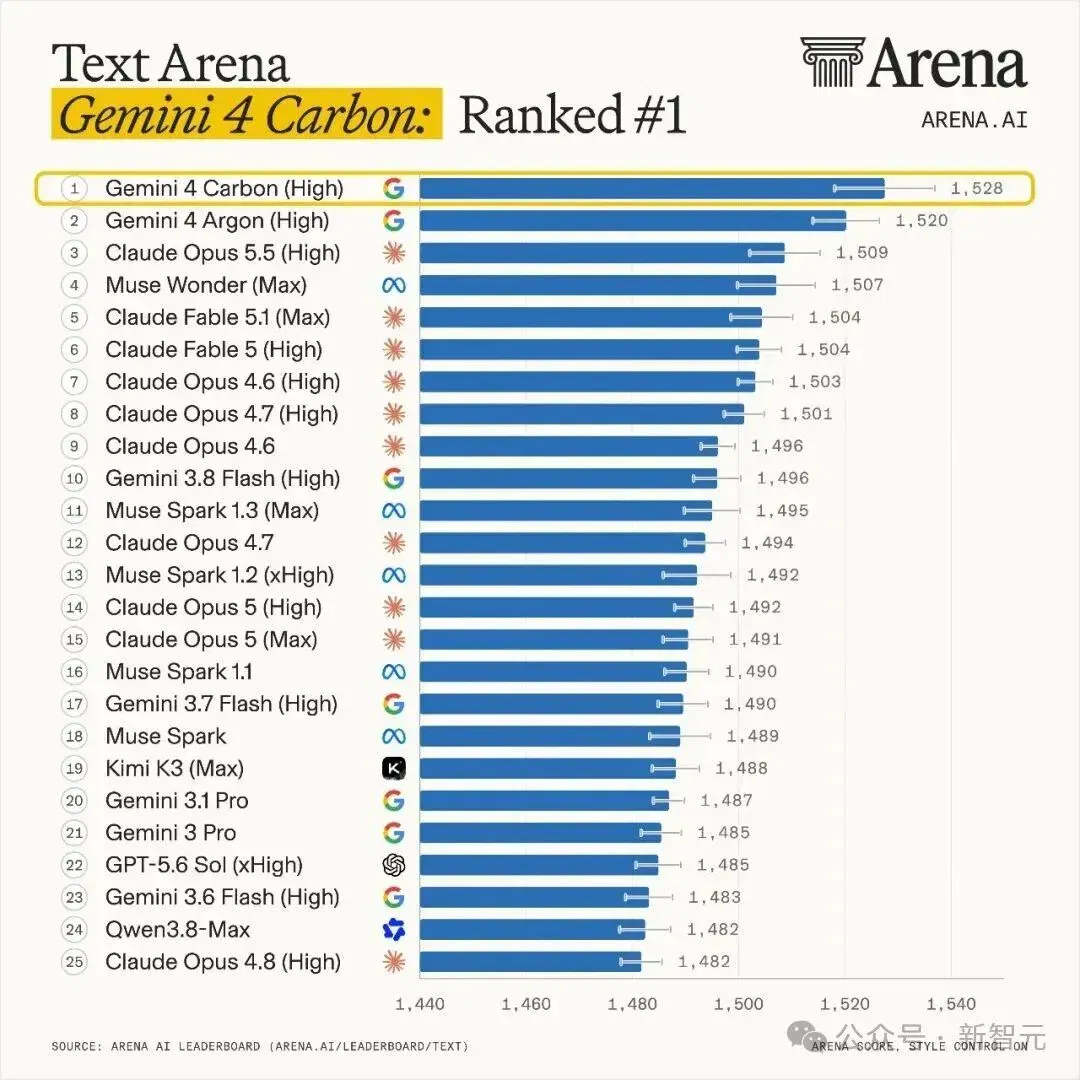
On October 29, built on Argon, Gemini 4 Carbon (High) reached the top with 1,528 points, pushing its sibling Argon (1,520 points) into second place. Google DeepMind sounded confident at launch:
Gemini 4 Carbon is our next-generation frontier model, with industry-leading capabilities in cybersecurity and long-horizon tasks.
Then, on November 19, Google released its third Gemini 4 model, Neon, positioned between Carbon and Hydrogen and focused on complex software engineering, knowledge work and scientific tasks.
In the Arena text rankings updated on November 22, Neon ranked third, tied with Meta's Muse Wonder at 1,512 points. All three top places now belonged to Google.
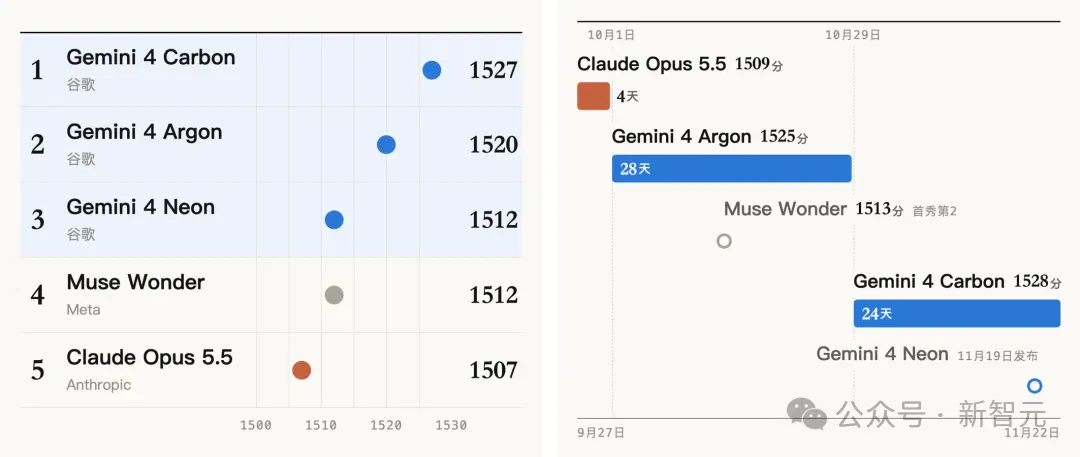
Over two months, three Gemini 4 models took turns pushing Claude all the way from first place to fifth.
Claude still leads in the agent-ranking snapshot, with Neon second
Beyond the text-ranking snapshot above, the article also compares a different leaderboard: the Agent Arena Index, which looks at real agent tasks.
According to the rankings announced on November 19, first place here still belonged to Claude Fable 5.2 (Max), with 1,453 points.
But Google had already taken second place.
Newly released Gemini 4 Neon entered the agent rankings at number two with 1,336 points, based on 4,200 real agent sessions, one point ahead of third-place Claude Opus 5.5 (Max) at 1,335, and 117 points behind leader Fable 5.2.
Its older siblings Carbon (fourth, 1,303 points), Hydrogen (ninth) and Argon (eleventh) were all behind it, making Neon Google's strongest model on this leaderboard.
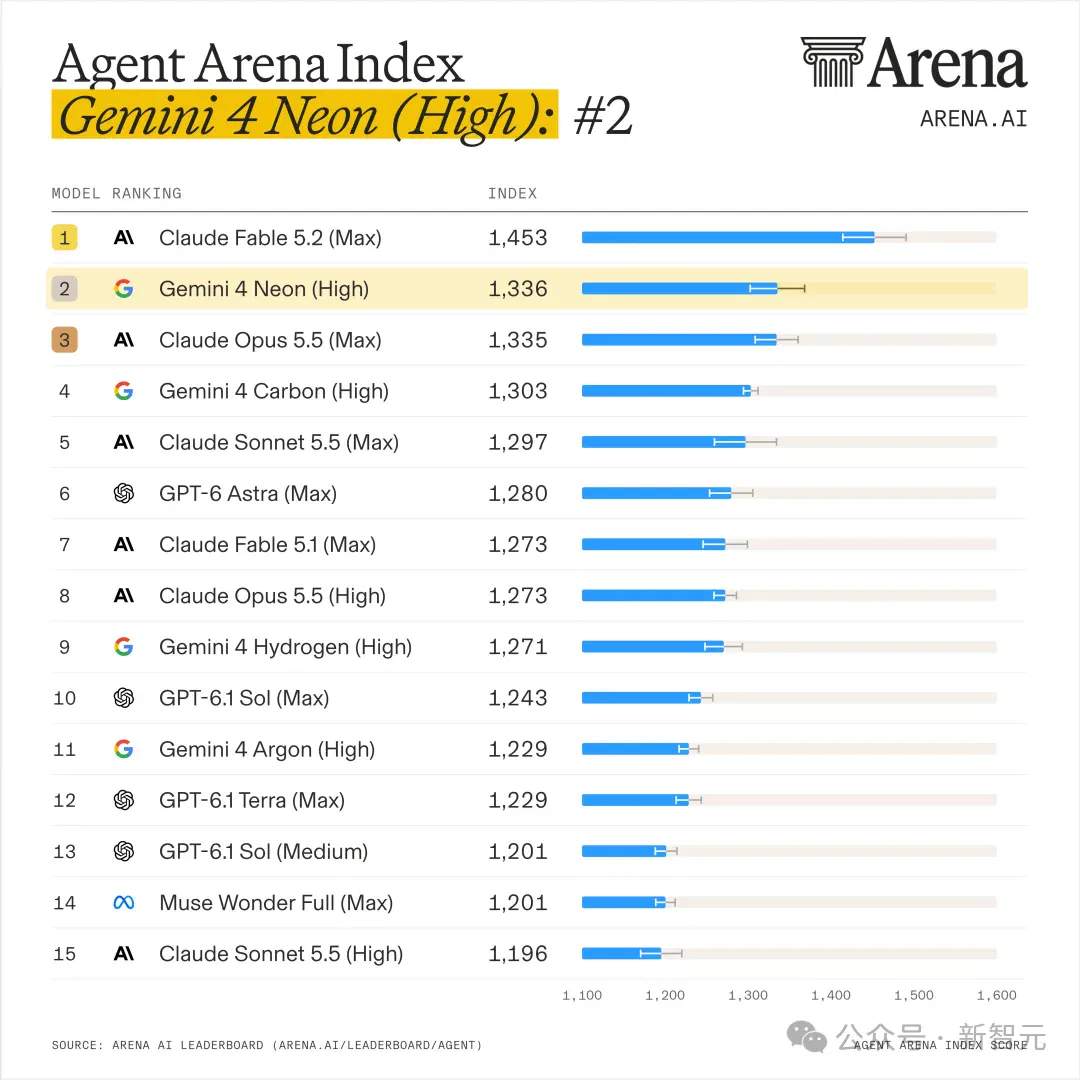
By subcategory, Neon ranked second for both user satisfaction and steerability—whether it can change course after a user corrects it—and third for task completion.
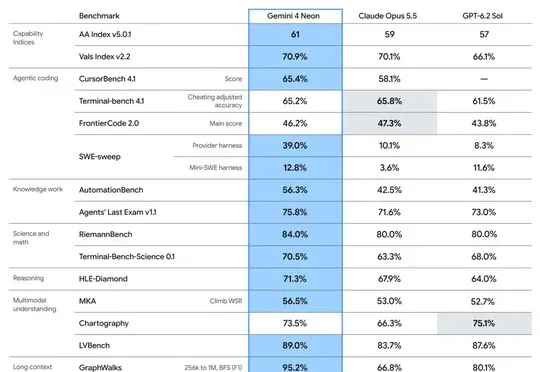
On Google's self-reported practical coding benchmark, CursorBench 4.1, Neon also scored a strong 65.4%, directly beating Claude Opus 5.5's 58.1%.
The real sting is the price: Neon's API costs $3 per million input tokens and $15 per million output tokens.
In Agent Arena's real sessions, Neon's median cost per task was just $2.82, 53% cheaper than third-place Claude Opus 5.5 (Max) and 69% cheaper than leader Claude Fable 5.2 (Max).
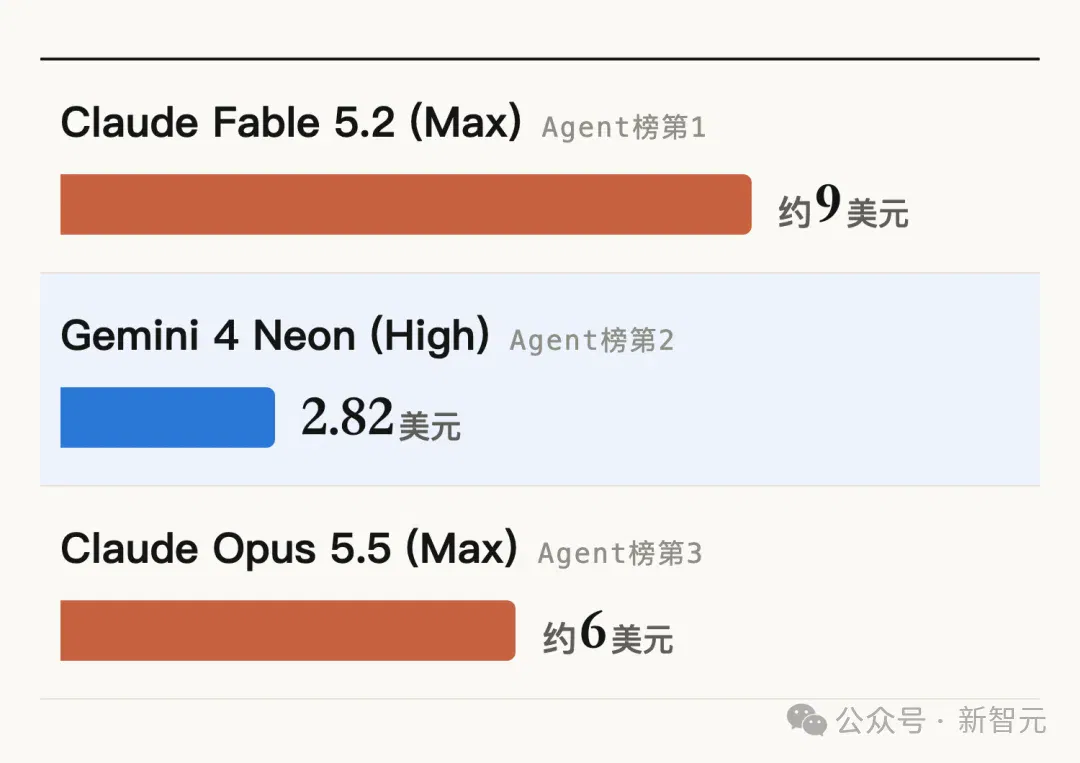
Almost the same score as Opus 5.5, at less than half the cost.
$7 versus $27! Arena puts Neon to the test
At such a much lower price, how good is the work?
On November 20, Arena's Peter Gostev released a hands-on testing video, pitting the freshly released Gemini 4 Neon against Opus, Fable, Astra and Sol on 3D scenes, games and UIs.
The first task asked the models to write code generating a 3D scene of Hagia Sophia and the Golden Horn in Istanbul. Neon spent about $6 on this task.

The Istanbul 3D scene generated by Neon's code; this task cost about $6.
For the second task, generating a 3D White House scene, Peter placed the visuals produced by Gemini 4 Neon and Claude Opus 5.5 (Max) side by side, with their respective costs labeled above.
Claude Opus 5.5 (Max) burned through about $27.66 to complete this task, while Gemini 4 Neon beside it spent only about $7.17 for the entire process—roughly a quarter of the cost!

The same White House scene task: Gemini 4 Neon on the left at about $7.17, Claude Opus 5.5 (Max) on the right at $27.66.
In the third test, Neon wrote a little New York rooftop parkour game that could be played straight away. This task cost about $3.
Gostev did, however, candidly complain while playing that the game's controls still did not feel very good.

Peter Gostev tries the New York rooftop parkour game written by Neon.
Across the snapshots from different dates described above, Google occupied the top three text-ranking places. In the cited November 19 agent rankings, Claude Fable 5.2 still ranked first and Neon second, with Neon's median cost for the sampled tasks below half that of the Opus setting used in the comparison.
From September 27, when Opus 5.5 reached the top, less than two months passed before first place in the text rankings changed hands twice.
References:
https://x.com/alexmichael/status/2124496549036077213
https://arena.ai/leaderboard/chat/text
https://x.com/arena/status/2103893011164017018
https://x.com/arena/status/2115495002998751262
https://x.com/arena/status/2123169189397709174
This article is from "AI Era," by "Moses."
Related topics
After reading
Join the AINRK community
Read how to join the community and connect with people working in AI.
Related articles
Continue reading related topics and articles in this category.
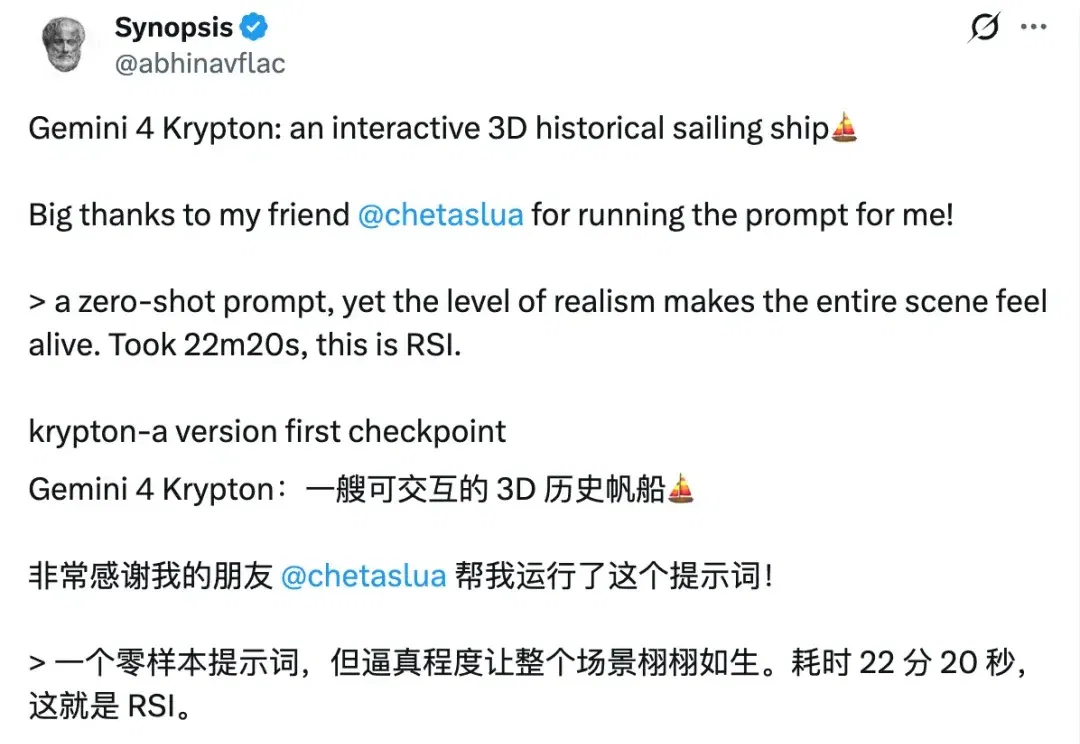
测试者分享 Gemini Krypton 动画与 3D 案例,模型信息待确认 (opens in a new tab)
早期测试者分享了标为 Gemini 4 Krypton 的代码动画、SVG 和 3D 场景,并与 Carbon、Argon 作对比。模型身份及稳定表现仍待官方信息验证。

DeepMind Uses Gemini 4 and Lean to Cut a Quantum Simulation's Resource Cost to About 1/11.8 (opens in a new tab)
DeepMind and Google Quantum AI use Gemini 4 teams and Lean to search and verify quantum algorithms. Fusion, photochemistry and drug-metabolism benchmarks show about 11.8×, 8× and 2.5× resource improvements, not hardware speedups; they still exceed early error-corrected machines.

SemiAnalysis Posts an Apology Form as Gemini 4 Updates Prompt a Reassessment (opens in a new tab)
SemiAnalysis posted an apology form on X after its pessimistic assessment of Gemini. The report traces Argon, Carbon, Hydrogen and Neon through Google's long pretraining cycles, parallel development, compute allocation and post-training on real engineering tasks.
DeepMind looks beyond AGI: Four potential paths to ASI (opens in a new tab)
A DeepMind Institute essay explores model scaling, paradigm shifts, multi-agent coordination and RSI. It separates global effective-compute growth from fixed-workload cost reductions, treating future trends as conditional and calling for better measurement and governance.
Google Launches Gemini 4 Neon With Hydrogen Subagent Orchestration (opens in a new tab)
Google's Gemini 4 Neon coordinates Hydrogen subagents in Antigravity for coding, analysis and long tasks. This report covers launch-time benchmarks, pricing and demos; cost and ranking comparisons depend on specific tasks, reasoning tiers and agent frameworks.