Gemini 4 Neon Targets Efficiency as Antigravity Feedback Highlights Tool-Level Limits
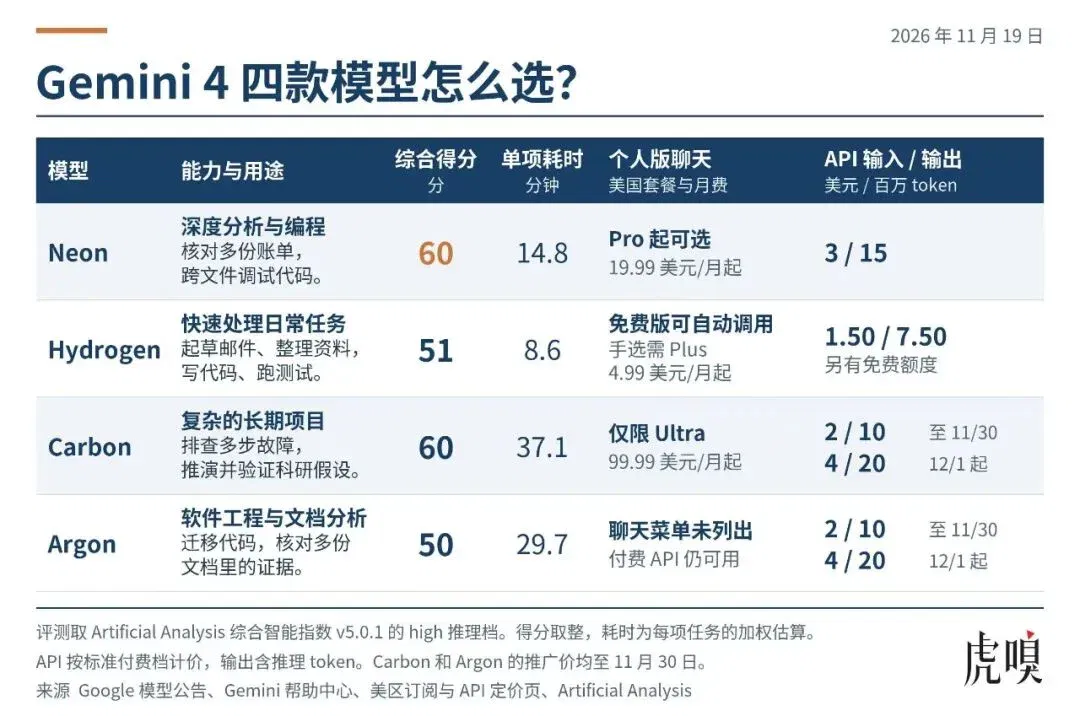
Google positions Gemini 4 Neon between Carbon and Hydrogen for coding, knowledge work and research. The report reviews Antigravity stability, long-task and quota complaints; version-specific user reports and tests do not establish that all users cannot run Neon.
Editor's fact-check (November 22, 2026): Google officially lists November 18, 2026 as Gemini 4 Neon's release date. The Antigravity failures and quota issues described here come from particular user reports or tests, not a uniform finding across all users, versions and tasks. In particular, the November 17 report about Gemini 4's long context predates Neon's release and cannot be treated directly as a test result for Neon itself. Model metrics, output speed and the tool's end-to-end experience must also be understood separately. Google release announcement (opens in a new tab); Official model card (opens in a new tab)
Neon is here. (Huxiu note: Neon is the noble gas that is the tenth element in the periodic table. High voltage applied to low-pressure neon gas makes it glow, producing neon light.)
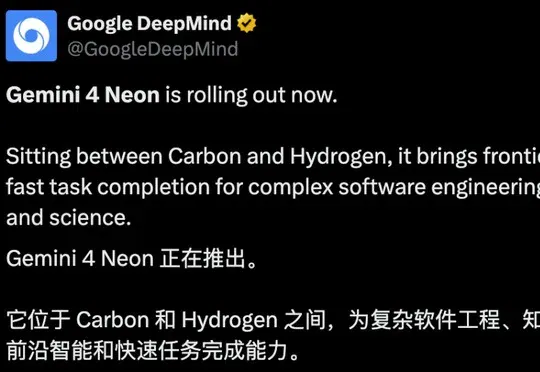
In the early hours Beijing time, Google released Gemini 4 Neon, a new member of the Gemini 4 family and another elemental model after argon, carbon and hydrogen: a value-oriented combination of capability, speed and cost.
In just five weeks, Google has introduced four Gemini 4 models to the public. The rapid succession has prompted speculation about AI evolving and upgrading models itself. Another discussion is that, at this pace, it will soon reach uranium and plutonium.
It is hard to imagine how staggeringly powerful such a model would be. Of course, models should avoid names that are too grand, lest they fail to live up to them.

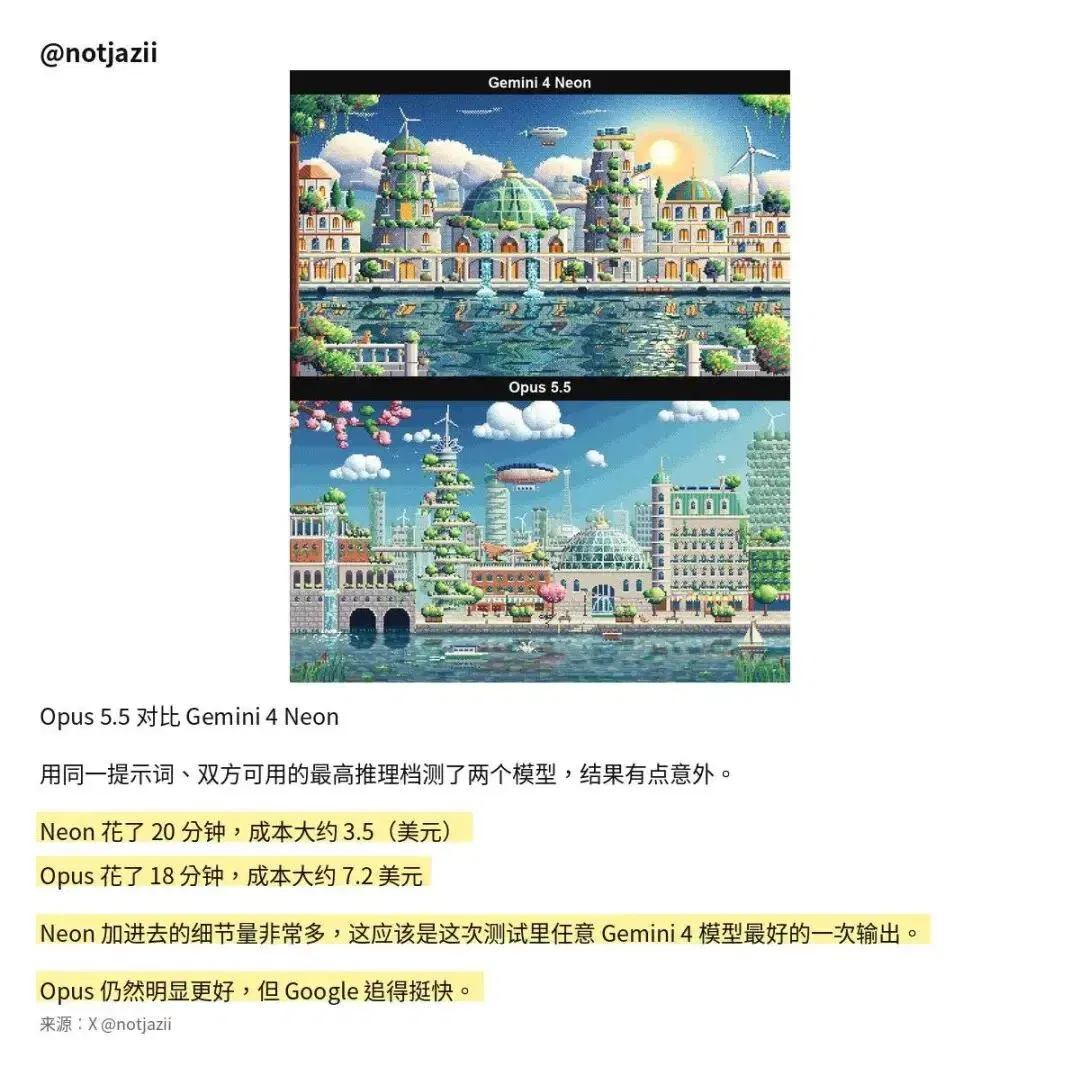
On social media, praise for Neon has focused mainly on visuals and speed. Some users find it excellent at reproducing front-end component animations. In certain comparison tests, Neon completed generation tasks faster than heavyweight models, prompting some to call it a cheaper Opus alternative.
Among critics, some find Neon's final output rather plain. More complaints, however, concern the experience of Google's coding tool Antigravity.
A Look at the Benchmarks
As usual, here is the quick version first.
- Near-flagship capabilities, with a focus on completing complex tasks faster. Google positions Neon between Carbon and Hydrogen for complex coding, knowledge work and scientific research. Carbon still handles the hardest tasks requiring prolonged reasoning; Neon is not a complete replacement for the flagship.
- Speed is a major strength. Artificial Analysis measured Neon's output at about 110 tokens per second, versus about 57 for Carbon. Faster output does not mean every task finishes twice as fast, however; actual results still depend on the task.
- Office work, research and coding are the main uses. According to Google, Neon can combine documents, spreadsheets, images, audio and video to prepare research briefs. In Antigravity, it can also make repository-wide changes, debug and refactor, sharing work with Hydrogen: Neon plans and Hydrogen executes.
- Pricing sits in the middle, but is temporarily higher than the flagship's promotion. Neon's API input and output prices are $3 and $15 per million tokens respectively, with cached input at $0.15. Both input and output unit prices are twice Hydrogen's and 25% below Carbon's standard prices starting in December, but 50% above Carbon's promotional prices through November 30.
- In-app use requires a paid subscription, while the API is usage-based. Google is opening Neon in the Gemini app and Antigravity to AI Pro and Ultra users. Developers can access it through the paid API, with a one-million-token context. Thinking tokens are billed as output.
Now for a closer look at the benchmarks.
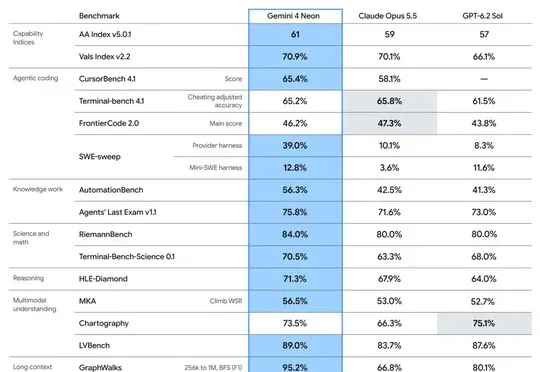
On benchmark scores alone, Neon is already close to flagship level. But Google's main emphasis this time is value for money.
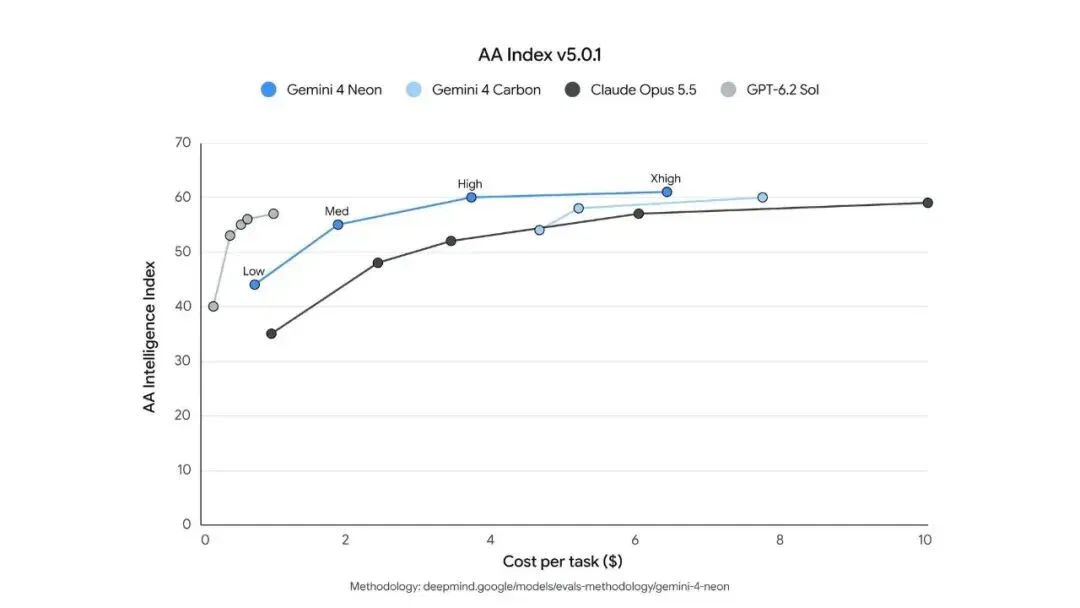
In third-party evaluator Artificial Analysis's Intelligence Index, Neon scored 61 and ranked third at launch, behind only Claude Fable 5.2 and GPT-6.2 Astra and slightly above Carbon.
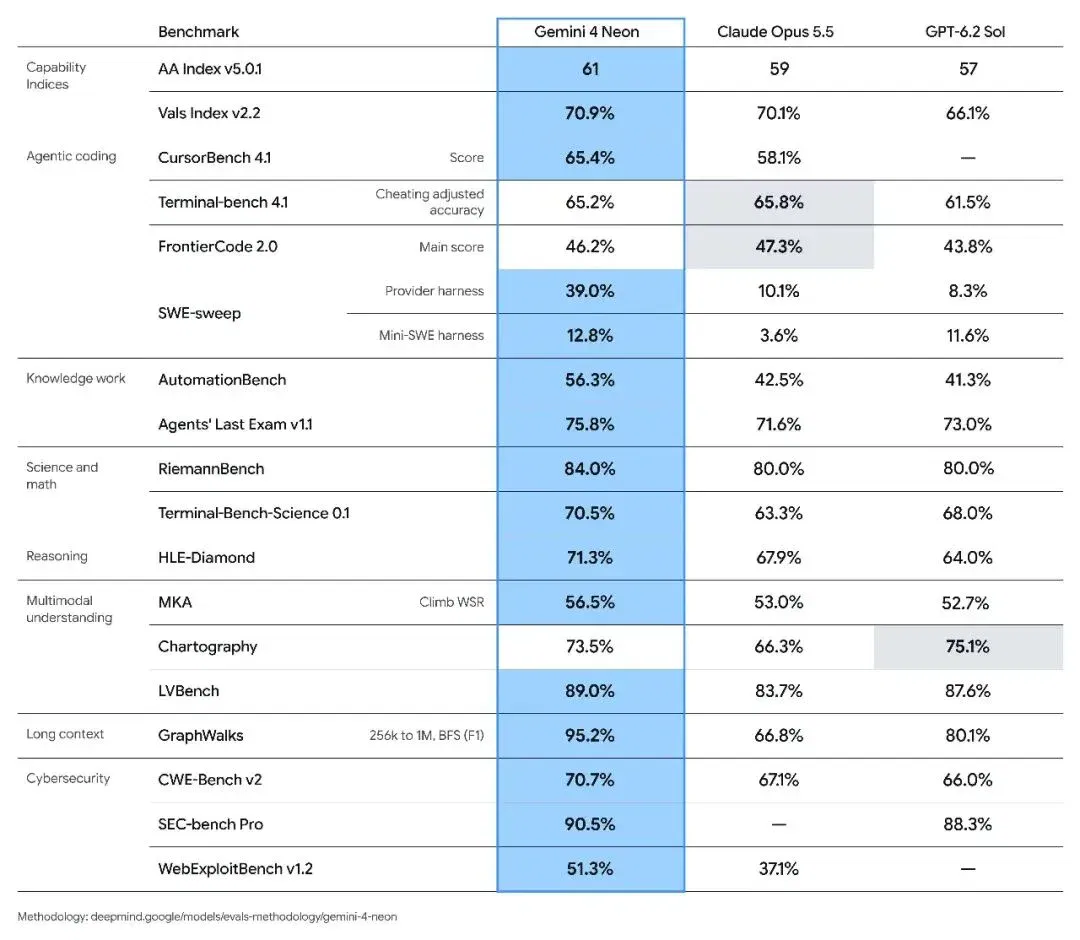
Coding is a particular strength for Neon. It ranks first on Artificial Analysis's coding-agent index. Google says Neon does more than generate code snippets: It handles cross-file debugging, refactoring and targeted edits. In Antigravity, it can plan while several Hydrogen subagents execute separate parts. Opus still holds a slight edge in some command-line and coding tests, however.
For office work, Neon emphasizes organizing source material. It can combine spreadsheets, PDFs, charts, audio and video to support research, analysis and reporting, ranking second on the Vals Index covering enterprise knowledge work. For scientific research, Google's published mathematics and science tests also show competitive performance.
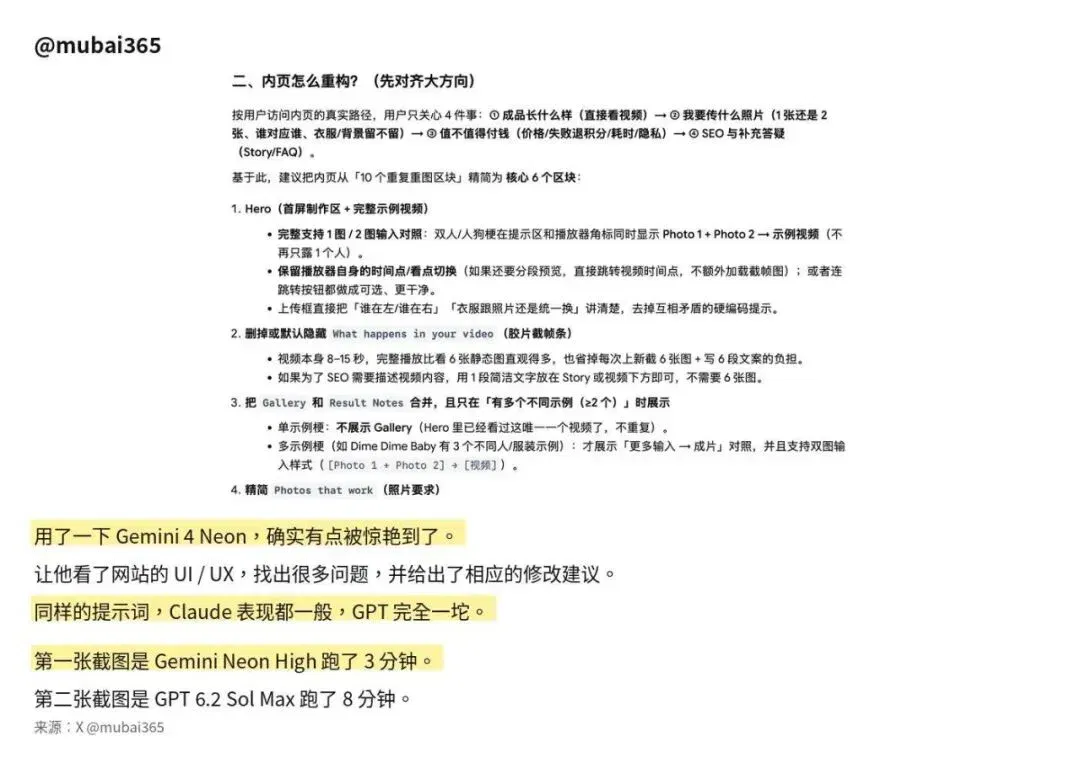
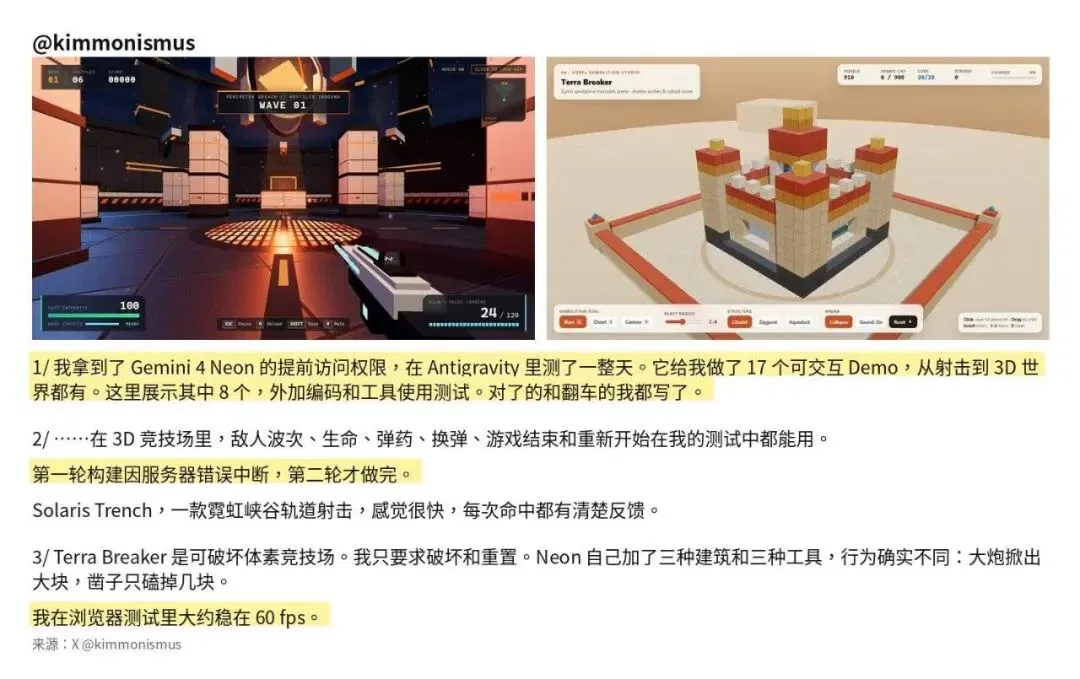
Google also demonstrated several 3D-development examples: reconstructing Turing's study from historical photographs and creating a skiing simulator with effects such as tracks in the snow and avalanches.
Cost is another focus. Google says that at the default high setting, Neon's per-task cost in the relevant evaluations was 32% lower than Carbon's. Neon's clearer positioning is to make complex work faster and more economical.
If the Models Are Stronger, Why Do People Still Complain About Antigravity?
The impressive benchmark scores of the Gemini 4 models contrast with user sentiment toward Google's own AI coding tool, Antigravity.
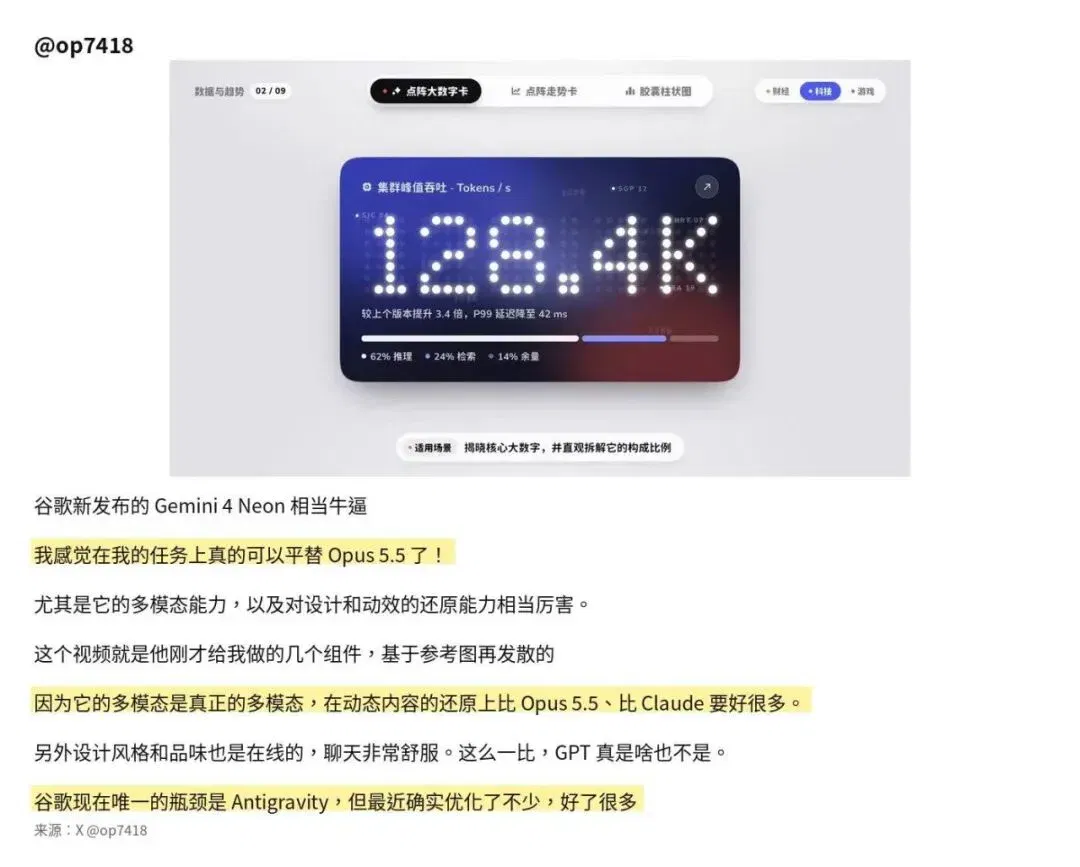
Antigravity is Google's AI coding tool, comparable to Cursor, Claude Code, OpenAI Codex or GitHub Copilot.
The problem is that model capabilities keep improving, while the actual user experience has not improved in step.
On social media, many people complain that Gemini 4 is a letdown. The three biggest issues are unstable operation, errors on long tasks and unpredictable usage limits.
First, stability.
Since November, multiple developers have reported frequent slow responses, stuck tasks and unavailable models in Antigravity. One user said that after a software update, even changing a few lines of code caused the AI to search repeatedly and loop through actions. A task that should have taken seconds stretched to one or two hours before they had to force it to stop.
More troublesome than speed is that AI may forget what it is supposed to do while performing a task.
On November 17, a Google AI Ultra user published a set of reproduction tests: Once a conversation exceeded about 128,000 tokens, the Gemini 4 model in Antigravity could lose early context without warning.
Another issue is quotas. Google applies five-hour and weekly quotas in parallel. Complex tasks consume more resources, but that consumption is hard to estimate in advance. One Ultra subscriber even reported that 16 subagents that had already finished their work continued to appear as running for a long time, consuming quota.
Of course, Antigravity is not entirely without merit. This September, Kommunicate asked Claude Code, Codex and Antigravity to complete the same email-processing system development task. The result was that Antigravity produced the most feature-rich prototype, supporting dynamic routing and failure retries and adding an administrative dashboard. But it did not implement actual Gmail integration, some features exceeded the original requirements and it crashed twice during startup.
Another test highlighted a different strength. In October, TLE Labs tested the three tools' code-review capabilities on 168 pull requests. On code that did not actually contain a problem, Antigravity's false-positive rate was just 5.2%, below Claude Code's 20.7% and Codex's 47.8%.
The tradeoff was that it also missed real errors more often. Its severity-weighted defect detection rate was 70.7%, while Claude Code and Codex reached 89.2% and 91.6% respectively.
That is Google: always a little short of the mark. How long this neon light of leading capabilities can keep shining ultimately comes down to engineering as a whole.
This article was originally published on the WeChat public account 'Huxiu App,' by Huxiu App.
Related topics
After reading
Join the AINRK community
Read how to join the community and connect with people working in AI.
Related articles
Continue reading related topics and articles in this category.
Google Launches Gemini 4 Neon With Hydrogen Subagent Orchestration (opens in a new tab)
Google's Gemini 4 Neon coordinates Hydrogen subagents in Antigravity for coding, analysis and long tasks. This report covers launch-time benchmarks, pricing and demos; cost and ranking comparisons depend on specific tasks, reasoning tiers and agent frameworks.
Google unveils Gemini 4 Neon and expands Genie 4 access for eligible Ultra users (opens in a new tab)
Google introduces Neon for efficient, complex tasks, with a million-token context window and API pricing, and expands Project Genie interactions. Rollout is gradual; cybersecurity models and Genie access remain subject to eligibility and availability restrictions.
最快今日发布!谷歌Gemini 4 Argon已对部分用户开放 (opens in a new tab)
就在刚刚,海外科技圈爆料:谷歌下一代重磅模型 Gemini 4 Argon 已密集现身多个平台,甚至已经对部分 Pro 用户开放!
美国豆包实至名归——“反重力”2.0引众怒:IDE功能被剥离,开发者被迫回退旧版。 (opens in a new tab)
谷歌旗下AI开发工具Antigravity(反重力)近日推送2.0版本更新,却引发开发者社区强烈反弹。这次被官方称为"升级"的更新实际上将原有的VS Code风格IDE功能剥离,替换为纯Agent模式界面,导致大量用户配置丢失、插件失效,开发者纷纷寻找回退方案。
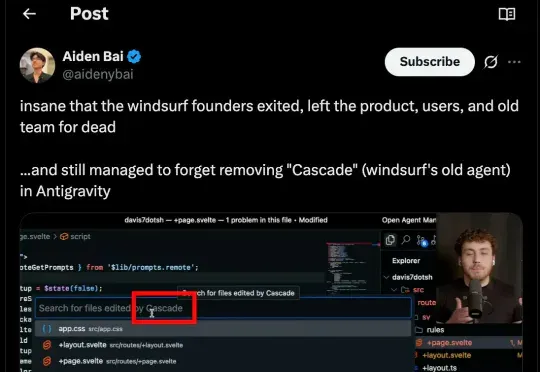
谷歌24亿美元买个壳?刚发布的“下一代AI IDE”被爆“复制”Windsurf,连Bug一起 (opens in a new tab)
Google 前天发布了 Antigravity,一款号称“下一代 agentic 开发平台”的全新 IDE。官方宣传强调它能规划、执行、验证整个开发流程,似乎代表着 AI 编程进入了新的阶段。然而,最早一批上手使用的开发者却纷纷吐槽:任务跑着跑着就因“模型过载”中断,信用额度几十分钟内耗尽,连完整测试都难以完成,体验堪称“开局即崩”。