PanDWM generates panoramic driving video, then lifts it into 4D Gaussian scenes for new viewpoints
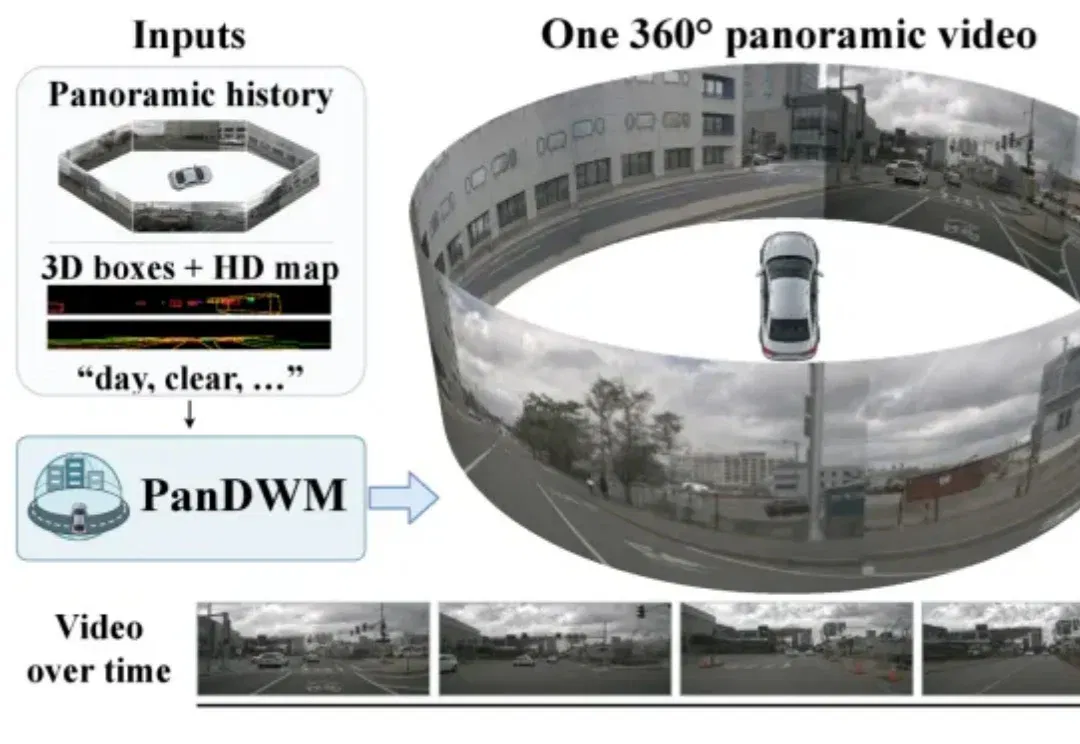
Peking University's PanDWM maps six cameras to a panoramic strip, generates video with four-step causal diffusion, then lifts and fuses Gaussians for novel views. Its 0.5 and 1.96 s/frame timings use H100 and A40 GPUs; full 4D processing and refinement cost extra, with drift and occlusion limits.
Editor's fact check (November 26, 2026): The speed figures in this article must be distinguished by processing stage and hardware. Approximately 0.5 seconds per frame on an H100 refers to denoising plus VAE decoding for the four-step student; the main table's 1.96 seconds per frame measures the same video-generation stages on an A40. These figures exclude full 4D processing and novel-view refinement. The paper separately reports approximately one second per frame on an H100 for the Gaussian stage including depth relabeling, while novel-view refinement requires additional denoising. A single feed-forward pass first produces a single frame's 3D Gaussians; 4D construction then fuses static content from neighboring frames. Unseen parts of moving objects and long-horizon drift remain unresolved. Results are limited to the paper's nuScenes settings and tested comparisons; they should not be read as guaranteeing seamless, drift-free output or accurate reconstruction from arbitrary viewpoints in every scene.PanDWM paper: Tables 1 and S4, 4D runtime, and limitations (opens in a new tab)Authors' project page: 19.2 seconds of generated future and method overview (opens in a new tab)PanDWM official code repository (opens in a new tab)
Autonomous-driving simulation needs a world model that can roll forward: given a map of the vehicle's surroundings, 3D boxes, and several past frames, the model generates the upcoming surround-view video. Such models have developed rapidly over the past two years, but most methods still generate separate videos for the six cameras around the vehicle and then try to align them.
Members of Hao Tang's team at Peking University took a different approach: if the desired output is the complete 360° world around the car, why not generate a panorama directly? Their PanDWM places the six cameras into a single panoramic strip, uses a causal model requiring just four denoising steps to generate future frames segment by segment, and then uses a feed-forward decoder to lift each frame into 3D Gaussians. Static Gaussians from neighboring frames are fused into a 4D scene that can be rendered from viewpoints outside the original trajectory. On a single H100, PanDWM takes approximately 0.5 seconds to generate one 360° frame, including VAE decoding.

- Paper title: PanDWM: Panoramic 4D Driving World Models
- Paper: https://arxiv.org/abs/2611.19857
- Project page: https://aigeeksgroup.github.io/PanDWM/
- Code: https://github.com/AIGeeksGroup/PanDWM
- Model: https://huggingface.co/AIGeeksGroup/PanDWM
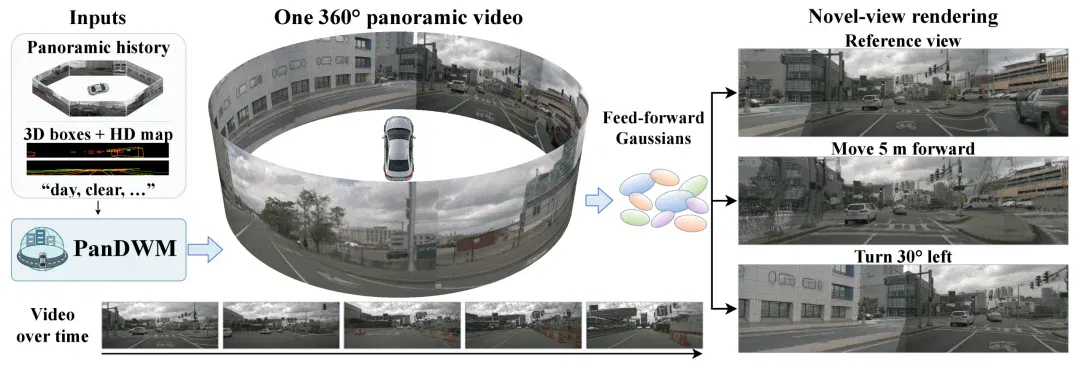
Figure 1: Conditioned on panoramic history frames, 3D boxes, HD maps, and text, PanDWM generates a 360° panoramic video. Feed-forward Gaussian lifting then enables rendering from novel viewpoints, such as moving five meters forward or turning 30° left.
The seam problem between six cameras
Take nuScenes as an example: the vehicle carries six cameras facing forward, backward, front-left, front-right, rear-left, and rear-right. Most mainstream driving world models follow this setup, generating one video per camera and using cross-view attention to let the streams refer to one another.
The difficulty lies at the boundaries between cameras. For example, as a car passes diagonally in front, its nose may already be in the front camera while its rear remains in the front-left camera. The two halves must be generated in separate images, and matching their colors and outlines depends on the cross-view relationships the model has learned. Yet adjacent cameras have only narrow overlapping regions, offering little signal for learning those correspondences. Objects at the boundaries are therefore more prone to misalignment.
Treating surround views as one image
PanDWM chooses to address these boundaries at their source. Using the six cameras' calibration parameters, it maps their images onto a 360° panoramic strip with a resolution of 4114×256. To fit the pretrained model, the strip is divided into two overlapping halves, each 2304×256, with the split positions arranged so that every camera boundary falls inside one of the halves.
This turns cross-camera consistency into spatial continuity within an image: a vehicle crossing a boundary is generated in the same image, making continuity easier to maintain. Each pixel on the strip also records its corresponding source-camera ray, preserving accurate geometry for subsequent 3D lifting. The 3D-box and HD-map conditions are assembled into strips in the same way.
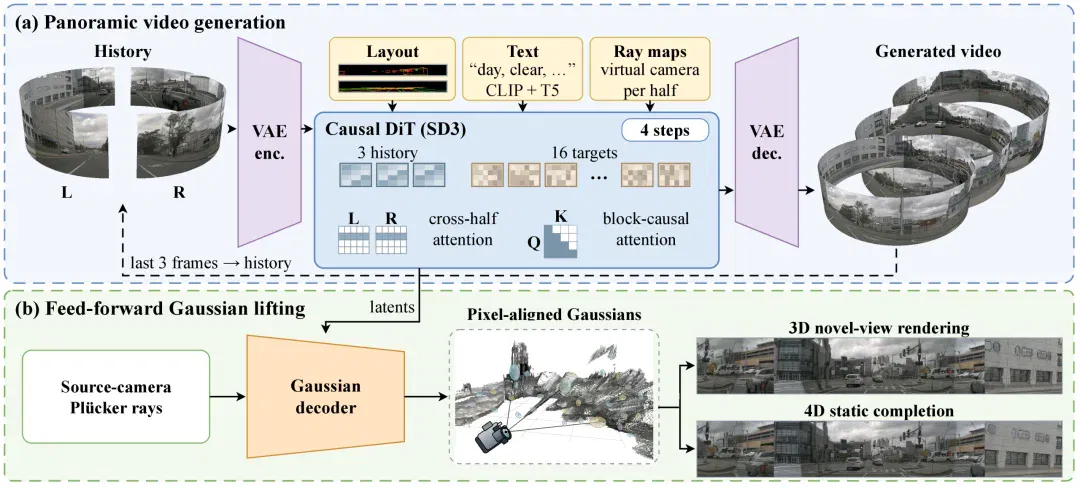
Figure 2: PanDWM's overall framework consists of causal panoramic-video generation and feed-forward Gaussian lifting.
Four-step causal generation, trained on its own history
The generation component is a chunkwise causal diffusion Transformer. Each window refers to three history frames and generates 16 future frames, with windows advancing one after another. PanDWM first trains a 50-step causal teacher, then distills it into a student requiring only four denoising steps.
Distillation takes place in two stages: consistency distillation first, followed by distribution matching distillation (DMD) with an adversarial discriminator head to bring student outputs closer to real footage. Motion and sharpness constraints are also added to prevent blur and rigid motion. At the same time, the student's history frames during training are its own generated frames, rather than real footage. Because the model must rely on its own outputs during inference, adapting to this in training makes errors less likely to keep accumulating during long-horizon rollouts.
From video to a 4D scene with changeable viewpoints
The panoramic video alone can only be viewed from the original camera positions. To enable novel-view rendering, PanDWM's feed-forward Gaussian decoder places pixel-aligned 3D Gaussians along each pixel's source-camera ray. One forward pass produces a single frame's 3D scene without per-scene optimization. Static Gaussians from neighboring frames then fill holes left by occlusion to form a 4D scene. For viewpoints that depart substantially from the original trajectory, PanDWM further refines the render to remove artifacts.
Ultimately, PanDWM outputs more than a video: it produces a 4D scene that can be rendered again after shifting the viewpoint laterally by several meters.
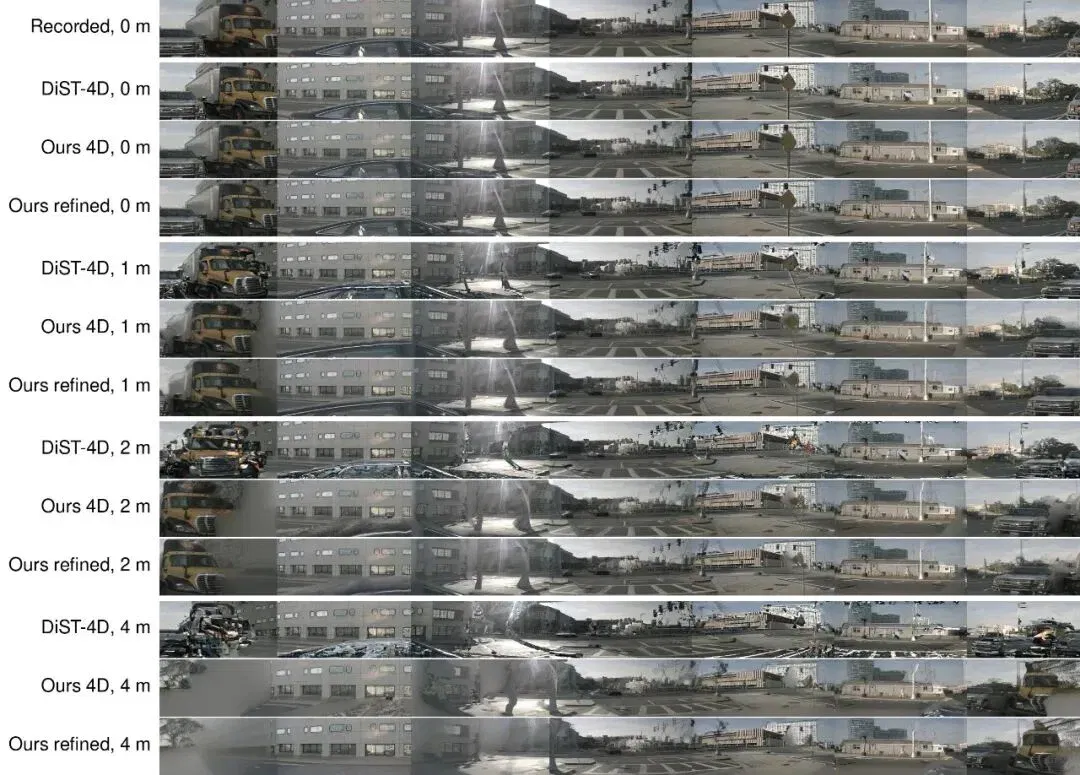
Figure 3: Renderings after lateral viewpoint shifts of 0, 1, 2, and 4 meters. The first row is real footage; the remaining rows show DiST-4D and PanDWM 4D scenes.
Experimental results
Experiments are conducted on nuScenes, with comparison methods including UniMLVG, OpenDWM, DreamForge, DiST-4D, and OmniNWM. For speed, on a single A40 and counting denoising plus VAE decoding, PanDWM takes 1.96 seconds per frame, approximately 17 times faster than the 50-step teacher's 33.7 seconds and 8–46 times faster than the comparison methods. For quality, when evaluated on 360° panoramic strips, PanDWM achieves an FID of 10.1 and an FVD-1 of 37.4, the lowest among the compared methods. The four-step student's FID is broadly on par with the 50-step teacher's, at 10.1 versus 9.93, while FVD falls by 22%–25%. To test whether the panoramic representation itself is useful, the researchers train panoramic and six-camera versions with identical initialization and training settings.
The panoramic version produces lower FID whether evaluated in panoramic space or six-camera space. For long-horizon rollouts, the researchers evaluate a 19.5-second sequence, comprising three observed history frames and 12 windows containing 19.2 seconds of generated future. Under this setting, the four-step student's FVD is below the 50-step teacher's in every time interval, indicating that training on self-generated history alleviates error accumulation. For 4D scene quality, PanDWM has the lowest depth error among feed-forward methods that use camera input alone
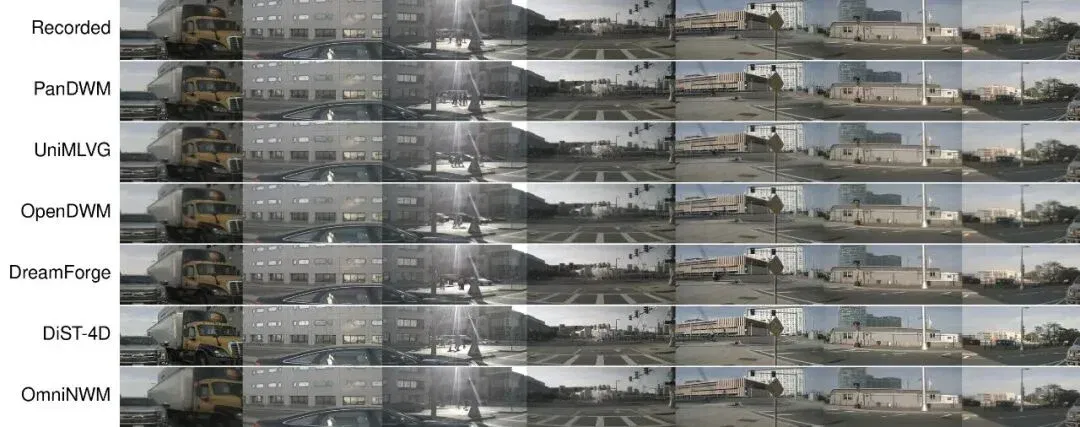
Figure 4: Comparison of the 360° panoramas generated by different methods at the same instant. The first row is real footage.
Conclusion
PanDWM starts from a simple idea: surround views already form a continuous 360° world, so rather than have a model learn to stitch six images together, generate a panorama directly. Around this representation, the team connects fast causal video generation with feed-forward 4D reconstruction, enabling a driving world model to produce scenes for novel-view rendering relatively quickly. The paper, code, and model weights have all been made public.
About the authors
Jiajun Sun is a member of Hao Tang's team at Peking University and a co-first author of this paper. He received his undergraduate degree from Shenzhen University and will pursue an MPhil at the Hong Kong University of Science and Technology (Guangzhou). His research focuses on driving world models.
Hao Tang, the paper's corresponding author, is an assistant professor and PhD supervisor in Peking University's School of Computer Science. He has been selected for a national high-level overseas talent program and Stanford's list of the world's top 2% scientists, and previously held postdoctoral research positions at CMU and ETH Zürich.
This article is from Synced, by Jiajun Sun.
Related topics
After reading
Join the AINRK community
Read how to join the community and connect with people working in AI.
Related articles
Continue reading related topics and articles in this category.
Infrathon tests agents' sustained optimization over 12–24 hours on 25 AI infrastructure tasks (opens in a new tab)
Infrathon spans 25 operator, module and system tasks. Across six models, 150 runs and over 10,000 GPU-hours, Claude Opus 5.5 leads with a 91.2 mean rank score, and 135 runs improve in their second half. Benefits vary by task and model; the benchmark does not establish general RSI.
TokenRhythm and Peking University introduce VAHBench for agentic long-video generation (opens in a new tab)
VAHBench evaluates long-video production across 48 agent configurations and 240 runs. Higher visual quality does not ensure complete delivery, longer and more complex tasks are harder to finish, and adding tools does not always improve the overall score.
Qwen3.5-27B self-rewriting experiment: up to 6.6 points higher accuracy on 490 math problems (opens in a new tab)
A research team lets models inspect internal states and edit their weights with code, without gradient training. After reserved-problem checks, Qwen3.5-27B's accuracy on 490 held-out math problems rises from 57.2% to as much as 63.8%. Smaller models fail; results remain task- and protocol-specific.
EMNLP 2026 Outstanding Paper UReason: why correct reasoning can still produce the wrong image (opens in a new tab)
UReason tests reasoning-to-generation alignment in unified multimodal models. Across eight open models, generating from the final refined prompt works better; Bagel rises from 17.8% to 62.6% on 500 testmini cases. The EMNLP 2026 Outstanding Paper does not show that reasoning harms every image task.
Google's SIM research: carrying self-improvement experience across models and datasets (opens in a new tab)
Can agents keep improving when models or datasets change? Google and Penn State's SIM carries optimization records alongside the harness. Tested gains come with budget, repetition and transfer limits; the work remains a preprint.