Infrathon tests agents' sustained optimization over 12–24 hours on 25 AI infrastructure tasks
Infrathon spans 25 operator, module and system tasks. Across six models, 150 runs and over 10,000 GPU-hours, Claude Opus 5.5 leads with a 91.2 mean rank score, and 135 runs improve in their second half. Benefits vary by task and model; the benchmark does not establish general RSI.
Editor's fact check (November 26, 2026): This article introduces the research team's benchmark and experiments. “First” is the authors' characterization of its scope. The 91.2 figure is an equally weighted aggregate of the six models' within-task rank scores, not accuracy or a percentage speedup; final performance takes the highest valid private-test score within each run's budget. The increase from 6.82× to 19.86× is the mean KV compression ratio for particular video pipelines and samples. Better mean quality does not mean every sample improves or total runtime necessarily falls. Long-versus-short comparisons are limited to six tasks, two models, and equal GPU-hour budgets. This work explores infrastructure engineering optimization; it does not establish general recursive self-improvement on open-ended tasks.Infrathon paper: experiments, behavior analysis, and appendices (opens in a new tab)
The central vision of Recursive Self-Improvement (RSI) is for AI systems to keep improving their capabilities through continuous experimentation, feedback, and iteration. Realizing it, however, requires more than advances in model algorithms: AI infrastructure must also be efficient, reliable, and capable of ongoing optimization. From low-level GPU operators to complete training and inference systems, infrastructure efficiency directly affects the speed of model iteration, resource utilization, and computational costs.
As frontier agents grow more capable, a further question arises: can agents optimize not just models themselves but also the infrastructure supporting AI, and sustain performance improvements through long periods of experimentation and iteration?
To investigate, researchers from the University of Washington (UW), the Allen Institute for AI (AI2), Pyromind Dynamics, RadixArk, and other institutions jointly introduce Infrathon. The benchmark covers 25 real-world AI infrastructure optimization tasks at three levels—operators, modules, and systems. Through long-horizon evaluations of 12–24 hours, it systematically studies frontier agents' sustained optimization on complex infrastructure tasks and offers a new research reference for automated AI infrastructure optimization toward RSI.
- Paper title: Infrathon: Benchmarking Language Agents for Real-World, Long-Horizon AI Infra Optimization
- Project page: infrathonx.github.io
- English blog: infrathonx.github.io/blog.html
- Paper: arxiv.org/abs/2611.11995
- GitHub code: github.com/InfrathonX/Infrathon
- Dataset: huggingface.co/datasets/Infrathon/Infrathon
- Docker Hub: hub.docker.com/r/infrathon/infrathon
Infrathon evaluates frontier agents on real-world AI infrastructure tasks with 12–24-hour run budgets. Claude Opus 5.5 leads the six tested models with a mean rank score of 91.2. Agents can also find better solutions: Claude increases mean KV-cache compression from 6.82× to 19.86× while improving video quality. Under equal GPU-hour budgets, longer runs are more effective for module and system tasks, while multiple shorter runs remain competitive on operators.
AI infrastructure optimization is not a one-off code edit. It is an iterative process of locating bottlenecks, trying solutions, validating correctness, and measuring performance. One optimization may resolve the current bottleneck while exposing another in a different component. Agents must therefore not only adjust code using test feedback, but also recover from failed experiments and keep exploring when early progress is limited.
This makes AI infrastructure optimization an important setting for testing long-horizon agent execution. Compared with completing an individual task quickly, real infrastructure optimization requires agents to keep experimenting and accumulating feedback within limited compute resources and a time budget, eventually finding an effective solution.
What have existing benchmarks evaluated?
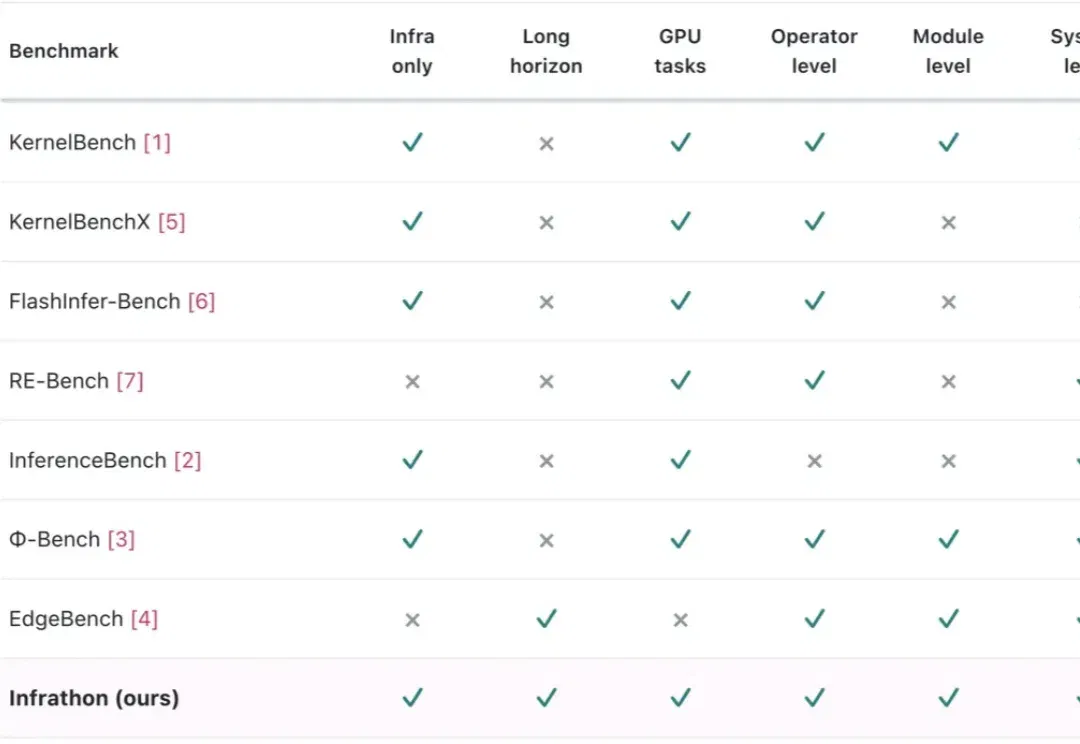
Existing benchmarks differ in task coverage, runtime, and available GPU tasks. KernelBench [1] evaluates operators and modules, while InferenceBench [2] focuses on complete inference services. Φ-Bench [3] covers all three levels, but most tasks have 1.5-hour budgets. EdgeBench [4] supports long runs across broader domains, but its open-source release does not include GPU tasks.
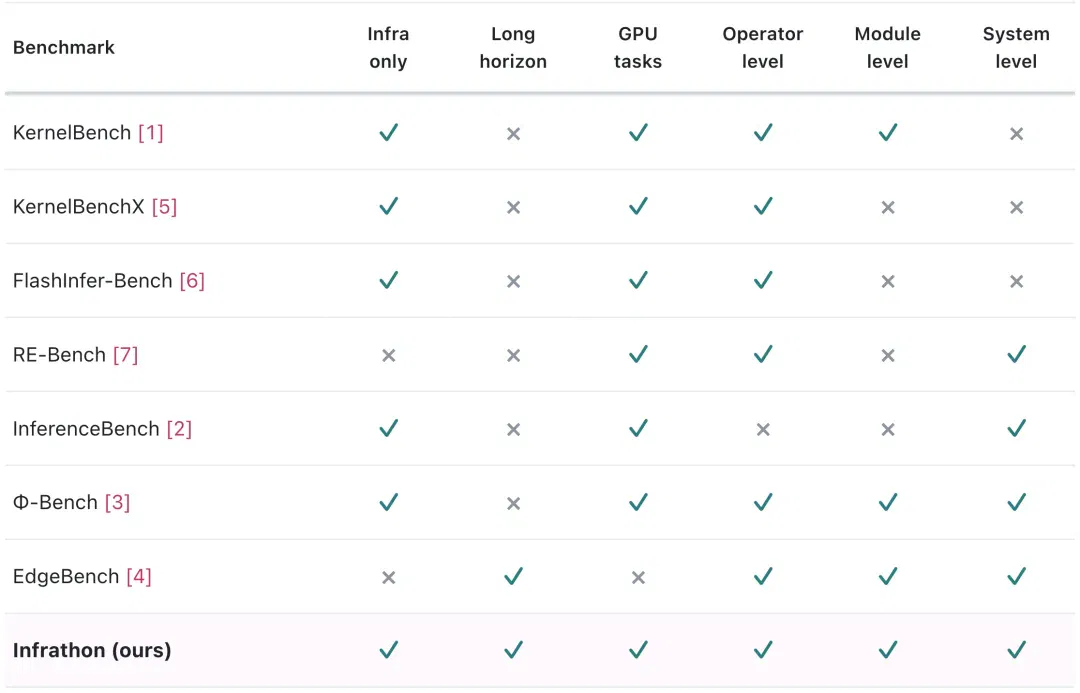
Coverage of related benchmarks. AI Infra only: exclusively evaluates AI infrastructure. Long-horizon execution: every task runs continuously for at least 12 hours. GPU tasks: the open-source release includes at least one GPU task. Operators, modules, and systems refer to computational primitives, components, and complete workflows, respectively. ✓ and × indicate whether the relevant coverage has been reported.
These differences leave an unresolved question: can frontier agents sustain improvements to real-world AI infrastructure over long runs?
To study this, we used Infrathon-build to construct Infrathon's 25 tasks with human experts, drawing on open-source infrastructure and research projects. Eleven operator-level tasks optimize computational primitives with budgets of 12 hours; five module-level tasks optimize interacting components with budgets of 24 hours; nine system-level tasks optimize end-to-end training or inference workflows with budgets of 24 hours. Infrathon is the first long-horizon AI infrastructure optimization benchmark to cover all three levels, using 12–24-hour budgets and performance metrics such as TFLOP/s that have no fixed upper bound.
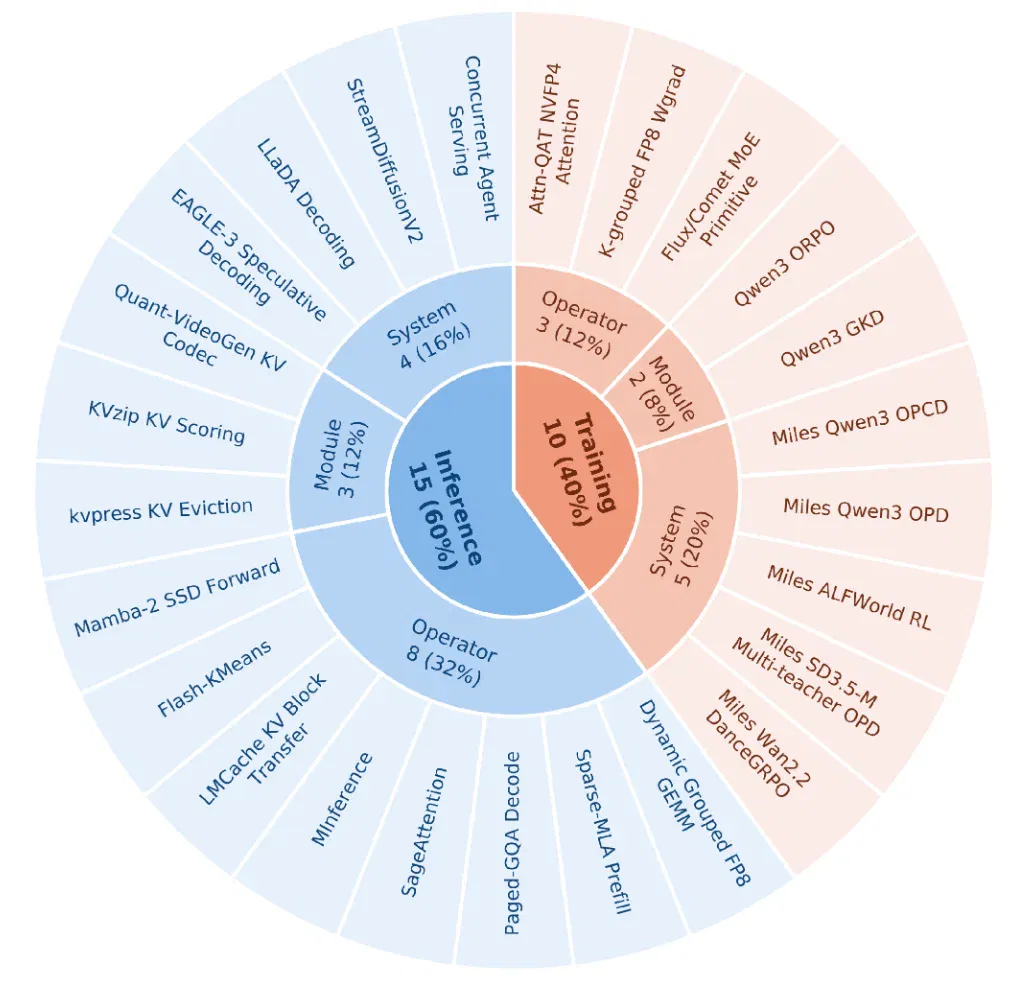
Task categories. The ring charts show training or inference categories, optimization levels, and individual tasks.
Each task specifies its Workspace, Public tests, Private tests, Resource, and Time budget. Agents develop solutions in the Work environment and run Public tests there. The Controller checks instruction following and attempts to exploit the scoring mechanism. Approved solutions enter the Judge Environment to run Private tests. Throughout the run, agents continue revising based on feedback.
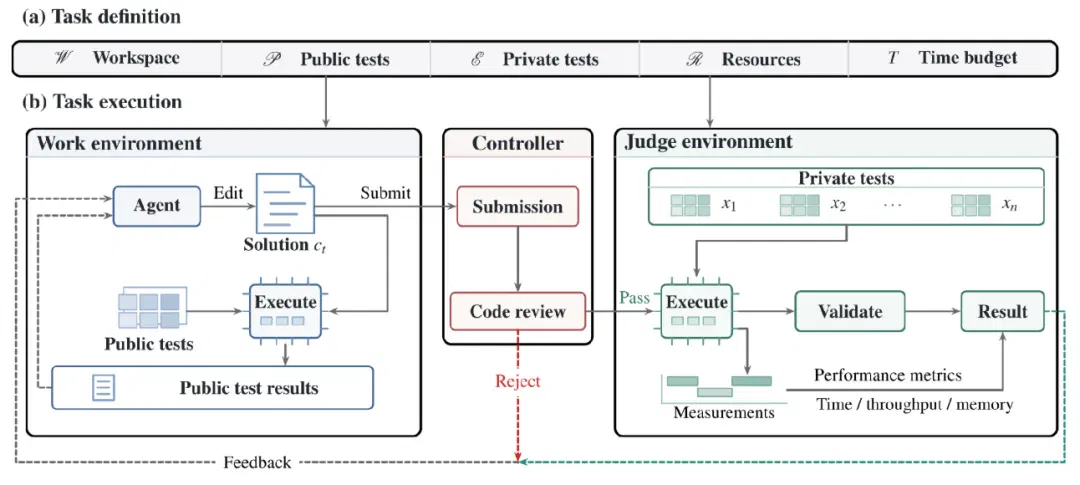
Infrathon's execution framework.
Take the KVzip KV Scoring task as an example:
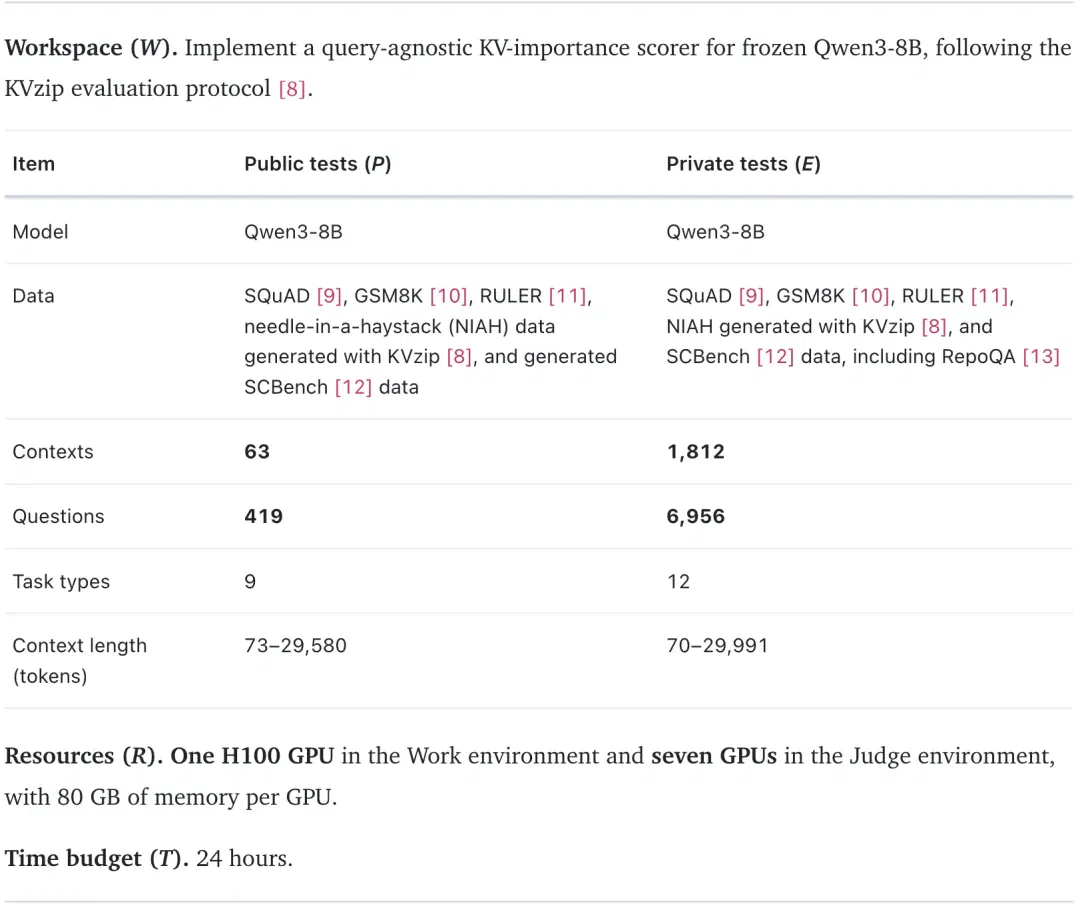
Example task: KVzip KV Scoring. Private tests use samples disjoint from Public tests and include additional task types.
We obtain three main findings:
1. Claude Opus 5.5 leads overall among six models, with a mean rank score of 91.2.
We evaluate six models on all 25 tasks, conducting 150 runs and spending more than 10,000 GPU-hours on the main experiment. Each run reports its highest valid Private tests score within the Time budget. Because tasks use different metrics, we compute scores from within-task ranks and aggregate across tasks with equal weighting.
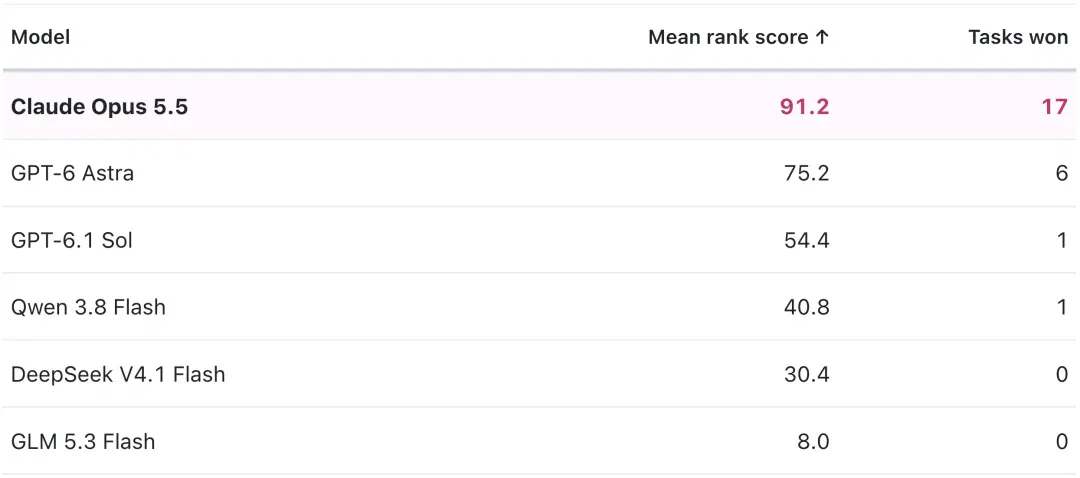
Mean rank scores range from 0 to 100; 100 means ranking first on every task.
Claude ranks first on nine of 11 operator tasks, two of five module tasks, and six of nine system tasks. Final model rankings, however, do not fully describe long-horizon optimization ability. Relative performance also changes as runs grow longer. At 25% of the Time budget, GPT-6 Astra has a mean rank score of 84.0, ahead of Claude Opus 5.5's 79.2. At 50%, Claude overtakes Astra, 89.6 to 80.0. Across all 150 runs, 135 set further best scores in the second half. For engineering tasks requiring repeated experiments and continual revision, these results show that evaluation duration affects not only final performance, but potentially how we judge the relative capabilities of different models.
2. Infrathon can support Knowledge Discovery
In the Quant-VideoGen KV Codec [14] task, agents compress the attention keys and values (KV) cached during video generation. We compare the codec developed by Claude Opus 5.5 during its 24-hour run with Quant-VideoGen's human-designed codec. Evaluation uses HY-WorldPlay [15] with WorldScore [16], and LongCat-Video [17] with MovieGen [18].
Claude increases mean KV-cache compression from 6.82× to 19.86× while improving video quality: both datasets have higher mean PSNR and SSIM and lower mean LPIPS.
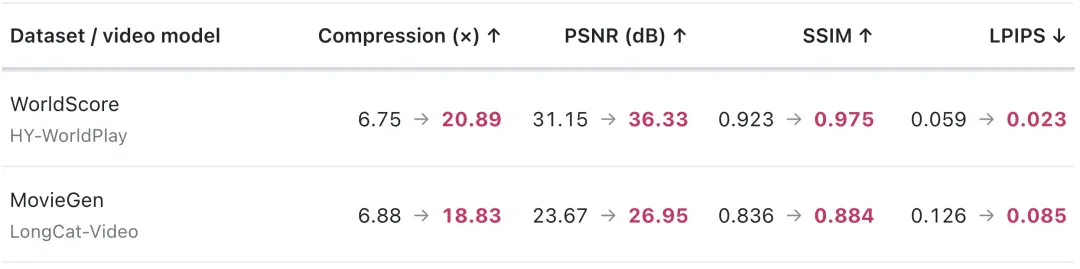
All table entries are sample means; arrows indicate Human → Claude. Quality metrics use the uncompressed BF16 results as the reference.
The human codec quantizes the residuals remaining after cache clustering one value at a time. Claude instead uses principal component analysis (PCA) to transform the residuals and applies entropy coding after quantization.
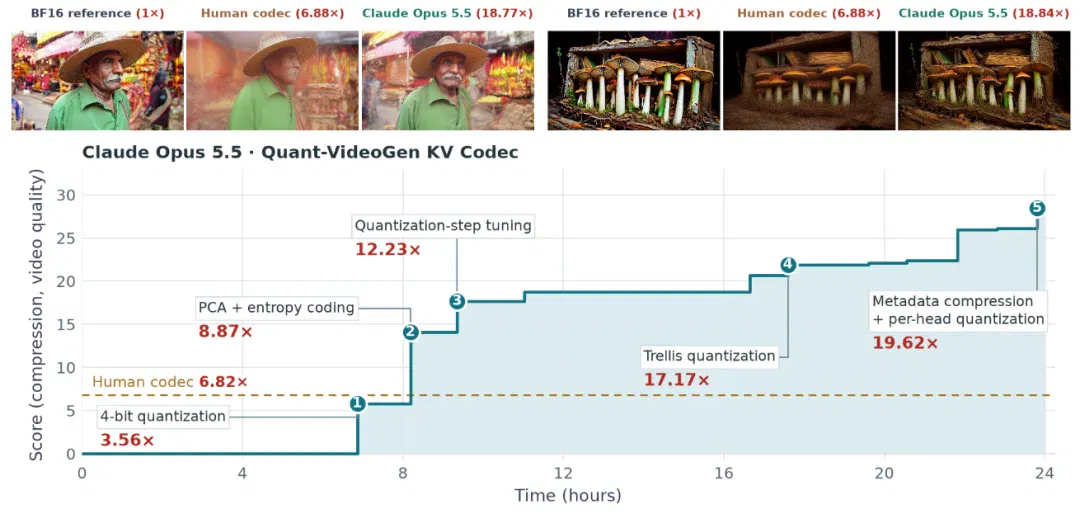
Top: two video examples, with compression ratios in red. Bottom: Claude's Private tests score combines compression ratio and video quality. The dashed line denotes the human solution; the five numbered points correspond to selected submissions and their code changes.
In these two LongCat-Video examples, Claude's solution preserves clearer facial details and mushroom textures than the human codec.
3. Long Horizon vs. Short Horizon
We evaluate six tasks using GPT-6 Astra and Claude Opus 5.5 under equal GPU-hour budgets, choosing one training and one inference task at each optimization level. Long-horizon optimization uses one T-hour run. Short-horizon best-of-n test-time scaling (TTS) uses n independent T/n-hour runs and takes the best result, with n = 2 or 4. T is 12 hours for operators and 24 hours for modules and systems.
Longer runs are more effective for module and system tasks, while short-horizon TTS remains competitive on operators.
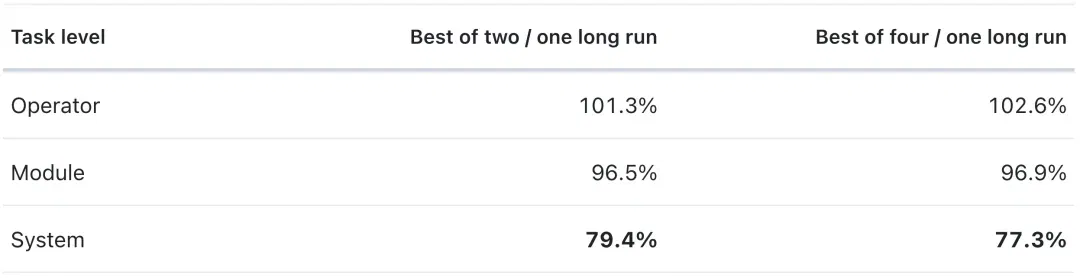
The table reports geometric means of task–model score ratios. A value of 100% means that the two configurations perform equally under the same total GPU-hour budget.
Long-horizon runs win nine of the 12 comparisons, including all four system-level comparisons.
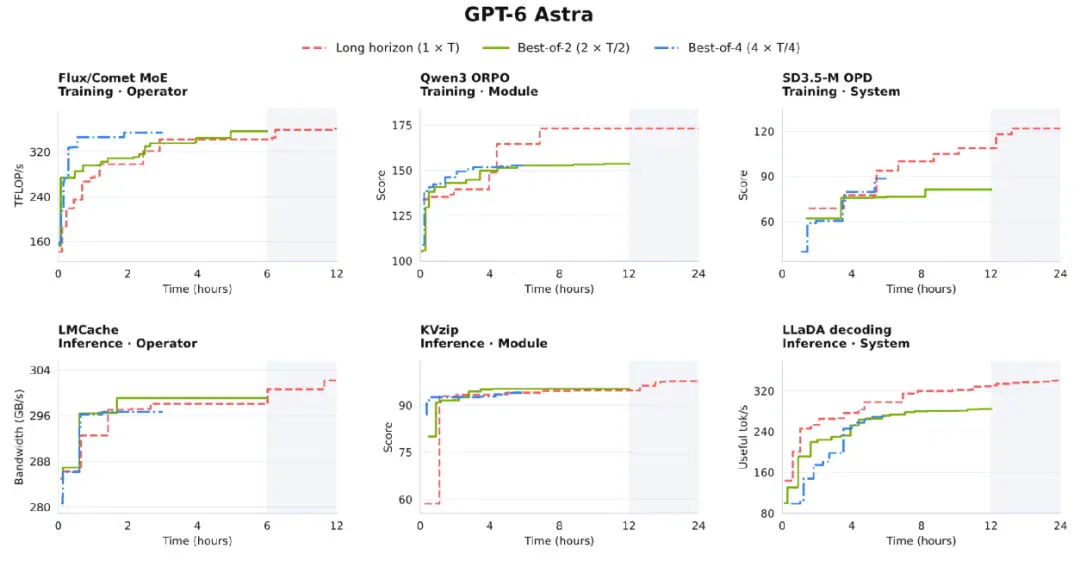
GPT-6 Astra: performance comparison of long- and short-horizon optimization. The first half of the budget occupies 75% of each chart's horizontal axis.
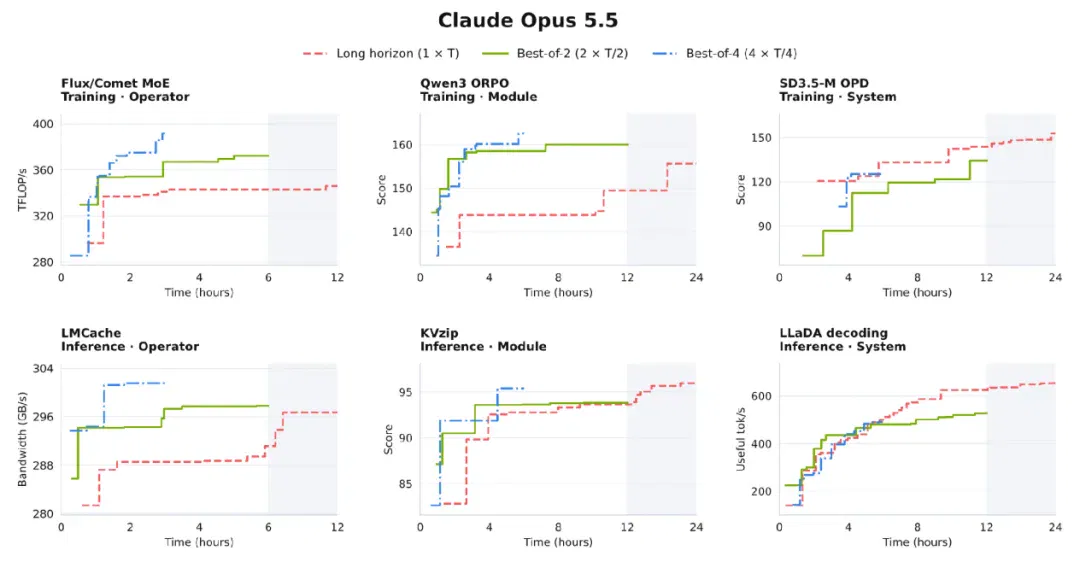
Claude Opus 5.5: performance comparison of long- and short-horizon optimization. The first half of the budget occupies 75% of each chart's horizontal axis.
Acknowledgments
As a joint research participant in Infrathon, Pyromind provides GPU compute resources and experimental-platform support, including infrastructure such as Sandbox, Jupyter, and distributed storage, enabling the large-scale, long-duration agent evaluations. Pyromind also participates in Human Review during the experiments, helping the researchers review and analyze long-horizon agent trajectories, experimental results, and representative cases, supporting the reliability of the findings.
With RSI as its long-term goal, Pyromind uses AutoRL to drive continued model iteration through cycles of training, inference, evaluation, and feedback. This places greater demands on AI infrastructure's computational efficiency, resource utilization, and operating costs. Infrathon focuses on long-horizon automated optimization in real AI infrastructure, spanning low-level operators, key modules, and end-to-end systems, offering a valuable research reference for infrastructure automation toward RSI.
About the authors
Zhengyu Hu is a PhD student at the University of Washington, Seattle, advised by Professor Radha Poovendran. His research focuses on Data-Centric AI and Long-Horizon Agents.
Teng Xiao currently works at the Allen Institute for AI (AI2) and the University of Washington, collaborating with Professors Noah A. Smith and Hanna Hajishirzi.
Niqi Lyu, technical lead at Pyromind Dynamics, focuses on technical practice and research in large-model post-training and participates in the Infrathon collaboration.
Reference:
[1] KernelBench: Can LLMs Write Efficient GPU Kernels?
[2] InferenceBench: A Benchmark for Open-Ended LLM Inference Optimization by AI Agents
[3] Φ-Bench: Can Large Language Models Engineer the Infrastructure That Powers Them?
[4] EdgeBench: Unveiling Scaling Laws of Learning from Real-World Environments
[5] KernelBenchX: A Comprehensive Benchmark for Evaluating LLM-Generated GPU Kernels
[6] FlashInfer-Bench: Building the Virtuous Cycle for AI-driven LLM Systems
[7] RE-Bench: Evaluating frontier AI R&D capabilities of language model agents against human experts
[8] KVzip: Query-Agnostic KV Cache Compression with Context Reconstruction
[9] SQuAD: 100,000+ Questions for Machine Comprehension of Text
[10] Training Verifiers to Solve Math Word Problems
[11] RULER: What's the Real Context Size of Your Long-Context Language Models?
[12] SCBench: A KV Cache-Centric Analysis of Long-Context Methods
[13] RepoQA: Evaluating Long Context Code Understanding
[14] Quant VideoGen: Auto-Regressive Long Video Generation via 2-Bit KV-Cache Quantization
[15] WorldPlay: Towards Long-Term Geometric Consistency for Real-Time Interactive World Modeling
[16] WorldScore: A Unified Evaluation Benchmark for World Generation
[17] LongCat-Video Technical Report
[18] Movie Gen: A Cast of Media Foundation Models
This article is from Synced, by Synced.
Related topics
After reading
Join the AINRK community
Read how to join the community and connect with people working in AI.
Related articles
Continue reading related topics and articles in this category.
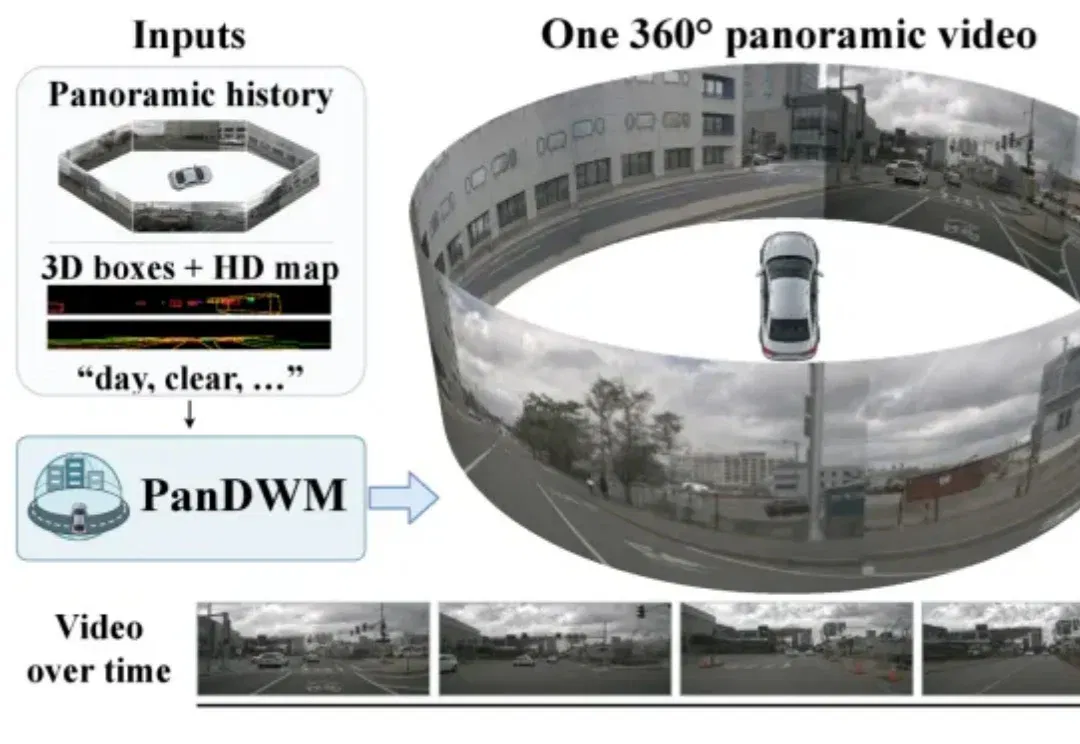
PanDWM generates panoramic driving video, then lifts it into 4D Gaussian scenes for new viewpoints (opens in a new tab)
Peking University's PanDWM maps six cameras to a panoramic strip, generates video with four-step causal diffusion, then lifts and fuses Gaussians for novel views. Its 0.5 and 1.96 s/frame timings use H100 and A40 GPUs; full 4D processing and refinement cost extra, with drift and occlusion limits.
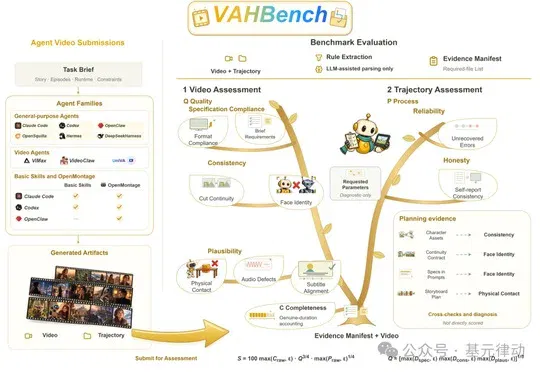
TokenRhythm and Peking University introduce VAHBench for agentic long-video generation (opens in a new tab)
VAHBench evaluates long-video production across 48 agent configurations and 240 runs. Higher visual quality does not ensure complete delivery, longer and more complex tasks are harder to finish, and adding tools does not always improve the overall score.

Qwen3.5-27B self-rewriting experiment: up to 6.6 points higher accuracy on 490 math problems (opens in a new tab)
A research team lets models inspect internal states and edit their weights with code, without gradient training. After reserved-problem checks, Qwen3.5-27B's accuracy on 490 held-out math problems rises from 57.2% to as much as 63.8%. Smaller models fail; results remain task- and protocol-specific.
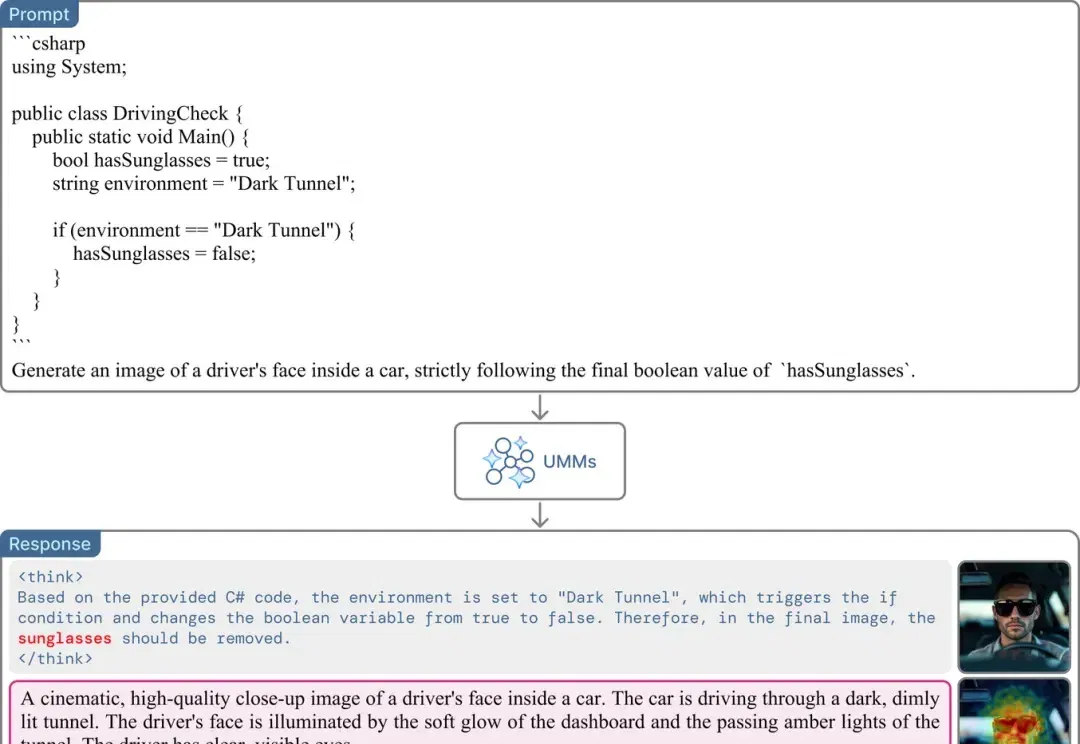
EMNLP 2026 Outstanding Paper UReason: why correct reasoning can still produce the wrong image (opens in a new tab)
UReason tests reasoning-to-generation alignment in unified multimodal models. Across eight open models, generating from the final refined prompt works better; Bagel rises from 17.8% to 62.6% on 500 testmini cases. The EMNLP 2026 Outstanding Paper does not show that reasoning harms every image task.
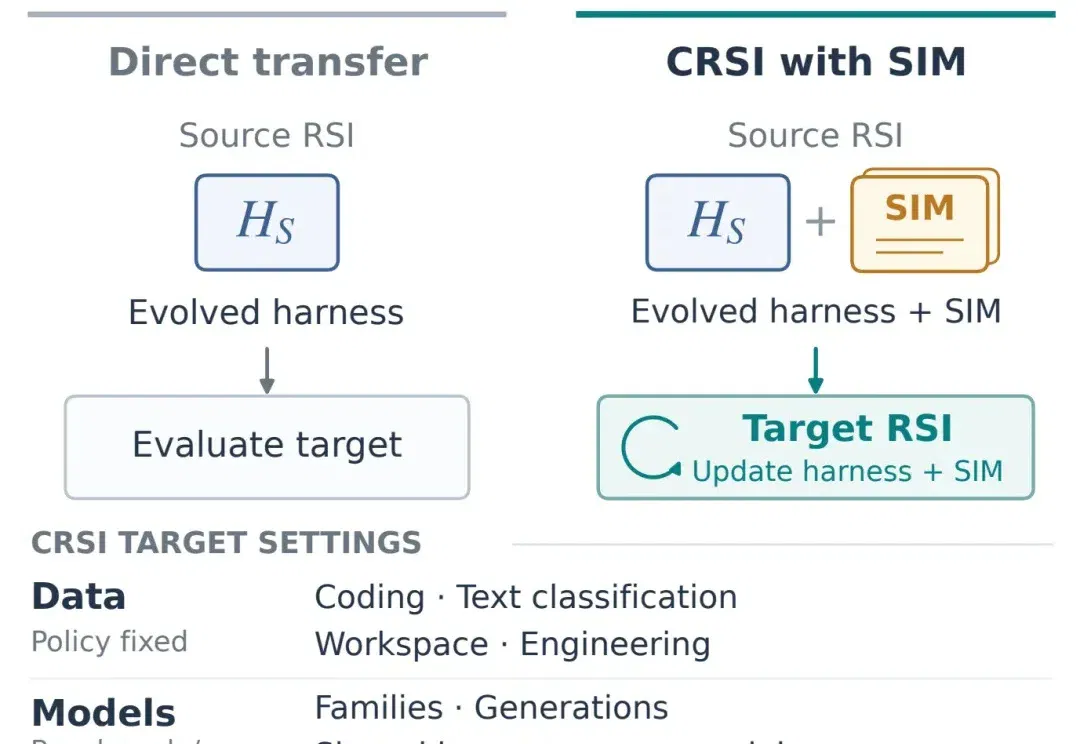
Google's SIM research: carrying self-improvement experience across models and datasets (opens in a new tab)
Can agents keep improving when models or datasets change? Google and Penn State's SIM carries optimization records alongside the harness. Tested gains come with budget, repetition and transfer limits; the work remains a preprint.