Google's SIM research: carrying self-improvement experience across models and datasets
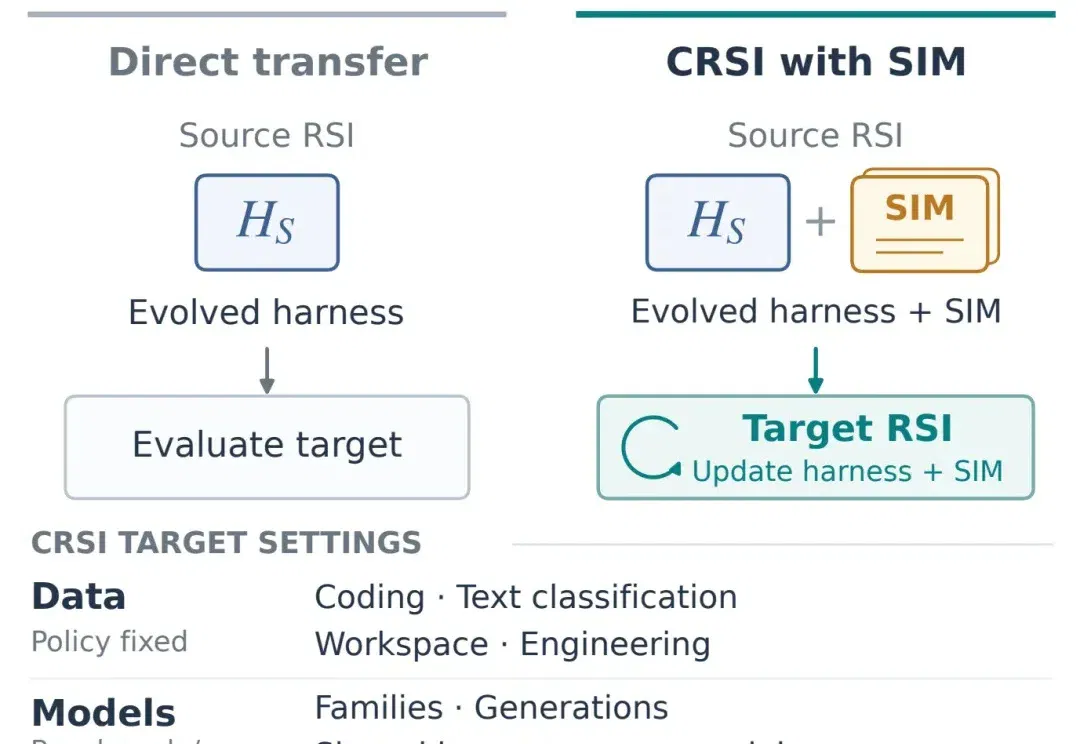
Can agents keep improving when models or datasets change? Google and Penn State's SIM carries optimization records alongside the harness. Tested gains come with budget, repetition and transfer limits; the work remains a preprint.
Agent self-improvement usually takes place with a fixed model, fixed data, and fixed task benchmarks. Real systems, however, keep changing: the task model may be upgraded, or the model may stay the same while the system moves to a new dataset or task benchmark. Can previously accumulated optimization experience help the system continue improving after these changes, without searching from scratch every time?
A Google team and collaborators at Pennsylvania State University recently released new RSI research exploring continual recursive self-improvement (CRSI). The study examines continued optimization across both datasets and models, and introduces Self-Improvement Memory (SIM): the reasons for edits, expected outcomes, actual outcomes, and evaluation context travel alongside the harness, allowing subsequent optimization to draw on existing experience and continue adding to, testing, and revising it in a new setting. The paper is currently a preprint and has not undergone peer review.
- Paper: Self-Improvement Memory Enables Continual Recursive Self-Improvement
- Authors: Xin Yu, Fei Xia, Jiaqi Pan, Youbao Tang, Chengzhi Liu, Adams Yu, Sicong Jiang, Yanfei Chen, Lingzhou Xue, and Ting Yu.
- Affiliations: Google Cloud AI, Google DeepMind, Google Cloud AI Research, and The Pennsylvania State University.
- Paper: https://arxiv.org/abs/2611.18856
- Project page: https://lucasxinyu.github.io/sim/
- Discussion: https://huggingface.co/papers/2611.18856
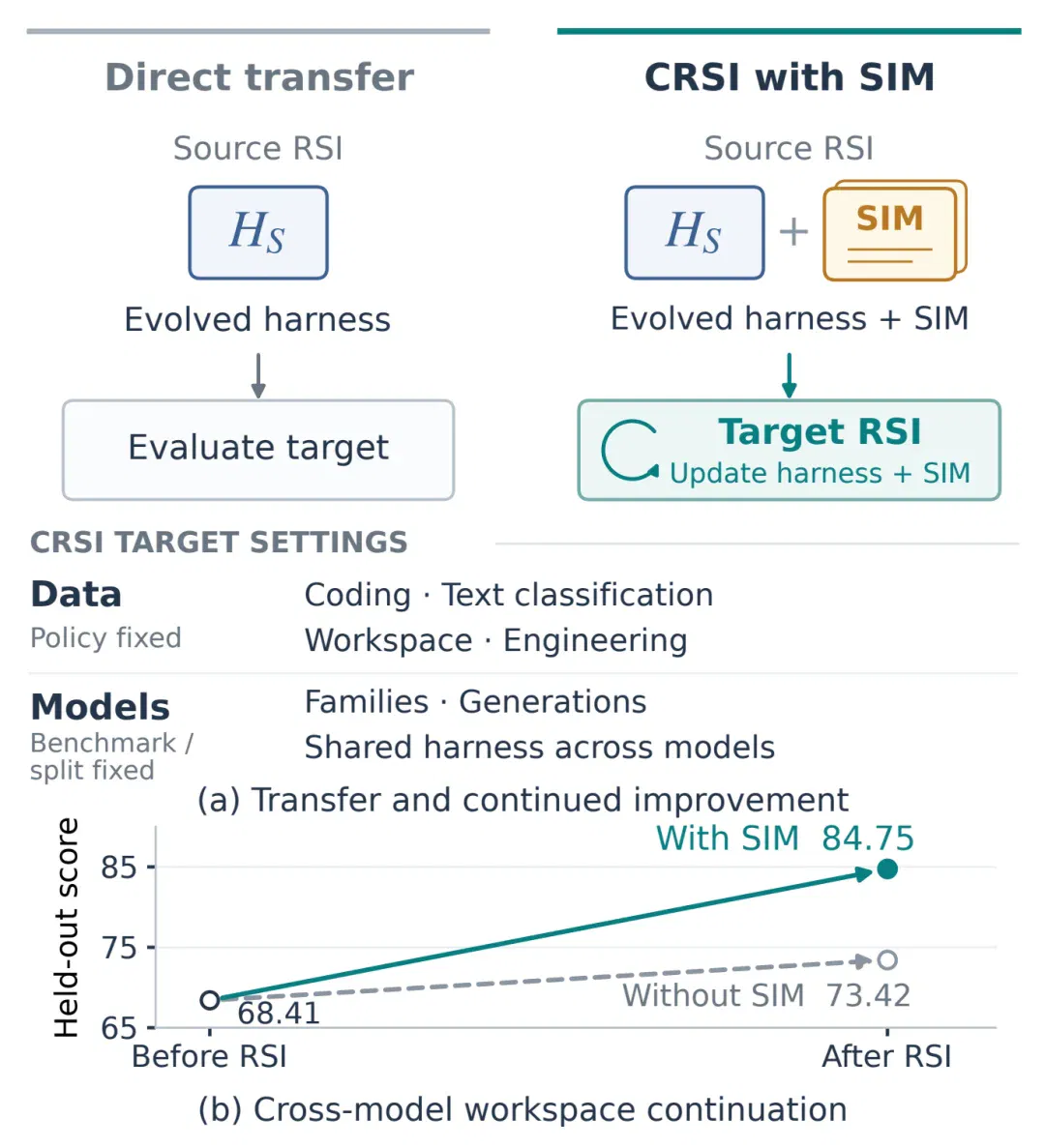
The idea behind continual recursive self-improvement. What transfers is not just the optimized harness, but also the experience that produced its edits. The workspace scores shown in the figure belong to a single experimental setting.
From keeping code to keeping the reasons behind edits
An agent's capabilities depend on more than model parameters. How prompts are organized, which tools are called, how returned results are handled, and when execution stops are all arranged by programs outside the model. This collection of programs is usually called the harness.
Recursive self-improvement can take place at this layer: run the current version, collect feedback, propose edits, and then use evaluation to select the next version. The task model's weights can remain frozen; what changes is the external program.
The problem is that an edit that works in the source environment may no longer suit a new model or task. In one example in the paper, giving Gemini a harness optimized by Opus to execute workspace tasks produces an initial score of 68.41, below the Gemini seed harness's 73.89. Reusing the code alone does not guarantee a benefit.
The paper therefore studies continual recursive self-improvement (CRSI). Its two main settings are cross-dataset transfer, which keeps the task model fixed while changing the task benchmark; and cross-model transfer, which keeps the task benchmark and data splits fixed while changing the task model. Provided that their executable interfaces are compatible, both continue optimizing an existing harness. SIM records why the source optimization produced this code, helping subsequent optimization decide which edits to retain and which to redesign, while appending new attempts to the history.
An experimental log for the optimizer to read
SIM serves the optimizer that proposes and filters edits, rather than directly serving the model that completes tasks. It is also neither a user profile nor a chat history.
Records are organized around recurring harness problems. For selected edits, SIM stores the edits themselves, their rationale, predicted and observed outcomes, and context such as the model, benchmark, and round. Later attempts can be appended under the same problem while preserving earlier history; even selected edits that cause regressions can be recorded faithfully. The current method does not retain every candidate that was not selected.
Both the edit-proposal and candidate-selection components read these records. For example, a completion check may originally have been intended to prevent an agent from stopping prematurely. After a task change, its implementation may need to change, but the judgment that execution should not end simply because the model declares completion may remain useful. The record lets the optimizer reconsider that judgment, rather than merely copy the code.
How can memory's benefits be separated from the benefits of further optimization?
The paper sets up four comparison conditions: a cold start from a seed harness; transfer of only the optimized harness; additional transfer of problem root-cause labels; and transfer of the full SIM.
The last three start from the same source harness, with the target task, task model, optimization rounds, and candidate budget held constant. The evaluation set is separate from the feedback used for optimization. Equal numbers of rounds and equal candidate budgets, however, do not mean equal token usage or runtime.
The study covers coding, text classification, workspace tasks, and engineering design—four domains. Across the six cross-dataset settings and four cross-model comparisons from Opus to Gemini that were tested, full SIM achieves higher final scores than both harness-only transfer and transfer retaining only root-cause labels.
In the cross-model workspace experiment, the two continued runs start from the same score of 68.41 and full SIM ultimately reaches 84.75, while harness-only transfer reaches 73.42. This 11.33-point gap belongs to a particular setting and cannot be treated as the average improvement across domains.
Ten independent source runs: nine wins, with the negative result retained
To reduce dependence on a single source optimization, the paper conducts ten independent source runs in coding. Each first optimizes Terminus-2 on Terminal-Bench 2.1, then uses the same source harness for two matched continuations on Terminal-Bench 4: one with SIM and one without, each undergoing ten rounds of target optimization.
Across the ten pairs, SIM achieves a higher final score in nine, with an average advantage of 2.36 points, a 95% confidence interval of [1.05, 3.68], and a paired t-test p-value of 0.003; in the remaining pair it scores 0.61 points lower. The 2.36 figure is a score difference, not a relative percentage improvement.
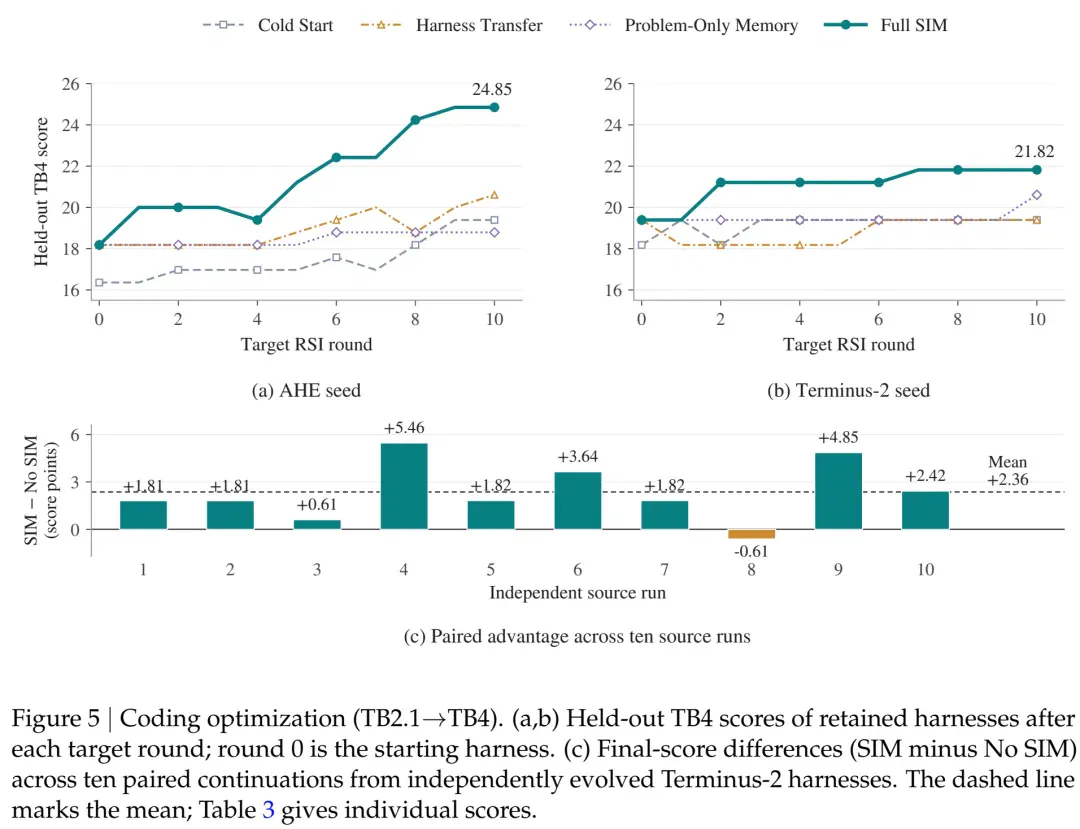
Optimization trajectories and results for the ten coding pairs. The negative pair remains in the figure; the unit of independent repetition is the source optimization run, rather than a single task rollout.
These results support an average benefit from the full SIM continuation pipeline in this coding experiment, but do not yet isolate the causal contribution of each memory field. In the main comparisons for other domains, most conditions have only one complete optimization run. It would therefore be incorrect to say that all four domains underwent ten independent repetitions.
Experience can accumulate; its range of applicability still needs testing
This work is valuable because it extends the assets left by an optimization run beyond its final code to experience records that can be inspected and continued. As tasks and models change, the next optimization round has an opportunity to use past evidence rather than infer the intent of edits from code alone.
Interface compatibility nevertheless remains a prerequisite, and not every transfer produces a gain. Besides the negative coding pair, one continuation across model generations in the paper performs worse than optimization from scratch. The current implementation has the optimizer read the entire SIM; context costs, retrieval methods, and scalability after long-term accumulation remain to be studied.
The more defensible conclusion is that retaining why an edit was made and what happened afterward can improve continual harness optimization in the tested settings. It does not prove that the system will improve itself without limit.
This article is from Synced, by Synced.
Related topics
After reading
Join the AINRK community
Read how to join the community and connect with people working in AI.
Related articles
Continue reading related topics and articles in this category.
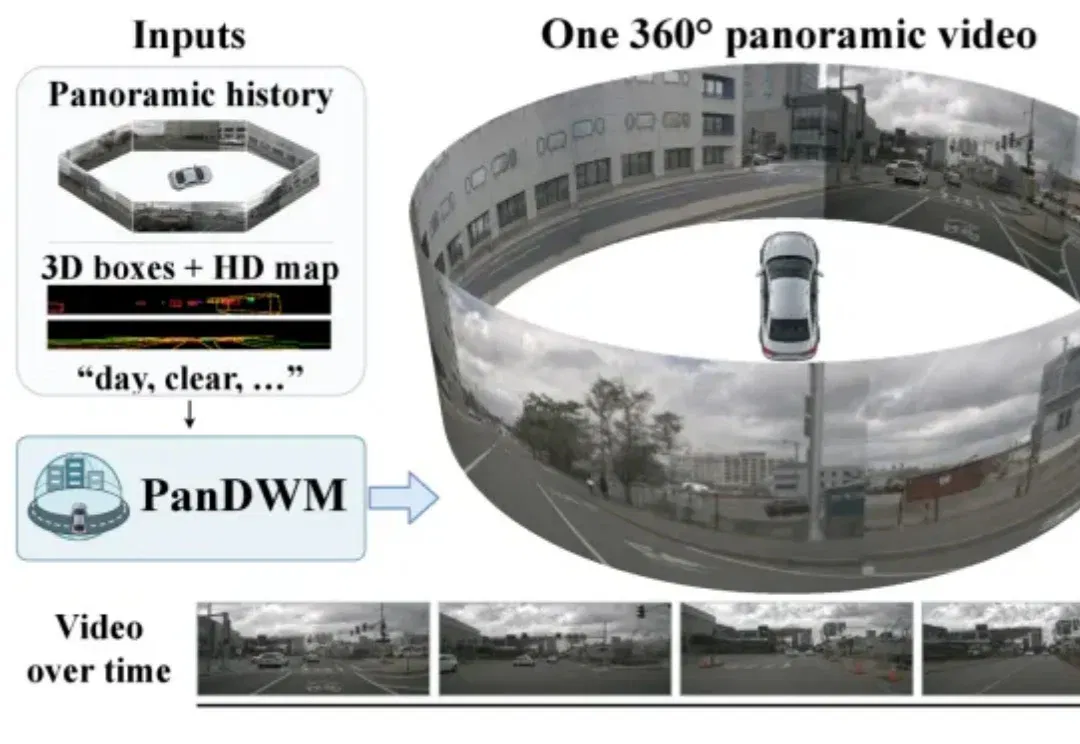
PanDWM generates panoramic driving video, then lifts it into 4D Gaussian scenes for new viewpoints (opens in a new tab)
Peking University's PanDWM maps six cameras to a panoramic strip, generates video with four-step causal diffusion, then lifts and fuses Gaussians for novel views. Its 0.5 and 1.96 s/frame timings use H100 and A40 GPUs; full 4D processing and refinement cost extra, with drift and occlusion limits.
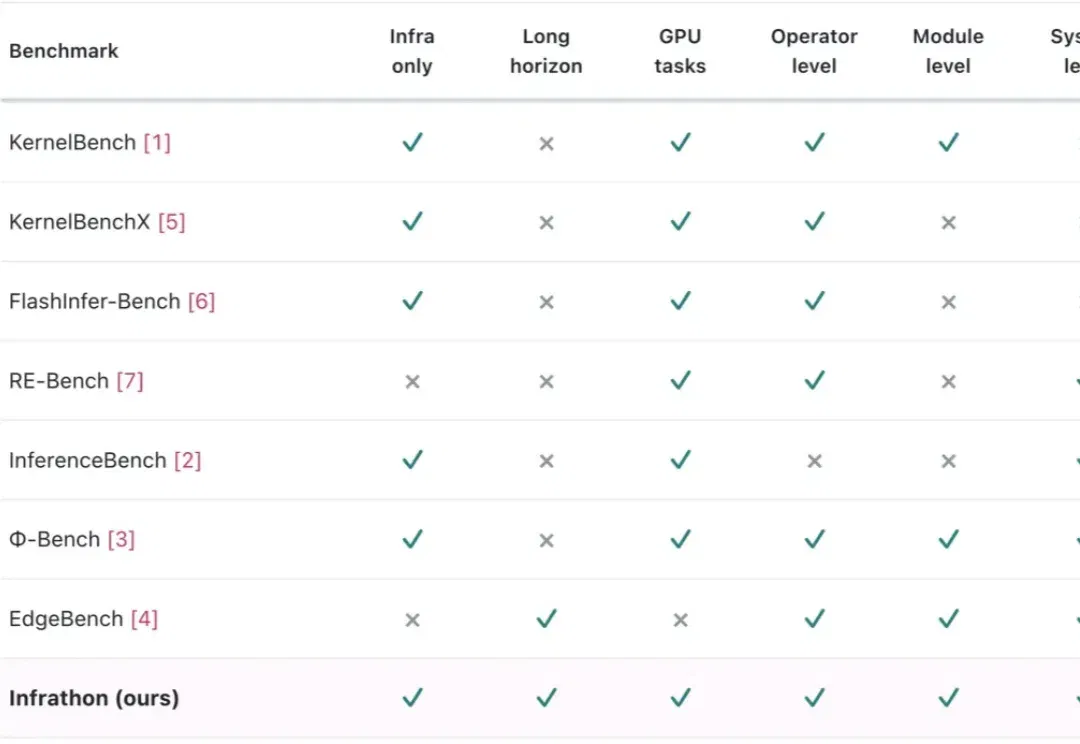
Infrathon tests agents' sustained optimization over 12–24 hours on 25 AI infrastructure tasks (opens in a new tab)
Infrathon spans 25 operator, module and system tasks. Across six models, 150 runs and over 10,000 GPU-hours, Claude Opus 5.5 leads with a 91.2 mean rank score, and 135 runs improve in their second half. Benefits vary by task and model; the benchmark does not establish general RSI.
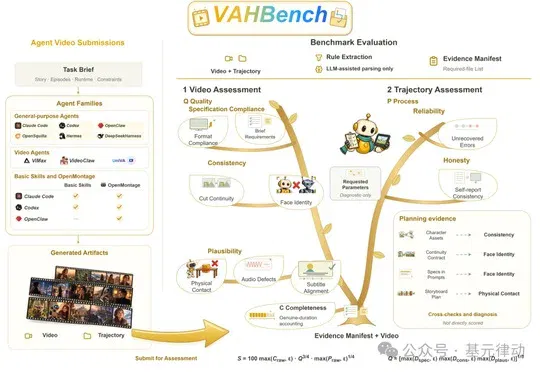
TokenRhythm and Peking University introduce VAHBench for agentic long-video generation (opens in a new tab)
VAHBench evaluates long-video production across 48 agent configurations and 240 runs. Higher visual quality does not ensure complete delivery, longer and more complex tasks are harder to finish, and adding tools does not always improve the overall score.
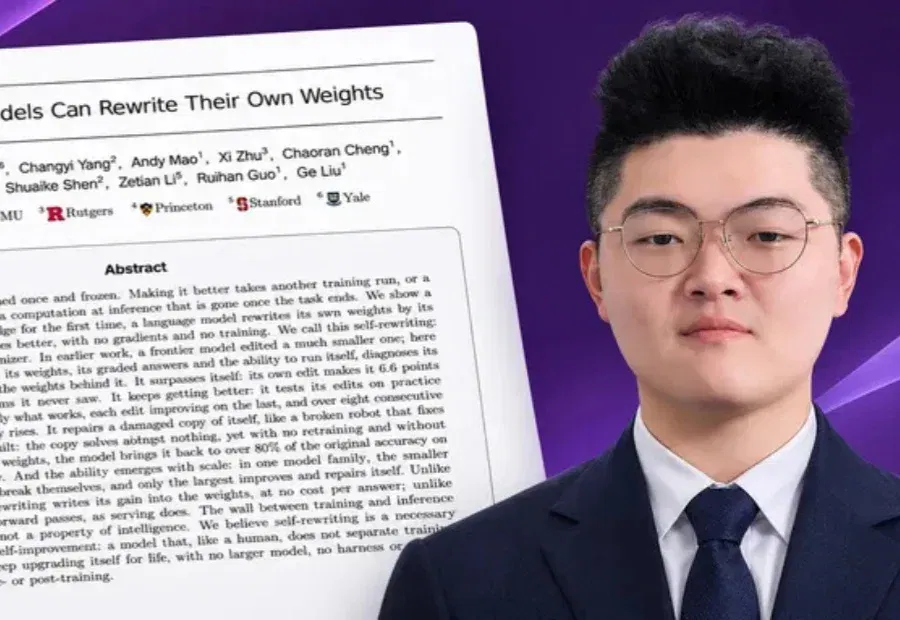
Qwen3.5-27B self-rewriting experiment: up to 6.6 points higher accuracy on 490 math problems (opens in a new tab)
A research team lets models inspect internal states and edit their weights with code, without gradient training. After reserved-problem checks, Qwen3.5-27B's accuracy on 490 held-out math problems rises from 57.2% to as much as 63.8%. Smaller models fail; results remain task- and protocol-specific.
EMNLP 2026 Outstanding Paper UReason: why correct reasoning can still produce the wrong image (opens in a new tab)
UReason tests reasoning-to-generation alignment in unified multimodal models. Across eight open models, generating from the final refined prompt works better; Bagel rises from 17.8% to 62.6% on 500 testmini cases. The EMNLP 2026 Outstanding Paper does not show that reasoning harms every image task.