TokenRhythm and Peking University introduce VAHBench for agentic long-video generation
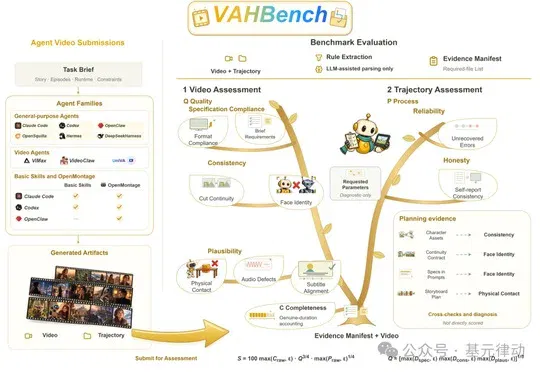
VAHBench evaluates long-video production across 48 agent configurations and 240 runs. Higher visual quality does not ensure complete delivery, longer and more complex tasks are harder to finish, and adding tools does not always improve the overall score.
Give an AI a brief for a short drama: three vertical episodes, 60 seconds each, four main characters, and a line of dialogue that must be spoken. Can it write the script, generate the visuals, edit the footage and add subtitles on its own, then deliver a complete series—without someone sitting beside it, repeatedly revising the prompts?
This is much harder than generating a single stunning clip. A complete drama needs enough usable footage, characters who remain recognizable from beginning to end, every required line of dialogue, and subtitles that match. The agent must also manage a large collection of assets, withstand the various failures that occur along the way, and assemble the results of successive tool calls into a finished work that can pass acceptance checks.
VAHBench is the acceptance-testing ground built for this purpose. It does not ask whose images are more dazzling. Instead, it scrutinizes delivery as a client would: Have all the videos been delivered? Have the requirements been met? Was the production process reliable? We hope it can provide verifiable objectives and experimental evidence for developing better video harnesses. A harness can be understood as the execution system that keeps a large model working: it organizes context, calls tools and manages task progress, driving production all the way through to delivery.
Here are three findings up front: high visual quality does not mean complete delivery; the longer and more complex the task, the harder it is to deliver everything; and providing more tools does not necessarily make an agent stronger.
An examination that recognizes only the finished video
VAHBench sets five tasks: five English-language short-drama briefs covering workplace comebacks, contract romance, technology-workplace satire, apartment mysteries and inheritance disputes. Each specifies the story, characters, dialogue, format and delivery requirements. The participants comprise 12 system setups, including general-purpose harnesses such as Claude Code and Codex, agents built specifically for video, and combinations equipped with the OpenMontage composition tool library. Together, these make up 48 configurations and 240 runs. All systems use the same image- and video-generation interfaces, with no human intervention to guide creative decisions during execution.
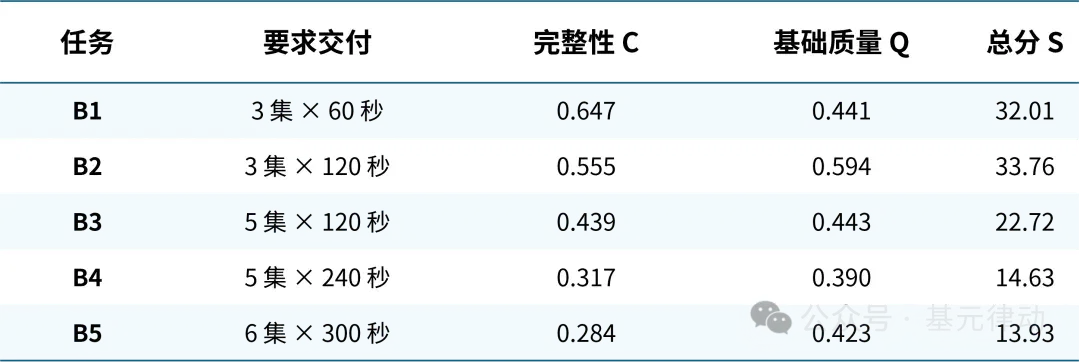
The tasks scale from three episodes of one minute each to six episodes of five minutes each. For just one configuration, the five tasks require delivery of 22 finished episodes totaling 69 minutes. The table below shows the average results of the 48 configurations on each task: completeness declines as tasks become longer and more complex. B2's overall score is slightly higher than B1's because better basic quality makes up some of the difference.
Completeness: How much video was actually delivered?
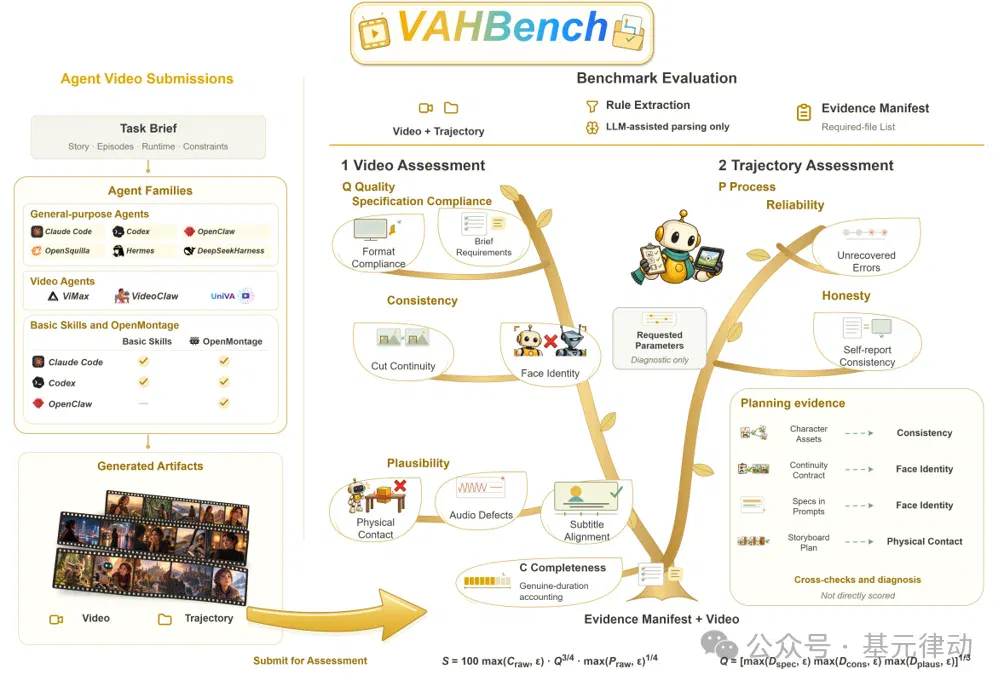
A file's duration is not the same as genuine work. Frozen frames, black screens, repeated footage and abrupt splices can all pad the running time. VAHBench deducts detected invalid intervals and counts only genuinely usable seconds. Missing an episode also incurs a penalty, and padding the duration does not earn completeness credit. When source-timing evidence is available, even slowing playback to stretch a video falls within the checks.
Basic quality: Does the delivered work meet the standard?
We look for defects in three areas: whether specifications are correct, including the format and decidable requirements in the brief; whether the work is consistent, including whether characters retain the same faces and edits preserve continuity; and whether it is plausible, including natural-looking physical contact, audio defects, and alignment between subtitles and speech. These component scores clearly distinguish work that is unfinished from work that is finished but flawed.
Process performance: Was the work reliable, and was the report truthful?
Beyond the finished videos, we also examine the agent's work records: Did the production tasks ultimately succeed? Does what it reported as completed match the files actually saved? A task that fails along the way but is later successfully recovered is not counted as a failure. Claims without supporting evidence are recorded as unknown. Language models only assist with parsing the logs; fixed rules assign every score.
From the brief to the finished videos and execution records, VAHBench connects acceptance checks into a complete chain of evidence, focusing on delivery completeness and basic defects. Whether the images are beautiful or the story is moving still requires human judgment and falls outside our evaluation scope. Those aspects test the model's capabilities more directly, whereas VAHBench focuses more on the capabilities of the agent harness.
The results: Good visual quality does not mean complete delivery
Claude Code leads the overall results, with a mean total score of 47.86 and the highest score on all five tasks. Codex is particularly revealing: its mean basic quality, 0.616, is higher than Claude Code's 0.513, yet its completeness is only 0.136 and its total score just 8.47. However polished a video may be, that does little good if the full delivery is missing: quality scores cannot compensate for the shortfall. Purpose-built video agents are also held back by completeness, with mean completeness of just 0.125 for UniVA, 0.375 for VideoClaw and 0.190 for ViMax.
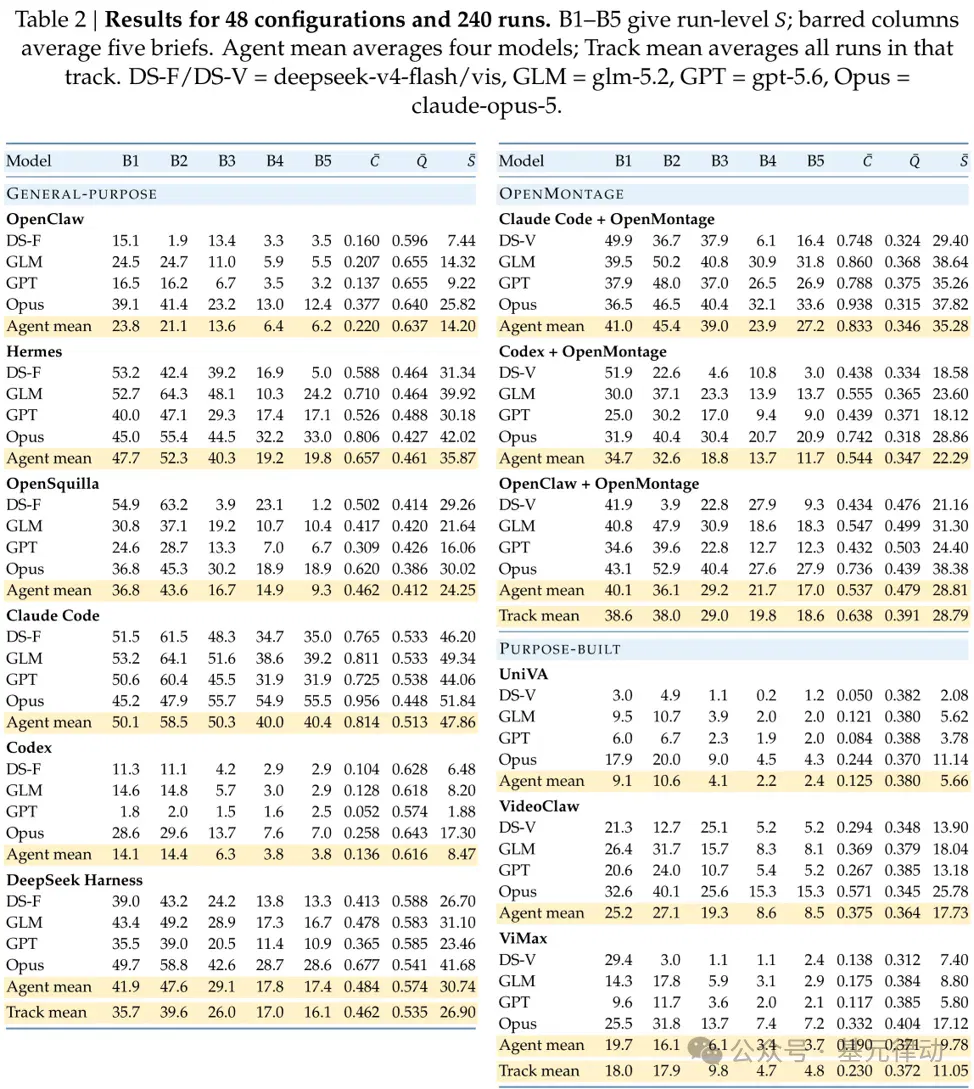
Does giving an agent another set of tools necessarily make it stronger? Not necessarily. We equipped three harnesses with the OpenMontage composition tool library and made paired comparisons across three shared text models and five tasks. Codex and OpenClaw both gained more than 14 points in mean overall score, while Claude Code lost more than 11 points.
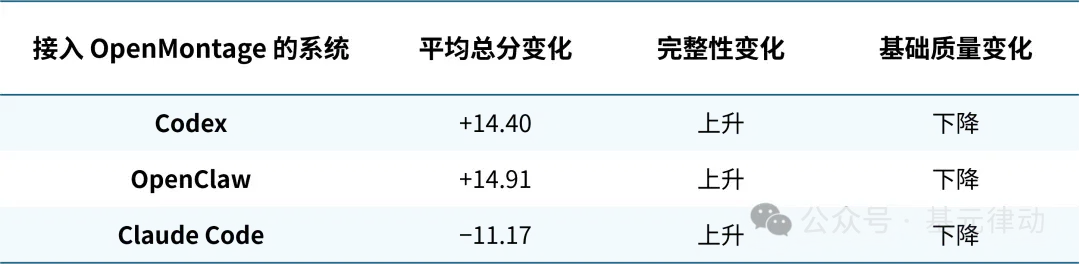
Each system has 15 paired comparisons: three shared text models × five tasks. This statistical basis differs from the four-model averages in Table 2, so the figures in the two tables cannot be subtracted directly.
The three comparisons have something else in common: completeness rises in all three, while basic quality falls in all three. The tools help agents deliver more content but also introduce new quality losses. More tools are therefore not automatically better; they need to be designed together with planning, orchestration and acceptance strategies. VAHBench can help reveal whether a change increases usable delivery, quietly lowers quality—or does both.
Of course, these conclusions apply only to the configurations and tasks tested in the paper. Even so, they point to several clear directions for further development: keep requirements in view throughout the process, make failures recoverable, and check the finished work before handing it over.
From the testing ground to production: Bringing evaluation into harness development
Evaluation is about more than ranking systems. We hope to gradually incorporate VAHBench's task definitions, checking rules and failure cases into the everyday iteration of video harnesses. That way, every change must answer the same question: Does it make the agent more reliable at completing what the user asked it to do?
First, keep the requirements checklist active throughout the process.
The number of episodes, duration, mandatory dialogue and delivery format should not be read once at the start and then forgotten. They should become trackable task states. As asset generation and editing proceed, the harness should always know which requirements have been met and which remain outstanding, and schedule its next actions accordingly. VAHBench's approach to checking the brief against the finished work can serve as the acceptance standard for this progress ledger.
Second, turn identified defects into actionable rework orders.
If an episode lacks enough usable running time, locate the segment that needs to be added. If subtitles do not match the speech, realign the subtitles separately. If a production task fails, recover it. We hope to gradually establish the following loop: generation and assembly → delivery checks → defect localization → targeted repair → acceptance checks again.
Whether this loop really works must be established experimentally: Do repairs improve completeness? How much additional cost do they incur? Do they introduce new defects? All of these should be recorded and compared. Self-checks during production must also remain separate from the independent evaluation used for final comparisons, so that a system does not learn to game the test and perform well only on familiar tasks and rules.
Third, make every version upgrade comparable on an evidential basis.
After changing a planning strategy, adjusting context management, adding a tool or modifying a recovery mechanism, teams can use the same set of tasks to examine changes in completeness and basic quality, and turn failures encountered in practice into regression tests. This helps teams detect capability regressions earlier and distinguish improvements that work broadly from flashes of success on a particular example.
Further ahead, account for cost and stability too
Once delivery meets the requirements, record the money and time spent and the number of calls made, then compare usable output under different resource conditions. We also hope to continue testing stability, narrative alignment and perceived quality through expanded tasks, repeated experiments and human annotation, while calibrating the accuracy and thresholds of the automatic detectors.
VAHBench aims to give video agents a concrete acceptance checklist: help developers identify problems worth optimizing, verify whether changes really work, and turn each failure into the starting point for the next round of development. We believe progress in video harnesses must ultimately show up in the complete work delivered to the user.
The paper, code and tasks are all publicly available. We welcome readers to explore them and exchange ideas.
论文:https://arxiv.org/abs/2611.20535
代码:https://github.com/TokenRhythm/VAHBench
考题与示例:https://huggingface.co/datasets/TokenRhythm/VAHBench
This article comes from the WeChat account TokenRhythm and was written by TokenRhythm.
Related topics
After reading
Join the AINRK community
Read how to join the community and connect with people working in AI.
Related articles
Continue reading related topics and articles in this category.
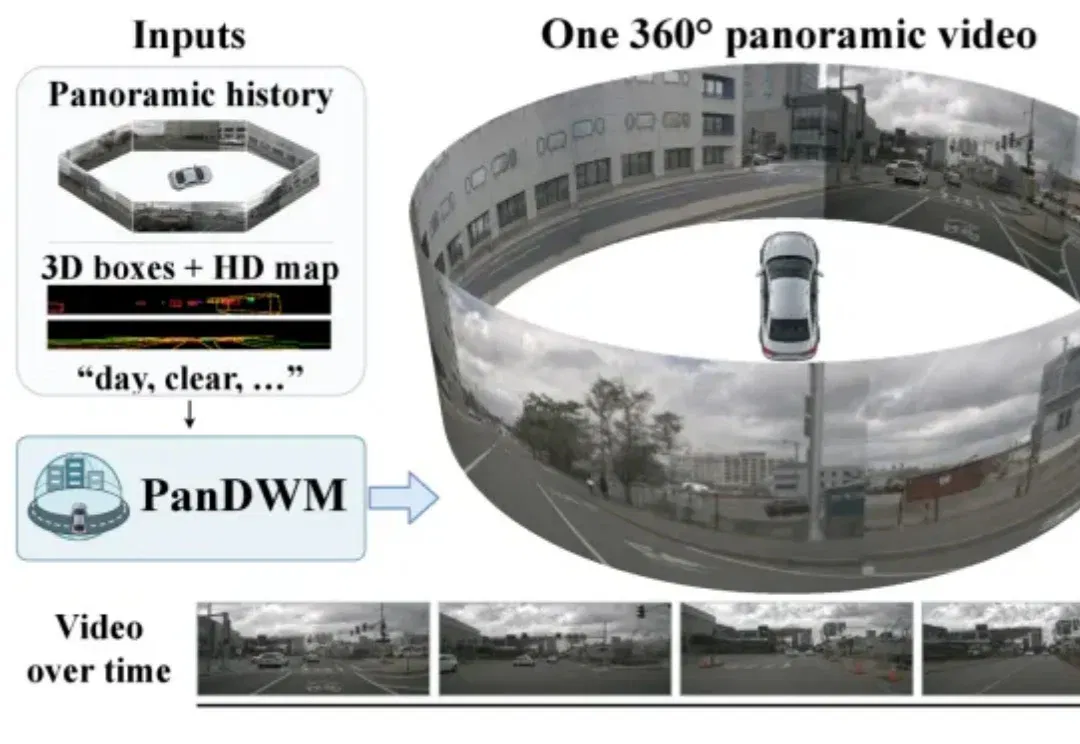
PanDWM generates panoramic driving video, then lifts it into 4D Gaussian scenes for new viewpoints (opens in a new tab)
Peking University's PanDWM maps six cameras to a panoramic strip, generates video with four-step causal diffusion, then lifts and fuses Gaussians for novel views. Its 0.5 and 1.96 s/frame timings use H100 and A40 GPUs; full 4D processing and refinement cost extra, with drift and occlusion limits.
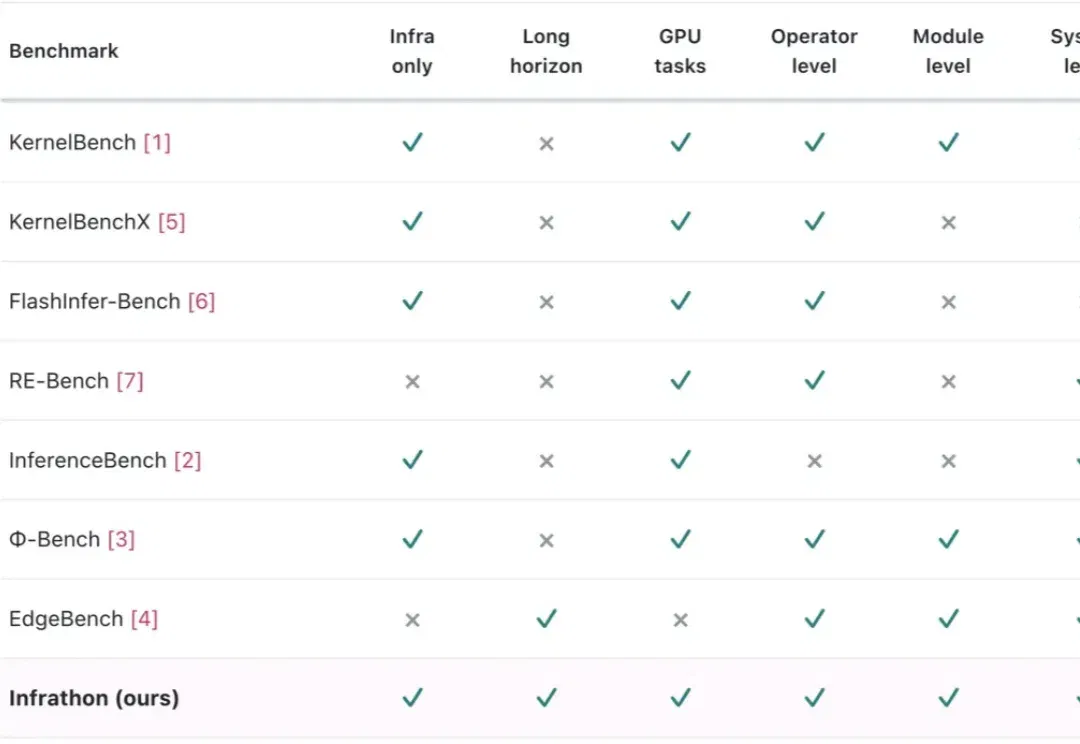
Infrathon tests agents' sustained optimization over 12–24 hours on 25 AI infrastructure tasks (opens in a new tab)
Infrathon spans 25 operator, module and system tasks. Across six models, 150 runs and over 10,000 GPU-hours, Claude Opus 5.5 leads with a 91.2 mean rank score, and 135 runs improve in their second half. Benefits vary by task and model; the benchmark does not establish general RSI.
Qwen3.5-27B self-rewriting experiment: up to 6.6 points higher accuracy on 490 math problems (opens in a new tab)
A research team lets models inspect internal states and edit their weights with code, without gradient training. After reserved-problem checks, Qwen3.5-27B's accuracy on 490 held-out math problems rises from 57.2% to as much as 63.8%. Smaller models fail; results remain task- and protocol-specific.
EMNLP 2026 Outstanding Paper UReason: why correct reasoning can still produce the wrong image (opens in a new tab)
UReason tests reasoning-to-generation alignment in unified multimodal models. Across eight open models, generating from the final refined prompt works better; Bagel rises from 17.8% to 62.6% on 500 testmini cases. The EMNLP 2026 Outstanding Paper does not show that reasoning harms every image task.
Google's SIM research: carrying self-improvement experience across models and datasets (opens in a new tab)
Can agents keep improving when models or datasets change? Google and Penn State's SIM carries optimization records alongside the harness. Tested gains come with budget, repetition and transfer limits; the work remains a preprint.