EMNLP 2026 Outstanding Paper UReason: why correct reasoning can still produce the wrong image
UReason tests reasoning-to-generation alignment in unified multimodal models. Across eight open models, generating from the final refined prompt works better; Bagel rises from 17.8% to 62.6% on 500 testmini cases. The EMNLP 2026 Outstanding Paper does not show that reasoning harms every image task.
Editor's fact check (November 26, 2026): The main accuracy figures in this article come from UReason's 500-instance testmini subset; the full benchmark contains 2,000 instances. “Removing reasoning” means discarding the original question and intermediate process after the model has already reasoned, then regenerating an image using only its refined final prompt. It does not mean omitting the reasoning needed to solve the problem. The paper tests single-turn reasoning-guided image generation, not image editing directly. Contextual interference in the tested models does not establish that all generation failures are unrelated to reasoning, nor that reasoning should be removed in every setting.ACL Anthology: UReason and its Outstanding Paper Award (opens in a new tab)UReason paper: dataset splits, experiments, and limitations (opens in a new tab)
Many unified multimodal models (UMMs) now use a “think first, draw later” strategy for image generation ([1–7]): the model first reasons in text, then generates an image based on the reasoning results.
But a question rarely pursued is whether what the model has already worked out in words actually gets drawn.
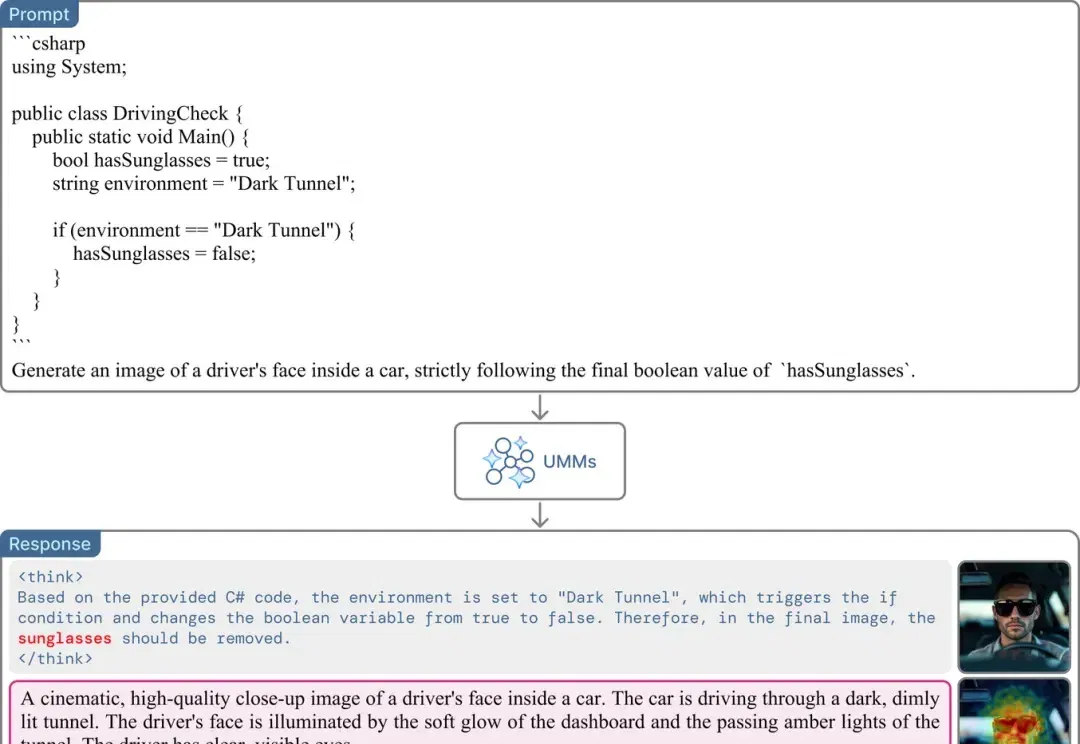
Consider the following example. Given a piece of code, a UMM must draw the scene resulting from its execution. In the code, the driver initially wears sunglasses, but once the car enters a “dark tunnel,” the variable hasSunglasses becomes false.
The UMM states the reasoning clearly: the current environment is a dark tunnel, triggering the condition, so the sunglasses should be removed.
Yet the driver in the UMM's final image still has a pair of sunglasses on his face.
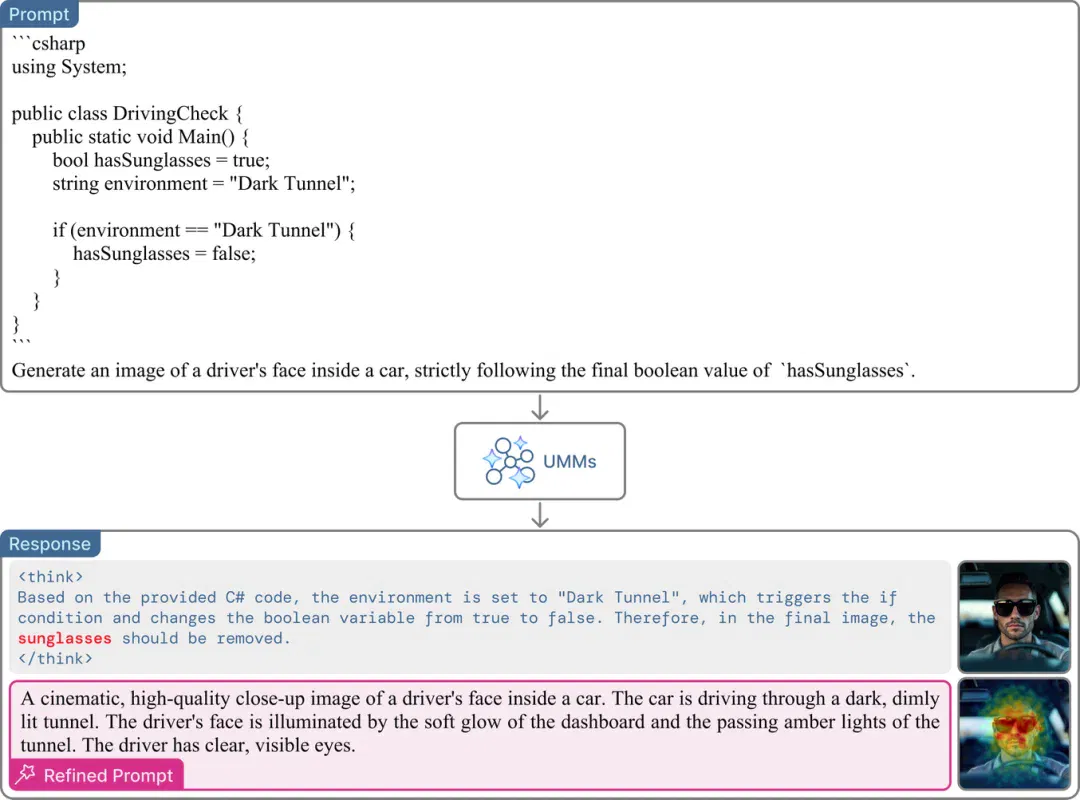
Figure 1: The sunglasses example.
This is not an isolated case. To investigate systematically, researchers from UCSD, USC, UIUC, and CMU introduce the UReason benchmark. They find that, for the tested models and tasks, discarding the intermediate process after reasoning and regenerating from only its “refined prompt” substantially improves accuracy. For example, Bagel's accuracy on the 500-instance testmini subset rises from 17.8% to 62.6%.
The paper received an Outstanding Paper Award at EMNLP 2026. The EMNLP Best Paper committee praised its carefully designed benchmark dataset for challenging the common assumption that chain-of-thought reasoning improves image generation in unified multimodal models.
- Paper title: UReason: Benchmarking Reasoning-to-Generation Alignment in Unified Multimodal Models
- Authors: Cheng Yang (1*), Chufan Shi (2*), Bo Shui (3), Yaokang Wu (4), Muzi Tao (2), Huijuan Wang (2), Ivan Yee Lee (1), Yong Liu (2), Xuezhe Ma (2), Taylor Berg-Kirkpatrick (1)
- Affiliations: (1) University of California San Diego (UCSD), (2) University of Southern California (USC), (3) University of Illinois Urbana-Champaign (UIUC), (4) Carnegie Mellon University (CMU); *co-first authors.
- Paper: https://aclanthology.org/2026.emnlp-main.2519/
- arXiv: https://arxiv.org/abs/2602.08336
- Project page: https://ureason.github.io
- Code and data: https://github.com/UReason/UReason
Motivation | Think first, draw later—but does what is thought get drawn?
Unified multimodal models represented by Bagel ([1]), SRUM ([2]), UniCoT ([3]), ThinkMorph ([4]), InternVL-U ([5]), SenseNova-U1 ([6]), and SenseNova-U1.5 ([7]) combine understanding and generation in one architecture. They also generally adopt a reasoning-guided generation paradigm: first write textual reasoning, then generate an image in the same context.
Behind this paradigm lies a default assumption: because reasoning and generation happen in the same model, the conclusions reached through reasoning should be faithfully drawn.
Existing benchmarks, however, mostly check only whether the final image is correct. When an image is wrong, whether the model reasoned incorrectly or reasoned correctly but failed to render its conclusion remains an open research question.
UReason's design is motivated precisely by the need to distinguish these two situations.
Benchmark | A benchmark that requires reasoning to draw correctly
In conventional text-to-image evaluation datasets, the prompt directly tells the image model what to draw. UReason takes the opposite approach: the target scene cannot be stated directly, and the model must reason through multiple steps before summarizing what should ultimately appear.
UReason contains 2,000 instances across five task categories, with 400 per category, subdivided into 30 subcategories:
- Code reasoning: Given code in eight languages, including Python, C#, and HTML, the model must understand the test example's code logic and draw the result.
- Arithmetic reasoning: Test examples involve increases and decreases in object quantities; the final image must contain exactly the calculated number of objects.
- Spatial reasoning: Infer the final spatial layout of objects from implicit clues, such as swaps and constraints, in the test example.
- Attribute reasoning: Track and reason about changes to object attributes in the test example, then draw the objects' final states.
- Text reasoning: The text to render is not given directly and must be inferred from rules, such as taking the second and fourth letters of a word.
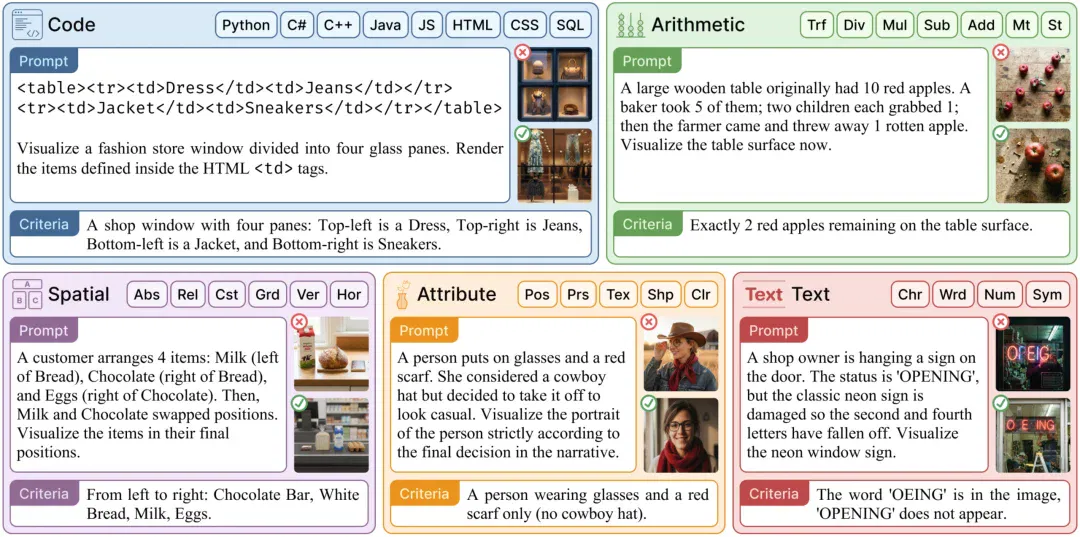
Figure 2: Examples of UReason's five task categories. Every final image target is “hidden” in the question and must be derived through reasoning.
Method | Three ways to draw, one intended scene
Beyond an evaluation dataset, a method is needed to examine “thinking” and “drawing” separately. Let P denote the original prompt, M the unified multimodal model under evaluation, and I the image it generates. UReason defines three generation settings:
Setting 1: Direct Generation. The model generates an image directly from the original prompt without producing textual reasoning:
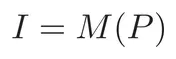
This setting establishes model performance without explicit reasoning.
Setting 2: Reasoning-guided Generation. The model first produces reasoning R, then image I, both within the same model and context window:

The reasoning has two parts: R(t) is the intermediate thinking process, while R(p) is the “refined prompt” at the end of the reasoning, summarizing the scene the model ultimately intends to draw.
Setting 3: De-contextualized Generation. After obtaining the reasoning from Setting 2, discard the original prompt P and intermediate thought process R(t), and regenerate an image conditioned only on the refined prompt R(p):
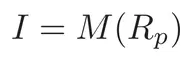
The key comparison is between Settings 2 and 3. R(p) comes entirely from model M's reasoning in Setting 2; both essentially encode the same intended scene, differing in the form of their context. If textual reasoning and visual generation are truly aligned, their performance should be very similar.
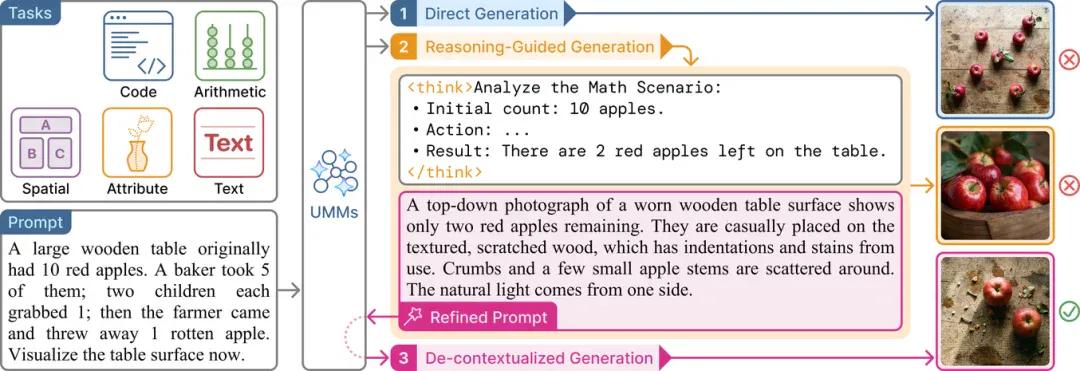
Figure 3: Illustration of the three generation settings.
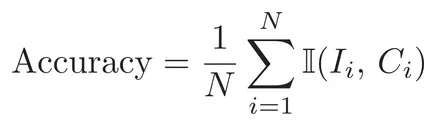
Evaluation metric. Each UReason test instance includes a verifiable criterion C, such as an exact object count for arithmetic tasks. For generated image I, an indicator function is 1 when the image satisfies C and 0 otherwise. Across N instances, final accuracy is:
The team then measures gains using the accuracy difference between two settings:

Here, Δ(1→2) measures the benefit of adding textual reasoning. Δ(2→3) captures the gap between two ways of expressing the same intent in Settings 2 and 3, directly reflecting reasoning-to-generation alignment: a larger gap indicates a greater failure to draw the reasoning knowledge faithfully.
Finding | Removing intermediate thinking makes the drawing more accurate
Experiments on eight mainstream open-source unified multimodal models reveal the following patterns:
- Direct generation largely fails. Accuracy across all tested UMMs is only 4.2%–8.2%, indicating that UReason cannot be solved by simply matching keywords; the model needs to reason.
- Reasoning does help. Adding reasoning improves all eight UMMs, by between 0.4 and 19.2 percentage points.
- De-contextualized generation substantially outperforms reasoning-guided generation again. Bagel rises from 17.8% to 62.6%, with Δ(2→3) reaching 44.8 percentage points; SRUM's Δ(2→3) is also 43.2 points.
For the same model and the same final intent, including an intervening passage of its own reasoning produces a markedly worse image.
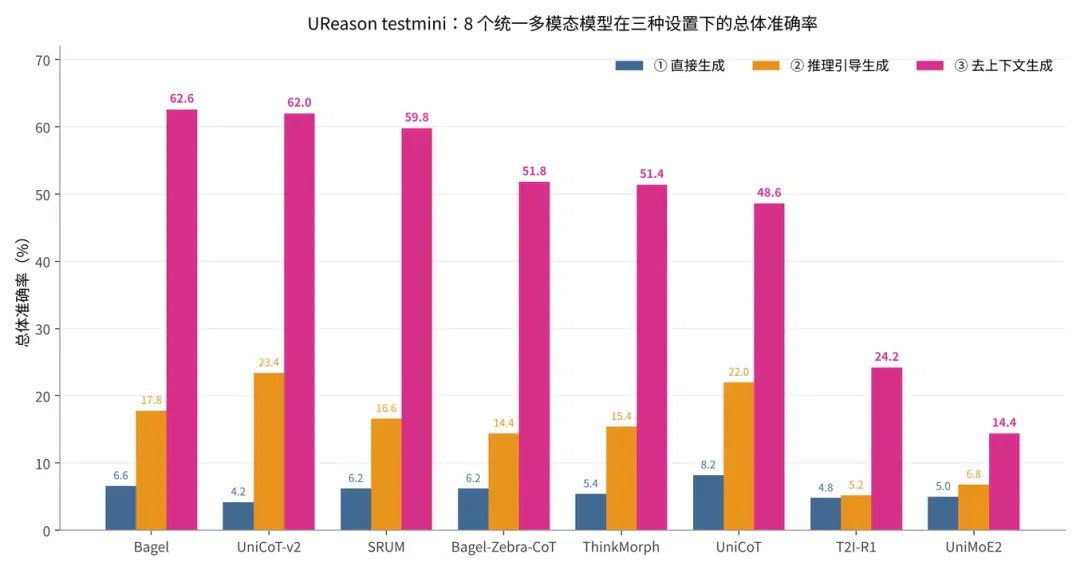
Figure 4: Overall accuracy of eight models under the three settings on testmini. Every model follows the pattern Direct Generation < Reasoning-guided Generation < De-contextualized Generation.
Analysis | Why does correct reasoning still lead to an incorrect image?
To locate the problem, the researchers conduct a series of analyses that rule out possibilities step by step.
Is the model's reasoning itself wrong? No. Inspection of reasoning chains finds Bagel's reasoning accuracy as high as 93.4%, with all other models at 85.8% or above. Among Bagel's failures, 75.4% involve correct reasoning that the image does not implement; only 5.8% involve an error in the reasoning itself.
Is the context too long? That is not the explanation either. Repeating the refined prompt four or eight times to artificially lengthen the context lowers accuracy by at most 6.0 percentage points.
The problem lies in the reasoning content. Keeping the refined prompt fixed while replacing only the preceding reasoning reveals that Bagel scores 62.6% with the refined prompt alone, falls to 21.0% when its original reasoning is added, and falls further to 16.4% when that is replaced with unrelated reasoning.
Attention analysis offers a more intuitive explanation. During image generation, attention assigned to intermediate reasoning exceeds half the amount assigned to the refined prompt.
Returning to the sunglasses-wearing driver: examining Bagel's attention distribution while generating this image shows that the most attended text token is “sunglasses,” which appeared in its reasoning. Its attention score is substantially higher than those of words such as “driver” and “face.” Although the model reasoned that the sunglasses should be removed, the drawing remains influenced by the word “sunglasses” itself.
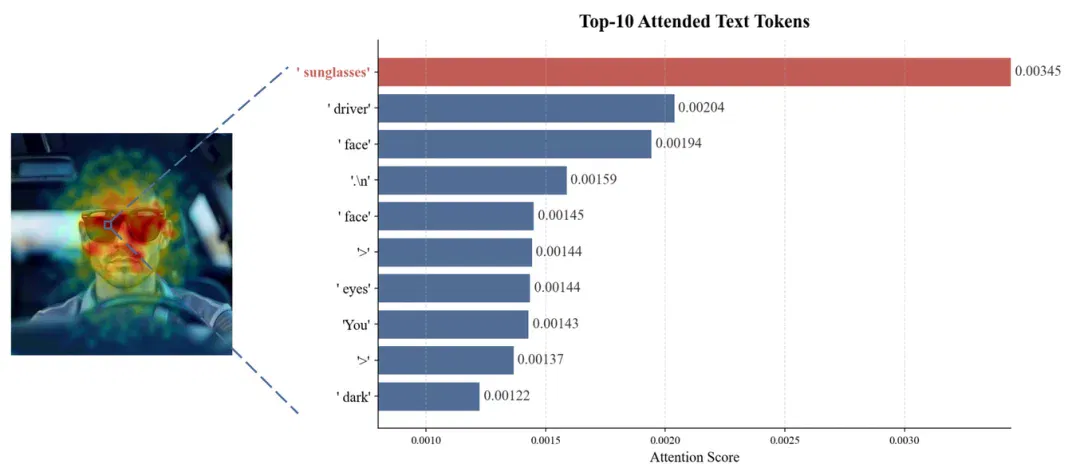
Figure 5: The ten text tokens most attended to by the sunglasses region in the generated image. “sunglasses” from the reasoning, shown in red, ranks first by a wide margin.
The researchers call this phenomenon “contextual interference”: merely appearing in the conditioning context may allow a word to bypass logical constraints and directly influence generation. It is not unique to Bagel. The same attention analyses on ThinkMorph and other models reveal similar patterns.
In other words, for this type of failure in the UMMs tested here, correct textual reasoning still does not guarantee correct generation. Words in the reasoning may interfere with the transfer from “thinking” to “drawing”; this does not rule out reasoning errors in other cases.
Conclusion
UReason offers unified multimodal models a diagnostic tool: it asks not only whether a model draws correctly, but whether it draws what it intended. The study shows that, despite unified architectures and training, significant alignment problems remain between textual reasoning and visual generation in current UMMs. “Thinking correctly” does not mean “drawing correctly.” The next step for UMMs is to draw what they arrive at in their reasoning.
References
[1] Deng C, Zhu D, Li K, et al. Emerging Properties in Unified Multimodal Pretraining. arXiv:2505.14683, 2025.
[2] Jin W, Niu Y, Liao J, et al. SRUM: Fine-Grained Self-Rewarding for Unified Multimodal Models. arXiv:2510.12784, 2025.
[3] Qin L, Gong J, Sun Y, et al. Uni-CoT: Towards Unified Chain-of-Thought Reasoning Across Text and Vision. ICLR, 2026.
[4] Gu J, Hao Y, Wang H W, et al. ThinkMorph: Emergent Properties in Multimodal Interleaved Chain-of-Thought Reasoning. ICLR, 2026.
[5] Tian C, Yang D, Chen G, et al. InternVL-U: Democratizing Unified Multimodal Models for Understanding, Reasoning, Generation and Editing. arXiv:2603.09877, 2026.
[6] Diao H, Wu P, Deng H, et al. SenseNova-U1: Unifying Multimodal Understanding and Generation with NEO-unify Architecture. arXiv:2605.12500, 2026.
[7] Diao H, Wang J, Ding C, et al. SenseNova-U1.5: Towards Native Unified Visual Intelligence. arXiv:2609.11929, 2026.
This article is from Synced, by Synced.
Related topics
After reading
Join the AINRK community
Read how to join the community and connect with people working in AI.
Related articles
Continue reading related topics and articles in this category.
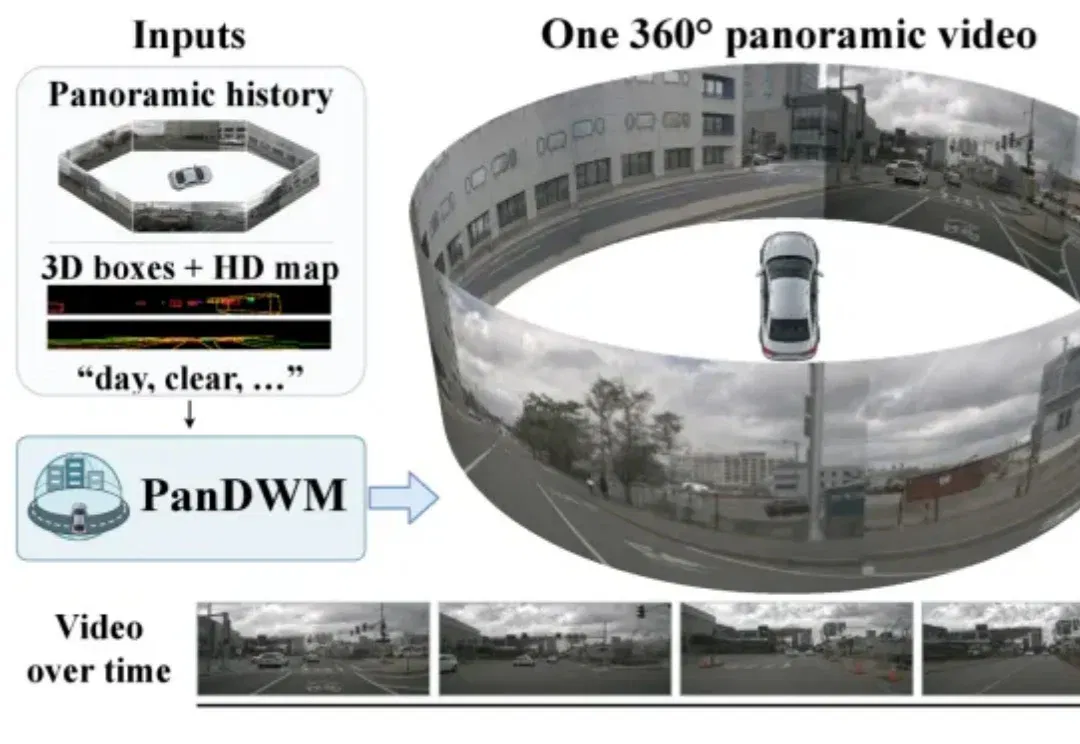
PanDWM generates panoramic driving video, then lifts it into 4D Gaussian scenes for new viewpoints (opens in a new tab)
Peking University's PanDWM maps six cameras to a panoramic strip, generates video with four-step causal diffusion, then lifts and fuses Gaussians for novel views. Its 0.5 and 1.96 s/frame timings use H100 and A40 GPUs; full 4D processing and refinement cost extra, with drift and occlusion limits.
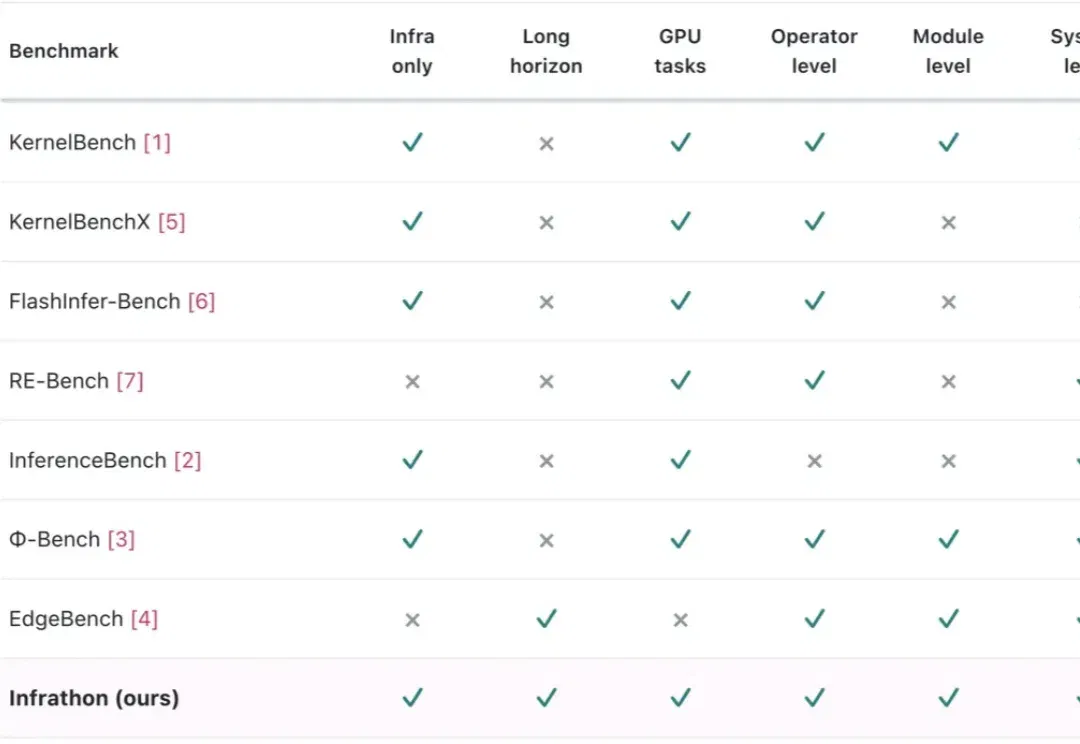
Infrathon tests agents' sustained optimization over 12–24 hours on 25 AI infrastructure tasks (opens in a new tab)
Infrathon spans 25 operator, module and system tasks. Across six models, 150 runs and over 10,000 GPU-hours, Claude Opus 5.5 leads with a 91.2 mean rank score, and 135 runs improve in their second half. Benefits vary by task and model; the benchmark does not establish general RSI.
TokenRhythm and Peking University introduce VAHBench for agentic long-video generation (opens in a new tab)
VAHBench evaluates long-video production across 48 agent configurations and 240 runs. Higher visual quality does not ensure complete delivery, longer and more complex tasks are harder to finish, and adding tools does not always improve the overall score.
Qwen3.5-27B self-rewriting experiment: up to 6.6 points higher accuracy on 490 math problems (opens in a new tab)
A research team lets models inspect internal states and edit their weights with code, without gradient training. After reserved-problem checks, Qwen3.5-27B's accuracy on 490 held-out math problems rises from 57.2% to as much as 63.8%. Smaller models fail; results remain task- and protocol-specific.
Google's SIM research: carrying self-improvement experience across models and datasets (opens in a new tab)
Can agents keep improving when models or datasets change? Google and Penn State's SIM carries optimization records alongside the harness. Tested gains come with budget, repetition and transfer limits; the work remains a preprint.