PMOPD uses update subspaces to reduce multi-teacher distillation interference, improving two model families
Ant Group's PMOPD builds subspace memories from parameter displacements and projects gradients and optimizer updates. In the tested math, reasoning and code settings, three-task averages rise by 2.54 points for Qwen2.5-7B and 2.09 for Llama-3.1-8B over standard MOPD.
Editor's fact check (November 26, 2026): The results in this article correspond to the paper's tested Qwen2.5-7B and Llama-3.1-8B models and its math, reasoning, and code configurations. Improvement in all three over standard MOPD does not mean surpassing the corresponding specialist teacher on every task: for example, the Llama code teacher scores 42.00, versus PMOPD's 32.33. The preferred task order and four-cycle optimum are also observations under this experiment's budget. More tasks and larger models remain directions for future research.PMOPD paper: main results in Table 3 and ablations (opens in a new tab)Ant Group's PMOPD project page (opens in a new tab)
Aggregating capabilities in large-model training
Giving a single large language model the combined ability to handle multiple tasks is an important post-training objective. Before on-policy distillation (OPD), capability aggregation during SFT and RL mainly relied on two approaches: 1. Data aggregation, mixing training data from different tasks. 2. Parameter merging, training domain models separately and then merging their parameters. These methods can combine capabilities across domains, but often require repeated trade-offs in data ratios and training strategies, with extensive ablations to determine the best implementation.
As OPD develops, Multi-Teacher On-Policy Distillation (MOPD) is becoming an important route to capability aggregation: independently train teachers for individual domains, then distill their capabilities into a single student. But when multiple teachers jointly train the same student through MOPD, different tasks impose conflicting update demands on the same model parameters. An improvement in one capability may come at the expense of another, making it difficult for the student to match specialists in every domain at once.
Existing methods usually mitigate interference by adjusting task-sampling ratios or balancing losses, without directly identifying which parameter-update directions harm existing capabilities. To address this, Ant Group researchers propose projection-based multi-teacher on-policy distillation, Projection-based Multi-Teacher On-Policy Distillation (PMOPD). Starting from the geometry of parameter updates, the method compresses the key update directions used by each task into a low-dimensional “subspace memory.” When learning a new task, projection removes update components that conflict with protected directions, reducing interference with existing capabilities. Relative to standard MOPD, PMOPD improves the three-task average by 2.54 points for Qwen2.5-7B and 2.09 points for Llama-3.1-8B.
The project and related supporting work are now open-source on GitHub, with the hope of drawing more community attention to optimizing multi-teacher on-policy distillation.
- Paper title: PMOPD: Task Ordering, Cycling, and Parameter-Update Subspace Protection in Multi-Teacher On-Policy Distillation
- Paper: https://arxiv.org/abs/2609.34605
- Project: https://digital-avatar.github.io/ai/PMOPD/
- Code: https://github.com/ant-research/PMOPD
Parameter-update subspaces and cross-task interference in MOPD
As a post-training method for combining multiple task capabilities, MOPD currently has two main implementations: within-batch and between-batch data mixing. Within-batch mixing considers multiple tasks at every step, but suffers from gradient cancellation. In between-batch mixing, each step's gradient concentrates more on the current task, but cannot see whether other tasks are being affected at that step, making capability fluctuations and order effects more likely.
PMOPD chooses between-batch mixing and must handle updates coming from different tasks' data at successive steps. It therefore focuses not on one step's gradient direction, but on the overall task-update direction after a period of task training. Specifically, the team records the parameter difference before and after a task block, calling the cumulative parameter change over that interval the parameter displacement. Truncated singular value decomposition (SVD) then extracts the principal directions to form the task's update subspace, representing its parameter-update directions.
Two key phenomena emerge in the experiments.
First, a task's main update directions form very early. By approximately 20% of training, the subspace extracted at that point already has high average similarity to the final subspace. In other words, although parameters keep changing, the main directions along which a task modifies the model have largely emerged early on.
Second, update directions are relatively consistent within the same task but clearly separated across tasks. The math, code, and reasoning update subspaces have very low similarity. This suggests that different capabilities are not written uniformly across every parameter direction; each concentrates in a relatively compact space. The overlap between subsequent updates and existing task subspaces is the part that genuinely needs to be managed across tasks.
This observation turns the abstract problem of “task conflict” into a more concrete geometric problem: first identify the update directions mainly occupied by a task, then prevent subsequent training from interfering along those directions.
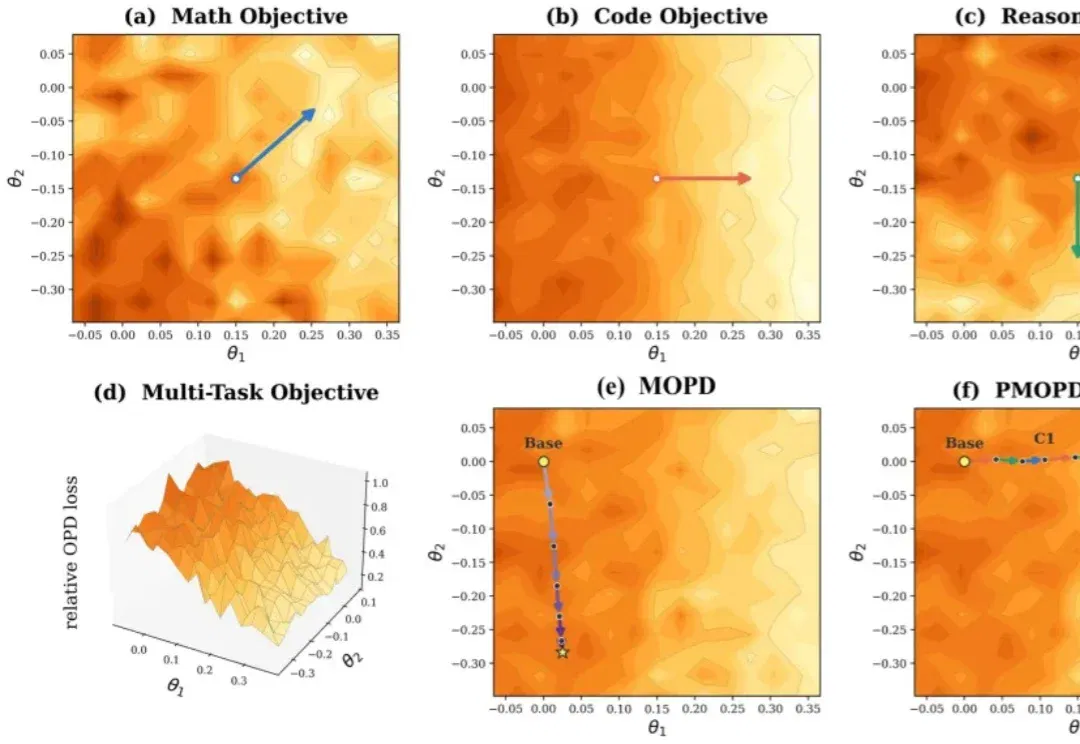
The paper's optimization trajectories illustrate this directly. At the same model checkpoint, math, code, and reasoning each prefer a different next-step direction. Standard MOPD updates oscillate in the joint loss landscape, while PMOPD corrects updates overlapping protected directions, moving more steadily toward a low-loss region shared by multiple tasks.
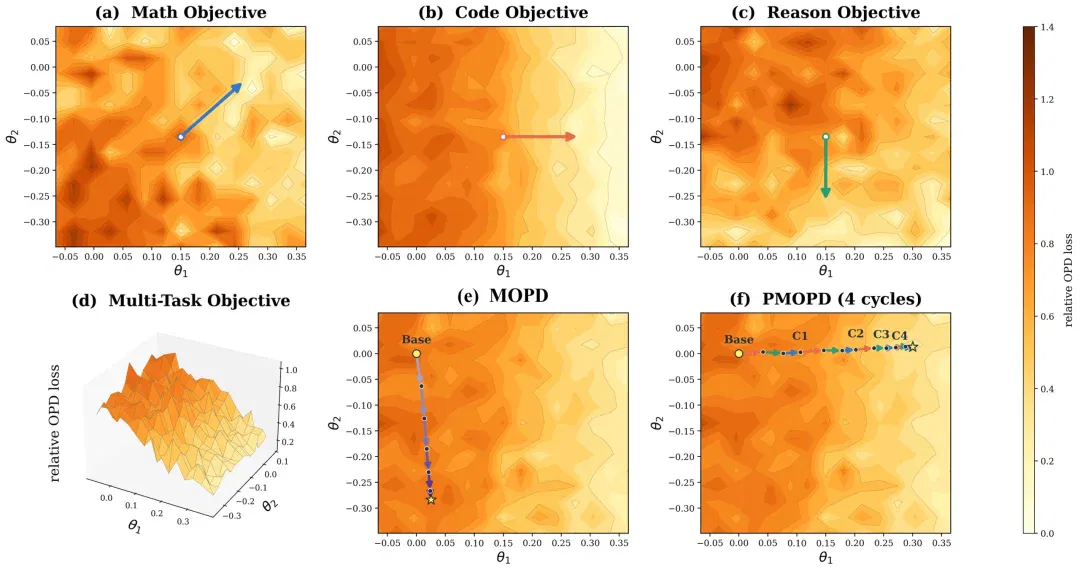
Figure 1: Comparison of parameter-update directions for different tasks and of MOPD and PMOPD optimization trajectories in the joint loss landscape. By correcting updates that conflict with protected task directions, PMOPD makes training enter a shared low-loss region more steadily.
Dual projection protection based on subspace memory
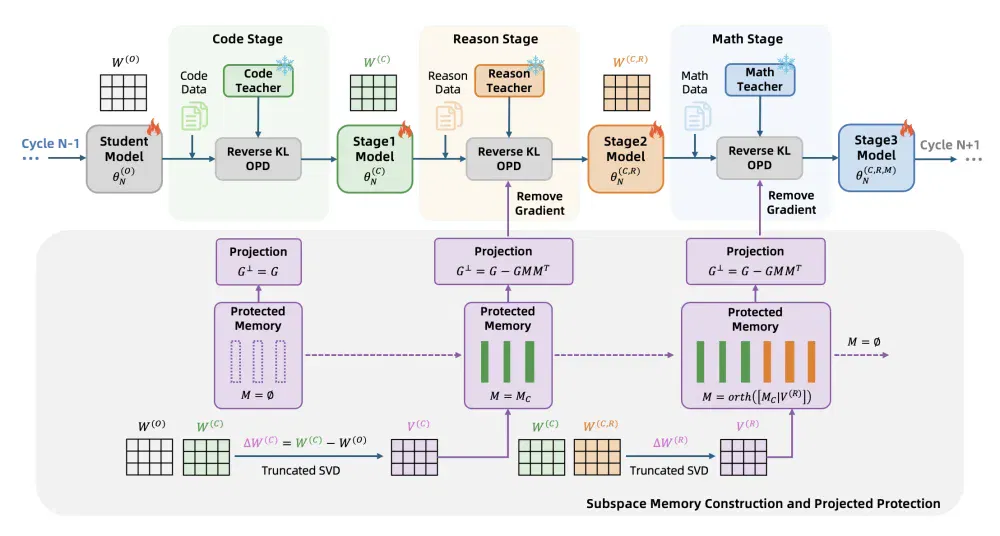
Figure 2: The PMOPD pipeline. Each cycle distills Code, Reason, and Math sequentially. Cumulative parameter displacements from completed tasks form subspace memories used to project subsequent gradients and optimizer updates.
PMOPD trains tasks sequentially in blocks. After each task block, it saves that training interval's principal update directions as a “subspace memory” for later tasks to avoid. Taking Code→Reason→Math within one cycle as an example, the full process is:
1. Perform single-task on-policy distillation. The student first generates answers under its current policy; the corresponding specialist teacher then provides token-level supervision on those generated trajectories. The teacher sees what the student will actually generate in its current state, rather than fixed answers unrelated to that state.
2. Extract the task-update subspace. After the task block ends, calculate each parameter matrix's cumulative displacement from before to after training, retaining the top 16 right singular vectors. A small set of basis vectors summarizes the task's main update directions.
3. Update the subspace memory. Merge the newly extracted directions with the existing memory and orthogonalize them, removing redundant directions to obtain the space requiring protection in the current cycle.
4. Constrain subsequent task updates. When training the next task, use projection to remove update components that fall within the protected space, minimizing the new task's overwriting of effective directions already formed.
PMOPD applies projection not just once, but separately to the raw gradients and the final parameter updates produced by the optimizer.
This is because adaptive optimizers such as Adafactor rescale gradients element by element according to parameter states. Even if a raw gradient avoids the protected space, preconditioning may deflect its direction again. Projecting only the gradient corrects the starting direction; projecting the optimizer update once more ensures that the model's actual final step does not reenter the protected region.
Ablations support this design. With the same task order, cycle count, and training budget, Qwen2.5-7B's three-task average without projection is 63.85; adding gradient projection raises it to 66.22; adding optimizer-update projection raises it further to 66.97. The two projections are not redundant: they constrain separate stages before and after optimization.
PMOPD also does not retain all historical directions forever. At the beginning of each new cycle, the subspace memory is cleared and rebuilt from the model's current state. This protects recently formed capabilities without allowing constraints to accumulate until the model has no room left to learn new ones.
Choosing task order: a task-conflict probe
In multi-teacher distillation, training on the same data does not necessarily produce the same model. Which task is learned first or last changes the constraints on subsequent updates and affects the final combination of capabilities.
The paper enumerates all six orders of the three tasks—math, reasoning, and code. With exactly the same amount of data and training budget, the average-score gap between the best and worst orders is 2.97 points. Task order is therefore not an inconsequential engineering detail, but an important variable in aggregating multiple capabilities.
As the number of tasks grows, however, trying every permutation quickly becomes impractical. The researchers therefore design a lightweight conflict probe. It first builds a subspace from task A's cumulative parameter displacement, then measures how much of task B's gradient falls within that space. A higher proportion indicates that training on B is more likely to touch parameter directions already used by A.
Task interactions are asymmetric: the extent to which A constrains B need not equal the extent to which B constrains A. PMOPD therefore measures both directions, combines them into an undirected conflict score between tasks, and further computes each task's average conflict with the others.
In the full measurement, the average conflict scores for Code, Reason, and Math are 22.34%, 28.50%, and 29.38%, respectively. Sorting from low to high conflict gives Code→Reason→Math, which is also the best-performing of the six orders.
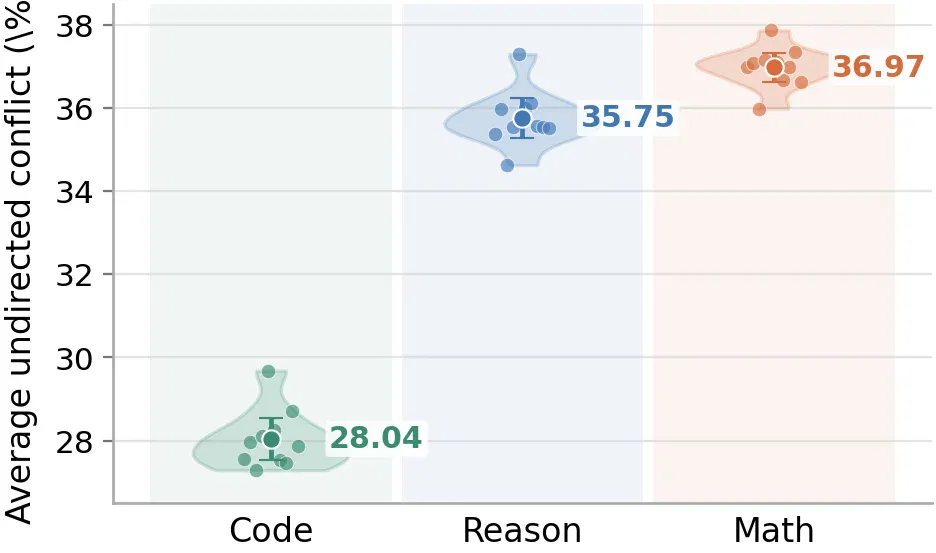
Figure 3: Task-level mean undirected conflict estimated over ten folds using 60-example subsets. Every fold recovers the stable ordering Code < Reason < Math.
This result does not depend on large-scale preliminary experiments. The team divides each task's data into ten small subsets and estimates with only 60 examples per fold. All ten recover the same ordering, Code < Reason < Math. In other words, a small-sample probe before formal training offers a chance to find a more suitable task order.
Why put low-conflict tasks first? Tasks completed earlier enter subspace memory first and constrain subsequent updates. Adding directions with less overlap with other tasks first can reduce the effective updates projected away during later training. When more conflicting tasks arrive, the existing memory can prevent them from excessively overwriting earlier capabilities.
Choosing the number of cycles: subspace consistency
Once task order is determined, another question remains: should the three tasks be trained sequentially just once, or split into multiple cycles with repeated switching?
Here too, more frequent switching is not necessarily better. If a task is trained continuously for too long, the model may drift substantially before returning to an earlier task. But if switching is too frequent, each block contains too little data; noise affects the cumulative parameter displacement, making it an unstable representation of the task's principal update directions.
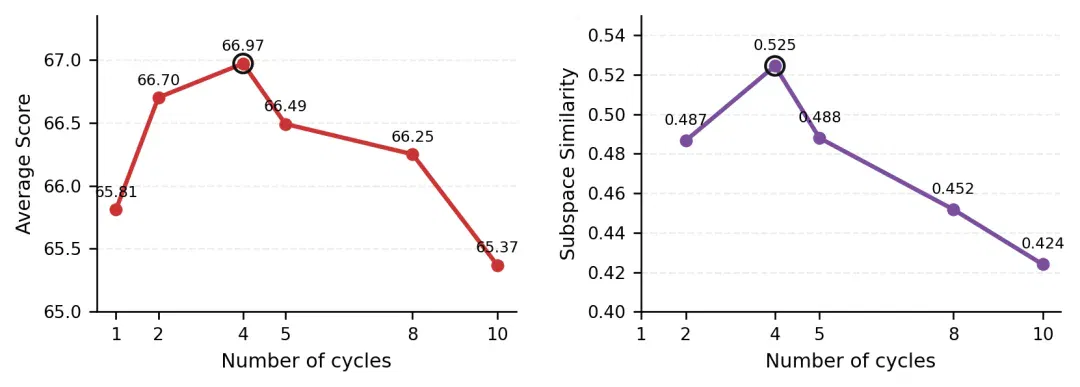
Figure 4: Three-task average scores and cross-cycle subspace consistency at different cycle counts. Both metrics peak at four cycles.
With the total amount of data per task fixed, the paper compares 1, 2, 4, 5, 8, and 10 training cycles. The three-task average rises from the single-cycle score of 65.81 to the four-cycle score of 66.97, then gradually declines, reaching a ten-cycle score of 65.37.
The team further compares update subspaces formed by the same task in adjacent cycles. More similar subspaces indicate that the current block contains enough information for a relatively stable direction estimate. This “cross-cycle subspace consistency” also peaks at four cycles, at 0.525, matching the peak in model performance.
This provides a more direct basis for choosing task-switching frequency than repeated trial runs: blocks must be long enough for update directions to emerge stably, but not so long that other capabilities go unvisited for an extended period. Under this paper's training setup, four cycles strike a good balance between the two.
Experimental results
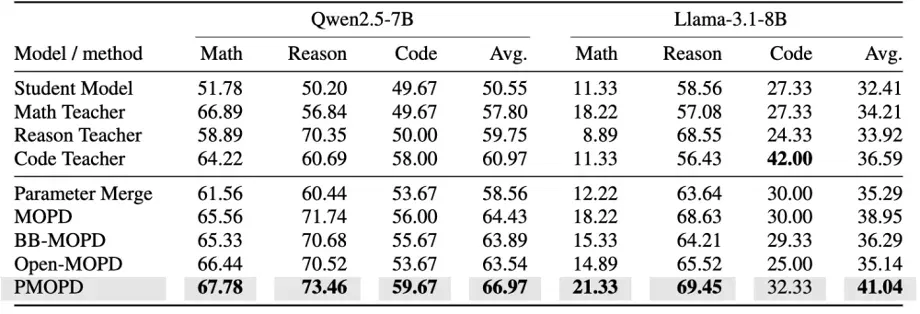
Table 1: Main results for PMOPD on Qwen2.5-7B and Llama-3.1-8B. Compared with standard MOPD, PMOPD improves math, reasoning, and code in both model families; this does not mean that every score exceeds the specialist teacher's.
The paper validates the method on two model families, Qwen2.5-7B and Llama-3.1-8B, comparing it with parameter merging, standard MOPD, different batch-mixing approaches, and Open-MOPD.
On Qwen2.5-7B, PMOPD's math, reasoning, and code scores are 67.78, 73.46, and 59.67, respectively, giving a three-task average of 66.97. Relative to standard MOPD, the three task gains are 2.22, 1.72, and 3.67 points, with an average improvement of 2.54 points.
The same trend appears on Llama-3.1-8B: math, reasoning, and code improve by 3.11, 0.82, and 2.33 points, respectively, with the average rising from MOPD's 38.95 to 41.04.
More noteworthy than the average gain is PMOPD's improvement on every task in both model families. Multi-task methods sometimes trade one capability for another: the average looks higher, yet a “capability seesaw” remains inside the model. These results suggest that PMOPD does more than redistribute performance among the three tasks; it enables the student to absorb more of multiple specialist teachers' capabilities.
For general-purpose models that must handle mathematical problem-solving, complex reasoning, and code generation together, this integration approach also retains the advantages of single-model deployment. Capability fusion happens during training, so inference requires neither maintaining additional specialist models nor adding task routing.
Parameter-update geometry offers a new approach to integrating capabilities
PMOPD's central lesson is that integrating multiple capabilities is not only a data-mixture problem, but also a problem of managing parameter-update directions.
When different specialist teachers train a single model together, what really needs coordinating is not task labels, but the update trajectories they leave in shared parameter space. By identifying low-dimensional task subspaces, protecting effective directions already formed, and using geometric metrics to organize task order and training cycles, PMOPD provides an interpretable, practical mechanism for controlling interference in multi-teacher on-policy distillation.
The approach also opens possibilities for capability fusion at a larger scale. In the future, when a model must integrate more specialist domains, more teachers, or even a continuing stream of new capabilities, attention can shift from “how to mix all the data together” toward “how to identify, preserve, and coordinate the update spaces of different capabilities,” further improving the stability of capability integration across domains.
Author information
The authors are from Ant Group's research team. The team has explored reinforcement-learning training for large language and multimodal models, long-horizon agentic task training, multi-teacher on-policy distillation, and other areas. The authors can be reached at liuyouzhi22@mails.ucas.ac.cn and zhengruobing.zrb@antgroup.com, and welcome discussion and exchange.
This article is from Synced, by the Ant Group research team.
Related topics
After reading
Join the AINRK community
Read how to join the community and connect with people working in AI.
Related articles
Continue reading related topics and articles in this category.
PanDWM generates panoramic driving video, then lifts it into 4D Gaussian scenes for new viewpoints (opens in a new tab)
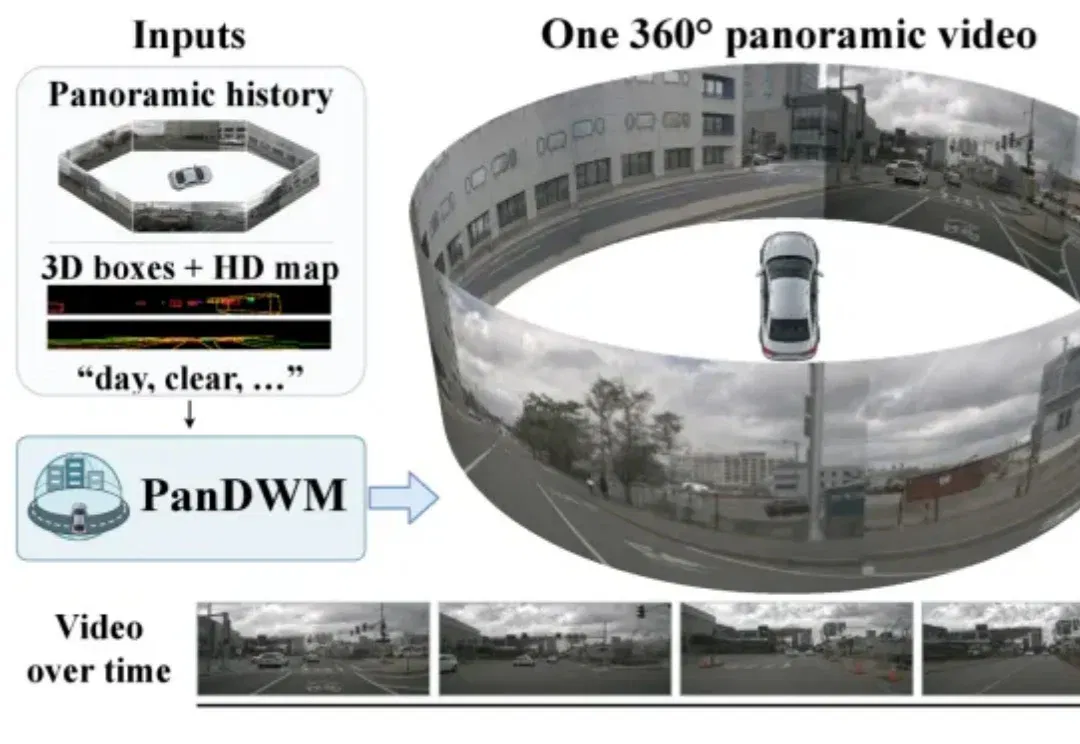
Peking University's PanDWM maps six cameras to a panoramic strip, generates video with four-step causal diffusion, then lifts and fuses Gaussians for novel views. Its 0.5 and 1.96 s/frame timings use H100 and A40 GPUs; full 4D processing and refinement cost extra, with drift and occlusion limits.
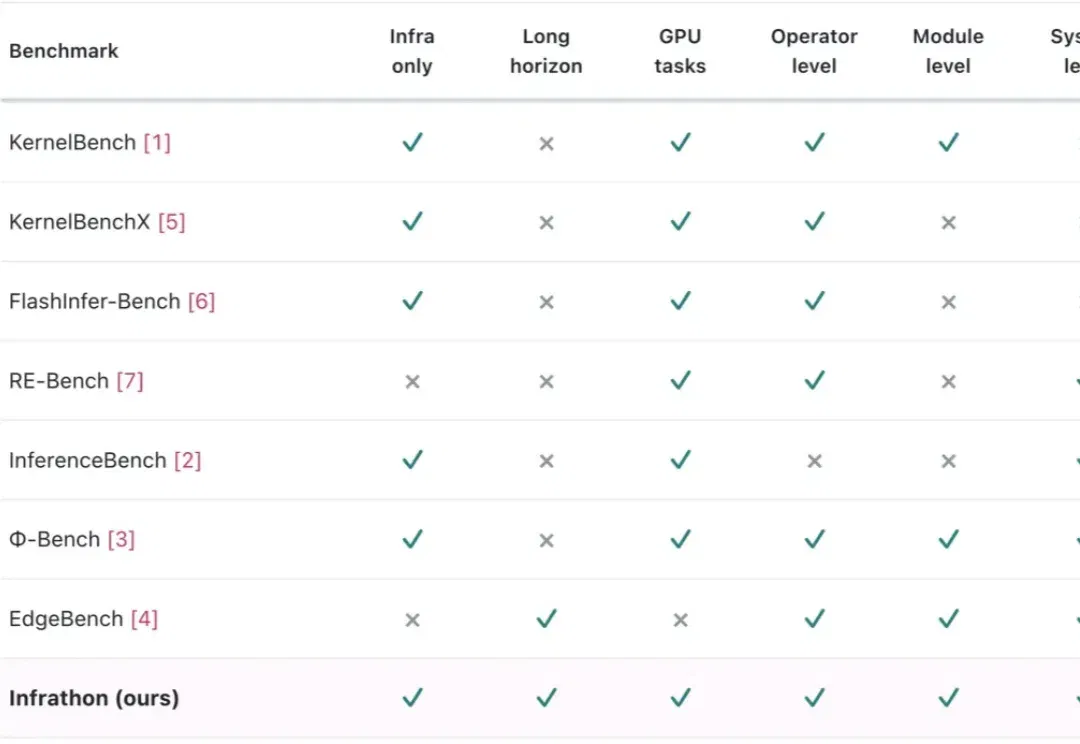
Infrathon tests agents' sustained optimization over 12–24 hours on 25 AI infrastructure tasks (opens in a new tab)
Infrathon spans 25 operator, module and system tasks. Across six models, 150 runs and over 10,000 GPU-hours, Claude Opus 5.5 leads with a 91.2 mean rank score, and 135 runs improve in their second half. Benefits vary by task and model; the benchmark does not establish general RSI.
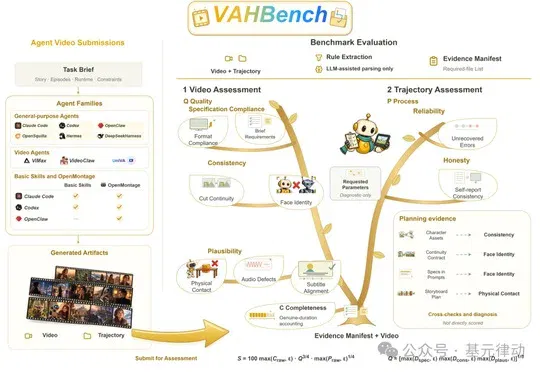
TokenRhythm and Peking University introduce VAHBench for agentic long-video generation (opens in a new tab)
VAHBench evaluates long-video production across 48 agent configurations and 240 runs. Higher visual quality does not ensure complete delivery, longer and more complex tasks are harder to finish, and adding tools does not always improve the overall score.

Qwen3.5-27B self-rewriting experiment: up to 6.6 points higher accuracy on 490 math problems (opens in a new tab)
A research team lets models inspect internal states and edit their weights with code, without gradient training. After reserved-problem checks, Qwen3.5-27B's accuracy on 490 held-out math problems rises from 57.2% to as much as 63.8%. Smaller models fail; results remain task- and protocol-specific.
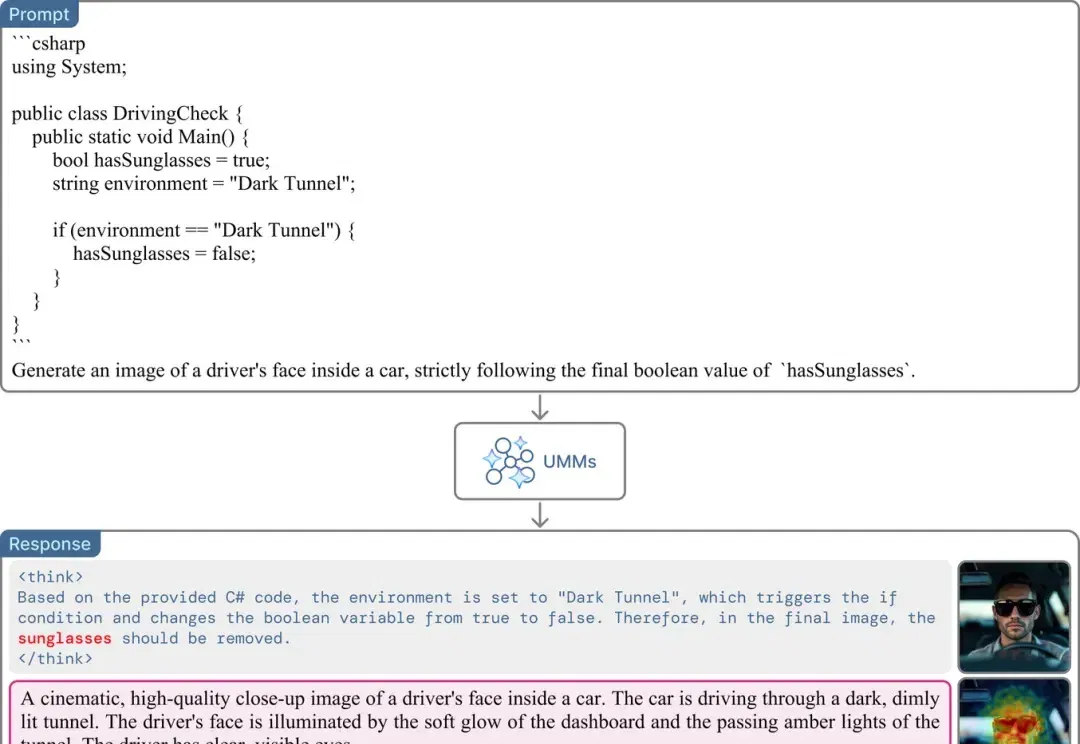
EMNLP 2026 Outstanding Paper UReason: why correct reasoning can still produce the wrong image (opens in a new tab)
UReason tests reasoning-to-generation alignment in unified multimodal models. Across eight open models, generating from the final refined prompt works better; Bagel rises from 17.8% to 62.6% on 500 testmini cases. The EMNLP 2026 Outstanding Paper does not show that reasoning harms every image task.