Report examines Tesla FSD v15's Reality View: Road scenes generated from shared visual features
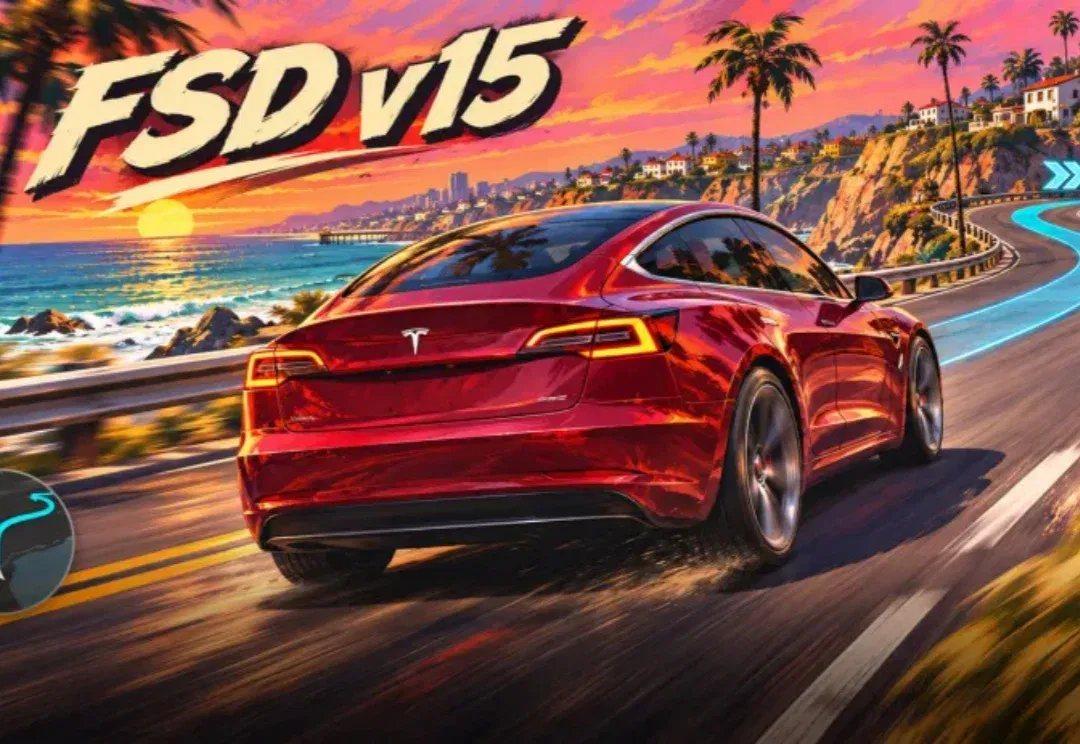
A report citing Tesla and Musk explains Reality View's shared visual encoder, separate diffusion branch and proposed latency reduction. Realistic imagery does not validate driving safety. FSD still requires driver supervision; features vary by hardware, version and region.
Editor's verification (2026-11-24): Reality View is generative driving visualization, not a port of GTA 6. Realistic imagery cannot establish that driving decisions are correct or that unsupervised operation is possible. Tesla explicitly states that FSD (Supervised) still requires continuous driver attention and readiness to take over; features vary by vehicle, hardware, software version, and region. The model architecture, costs, and TOPS ratios in this article come from explanations and estimates cited in the report. The original X post could not be accessed during this check and has not been independently verified. TOPS figures for different chips do not directly indicate actual performance when their precision, sparsity, or other measurement conventions differ. Nor can the claim that "more than 90% remains for driving" be established solely from a ratio of peak compute figures. Tesla's FSD supervision requirements (opens in a new tab) | Tesla post cited by the report (access restricted) (opens in a new tab)
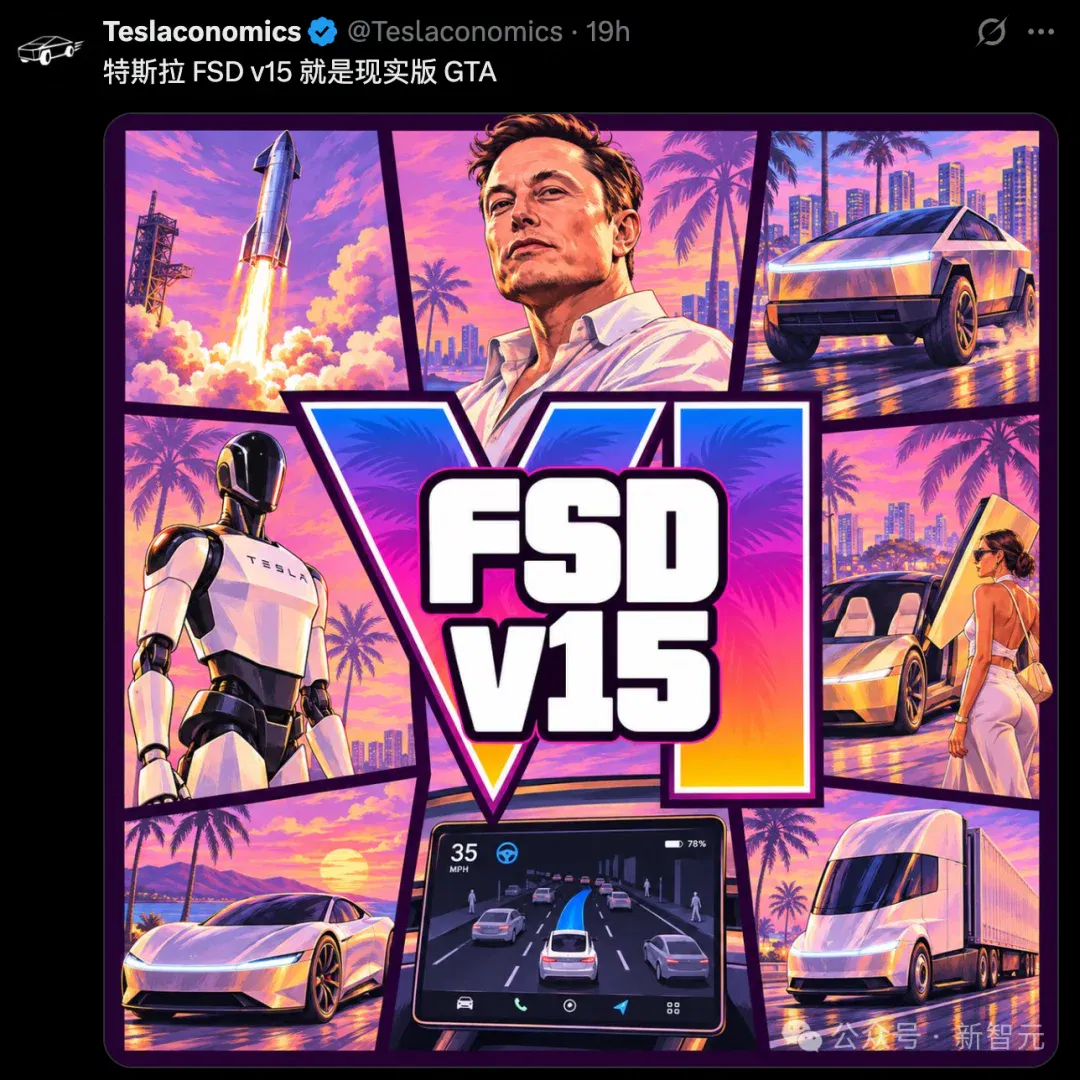
Musk has brought a "real-life GTA" into the car!
This weekend, Tesla officially rolled out its new-generation FSD v15, bringing a new upgrade to its end-to-end driving neural network.
One FSD v15 feature attracting the most attention, Reality View, has set car owners online and the AI community buzzing.
On the center display, nearby high-rises, roadside trees, pedestrians crossing the street, and oncoming cars appear with lighting as natural as a cutscene in a AAA game.
Just how striking is it?!
One owner was astonished: 「FSD v15 can even recognize ocean waves」.

Many people's first reaction was that it looked more like GTA than GTA 6 itself!
Most remarkably, every frame is generated by AI in real time, frame by frame, using an "end-to-end neural network".
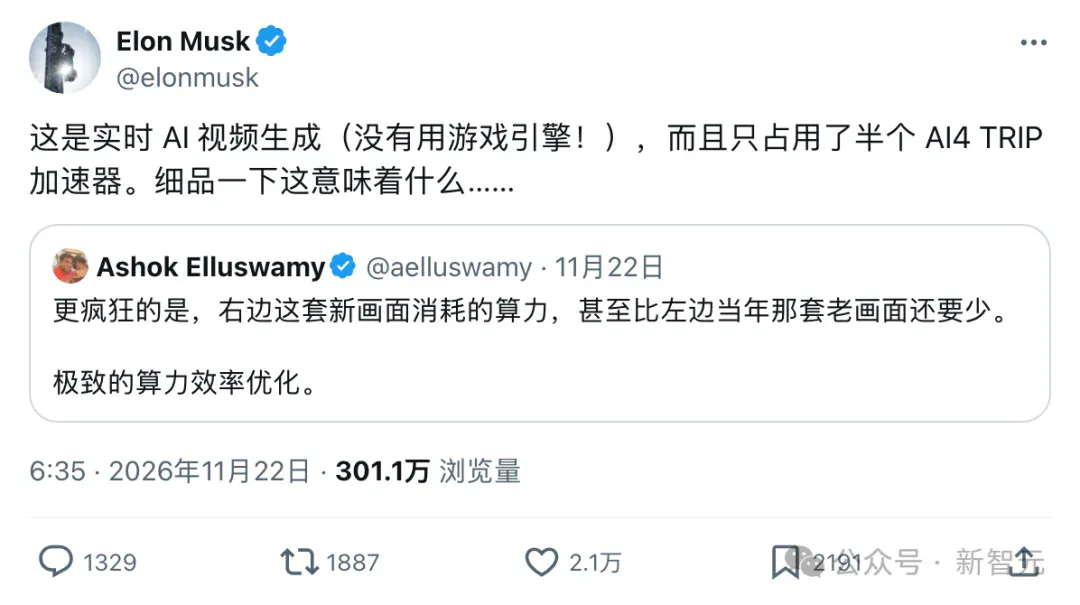
Musk could hardly contain his excitement: 「This is real-time AI video generation, with no game engine! It uses just half an AI4 TRIP accelerator」.
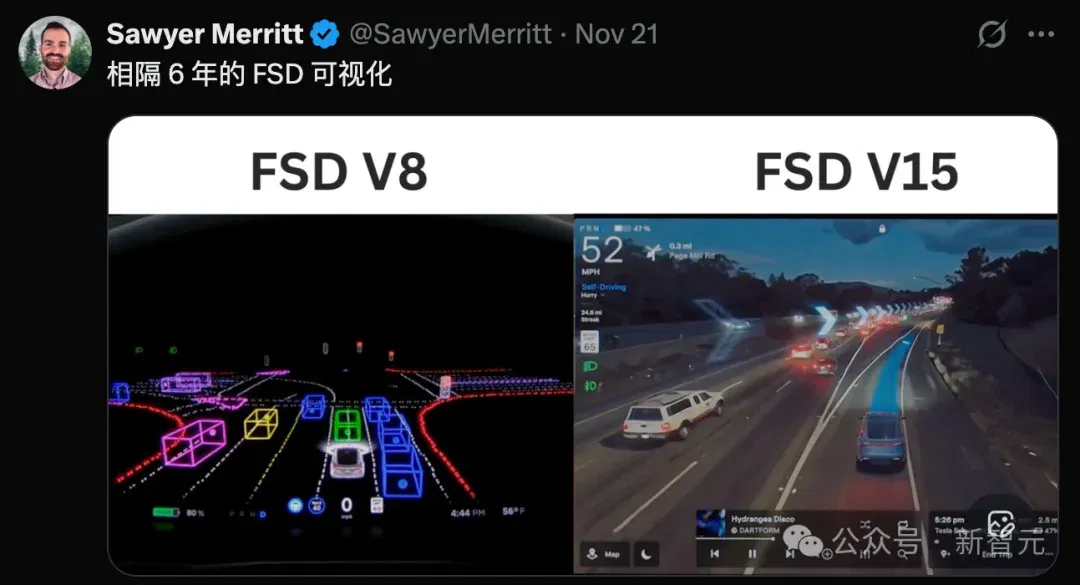
In just six years, Tesla FSD has been transformed, with its center-screen graphics evolving from dots, lines, and stick figures into realistic rendering comparable to a AAA title.
AI generates the world as it drives. With this FSD v15 update, game engines might be facing unemployment...
Musk: FSD is a real-life GTA!
The internet is now practically flooded with stunning videos "drawn" frame by frame by Tesla FSD v15.
A Tesla is reversing in a parking lot.
The "cameraperson" on the center screen suddenly circles to the front of the car, filming it head-on as it slowly backs out of the space.
Once the car shifts into drive and moves forward, the camera smoothly swings back around to the rear, following from slightly above.
Even on San Francisco's night streets amid shifting lights, the roadside redbrick buildings, pedestrian crossings, tree shadows, and oncoming headlights are all drawn live, frame by frame, by the onboard neural network.
At an intersection, a three-dimensional blue arrow suspended in midair clearly shows which lane FSD intends to turn into next.
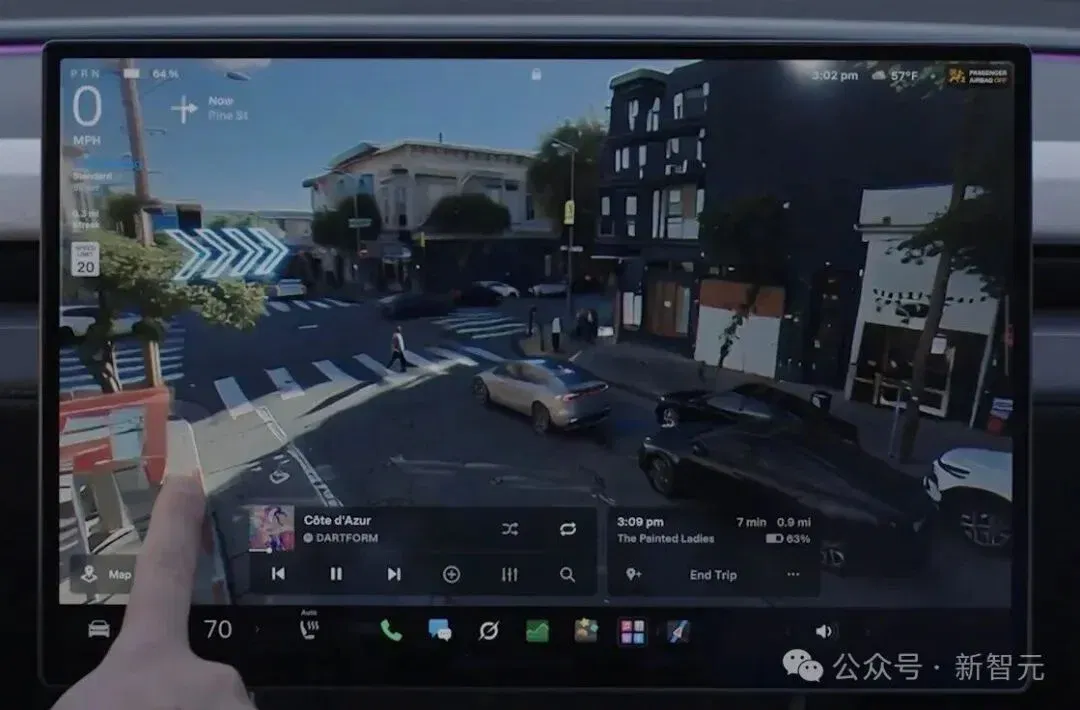
Near the destination, marker pins automatically appear over empty roadside parking spaces, indicating where it plans to park.
The owner only needs to tap a different pin in the screen's generated three-dimensional street view, and the vehicle immediately changes course and smoothly reverses into the newly chosen space.
During a drive, owners can switch freely between a full-screen Reality View, a full-screen navigation map, and a split-screen mode.
They can also activate, with one tap, a quiet mode previously available only on Robotaxi vehicles, leaving just speed and arrival time on the display.
The first early-access owners to receive FSD v15 soon took the system onto night roads that put perception to the test.
A huge branch snapped off by the wind lay across the middle of a lane, and Reality View on the center screen immediately drew a realistic image of the obstructing branch.
The vehicle then reversed a short distance to create room for the turn before driving onto the grassy left shoulder and smoothly going around the obstacle.
Tesla AI lead Ashok Elluswamy explained that driving and visualization share visual-encoder features, while the images are generated by a separate diffusion branch with approximately one billion parameters. Shared features do not mean video is generated directly by the model that outputs driving actions.
Musk put it even more directly: "FSD is a real-life GTA!"

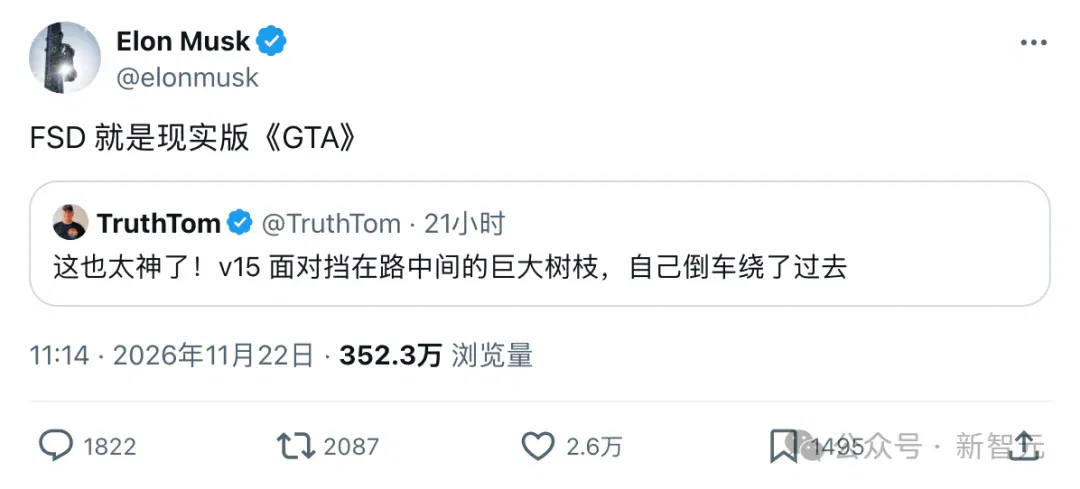
So what lies behind FSD v15's highly realistic visual upgrade? How exactly does it work?
Dispensing with the 3D game engine
AI generates the world "end to end" in real time
First, compare FSD in 2020 with FSD v15 today: they are worlds apart.
Back then, the display could only draw red, yellow, blue, and green 3D wireframes against a black background, using a few matchbox-like shapes for nearby cars. Today, the screen is filled with neon streetscapes, pedestrians, and real-time light and shadow.
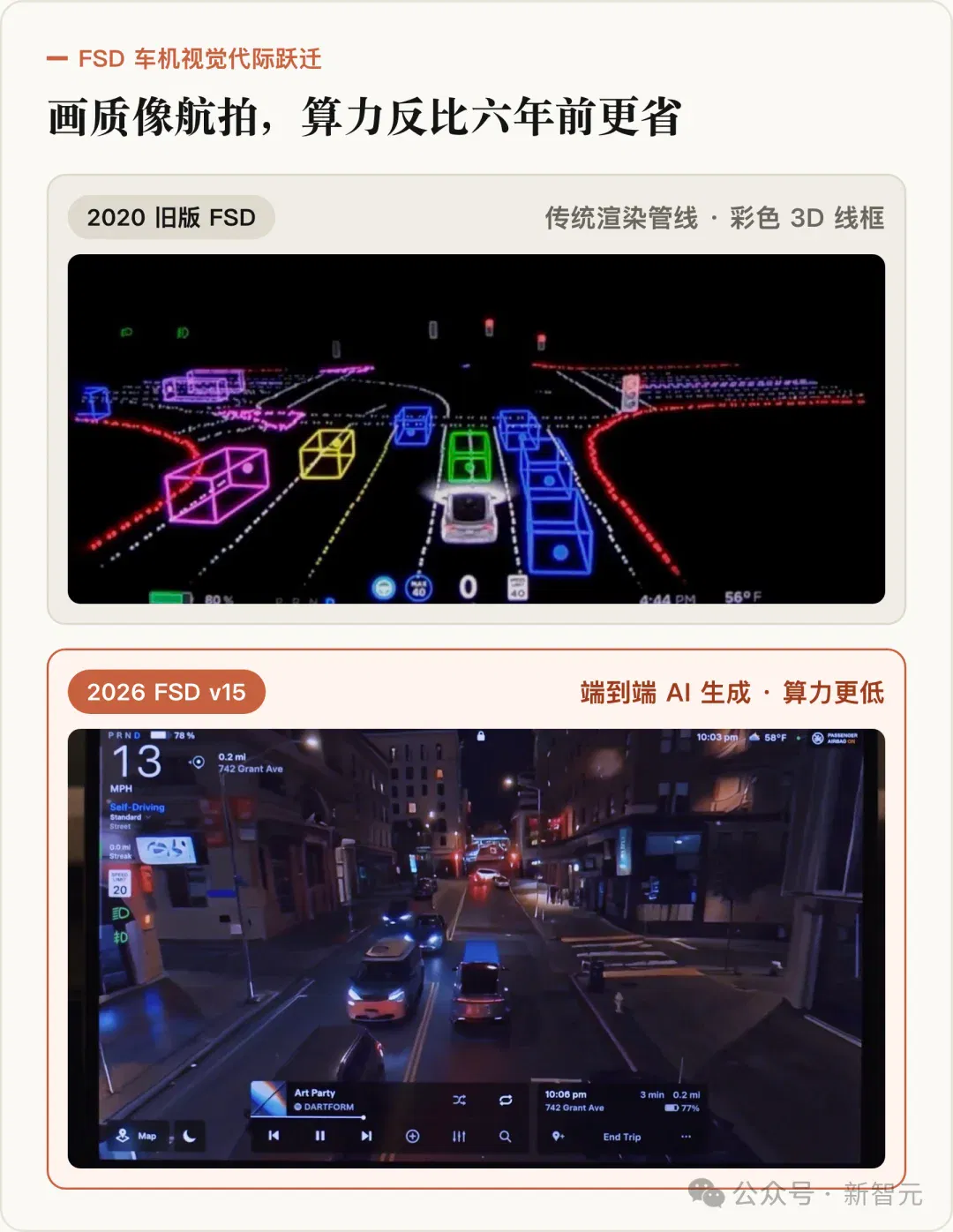
There is no game engine: the video is generated entirely by AI in real time, using only half a TRIP accelerator on the AI4 chip.
An onboard computer costing just $650 can apparently run this system. The secret lies in the underlying models' "reuse" design.
At almost the same time, Musk published a long post laying out Reality View's underlying architecture in detail.
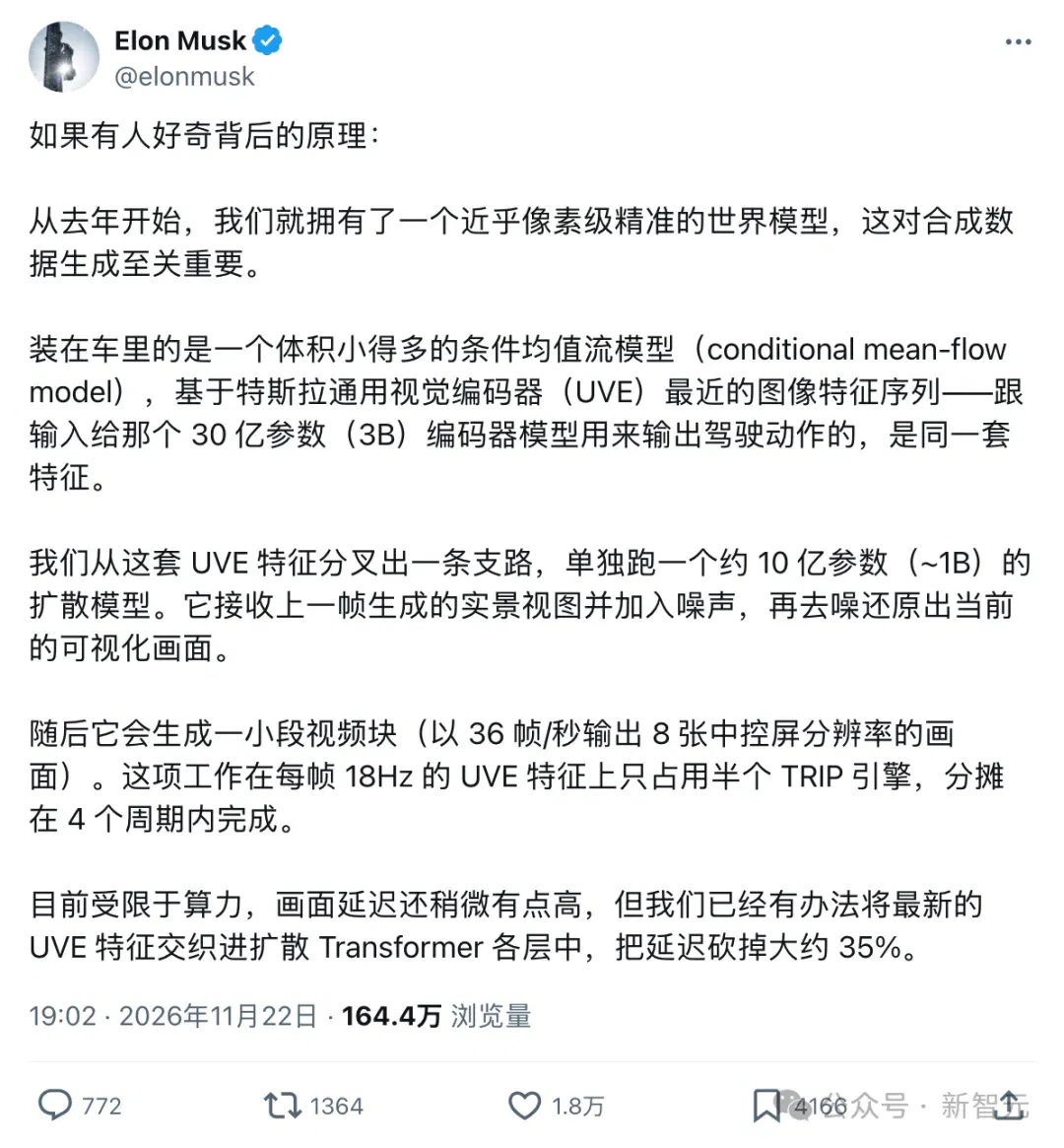
Since last year, Tesla has had an almost pixel-perfect "world model" in the cloud, specifically for generating large quantities of synthetic training data.
The version now placed in the car is a highly condensed, streamlined variant: a conditional mean-flow model based on a recent sequence of features from Tesla's Universal Vision Encoder (UVE).
The car's main driving model, with three billion parameters (3B), uses these UVE features to output steering and braking actions.
Engineers branched off the existing UVE feature stream and attached a separate lightweight diffusion model with approximately one billion parameters (~1B).
This diffusion model takes the previously generated frame, adds noise, and then denoises it in real time to reconstruct the current view. It outputs chunks at 36 frames per second, each containing eight consecutive images at the center display's resolution.
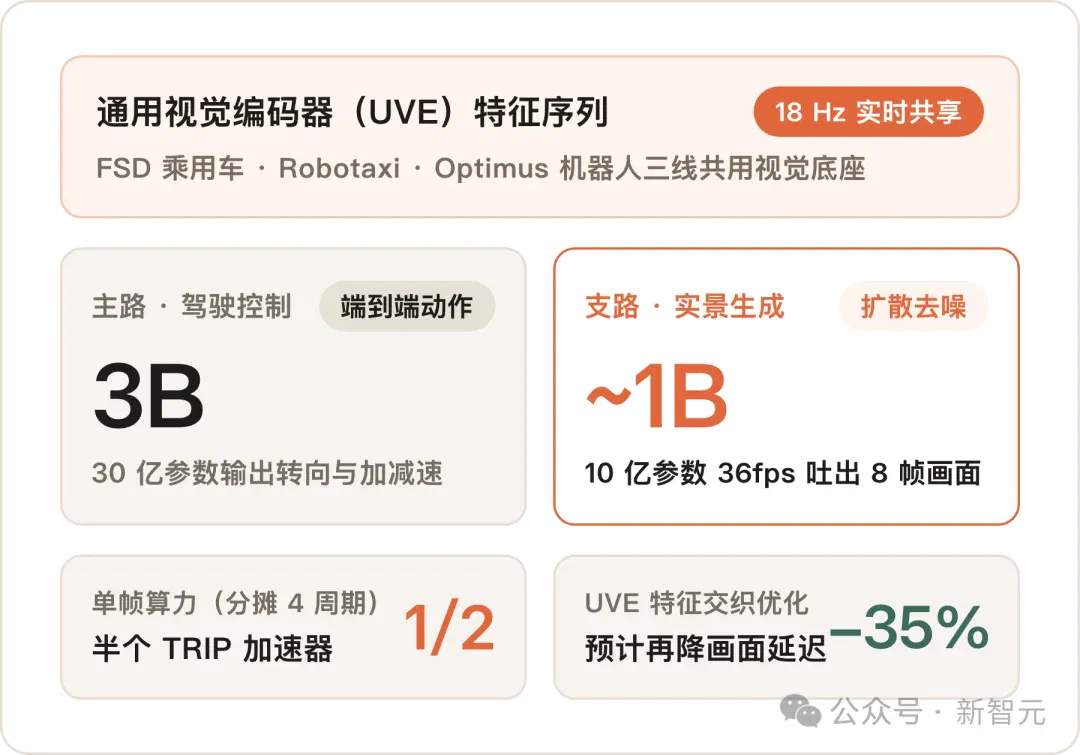
Working on the UVE feature cycle at 18 Hz, the entire denoising and generation process uses only half a TRIP engine, with the work evenly distributed across four cycles.
Musk also outlined the next optimization for the slight visual lag mentioned by early testers—
the team is interleaving the latest UVE visual features through the diffusion Transformer's layers, which is expected to cut visualization latency by approximately another 35%.
Just half an accelerator, with less than 1% of an H100's compute
Breaking down the AI4 onboard computer's hardware specifications shows just how small this half-TRIP allocation is.
A standard AI4 computer contains two custom chips, each with three custom TRIP neural-network processors, for six in total.
Based on estimates from public hardware teardowns, one TRIP provides approximately 40 TOPS, and the whole computer approximately 240 TOPS.
The half-TRIP allocated to Reality View offers only approximately 20 TOPS, exactly one-twelfth of the vehicle's neural-network compute.
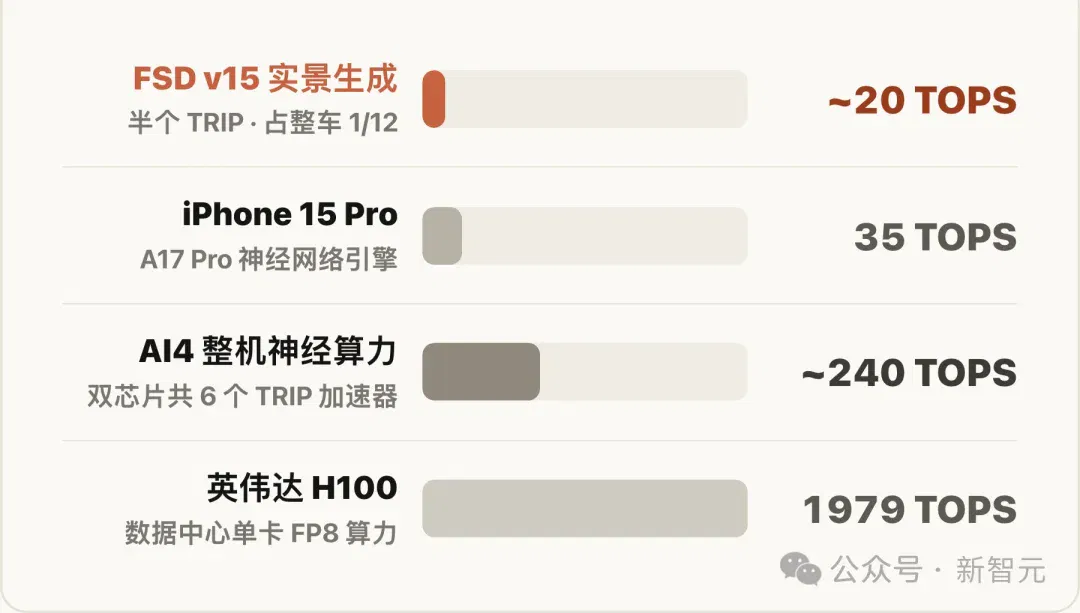
More than 90% of onboard AI compute therefore remains firmly reserved for safe driving itself.
For comparison, even the iPhone 15 Pro, released in 2023, has a neural engine rated at 35 TOPS.
On paper, Tesla's compute budget for generating video of the outside world in real time is lower than that of a three-year-old Apple phone.
Comparing with cloud hardware, one NVIDIA H100 offers standard 8-bit compute of up to 1979 TOPS. Half a TRIP is only approximately 1% of a single H100, or just 2% even under the most generous estimate.
The singularity is here, and the creator of Unreal Engine is astonished
As is well known, Musk's cars and humanoid robots use the same underlying system.
In the very first line of FSD v15's official release notes, Tesla made it explicit—
FSD passenger vehicles, Robotaxi vehicles, and Optimus humanoid robots now share the same upgraded Universal Vision Encoder (UVE).
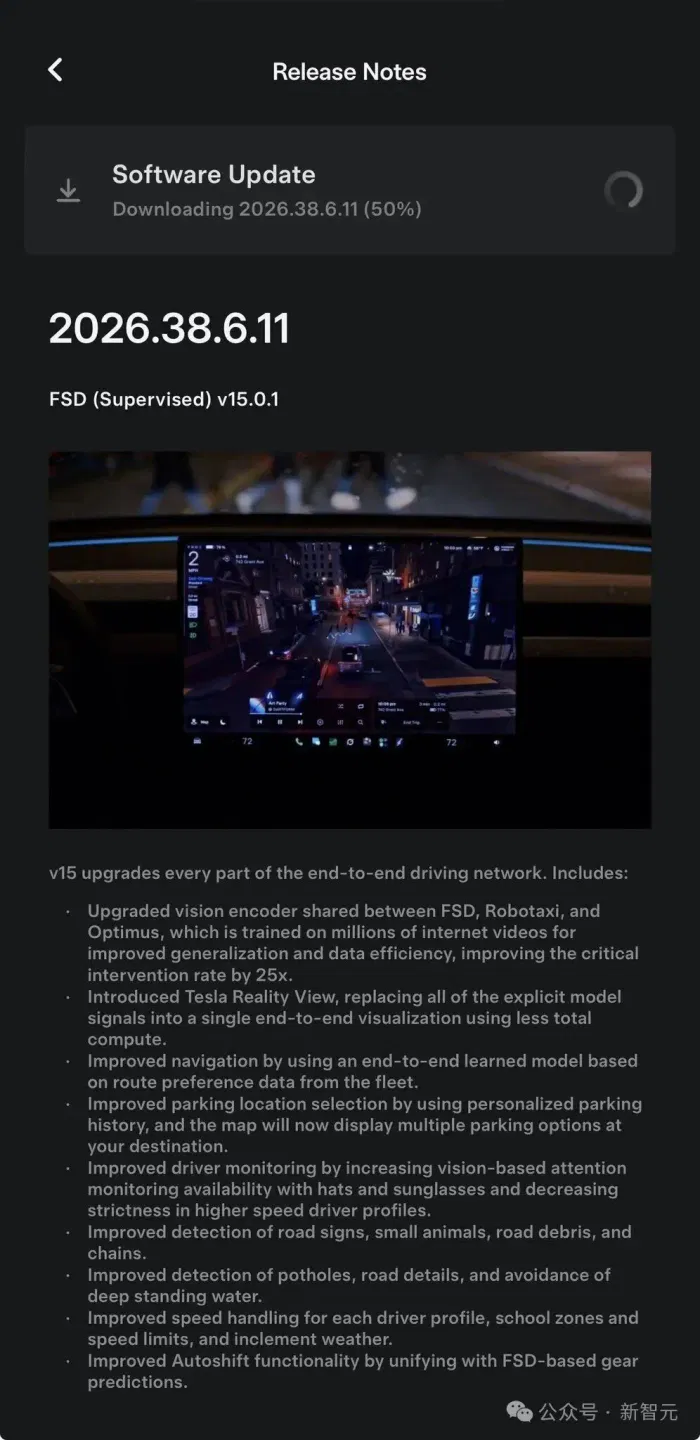
This "three-in-one" visual brain was trained on millions of internet videos.
The report also cites a claim of a 25-fold improvement in safety-critical cases. The metric's definition, direction, comparison baseline, and test conditions still await verification against accessible primary material; no direct conclusion about safety can be drawn from it.
As for the next step, AI4 is sufficient for cars, while the strongest next-generation AI5 will be prioritized entirely for Optimus humanoid robots.
A software update for a car quickly caught the attention of much of Silicon Valley and the gaming world.
Epic Games founder and Unreal Engine creator Tim Sweeney, who has spent his career on 3D graphics engines, exclaimed—
"World models have left traditional game engines far behind."
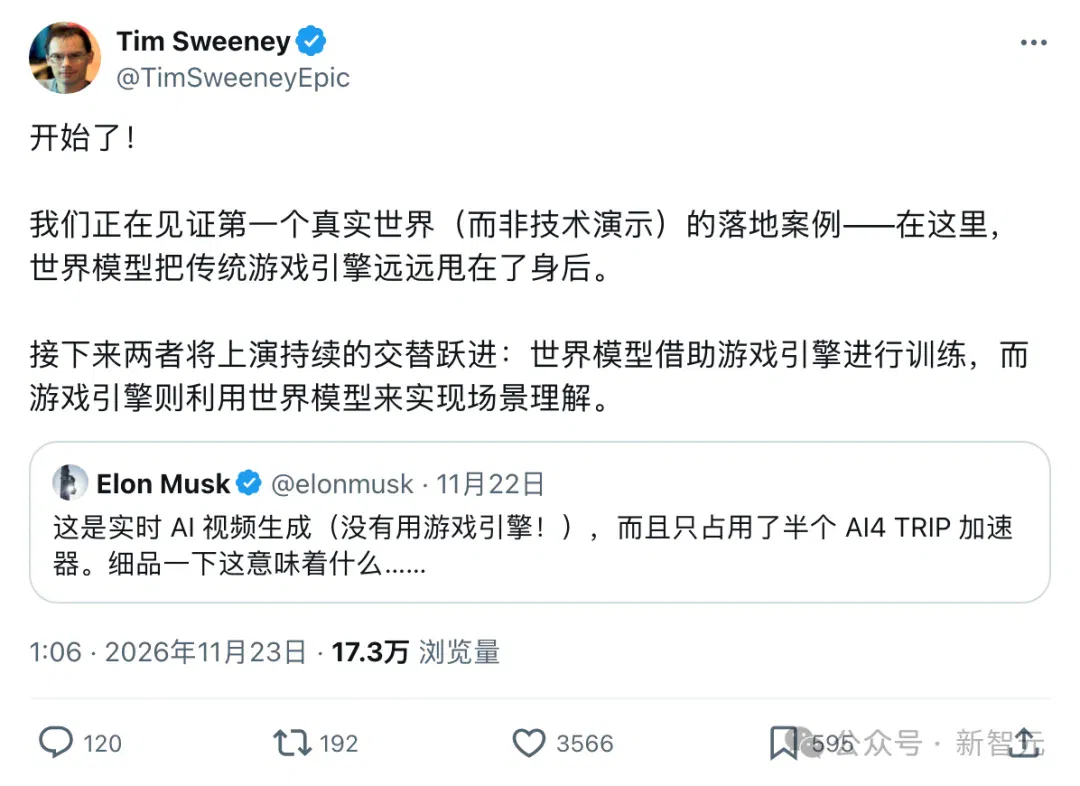
Even a creator of 3D game engines has to acknowledge that the gears of the era have shifted.
No wonder that, on the same day, Musk exclaimed twice in succession: "Welcome to the singularity!"
On one side, AI has cracked the Riemann Hypothesis, breaking through the ceiling of the purely numerical mathematical universe. On the other, FSD v15 connects to a world model to redraw the world in real time on actual streets.
Virtual simulation and physical reality have formally converged at this moment.
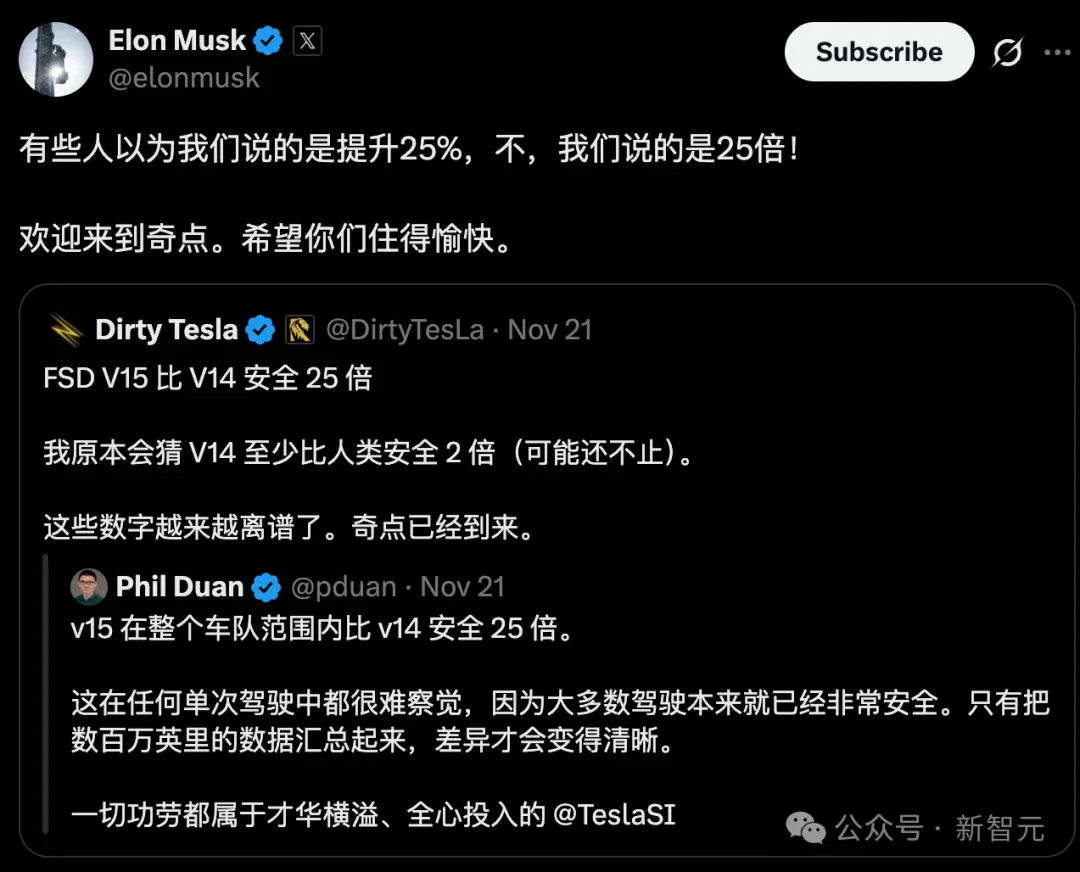
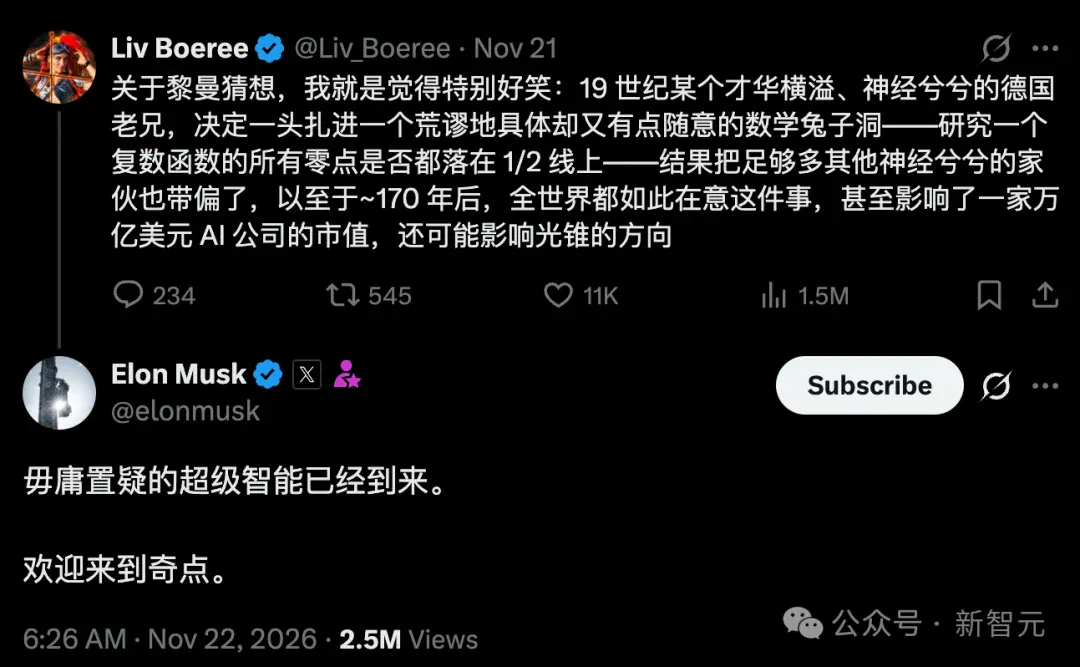
From simple dots, lines, and stick figures to real-time AI rendering, Tesla needed just six years.
At this pace, the script for driving may soon be rewritten.
With the steering wheel handled by a neural network and the streetscape by a diffusion model, the human in the driver's seat must still continuously supervise the road and system and take over immediately when needed, rather than merely watch the generated imagery!
References:
https://x.com/Tesla/status/2124222447855743019
This article is from "Xinzhiyuan," by "Moxi" and "Taozi."
Related topics
After reading
Join the AINRK community
Read how to join the community and connect with people working in AI.
Related articles
Continue reading related topics and articles in this category.

Yoroll Launches Interactive Short-Drama Adaptation Tool; Guaranteed Deals Depend on Project Terms (opens in a new tab)
Yoroll adapts finished short dramas with branches, generated shots and compositing, illustrated by the 30-episode Clutch Time. Platform guarantees depend on tiers, exclusivity and other terms; one-click adaptation does not ensure a guarantee, reliable output or distribution income.
Alpöge says “250,000 pages” was a joke, addresses Riemann-proof code criticism (opens in a new tab)
Levent Alpöge says the “250,000-page” proof was a joke and acknowledges redundant, low-quality Lean code in his work with Claude. He argues that its ideas should lead to a more natural, concise mathematical framework; code quality and formal correctness remain distinct.

Diedieshe explores screen-aware AI comment overlays and customizable companions (opens in a new tab)
Diedieshe uses floating AI comments for screen-based tips and character companionship in reading, gaming and daily use. Value depends on accuracy and disruption; this review could not verify the reported 10 million users or four-second response claims.
Ant Ling launches the LingSante health-model family and releases two core models’ weights (opens in a new tab)
Ant introduces LingSante, releasing weights for 560B flash and 124B air-VL alongside Afu video interaction and doctor tools. The article’s examples and developer benchmarks do not establish clinical validity; deployment needs suitable hardware and professional review.
Dario’s early “immersive games” idea draws criticism; media accounts are distinct from company policy (opens in a new tab)
The article revisits media accounts of Dario’s early OpenAI discussions and critiques his views on AI jobs, safety and Anthropic’s culture. The idea is not current company policy; online speculation about his health lacks reliable evidence.