Alpöge says “250,000 pages” was a joke, addresses Riemann-proof code criticism

Levent Alpöge says the “250,000-page” proof was a joke and acknowledges redundant, low-quality Lean code in his work with Claude. He argues that its ideas should lead to a more natural, concise mathematical framework; code quality and formal correctness remain distinct.
Editorial check (2026-11-24): The generalized Riemann hypothesis here should be understood within the verified scope of Dirichlet L-functions, not extended to conclusions about every type of L-function. Redundant code, the completeness of natural-language explanations, formal proof correctness and recognition by the Clay Mathematics Institute are separate issues. MIT verification record (opens in a new tab)
Over the past few days, discussion of Claude’s involvement in proving the Riemann hypothesis has swept through much of the technology and mathematics worlds. One especially popular detail was the claim that translating the proof into human-readable text would produce more than 250,000 pages.
The person at the center of the story has now clarified that the supposed 250,000 pages were a joke.
Anthropic mathematician Levent Alpöge has just published a lengthy post on X responding to the controversies surrounding the Riemann-hypothesis proof and reflecting on mistakes he made in announcing the result.
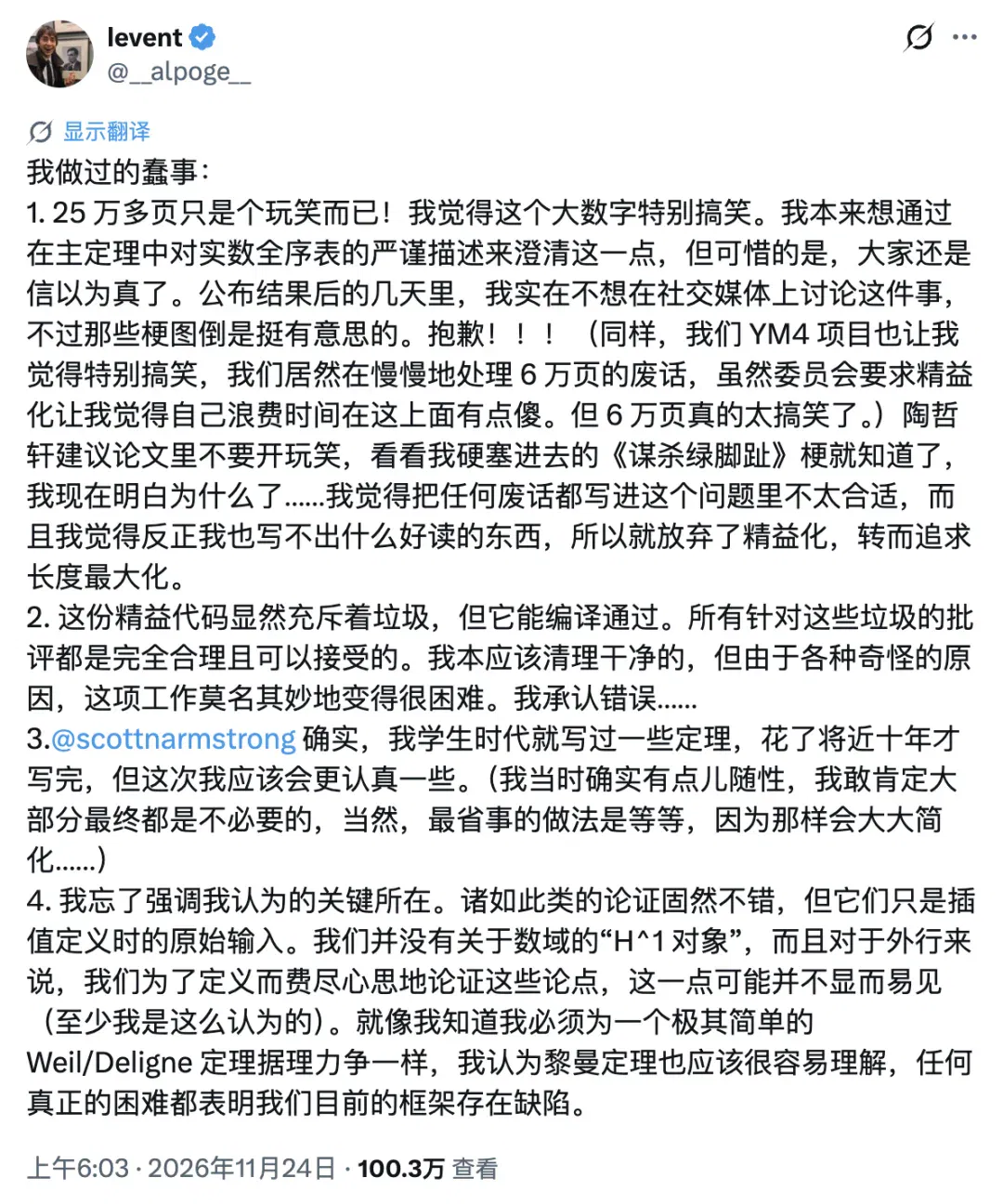
Image | 🔗 https://x.com/__alpoge__/status/2124987173439209561
“Folks, the more than 250,000 pages was a joke! I just find really large numbers very funny.”
Alpöge said he thought that his deliberately cumbersome description of the total ordering of real numbers in the main theorem would make the humor obvious. Instead, people took the number as fact and spread it widely.
He had not wanted to post on social media in the days following the announcement, so he did not clarify immediately, although he did see plenty of memes. “Terence Tao advises against making jokes in papers. Now I finally understand why.”
250,000 pages was a joke, but 17.37 million lines of code are a real challenge
The story goes back to November 20.
That day, Alpöge announced on his personal website that he and Claude had completed formal proofs of the Riemann hypothesis and generalized Riemann hypothesis.
According to the previously disclosed information, the project began on October 6 and lasted about 41 days. Alpöge and Claude completed the final step of the core proof on November 15, then extended the result to the generalized Riemann hypothesis on November 16.
Rather than following the traditional way of announcing mathematical research with a complete natural-language paper, Alpöge published only a four-page explanatory note, accompanied by an enormous Lean formal-proof codebase.
Previously disclosed counts put the codebase at 175,187 Lean source files and about 17.37 million lines of code, distributed in 14 compressed archives for others to download.
Lean is a formal proof assistant whose computer kernel can check whether mathematical reasoning follows strict logical rules. It lets mathematicians turn theorems, definitions and reasoning steps into machine-checkable code.
On November 21 local time, the Lean and Mathlib communities issued a joint statement expressing full confidence in the formal proof’s correctness. MIT mathematician Andrew Sutherland also independently checked the relevant code.
Passing formal verification, however, is different from mathematicians fully understanding the ideas, completing peer review or the Clay Mathematics Institute formally recognizing the result.

In his latest response, Alpöge also acknowledged substantial redundancy and quality problems in the Lean code he submitted.
“There is obviously a lot of junk in the Lean code. Although it compiles, all criticism of that junk code is reasonable, and I fully accept it.”
He said he should have cleaned up the code before publishing, but for various reasons the work proved much harder than expected.
Responding to questions about progress on organizing the proof, Alpöge admitted that even as a student he had once spent nearly a decade writing up theorems he had already proved. For a result as important as the Riemann hypothesis, however, he felt he should have been more responsible.
He also said much of the current proof might ultimately be unnecessary. As researchers better understand its structure, the whole argument may be substantially simplified.
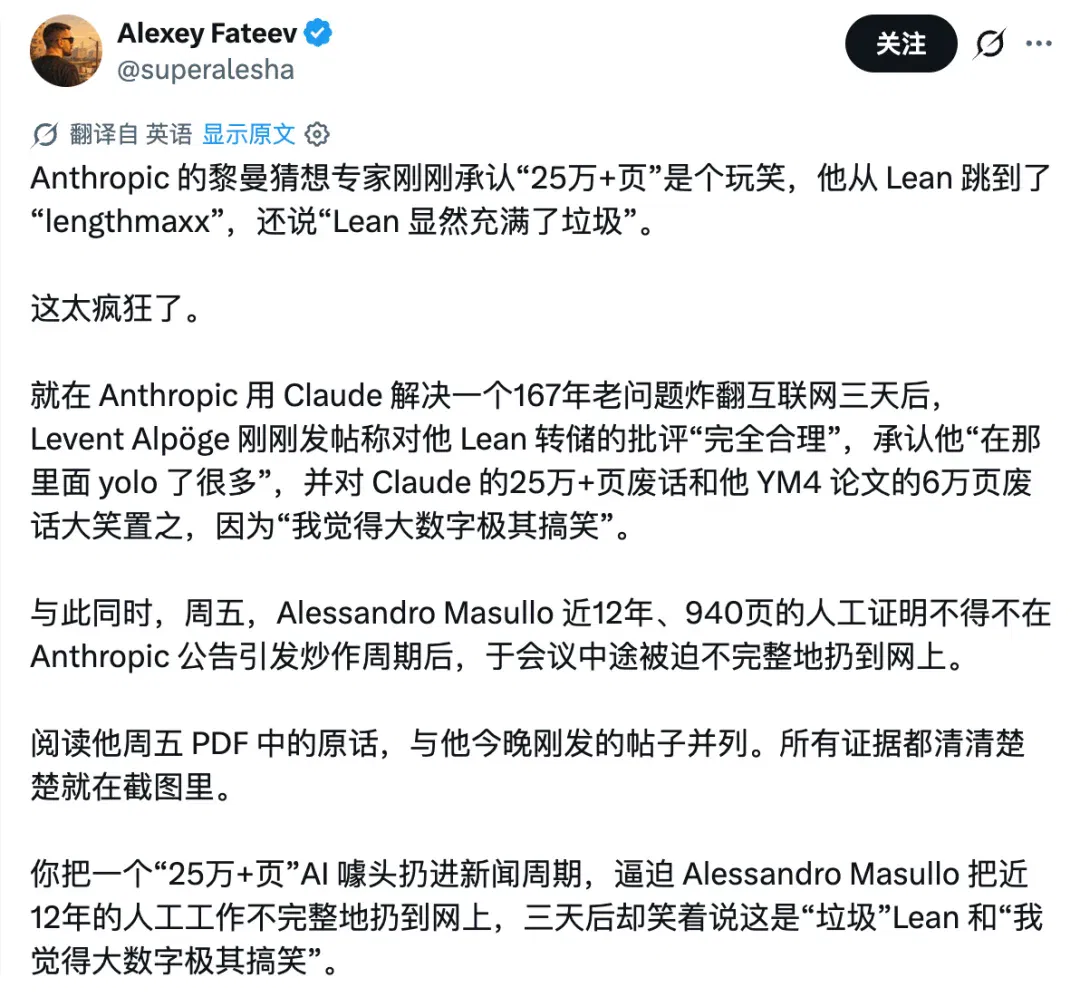
X user Alexey Fateev criticized him, however, arguing that the publicity generated by Anthropic had pressured another mathematician, Alessandro Masullo, to release early a 940-page manuscript claiming a proof of the generalized Riemann hypothesis, after nearly 12 years of work.
Against that backdrop, explaining the “250,000 pages” as a joke seemed somewhat irresponsible, in that criticism.
What matters beyond proving the Riemann hypothesis
Alongside responding to the controversy, Alpöge added a mathematical point that he felt he had not emphasized enough when announcing the result.
In his view, proving the Riemann hypothesis matters, but the mathematical ideas produced along the way should also serve a deeper goal: developing more natural, unified definitions and theoretical frameworks.
For example, mathematics does not yet have an H¹ object over number fields that fits his vision. Alpöge believes one important reason mathematicians invest so much effort in complex arguments is to accumulate material for building new mathematical concepts.
He hopes the Riemann hypothesis will eventually have a more natural and concise proof, just as he previously sought simpler ways to understand the theories of Weil and Deligne.
“I think the Riemann hypothesis should be easy. Any genuine difficulty may mean that the theoretical framework we currently use is not good enough.”
Here, “easy” means that the proof might become natural and concise within a suitable framework. It does not deny the difficulty of a problem that has challenged mathematicians for 167 years.
Claude had already made research progress related to the Riemann hypothesis in August this year.
At the time, Anthropic announced that Claude had independently completed a mathematical research project raising the lower bound on the proportion of nontrivial zeros of the Riemann zeta function on the critical line from 41.6% to 67.2%.
Anthropic also explicitly said that the approach was not expected to prove the full Riemann hypothesis directly.
By contrast, the result announced in November involved collaboration between a human mathematician and AI: Alpöge guided the research direction, while Claude undertook extensive derivations and formalization.
According to Alpöge’s earlier account, Claude was advancing the argument faster than he was near the end. When the full formal proof was completed, he had still not fully absorbed some of its mathematical details.
In a sense, the confusion over a 250,000-page proof exposed a question that is becoming increasingly hard to avoid as AI enters frontier mathematics.
Mathematicians used to spend enormous amounts of time finding a proof; once they found it, the research had made decisive progress. But as AI participates at scale in mathematical derivation, proof generation may become much faster than human understanding.
A computer can check whether an argument holds. Extracting new concepts from complex derivations, finding more concise proofs and turning the ideas into knowledge that can inspire other research still require substantial work.
As AI accelerates the answering of mathematical questions, the next challenge for human mathematicians may be how to make those answers part of human knowledge.
This article is from the WeChat account “APPSO,” by “APPSO.”
Related topics
After reading
Join the AINRK community
Read how to join the community and connect with people working in AI.
Related articles
Continue reading related topics and articles in this category.

Claude 推出表格与白板工具,更新数据分析和应用连接 (opens in a new tab)
Anthropic 公布 Claude Sheets、Whiteboards 及 Data 更新,覆盖表格编辑、团队构思和数据解读。部分能力分批推出,连接器及账号条件各有不同。

Dario’s early “immersive games” idea draws criticism; media accounts are distinct from company policy (opens in a new tab)
The article revisits media accounts of Dario’s early OpenAI discussions and critiques his views on AI jobs, safety and Anthropic’s culture. The idea is not current company policy; online speculation about his health lacks reliable evidence.
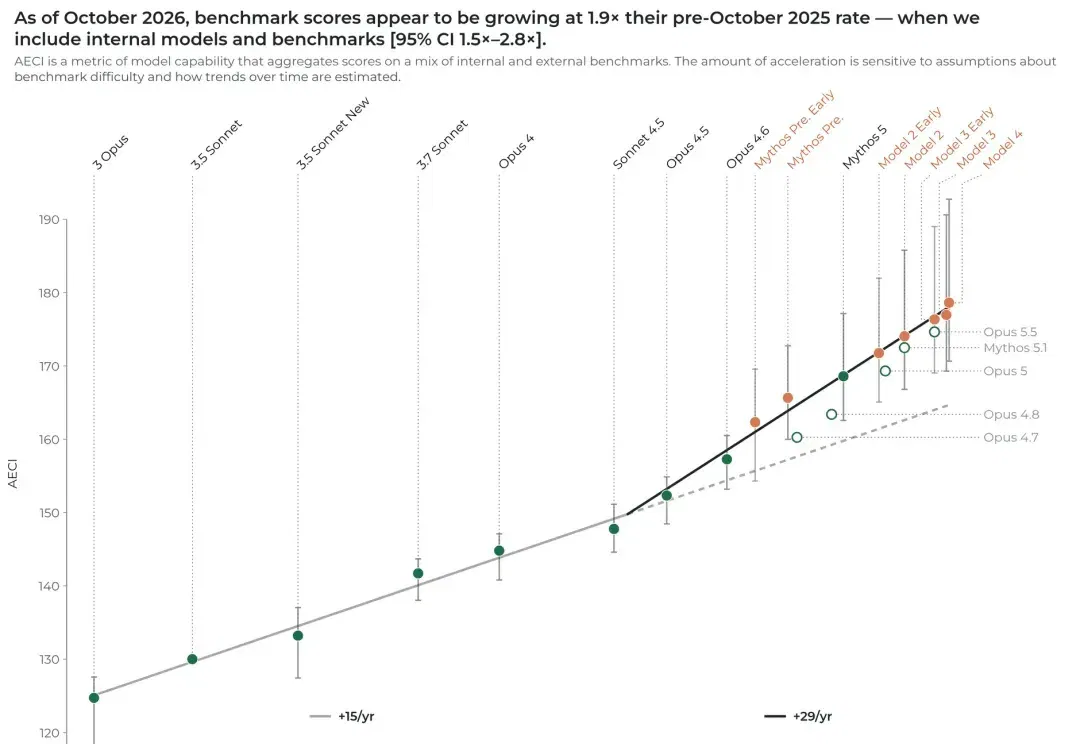
Anthropic’s internal models: METR reports faster R&D; unreleased products remain unconfirmed (opens in a new tab)
METR estimates Anthropic’s AECI progress at about 1.9× its previous pace, with uncertainty over causes and broader applicability. Reports of stronger internal models, Model 5 or future leaps are not confirmed product or release announcements.

Report revisits Dario Amodei’s early AGI risk estimate and Anthropic’s safety culture (opens in a new tab)
A commentary citing a Washington Post investigation and social-media accounts examines Amodei’s 2022 memo, Anthropic’s culture and IPO pressures. The 20%–30% figure was his subjective estimate of human destruction or permanent stagnation, not an objective probability.

Podcast recounts Anthropic equity offer as AI talent competition meets model criticism (opens in a new tab)
On All-In, Calacanis recounted a reported US$40 million four-year equity offer to a new CS graduate. The article also reviews GPT-6.2 Astra criticism, rankings and financing reports. The offer is not a verified cash salary; morale claims are secondhand.