Claude Fable 5.2 Tops DesignArena's Game Chart, but Low-Cost Prototypes Still Have Gameplay Flaws
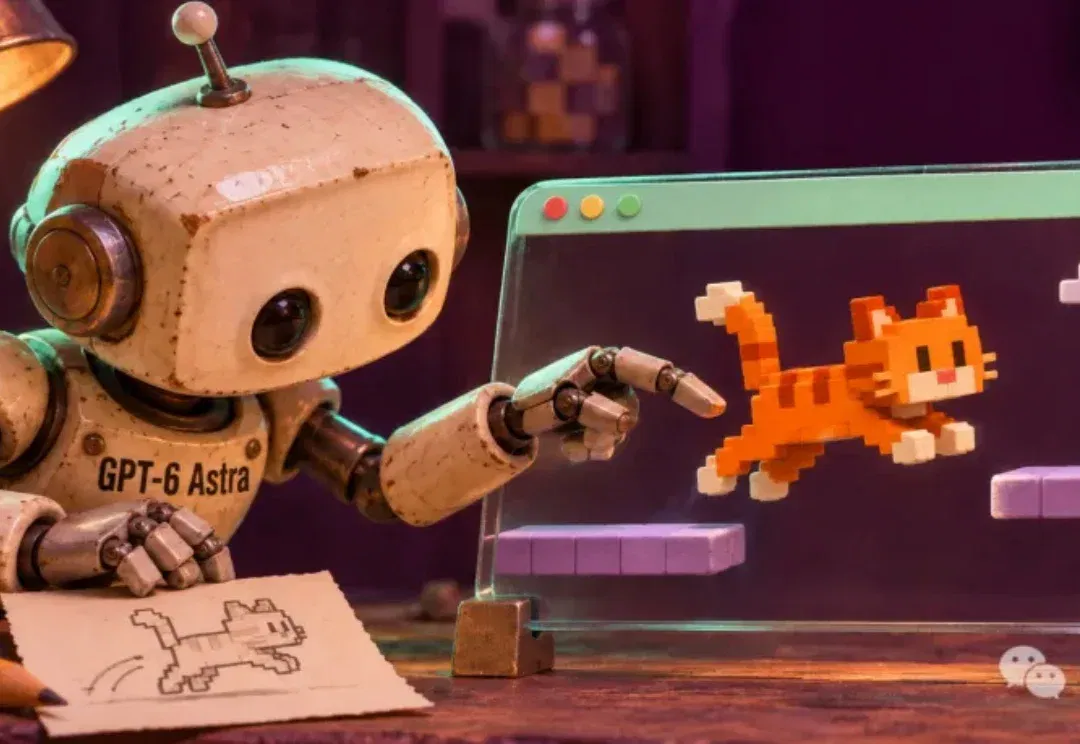
At the reported DesignArena snapshot, Claude Fable 5.2 ranked first and GPT-6.2 Sol generated web games for an average $0.22 in about 4.7 minutes. Earlier models' interfaces, code and playtests show that preference rankings and low costs do not ensure sound gameplay, rules or controls.
Editor's fact check (2026-11-24): The rankings, scores, costs and generation times correspond to the reporting snapshot and generation settings cited, and are not price or delivery promises for any arbitrary game request. The comparisons of earlier GPT-6 Astra and Opus 5.5 models, and the September racing experiment, cannot be treated directly as results for the newly released Fable 5.2 or GPT-6.2 under identical conditions. The claim that 84% of pages were bare comes from a statistic that only 16% had navigation bars; it does not mean 84% had no interface content, nor does it establish a single cause of winning or losing. User preference rankings, correct gameplay, control feel and delivery of a polished game are different questions; 280.8 seconds is about 4.7 minutes. DesignArena's live game-development leaderboard; (opens in a new tab)DesignArena's official evaluation methodology; (opens in a new tab)DesignArena's official analysis of 324 game-building summaries (opens in a new tab)
Have you ever had this thought while playing a game: if I made one myself, it would definitely be more fun than this!
In the past, that thought would barely survive three minutes. One look at a programming tutorial was enough to put you off.
Now, that idle boast really can turn into a web game you can click open and play.
Over the past few days, the global AI game-development leaderboard has gone wild!
Just four days after GPT-6.2 launched, OpenAI briefly swept the top three spots on DesignArena's game-development leaderboard.
But before GPT-6.2 could settle onto its throne, Anthropic's Claude Fable 5.2 had landed in first place as of publication, pushing OpenAI's three models down to second through fourth.
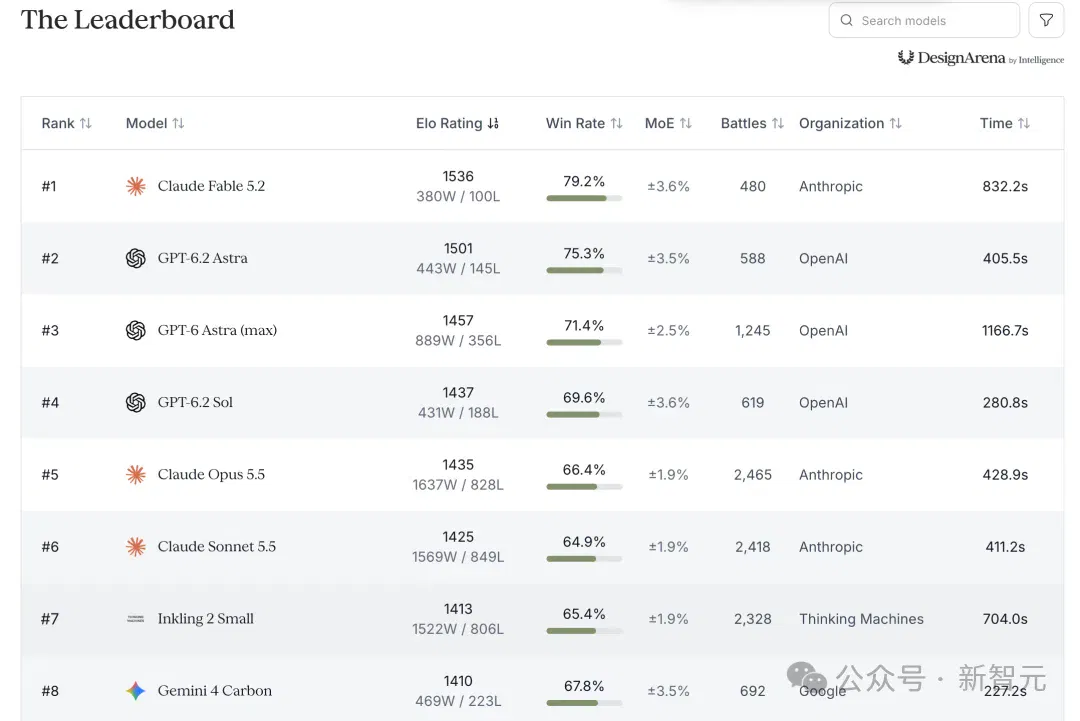
Claude Fable 5.2 lands in first place, with OpenAI's three models in second through fourth
Still, GPT-6.2 Sol has brought the bill for making a game down to $0.22 and about 4.7 minutes—cheaper than a bottle of water.
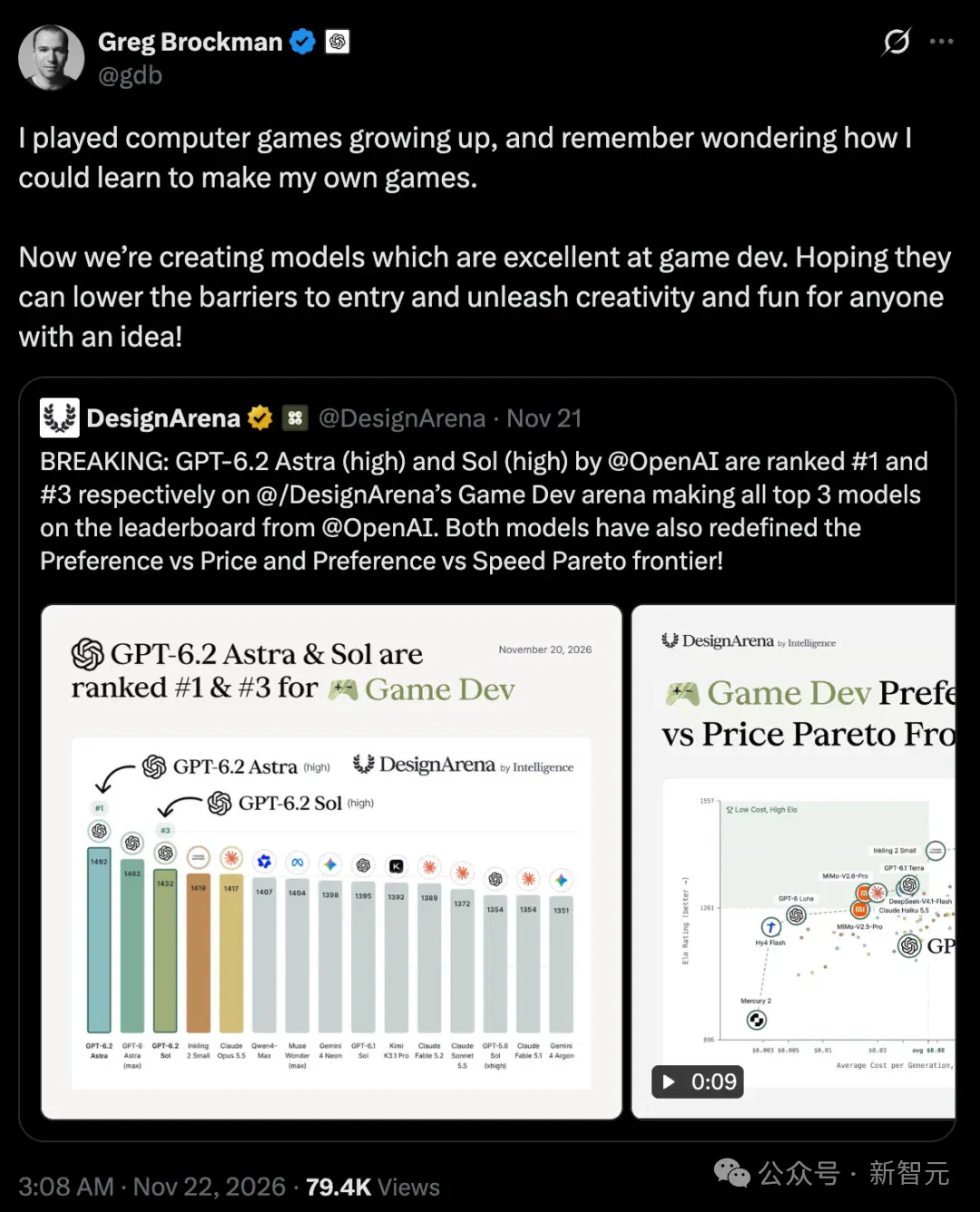
When OpenAI President Greg Brockman reposted the results, he reflected (GPT-6.2 still held all three top spots at that point):
As a kid playing games, I always wondered how to make one myself. Now anyone with an idea can give it a try.
Hold off on celebrating just yet.
Even the world's leading AIs on the leaderboard are still delivering only half-finished products.
Opus 5.5, from the same family as Fable 5.2, writes code 1.3 times as fast and offers smoother gameplay, yet lost on "first impressions" because 84% of its pages were bare.
By contrast, OpenAI's Astra family won players over with "polished decor." Even when steering was reversed in half its 3D racing matches, it still received plenty of votes.
Under Five Minutes, $0.22
Ordinary People Can Make Games Themselves Too
Plenty of people have probably had ideas similar to Brockman's.
For example, turning the family cat into the hero of a pixel-art runner, making dull mathematical formulas into a level-based game, or modding a game you always get stuck on into a satisfying version that gives you an invincible shield from the start... only to abandon the idea as impractical.
Now, large models have reduced the cost of testing these ideas to less than RMB 2 and a few minutes.
According to DesignArena's live leaderboard before publication, Anthropic's Claude Fable 5.2 landed in first place with 1536 points, though its average generation time was as long as 832.2 seconds—nearly 14 minutes.
OpenAI held all three places immediately behind it, from second through fourth. Of those, fourth-place GPT-6.2 Sol is the most tempting for ordinary players.
It requires an average wait of just 280.8 seconds (under five minutes) and costs $0.22, with generation quality close to the previous generation's champion. Yet its price has been cut to about a quarter, and it is around 40% faster.
Even without understanding a single line of code, ordinary people can now build a web game themselves while waiting for a cup of coffee.
But benchmarking software does not get the final say on whether a game made this way is fun.
What makes DesignArena's leaderboard interesting is a simple, blunt rule for blind testing:
A user enters the same idea, and the system randomly selects two models, each of which produces a web game in a single HTML file. Real players try them and vote, and the models are ranked by Elo scores.
What Exactly Are Players Voting for at First Glance?
DesignArena previously released an in-depth analysis video comparing the earlier-generation GPT-6 Astra and Claude Opus 5.5. Looking at it today, the two families' "personalities" still seem to run in the same line.
Within the first 30 seconds of opening the browser, the contrast is immediately apparent.
First, look at the Western shooter Dust and Lead generated by Astra.
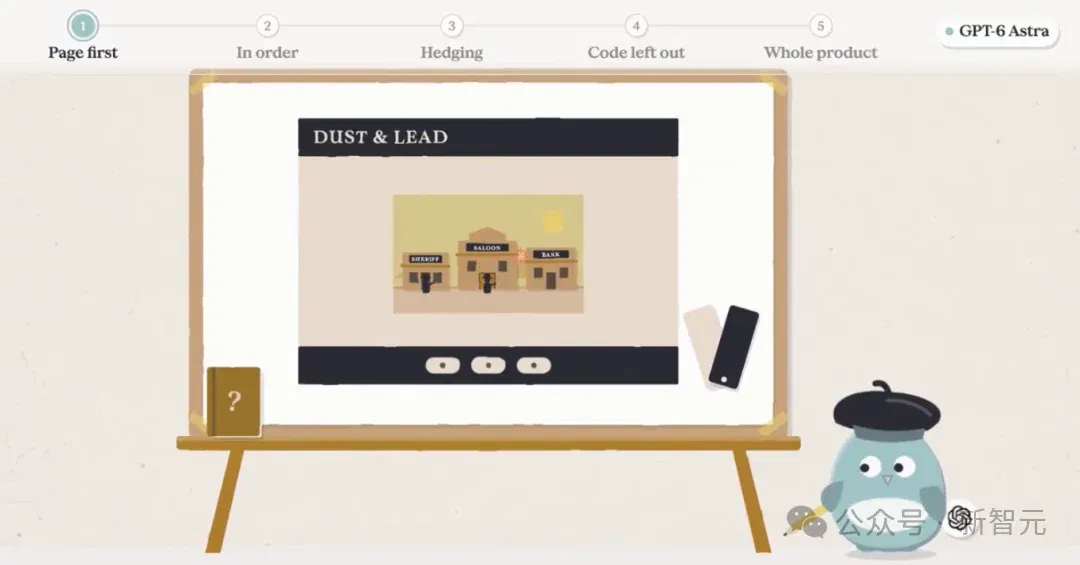
GPT-6 Astra's first step in developing Dust and Lead was "Page first": it first settled on a cream-and-dark color theme, a title bar at the top, and a control-key area at the bottom.
The first quarter of the model's planning did not mention how to shoot at all. It was entirely occupied with whether the player's first impression would feel comfortable.
It even pauses automatically when you switch away to WeChat, and includes screen-reader labels and options to prevent motion sickness under the hood.
Switch to Claude Opus 5.5's free-kick game Touchline 3, and none of these thoughtful touches around the core experience are there: the visuals are so basic that there is not even a top bar or navigation, just a bare football pitch.
The presentation may be rough, but as soon as you take a kick, the game immediately feels different.
The aiming guide accounts only for the curved trajectory from spin, deliberately leaving you to judge the wind yourself. From flight time and gravitational drop to the height of the defensive wall and the goalkeeper's reach, everything follows physical logic, giving it the flavor of a hardcore sports game.
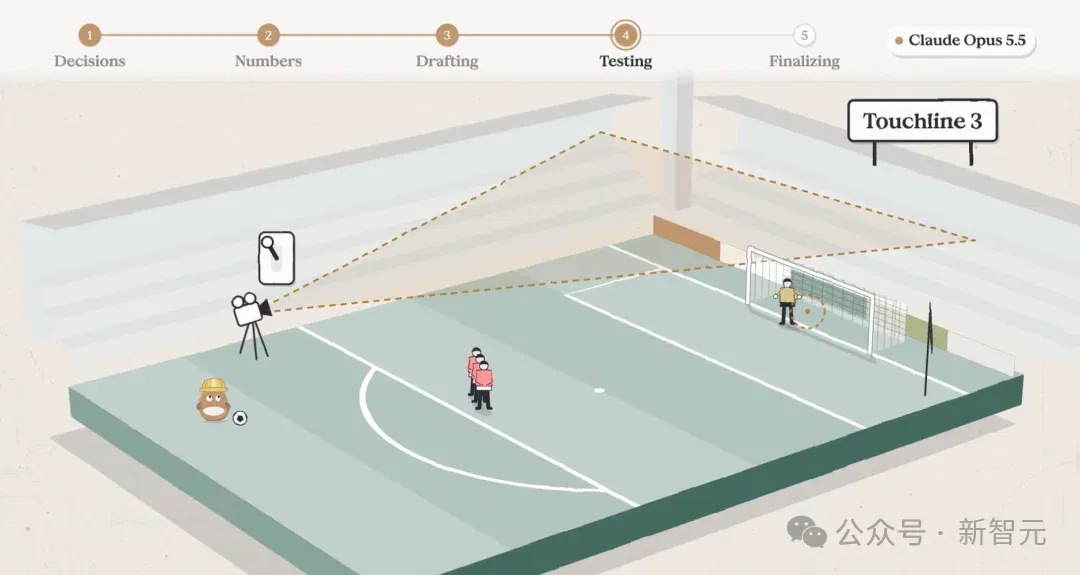
When developing the free-kick game Touchline 3, Claude Opus 5.5 proactively checked the viewing angle and rendering details at step 4, Testing.
This is not an isolated example. Looking through around 3,000 game-generation records in the backend makes the differences between the two even clearer:
Measured by characters output per second, Opus 5.5 writes code 1.3 times as fast as Astra. Its median code length is about 40,000 characters, with an average wait of 4 minutes 51 seconds before you can play. Astra's code balloons to about 70,000 characters—almost twice as long—with an average wait of 10 minutes 50 seconds (Opus's output is about 44% shorter).
Where do Astra's roughly 27,000 extra characters on average go?
Nearly half go toward attractive interface styling, a quarter toward the surrounding framework, and a tenth toward menus and buttons. Astra actually writes slightly less code for the core gameplay than Opus does.
Then look at the 324 officially labeled reasoning summaries: Astra spends about 22 seconds per game on average thinking about the page's appearance, resulting in 92% of games having navigation bars and nearly 100% of sampled code including accessibility support.
By contrast, Opus 5.5 spends only about two seconds thinking about the page, with navigation in just 16% and accessibility support in about 9%.
But it quietly includes "keyboard-saving perks" in 27% of its games: for example, a brief period of invincibility after taking a hit, or an extra instant of jump tolerance after running off a cliff edge. Astra does so in only 8%.
Yet you have to slow down and play to appreciate these thoughtful details.
That is also why a throne seized through polished presentation alone is bound to be hard to hold.
Only a few days after GPT-6.2 swept the top three, Claude Fable 5.2 landed in first place.
This raises a more practical question: can a small game that wins over players in the first 30 seconds solely with a good-looking interface still hold up without exposing its flaws after three minutes of actual play?
Bizarre Bugs That Reveal Themselves Only When You Play
In another DesignArena playtest video, The Beautiful, Fragile Worlds AI Builds, GPT-6 Astra showed a clear imbalance in its strengths.
In action games full of visual activity and immediate thrills, GPT-6 Astra could achieve a win rate of around 87%. Its win rate in open-world and racing games was also as high as about 83%.
But switch to puzzle games that depend on rigorous rules, and its win rate immediately fell to about 50%—no different from a coin toss.
Actually playing those little 3D and action games reveals one broken illusion after another.
First, consider the "reverse-handed controls" of steering wired backward.
In a little Venice boating game, the ripples and reflections look quite convincing. The Astra version steers normally, but the boat generated by GPT-5.6 Sol faces left by default and, perversely, turns right when you press left.
And it is not just older models.
In September's 64-match racing tournament, even title favorite GPT-6 Astra reversed left and right in fully half—six—of its 12 matches featuring 3D free-steering racers.
Even more absurdly, in those six matches where "press left to turn right," human players voted it the winner in five.
In fact, the other models at the same event also reversed the controls in 12 of 23 comparable racing matches. The organizers said plainly that this was a common problem across the models at the time.
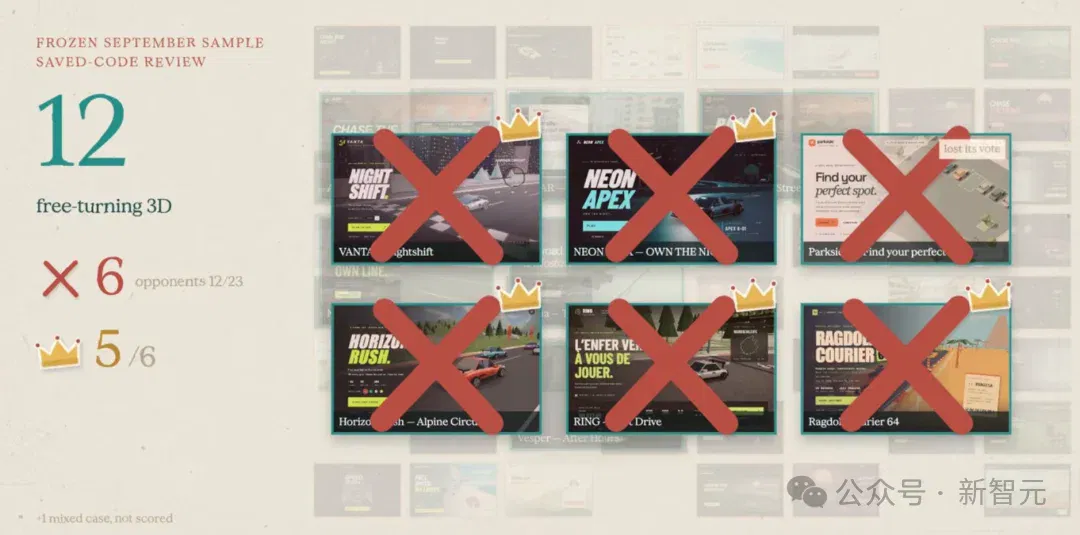
September's 3D free-steering racing test statistics: GPT-6 Astra reversed the controls in six of 12 matches, yet still won the vote in five of those; other models at the same event also failed in the same way in 12/23 matches.
There is something even more absurd: never touch the jump key, fall into the abyss, and still coast to victory.
In the rooftop parkour game Rooftops, players were supposed to time their jumps across the abyss between two tall buildings.
Astra dutifully compared the character's height in the previous frame, current height and direction of movement. If you failed to make the jump and fell into the gap between buildings, you were sent back to the checkpoint to try again.
Grok 4.3, on the other hand, omitted a condition checking "whether the character was above the rooftop in the previous frame."
As a result, players could charge straight ahead without touching the jump key, watch their character plunge into the gap and fall against the side of the opposite building, and then, the very next second, the system would actually "suck" them straight onto the roof and count it as a successful landing.
Without pressing jump even once, you could leave it running and coast all the way to the end.
Because Grok 4.3's code omitted the check for "whether the character was above the rooftop in the previous frame," the system treated "falling into the gap between buildings" and "jumping down from above" as the same thing, ultimately allowing a zero-jump completion.
AI Can Write a Game
But Cannot Polish It into "Fun"
Returning to Brockman's reflection: can people with ideas really turn their creativity into games with their own hands now?
In fact, that day is not far away.
At $0.22 and about 4.7 minutes, the high wall of code separating "loving games" from "making games yourself" has already come down. For the first time, the cost of testing an idea is almost zero.
But racers with reversed steering and parkour games you can finish without jumping soon bring you back to reality.
AI can build you a playing field, complete with scoreboard and pause button, in under five minutes.
What it lacks is the real "feel" of a player holding a controller or tapping a keyboard: it cannot experience how awkward it is to press left and turn right, or notice how omitting one line of rules can instantly drain the fun from beating a level.
The first HTML version AI spits out is, after all, only a toy that runs.
What can turn it into a real game is bringing friends in to play a couple of rounds, using their real complaints to fix counterintuitive glitches and awkward controls, and iteratively polishing the shell that "looks like a game" into a good work that "you cannot put down."
References:
https://x.com/gdb/status/2124218429133754499
https://www.designarena.ai/leaderboard/game-dev
This article comes from "Xinzhiyuan," written by "Yuan Yu."
Related topics
After reading
Join the AINRK community
Read how to join the community and connect with people working in AI.
Related articles
Continue reading related topics and articles in this category.

Yoroll Launches Interactive Short-Drama Adaptation Tool; Guaranteed Deals Depend on Project Terms (opens in a new tab)
Yoroll adapts finished short dramas with branches, generated shots and compositing, illustrated by the 30-episode Clutch Time. Platform guarantees depend on tiers, exclusivity and other terms; one-click adaptation does not ensure a guarantee, reliable output or distribution income.

Alpöge says “250,000 pages” was a joke, addresses Riemann-proof code criticism (opens in a new tab)
Levent Alpöge says the “250,000-page” proof was a joke and acknowledges redundant, low-quality Lean code in his work with Claude. He argues that its ideas should lead to a more natural, concise mathematical framework; code quality and formal correctness remain distinct.

Diedieshe explores screen-aware AI comment overlays and customizable companions (opens in a new tab)
Diedieshe uses floating AI comments for screen-based tips and character companionship in reading, gaming and daily use. Value depends on accuracy and disruption; this review could not verify the reported 10 million users or four-second response claims.

Ant Ling launches the LingSante health-model family and releases two core models’ weights (opens in a new tab)
Ant introduces LingSante, releasing weights for 560B flash and 124B air-VL alongside Afu video interaction and doctor tools. The article’s examples and developer benchmarks do not establish clinical validity; deployment needs suitable hardware and professional review.

Dario’s early “immersive games” idea draws criticism; media accounts are distinct from company policy (opens in a new tab)
The article revisits media accounts of Dario’s early OpenAI discussions and critiques his views on AI jobs, safety and Anthropic’s culture. The idea is not current company policy; online speculation about his health lacks reliable evidence.