NeurIPS 2026: ActionUNet improves VLA robustness with lightweight multi-scale fine-tuning
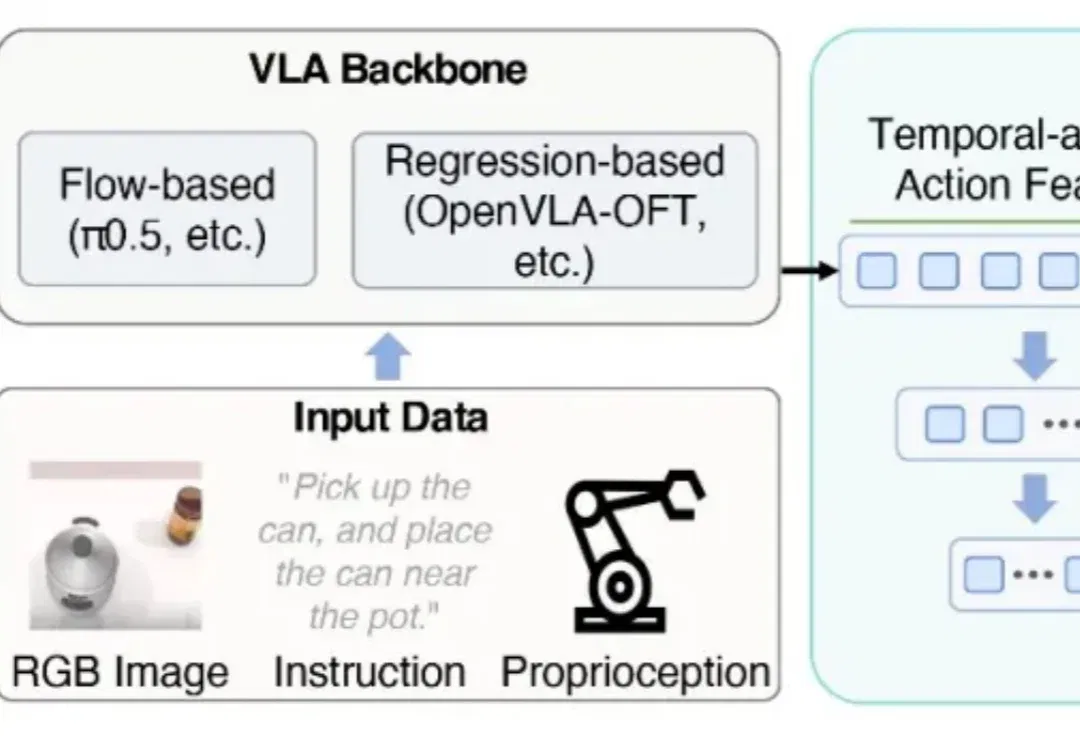
ActionUNet preserves the pretrained VLA backbone while training an action expert and lightweight multi-scale module. Experiments improve robustness under specified disturbances, with modest added policy-call latency; the new module still requires training.
The authors are from the LAMP Laboratory at the University of Chinese Academy of Sciences (UCAS). First author Zhu Di is a master’s student who enrolled in 2025; co-first author Yan Ziheng is a doctoral student who enrolled in 2024. Their main research area is embodied intelligence, particularly vision-language-action (VLA) models and robot manipulation learning.
Adviser: Wan Fang, associate professor and doctoral supervisor at the UCAS School of Computer Science and Technology.
Introduction
Large-scale pretraining gives vision-language-action (VLA) models rich visual, linguistic and action priors. Yet when these models undergo downstream supervised fine-tuning (SFT) with limited task demonstrations, they can still overfit their training environments: they complete operations in familiar settings but behave inconsistently when extra objects or scene changes appear. This article addresses how to improve VLA robustness at low cost during post-training SFT while preserving pretrained capabilities.
The LAMP Laboratory at UCAS proposes ActionUNet, an efficient multi-scale fine-tuning framework for pretrained VLAs. Rather than reconstructing the pretrained backbone, it introduces a lightweight Temporal U-Net in the action-feature space to fuse information across coarse and fine temporal scales, then generates continuous, smooth actions through a conditional SIREN decoder. Experiments on the π0.5 baseline show that ActionUNet improves average success rates in RoboTwin 2.0 Hard settings, LIBERO-Plus perturbation tests and real dual-arm robot Hard settings by 9.8, 6.1 and 11.4 percentage points, respectively.
- Paper title: ActionUNet: Improving Robustness of VLA Models with Efficient Multi-scale Fine-tuning
- Paper: https://arxiv.org/abs/2609.34982
- Code: https://github.com/Di-Zhu123/ActionUNet
Motivation
Pretrained VLAs usually first extract information from images, language instructions and robot states, then use an action expert to predict subsequent action sequences. A common approach to downstream tasks is to continue fine-tuning on a small number of demonstrations to adapt the model to specific operations. But when training samples cover only limited scene conditions, the fine-tuned policy may rely too heavily on those conditions, failing to fully exploit the general priors acquired through pretraining.
The researchers further analyze the issue through action execution. In block stacking, for example, a robot arm needs large movements to transfer an object, but small, precise adjustments when approaching the target, grasping and aligning. The paper measures action scale using end-effector displacement between adjacent recorded steps, finding differences not only between tasks but also between stages of the same task. Figure 1 illustrates this multi-scale phenomenon across tasks and stages.
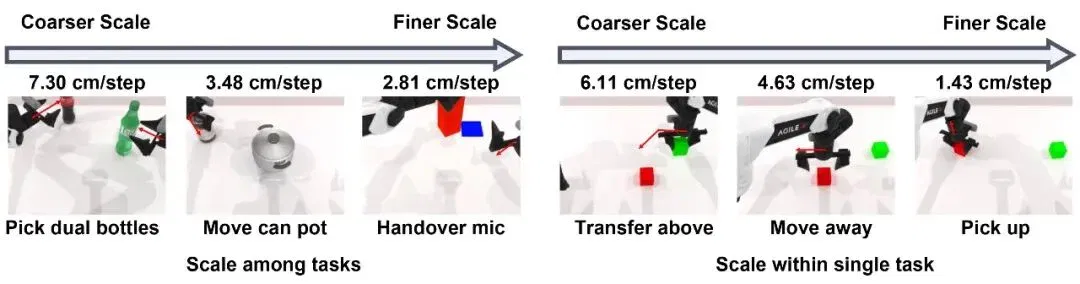
Figure 1: Differences in action scale across tasks and stages within a task.
Method
1. Multi-scale action-feature modeling with a Temporal U-Net. Action features ordered by timestep are progressively downsampled to obtain coarse-scale information about overall movement, then progressively upsampled, with skip connections preserving fine-grained action details. The resulting features contain both longer-range motion structure and the local information needed in critical manipulation stages.
2. Continuous action decoding with a conditional SIREN. After multi-scale feature fusion, directly producing actions step by step may cause discontinuous changes. The researchers represent an action segment as a continuous function queryable over time: features at each temporal position generate a local action function, and a Matérn kernel blends neighboring results with weights to reduce high-frequency jitter. For models trained with flow matching, temporally correlated noise is also used to align the training objective with the continuous action representation. This module improves transitions between actions while retaining multi-scale expressiveness.
3. Efficient fine-tuning for pretrained VLAs. Training freezes the pretrained backbone and fine-tunes only the action expert and the newly added ActionUNet. The module can integrate with the flow-matching π0.5 or the regression-based OpenVLA-OFT, without training an entire VLA from scratch. “Plug-and-play” here means architectural ease of integration; it does not mean the added module requires no training. Under identical test conditions on a single RTX 4090, adding the module raises average computation latency per policy call from 60.95 ms to 64.89 ms, an additional overhead of approximately 6.46%.
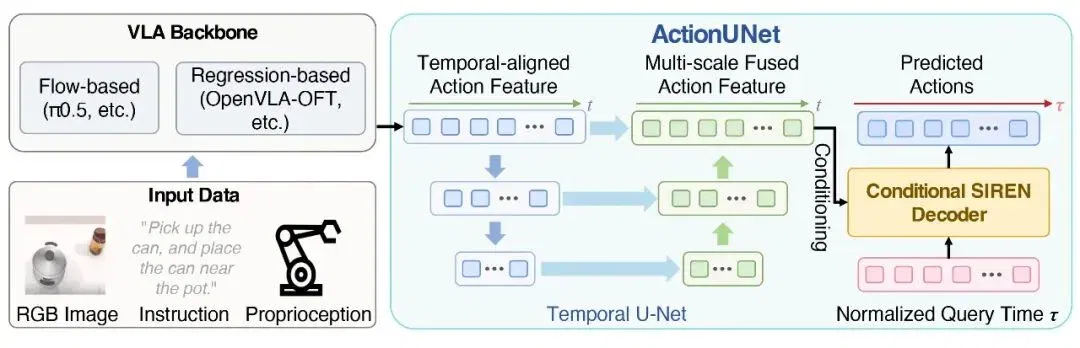
Figure 2: ActionUNet introduces multi-scale modeling and continuous decoding into the action-feature space of a pretrained VLA.
Experiments
RoboTwin Clean2Rand
In RoboTwin 2.0, the researchers selected 12 dual-arm tasks covering different combinations of action scales, fine-tuned on 50 clean demonstrations per task, and evaluated separately under Easy and Hard settings. Hard includes changes in backgrounds, lighting and distractors, allowing them to examine how models perform when moving from training conditions to more complex scenes.
With π0.5 as the baseline, ActionUNet raises average success in the Easy setting from 59.6% to 68.4%, and in the Hard setting from 29.8% to 39.6%, improvements of 8.8 and 9.8 percentage points, respectively. Overall gains are observed in single-, dual- and triple-scale task groups, indicating that multi-scale fine-tuning is not effective for only one kind of action pattern.
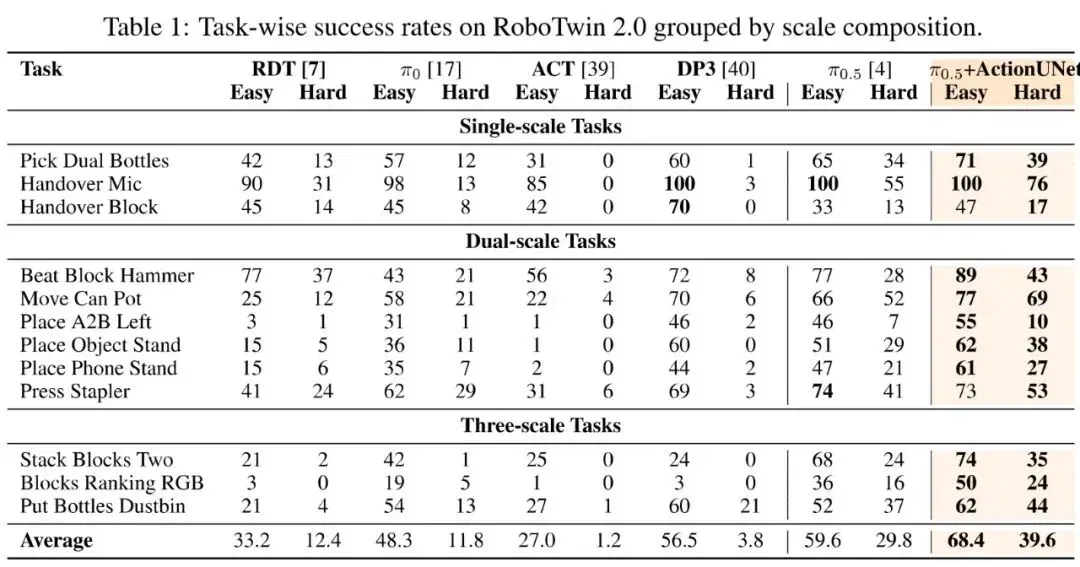
Figure 4: Success rates for RoboTwin 2.0 tasks under Easy and Hard settings (Table 1 in the original paper).
LIBERO-Plus
LIBERO-Plus adds seven categories of variation to LIBERO: cameras, robot states, language, lighting, backgrounds, sensor noise and layouts. It emphasizes generalization from clean training data to perturbed test environments. Models are first fine-tuned on standard LIBERO, then tested directly on LIBERO-Plus.
On π0.5, ActionUNet raises average LIBERO-Plus success from 65.8% to 71.9%, with improvements across all seven perturbation types. On OpenVLA-OFT, average success also rises from 60.9% to 64.6%. On standard LIBERO, average success after adding ActionUNet reaches 97.7% (π0.5) and 98.6% (OpenVLA-OFT), respectively. These results indicate that multi-scale fine-tuning can improve performance under perturbations while maintaining strong performance on standard tasks.
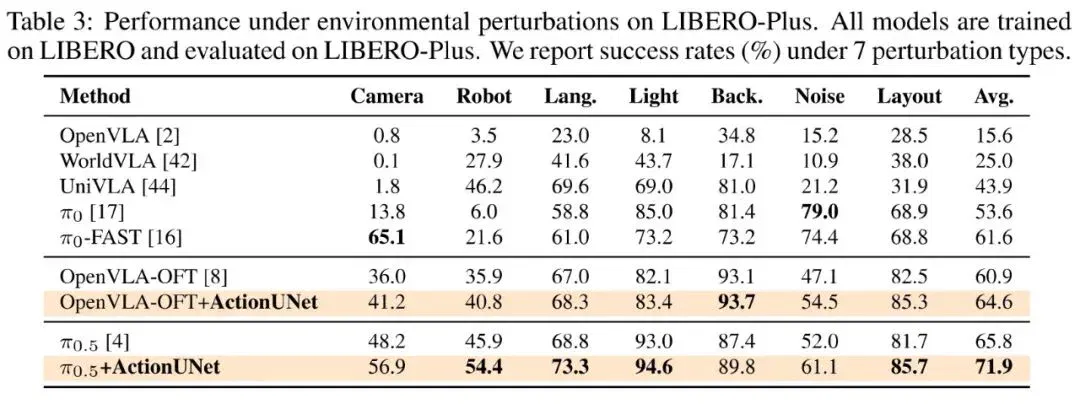
Figure 5: Success rates of different models under LIBERO-Plus’s seven perturbation types (Table 3 in the original paper).
Real-robot experiments
The researchers further tested object placement into a basket, block stacking and bowl stacking on a real Realman Gen72 dual-arm robot. In the Hard setting with additional distractors, π0.5’s average success rate is 57.3%, rising to 68.7% with ActionUNet, an improvement of 11.4 percentage points. In the Easy setting it rises from 76.0% to 88.7%.
Ablation studies
To determine whether the gains come from multi-scale modeling or action smoothing, the paper tests the Temporal U-Net, SIREN and complete ActionUNet separately on four RoboTwin tasks. In difficult scenes, the original π0.5 achieves an average success rate of 34.5%; adding only U-Net yields 37.3%, adding only SIREN yields 33.3%, and complete ActionUNet reaches 46.5%. This shows that merely smoothing actions is insufficient to achieve the robustness gains of multi-scale fine-tuning.
The researchers also designed a parameter-matched single-scale control: it retains the same parameter count but removes temporal downsampling and cross-scale feature fusion. Its success rate in difficult scenes is 38.5%, still below the complete method’s 46.5%. This control further supports the conclusion that improvement cannot be attributed solely to additional parameters; multi-scale action-feature modeling is key.
Visualization
The paper further visualizes multi-scale feature responses and predicted action trajectories. Temporal features at different levels respond more strongly to their corresponding action scales. Under the same initial conditions, ActionUNet’s predicted end-effector trajectories are closer to demonstration trajectories, with smoother local changes in action.
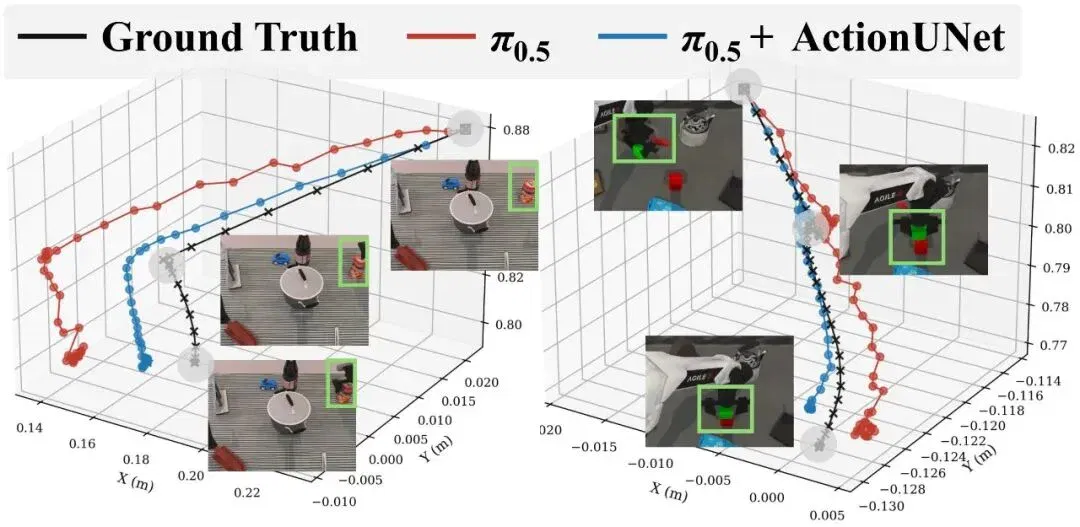
Figure 6: Comparison of trajectories predicted by π0.5 and ActionUNet under identical initial conditions (Figure 6 in the original paper).
The real-robot visualization shows object placement into a basket, bowl stacking and block stacking with extra distractors. In Figure 7, the top row uses the Easy setting matching training scenes, while the bottom row uses the Hard setting with added distractors, allowing direct observation of execution in both environments.
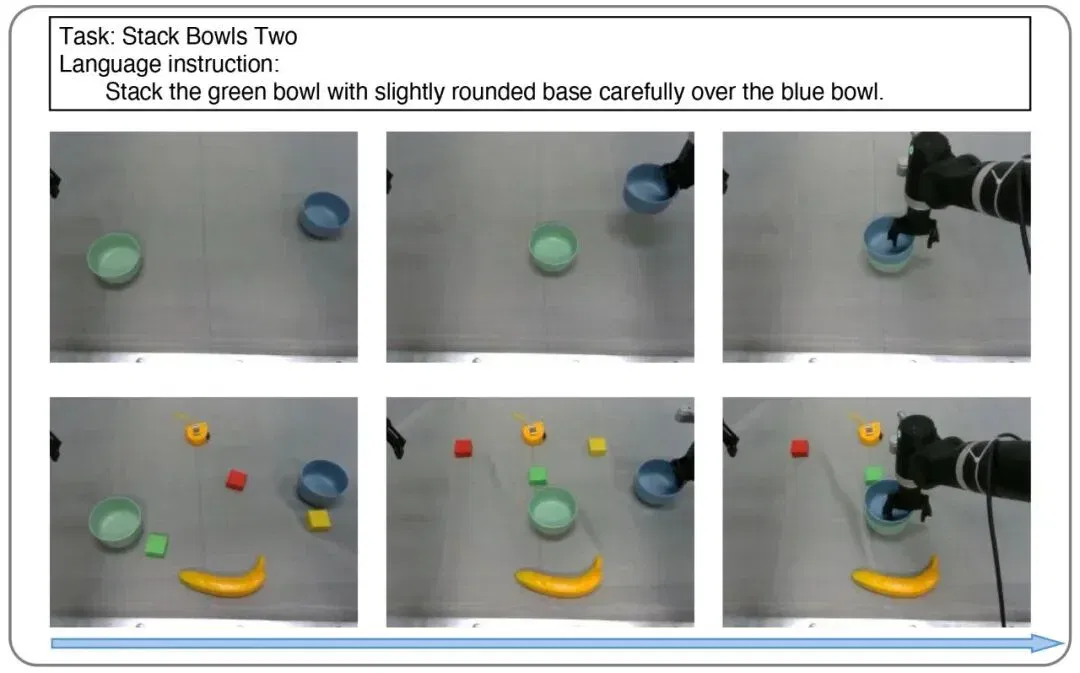
Figure 7: Keyframes of a real dual-arm robot stacking bowls, with Easy above and Hard below (Figure 7 in the original paper).
Overall, ActionUNet adopts a simple yet effective strategy: retain the pretrained backbone during downstream SFT and focus improvements on multi-scale modeling and continuous decoding of action features, improving manipulation robustness under the specified disturbances with low additional overhead.
This article comes from Synced, written by Zhu Di.
Related topics
After reading
Join the AINRK community
Read how to join the community and connect with people working in AI.
Related articles
Continue reading related topics and articles in this category.

RUC open-sources AutoMaster: Skill guidance and trajectory selection for agent post-training (opens in a new tab)
RUC introduces Skill-FT and AutoMaster. Across six settings with a fixed teacher, task pool, 512 selected trajectories per round and SFT recipe, gains over Vanilla SFT are 1.42–8.99 percentage points. Multiple rounds require extra sampling, training and evaluation.
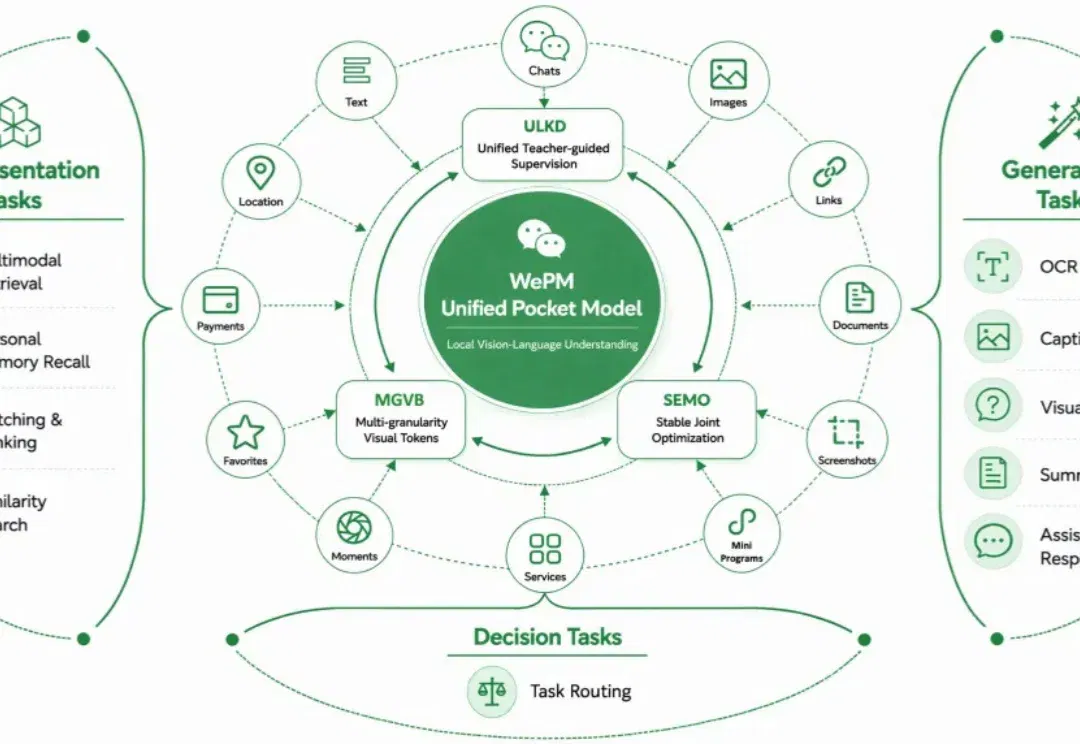
WeChat open-sources WePocketModel, unifying representation, generation and decision with one backbone (opens in a new tab)
Tencent's WeChat team releases WePocketModel, sharing one backbone across representation, generation and decision. WePM-4B uses 61.9% less resident weight memory than the selected specialist stack. Its roughly 8GB is BF16 weights, not total runtime memory; demos use an M5 Mac.
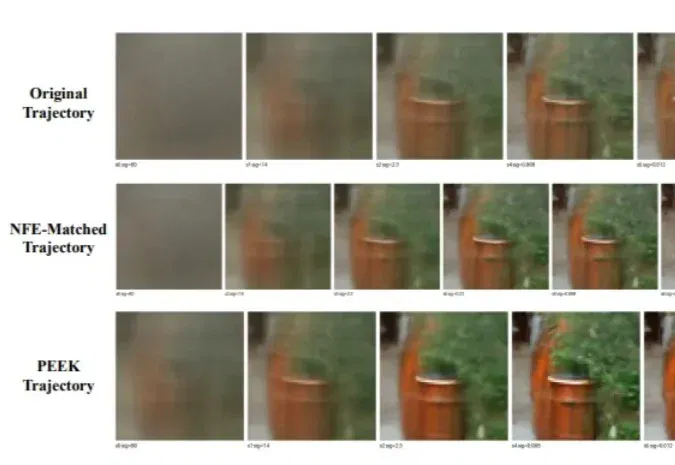
PEEK cuts FID by 49.3% in a specified ImageNet-EDM diffusion-sampling experiment (opens in a new tab)
NUS’s training-free PEEK adjusts deterministic diffusion sampling with look-ahead predictions. At an equal denoising-call budget, one ImageNet-EDM experiment lowers FID from 19.71 to 9.99. Results and one-time search costs depend on the setup.
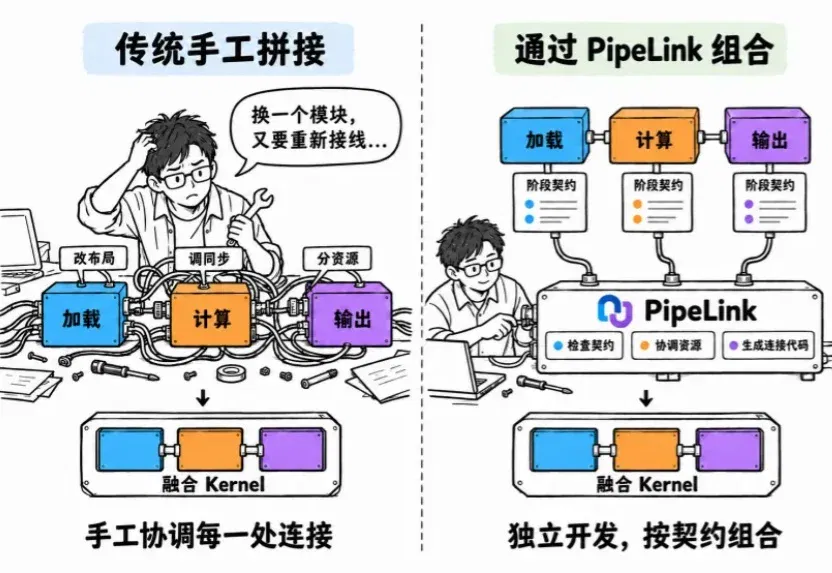
Peking University Open-Sources PipeLink to Make GPU Kernel Optimizations Reusable (opens in a new tab)
Peking University's PipeLink declares interfaces, synchronization and resource needs for GPU stages, checks contracts and links stages into fused kernels. Examples span toolchains, attention variants and communication-compute fusion; gains depend on components, workloads and hardware.
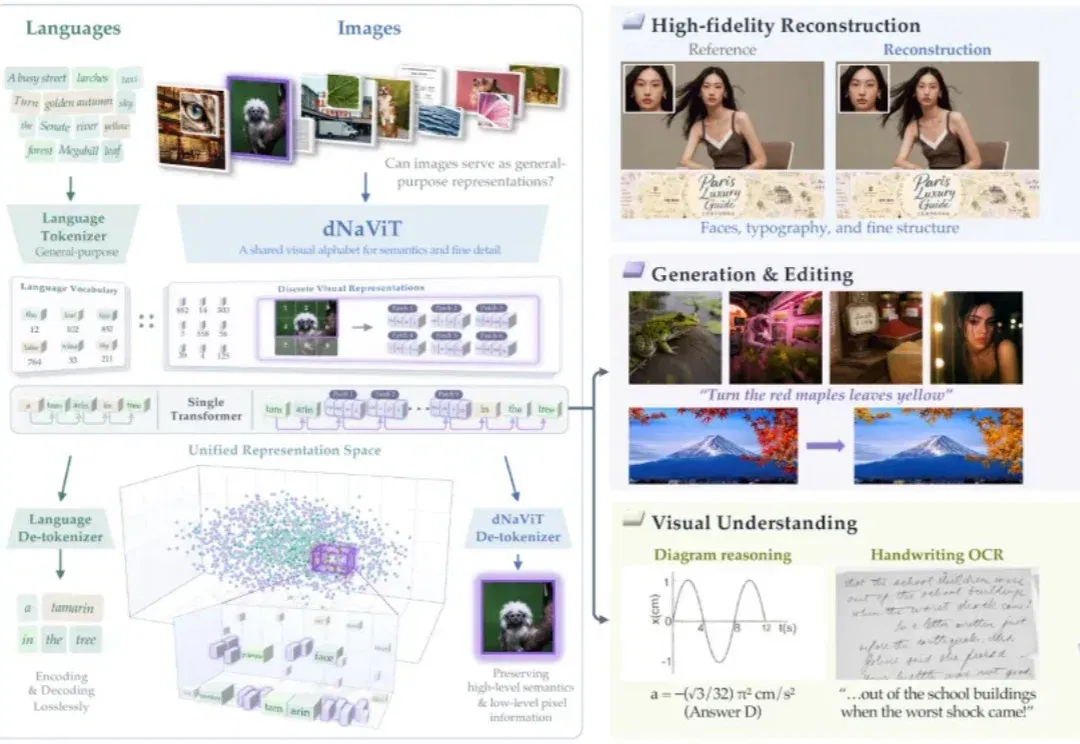
Can Discrete Codes Become a General Visual Representation? Meituan LongCat Open-Sources dNaViT (opens in a new tab)
Meituan LongCat's dNaViT combines a frozen visual encoder, residual modulation and grouped quantization to retain semantics and pixel detail. The team reports reconstruction, understanding, generation and editing through one encoding interface, with task-specific models and decoding branches.