Genesis AI raises $500M Series A to advance its full-stack robotics and Eno

Genesis AI announces funding at a $3.5B post-money valuation, outlining a stack of data gloves, simulation, models and the Eno robot. Production and customer deployments are planned; demonstrations and correlation experiments do not establish delivery at scale.
Editorial correction (November 19, 2026): Overgeneralizations about lossless transfer of human data to robots and full-stack integration as the only path have been corrected. Demonstrations and plans cannot replace validation of delivery at scale.
US embodied-AI company Genesis AI has just completed a new funding round:
A $500 million Series A, bringing its post-money valuation to $3.5 billion.
The investor lineup is also impressive:
NVIDIA, AMD, former Google CEO Eric Schmidt, Zoom founder Eric Yuan, Yahoo founder Jerry Yang and other prominent names are on the list.
Notably, this is the first time AMD and NVIDIA have jointly invested in an embodied-AI company.
At a time when embodied-AI fundraising has generally cooled, this round stands out.
What exactly makes Genesis different?
After studying its official website and technical documents, we found that the answer may lie in how Genesis positions itself:
A full-stack embodied-AI player.
The story begins half a year ago.
A year to reveal its capabilities
Genesis AI was founded in March 2025, with headquarters spanning the United States and France, by Chinese researcher Xian Zhou and Théophile Gervet.
Before formally founding the company, the team had already gained substantial recognition in academic and engineering circles through its open-source physics-simulation project.
This May, Genesis AI unveiled its first embodied foundation model: GENE-26.5.
As soon as it was released, a series of demonstration videos showcasing its capabilities attracted widespread attention.
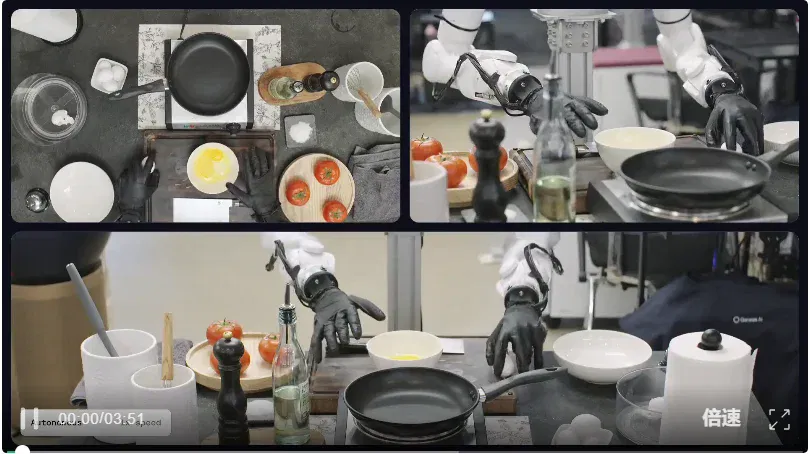
The main arena was the kitchen.
In a four-minute video that was not sped up, the robot smoothly completed more than twenty subtasks:
Cracking an egg with one hand, slicing tomatoes with a knife, and using a whisk, salt grinder and spatula.
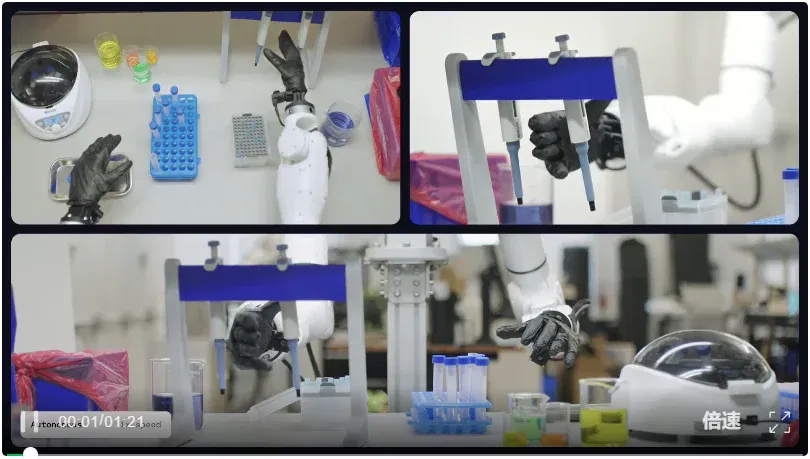
The next setting was the laboratory.
In another long-horizon task requiring millimeter-level precision, again shown in one continuous take, GENE-26.5 could autonomously pipette liquid, seal test tubes and finally place the tubes in a centrifuge.
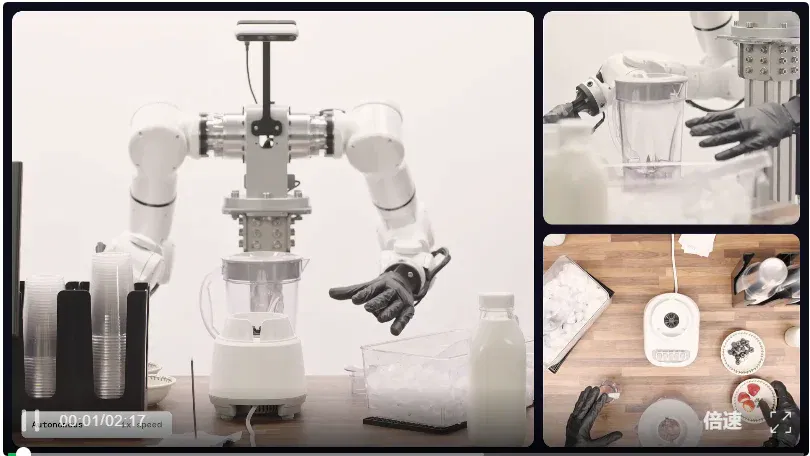
It could also make a milkshake, solve a Rubik's Cube and play the piano, demonstrating a range of general-purpose manipulation capabilities with its dexterous hands.
Most importantly, these capabilities were not assembled from multiple small, specialized models. The vast majority of operations relied on the same shared-weight GENE model.

But demonstration videos are now commonplace in robotics. The methodology behind them may be more worth examining.
Genesis has an unusual emphasis: according to the company, the model is not all it wants to show.
In its view, a robot is a tightly coupled engineering system. Weaknesses in any link, whether data, evaluation or robot hardware, can fall like dominoes and ultimately limit the performance of the whole.
What is the solution?
Genesis's answer:
We want it all.
Unpacking the full-stack three-in-one approach
In Genesis's architecture, data, models, evaluation and robot hardware are designed as a tightly coupled closed-loop system.
1. The data engine: solving the chicken-and-egg problem
One of the biggest bottlenecks in robot learning is the scarcity of high-quality data, especially hand-manipulation data.
Human hands generate the richest and most natural interaction data, but the large morphological differences between human and robotic hands make direct data transfer difficult.
What if this hardware gap did not exist?
Genesis's answer is forceful: bridge the gap directly at the physical level through
1:1:1 mapping across the entire chain.
- Human hands: the source of every interaction.
- Data gloves: electromagnetic-field (EMF) finger tracking and high-density tactile sensing capture high-fidelity signals from human hands at work.
- Genesis dexterous hands: matched one-to-one to human hands, with twenty degrees of freedom and a covering of flexible material that mimics human skin.

The team hopes that its glove and robot-hand designs will reduce the differences involved in transferring human demonstrations into robot learning. Whether specific motion and tactile information can be retained, and what results it produces on new tasks, still require experimental validation. Structural matching should not be interpreted as near-lossless transfer of all data.
Working becomes data collection.
Through this approach, by May this year Gene had used more than 200,000 hours of multimodal data. We understand that the volume has now reached the million-hour scale.
That is the appeal of the full-stack approach.
Many problems that seem difficult at the model level may have more fundamental solutions when viewed at the system level.
2. Genesis World: turning iteration into a compute problem
Data is the raw material, while the speed at which models improve depends on how efficiently that material is processed.
If every model improvement must be validated in the physical world, development cycles slow dramatically. Genesis's answer is to go all in on simulation.
We see simulation as an evaluation and iteration engine for robot foundation models, rather than merely a data generator.
Real-world experiments limit how quickly we can score candidate approaches. Simulation removes that constraint, turning the development cycle from a wall-clock problem into a compute problem.
This is Genesis World, a "Hyperbolic Time Chamber" where robots can learn through trial and error.

The effect is substantial.
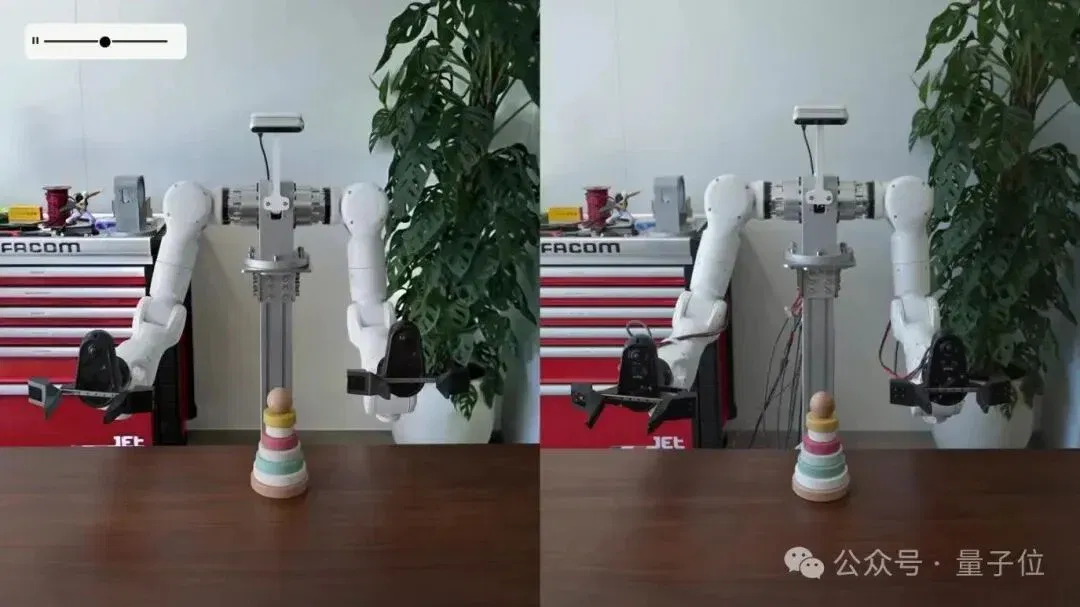
A single model evaluation may involve hundreds of tasks, each repeated hundreds of times. In the real world, this would require an operator and a robot to work continuously for more than 200 hours.
In Genesis World, the same tens of thousands of tests can be completed in less than half an hour, without an operator or robot hardware involved.
Of course, all of this depends on trustworthiness.
To narrow the sim-to-real gap, Genesis has invested heavily in developing its own Nyx rendering engine, Quadrants cross-platform compiler and unified physics engine.
In the company's controlled experiments, simulation evaluations and real-robot test results ultimately showed a strong correlation, with a Pearson correlation coefficient of 0.8996.
Beyond the simulation engine, Genesis has internally built a complete pipeline for automatically generating tasks, environments, objects and reward functions, allowing robots to improve themselves in large-scale, automatically generated simulation environments.
3. Eno: built to work
At this point, however, only the preparatory work is complete.
Data, simulation and models ultimately need a product form to carry them and create a bridge to the physical world.
For Genesis, that product is Eno.
Eno's minimalist, timeless design was described by Forbes as "robotics' iPhone moment."
Notably, Eno has just won Gold at the German Design Awards. It is not the sleek, bipedal humanoid robot we might imagine. Instead, it has a wheeled base and a torso formed from several folded panels.
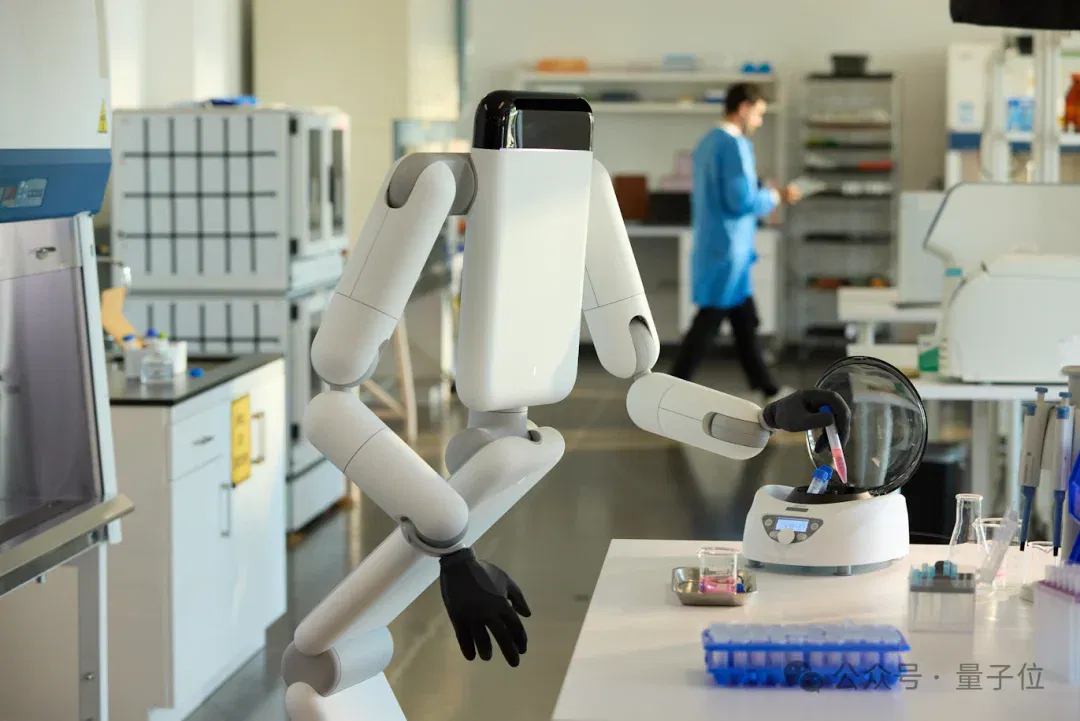
Airplanes do not need birds' wings. Similarly, many human features may actually be a burden for machines.
From the outset, Eno's design goal was not to imitate human appearance. Yet this allows it to have capabilities that most resemble human abilities, contained in an elegant, minimalist body.
Wheels provide movement efficiency and endurance, while its height-adjustable body lets it work at surfaces of different heights.
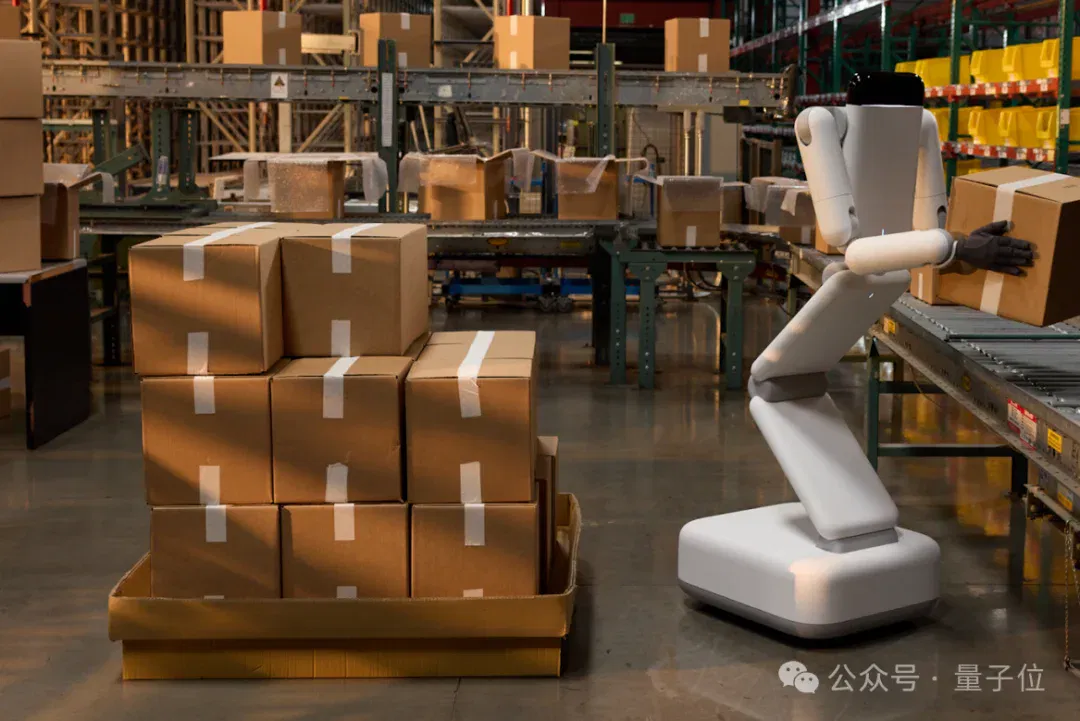
Every design decision serves function, efficiency and cost. Behind this lies the same first-principles approach: being natively full-stack and embodied.
As Genesis CEO Xian Zhou said in the funding statement:
Our mission is to remove the limits the physical world places on human ambition. To do that, we are building the world's best general-purpose robot: one that can work reliably in the real world, day after day.
That requires intelligence, hardware and everything needed to train and test the robot to operate together as one system. By building all of this ourselves, we can work relentlessly on every detail and improve the whole robot faster.
Deployment is king
With $500 million in hand, what comes next?
Mass production.
Genesis says this round of funding will be used primarily to advance large-scale real-world production and deployment of Eno.
Specifically, it plans to begin production and customer deployments before the end of 2026, starting in industrial environments such as manufacturing, logistics and laboratories, then expanding to service sectors such as hotels and hospitals, and eventually to consumer homes and outdoor applications.
From structured environments to unstructured ones, one step at a time.
But honestly, even taking the first step is extremely difficult.
Demonstration videos can offer limitless room for imagination. Once deployment is involved, reliability becomes the sole yardstick.
The embodied-AI chain is long, and an error in any link can cause the entire system to fail in a real setting.
At the same time, the real world's long-tail problems are complex and varied. Delivery standards can only be met gradually by working through actual situations.
Technology and products must advance together. Sitting in a laboratory training models is not enough; getting hands dirty is essential. Only work on the front lines can close the model–deployment–data loop.
From this perspective, production and deployment at scale may themselves be an indispensable part of embodied-AI R&D.

Over the past few years, debates about the path toward general-purpose robots have often centered on humanoid versus non-humanoid forms.
Genesis AI now offers a new frame of reference: the real distinction may lie in the development paradigm rather than appearance.
Pursuing AGI in the physical world is a much longer and more arduous battle than developing large language models.
When a system reaches a certain level of complexity, local optimization will eventually hit bottlenecks. Only by controlling all the variables and thinking, designing and iterating on them as a whole can a breakthrough become possible.
Computer pioneer Alan Kay offered this maxim decades ago:
People who are really serious about software should make their own hardware.
That is true of Tesla making cars and Apple making consumer electronics. Now, a growing number of embodied-AI companies such as Genesis are demonstrating:
Building robots must work the same way.
"Natively full-stack."
As more model companies explore robotic capabilities, vertical integration is one path Genesis has chosen. Whether it is superior to other divisions of labor still needs to be tested through delivery results. It cannot be regarded as the only route to physical AGI.
This article was originally published by QbitAI. Author: Jay.
Related topics
After reading
Join the AINRK community
Read how to join the community and connect with people working in AI.
Related articles
Continue reading related topics and articles in this category.
智动未来据报完成亿元级Pre-A+融资,资金用于产线与服务机器人部署 (opens in a new tab)
机甲觉醒报道,智动未来宣布完成亿元级Pre-A+轮融资,由中美绿色基金领投、南曦创投联合领投,资金拟用于广州产线、服务场景部署和世界模型研发。“智子世界”仍属技术预览,商业化效果待更多应用数据检验。

Syncere raises $11M for Lume, a household robot shaped like a floor lamp (opens in a new tab)
Syncere uses a floor-lamp form for Lume: one robot handles some pick-and-place tasks, while two work together in Duet mode on tasks such as folding clothes. Demos are edited; pricing and delivery reflect the source date, and home reliability remains unproven.
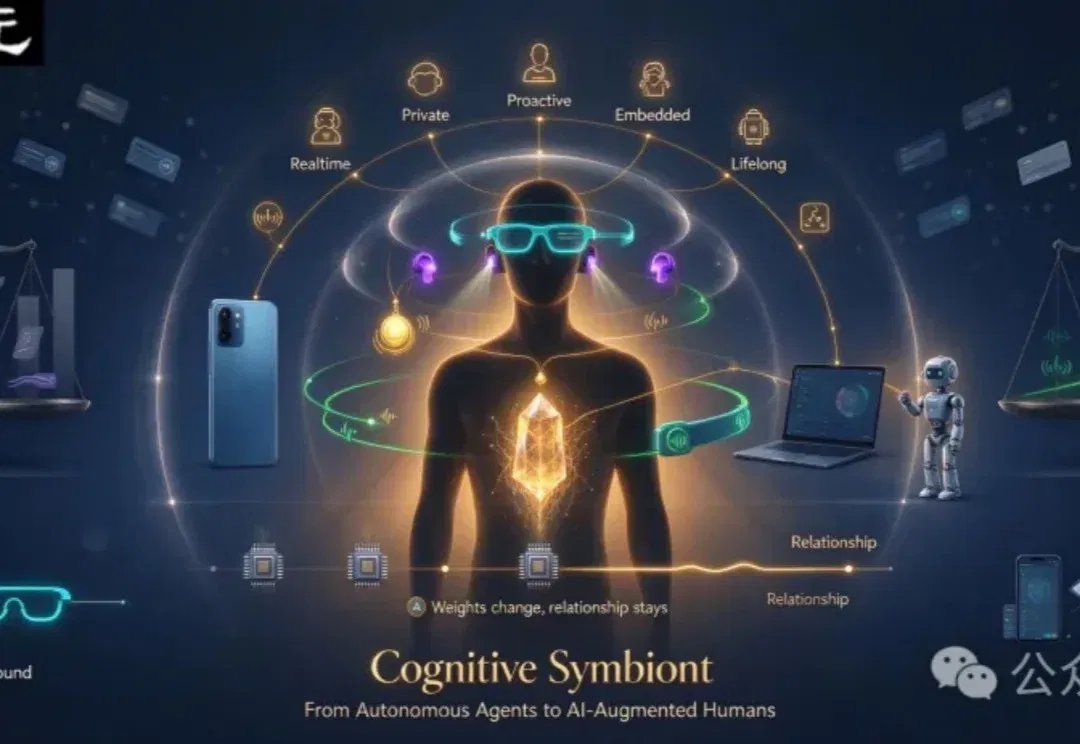
Oxford researcher proposes cognitive symbionts for wearable AI augmentation and governance (opens in a new tab)
Hao Fei's perspective paper proposes cognitive symbionts and AI-Augmented Human Intelligence, covering long-term memory, wearables, proactive help and governance. Privacy, low latency and lifelong companionship are design goals, not verified product guarantees.
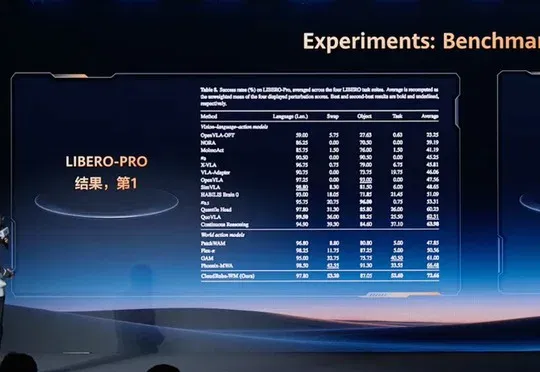
Huawei Cloud unveils CloudRobo-WM1.2, plans November 30 release of weights and code (opens in a new tab)
Huawei Cloud presents its Ascend-native embodied world model CloudRobo-WM1.2 and development platform, with two benchmark results and industrial demonstrations. Model weights, inference and post-training code, and pretraining practices are scheduled for November 30.
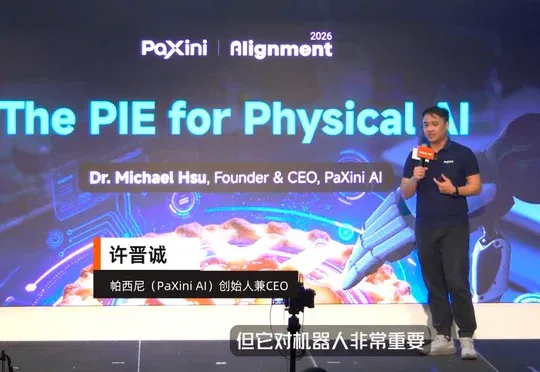
PaXini's Xu Jincheng on tactile sensing, embodied data and robotic execution (opens in a new tab)
In an ALIGNMENT conference talk, PaXini founder Xu Jincheng describes tactile sensors, data collection, VTLA models and execution hardware, discussing how perception, intelligence and execution work together. Product capabilities are claims disclosed in the talk.