Oxford researcher proposes cognitive symbionts for wearable AI augmentation and governance
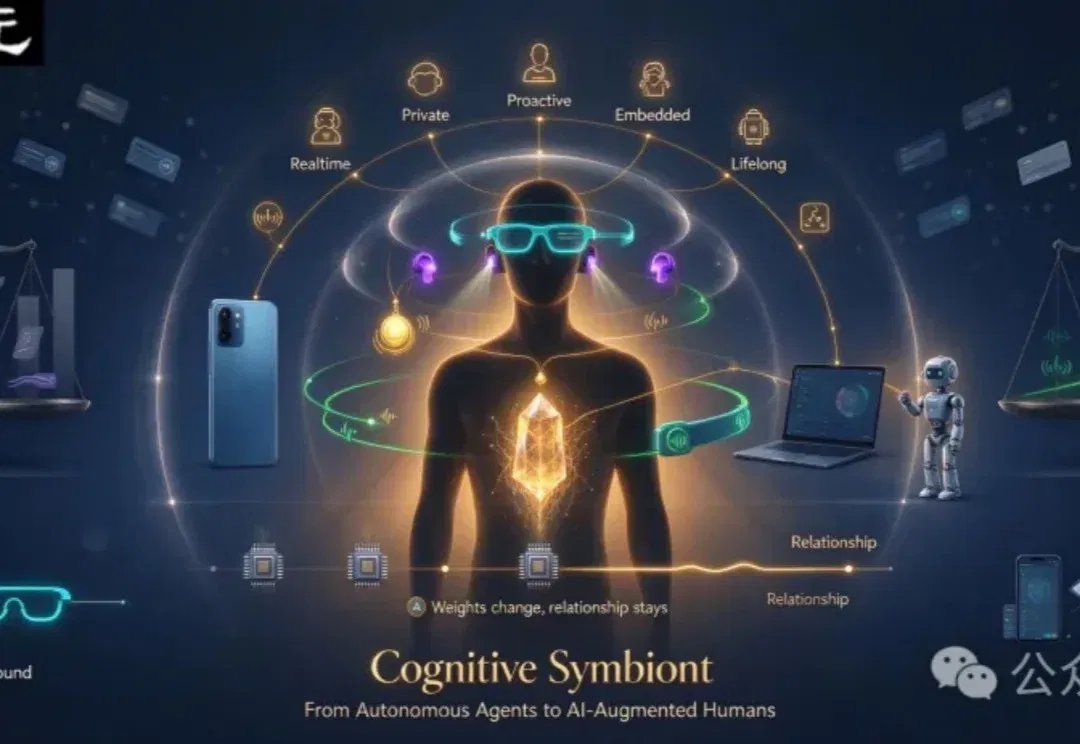
Hao Fei's perspective paper proposes cognitive symbionts and AI-Augmented Human Intelligence, covering long-term memory, wearables, proactive help and governance. Privacy, low latency and lifelong companionship are design goals, not verified product guarantees.
Editorial correction (November 18, 2026): The paper presents a design and governance vision. Statements about absolute privacy, latency, legal obligations and the scope of cryptographic proofs have been corrected.
The first Iron Man film came out in 2008.
Tony Stark had a butler who never appeared in person: Jarvis.
It had known Tony for years. As Tony talked and worked, it chimed in and helped, never requiring him to stop and explain the whole background again.
Eighteen years later, everyone in Silicon Valley is building their own Jarvis.
In a 2025 open letter, Mark Zuckerberg called for personal superintelligence for everyone. He also bet that glasses capable of seeing what you see and hearing what you hear would become the next primary computing device.
By 2026, Meta's Muse, OpenAI's Dots and xAI's Grok Bot had launched in succession. This generation of personal agents stays in the background, tracking long-term goals, learning preferences and running errands for you.
The author focuses on existing assistants' shortcomings in continuous contextual understanding and long-term personal experience. Real products may also use on-device or hybrid deployment, so it is inaccurate to generalize that all assistants live in the cloud.
When you freeze in a meeting, agonize over something late at night or feel helpless in an unfamiliar country, they are not there: they do not know where you are, who is sitting across from you or how you feel at that moment.
The most valuable thing about Jarvis is precisely what everyone has overlooked: it is always by your side.
So how can everyone have a Jarvis? And how much further should it go than Jarvis did?
Recently, Oxford senior researcher Hao Fei posted a fifty-nine-page perspective paper on arXiv, addressing both questions in one go.

Paper: https://arxiv.org/abs/2611.05376
Project website: https://cognitive-symbiont.github.io
The paper's central judgment adds a second main thread to AI's endgame:
AGI is about how intelligent the machine itself is; AHI is about how much more intelligent a particular person can become with the machine's help.
The paper names this new entity the Cognitive Symbiont.
Its proposed design goals include long-term companionship, close personal use, minimal interruption and privacy protection. These are aspirations for cognitive symbionts, not implemented or validated guarantees of lifelong service or absolute privacy.
It has no body of its own, so it borrows yours.

Glasses give it a first-person view and a display for a short line of text. Earbuds let it whisper to you alone. A pendant records audio throughout the day: say something quietly, and it remembers.
Rings and wristbands read heart rate and sleep, and allow silent commands through electromyographic gestures. Phones and computers handle computing power, screen content and calendars.
At the outermost edge are AR projections, silent speech and even neural interfaces.
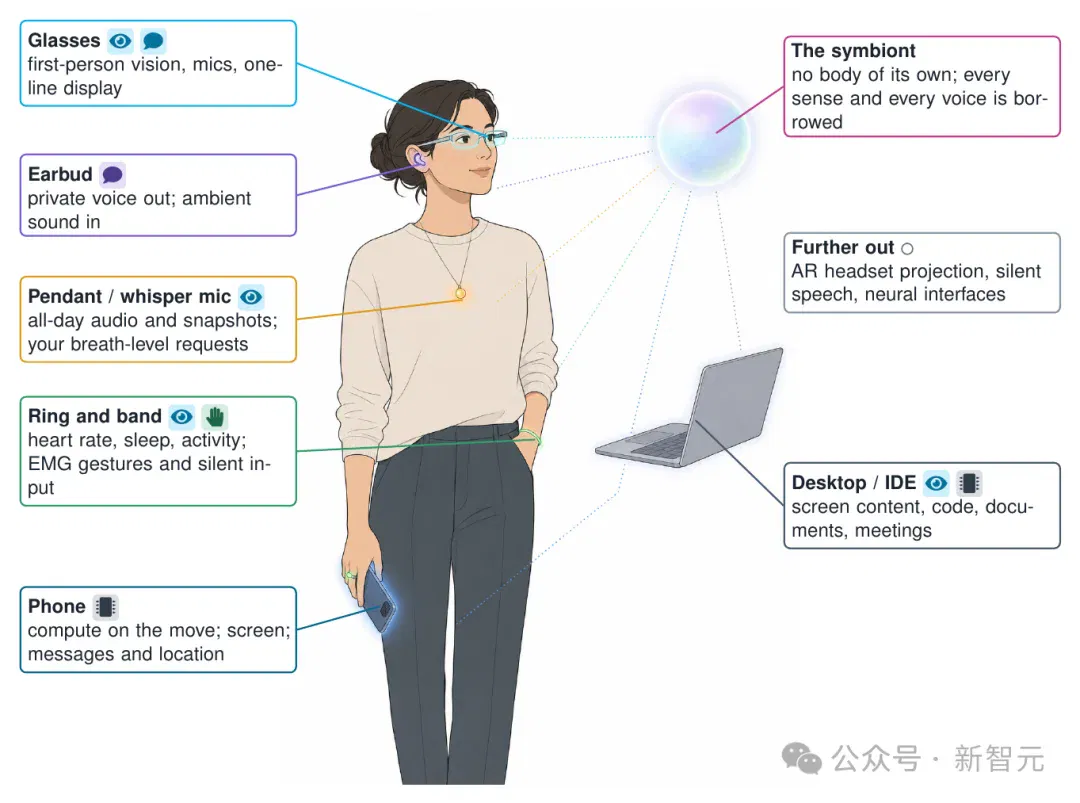
Figure 1: A device constellation. Glasses, earbuds, pendants, rings and wristbands each handle part of the input or output; neural interfaces sit at the outermost layer.
Its real skill is returning precisely the relevant fragment of your own experience, knowledge or commitments at exactly the right second.

From the chat box to your body: the fourth form of agent evolution
The work a symbiont is meant to do is on an entirely different wavelength from today's agents.
Hao Fei organizes human–agent relationships into four forms: a question-and-answer assistant in a chat box; an autonomous agent working on your computer; a personal agent acting according to your habits in the cloud; and finally a symbiont worn on your body.
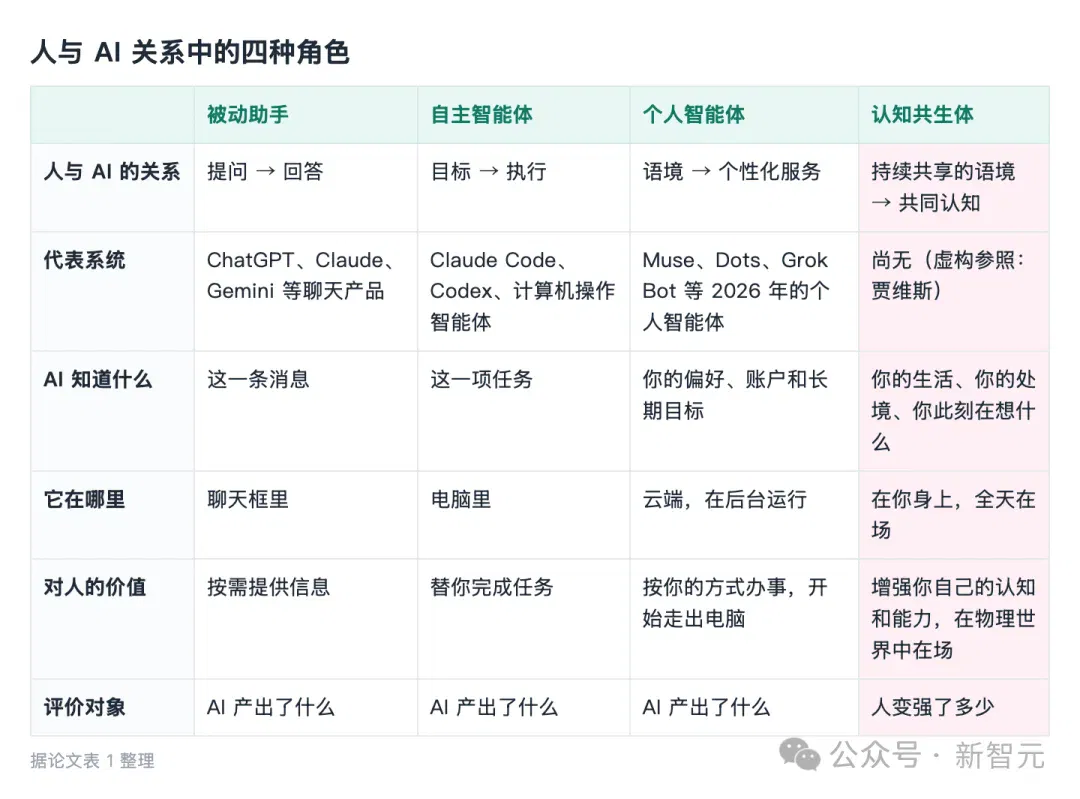
Figure 2: Four forms of human–agent relationship, adapted from Table 1 of the paper.
Across that progression, what AI knows expands from a single message to an entire life, while its location moves from a dialogue box onto your body.
The most consequential change is hidden in the final row.
The first three forms are judged on what the AI delivers. With a symbiont, the subject of evaluation becomes how much more capable you have become.
The paper also names this new direction AHI: AI-Augmented Human Intelligence.
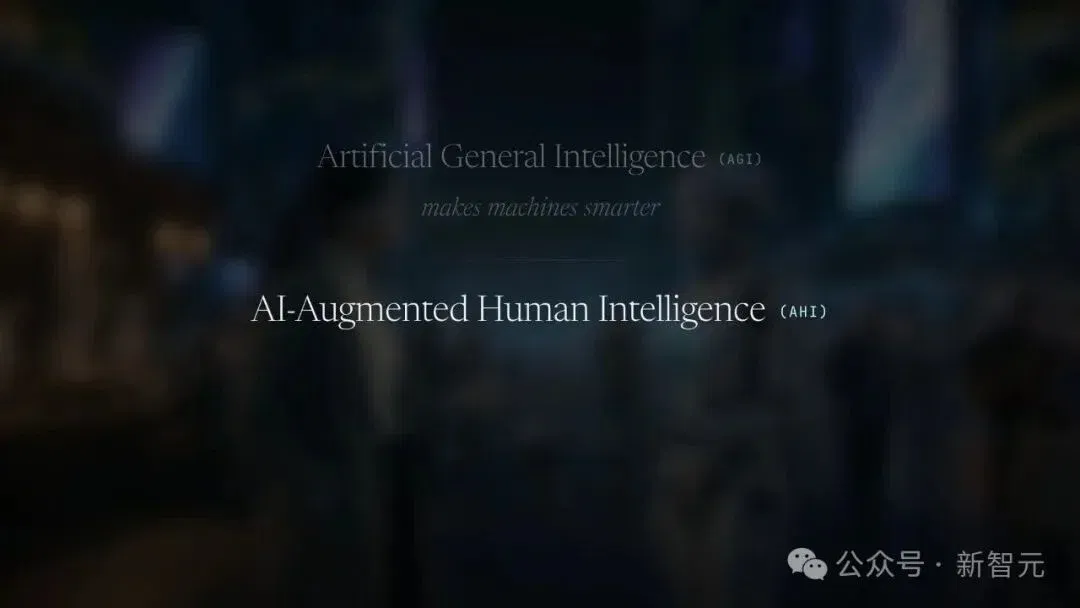
It sits alongside AGI as a second main thread of AI's endgame, sharing the same foundation. A single foundation model can serve both as an agent doing work for you and as a symbiont augmenting you. Every advance in that foundation also benefits AHI.
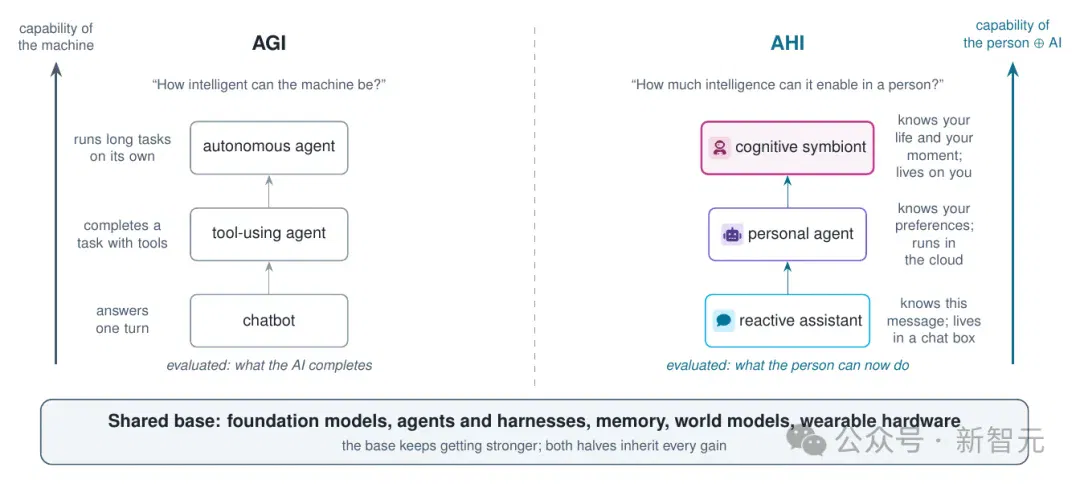
Figure 3: Two main threads of AI's endgame. The left is scored on what AI accomplishes; the right on what the person can now do.
The symbiont includes all the capabilities of the preceding three forms: it still books flights and edits code. As Hao Fei puts it, no one will wear a symbiont that cannot even book a flight properly.
Six steps beyond Jarvis
Speaking at the instant you get stuck
Jarvis is already highly capable.
The paper sets six firm requirements for symbionts: real-time, private, proactive, low-friction, embedded in life and lifelong. Jarvis meets all six in comparison.
But Jarvis also has six clear shortcomings:
- Eyes: Jarvis sees through Tony's custom laboratory and armor; ordinary people have only a few affordable wearables. In compensation, the symbiont has signals Jarvis never had: heart rate, first-person video and thoughts you speak aloud yourself.
- Understanding: Jarvis knows schedules, systems and battlefields inside out. A symbiont most needs to understand your goals, emotions and blind spots.
- Help: Jarvis executes and raises alarms, but rarely helps Tony make life choices, recover from low points or navigate other people and foreign cultures. Those are precisely the symbiont's domain.
- Growth: Across several films, Jarvis's understanding of Tony barely advances. A symbiont must understand you better the longer you spend together, with the entire system evolving alongside you.
- Accessibility: Jarvis is custom-made for one billionaire. The symbiont must become a paradigm available to everyone.
- Loyalty: Jarvis's loyalty depends on the screenwriter. A symbiont's loyalty must be built into its architecture.
The paper's ambition can therefore be condensed into one sentence: a Jarvis for everyone, and six steps beyond it.
In a meeting, a colleague suddenly asks about a number in a report you wrote three years ago. You remember the conclusion but cannot recall the figure.
Before the question is finished, the symbiont has anticipated its direction, retrieved the report and displayed one line on your glasses. You answer immediately, in your own words.

The paper calls this cognitive full-duplex: while you conduct a meeting in the foreground, it simultaneously conducts another in the background.
A slow loop retrieves and checks information in the background. A fast loop puts the cue before your eyes within a second, and it disappears once the moment has passed.
More often, however, its best output is silence.
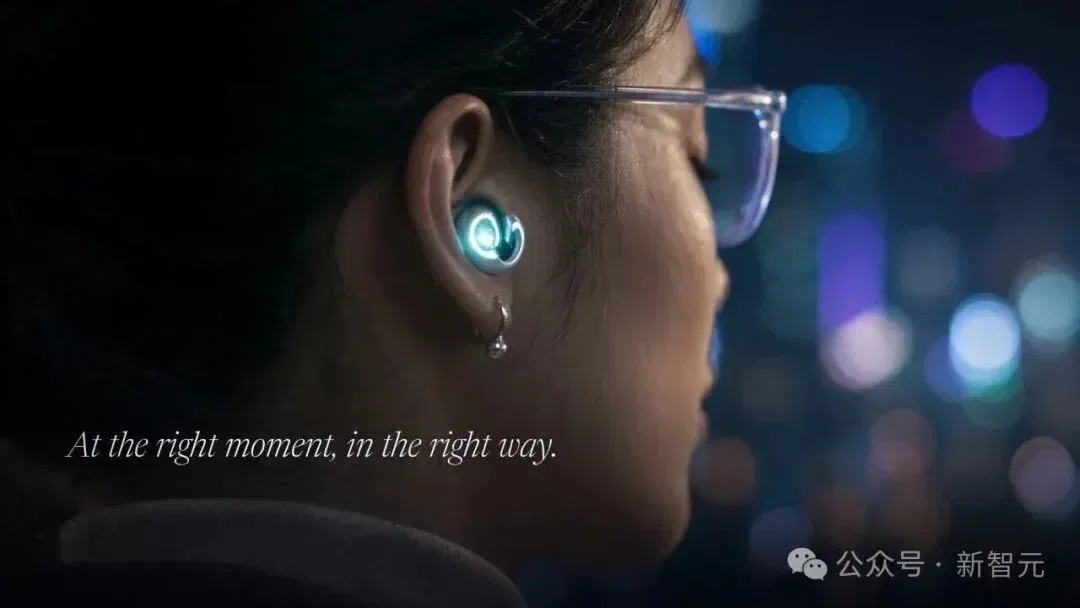
Late at night, you are about to agree to something you should not accept, staring at the reply box for twenty minutes.
The symbiont does not advise you against it. It simply retrieves the reason you wrote down six months ago for declining a similar invitation and asks: does that reason still hold today?
The final decision remains yours.

Or imagine a reception where, across the room, a stranger is studying the same problem as you.
The paper envisions two symbionts exchanging necessary information within authorized limits and alerting their users. Completion in under two seconds without any information crossing those limits is a scenario description; this article identifies no evidence that it was measured as system latency or security performance.

The lesson of F.R.I.D.A.Y.
Models can change; the relationship must remain
Marvel fans remember that Jarvis was later replaced, with Tony adopting a new assistant, F.R.I.D.A.Y.
The paper specifically notes this: once the owner changes systems, the relationship has to start again from scratch.
That is everyday reality for AI users today. Foundation models change every few months. Switch apps or glasses, and the AI must get to know you all over again.
Hao Fei's answer is to separate you from the model.
Your life record, the AI's understanding of you, its policy for deciding when to intervene and its tool-calling framework, or harness, are all defined outside the foundation model.
When the model is upgraded, these components migrate together and can resume operation after a calibration period.
In the paper's terms, what truly belongs to you is the record and its understanding of you. The relationship passes from generation to generation; the weights can be replaced at any time.
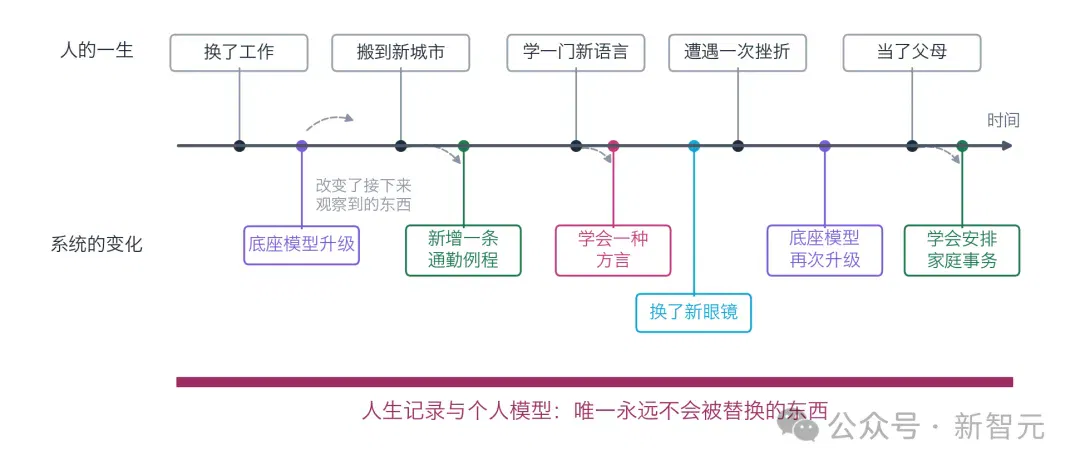
Figure 4: Person and system evolve together. Life events appear above, system changes below. The bottom line is the one thing never replaced. Redrawn in Chinese from Figure 16 of the paper.
In this design, the system itself also evolves: it establishes procedures for frequent tasks, writes its own tools and adjusts the rhythm of the fast and slow loops.
It changes only the outer framework: readable, auditable and reversible, with every step recorded.
One of the paper's nine design principles states it plainly: replace any layer, but preserve the relationship.
Jarvis becomes Vision
Humans and robots share one brain
If everything so far sounds like a better AI assistant, the next judgment is the paper's boldest.
When physical AI is mentioned today, almost everyone focuses on one kind of agent: embodied robots with their own bodies, senses and goals.
Hao Fei argues that the physical-AI era contains two kinds of intelligent individual.
One is the embodied robot. The other is the AI-augmented human, whose own senses, memory and judgment are connected to a personal AI worn close to the body.
More importantly, both share a cognitive core: remembering the past, interpreting circumstances and other people's minds, knowing when to act and learning from experience.
They differ in only three respects: whose goals, whose body and who is responsible when something goes wrong.
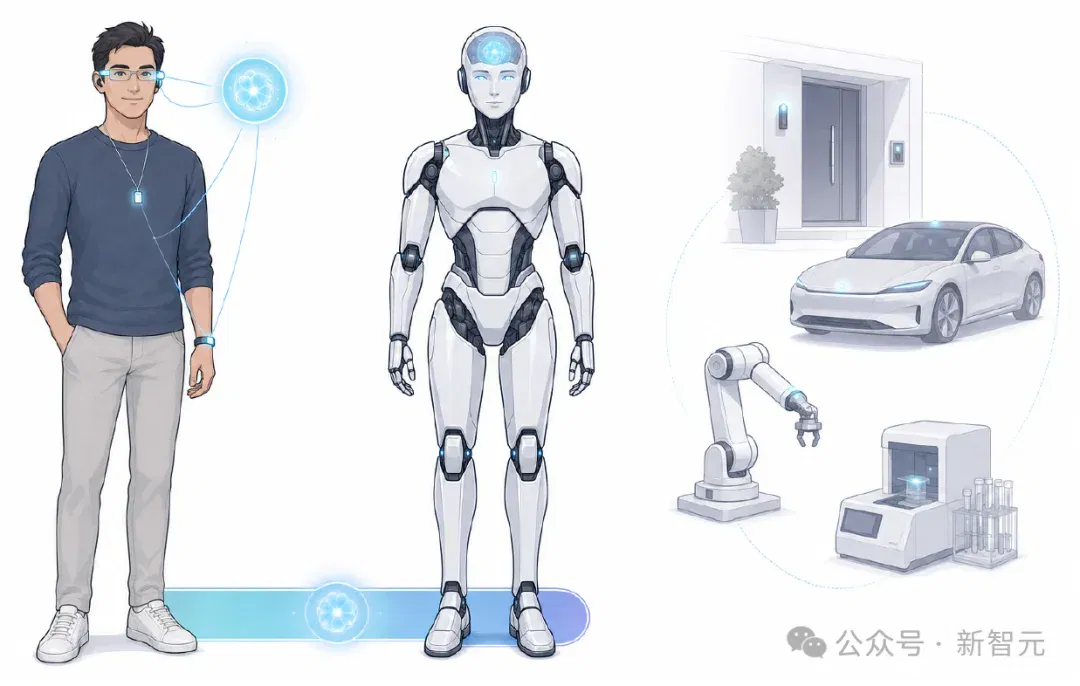
Figure 5: Two intelligent individuals. The AI-augmented human is on the left, the embodied robot in the center, both sharing the same cognitive core. On the right are environmental devices either can use.
This leads to a conclusion that could unsettle embodied-AI researchers:
For robots to advance, a better body alone is not enough. They also need this kind of cognitive core.
Marvel told this story long ago.
In Avengers: Age of Ultron, Jarvis's core is ultimately placed inside a body and becomes Vision.
A former symbiont acquires goals and a body of its own. This is the leap from an AI-augmented human to AI as an individual.
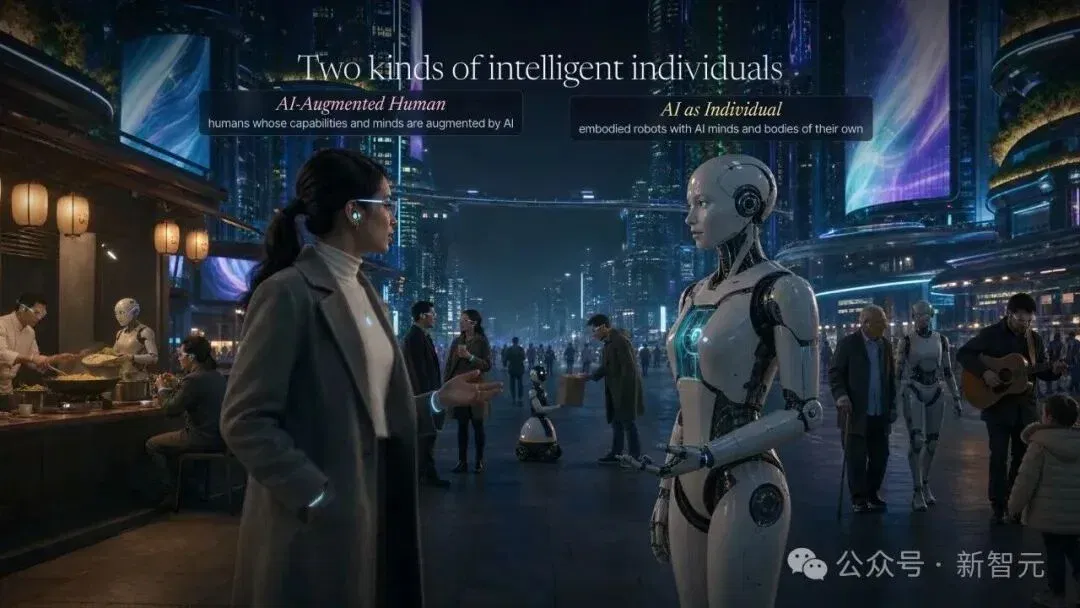
Conversely, although a symbiont lacks a body, it can use its surroundings. Enter a laboratory, and it can operate the instruments; return home, and it can coordinate the entire house. What a person can accomplish in the physical world expands accordingly.
The paper also plants a larger idea: this personal runtime, operating continuously across many devices and many years, is envisioned by Hao Fei as eventually becoming an AI-native operating system.
The better AI knows you, the more it needs boundaries
Anything that makes people more capable in public will inevitably be used by someone to cheat.
That has already happened. In 2025, a product called Cluely openly marketed cheating as a selling point. During China's national college entrance examinations, several chatbot providers temporarily disabled some features.
The paper devotes an entire section to unpacking the risks.
For users, these include manipulation and sycophancy, overdependence and skill erosion, false memories, leaks of thought-related data and vendor lock-in. For others nearby, they include covert help in exams and hidden prompting during negotiations. Institutional risks include employers forcing people to wear them, records being used as evidence, and use in screening people or setting prices.
Hao Fei also lists five futures that must never happen.

Figure 6: Five futures the paper explicitly seeks to avoid, compiled from Sections 12, 15 and 16.
Marvel fans will recognize the last one immediately: a system that constantly improves itself while no one can see clearly what it changes. In other words, Ultron.
Could all these risks kill the paradigm in its infancy?
The paper's answer is direct. Earlier cognitive augmentation was difficult to govern because it was invisible and could not be switched off. A pill taken before an exam leaves no visible trace in the examination hall.
A symbiont is the opposite: worn outside the body, removable and inspectable.
That gives an entire set of rules something concrete to work with:
- The author proposes assistance-disclosure boundaries for exams, courts, competitions and negotiations. This is a governance recommendation, not a uniform disclosure obligation already in force everywhere.
- A setting can declare assistance levels in advance, ranging from total prohibition to accessibility support only, access to personal records only or unrestricted use. The symbiont recognizes the setting, switches modes automatically and records the change.
- Tamper-resistant logs, hardware attestation and cryptographic methods can provide evidence within agreed systems and protocols. They cannot unconditionally prove that a user received no help through any other means.
- Roles requiring independent ability assess you only after the symbiont is removed.
In Hao Fei's design, governance and functionality are built into the architecture together. That is what would let symbionts enter examination halls, meeting rooms and homes.
Conclusion
In 1960, J. C. R. Licklider, who introduced man–computer symbiosis, made a prediction: human brains and computers would eventually be coupled very tightly together.
Sixty-six years later, that prediction has a fifty-nine-page blueprint.

When that day comes, would you let an AI remember your entire life and speak in your ear?
About the researcher
Hao Fei is a senior researcher in Oxford's Department of Computer Science. He previously served as a senior researcher at the National University of Singapore and conducted research at Sea AI Lab, Kunlun's Skywork AI and Microsoft Research Asia as a Zhuxing Scholar.
His research covers cross-modal large models, general-purpose foundation models, and modeling human cognition and mental states. He led NExT-GPT, an influential work in omni-modal large models, followed by UniVA universal video agents, multimodal generalist models, unified vision models, joint audio–video generation and video reasoning. The open-source code has accumulated more than twenty thousand GitHub stars.
He has also led the largest tutorial series in multimodal large models and a series of workshops on unified multimodal understanding and generation.
This July, he proposed Mental World Modeling, separately modeling the human mental world for the first time alongside physical-world modeling.
His work has over sixteen thousand citations and an h-index of 68. He has received the WAIC Yunfan Rising Star and Brilliant Star awards, the Ant InTech Future award and a WAIC 2024 Outstanding Paper Award. Several other papers have won or been nominated for best-paper awards at AI conferences. He has appeared on Stanford's global top-2% scientists list for multiple consecutive years; his doctoral dissertation received an outstanding-dissertation award from the Chinese Information Processing Society of China. He has long served as a senior area chair at leading AI conferences and on the editorial boards of IEEE and ACM journals.
References:
https://arxiv.org/abs/2611.05376
https://cognitive-symbiont.github.io
https://www.youtube.com/watch?v=OBQF9SN7S3E
https://techradar.com/ai-platforms-assistants/ai-glasses-will-become-your-primary-computing-devices-according-to-mark-zuckerberg-as-he-ushers-in-the-era-of-personal-superintelligence
This article was originally published by AI Era. Author: LRST.
Related topics
After reading
Join the AINRK community
Read how to join the community and connect with people working in AI.
Related articles
Continue reading related topics and articles in this category.
智动未来据报完成亿元级Pre-A+融资,资金用于产线与服务机器人部署 (opens in a new tab)
机甲觉醒报道,智动未来宣布完成亿元级Pre-A+轮融资,由中美绿色基金领投、南曦创投联合领投,资金拟用于广州产线、服务场景部署和世界模型研发。“智子世界”仍属技术预览,商业化效果待更多应用数据检验。

Syncere raises $11M for Lume, a household robot shaped like a floor lamp (opens in a new tab)
Syncere uses a floor-lamp form for Lume: one robot handles some pick-and-place tasks, while two work together in Duet mode on tasks such as folding clothes. Demos are edited; pricing and delivery reflect the source date, and home reliability remains unproven.

Genesis AI raises $500M Series A to advance its full-stack robotics and Eno (opens in a new tab)
Genesis AI announces funding at a $3.5B post-money valuation, outlining a stack of data gloves, simulation, models and the Eno robot. Production and customer deployments are planned; demonstrations and correlation experiments do not establish delivery at scale.
Huawei Cloud unveils CloudRobo-WM1.2, plans November 30 release of weights and code (opens in a new tab)
Huawei Cloud presents its Ascend-native embodied world model CloudRobo-WM1.2 and development platform, with two benchmark results and industrial demonstrations. Model weights, inference and post-training code, and pretraining practices are scheduled for November 30.

PaXini's Xu Jincheng on tactile sensing, embodied data and robotic execution (opens in a new tab)
In an ALIGNMENT conference talk, PaXini founder Xu Jincheng describes tactile sensors, data collection, VTLA models and execution hardware, discussing how perception, intelligence and execution work together. Product capabilities are claims disclosed in the talk.