Google expands TPU system sales as software adaptation and inference economics draw attention
QbitAI discusses complete-system deliveries, TorchTPU and agent-inference tests using filings and sources. Revenue, unfulfilled contracts and model-specific token-per-dollar comparisons are distinct measures; optimization rounds can change results.
Editorial correction (November 16, 2026): TPU revenue, pending deliveries and inference comparisons across models use different measures. They must not be combined into a fixed performance lead or a claim that revenue recognition has not begun.
Nvidia has more to worry about than Jensen Huang’s recent troubles.
Google introduced two TPU chips this week for confidential inference and long context. Alongside two launched earlier this year, generation eight now has four configurations.
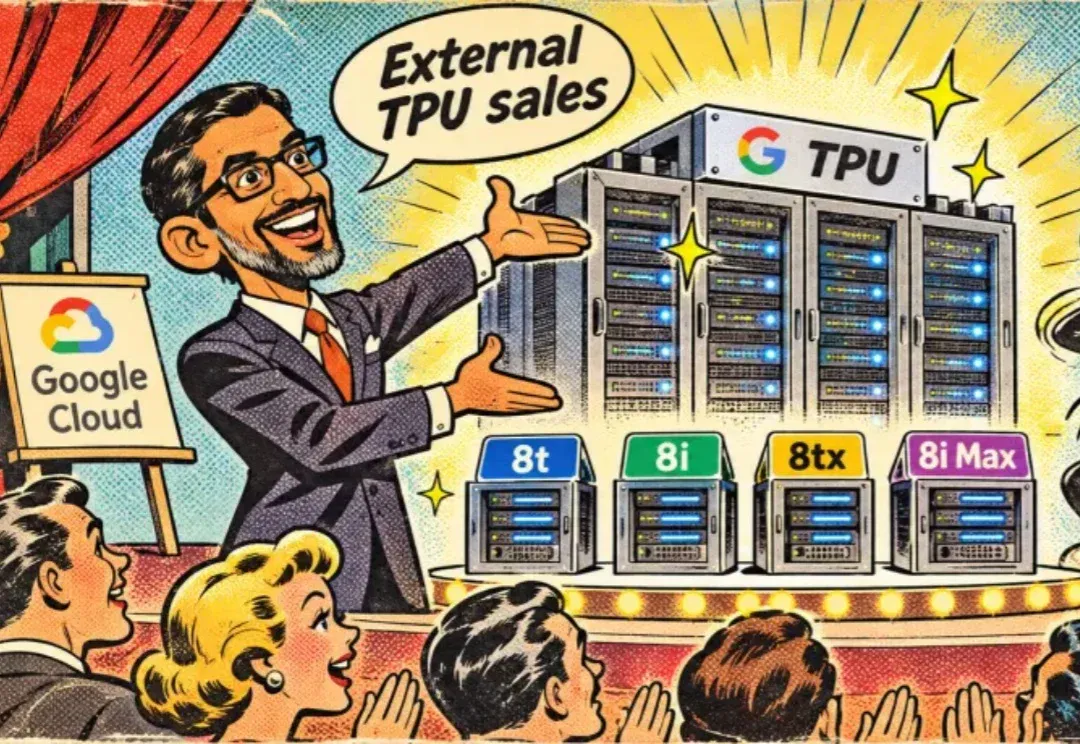
This is Google’s first year introducing four TPU systems. Its ambitions may exceed outside expectations——
It also began selling TPU systems externally for the first time this year.
QbitAI has learned from Google insiders that there is considerable confidence within Google. They say that "TPU market share will rise rapidly next year" and that, at that point, "more large enterprises will use TPUs on a large scale."
They are equally confident about performance.
At least some senior figures believe Nvidia’s era of unchallenged dominance is nearing its end.
Lisa Su: “Excuse me?” (meme)
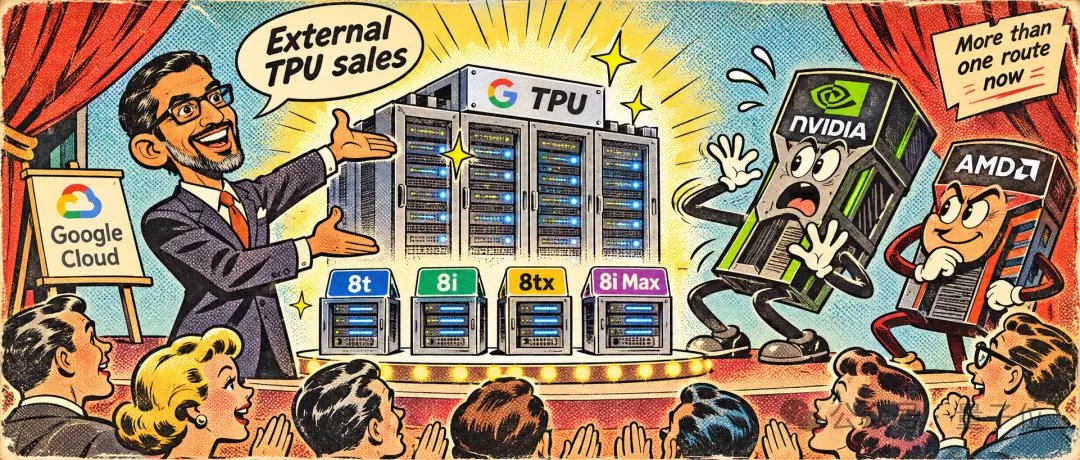
△ AI-generated image
Selling TPU systems externally, “like Nvidia”
Google made a break with tradition this year—
selling complete TPU systems to outside customers for the first time.
A source close to Google told QbitAI that an executive with under three years at the company drove the decision.
Amid intense debate within the company, he strongly advocated changing the commercial strategy for TPUs, ultimately getting management to make the decision to sell TPUs to external customers "just like NVIDIA."

△ AI-generated image
Initially, in 2013, TPUs were internal accelerators intended to reduce AI computing costs. External compute rental began through Google Cloud in 2018.
Cloud rental left all related hardware infrastructure operated by Google.
At this year’s Q1 earnings call, Sundar Pichai cited strong demand from AI labs, capital-markets firms and high-performance computing and announced on-premises deployment for selected customers.
Internally, this round of external sales is seen as a structural shift toward "funding research through sales": using external orders to share the enormous capital expenditure on data centers, and using demand at scale to feed back into the cost curve of its self-developed hardware.
Google began delivering complete systems in Q2.
These include computing, storage, networking, software and training/inference services.
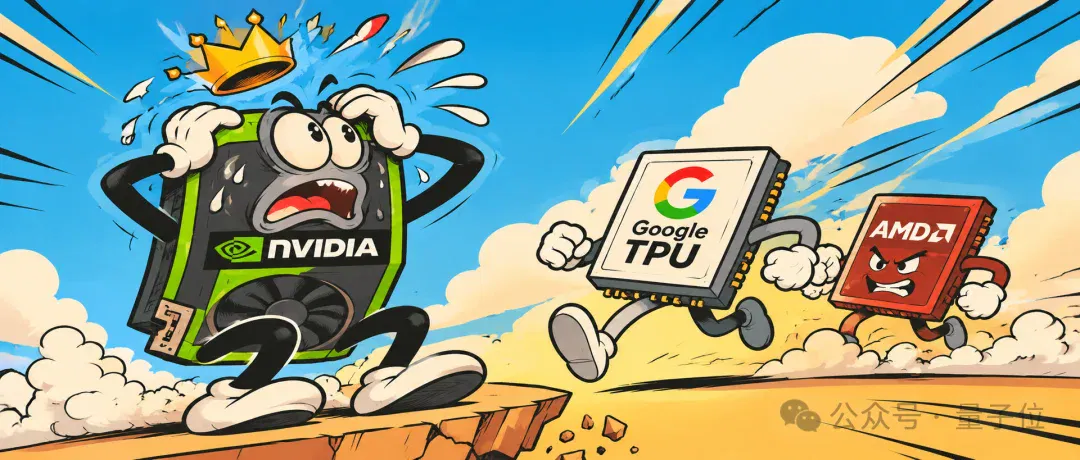
△ AI-generated image
The model is already showing revenue potential.
Google Cloud’s growth accelerated from 63% year on year in Q1 to 82% in Q2, then 103% in Q3, when revenue reached $30.7 billion. Operating profit rose from $3.594 billion to $11.121 billion.
Quietly: Cloud may be the only Q3 earnings segment that did not make readers frown.
Alphabet explicitly identified TPU system sales as an important contributor to Q3 Cloud growth.
Its latest 10-Q lists product sales, primarily TPU systems, as Cloud revenue. Management expects sales to expand further in Q4.
Q3 revenue contributions have already been disclosed, alongside contracts awaiting later delivery and recognition. Pending contracts do not mean all TPU sales remain outside financial reports.
Why now?
The article sees external sales as the result of natural evolution and external conditions.
At the Q2 call, Pichai emphasized that internal frontier-AGI compute needs remained a firm constraint. But persistent high-end GPU shortages push customers unable to obtain Nvidia systems toward alternatives.
Google wants that opportunity.
The seventh-generation TPU, Ironwood, released in 2025, was already designed specifically for inference. With the eighth generation this year, Google has gone further, separating training, real-time inference, confidential computing, and ultra-long context into different system configurations.
Chip leader Amin Vahdat says “the future is specialized,” aiming to challenge Nvidia’s one-general-purpose-chip-for-everything narrative through specialization.
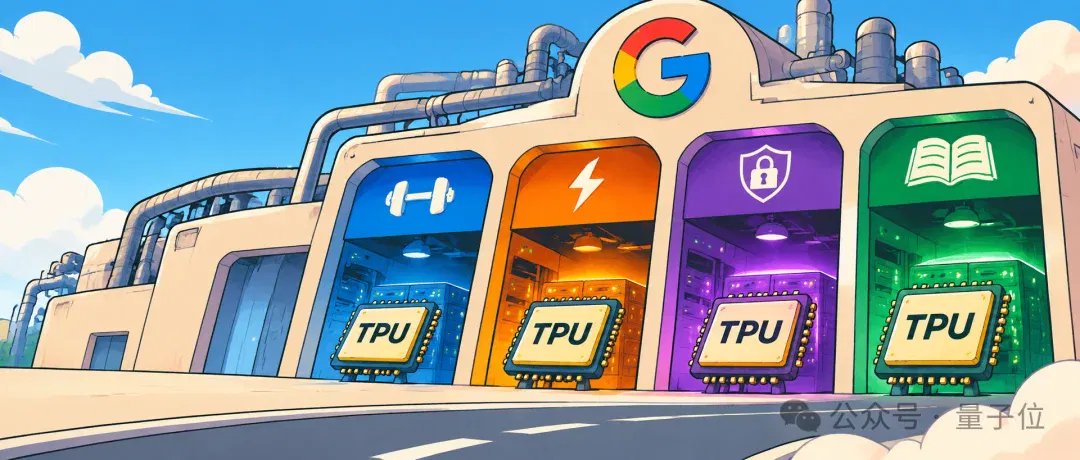
△ AI-generated image
Google is also working intensely to close gaps in TPU’s software ecosystem.
One of NVIDIA's biggest advantages over these years has been the CUDA ecosystem. NVIDIA equipped AI developers with a full toolbox early on, and a large amount of software has been adapted and optimized around CUDA.
PyTorch’s CUDA support is the most mature.
Building models with PyTorch and accessing Nvidia GPUs through CUDA has created a difficult-to-replace ecosystem barrier.
TPUs long relied on TensorFlow and JAX, with a very different stack and high migration barriers.
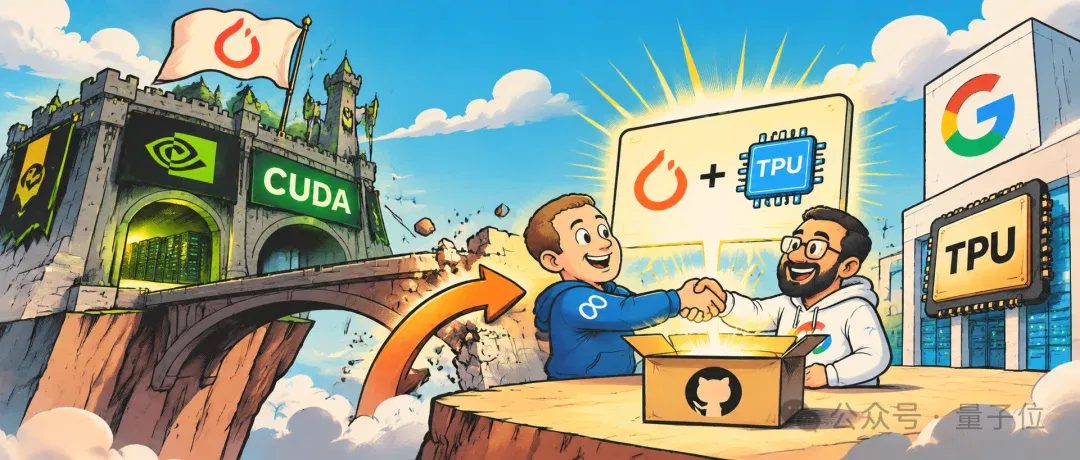
In mid-2025, Google began developing TorchTPU with Meta’s PyTorch team to run PyTorch models on TPUs with limited code changes.
TorchTPU was open-sourced late last month.
The implications hardly need spelling out.
△ AI-generated image
On November 5, SemiAnalysis published new agent-inference tests.
They showed that on models including Muse Spark, generation-seven Ironwood can exceed Nvidia GPUs’ tokens per dollar in some tests.
Nvidia had previously lost to AMD in only a few scenarios; TPU’s price-performance challenge creates an unwelcome new situation.
SemiAnalysis says Google’s AgentX submission showed TPUv7 beating GB300 NVL72 FP4 per dollar, prompting Nvidia to assemble a counterattack team.
Engineers and agents worked intensively through nights and weekends,
even until 2 a.m. local time.
After four optimization rounds, GB300 produced 1.5–2.6 times TPU’s tokens per dollar on one model’s test.

AMD is catching up within GPUs.
Google challenges GPUs as the default architecture.
Nvidia can scarcely avoid pushing itself harder.
Before Huang’s other troubles are resolved, the AI-chip market adds pressure from both sides.
A turbulent season for Nvidia indeed...
Reference:
[1]https://newsletter.semianalysis.com/p/tpu-strikes-the-king?utm_source=chatgpt.com
This article was originally published by QbitAI. Author: Hengyu.
Related topics
After reading
Join the AINRK community
Read how to join the community and connect with people working in AI.
Related articles
Continue reading related topics and articles in this category.

Google adds TPU 8tx and 8i Max for confidential computing and long-context tasks (opens in a new tab)
Google describes new eighth-generation TPU variants expected in 2027. The report covers customer needs, supply constraints and external sales; its 2028 revenue figures are institutional forecasts.
谷歌称 TPU 在轨运行 Gemma 4,原型卫星回传首个 AI 响应 (opens in a new tab)
谷歌披露 Project Suncatcher 原型卫星在轨启动 TPU,运行预部署的 Gemma 4 并回传生成结果。文章沿着这次演示梳理太空计算的电力、星间通信、散热与辐射问题:单颗芯片的短时运行已迈出验证一步,规模化集群及经济性仍需要后续实验。
Neon identifiers surface in Gemini web code; model and subscription positioning remain unconfirmed (opens in a new tab)
A source report recounts developers finding Neon model and subscription identifiers in Gemini web code, alongside discussion of element naming. Code strings and online guesses do not establish a release, plan features or access date.
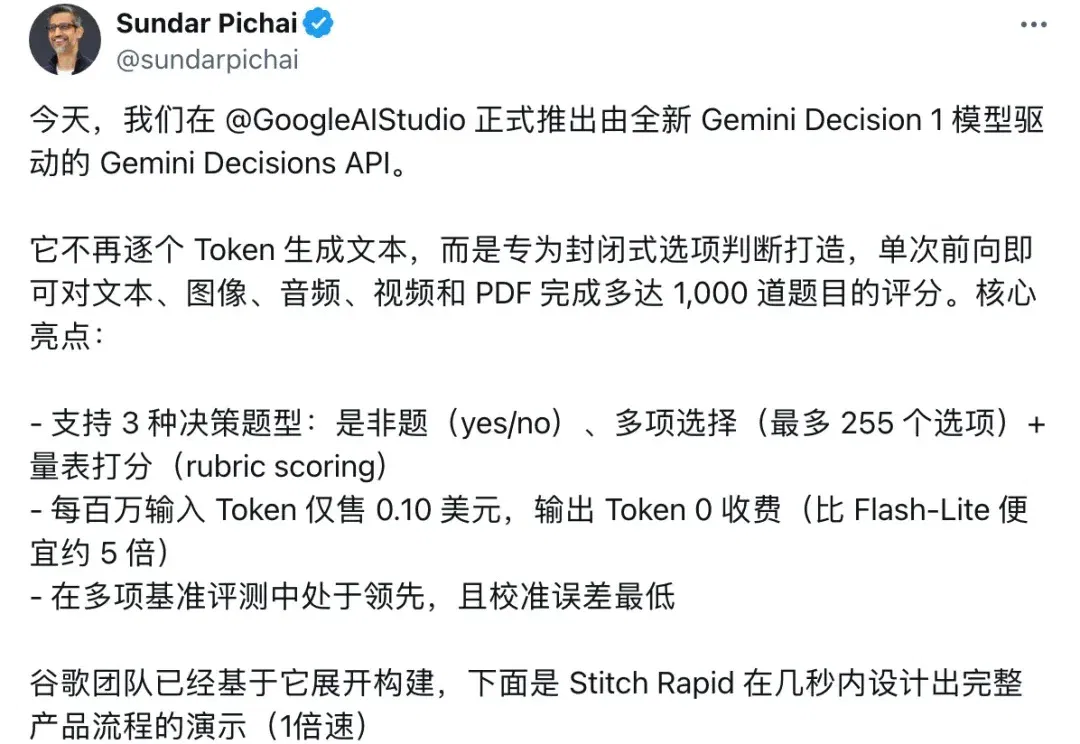
Karpo Decision goes open-source; 31B model ties first on a specified Decision Index version (opens in a new tab)
MachinePulse releases 0.8B–31B decision models that score options in one forward pass. The 31B model ties first at 73.9 in the November 12 Decision Index 0.4.1 snapshot. Latency and costs depend on test configuration; single decisions differ from full workflows.
Tongxin Intelligence raises seed and angel funding for AGI inference-chip design (opens in a new tab)
The BIGAI-incubated team outlines Vector, Tensor and AGI Core units, planning FPGA validation before further design, tapeout and production. The proposed architecture's commercial efficiency remains to be demonstrated.