Tongxin Intelligence raises seed and angel funding for AGI inference-chip design
The BIGAI-incubated team outlines Vector, Tensor and AGI Core units, planning FPGA validation before further design, tapeout and production. The proposed architecture's commercial efficiency remains to be demonstrated.
Before a chip is even built, the AI intended to run on it may have gone through several updates.
That is the timing gap next-generation AI poses for chipmakers: models iterate rapidly, while defining and mass-producing a chip takes a long engineering cycle. Waiting for computing requirements to settle could mean starting too late.
Tongxin Intelligence has chosen to enter now.
Initiated by AI expert Professor Zhu Songchun and incubated by the Beijing Institute for General Artificial Intelligence (BIGAI), the company was founded this April. Within six months, it completed seed and angel rounds totaling hundreds of millions of yuan, mainly for core architecture design and R&D before tapeout.
It aims to build a new inference chip for AGI algorithms: compatible with mainstream models while adding dedicated hardware for logical, causal and value reasoning.
The underlying question is difficult: can the computing needs of next-generation AI already be defined?
To this end, Tongxin has scientists studying artificial general intelligence work on the design together with engineers who have experience bringing large chips into mass production. Amid constantly changing algorithms, they need to identify the computations that will be called repeatedly and are worth accelerating with dedicated hardware, and then decide how the chip should be organized.
Models will evolve, but Tongxin is already choosing which capabilities to implement in hardware ahead of time.
AI enters the real world, posing new questions for chips
AI's boundaries are gradually extending from discrete interactions into the physical world.
In the first half of this year, LeCun, who left Meta to establish AMI Labs and raised $1 billion, argued that large language models are helpless in the physical world. His answer is world models: predict the next world state from a current state and hypothetical action, then use that prediction for planning.
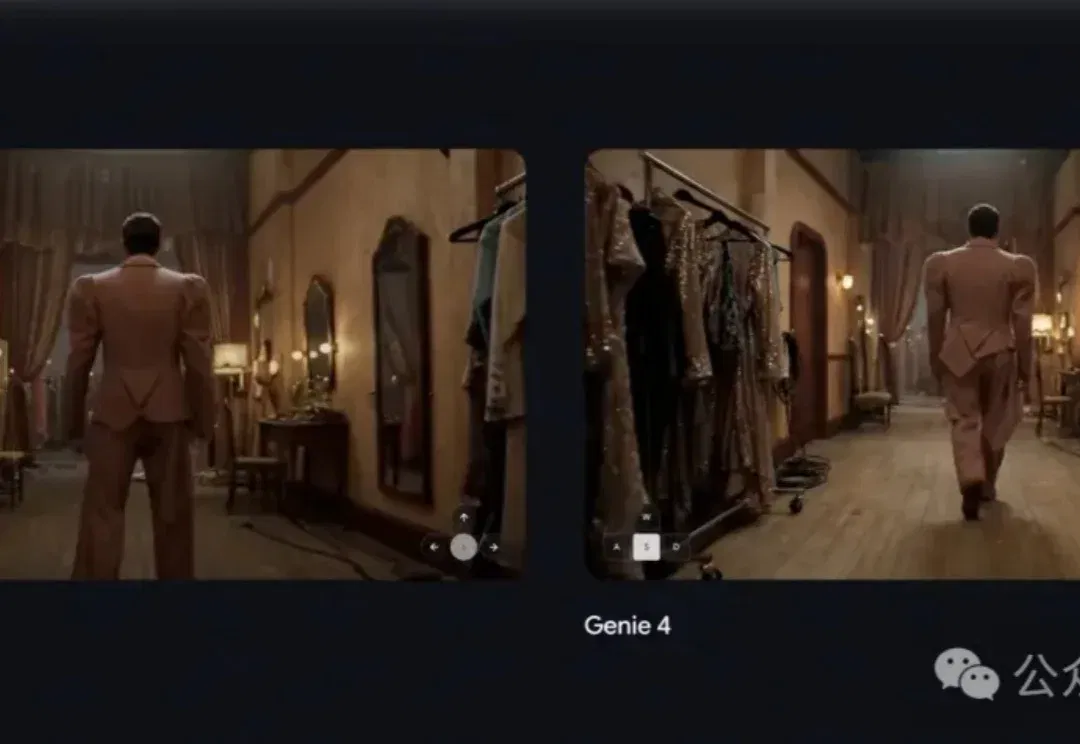
Last month, Google DeepMind announced Genie 4. Users can change weather or add people and objects in a simulated environment, with the model generating resulting changes in real time. DeepMind explicitly identifies training environments for robots and agents as an important application.

△ From Google DeepMind's official website
These efforts make AI's tasks more concrete: understand what is present, predict what an action will cause and inform the next decision. Agent development also influences chip design, a connection global technology leaders are examining.
In September, AMD announced an agreement to acquire Fei-Fei Li's World Labs for approximately $8.2 billion. Explaining it, Lisa Su emphasized that next-generation AI computing platforms require deep understanding of how models evolve.
Chipmakers must understand earlier what future AI will compute and where efficiency bottlenecks will arise. World models and robotics algorithms are still changing, but hardware choices must be made in advance, bringing model research and chip design closer.
Li said more directly: 'Without dedicated hardware investment, AI's efficiency and scale will be constrained.' She also disclosed technical collaboration with AMD on GPU training and inference optimization.
At the recent CoRL, Su made the reasoning more specific: hardware optimization takes years; deeper understanding of model computations and technological direction improves the chances of optimizing hardware, software and systems together.
The demand for interactive responsiveness is also prompting NVIDIA to adjust its inference systems. To meet agents' need for low latency, NVIDIA pairs GPUs with Groq's dedicated accelerators, assigning different stages of computation to the hardware better suited to executing them, while taking both overall throughput and interactive response speed into account.
All these developments raise the same question: how should chips support AI that must judge changing environments and act promptly?
Modern GPUs excel at massively parallel computation, supported by specialized matrix units—a main reason for their dominance in the language-model era.
But an agent that needs to act in a real environment also has another set of work to handle: repeatedly querying relationships between objects, updating the state of its surroundings at any time, and working through the consequences that its actions might bring.
With graph structures and dynamic branches, computation can become fragmented and memory access irregular. GPUs can execute these algorithms, but may not fully use their parallel resources, spending time locating and moving data or waiting for earlier results.
Operations per second alone can no longer explain task-completion speed. Software optimization, storage organization, compute units and scheduling must be reconsidered together.
Compute advantages in large models do not automatically become efficient physical action.
A growing inference market lies behind the efficiency issue. China Insights Consultancy forecasts China's AI inference-chip market at about RMB 1.17 trillion by 2030.
The opportunity Tongxin sees lies in the efficiency gap between new tasks and existing ways of computing. From the cloud to the robot edge, tasks have different requirements for throughput, response speed, and power consumption. Those differences also leave Tongxin room to start with the task and redefine the computing architecture.
AI's movement into the physical world is clear, but implementation paths continue evolving. Assessment must return to basic questions: are the problems real, how will demand change, which computations merit dedicated hardware, can theory guide product definition, and can the engineering team build it.
The collaboration between Li and Su illustrates that defining the next generation of AI chips requires not only a theoretical understanding of how intelligence works, but also the engineering ability to translate that understanding into hardware.
Only by following this line of thinking further can we understand why Tongxin chose to start with Professor Zhu Songchun's theory of intelligence in designing a chip.
Redefining AGI chips from an understanding of intelligence
Perhaps the greatest challenge in designing for an unsettled workload is the lack of a reference point.
Early GPUs had graphics rendering as a target; AI accelerators had matrix multiplication. For AGI chips, model approaches remain contested and computing needs undefined. Observing the present alone cannot supply an answer.
Deciding what belongs on silicon despite changing requirements needs a framework. Tongxin starts with the CUV framework proposed by Zhu's team.
A Marr Prize and Helmholtz Prize recipient, Zhu has spent three decades at the intersection of vision, cognition and robotics. His team's CUV framework, published in Engineering this year, unifies cognitive architecture (C), capability systems (U) and value systems (V):
- C is cognitive architecture, organizing internal modules and cooperation to connect perception, memory and reasoning;
- U is the capability system, covering callable skills such as object recognition and path planning;
- V is the value system, describing goals, preferences and constraints that guide actions. For robots, this may mean completing service tasks while considering safety and others' needs.
CUV brings what is seen, what can be done and what should be done into one decision process. What drives intelligence's growth is what it wants, rather than simply how much data it receives.
Zhu's team discussed these issues in papers as early as 2020. At a time when deep learning was at the height of its popularity, Professor Zhu Songchun and his team had already written a paper on "small data, big tasks." They called five things that cannot be seen in pixels, namely function, physics, intent, causality, and utility, the "dark matter" of vision.
Six years later, world models and spatial intelligence are prominent, and the industry asks how AI understands an action's consequences. Zhu's team had already highlighted that question.
'Small data, big tasks' emphasizes prior knowledge such as physical laws and common sense to handle broader tasks with less training data—an instruction manual for understanding the world.
For serving water, Tongxin's design would organize the cup, water source and guest's spatial relationships into a parse graph, plan around delivery, and call cup-taking, filling and movement skills to bring water to the guest.
If the guest moves during delivery, still-valid information is retained while affected state and paths are updated, reducing repeated computation.
In this process, the chip needs to perform more specific work: storing the current state and target state, accessing relationships between objects, performing probability calculations, comparing different plans, and scheduling the corresponding skills. All of these processes need to be implemented as executable algorithms and then broken down into basic computations, that is, operators.
Tongxin identifies operators suitable for acceleration and defines compute units, storage and data paths accordingly.
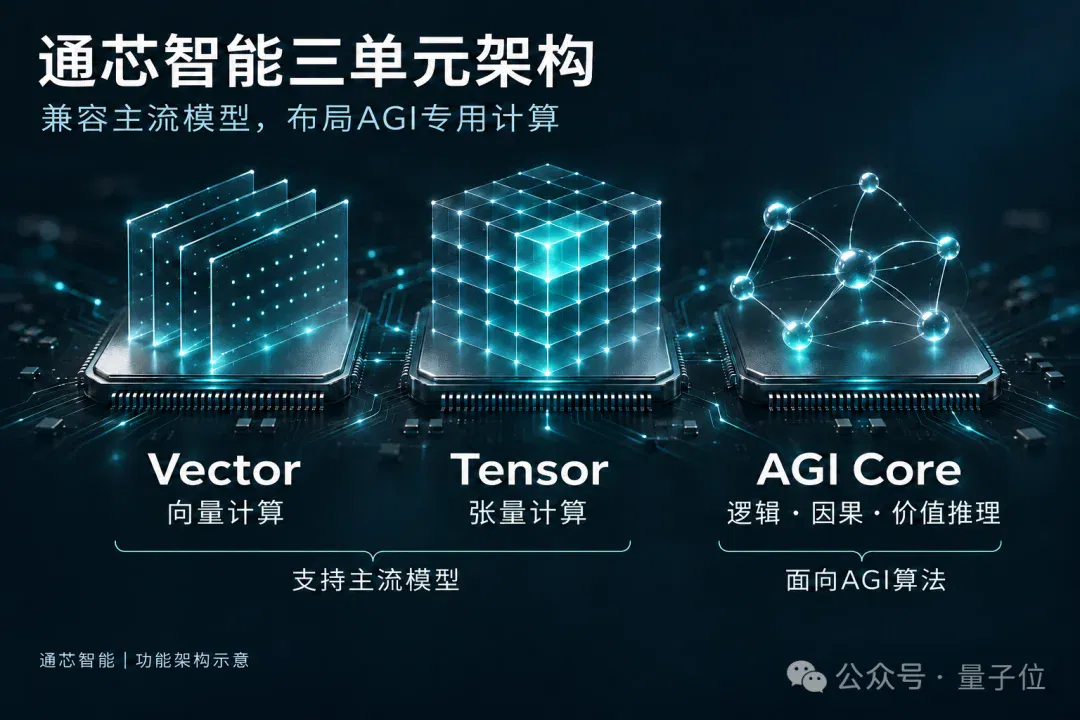
Vector and tensor operations underpin large language models, and this is where GPUs excel. An agent that needs to act in the real world must repeatedly answer the questions "What will happen if I do this, and is it worth doing?": reasoning about relationships between objects on a graph, making probabilistic inferences about uncertain situations, working through physical consequences, and then scoring each candidate action.
In Tongxin's definition, an AGI chip is not merely a faster GPU. It adds computational types beyond vectors and tensors—additional structure rather than compute alone.
Its chip plan includes Vector, Tensor and AGI Core units. Vector and Tensor support mainstream architectures such as CNNs and Transformers. AGI Core targets dedicated acceleration for parse-graph-based logical, causal and value reasoning and probabilistic computation.
These requirements also appear independently in other teams' research.
Li's spatial intelligence explores understanding 3D environments; DeepMind graph networks organize entities and relationships. DARPA-supported probabilistic programming combines prior knowledge with limited data under incomplete information; Pearl's causality asks what changing a condition would cause. In Reward Is Enough, Silver, Sutton and colleagues propose that agents pursuing reward through trial and error could develop perception, learning, reasoning and other abilities.
Tongxin believes graph storage and processing, probabilistic and causal inference, and evaluating action outcomes contain computations worth accelerating, informing AGI Core's planned units. Zhu's theories offer a clear starting point from which the company hopes to extract capabilities useful to more models.
Understandings of intelligence may differ, but the hardware foundation must find their common computational ground.
From theory to silicon: Tongxin's engineering basis
A systematic framework and understanding of intelligence and algorithms still leave the chip to be built.
Founder and CEO Wang Haiyang studied under Academician Xia Peisu, a founder of Chinese computing. A founding Loongson CPU team member, Wang led architecture for Hygon's first four CPU generations and co-founded a GPU unicorn. He has 25 years in chip R&D and 15 in SoC architecture, participating in CPU, GPU and GPGPU development through mass production.

△ Tongxin founder and CEO Wang Haiyang
Co-founder Shi Feng studied under Zhu and earned a UCLA doctorate. He defines AGI Core's technology and architecture and heads BIGAI's AGI Chip Center.
Both founders previously participated in the development of Loongson. Later, Wang Haiyang worked in industry to bring generation after generation of large chips into mass production, while Shi Feng combined intelligence algorithms with chip design, taking responsibility for translating the requirements of models and algorithms into computing units in the AGI Core.
The core founding team averages over 20 years' experience, with staff from Hygon, Baidu, ByteDance and Alibaba. Together, they have completed architecture, frontend/backend design, tapeout and production delivery for more than ten large chips.
That experience informs specific trade-offs.
First, memory. Wang was among the earliest to propose hybrid compute-in-memory. Tongxin is not building a purely compute-in-memory chip; it treats the technique as one means of easing the memory wall. Different tasks need different speed, capacity and cost, so storage and computation are matched accordingly—different knives for different jobs—reducing data movement and idle compute waiting for data.
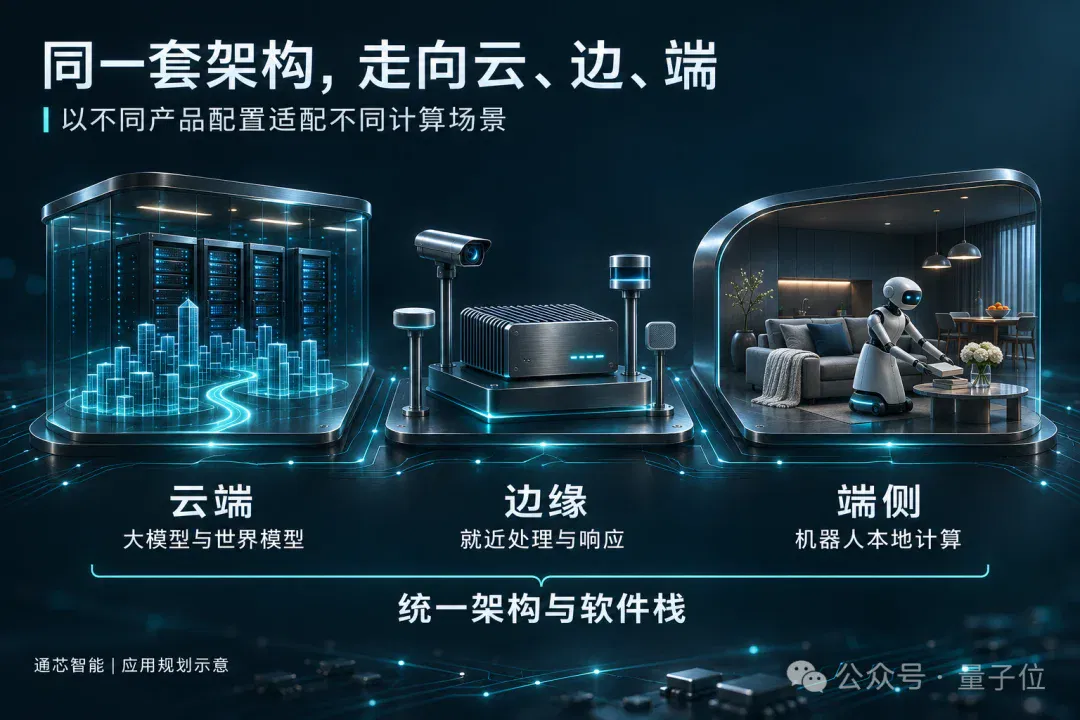
Next is area. Reconfigurable design reorganizes some hardware by task, using general units for compatibility and specialized units for efficiency. A planned Chiplet design addresses cloud, edge and device needs through configurations on the same architecture and software stack, matching cloud throughput and robot power/size constraints.
Tongxin is not jumping entirely into the future. A chip designed only for tomorrow may be unusable today.
Its first generation targets cost-effective inference for cloud models, world models and embodied edge computing. Existing models should run directly, AGI Core is included, and new capabilities are validated in stages.
AGI chips and GPUs need not be mutually exclusive. Tongxin positions itself as complementary to GPU-centered systems: language models remain important to AGI and one way agents understand the world, so compatibility and specialization proceed together.
Progress is faster than many expect. Within three months of founding, Tongxin completed architecture and project initiation. It is now in chip design and plans FPGA prototype validation in early December. Commercial plans cover cloud inference, general-purpose agents and on-device physical intelligence, with initial intentions for cooperation at scale.
It also plans adaptation with BIGAI's general agent Tongtong and related models, plus joint laboratories with Peking University, Tsinghua, the CAS Institute of Computing Technology and leading model-industry partners.
Wang Haiyang noted that, for Tongxin, defining the architecture is only the starting point; design, verification, tapeout, and mass production still follow. The computing capabilities selected today need to remain suited to the models and tasks that will exist after this round of research and development.
The broader lesson of its exploration is that as AI extends into the real world, chip teams need to understand algorithms earlier, break key computations down into operators, and then implement the parts worth accelerating in the hardware design.
Ultimately, this approach will have to prove its value through more timely responses from robots, lower running costs for agents, and more convenient deployment for developers.
From theory to algorithms, operators, silicon and real tasks, Tongxin is advancing the stages together.
Next-generation AI-chip competition begins before silicon exists: understanding intelligence and defining its computation.
Entering early is only the first step. Tongxin must now demonstrate with a working chip that today's judgments can become tomorrow's efficiency advantages.
As Zhu puts it: 'The chip is the agent's heart. Giving machines a heart begins with this chip.'
This article comes from QbitAI. Author: Yunzhong.
After reading
Join the AINRK community
Read how to join the community and connect with people working in AI.
Related articles
Continue reading related topics and articles in this category.

Google expands TPU system sales as software adaptation and inference economics draw attention (opens in a new tab)
QbitAI discusses complete-system deliveries, TorchTPU and agent-inference tests using filings and sources. Revenue, unfulfilled contracts and model-specific token-per-dollar comparisons are distinct measures; optimization rounds can change results.

Google adds TPU 8tx and 8i Max for confidential computing and long-context tasks (opens in a new tab)
Google describes new eighth-generation TPU variants expected in 2027. The report covers customer needs, supply constraints and external sales; its 2028 revenue figures are institutional forecasts.

AI Futures Project advances its superhuman AI researcher forecast: evidence and uncertainty (opens in a new tab)
The team updates its forecasts using METR’s assessment of accelerated R&D at Anthropic. Median estimates from different methods differ by more than a year, and some crucial evidence remains unpublished.
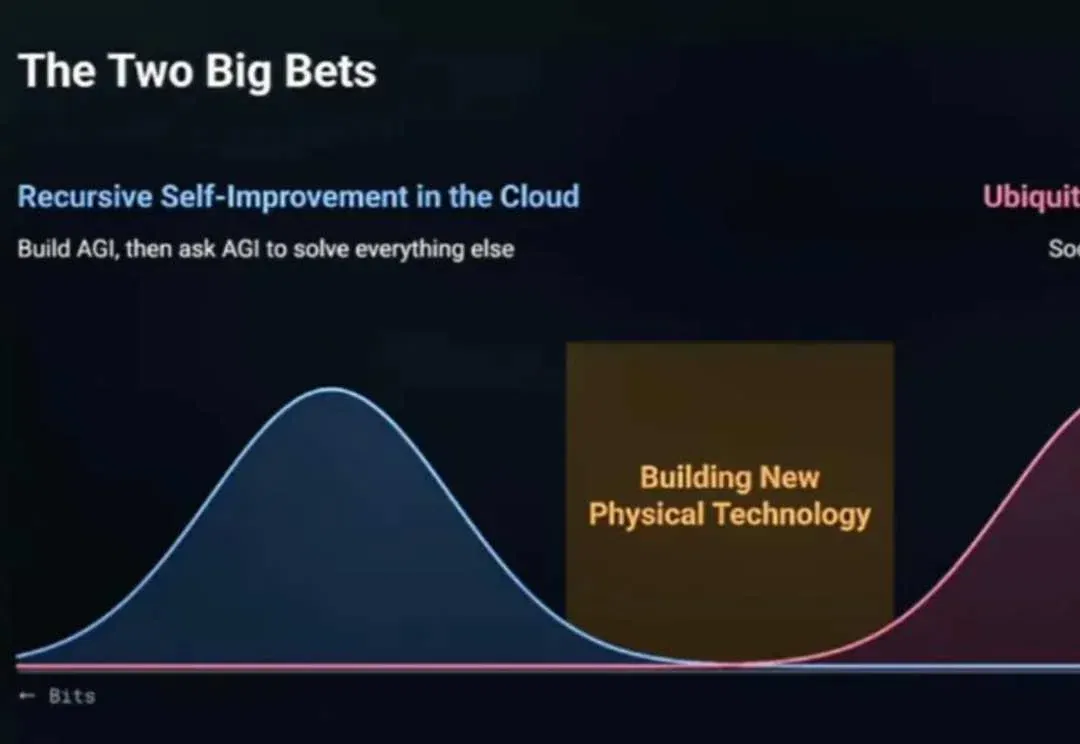
Ted Xiao on AI in the physical world: how verification speed limits faster R&D (opens in a new tab)
The talk examines verification bottlenecks in engineering, robot training and automated labs, arguing for testing verifiers in actual settings and using limited real-world tests to guide the next iteration.
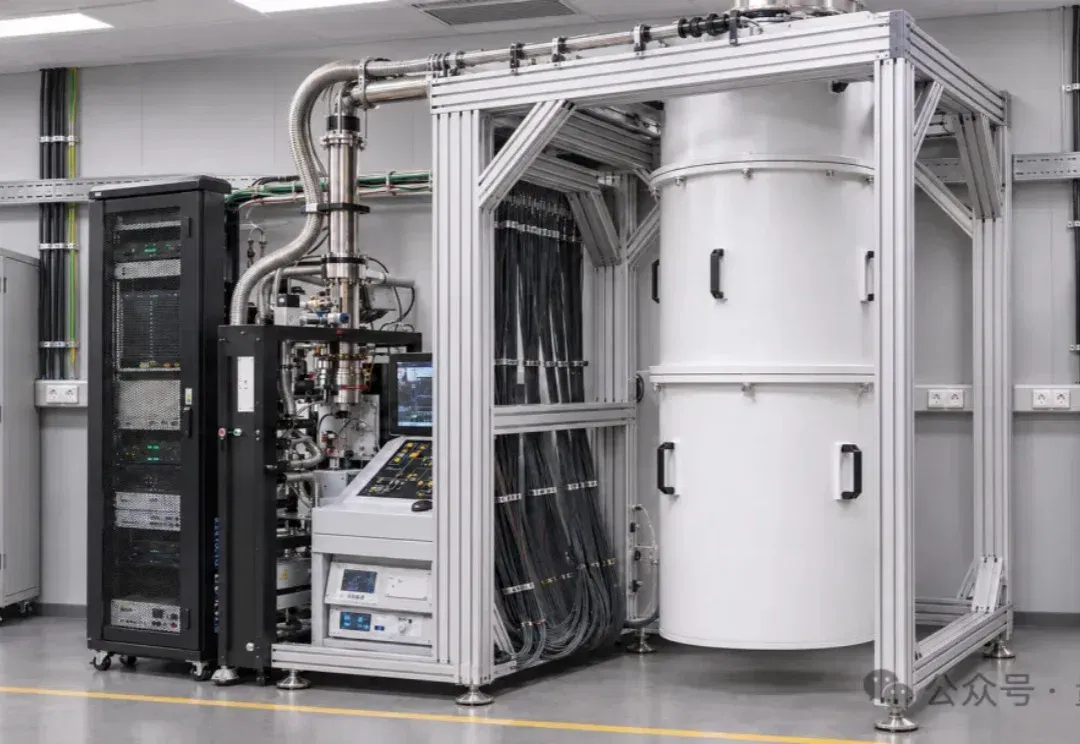
从芯片互连到测控,正元量子推进千比特超导整机研发 (opens in a new tab)
正元量子宣布近亿元天使轮融资,计划推进三维封装、低温互连及集成测控。文章解释物理比特规模扩大时,连接和纠错所面临的工程问题。