Neon identifiers surface in Gemini web code; model and subscription positioning remain unconfirmed
A source report recounts developers finding Neon model and subscription identifiers in Gemini web code, alongside discussion of element naming. Code strings and online guesses do not establish a release, plan features or access date.
Editorial correction (November 18, 2026): Element atomic numbers have been corrected. Code identifiers and online speculation do not constitute Google-confirmed release plans.
I never expected to complain that Google releases too many models...
Developers have reportedly discovered another model identifier in the Gemini web app’s code: gemini-4-neon.
Neon is element number ten in the periodic table.
As soon as it surfaced, people complained about the lack of order. Why jump straight from Hydrogen to Neon?
What happened to hydrogen, helium, lithium, beryllium, boron, carbon, nitrogen, oxygen, fluorine and neon?
Speaking of the periodic table, someone presented a newly designed Gemini interface.
“I devised a brilliant solution for Google... Google can use it free.”
Who expected to revisit middle-school chemistry here years later? Please stop at calcium; I cannot recite any further. Just kidding.
What tier is Gemini 4 Neon?
According to model-tracking account AI Tracker Bot, gemini-4-neon appears in Gemini web-app code alongside earlier identifiers such as gemini-4-argon and gemini-4-carbon.
Besides the model, the code also contains a NEON subscription tier with the same name.
It is marked TIER_NEON, with the usage-page name “Gemini Ultra,” yet internally distinguished from ordinary Ultra.
Other users found Neon associated with upsell_MODE_CATEGORY_PRO. Upselling is a common software-product paid-upgrade mechanism.
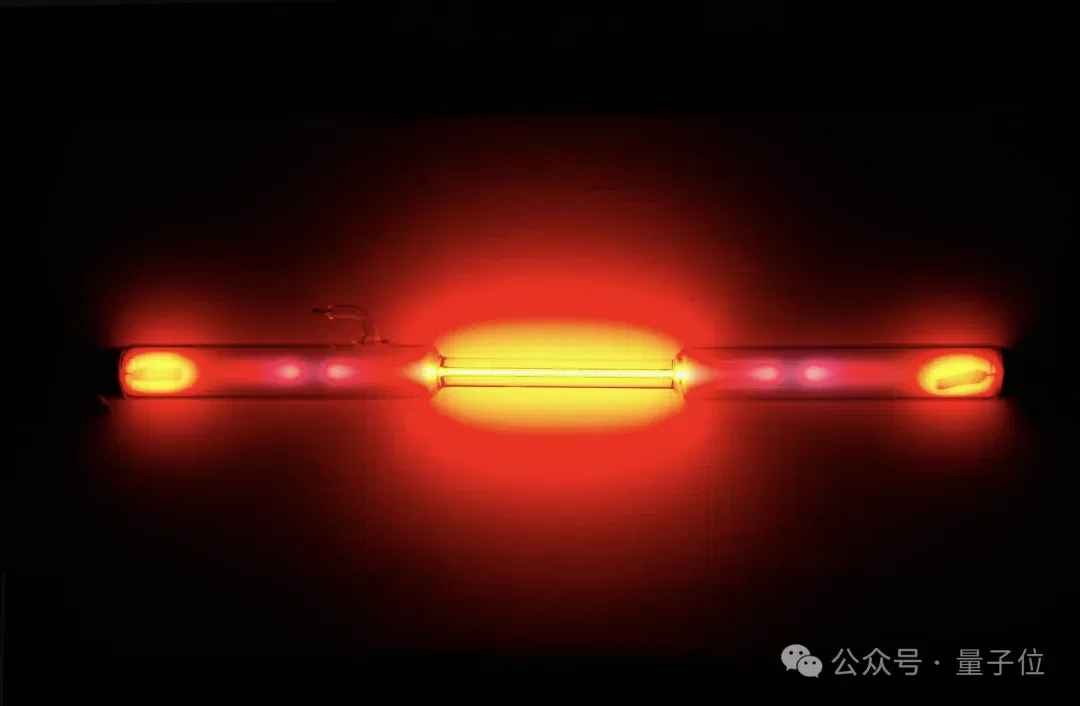
△Neon, a colorless, odorless, inert monatomic gas
That makes its positioning more mysterious: some had previously speculated it was a new lightweight Flash-Lite model.
This seems to be the fourth element to surface in the Gemini 4 series.
On September 30, Google first announced Gemini 4 Argon, targeting demanding software engineering, deep reasoning, enterprise knowledge work and cybersecurity.
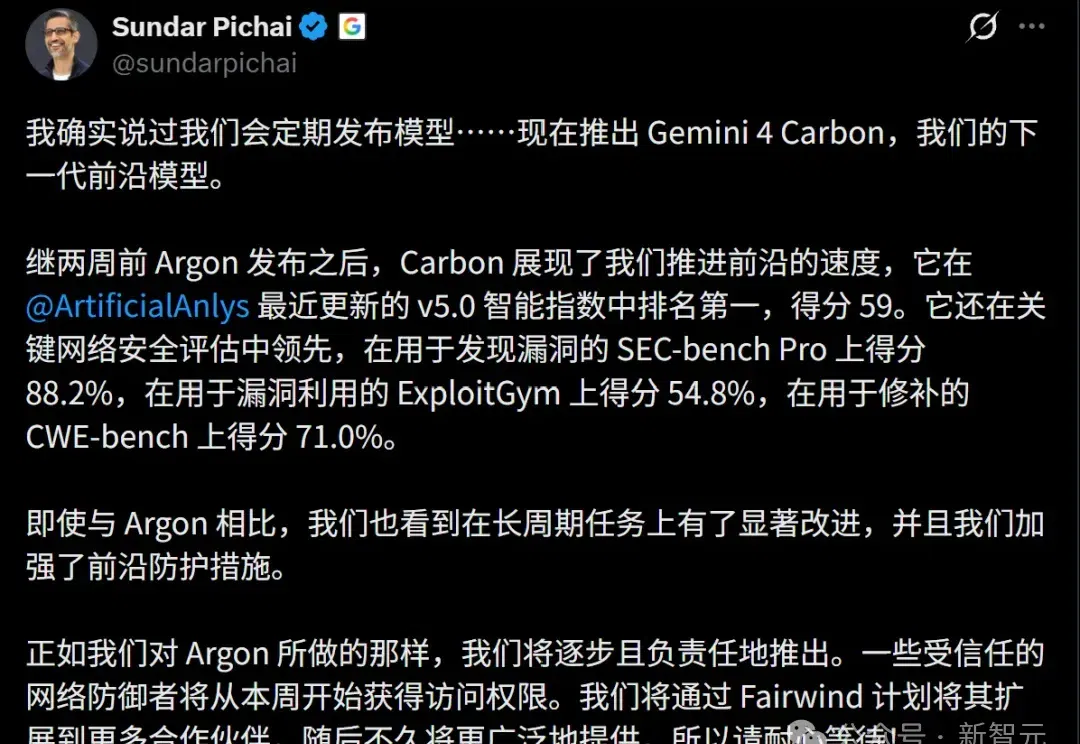
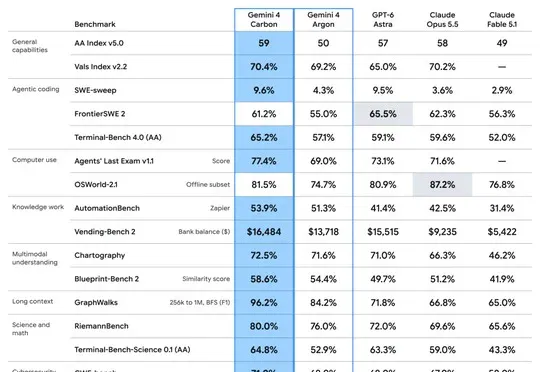
On October 28, Gemini 4 Carbon followed as a stronger frontier model, emphasizing long-horizon agent tasks, code and cybersecurity.
On November 12, Gemini 4 Hydrogen arrived, emphasizing speed and efficiency for everyday coding and agent workflows.
The Neon identifier has sparked discussion about the next model, but its name, positioning and release date have not been officially confirmed. Discussion of subsequent element names is speculation.
“Google is too slow. Where is Gemini 4 Oganesson?”
“At this rate Google will need to discover new chemical elements.”
You never know.
Before Neon, Krypton also circulated online a few days earlier.
On November 14, a leaker claimed Google was testing Krypton on Arena, showing generated code and animation and even saying it approached Claude Opus 5.5.
Soon afterward, the leaker corrected themselves: it was actually Gemini 4 Hydrogen with higher reasoning effort. All that hype amounted to little.
I will quit my job to study Gemini model names
Many people are looking for a pattern in Google’s periodic-table naming.
Jawns, for instance, tried ordering the Gemini 4 series along several dimensions.
Here is the reasoning.
By complexity and cost, the order should be Hydrogen → Argon → Carbon.
By atomic number, it is Hydrogen (1) → Carbon (6) → Argon (18). Those numbers are not atomic masses.
Alphabetically, including the previously internally tested Barium, Argon → Barium → Carbon works, until Hydrogen arrives.
By abundance in the universe, it should also be Hydrogen → Carbon → Argon.
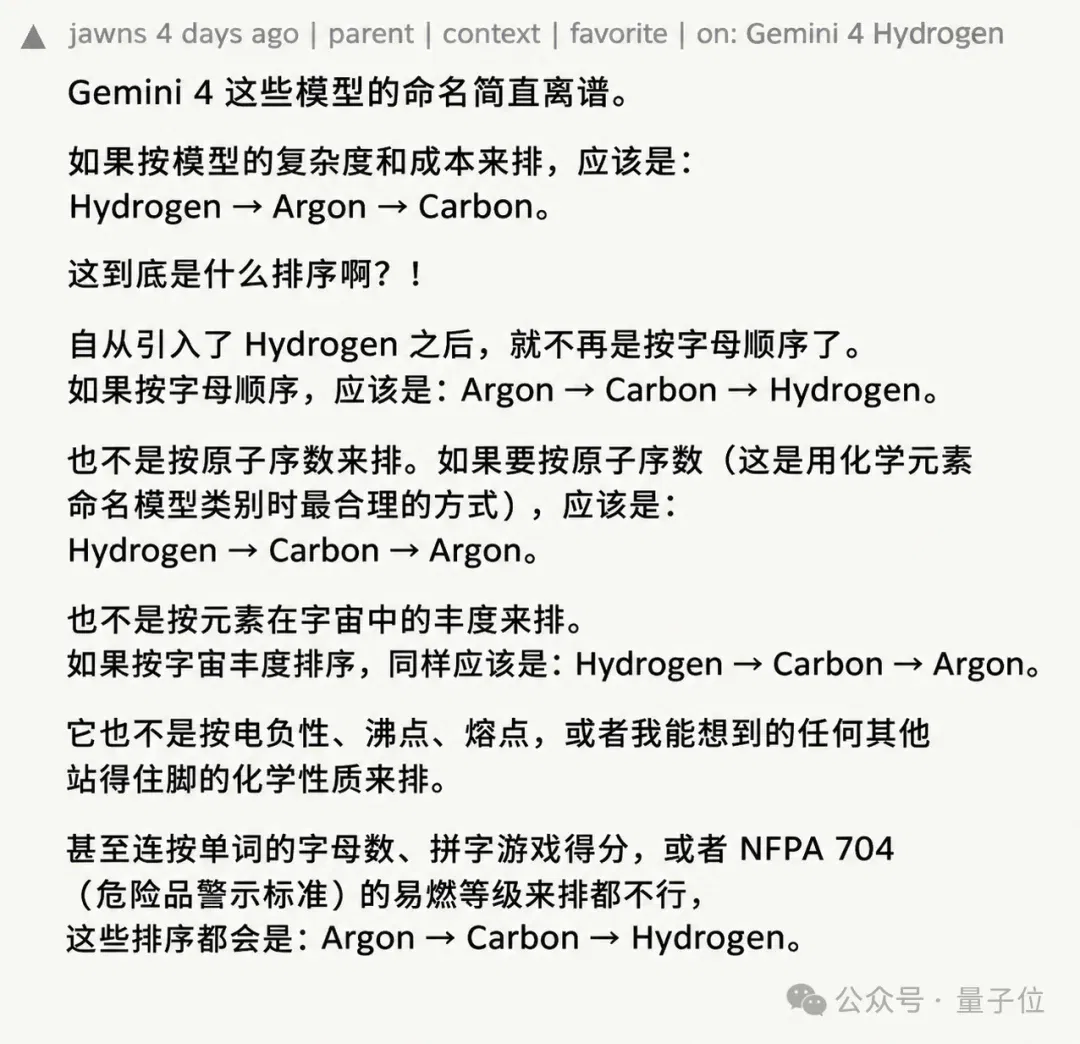
△An HN user investigates Gemini’s naming pattern
No pattern emerges.
“Bro, I think Google throws elements into a hat and picks randomly.”
“Even Starbucks cup sizes would be clearer.”
Honestly, Google has become a riddler. Perhaps the names are deliberately indecipherable: if everyone understood them, who would keep guessing and awaiting new models?
Another possibility, though, is that Google simply likes each element’s meaning.
Argon’s name comes from the Greek for “idle” or “inactive,” and it is a chemically stable noble gas. That has some conceptual resonance with the model’s cybersecurity defense and complex software-engineering capabilities.
Carbon underpins life and can form complex structures, perhaps matching the problems this leading frontier model aims to solve.
Hydrogen, the lightest element, fits a speed-and-efficiency positioning.
Neon comes from the Greek neos, meaning “new”; the word for neon lighting derives from it too. Perhaps that offers another angle on the model’s possible positioning.
Jokes aside, one criticism is fairly apt:
“When technology companies finally give products normal names, we will know they have achieved superintelligence.”
After all, the first job of a model's name should be to make it easier for users to understand the model. As for how much power it possesses, that is something it should prove to its users.
One More Thing
Google’s subscription system, not just model names, is also driving users to distraction.
When Gemini 4 Carbon expanded access, some Pro subscribers found no new model available.
Others saw Carbon on either their Google Workspace or AI Pro account while the other remained on Argon.
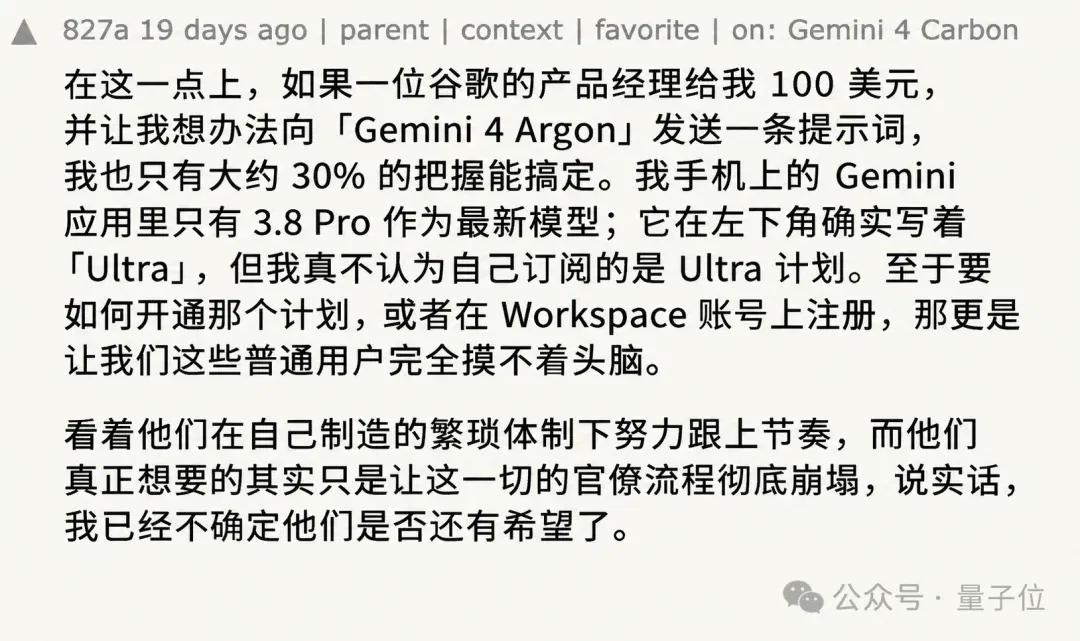
△Users complain about confusing paid tiers
Alongside those tiers, Gemini has six entry points: AI Studio, Gemini API, Gemini for Business, Gemini App, Google Search and Antigravity.
Now the newly surfaced model also comes with a Neon subscription tier, adding further confusion.
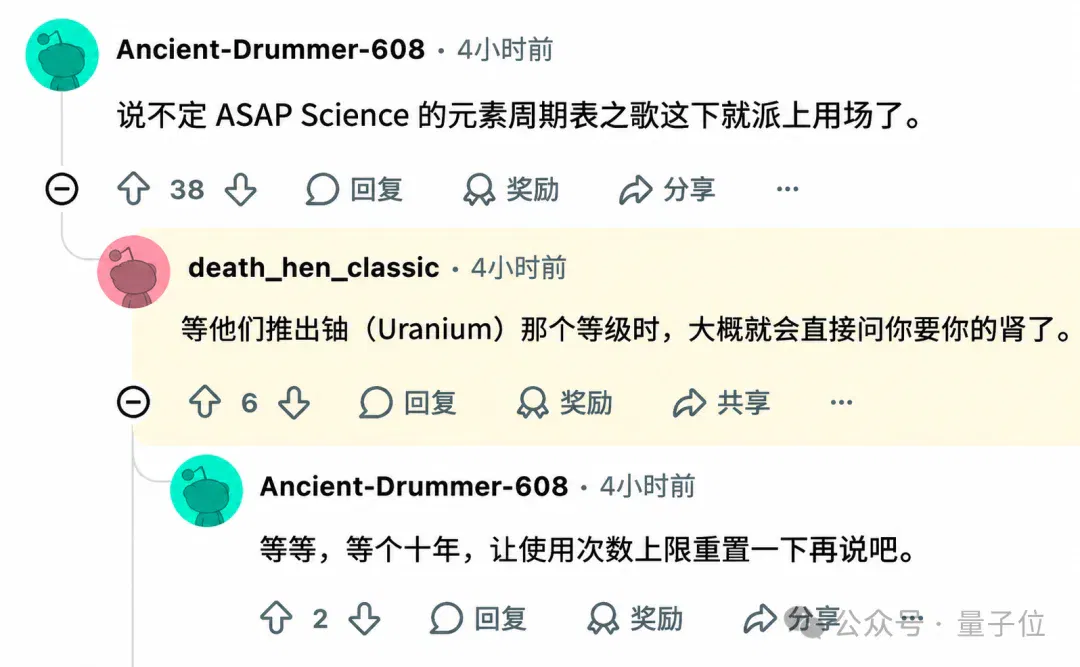
△Users imagine a uranium-tier subscription
This article was originally published by QbitAI. Author: Cheng Qian.
Related topics
After reading
Join the AINRK community
Read how to join the community and connect with people working in AI.
Related articles
Continue reading related topics and articles in this category.
Google 用 AlphaProof Code 验证 Signal 部分代码的安全性质 (opens in a new tab)
Google DeepMind 展示了由 Gemini 4 Carbon 驱动的形式化验证案例。团队报告四周内生成约 650 万行 Lean 证明,所验证的是明确规格下的部分安全性质。
Google 调整美国 K-12 教育账户的 AI 与搜索设置,引发学区争议 (opens in a new tab)
报道聚焦 Google 计划在 2027 年初调整学校账户的 AI 开关,以及部分搜索功能与 AI 设置的关系。文章整理学区、教师与家长对搜索访问和学生使用的不同顾虑。
Gemini 4 Carbon 的能力与开放范围:长程编程、网络安全和评测表现 (opens in a new tab)
这篇报道汇总 Gemini 4 Carbon 的代码生成演示、长程任务与网络安全评测,并对比多项基准成绩。Google 首批仅向部分受信任的网络防御伙伴开放模型;特定测试中的零攻击成功率不代表绝对安全,榜单领先也不能替代具体业务验证。
Google 发布 Gemini 4 Carbon,先向可信网络防御伙伴开放 (opens in a new tab)
Google 介绍 Gemini 4 Carbon 的长程工程、代码与网络安全能力,并从部分网络防御伙伴开始逐步开放。报道汇总官方与第三方评测;更大范围的开发者、企业和消费者使用仍取决于后续推出安排。

AI教科书全错!底层公式惊天Bug曝光,Gemini率先自我修复 (opens in a new tab)
各大AI框架都错了! PyTorch错了,JAX错了。连教科书里的标准公式,也错了。 谷歌DeepMind的主任研究科学家 Jon Barron披露了这一重磅炸弹! 本周,Google DeepMind 展示了一个问题:在 PyTorch、JAX 以及各类教科书中,该算法的每一个标准版本都一直在悄悄把某个数字舍入为零。 模型越自信,正确的训练信号反而越容易凭空消失。优化器因此失控,训练曲线剧烈震荡。 但最让人毛骨悚然,也最让人兴奋的是:这个隐藏在全人类眼皮底下的底层逻辑漏洞,是AI(Gemini)自己抓出来的。 这次,人类只负责了事后的复核与排版。 消失的数字,崩塌的模型标 这个Bug藏在AI