Google adds TPU 8tx and 8i Max for confidential computing and long-context tasks

Google describes new eighth-generation TPU variants expected in 2027. The report covers customer needs, supply constraints and external sales; its 2028 revenue figures are institutional forecasts.
Editorial correction (November 16, 2026): CPUs were not pioneered by a single company, and suitability also depends on the task and hardware. Revenue, price-difference, and market-share forecasts retain their attribution in the original report.

Image credit: Google
Alphabet's Google is expanding its lineup of artificial-intelligence chips, hoping to build on its rapid rise in recent years and further challenge Nvidia's dominance in an AI-chip market worth hundreds of billions of dollars.
Google is introducing two new tensor processing units (TPUs). TPUs are custom semiconductors designed by Google, mainly for training and inference in AI models. The new products target confidential computing and long-context tasks that process larger amounts of information, respectively, aiming to meet growing compute needs and security challenges as the AI industry shifts toward Agents.
During US stock trading on Monday, Alphabet shares rose as much as 4.1% to $296.33.
The release also signals faster product iteration in Google's chip business. Previously, Google typically introduced a generation of AI processors every two years. In April this year, the company released two new chips simultaneously for the first time, and it is now adding two new versions based on existing products.
In an interview, Google chip-business head Amin Vahdat said its four TPU products would each be optimized for different use cases.
"This is consistent with Google's long-standing view: the future belongs to specialized chips, and the benefits of specialization remain very substantial."
The AI-chip industry is currently in a turbulent period. On one hand, concerns that AI-infrastructure investment may slow are weighing on technology stocks; on the other, the US Democratic Party's sweeping midterm-election victory adds uncertainty to the future of data-center projects.
Demand for Nvidia's AI processors nevertheless still exceeds its supply capacity, leaving room for Google and other competitors to grow.
Two new chips target secure computing and long-context inference
Google's new TPU 8tx and 8i Max are not completely redesigned chips. Instead, existing chip architectures have been reconfigured according to customer needs.
The 8tx mainly targets government agencies and customers in strictly regulated industries, handling highly sensitive computing tasks that require confidentiality. The system will run with AMD chips as part of Google's partnership with AMD.
The 8i Max mainly targets AI applications requiring long context windows. A context window determines how much information an AI system can process in a single request.
Vahdat said this capability is essential not only for drug discovery and mathematical research, but also for AI coding applications.
The AI-accelerator market in which TPUs compete is still dominated by Nvidia GPUs.
More than a decade ago, Google began working with Broadcom to develop TPUs, with Broadcom assisting chip design and coordinating production. Google initially wanted specialized chips to meet its search business's growing computing needs more efficiently.
The company subsequently came to recognize TPUs' potential for AI computing and began using them for AI training and inference. Today, Google is no longer limited to providing TPU compute through its own cloud services; it has begun selling chips directly to external customers.
This shift is producing substantial commercial returns.
Bloomberg Intelligence forecasts that Google's TPU-related sales could exceed $135 billion by 2028, including supporting software and hardware revenue, far above the estimated $12 billion this year. That forecast does not include revenue from customers using TPUs through Google Cloud.
Google TPUs have already attracted major customers including Apple, Meta, and Oracle.
Vahdat said introducing more specialized versions would help Google further increase its market share. The two new chips are expected to become available next year.
"We could design a general-purpose chip that tries to cover the whole market, but developing specialized versions optimized for different scenarios actually creates greater value for customers."
Even Nvidia, which has long positioned GPUs as a general-purpose AI-computing platform, is beginning to introduce more specialized chip systems.
CPUs are a category of general-purpose processors whose modern development involves multiple institutions and companies. Large-scale model training usually relies on accelerators, while CPUs still participate in data processing, scheduling, and some computation.
Nvidia has also begun using technology acquired from startup Groq to introduce chips more focused on AI inference. Inference is the process in which a trained AI model actually performs tasks.
In the specific technical design, Google's 8tx works with AMD CPUs to enable chip-level data encryption and improve security.
Vahdat explained that in traditional computing, data usually need to be decrypted in memory before processing, while the new technology can reduce the security risks in this process.
The 8i Max integrates two TPU chips in the same package to provide greater computing performance and more memory capacity.
TPUs priced about 30% below Nvidia, with energy efficiency a competitive advantage
Bloomberg Intelligence analyst Mandeep Singh said value for money is one of TPUs' important competitive strengths.
Compared with Nvidia GPUs, TPUs are priced about 30% lower but remain competitive in throughput. Throughput measures the volume of data a chip can process in a given time.
This advantage is attracting customers from multiple industries, including finance.
Google disclosed in last month's earnings report that quantitative-trading firm Jump Trading had become a TPU customer.
In an interview, Jump Trading CTO Alex Davies said the company had tested TPUs for several years before formally signing a large procurement contract. The two sides ultimately reached a larger-scale partnership agreement about a year ago.
Jump Trading currently has thousands of TPUs, mainly for training AI models serving use cases such as trading research.
Although the company still mainly uses Nvidia GPUs to train models, Davies said a small group of enthusiastic employees strongly appreciated TPUs' performance on particular tasks.
He believes TPUs perform exceptionally well on some computing tasks, and that using different types of chips has value in itself.
"It is actually attractive to have some problems solved in different ways. You can learn from that."
Davies also noted that in applications where their performance matches or exceeds Nvidia chips, TPUs often have higher energy efficiency, further reducing the cost of use.
Last month, Oracle announced a partnership with Google that will give Oracle Cloud customers access to TPUs for the first time starting next year.
Previously, Oracle Cloud customers could choose only between Nvidia and AMD AI chips.
Karan Batta, senior vice president of Oracle Cloud Infrastructure, said in a statement: "As AI workloads become more complex, customers need more choice, which is why we are partnering with Google. This collaboration will further improve our ability to help customers develop and run AI on the infrastructure best suited to them."
Anthropic, the developer of the Claude chatbot, is another important customer of Google's TPUs.
According to recently filed regulatory documents, Anthropic has the option to purchase up to $150 billion of TPU chips between 2028 and 2031.
Bloomberg News also previously reported that OpenAI plans to purchase Google TPUs.
Google's dual role as an AI-model developer and chip designer gives its chip business a distinctive advantage.
The TPU R&D team can access Google's latest Gemini models early and use them to improve chip energy efficiency and find design flaws.
This capability is particularly important in semiconductor R&D. A single mistake in chip design can cause billions of dollars in losses and wipe out months of research and development.
Vahdat said AI is helping chip R&D teams reduce these risks.
OpenAI and Anthropic develop their own chips, bringing Google new competition
Despite rapid growth in its TPU business, Google still faces challenges from new entrants.
Chip startup Tenspresso, co-founded by two former Google TPU engineers, is focusing development of its first chip on long-context inference, the same application area targeted by Google's 8i Max.
However, Bloomberg reported last week that Tenspresso was still at least a year away from completing its first chip design.
Meanwhile, OpenAI and Anthropic are also advancing internal chip-development projects. Both teams have recruited engineers with TPU-development experience and may become new competitors to Google in the future.
Another risk comes from a possible slowdown in AI-infrastructure spending.
Bloomberg Intelligence analyst Singh expects opposition to data-center construction could reduce technology companies' originally projected $1.4 trillion of infrastructure investment in 2027 by about 5% to 7%.
That investment covers chips, networking equipment, land, and other materials needed to construct data centers.
Singh also noted that Google's TPU business has lower margins than Nvidia's.
Beyond uncertainty on the demand side, the supply chain is also an important constraint on Google's expansion of its TPU business.
Like the broader AI-chip and infrastructure industry, Google faces shortages of critical resources such as memory and chip-manufacturing capacity, making it difficult to fully meet market demand.
Google said in its earnings report that customers had already reserved all TPUs available for delivery.
To ease supply pressure, Vahdat's team is working to diversify suppliers as much as possible.
This means Google may no longer rely entirely on long-standing partner Broadcom. Broadcom has coordinated TPU manufacturing, but Google has also begun approaching other suppliers in recent years.
In recent months, Google signed a partnership agreement with Broadcom competitor Marvell Technology involving some TPU-related business, although the announcement disclosed few specific details.
There have also been reports that MediaTek is participating in work related to Google's TPU business.
Bloomberg Intelligence analyst William Tong believes Google is likely negotiating long-term agreements with more suppliers to secure future capacity and prevent supply-chain bottlenecks from worsening further.
References:
https://www.bloomberg.com/news/articles/2026-11-09/google-escalates-nvidia-rivalry-with-new-versions-of-its-tpu-systems?srnd=phx-ai
This article comes from the WeChat official account "Z Potentials," by "Z Potentials."
Related topics
After reading
Join the AINRK community
Read how to join the community and connect with people working in AI.
Related articles
Continue reading related topics and articles in this category.

Google expands TPU system sales as software adaptation and inference economics draw attention (opens in a new tab)
QbitAI discusses complete-system deliveries, TorchTPU and agent-inference tests using filings and sources. Revenue, unfulfilled contracts and model-specific token-per-dollar comparisons are distinct measures; optimization rounds can change results.
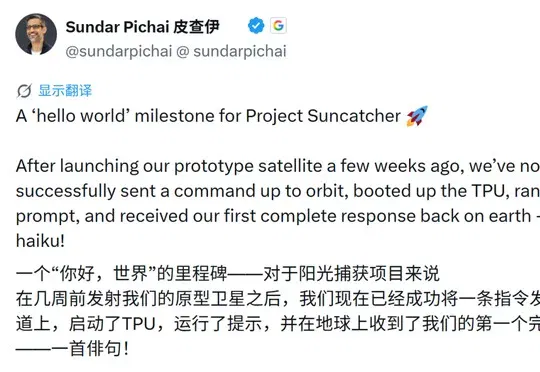
谷歌称 TPU 在轨运行 Gemma 4,原型卫星回传首个 AI 响应 (opens in a new tab)
谷歌披露 Project Suncatcher 原型卫星在轨启动 TPU,运行预部署的 Gemma 4 并回传生成结果。文章沿着这次演示梳理太空计算的电力、星间通信、散热与辐射问题:单颗芯片的短时运行已迈出验证一步,规模化集群及经济性仍需要后续实验。

Neon identifiers surface in Gemini web code; model and subscription positioning remain unconfirmed (opens in a new tab)
A source report recounts developers finding Neon model and subscription identifiers in Gemini web code, alongside discussion of element naming. Code strings and online guesses do not establish a release, plan features or access date.
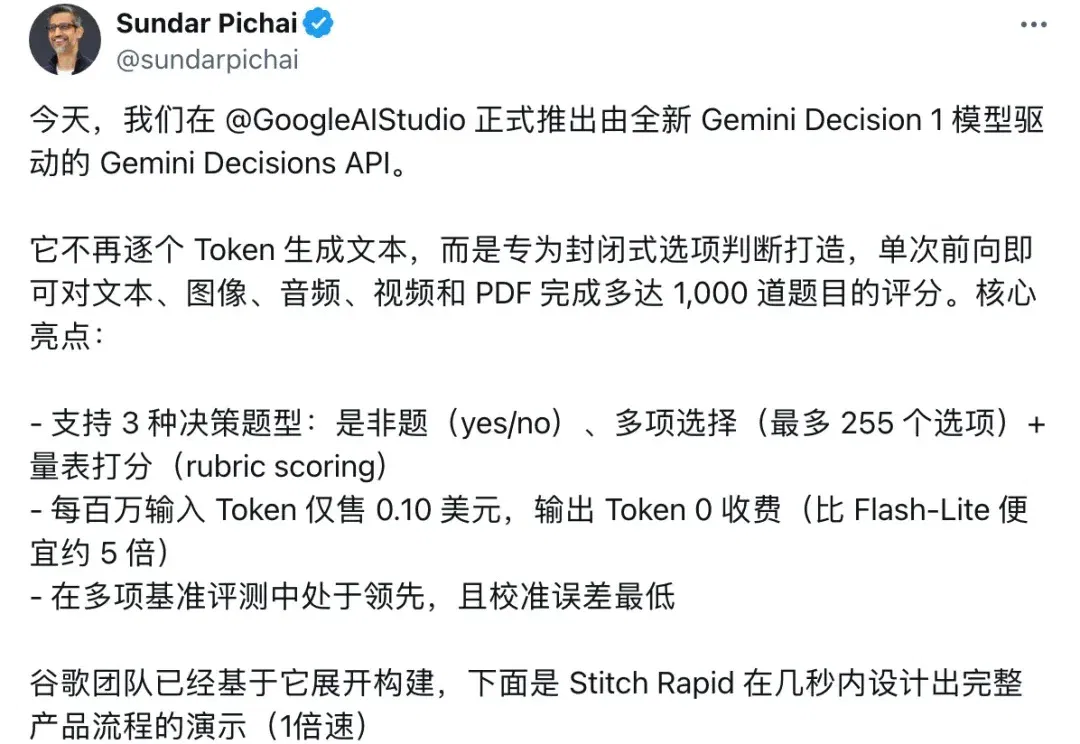
Karpo Decision goes open-source; 31B model ties first on a specified Decision Index version (opens in a new tab)
MachinePulse releases 0.8B–31B decision models that score options in one forward pass. The 31B model ties first at 73.9 in the November 12 Decision Index 0.4.1 snapshot. Latency and costs depend on test configuration; single decisions differ from full workflows.

Tongxin Intelligence raises seed and angel funding for AGI inference-chip design (opens in a new tab)
The BIGAI-incubated team outlines Vector, Tensor and AGI Core units, planning FPGA validation before further design, tapeout and production. The proposed architecture's commercial efficiency remains to be demonstrated.