Google releases Gemini 4 Hydrogen and the multimodel Orchestrator
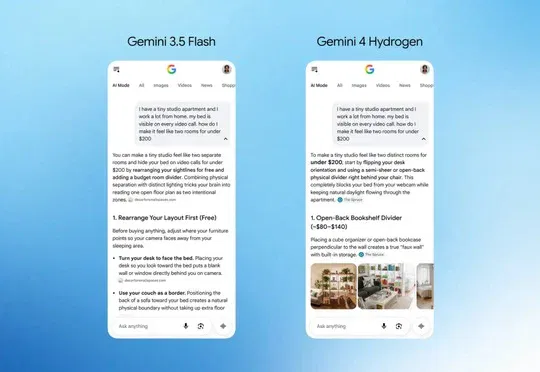
The new model emphasizes fast execution for coding and multimodal tasks. Google also details availability across services, API pricing and model-orchestration tests.
Editorial correction (November 13, 2026): The gains from multimodel orchestration are results from specified tests. They do not guarantee that adding parallel agents will avoid increasing token costs in every workflow.
Wake up, and Google has released another Gemini 4 model.
On November 12, Google officially released Gemini 4 Hydrogen and simultaneously introduced Orchestrator, an intelligent multimodel orchestration system.
This is a Flash-class large model, and the successor to Gemini 3.8 Flash. It is natively multimodal, with input, thinking and output sharing a 1-million-token window. Under the new Gemini naming scheme, however, Google chose an entirely new tier name: Hydrogen.

Within the Gemini 4 lineup, Carbon and Argon focus on deep reasoning and complex tasks, while Hydrogen serves as a "fast execution engine." Hydrogen emphasizes efficient operation and rapid responses, making it well suited to everyday coding, agentic workflows and multistep data processing.

Using Hydrogen for instant 3D coding, Geminisland lets anyone generate custom structures in real time on a shared pixel island with simple instructions. Players can freely roam and explore from a first-person perspective.
Across multiple benchmarks, Hydrogen is highly competitive in knowledge work, automation and code-repair tasks:
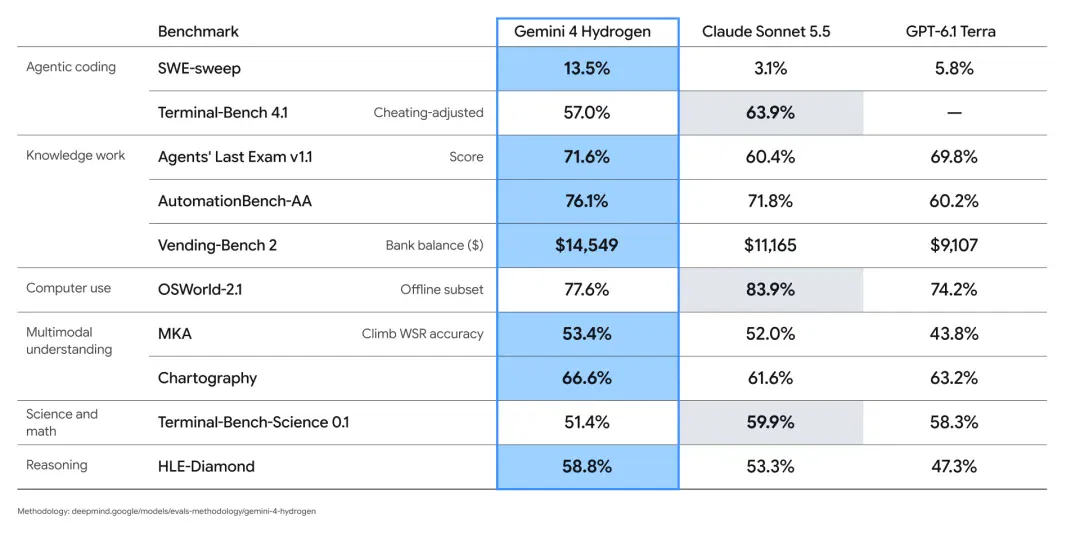
It is positioned against Anthropic's Claude Sonnet 5.5 and OpenAI's GPT-6.1 Terra. In practical tests involving complex graph computations, SQL queries and highly concurrent enterprise data workflows, Hydrogen ran 2–2.8 times faster than its predecessor. Meanwhile, time to first token (TTFT) remained low when cross-modal understanding of long videos and large codebases was required, with the million-token context fully loaded.
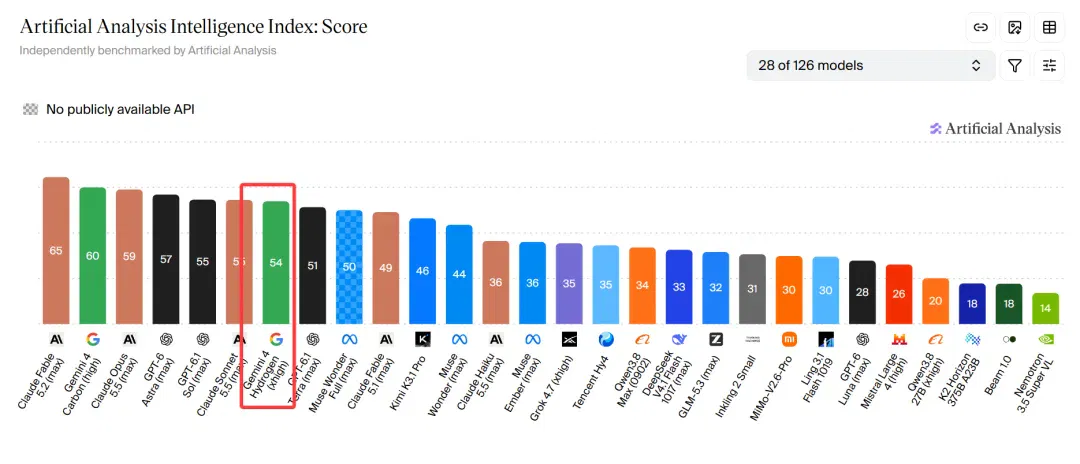
On the Artificial Analysis Intelligence Index, Hydrogen scored 51 at its default high setting; at the maximum xhigh setting, it scored 54, exceeding even Google's own larger-parameter Argon model, which scored 50.
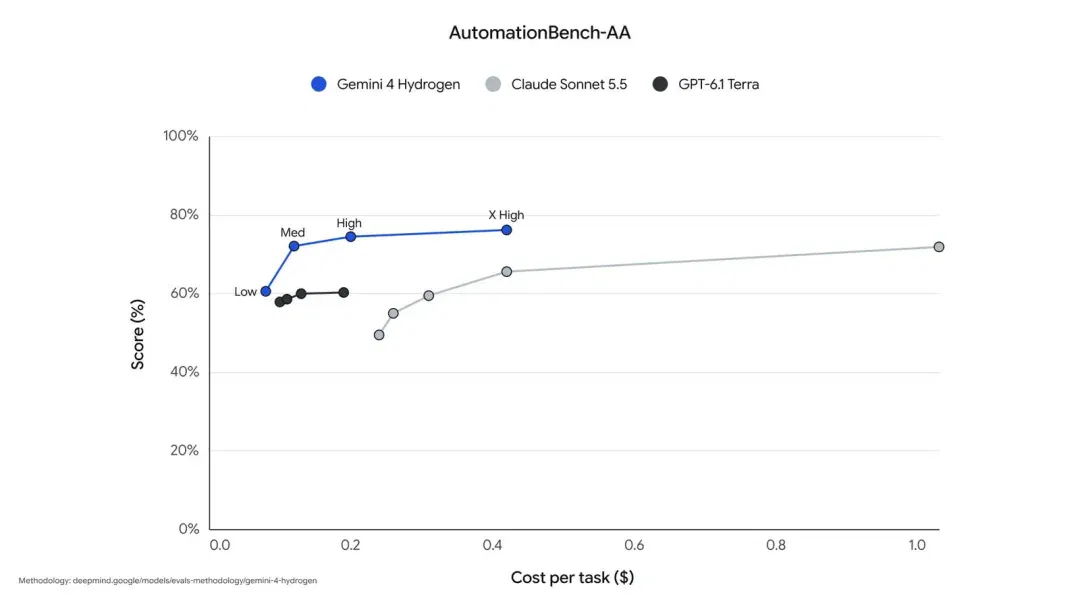
Hydrogen thus adds an xhigh reasoning-effort setting. Google recommends starting with high for most tasks and using xhigh only for difficult multistep problems, because the latter may increase latency and token consumption and overthink simple tasks.
With Hydrogen, Google is bringing the Gemini 4 series to a much wider audience so everyone can use it, including all tiers of Google AI Studio, Gemini API, Gemini for Business, the Gemini app and Google Search, as well as paid Google AI Pro and Ultra subscribers in Google Antigravity.
Availability differs by access point, however. In the Gemini app, free users receive Hydrogen responses through Auto model selection, while Google AI Plus, Pro and Ultra users can select it manually. Developers can use the free tiers of AI Studio and Gemini API, subject to rate limits.
Gemini 4 Hydrogen API pricing per million tokens is $1.50 for input, $0.075 for cache hits and $7.50 for output.
Google says that in actual software development, developers need frontier models in the Carbon and Argon tiers for in-depth architectural judgments when designing systems or resolving subtle bugs, but still need a fast, disciplined execution model to write code, run tests and verify changes. Hydrogen is designed both as a standalone model for everyday work and for use alongside Carbon and Argon as an efficient execution engine in multimodel workflows.
Google used specified benchmarks to compare Orchestrator's quota consumption and speed. Different tasks and parallel configurations can still increase tokens and actual costs; zero additional cost cannot be guaranteed for every workflow.
Orchestrator has begun rolling out to Ultra users first.
Beyond multimodel workflows, Hydrogen is also a major standalone upgrade over Gemini 3.8 Flash. It brings significant gains in both speed and intelligence: at the default high setting, tasks complete 2.5 times faster, Terminal-Bench 4.1 scores are more than triple (57% versus 18.2%), hallucinations are reduced more than fivefold, and it can adapt seamlessly when tool calls fail or searches return no results.
The efficiency gains also appear in how the model uses tools. When exploring a large codebase, Hydrogen can batch file reads and search calls in parallel, reducing the wait from inspecting files one by one. When necessary context is missing, it is also more inclined to identify the information gap rather than guess.
Google demonstrated a more tangible office-work example: given a YouTube keynote video and a design template in Antigravity, Hydrogen can generate a multipage presentation directly in Google Slides, then check and fix layout problems such as overlapping text on its own. Multimodal capabilities run throughout the task, from understanding the video and organizing content to calling applications and checking results.
What does it feel like for Hydrogen to be even faster than 3.8 Flash? It already seems hard to describe. Google has now made Hydrogen the default model for Search's AI Mode, while also using it for the underlying reasoning behind complex queries in AI Overviews on the main Search interface, delivering more useful, intuitive search results to all users worldwide.
With Hydrogen, people can ask the search box questions as they naturally think of them. Even if a query has multiple parts, hard-to-decipher typos or very specific requirements, Search can intelligently understand what you are looking for. Results provide AI-generated responses that are highly adaptive, visual and easy to browse.
Using Hydrogen's advanced reasoning, Google has also upgraded Query Fan-Out in Search—a mechanism in which an LLM breaks a complex question into parallel parts, retrieves and generates results for each, then combines them. This gives people a wider range of useful links than before, helping them find websites they had not previously discovered.
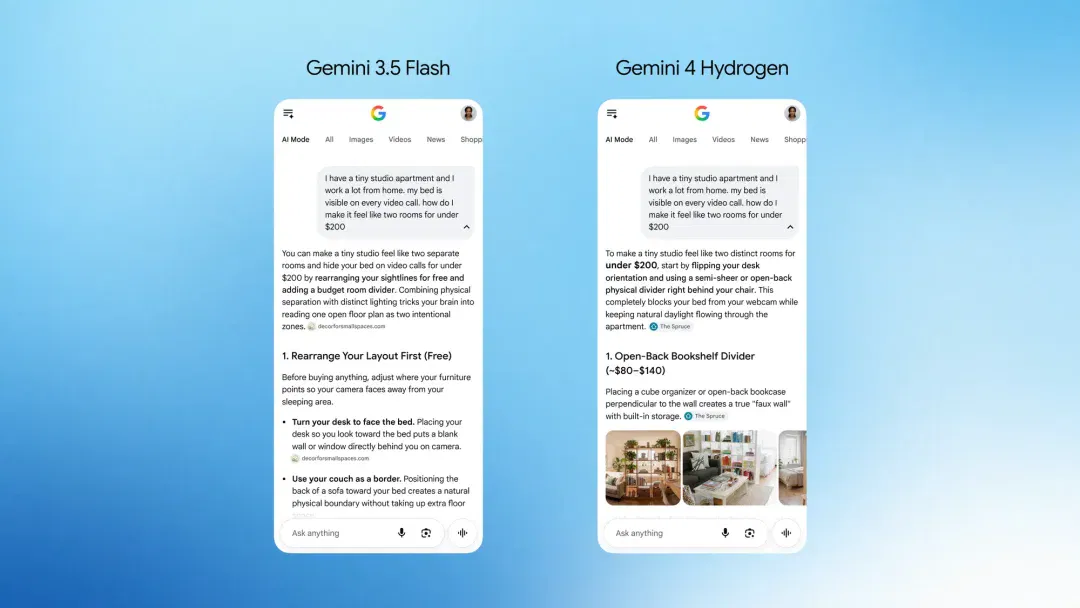
With Hydrogen added, Gemini 4 now spans Google's full suite of products, bringing frontier AI to more people.
References:
https://blog.google/innovation-and-ai/models-and-research/gemini-models/introducing-gemini-4-hydrogen/
https://deepmind.google/models/model-cards/gemini-4-hydrogen/
This article comes from the "Synced" WeChat account. Author: "Synced."
Related topics
After reading
Join the AINRK community
Read how to join the community and connect with people working in AI.
Related articles
Continue reading related topics and articles in this category.
Neon identifiers surface in Gemini web code; model and subscription positioning remain unconfirmed (opens in a new tab)
A source report recounts developers finding Neon model and subscription identifiers in Gemini web code, alongside discussion of element naming. Code strings and online guesses do not establish a release, plan features or access date.
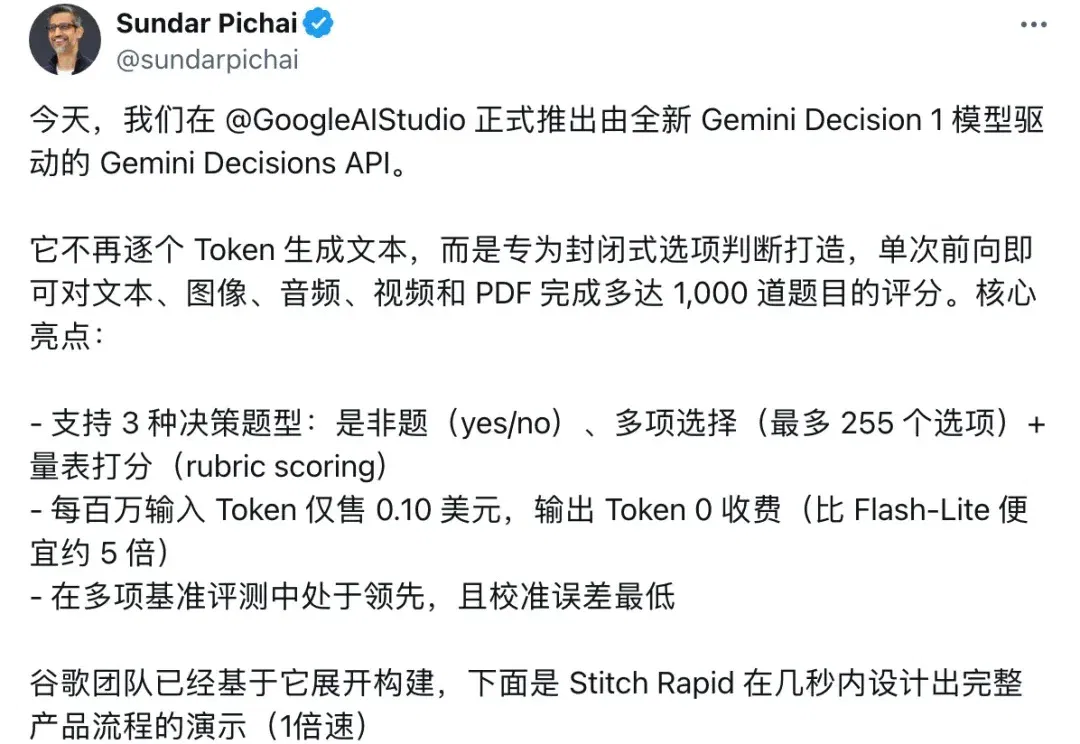
Karpo Decision goes open-source; 31B model ties first on a specified Decision Index version (opens in a new tab)
MachinePulse releases 0.8B–31B decision models that score options in one forward pass. The 31B model ties first at 73.9 in the November 12 Decision Index 0.4.1 snapshot. Latency and costs depend on test configuration; single decisions differ from full workflows.
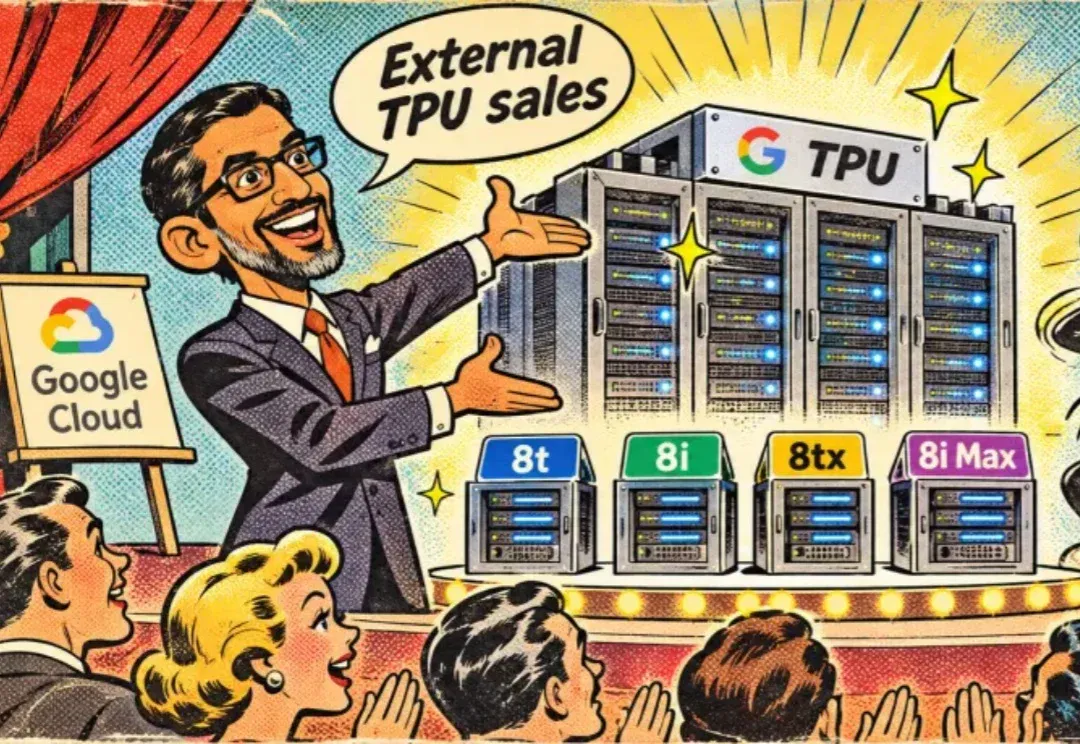
Google expands TPU system sales as software adaptation and inference economics draw attention (opens in a new tab)
QbitAI discusses complete-system deliveries, TorchTPU and agent-inference tests using filings and sources. Revenue, unfulfilled contracts and model-specific token-per-dollar comparisons are distinct measures; optimization rounds can change results.

Google adds TPU 8tx and 8i Max for confidential computing and long-context tasks (opens in a new tab)
Google describes new eighth-generation TPU variants expected in 2027. The report covers customer needs, supply constraints and external sales; its 2028 revenue figures are institutional forecasts.
AlphaGenome 2 predicts DNA variant effects in cell states to support disease research (opens in a new tab)
Google brings single-cell information into DNA sequence prediction and checks disease clues against existing studies. Model outputs help prioritize experiments and still require biological validation.