Google launches Gemini Decisions API with input-based pricing and option probabilities
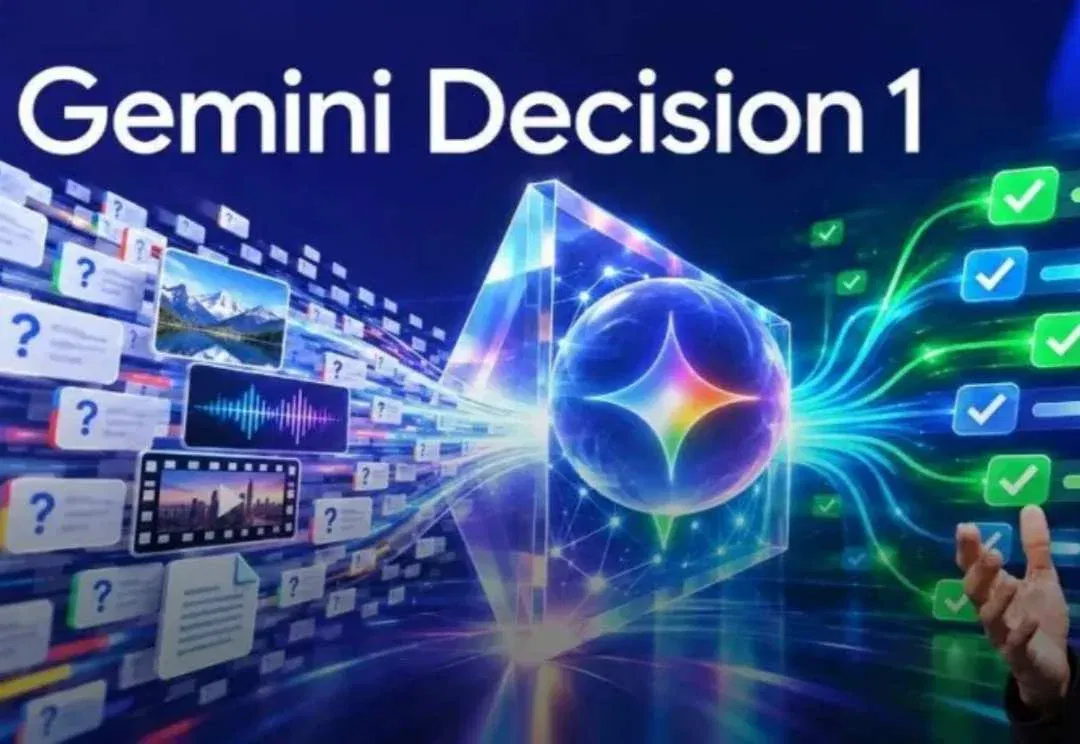
The API handles yes/no, multiple-choice, and scoring tasks with multimodal input and shared context. Google reports test latency and pricing; real-world calibration and costs depend on application conditions.
Editorial correction (November 13, 2026) Decision-model calibration and latency both depend on evaluation conditions. Probability outputs are not absolute accuracy rates or a guarantee of freedom from hallucinations.
After all that waiting, Gemini 4 Hydrogen did not arrive.
What Google served up last night was the multimodal decision model Gemini Decision 1.
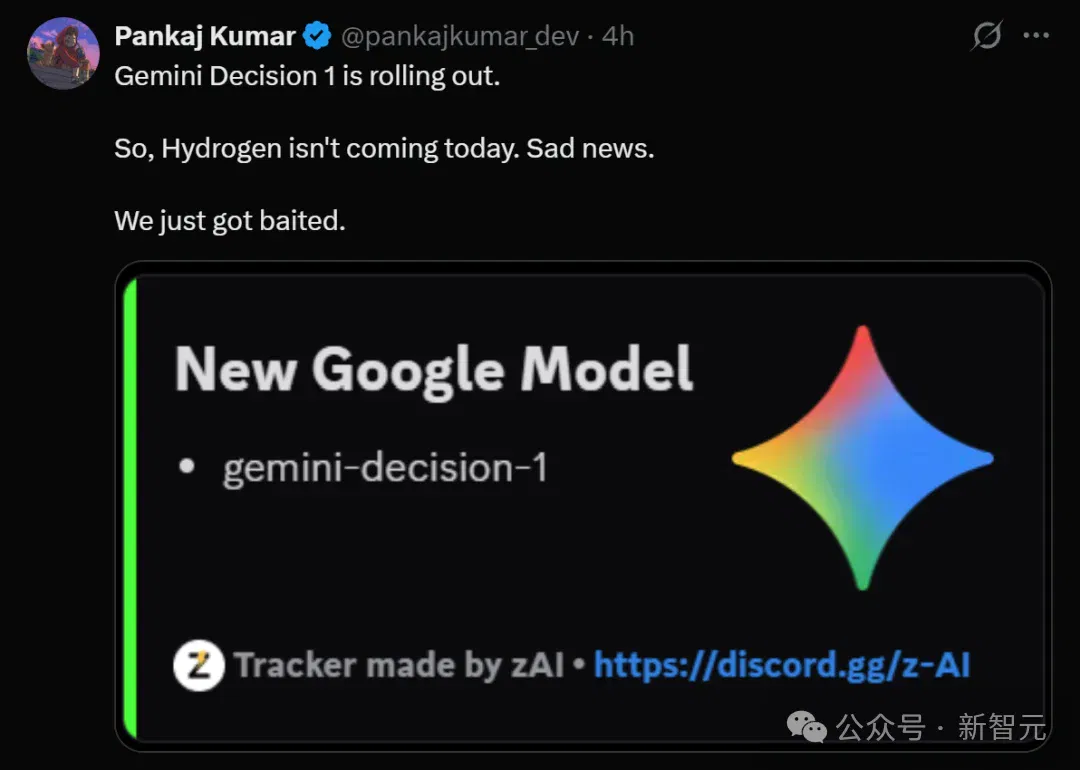
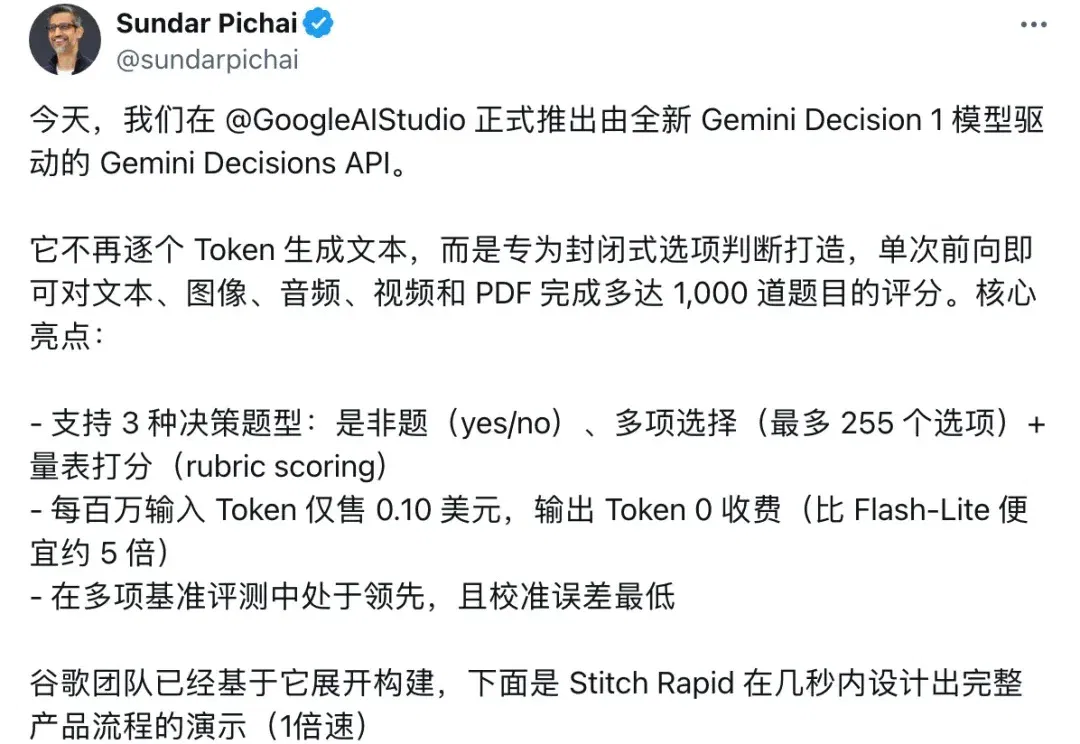
Sundar Pichai announced: today, Google officially launched the Gemini Decisions API, powered by the Gemini Decision 1 model.
Stitch Rapid uses the Decisions API to design an entire product flow in seconds
The “Jev” wave has finally reached Google.
It is built specifically for “closed-ended questions,” with ultra-low latency, native multimodality, and the ability to process 1,000 questions at once.
It has three native decision types: “Yes/No,” “multiple choice,” supporting up to 255 options, and “scoring against a rubric.”
It costs just US$0.10 per million input tokens, and output tokens are free! That is only one-fifth the price of Flash-Lite.
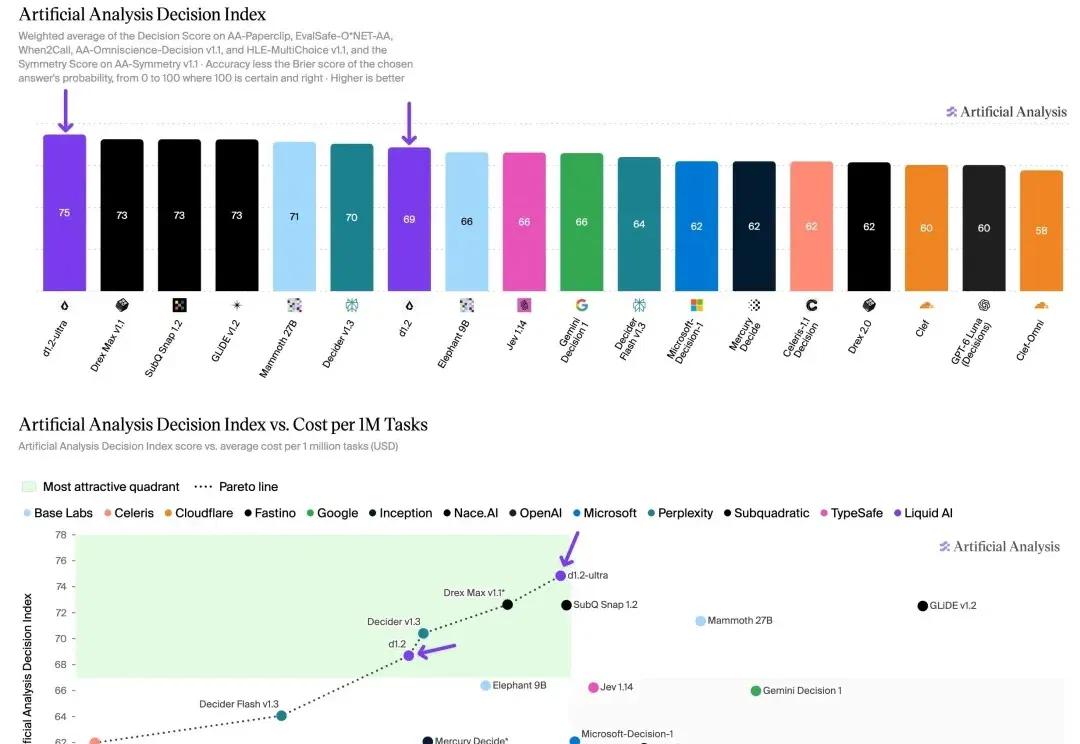
Across multiple benchmarks, it leads decisively with the lowest calibration error.
Using multimodality to disrupt decision models
TypeSafe AI’s Jev set off a wave in Silicon Valley, with other giants following suit. Google has finally entered decision models too.
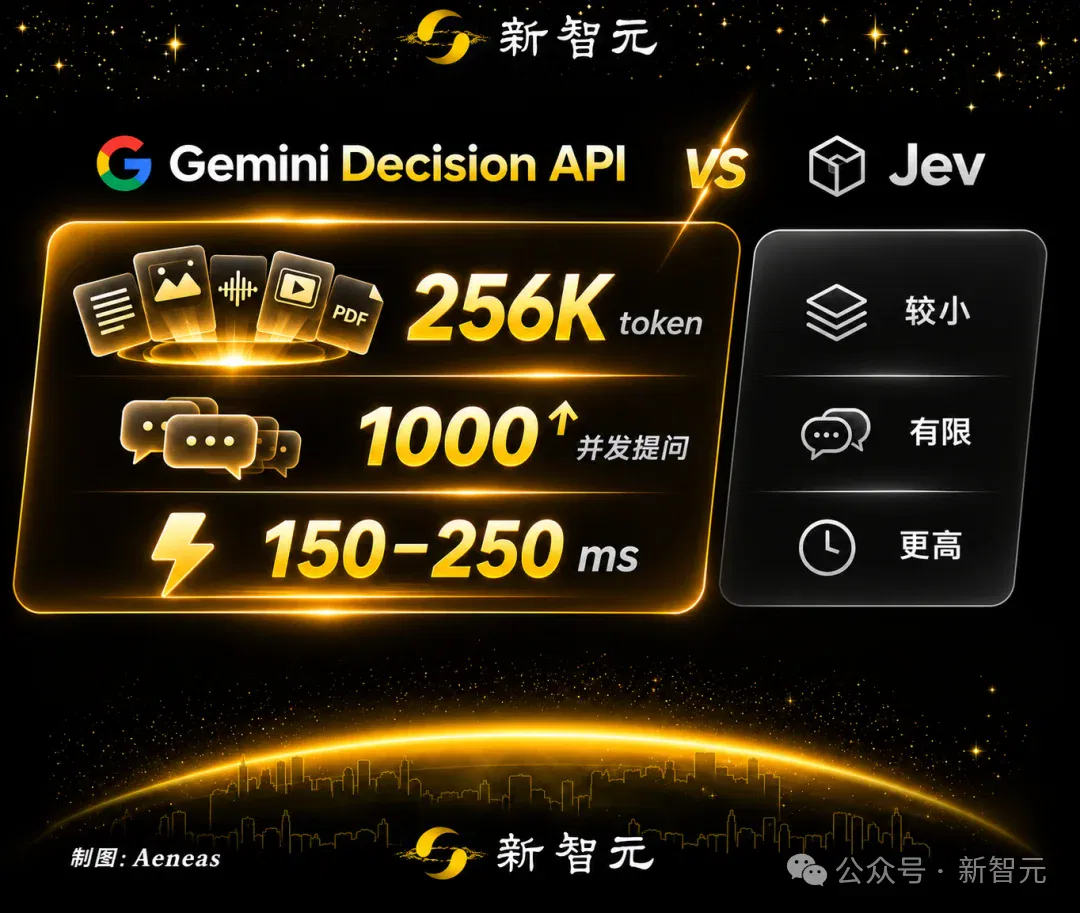
With Jev already pushing the price of text-only decisions down to US$0.042 per million tokens, how should Google respond?
The answer is: use multimodality to crush text-only models.
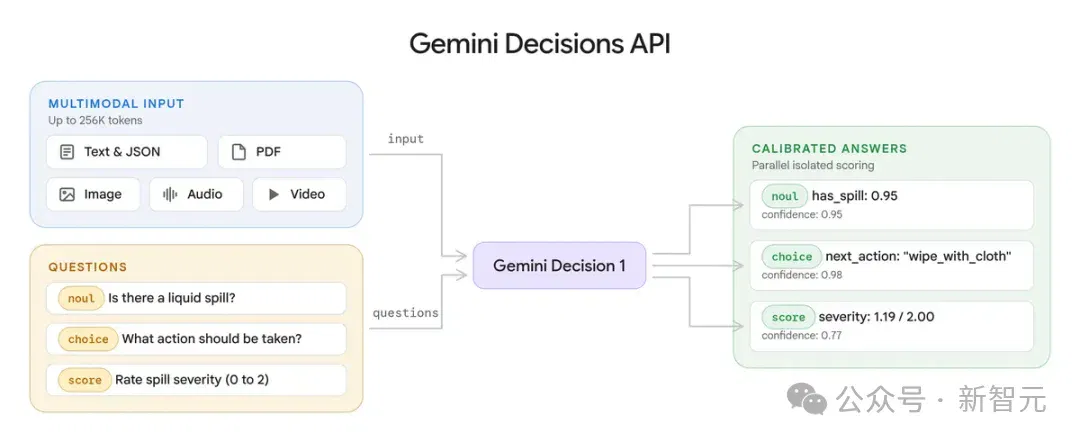
You can feed it as much as 256K tokens of data at once—text, images, audio, video, or PDFs—and then fire off 1,000 probing questions simultaneously!

Whether you need tool calling, policy risk controls, dynamic model routing, or context scoring, the Decisions API can give you a direct, clear-cut answer.
Gemini Decision 1 scores every option instantly through a single efficient “forward pass.”
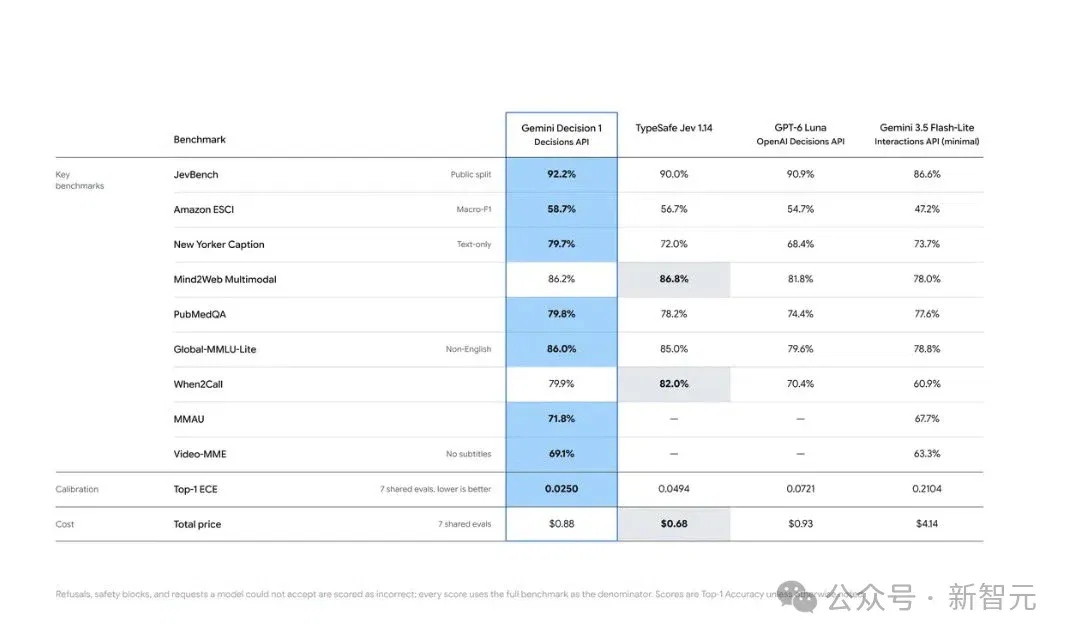
Topping benchmark rankings with exceptionally accurate “intuition”
Of course, decision models need more than speed. They also need accuracy!
Google reported competitive results on the decision-task benchmarks it officially selected. This does not justify claiming comprehensive leadership across every task.
More importantly, it has the lowest calibration error of all!
Calibration metrics reflect statistical performance on a given test distribution. They do not guarantee that confidence on any arbitrary question equals the true probability of correctness, nor do they directly establish a general hallucination rate.
Because it does not need to decode word by word, Gemini Decision 1 has a median model-compute latency of 50–100 milliseconds when processing multimodal contexts of up to 16K tokens. End-to-end latency is only 150–250 milliseconds.
In official tests, shared input helped score multiple questions in parallel. Actual latency still depends on input length, the number of questions, service load, and the network.
Priced at roughly one-fifth the cost of Gemini 3.5 Flash-Lite, currently widely regarded as the “value-for-money champion” when used through the Interactions API, this is an outright price slasher.
Native multimodality plus three decision modes: let the model handle everything in one pass!
Built on Gemini’s powerful native multimodal architecture, it can directly “see and hear” documents, recordings, or videos in a single forward pass.
You can mix different modalities: combine a “customer service call recording” with “account data,” for example, or bundle a “PDF insurance claim” with “photos of the damage.”
You can even freely adjust audio and video resolution to control visual detail and token costs.
You can mix the three core decision modes within a single request.
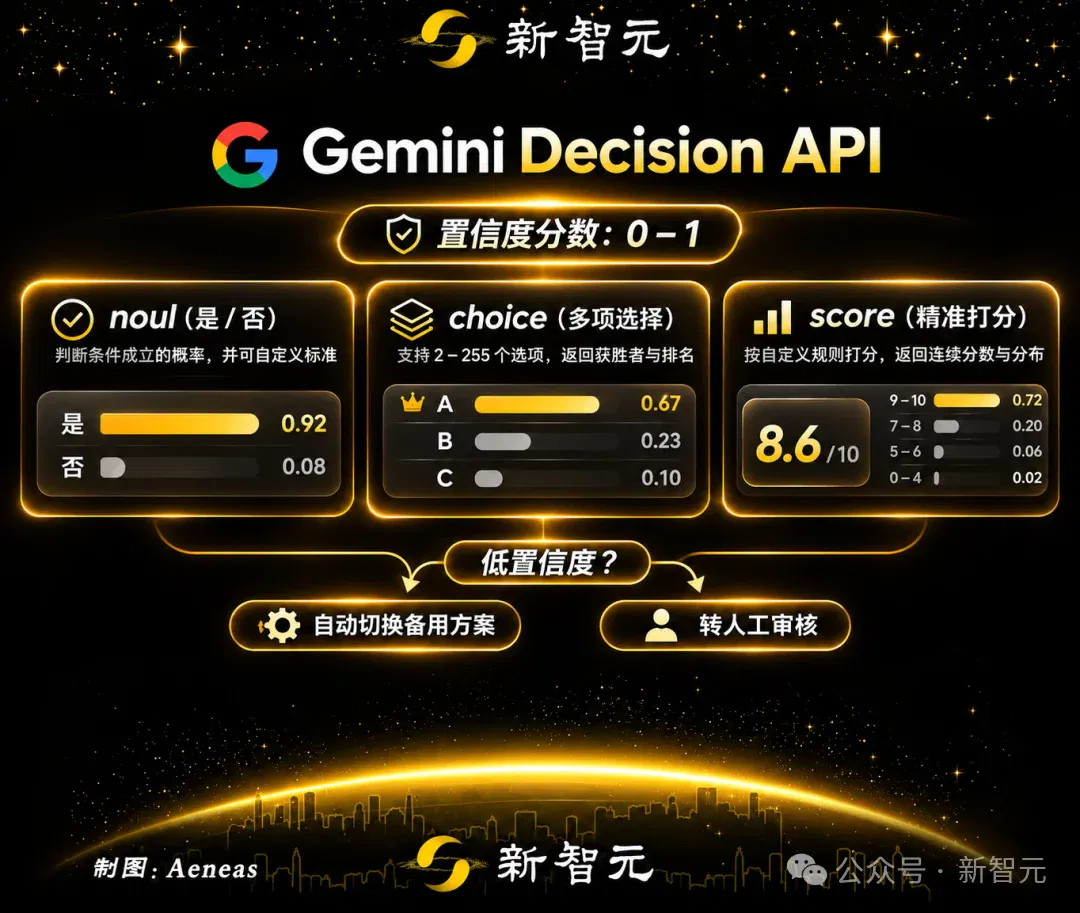
It also returns a “confidence score from 0 to 1” every time. In ambiguous cases, your code can send the case directly to a fallback or to human review—a very solid setup.
noul (yes/no): It determines the probability that a yes/no condition holds and lets you choose the descriptive criteria for “true” and “false.”
choice (multiple choice): It supports between two and 255 options! It tells you the winner directly, together with a probability ranking for all candidates.
score (precise scoring against an ordered rubric): It scores the input according to the rules you set, starting at zero, and provides a continuous weighted score and the probability of each level.
The interface is extremely approachable, using the familiar Content block format.
Take a look at this remarkably elegant code example: how to use a single request to have AI examine a photo of an office bar counter and make three different types of judgment simultaneously.

from google import genai
client = genai.Client(http_options={"api_version": "v1beta"})
result = client.decisions.create(
model="gemini-decision-1",
input=[{ # 共享输入:图片和一段文字
"type": "image",
"uri": "https://storage.googleapis.com/generativeai-downloads/images/spill.jpg",
"mime_type": "image/jpeg",
},
{
"type": "text",
"text": "早上9点客户会议前的休息室吧台检查。",
},
],
# 一次性连发3个问题!
questions={
"has_spill": {
"type": "noul",
"instructions": "吧台上是否有未清理的液体溢出?",
},
"next_action": {
"type": "choice",
"instructions": "哪种清理措施最适合当前场景?",
"criteria": {
"wipe_with_cloth": "吧台少量溢出,附近已有抹布。",
"dispatch_janitorial": "地面大面积危险、碎玻璃或持续漏水。",
"ready_for_meeting": "吧台干净,已准备就绪。",
},
},
"severity": {
"type": "score",
"instructions": "评估吧台脏乱的严重程度。",
"criteria": [
"干净且准备就绪。",
"轻微的局部溢出。",
"重大溢出或安全隐患。",
],
},
},
)
How are Google’s internal teams using it?
Google’s leading internal teams have long been treating it as a “low-latency control hub.”
There is no need to spend time and effort training custom classifiers, or to wait for a large model to generate slowly. Define the options, and the following features can go live straight away!
For example, it can power dynamic model routing in Gemini Notebook.
In Notebook, the Decisions API can act as a “traffic cop.” As soon as a user’s question arrives, it can classify the intent in a few milliseconds.
Simple questions go to a lightweight model, cutting latency by 40%, while complex questions are sent to a deep-reasoning model.
It can enable ultrafast design iteration in Stitch: this is absolutely the kind of application that threatens people’s livelihoods!
Stitch’s rapid canvas can generate “working wireframes” for an entire product flow in just seconds.
Changes you make by voice or clicking take effect instantly. Once the flow reaches the desired state, you can switch to full design mode with one click.
You can also use it to pick emojis instantly in CC. In Google Labs’ CC social app, it can choose the most suitable emoji from more than 200 in under a second. The emoji pops up immediately, making the experience very smooth.
It is also the safety layer for MCP tools in Search. Google Search uses the Decision API to detect adversarial behavior and content from adversarial evaluations, with high efficiency.
A free API arrives
This time, Google AI Studio has also prepared a free API tier so we can prototype to our hearts’ content without paying.
Its billing is exceptionally generous: shared input is charged only once, no matter how many questions you ask! Each question is charged only for the tokens in its own instructions and criteria.
There are no output charges, no surprise bills from wildly fluctuating “thinking tokens,” and no separate fees for audio transcription or OCR.
Google’s entire AI ecosystem is also moving to support it. Integrations with OpenRouter, LangChain, Vercel, LiteLLM, Pydantic AI, Pipecat, LiveKit, OpenCode, and the google-genai SDK are all being rolled out at full speed.
A battle of the giants: major players rush to follow within 17 days
The “decision-model” storm sparked by Jev has torn up the old rules of large-model billing: a single forward pass produces the result directly, costs plummet, and all output is free.
October could be called the “month of madness” for AI decision models. Within just 17 days, several leading AI laboratories released similar models.
Amazon: open-sourced a decision model called Strands Decider 2B.
Cloudflare: launched the Clef and Clef-flash models, open-sourced under Apache 2.0.
Perplexity: opened access to a Decisions API fine-tuned from a 27B open-source model.
Liquid AI: launched d1-ultra.
Giants including Microsoft and OpenAI have also moved quickly to make API-level adjustments, trying to counter this wave.
Amid this 17-day battle among the giants, Google’s approach with Gemini Decision 1 is to skip competition over text-only price differences and go straight to “native multimodality plus 1,000 concurrent questions.”
The current landscape is: choose Jev for rock-bottom text-only pricing, look to Google for complex multimodality and high concurrency, and leave ecosystem compliance to OpenAI.
The architecture of future agents is now out in the open: decision models (System 1) make judgments extremely quickly and cheaply, while large models (System 2) move into a supporting role for deep, “slow thinking.”
The next phase of the agent boom has arrived.
References:
https://blog.google/innovation-and-ai/technology/developers-tools/gemini-decisions-api/
This article comes from “Xinzhiyuan,” and was written by “Aeneas.”
Related topics
After reading
Join the AINRK community
Read how to join the community and connect with people working in AI.
Related articles
Continue reading related topics and articles in this category.
Karpo Decision goes open-source; 31B model ties first on a specified Decision Index version (opens in a new tab)
MachinePulse releases 0.8B–31B decision models that score options in one forward pass. The 31B model ties first at 73.9 in the November 12 Decision Index 0.4.1 snapshot. Latency and costs depend on test configuration; single decisions differ from full workflows.
Liquid AI launches d1.2 decision models with audio input and five new task types (opens in a new tab)
Liquid AI releases d1.2 and d1.2-ultra for reading, span extraction, image localization, numerical estimation and multi-label decisions. Ultra scores about 75 in AA's launch-period v2.1 decision-model view; calibration and new-task accuracy figures come from company tests.
Neon identifiers surface in Gemini web code; model and subscription positioning remain unconfirmed (opens in a new tab)
A source report recounts developers finding Neon model and subscription identifiers in Gemini web code, alongside discussion of element naming. Code strings and online guesses do not establish a release, plan features or access date.
Google expands TPU system sales as software adaptation and inference economics draw attention (opens in a new tab)
QbitAI discusses complete-system deliveries, TorchTPU and agent-inference tests using filings and sources. Revenue, unfulfilled contracts and model-specific token-per-dollar comparisons are distinct measures; optimization rounds can change results.
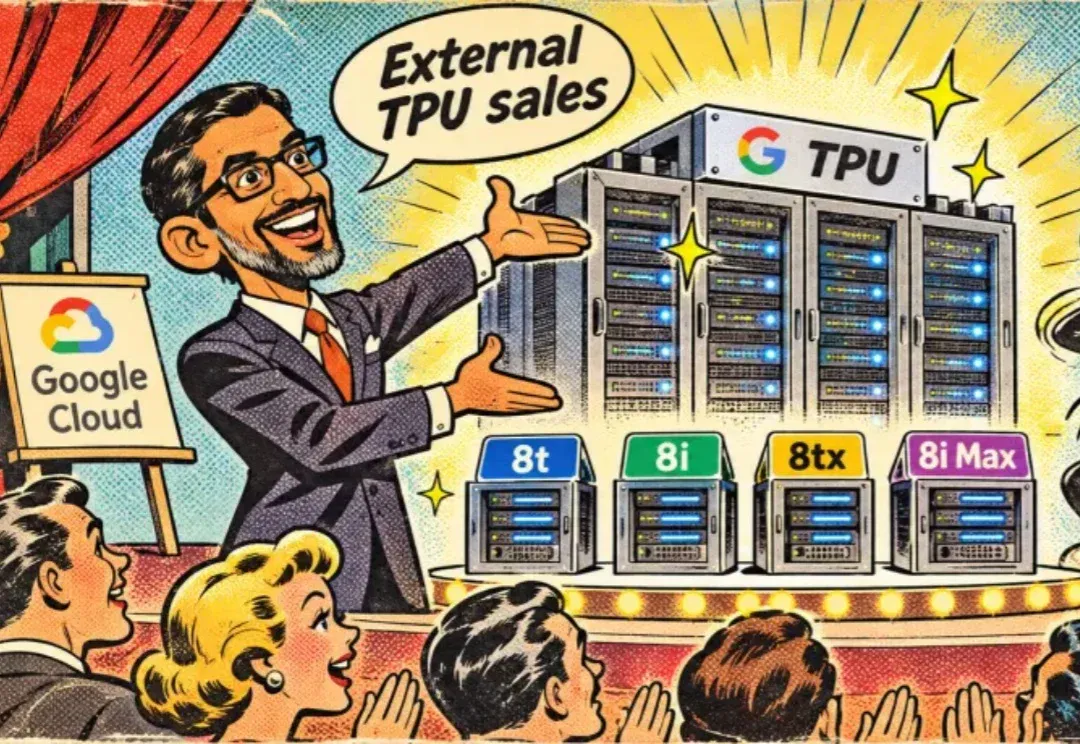
Google adds TPU 8tx and 8i Max for confidential computing and long-context tasks (opens in a new tab)
Google describes new eighth-generation TPU variants expected in 2027. The report covers customer needs, supply constraints and external sales; its 2028 revenue figures are institutional forecasts.