Liquid AI launches d1.2 decision models with audio input and five new task types
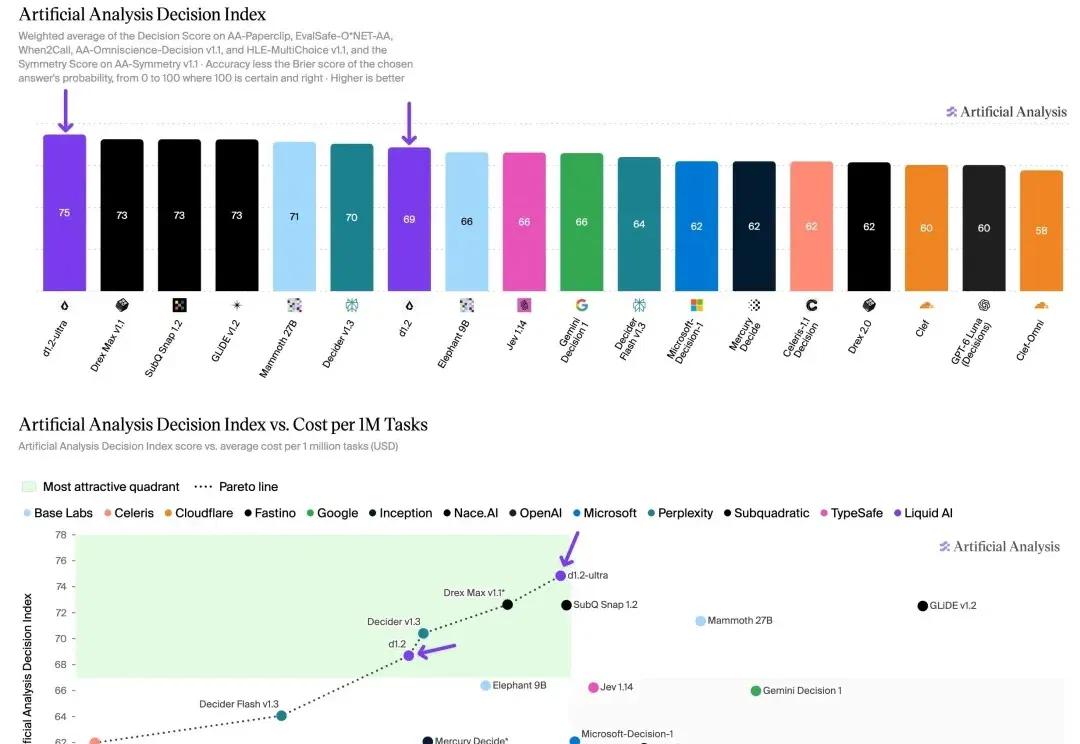
Liquid AI releases d1.2 and d1.2-ultra for reading, span extraction, image localization, numerical estimation and multi-label decisions. Ultra scores about 75 in AA's launch-period v2.1 decision-model view; calibration and new-task accuracy figures come from company tests.
Editorial correction (November 18, 2026): The two models' calibration-error order and leading margin have been corrected according to Liquid AI's announcement. The ranking is limited to AA's launch-period v2.1 decision-model view; internal tests are not equivalent to an independent, comprehensive evaluation.
RMB 1.68 billion in AMD-led funding, with four MIT scientists behind it.
Zhidx reported on November 17 that Liquid AI, a US AI-model unicorn incubated at the Massachusetts Institute of Technology (MIT), yesterday released the omnimodal decision models d1.2 and d1.2-ultra, both of which can process text, images and audio. Of the two, d1.2-ultra ranked first on third-party evaluator Artificial Analysis's (AA) Decision Index v2.1 decision-model leaderboard. The company also said it plans to release open weights for both models in the future.
Of the two models, d1.2-ultra prioritizes higher decision quality for more difficult tasks. d1.2 balances response speed and cost, with a price per million input tokens less than half that of the ultra version.
In the launch-period AA Decision Index v2.1 decision-model view, d1.2-ultra scored about 75. Liquid's official announcement described a lead of approximately two points over the previous best decision model, rather than the three points stated in the original draft; d1.2 scored about 69. The index comprises six components and cannot be described as an overall leaderboard covering every general-purpose model or task. AA's listed costs of about $63 and $133 per million tasks reflect its test workload, rather than API prices per million input tokens. Rankings change as the leaderboard is updated.
In an internal comparison of five models across 13 benchmarks and 22,505 questions answered by all models, Liquid AI reported calibration errors of 0.8 points for d1.2-ultra, 1.2 for d1.2 and 2.7 for Jev 1.14. The original draft reversed the figures for the two d1.2 models. Lower values indicate a closer match between confidence and accuracy in that test; they are not accuracy scores and cannot be compared directly across benchmarks.
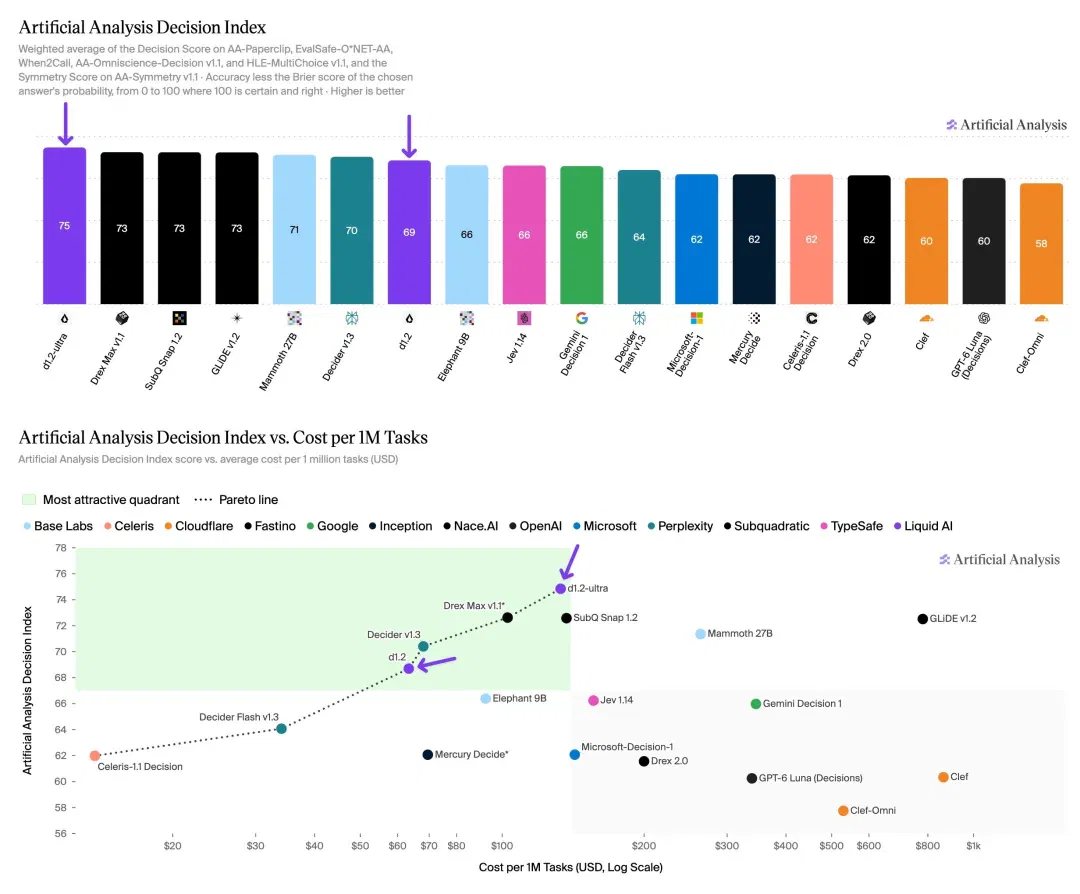
▲AA's overall decision-model leaderboard (top) and capability/cost comparison (bottom) (Image: Artificial Analysis)
For API pricing, both models charge only for input tokens, at the same prices as their predecessors d1.1 and d1-ultra. d1.2 costs $0.02 per million input tokens, approximately RMB 0.13; d1.2-ultra costs $0.042, approximately RMB 0.28. Text and images in the same request are charged only once; follow-up questions incur only the text-input cost of the questions themselves.
Through the API, the newly released d1.2 and d1.2-ultra add five task types: reading information, extracting text spans, locating objects in images, numerical estimation and multi-label decisions. According to Liquid AI's internal tests, accuracy in reading numerical values from receipts reached as high as 98%, while both models achieved 94% accuracy in locating specified objects in images.
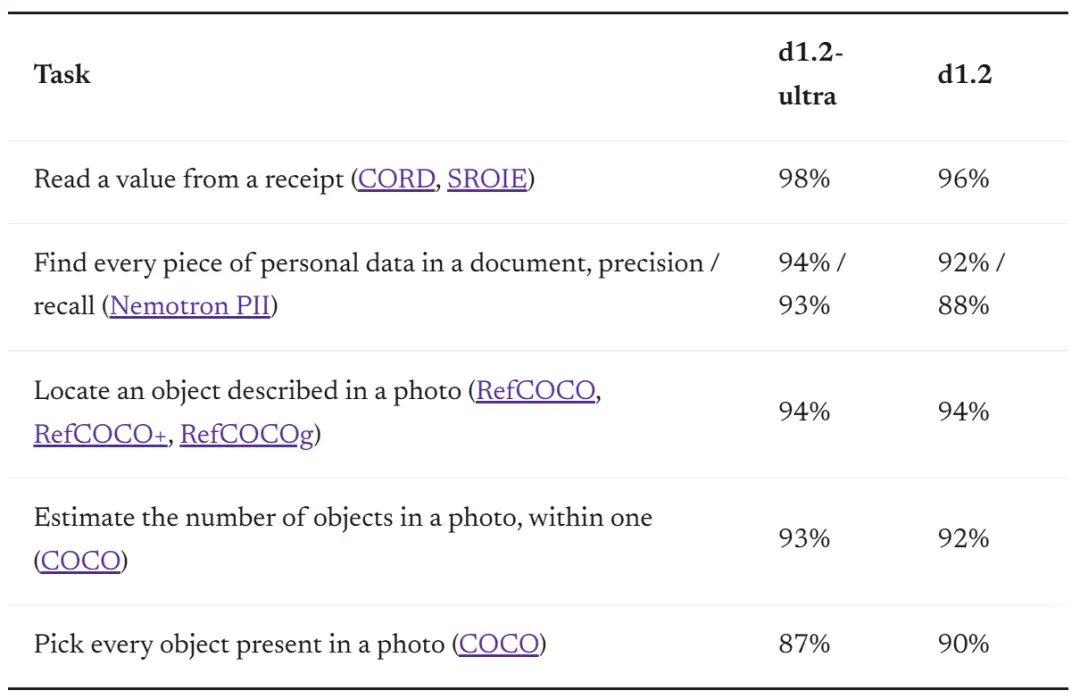
▲Internal task-test results for the two models (Image: Liquid AI)
One overseas commenter exclaimed that they could not wait for the open-weight version. Another said that not having to generate output tokens one by one was a major development for information-extraction workflows.

▲Comments from overseas users (Image: X)
Liquid AI was co-founded in 2023 by four scientists with MIT research backgrounds. In December 2024, it raised a $250 million Series A, approximately RMB 1.68 billion, led by AMD, at a post-money valuation of about $2.3 billion, approximately RMB 15.4 billion.
Developers can currently access d1.2 and d1.2-ultra through the Liquid API. Both models will also become available on OpenRouter and Vercel.
01.
Five new tasks
d1.2-ultra has the lowest calibration error among five models
Compared with the earlier decision models d1.1 and d1-ultra, the d1.2 series adds support for five task types:
1. Reading information: Both models can read text, numbers or dates from inputs. For example, they can read the amount due on an invoice and return the corresponding original characters, or return 'not found' if the field is absent.
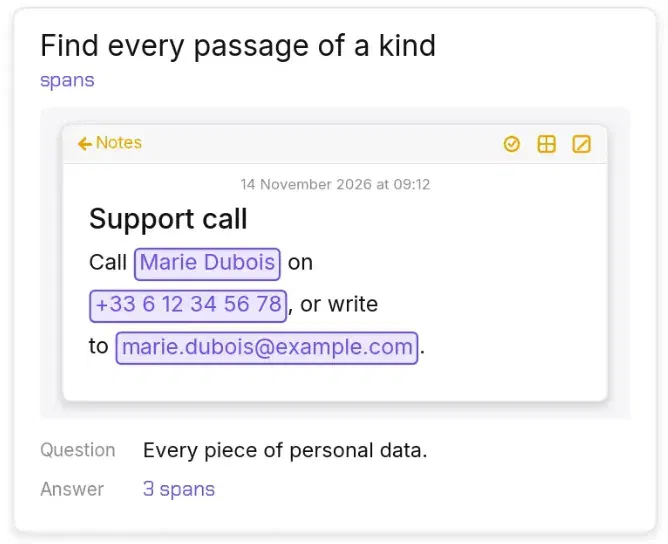
▲Reading the amount due on an invoice (Image: Liquid AI)
2. Text-span extraction: The models can identify every span of a particular information type within a text. For example, they can extract names, phone numbers and email addresses from notes individually and mark each item's position in the original text.
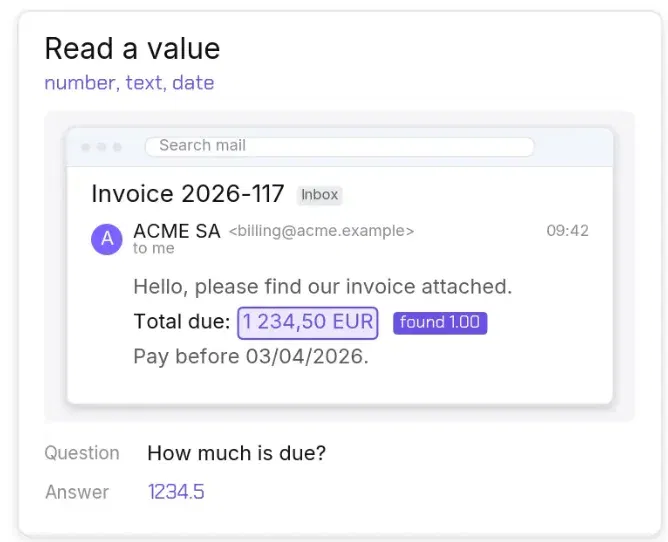
▲Marking names, phone numbers and email addresses in notes (Image: Liquid AI)
3. Image-object localization: Both models can locate a single target or find all instances of the same target class. For example, they can place a rectangular box around a signature on a scanned form, or return a bounding box for every tree in a photograph along with the total count.
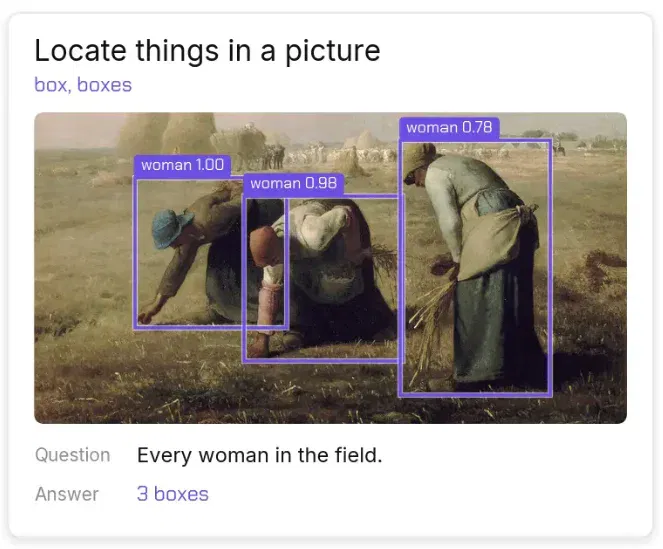
▲Bounding boxes around three women in an image (Image: Liquid AI)
4. Numerical estimation: Estimates include a predicted value and an interval. For example, the models can estimate the number of people in a photograph, returning both the most likely count and a range.
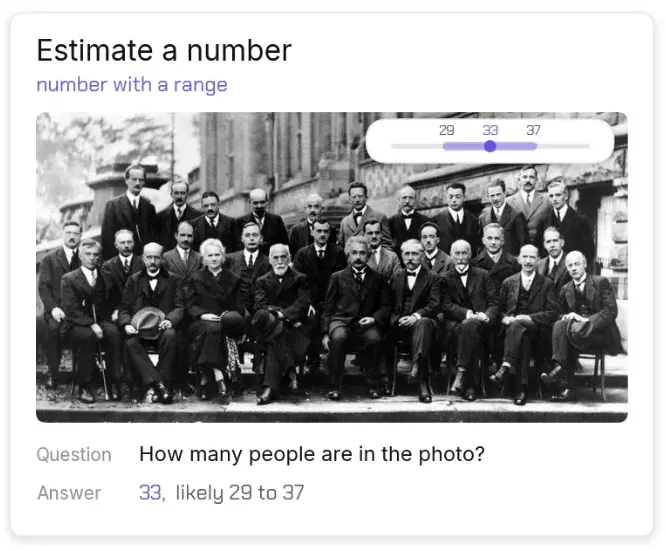
▲Estimating the number of people in a group photograph and providing a count range (Image: Liquid AI)
5. Multi-label decisions: Both models can select all applicable options and provide a probability for each. For example, a customer-service message about duplicate charges and an undelivered parcel can be classified under both 'billing' and 'delivery.'
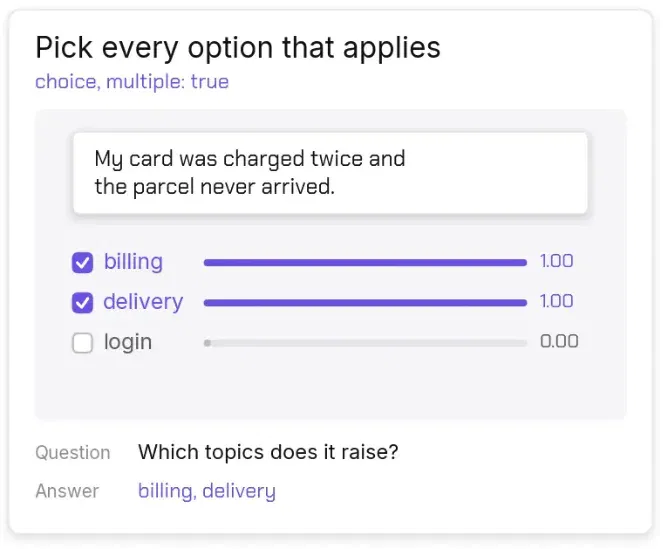
▲Identifying multiple topics in a customer-service message (Image: Liquid AI)
Both models also support audio analysis and spoken questions. For example, they can identify the language in a recording or determine whether an alarm is audible in the background.
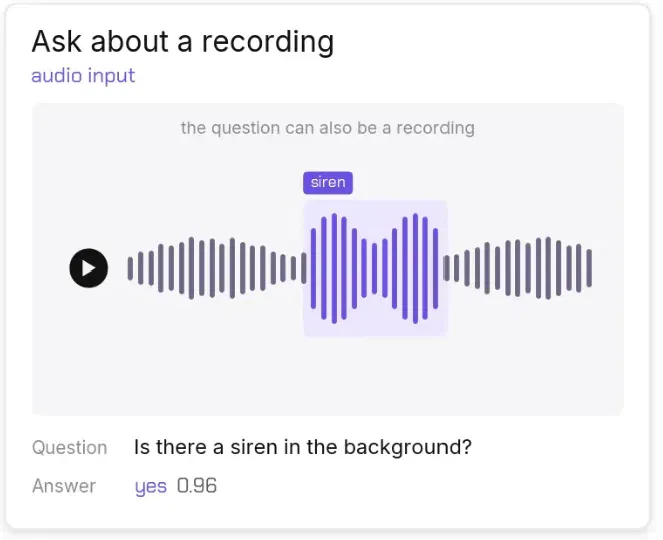
▲Determining whether an alarm is present in a recording (Image: Liquid AI)
According to Liquid AI, both models achieved 95%–97% accuracy on multiple-choice or yes/no questions in sound-recognition tests and language-identification tests covering 43 languages.
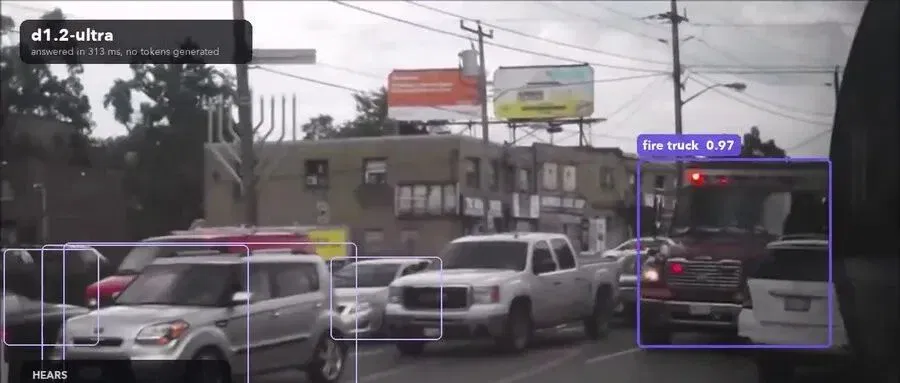
Liquid AI engineer Aurélien Lac shared an example on X in which d1.2-ultra placed bounding boxes around road vehicles and assigned a category and probability to a fire engine. The model also gave separate probabilities for sirens, traffic noise, horns and other sounds, demonstrating image localization and audio decisions.
▲d1.2-ultra locates road vehicles and gives decision probabilities for sounds such as sirens and traffic (Image: X)
Liquid AI also published probability-calibration results for the two models, testing whether their confidence in answers matched their actual performance. If a model assigns 80% confidence to a set of answers, for example, it should ideally answer 80 of every 100 questions correctly.
If a model's confidence accurately reflects its answering performance, developers can use it to arrange human review. Lower-confidence answers might be sent for manual checking, for instance, while higher-confidence answers are processed automatically.
Liquid AI measures the gap between predicted probabilities and actual accuracy using calibration error; lower values mean a closer match. The company tested five models on 22,505 questions answered in common across 13 benchmarks.
In this set of tests, calibration errors for d1.2-ultra and d1.2 were 0.8 and 1.2 respectively, lower than those of the other three models. Jev 1.14, Perplexity Decider v1.3 and the GPT-6 Luna Decisions API had calibration errors of 2.7, 3.7 and 7.2 respectively.
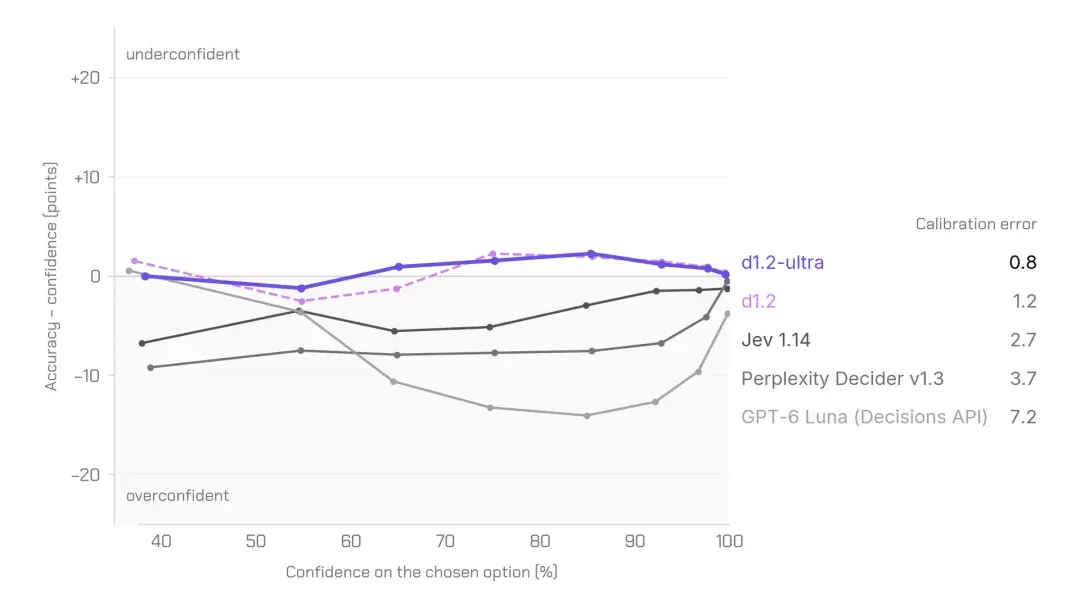
▲Comparison of probability calibration across five models (Image: Liquid AI)
Before this update, Liquid AI already offered model products spanning multiple modalities and tasks. Alongside the d-series decision models, it has introduced the LFM foundation-model family and the task-specific Liquid Nanos small-model family.
On October 28, the company released and open-sourced its new LFM3 family, comprising six models: 1.7B, VL-2B, Audio-2B, Omni-2B, d1-2B and d1-Omni-2B. Omni denotes omnimodal models that can handle text, images and audio together. On October 24, it released the d1.1 decision model, emphasizing decision quality close to d1-ultra at less than half the price.
02.
Co-founded by four MIT scientists
Previously raised RMB 1.68 billion in an AMD-led round
Founded in 2023 and originating from MIT's Computer Science and Artificial Intelligence Laboratory (CSAIL), Liquid AI primarily develops efficient foundation models. Its products focus on computational efficiency, memory footprint and local deployment to enable models to run on phones, computers, cars and other devices.
Liquid AI's four co-founders all have MIT research backgrounds: CEO Ramin Hasani, CTO Mathias Lechner, Chief Scientific Officer Alexander Amini and Daniela Rus.
Hasani has long studied liquid neural networks, robust deep learning and decision-making in complex dynamical systems. He earned a computer-science PhD from TU Wien in Austria in 2020, then conducted postdoctoral research with Rus at MIT CSAIL. He previously served as principal AI and machine-learning scientist at US asset manager Vanguard.
Lechner earned his PhD from the Institute of Science and Technology Austria (ISTA) in 2022 and has worked on liquid neural networks and the safety of machine-learning systems.
Amini earned his bachelor's, master's and doctoral degrees in computer science at MIT and is a principal organizer and lecturer for MIT's Introduction to Deep Learning course.
Rus has long worked on robotics, mobile computing and data science. She holds a computer-science PhD from Cornell University and serves as director of MIT CSAIL. She is a member of the US National Academy of Engineering and a MacArthur Fellow.
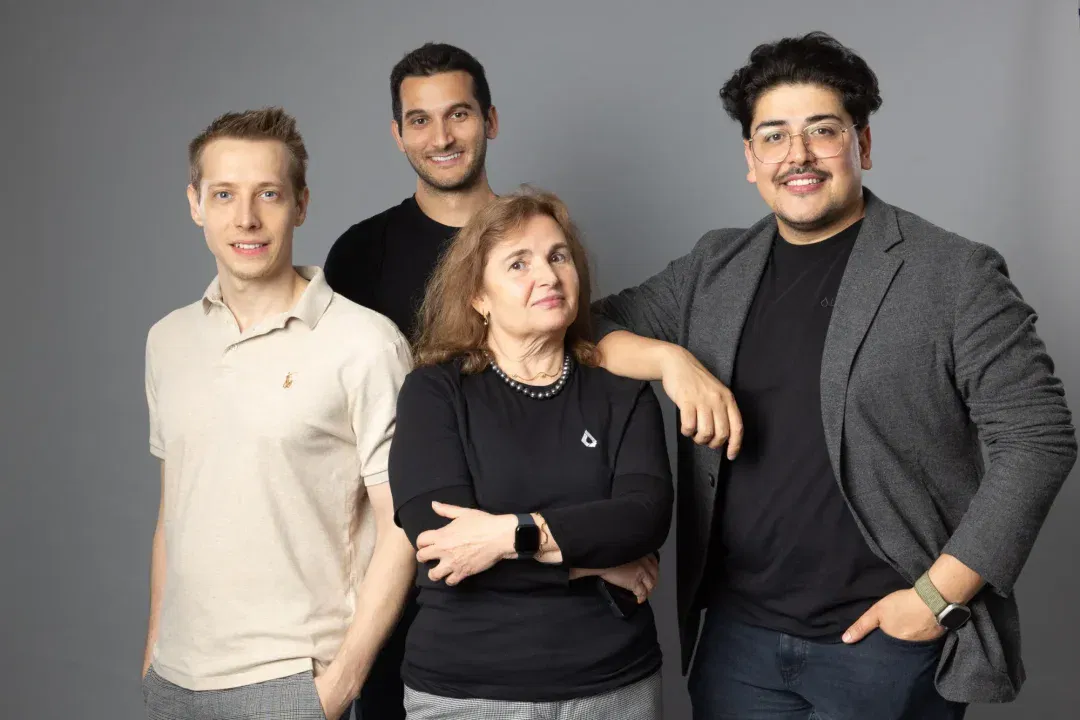
▲Liquid AI's four co-founders, from left: Lechner, Amini, Rus and Hasani (Image: Bloomberg)
In financing, Liquid AI completed a $250 million Series A, approximately RMB 1.68 billion, led by AMD in December 2024. It planned to use the funds to expand computing infrastructure, accelerate model research and development, and advance on-device and on-premises enterprise deployment.
03.
Conclusion: low prices, high accuracy and probability calibration
Decision models target enterprises' real everyday needs
With this update, Liquid AI focuses on practical needs in everyday business. Information reading, text-span extraction and image-object localization can read invoice amounts, find personal information and locate signatures on forms, supporting automated processing of documents, images and other materials.
Enterprise adoption, however, still depends on the combined cost of API calls and human error correction. The d1.2 series emphasizes low prices, task accuracy and probability calibration, addressing spending reduction, less rework and the arrangement of human review respectively. If these advantages materialize in real business, decision models could take on some tasks enterprises currently assign to general-purpose large models.
Source: Liquid AI
This article comes from Zhidx. Author: Sun Xiaowen.
After reading
Join the AINRK community
Read how to join the community and connect with people working in AI.
Related articles
Continue reading related topics and articles in this category.
Karpo Decision goes open-source; 31B model ties first on a specified Decision Index version (opens in a new tab)
MachinePulse releases 0.8B–31B decision models that score options in one forward pass. The 31B model ties first at 73.9 in the November 12 Decision Index 0.4.1 snapshot. Latency and costs depend on test configuration; single decisions differ from full workflows.
Google launches Gemini Decisions API with input-based pricing and option probabilities (opens in a new tab)
The API handles yes/no, multiple-choice, and scoring tasks with multimodal input and shared context. Google reports test latency and pricing; real-world calibration and costs depend on application conditions.
断层领先Jev,全球第一!决策模型新王震撼发布新版本 (opens in a new tab)
StartLux发布StartLux-Decision新版本,推出Instant与AutoThink双模型矩阵及原创RLCD²,在Decision Index 0.3和DecisionPivot评测中领先多款模型,并公开模型权重与推理代码。

被a16z看中,上线三周的Jev拿下75亿美元估值 (opens in a new tab)
TypeSafe AI完成8.7亿美元A轮融资,投后估值达75亿美元,由a16z领投,其可直接写入代码的决策模型Jev上线后迅速增长。
Jev被请下王座,StartLux中国开源决策模型冲上第一 (opens in a new tab)
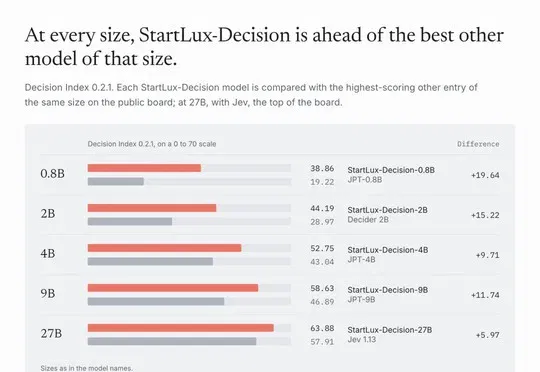
StartLux发布完全开源的StartLux-Decision,其27B版本在Decision Index 0.2.1的38项基准中有31项超过Jev 1.13,并以63.88分升至公开榜首。