An Invited Look at Doubao's Xiaodou: Memory, Proactive Reminders and Cross-App Tasks

Crossing shares an invited trial of Xiaodou, covering health-data summaries, recommendations, follow-ups, hotel searches, phone calls and Douyin–Feishu workflows. The product remains exploratory and invitation-only; data access and actions depend on authorization and available features.
Editor's fact check (2026-11-26): This article records the Crossing team's invited trial, with examples from particular accounts, permissions and the version available at the time. It is not a systematic evaluation of feature stability or end-to-end fulfillment. Access to health, location and other app data must remain within the user's authorization. The article does not medically validate the exercise-data summaries or recommendations. Accounts of calls placed on the user's behalf, order submission and scheduled tasks should be understood as the author's experiences; current product settings determine their availability and confirmation requirements for sensitive actions. The 419 million monthly active users refer to the Doubao app in QuestMobile's September 2026 figures, not Xiaodou's user base. QuestMobile's Q3 2026 AI Application Market Development Report; (opens in a new tab)Xiaodou's developer-provided App Store description (opens in a new tab)
Xiaodou—a Personal Agent still in an exploratory phase.

Recently, Doubao introduced Xiaodou, a new product exploring the Personal Agent direction. The 419 million monthly active users mentioned in the article come from QuestMobile's September 2026 statistics for the Doubao app, not Xiaodou's user base.

According to QuestMobile, Doubao is now China's largest AI-native app by monthly active users, while the newly introduced Xiaodou is an exploratory Personal Agent application.
Xiaodou can connect to apps such as Calendar, Feishu, Douyin and Health, combining their data with personal memory to better understand users.
Following these data trails, Xiaodou can learn your daily habits:
the things you casually liked while browsing Douyin, the orders you placed, your favorite songs—and even remember that the cat food you last bought is nearly running out and remind you in advance.
Its capabilities also extend into the offline world. Xiaodou can call tools directly to get things done, and can even use Doubao's voice capabilities to call restaurants and hotels on users' behalf, communicating directly with real businesses.
🚥
For now, Xiaodou's testing experience remains invitation-only.
The Crossing team obtained early beta access and tried Xiaodou firsthand. Next, we will share the results of our experience.
Xiaodou—a Personal Agent still in an exploratory phase
Xiaodou has its own separate app logo, which is very cute:

By our incomplete count, Xiaodou can currently connect to at least 45 apps, including Douyin, Soda Music, Amap ride-hailing, Feishu, Health, Calendar, Reminders, Contacts and Baidu Netdisk, and can access location information with user authorization, helping this Personal Agent better understand our personal context.
For this hands-on trial, we focused mainly on several of Xiaodou's core capabilities.
First, using personal memory and context to understand our habits and needs; second, proactively recommending content and reminding us of important matters based on that information.
We also tested its ability to call tools for everyday services and connect apps such as Douyin and Feishu to accomplish complex tasks.
Let's look at several concrete scenarios to see how Xiaodou actually performed.
[1] Personal memory and understanding
Health-data analysis
Many people now use phones or smartwatches to record health data such as sleep, heart rate and exercise.
These data are usually stored in phone or smartwatch apps. Xiaodou can now read them directly by connecting to a health app.
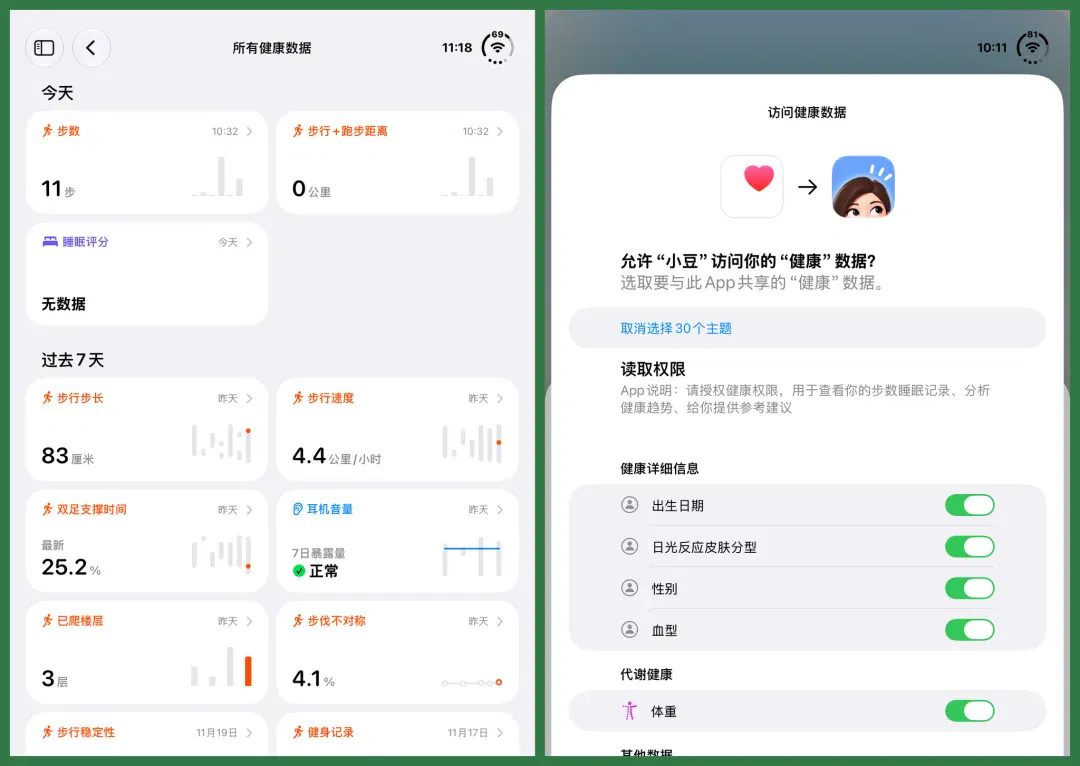
After connecting Apple Health, we can look up our exercise data directly in the Xiaodou app.
For example, I asked it to analyze my exercise over the past 30 days and suggest adjustments to my exercise plan based on my actual activity:
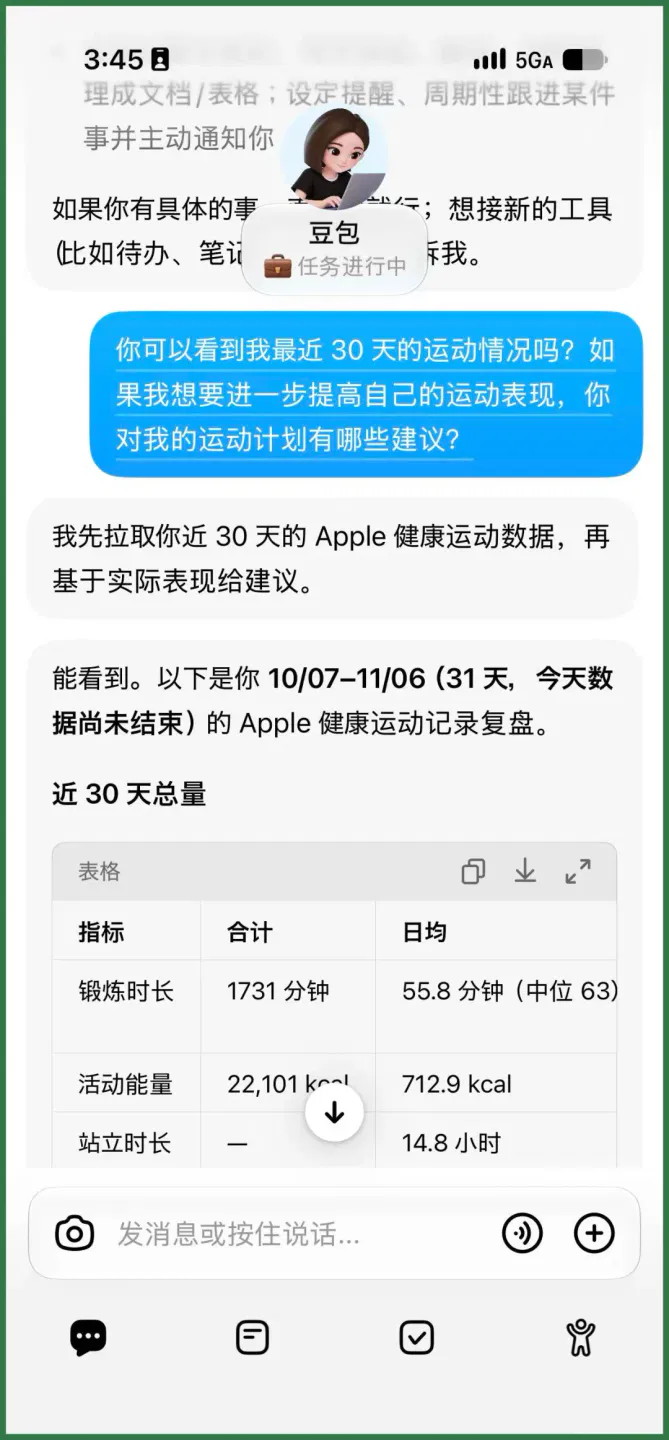
During testing, I also found that I could authorize Xiaodou to access my daily Activity Rings data.
If some exercise data had not yet synced from my COROS watch or other apps to Apple Health, it would remind me to sync and fill in the records promptly, then offer fairly professional exercise-plan recommendations based on those data.
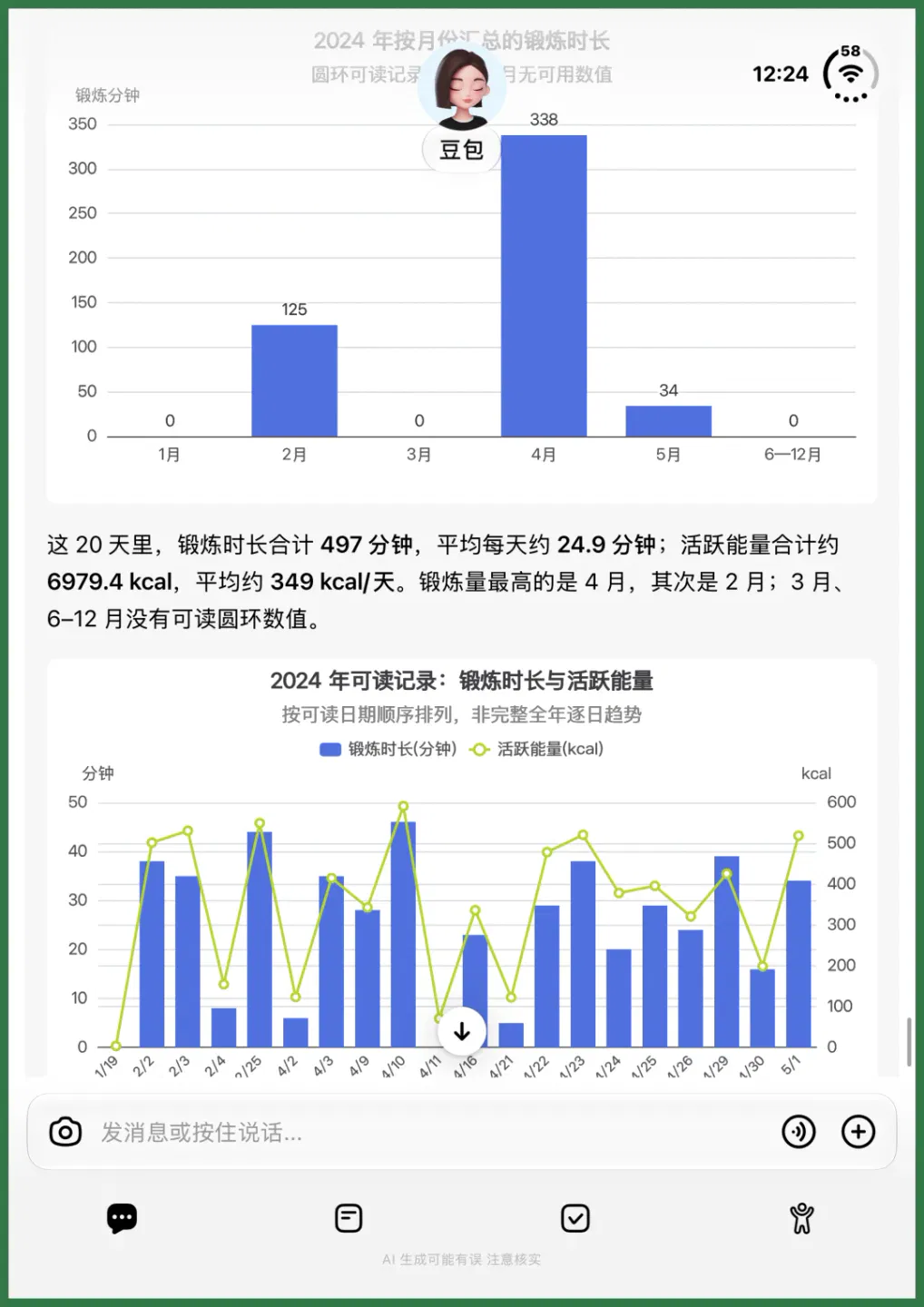
I could also authorize Xiaodou to access health data from the past several years, helping me total each year's exercise duration and active energy.
For example, I asked it to analyze all my health data from 2024. It totaled the year's exercise duration and active energy, then generated bar and line charts, giving me a more intuitive view of my exercise and a reference for future adjustments to my plan.
Beyond health data, we wanted to see whether Xiaodou could combine information from other apps to understand our interests and usage habits.
I tried asking Xiaodou to recommend apps that would suit me.
It first checked my personal context and found that I regularly needed to review Douyin content, organize materials and create AI content. It therefore recommended Notion for managing topics and source materials.
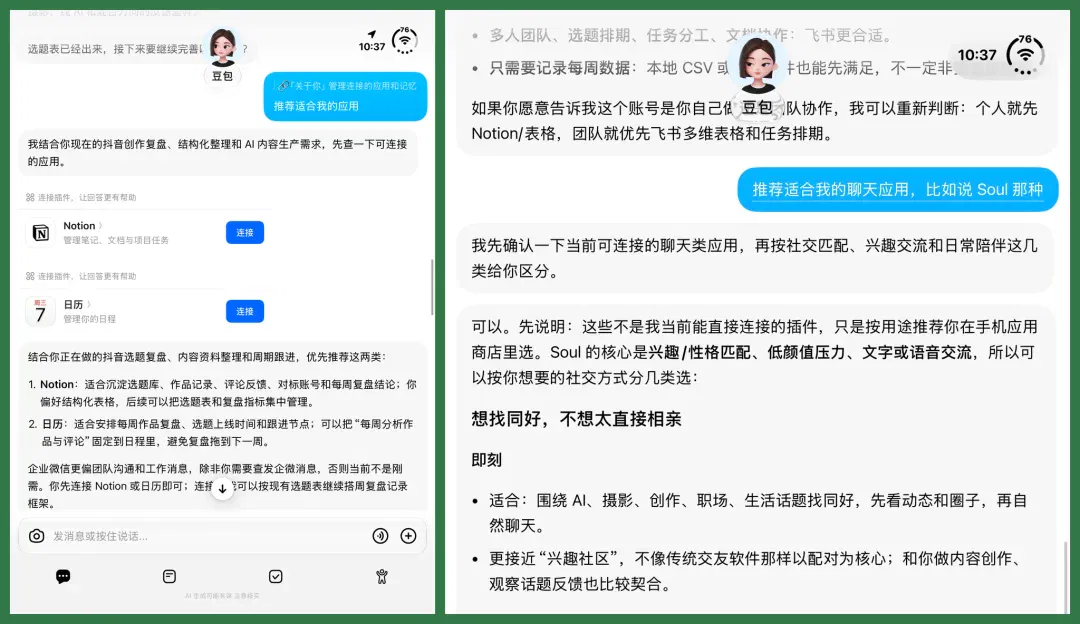
It did not recommend other collaboration tools because it thought Notion better suited my habits. Notion is indeed a tool I have used for a long time, but I had not previously volunteered that information to Xiaodou.
On another occasion, I asked it to recommend chat apps similar to Soul.
Unexpectedly, its first recommendation was Jike. Combining my interests on Douyin with related content in Feishu, it concluded that I preferred conversations about AI, photography and creative work.
It therefore thought that an interest-based community like Jike might suit me better than conventional social or dating apps.
[2] Proactive recommendations and ongoing follow-up
Proactivity is a direction worth watching for Personal Agents.
Xiaodou can recommend content we might find interesting based on personal context, and can periodically check information and proactively alert us when something changes.
Proactive recommendations based on interests
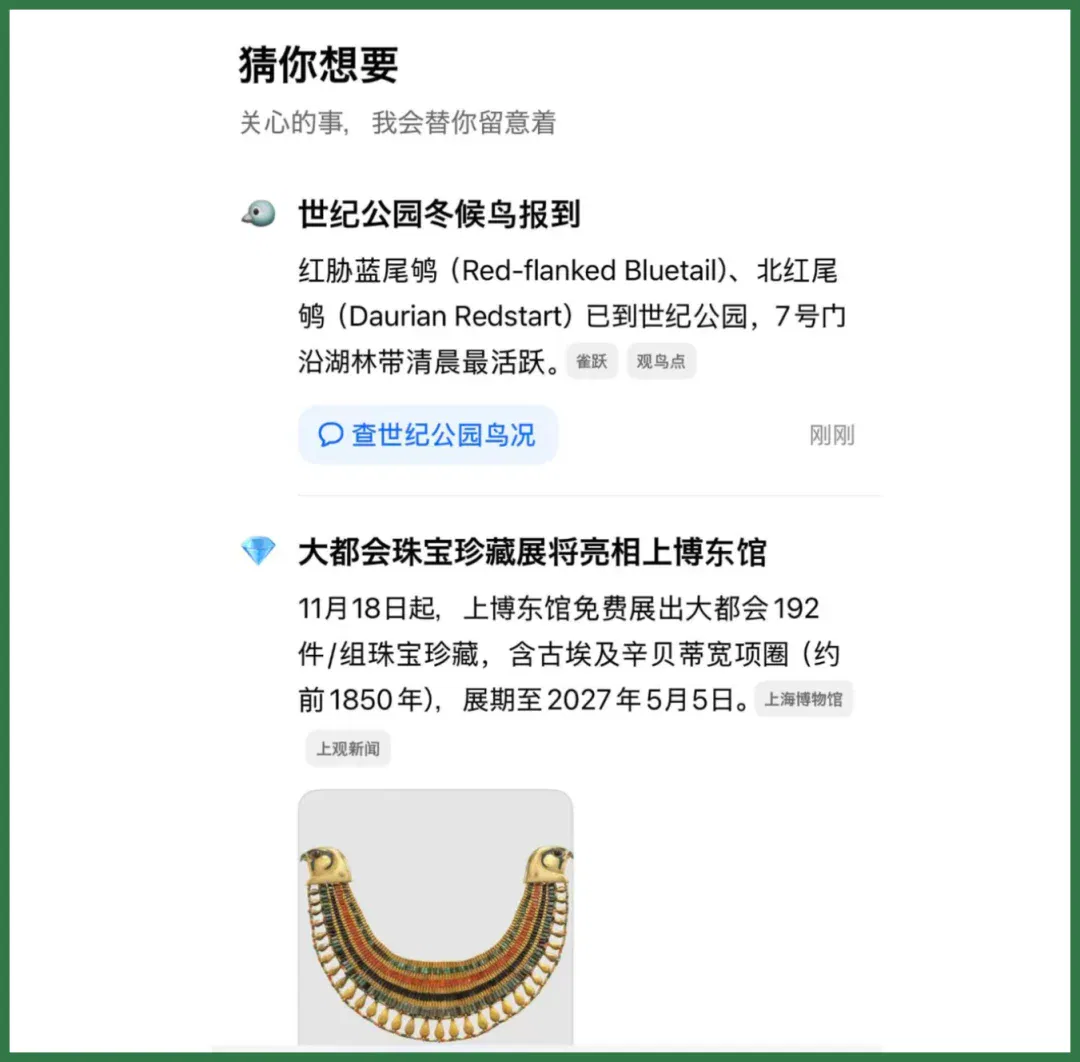
Xiaodou combines users' usual interests, local location information in Shanghai and their calendars to recommend content that closely matches their interests.
For instance, it reminded me that winter migratory birds could recently be seen in Shanghai's Century Park. It also recommended "Metropolitan Jewelry Treasures," an exhibition at the Shanghai Museum East running until May 5, 2027.
Proactively discovering website problems
Another interesting Xiaodou feature is its ability to periodically check for changes in certain information.
Previously, Koji deployed a birdcall detector running 24 hours a day on a Raspberry Pi at AI Hacker House, and later turned the detected data into a website.
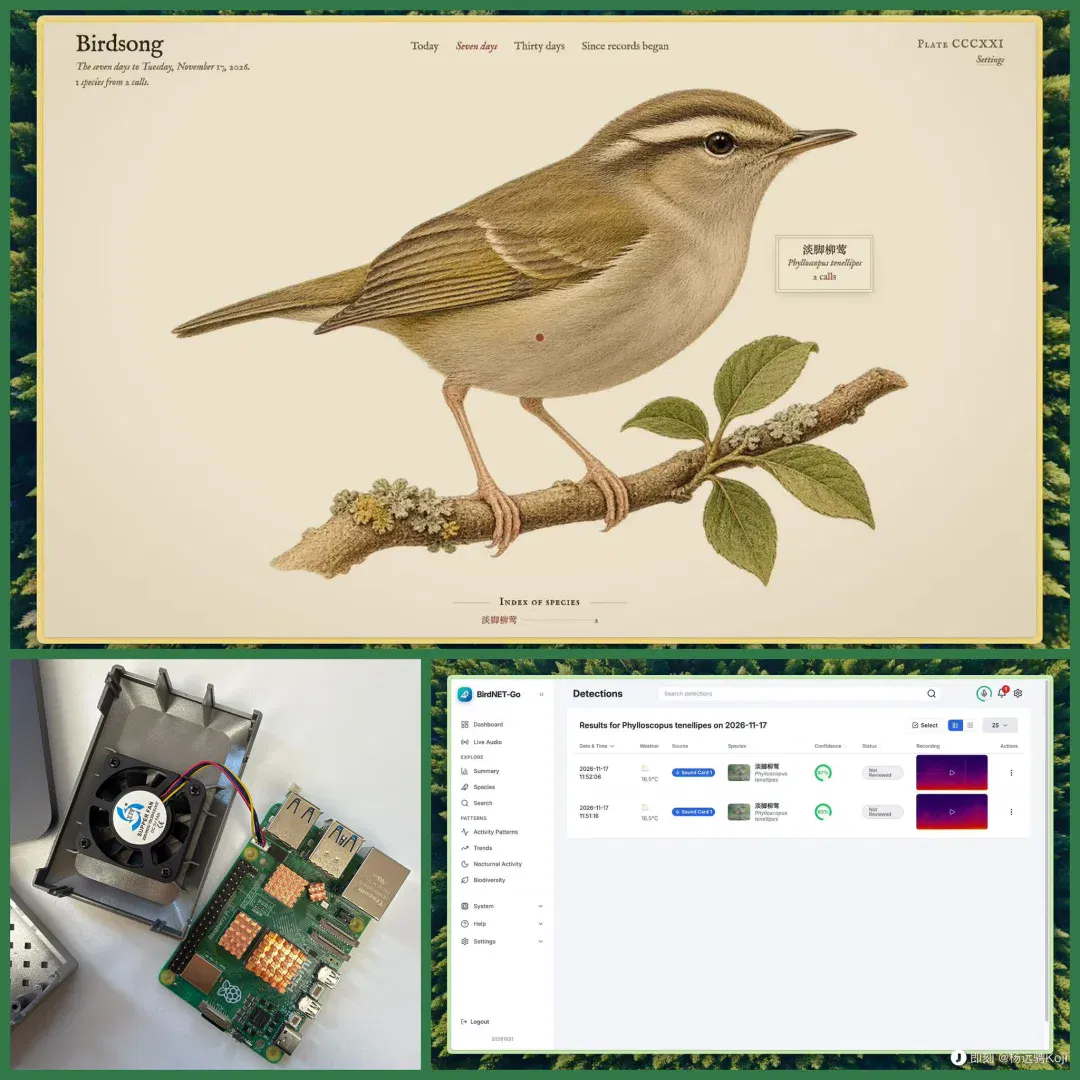
Koji's 24-hour birdcall-detector website
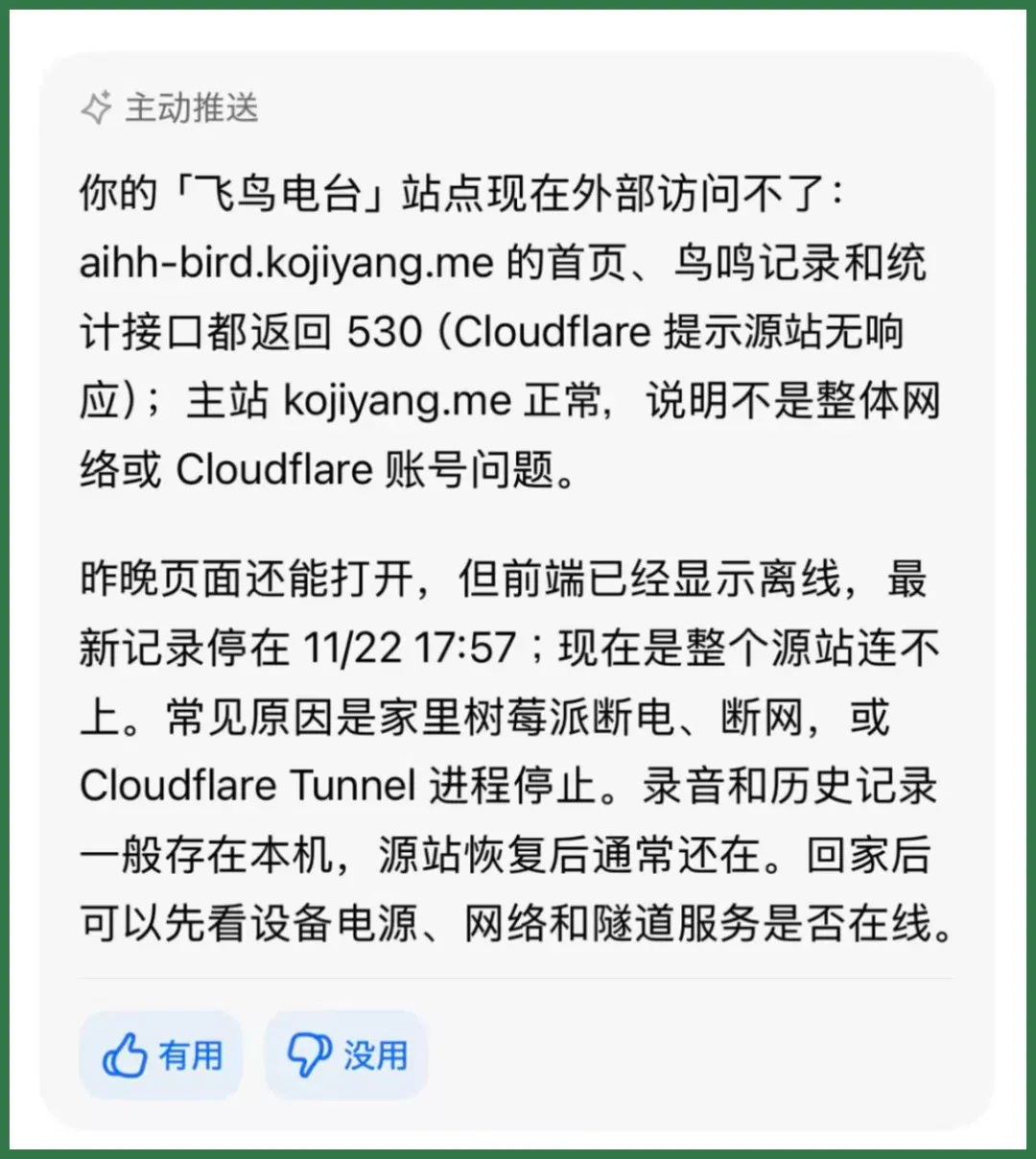
Last night, Koji's Feiniao Radio website suddenly became inaccessible externally because his Raspberry Pi had lost power.
Interestingly, through periodic checks, Xiaodou found that several Feiniao Radio endpoints were returning 530 errors while the main site was still working normally. It therefore judged that the problem might lie with the Raspberry Pi at home, such as a power or network outage—and Koji's Raspberry Pi had indeed lost power:
Proactively following up on Feishu drafts
This kind of proactive reminder can also be used at work.
Xiaodou can also read my documents in Feishu and, based on their comments, determine what stage a draft has reached, then proactively push the relevant information to me.
For example, Xiaodou found that Feishu contained four drafts still at the finalization stage and reminded me to check the comments for any new suggested revisions.
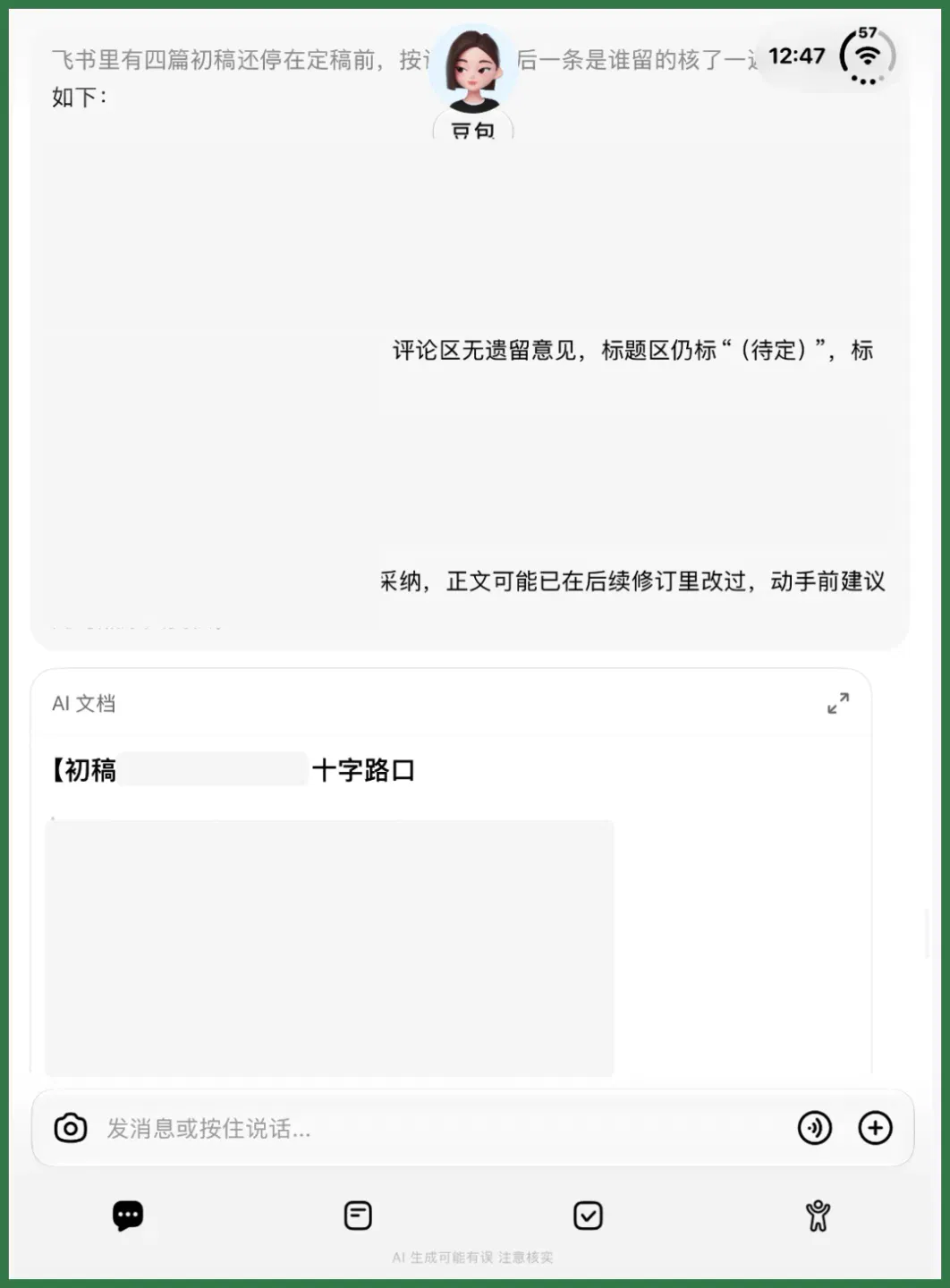
Interest recommendations, website-status checks and draft reminders in Feishu have something in common: users do not have to open the app and ask each time.
Based on existing information and settings, Xiaodou can keep following relevant content and proactively remind us when needed.
[3] Everyday services and tool use
Beyond understanding users and making proactive recommendations, Xiaodou also needs to perform actual operations, especially for travel and everyday services.
Hotel searches
Another typical Personal Agent use case is helping with travel and everyday needs, such as finding hotels and booking rooms.
A friend recommended three nearby getaway destinations to me on WeChat: Puyuan Fashion Ancient Town, Yanguan Ancient City and Pipa Island, adding that the first two were suitable for a night or two with my parents.
So I sent Xiaodou a screenshot of the WeChat conversation and asked it to check whether two rooms could be booked for two consecutive nights between December 28 and January 3.
Xiaodou directly identified the three destinations in the screenshot. About a minute later, it listed cards for available hotels by destination, including prices, numbers of reviews and room types:
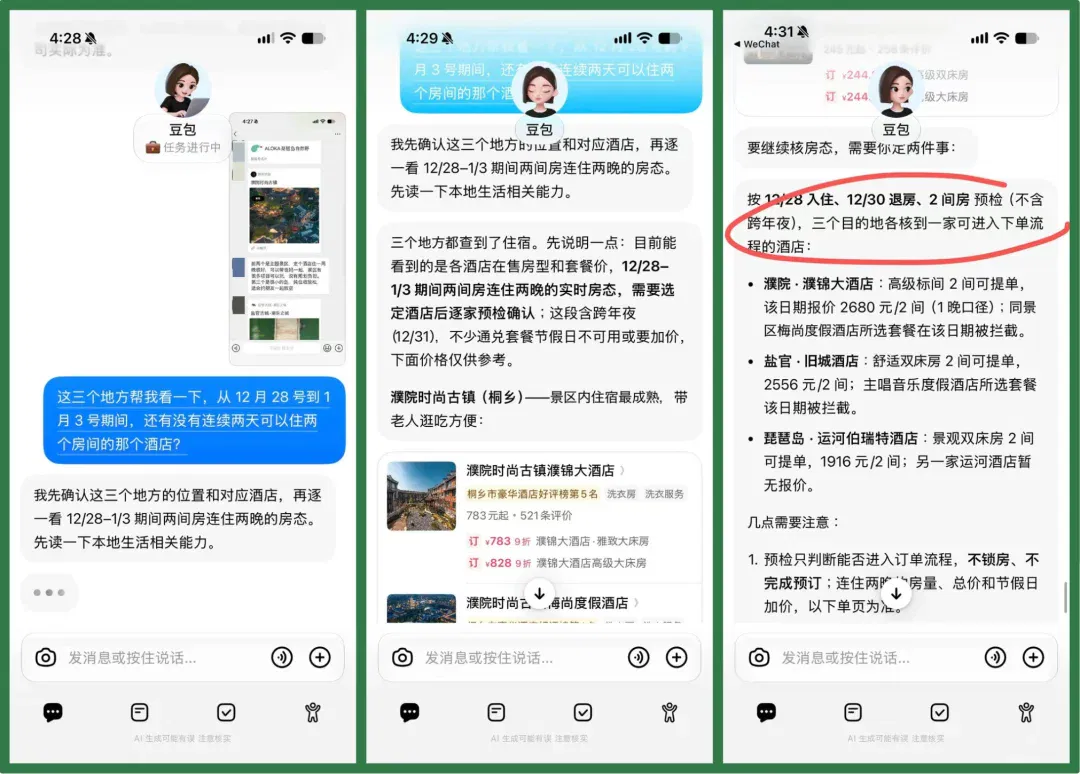
Xiaodou also warned us in advance that the period included New Year's Eve, when many hotel packages would cost more, so the prices on the cards were only references.
Moreover, Xiaodou did not stop at a simple search. Using a December 28 check-in and December 30 check-out to avoid New Year's Eve, it opened the ordering pages one by one to check.
Finally, it confirmed that two rooms could be booked at three of the hotels and submitted orders.
Making calls on the user's behalf
Simply searching for information about travel and everyday services is not particularly difficult.
But as we tested Xiaodou further, we found that it could even place calls for us directly in the background to ask businesses for specific information.
For example, I asked Xiaodou to check whether nearby Ziguangyuan restaurants had private rooms suitable for three or more people.
Xiaodou called the phone-assistant Skill in the background, first searching for nearby branches and verifying their information and phone numbers, then calling them one by one to ask about private rooms.
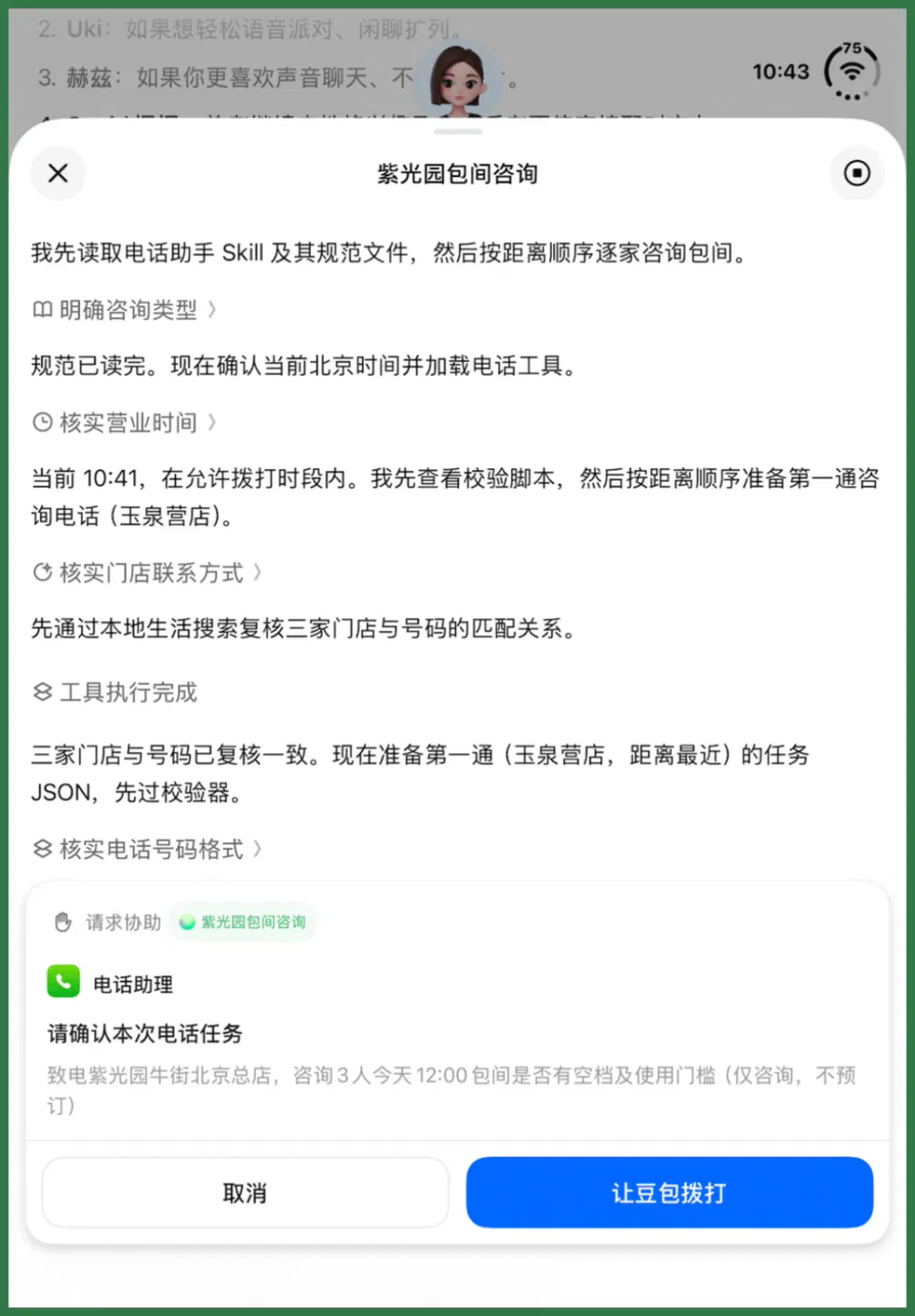
Interestingly, Xiaodou did not use my phone number to place the calls. It called real branches directly through the app's backend.
And it really did start talking with the restaurant staff.
The entire conversation had a clear objective: asking about private rooms. The two sides went back and forth naturally, much like an ordinary inquiry by phone.
I also recorded the full video, which shows Xiaodou having a conversation of about 40 seconds with a Ziguangyuan employee.

This feature is quite practical in daily life, since it neither occupies my phone's calling function nor requires me to stay in the Xiaodou interface.
Once it has clarified the private-room situation for me, I can simply go to the restaurant without calling each branch myself.
Compared with searching for hotels, calling on the user's behalf goes a step further: it requires communicating with real businesses and completing the inquiry based on their answers.
[4] Executing complex tasks across apps
The earlier scenarios mainly involved personal information, proactive reminders and everyday services.
Next, let's look at Xiaodou's ability to handle complex tasks, particularly whether it can connect different apps to complete a fairly comprehensive workflow, from gathering and analyzing data to generating documents and scheduling follow-ups.
Douyin—from content creation to e-commerce research
Doubao already had relatively deep connections with apps such as Douyin and Feishu, and Xiaodou continues in that direction.
We mainly tested two scenarios: content analysis for a Douyin account and real-time Douyin e-commerce research.
Douyin account analysis and topic recommendations
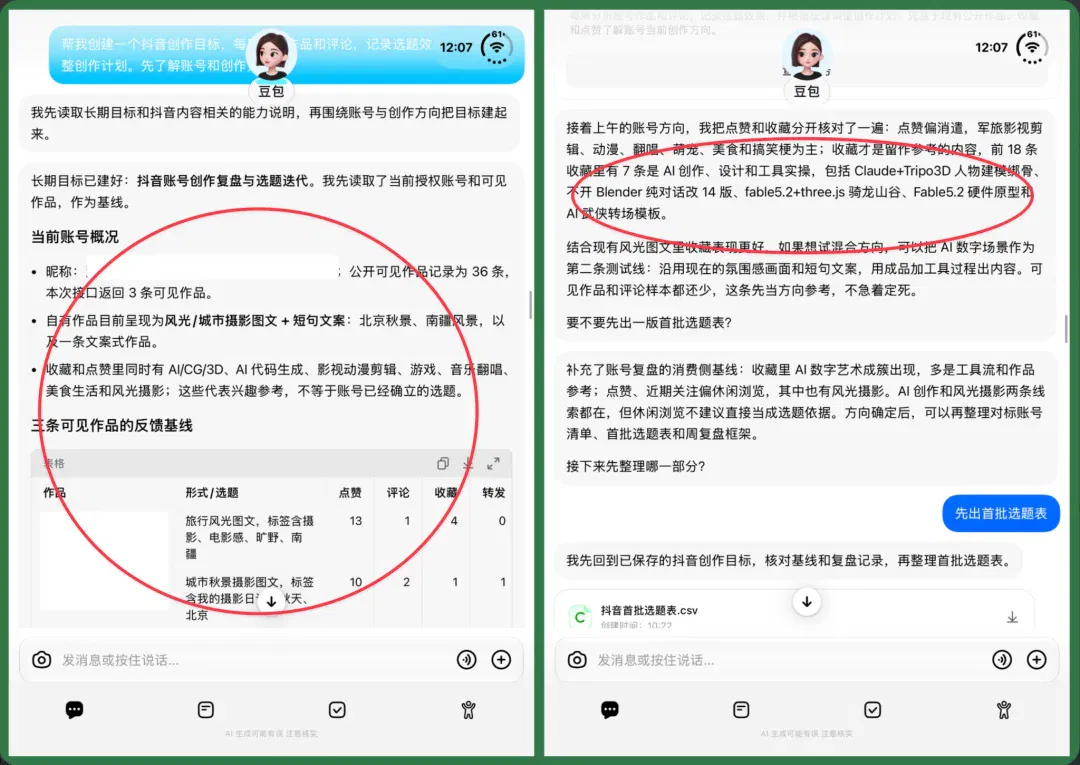
Xiaodou can connect directly to our Douyin account and read the relevant account data.
For example, it first analyzes my current account, then looks at content I usually like and save to understand my interests in AI, CG, 3D and AI code generation.
Finally, it uses this information to analyze suitable future Douyin topics and organize them into a topic-planning table.
Douyin e-commerce research + livestream selection
Next, I asked Xiaodou to help me research products on Douyin's e-commerce platform.
Recently, a number of robots, companion toys and related products from Japan and South Korea have appeared in the Chinese market, including Sony aibo, toio, LOVOT, Moflin and RoBoHoN, as well as products related to South Korea's Kakao Friends.
I wanted to understand their sales and user reviews on Douyin's e-commerce platform, so I asked Xiaodou to research this category directly.
It would search for relevant products, organize user reviews and classify positive reviews by different tags. It could even collect the exact review text, helping me understand what users actually liked about these products.
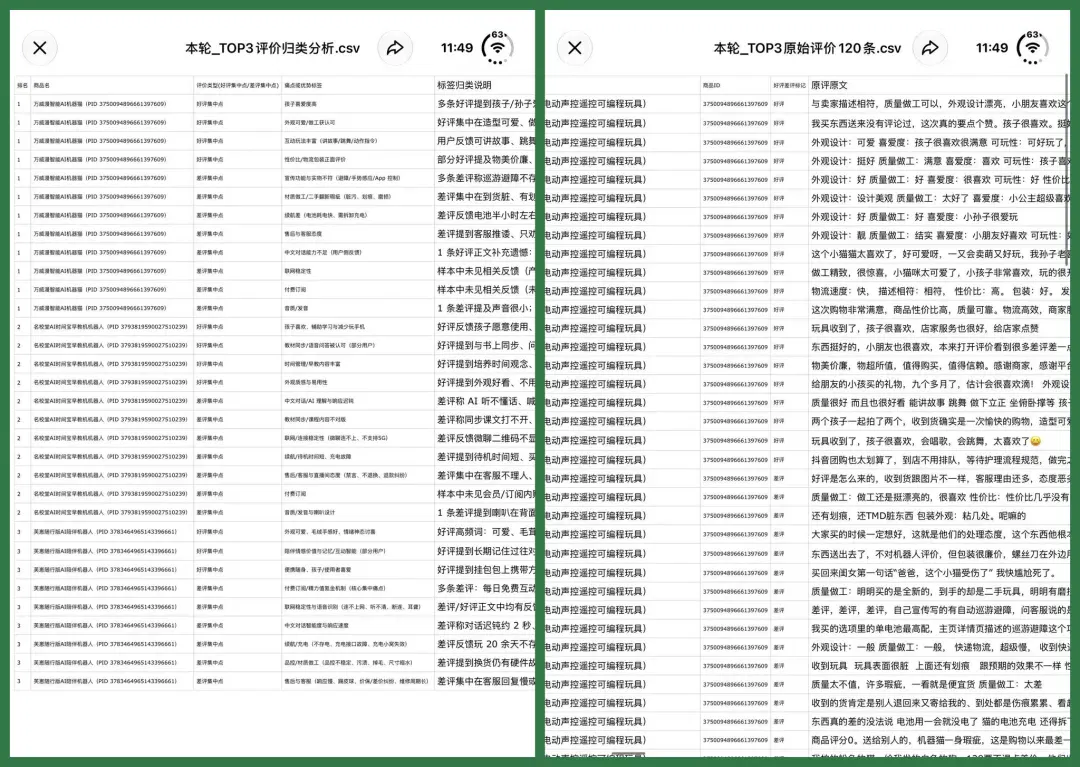
I even asked Xiaodou to search Douyin directly for livestreams selling AI robots, AI companion robots and AI dolls.
It listed the livestreams it found, including their featured products, selling prices and sales volumes. It even provided cards for streams currently live, making it easy for me to open and check them.

I made a point of checking Douyin myself and found that the livestreams Xiaodou listed were indeed live, and their corresponding product cards could all be found on Douyin.
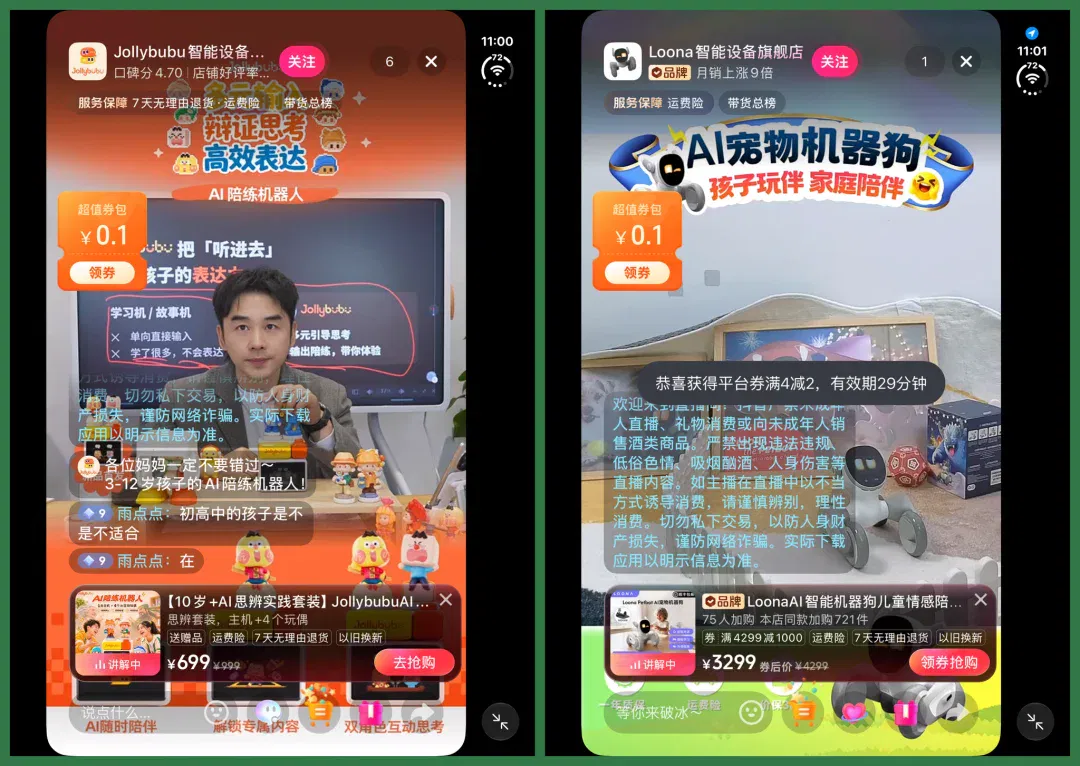
For fast-changing products such as AI companion dolls, research relying solely on older news and materials has relatively limited value.
Xiaodou, by contrast, can directly obtain real-time information from Douyin e-commerce, including currently live streams, product prices, sales volumes and user reviews, then analyze those data and even organize relevant keywords from the livestreams.
Feishu integration—from research to automatic daily updates
After completing the product research, content analysis and livestream sales-script organization, we can ask Xiaodou to save the results directly to Feishu Base.
For example, create three tables in the base, including product details and a main daily-report table, then set a scheduled task to automatically analyze AI-toy e-commerce data from the preceding 24 hours at 9 a.m. every day and generate a daily category report.
Feishu cloud documents can also be embedded directly in the base, making it easier for us to continue with deeper research and analysis.
This trial shows that Xiaodou's capabilities are actually interconnected.
Personal context helps it better understand user needs, app connections let it obtain more information, and tool calls and scheduled tasks enable it to execute and follow up on tasks further.
None of these capabilities is new in isolation, but combining them in a single Personal Agent creates a different experience.
After this full experience with Xiaodou, we were left with a question we found quite intriguing:
Previously, users of traditional AI chatbots mainly initiated conversations, asked questions and waited for the AI to answer or carry out tasks. Personal Agents are used somewhat differently.
They need to remember user preferences over time, connect apps such as Calendar, Health, Feishu and Douyin, and notice information worth paying attention to even when users have not proactively asked a question. They may even continue executing tasks in the background.
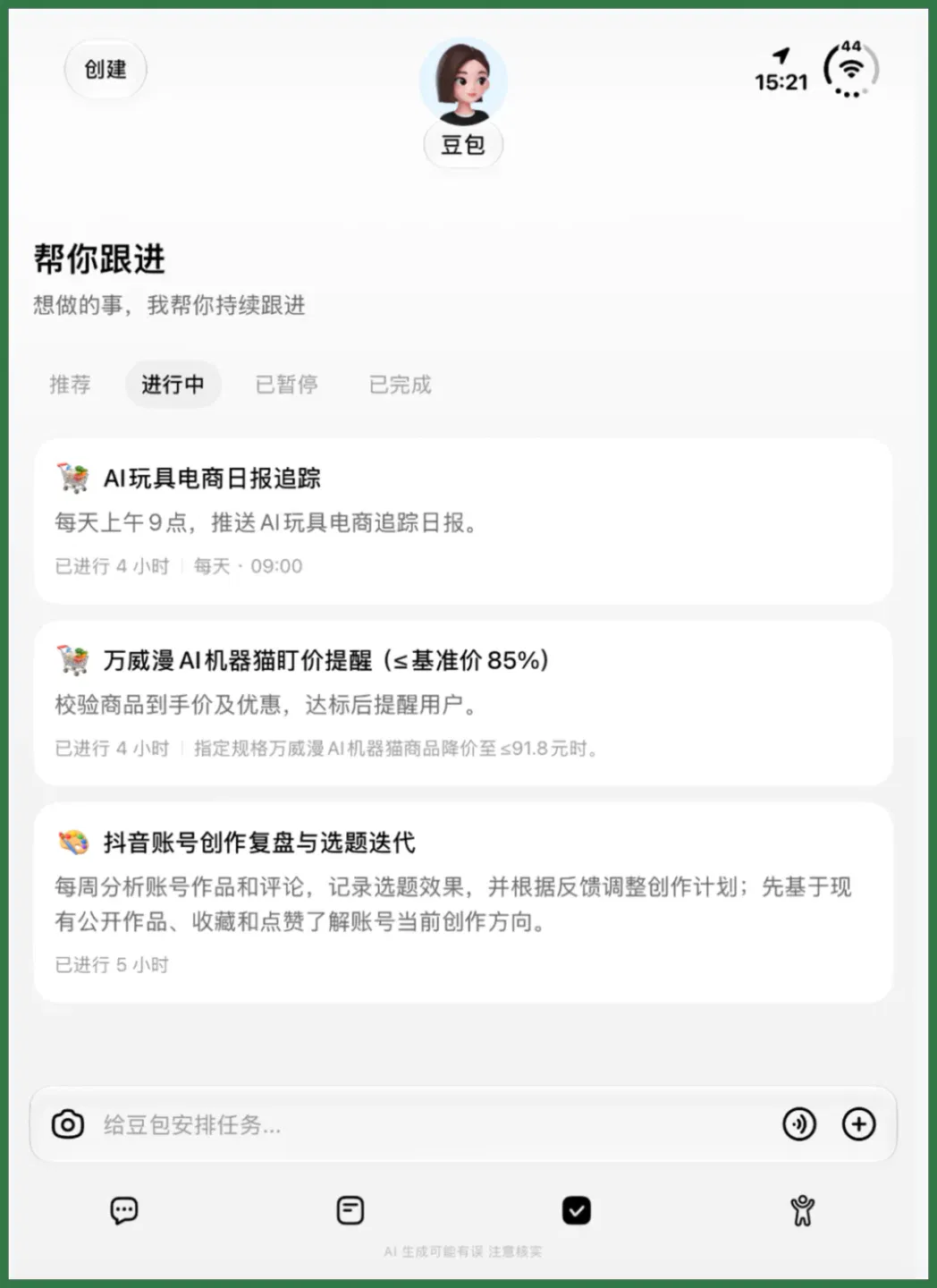
The Xiaodou app's "Follow Up for You" interface
This means Personal Agents need a redesigned product experience built around personal memory, app connections, proactive messages and task management.

The Xiaodou app's "Memory Summary" interface
For Doubao, which already has hundreds of millions of users, Xiaodou—still in its exploratory phase—may be a particularly noteworthy attempt by ByteDance in the Personal Agent direction.

This article is from "Crossing," by "GaKi".
Related topics
After reading
Join the AINRK community
Read how to join the community and connect with people working in AI.
Related articles
Continue reading related topics and articles in this category.

独家 | 豆包的AI个人助手产品叫“小豆”,计划推出独立App (opens in a new tab)
独家获悉,豆包的AI个人助手产品命名为"小豆",计划推出独立App,目前处于内部测试阶段,最终版本可能调整。

「豆包工作」升级实测:多Agents并行,操作Mac电脑 (opens in a new tab)
豆包工作新增多Agents并行与Mac电脑GUI操作两大功能,实测可完成Mac mini购机配置调研、自动撰写邮件草稿、调整长辈电脑系统设置及批量定时发送微博等任务。
Doubao Work Adds 21 Professional Workbenches: Four Task Trials and Human Review Limits (opens in a new tab)
QbitAI tries Doubao Work's new workbenches for finance, design, medicine and teaching. They produce useful drafts but sometimes miss instructions. The author's 80/100 is subjective; facts, medical information and final deliverables still need professional review.

Doubao adds map-based store discovery linking merchant details, deals and navigation (opens in a new tab)
Dujia tests Doubao’s Find Stores feature, which displays nearby merchants, group-buy offers and navigation and connects to ordering. The report examines conversational AI in local services; actual pages determine feature availability.

Doubao Work adds Kimi, GLM and DeepSeek and displays model credit multipliers (opens in a new tab)
The platform expands third-party model choices, adjusts some credit multipliers and introduces limited-time discounts, letting users choose models for different tasks within one work interface.