Author tries GLM-5.4 on a 3D hotpot restaurant and a 9,942-entry legacy archive redesign

Using Pi Agent, the author tests a 450 m² 3D restaurant, minigames and a 9,942-entry legacy project, checking layouts, local API timings and 49 request scenarios. These examples do not establish a general ranking or isolate the loop architecture’s contribution.
Editorial fact-check (November 24, 2026): This article records the author’s use of Pi Agent and the stated examples. The two model generations differ in visual interfaces, tools and iteration conditions, so these cases cannot establish a general ranking or isolate the contribution of Loop Transformer. Agreement across 49 request scenarios covers only the tested requests, not a formal proof for all data and inputs. Interface timings likewise concern this legacy project on the same machine, not model inference throughput. Z.ai’s November 23 release page lists Coding Plan, ZCode and Chat as available, while a standalone API and open weights are still announced as forthcoming. Actual access depends on region, channel and account permissions. Z.ai official GLM-5.4 release page (opens in a new tab)ZCode official model documentation (opens in a new tab)
Friends, I had barely reached my desk on Monday when Zhipu jolted me awake.
GLM-5.4 had just quietly gone live.

The notification mentioned only three things: a new model architecture, Loop Transformer, added vision capabilities, and stronger coding and “generalized coding” abilities.
In the author’s setup, simply setting the model name to glm-5.4 was enough to call it directly.

To be honest, China’s model scene had been quiet for quite a while.
Throughout November, the three leading overseas developers were battling fiercely, while Chinese developers kept refreshing X and Reddit for updates.
The model most often named in those requests was Zhipu’s GLM-5.5. Every few days, people speculated that the next big foundation model might be about to arrive!

People in the Xiaoyao Family community were watching every day too. After a neck-straining wait, Zhipu quietly released GLM-5.4 first.
So I quickly connected GLM-5.4 to Pi Agent and began testing.
◈ 1. Generalized coding
◽ 3D spatial modeling: fitting out a 450 m² bare-shell hotpot restaurant
Zhipu summarizes this generation’s new ability as “generalized coding”: every frame of a video, the geometry and materials of a 3D scene, and even interaction and physical rules can be expressed in code.
Combine dependable coding with vision that understands images, and a model can extend from writing webpages and changing APIs to building spaces and interactive creations.
For the first challenge, I gave GLM-5.4 a 450 m² bare-shell space and asked it to build a complete, explorable 3D hotpot restaurant from scratch in Three.js.
The difficulty was that all spatial constraints were fixed: immovable load-bearing columns, doors, windows and the main aisle, plus multiple zones from the storefront and main hall to private rooms. The same camera needed to switch between “unfinished” and “fitted out” at any time. Even small errors in coordinates, proportions or object intersections would become obvious when switching views.

GLM-5.4 built the space modularly in Three.js while taking screenshots through a preview tool to check its own work. It corrected visual flaws difficult to spot in code alone, such as “wooden slats blocking a private-room doorway” and “the pot divider misaligned with the red and white broths.” It ultimately delivered a complete webpage with multiple camera positions and free dragging.
First, watch the complete 19-second recording with matching camera positions, going from the street-facing storefront through the hall, private rooms and tables:
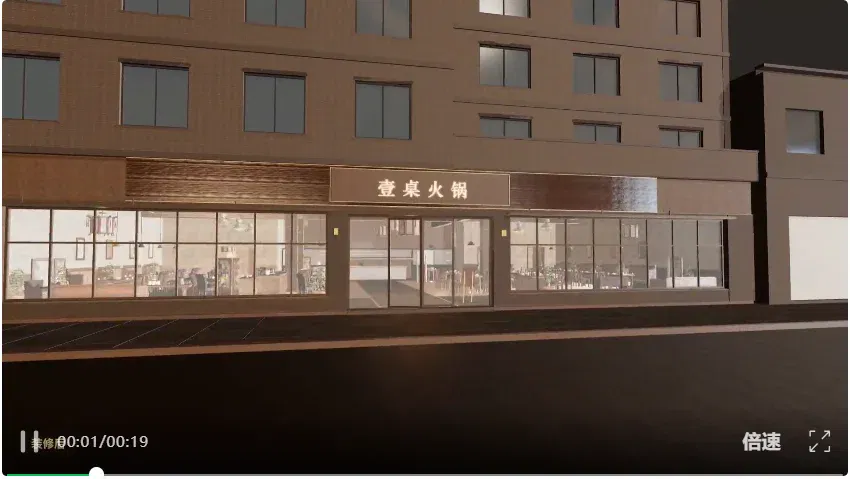
Enter the webpage and lower the camera to eye level, starting on the street: the sign, entrance and depth of the interior behind the glass connect naturally, immediately giving the impression of a real restaurant.

The storefront from the same camera position, before and after fitting out
Inside the hall, switching between fixed-camera views leaves the four load-bearing columns and 2.6-meter central aisle unchanged. Tables, chairs and booths extend along both sides in a stable spatial arrangement.

The hall before and after fitting out, from a fixed camera
Further back, private-room doorways, wooden slats and circulation routes align. Tables are directly visible through the entrances, avoiding the cobbled-together feel of something that looks convincing from afar but falls apart close up.

Private rooms and doorways from the same viewpoint
Moving close to a table makes the advantage of the added vision capability more apparent in this example: red and white broths remain separated by the divider in a split hotpot, and teacups have visible walls. The details are impressive.

Table close-up from the test: follow the marked boxes to see the pot divider and tea surface
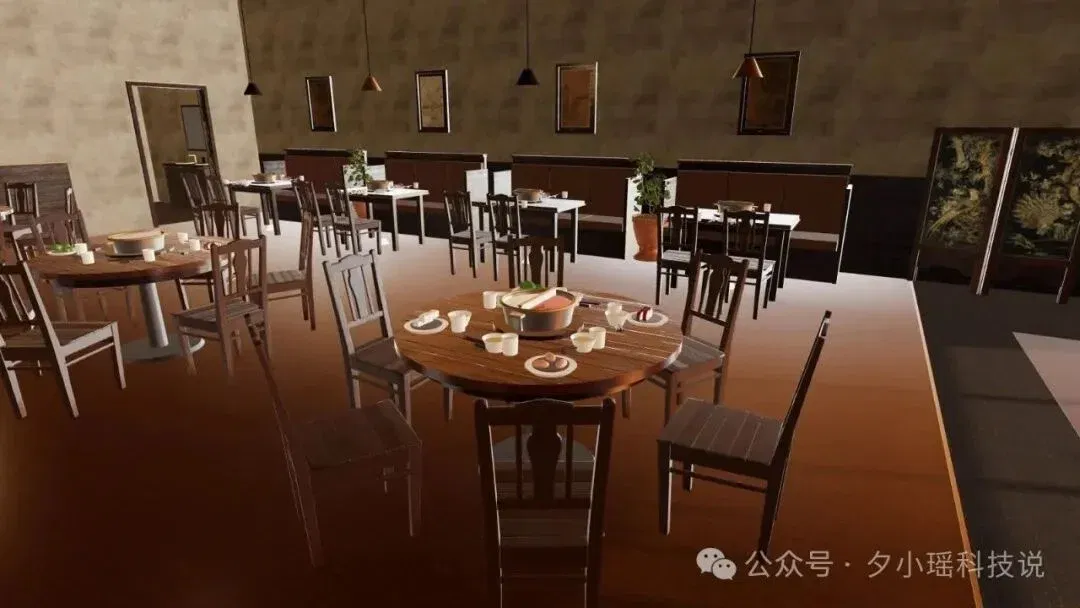
Table close-up: pot divisions, cups and saucers, and tabletop arrangement
To make the generational change more visible, I gave the same empty-room dimensions and assets to the previous generation’s text-only GLM-5.3 interface.
Both generations could build the restaurant. But with visual preview added, 5.4 showed a clear gap in the hall’s central-axis paving, the atmosphere of wooden beams and palace lanterns, and the completeness of hotpot and table settings:
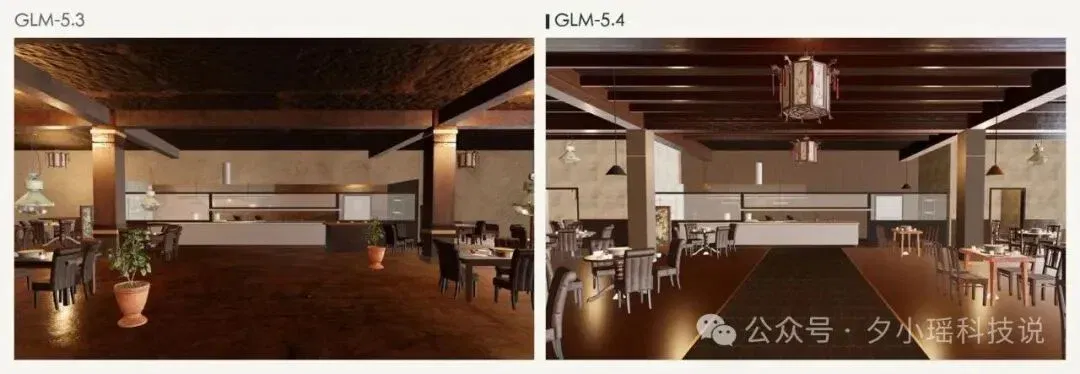
Hall comparison from the same camera: GLM-5.3 integration preview on the left, GLM-5.4 final version on the right
At table level, the difference was more direct: 5.3 still showed empty tables and chairs, while 5.4 had arranged split hotpots, teacups and complete place settings.
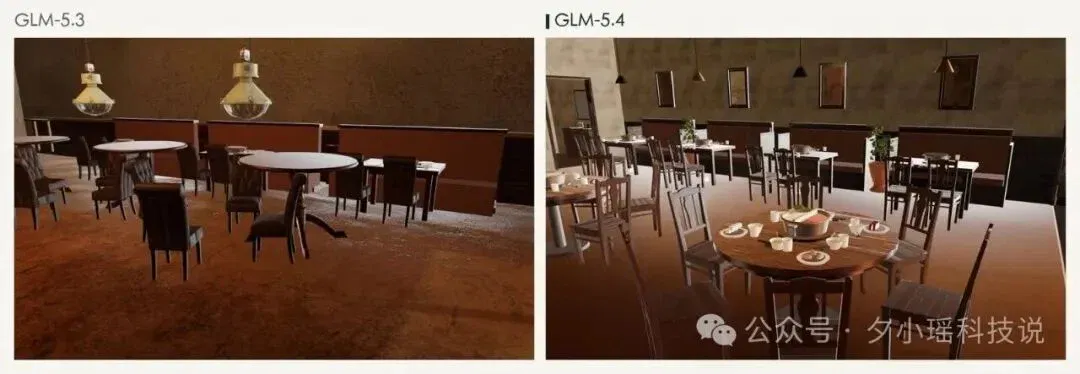
Table close-ups from the same camera: 5.4 has more complete hotpot and tableware settings
In this comparison, adding visual preview gave 5.4 a noticeably more finished sense of space.
Once the static restaurant was solid, interaction could be added.
◽ Interactive play: a set of 3D minigames inside the hotpot restaurant
With the space fitted out, I wanted to go further: could the model make the restaurant actually “come alive”?
I started a separate restaurant gameplay prototype with simpler art and added three dining-related minigames: customers pushing the door open and taking seats, clicking two slices of watermelon on a table to eat them, and throwing three arrows into a pot at the entrance. Each needed actions, a result and a restart.
First, entry: clicking “Welcome the first table” opens both glass doors, and customers walk around the waiting area to the designated table and sit down. The route is continuous rather than a teleport.

Customer-entry recording: opening the glass doors of the same fitted-out space and walking through the hall to the original table.
The watermelon also uses direct clicks on 3D objects. Click two slices, and the character raises a hand and eats them. Both the objects and panel count go from five slices to three, immediately resetting on restart.
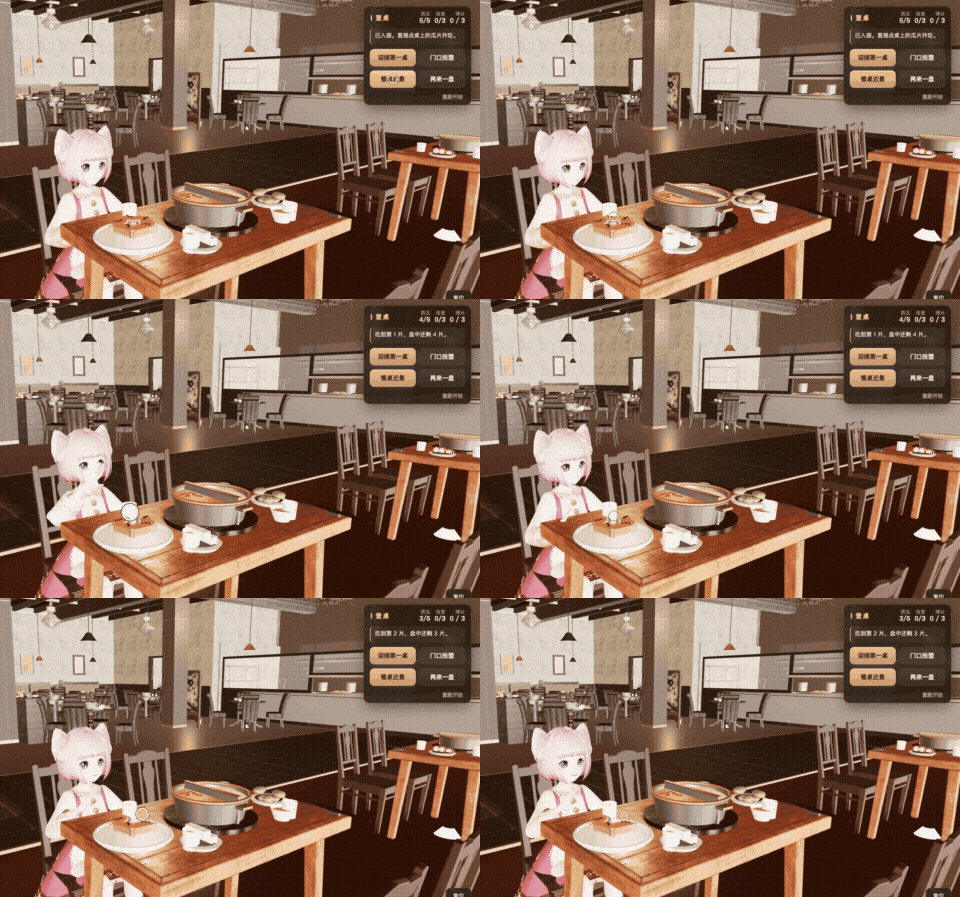
Clicking two watermelon slices on the original wooden table: five become three.

Tabletop close-up in the same restaurant: three watermelon slices remain beside the copper pot, cups and saucers
The most interesting of the three is pot-tossing at the entrance, where direction and force are adjustable:
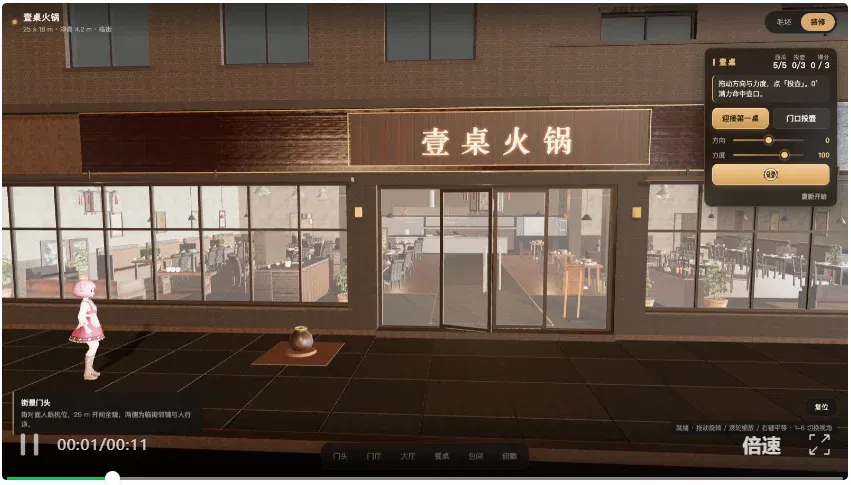
Throw three arrows in sequence: aiming straight at full strength lands one in the pot, while changing the angle or reducing force misses. After the throws, the result displays “1 / 3 hits.” It also works directly on a phone touchscreen.

The first two arrows under the same storefront: 0° at full force hits; +25° at 60% force misses
Character movements remain prototype-like, and pot-tossing uses simplified rules, far from a polished minigame. But it connects pathfinding, clicking, physical parabolas, scoring and restarting into a complete loop, which is entirely adequate for testing an idea.
Building a new scene from scratch tests imagination. But assessing how a coding model really feels requires returning to everyday work. Can it modify a legacy project that has run for years, with existing code and historical data?

◈ 2. Complex engineering refactoring
◽ Taking over a legacy repository: turning nearly 10,000 South Asia Daily archives into a research workspace
For the second main case, I brought out the South Asia Daily knowledge base I actually use. Accumulated from December 2022 through November 19, 2026, it contains 1,428 issues and 9,942 historical archive entries.
As data accumulated, the old version grew awkward. Searching a common country returned over a thousand items, mixing news and commentary in one long list. Reading matched material by month required manually entering dates and paging repeatedly. Once material was found, titles, issue numbers and links had to be copied manually. Two-character searches scanned the entire table in the backend and responded slowly.
Mobile was the biggest headache: filters occupied almost the entire initial screen, and not even the first result’s title was visible after searching.

I gave GLM-5.4 the full legacy code and an isolated copy of all 9,942 real archive entries:
rebuild the frontend and accelerate backend retrieval, with one nonnegotiable rule—every returned record must remain identical and in the same order before and after the changes.
First, watch the old and new versions side by side, new on the left and old on the right, both searching “Bangladesh.” After the changes, news and commentary for the same topic appear in two columns on one page, and useful entries can be added to a citation basket.
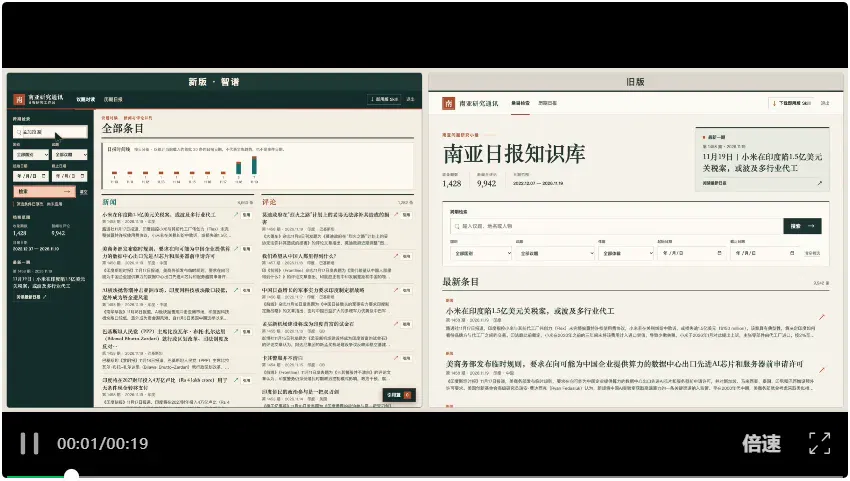
Both return 1,035 entries, but the new page has a more sensible layout.
The results split into 775 news entries on the left and 260 commentaries on the right, with a monthly timeline above. Click March 2023, and both columns immediately narrow to seven news entries and two commentaries, without manually entering start and end dates as before.
Click March 2023 to filter news and commentary together
Opening an entry brings up its details in a popup. News details can open the original daily report or add it to the citation basket; closing the popup returns to the two-column list with the filters intact.
Click “Download Markdown,” and news and commentary are grouped automatically, with titles, dates, issue numbers and original links packaged together. This removes the tedious work of copying sources by hand.

One news item and one commentary downloaded as Markdown
The increase in first-screen information density is even clearer.
For the same “Bangladesh” search, fully visible titles on the desktop’s initial screen increase from two to twelve, a full sixfold increase. Mobile saves 362 pixels, going from no visible titles on the first screen to two fully visible ones that can be opened immediately.

Initial search-screen comparison at the same 390 × 844 viewport
Backend retrieval becomes substantially faster.
The default list now identifies the current page’s entries before fetching details, and two-character terms receive a derived inverted index, taking about 19 seconds and 30 MiB to build for the entire store. Across 36 alternating local-interface test rounds on the same machine, responses improve by an order of magnitude:
- Default entry list, 9,942 entries: 28.36 ms → 1.43 ms (nearly 20 times faster; P95 45.36 → 2.18 ms);
- search “Bhutan,” 161 entries: 57.40 ms → 1.99 ms (nearly 29 times faster);
- search “India,” 7,700 entries: 57.50 ms → 12.88 ms; two-character term with no matches: 60.63 ms → 1.18 ms.
Finally, the complete JSON was compared in 49 request scenarios, producing 100% identical results with no lost records in those checks.
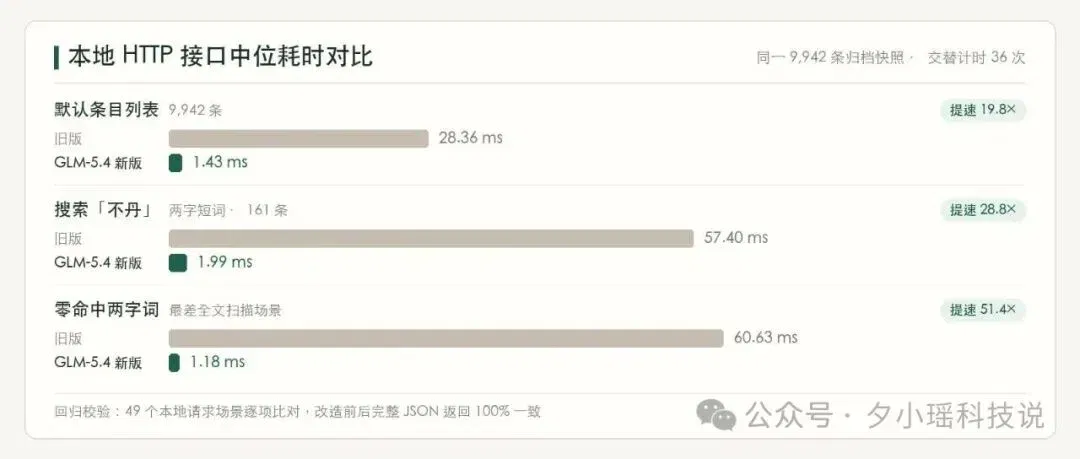
After improving the frontend and making backend retrieval more than twenty times faster, I also gave the same redesign request to the previous GLM-5.3, as usual.
Both generations could produce a two-column newspaper layout. But on a 390 × 844 phone screen, 5.3’s first attempt still filled the viewport with navigation and filters. 5.4 placed filters in a collapsible bar to leave room for content. That layout choice for real usage is the clearest sign of this generation’s improved engineering feel in the author’s experience:
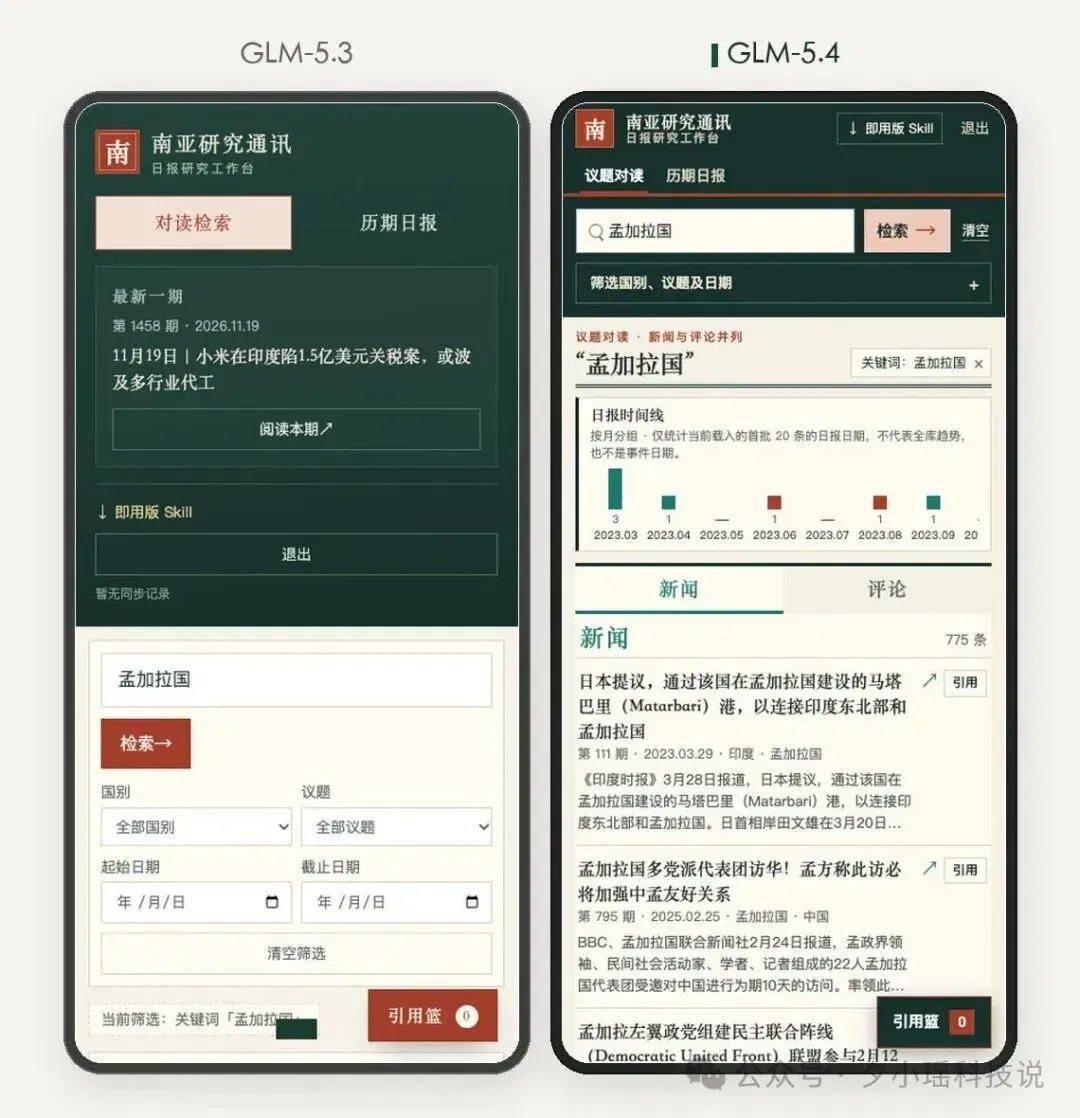
“Bangladesh” search at the same 390 × 844 viewport: GLM-5.3 first attempt on the left, GLM-5.4 final version on the right
Six times as many titles on the first screen, backend retrieval more than twenty times faster, and nearly 10,000 legacy records preserved: this is the kind of engineering ability that makes taking over a real old project reassuring.
◈ 3. Guessing Zhipu’s next move from Loop Transformer
After testing the cases, return to the official description: Loop Transformer.
A traditional Transformer resembles a one-way road: information moves from bottom to top and produces an output. Increasing depth requires adding actual layers and parameters.
Loop Transformer, a looped-depth architecture, does not simply keep adding parameters. It iterates network layers repeatedly, using deeper computation to seek more reliable reasoning.
The details of Zhipu’s network changes will become clear only when further official technical explanations are released.

Based solely on the feel of these tests, however, the combination of “architectural depth plus vision” suggests a direction to the author. Generalized coding no longer remains only a concept: 3D spaces, visual checking of tabletop details and interactive minigames can all be brought into a code-driven loop;
meanwhile, for a legacy project with nearly 10,000 actual archives, it changes both frontend interactions and underlying retrieval while preserving results in all 49 interface regression cases, showing more dependable stability across long, multi-file workflows in this experience.
Following this clue, Zhipu’s move is intriguing. With China’s model scene quieter lately, exploring a new underlying architecture may be more interesting than simply joining the race to accumulate GPUs.
Testing the new structure in 5.4 under real coding scenarios and getting engineering and value for money right could offer a substantial result for the recently subdued domestic model scene, while raising expectations for the much-requested next major foundation model, GLM-5.5.
This article comes from Xi Xiaoyao Tech Talk, written by the Xi Xiaoyao editorial team.
Related topics
After reading
Join the AINRK community
Read how to join the community and connect with people working in AI.
Related articles
Continue reading related topics and articles in this category.

Zhipu Launches GLM-5.4 with a Loop Transformer; Open Weights Remain Planned (opens in a new tab)
GLM-5.4 brings native vision, a 1M context and Generalized Coding to Coding Plan users. Zhipu says it loops 28 layers of a 750B base twice. API access and open weights remain future plans; product availability does not mean the weights have been released.
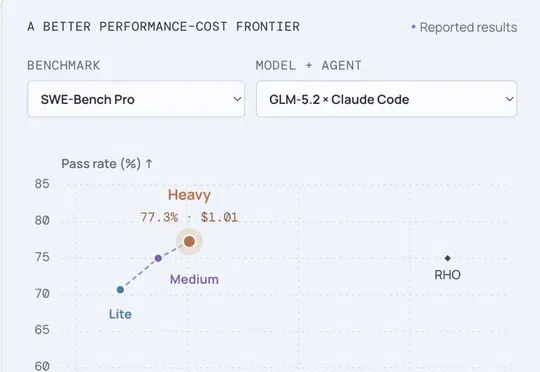
智谱唐杰署名RSI新成果开源!Agent自我进化成本还狂降53% (opens in a new tab)
智谱唐杰团队发布并开源无标签递归自我改进框架HarnessPro,在SWE-Bench Pro等基准提升通过率的同时,将单任务平均成本降低53.0%。
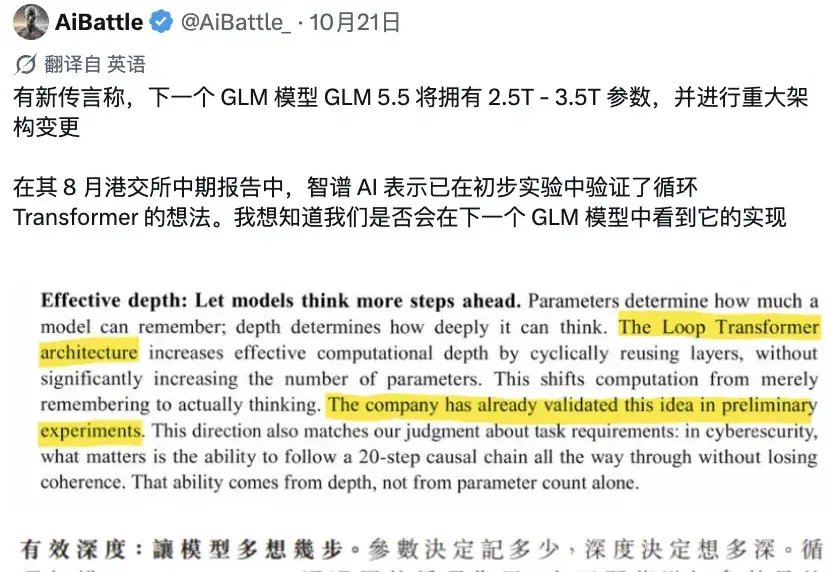
GLM-5.5最新曝光!「降智」问题3张重置卡已到位 (opens in a new tab)
GLM-5.5,真的马上就来了?! 这不嘛,网上有GLM Coding Plan用户收到官方补偿通知,原因是此前部分用户遭遇了模型「降智」问题。 但比补偿本身更有看头的,是智谱在公告里留下的一句话—— 新模型发布后,还会额外赠送一次额度重置机会哈! 好啊好啊,一份补偿通知,竟然顺手把下一代模型给剧透了。(doge) 而且巧了,最近关于GLM-5.5的爆料,也开始一波接一波冒出来了。 有小道消息称,GLM-5.5的参数规模可能达到2.5万亿—3.5万亿,比此前传闻的1.6万亿还要大上一截! 还有友友猜测,智谱此前初步验证的循环Transformer架构,会不会也用在下一代GLM上??? 这...

智谱新模型,懂法方面全球第一了 (opens in a new tab)
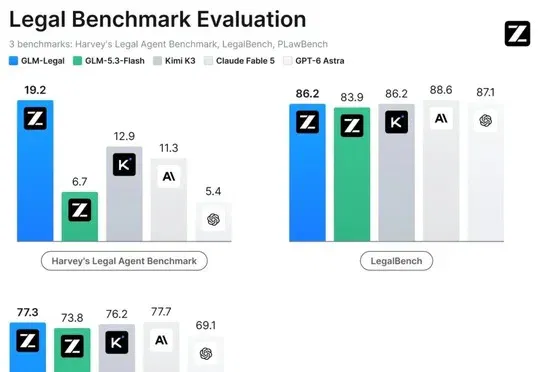
智谱推出法律专用开源模型GLM-Legal,可处理合同审查、证据分析和跨境合规,并在Vals AI法律测评中以19.2%的任务全通过率和86.23%的准确率位居Harvey LAB与LegalBench双榜开放权重模型榜首。
智谱发布 GLM-Legal:专攻法律的大模型,合同审查、证据梳理都能干 (opens in a new tab)
智谱旗下Z.ai发布基于GLM-5.3-Flash的法律专用模型GLM-Legal,面向合同审查、证据分析和合规研究,官方评测显示其在Harvey LAB明显领先、其余两项接近一线,目前需申请API权限且未开源。