Codex corrects GPT-6.2 usage accounting; some requests will reach limits sooner

Reporting cites Tibo saying some Codex requests were undercounted at GPT-6.2's launch. A fix means Astra and Sol will reach limits sooner, with a discretionary reset offered. This should be distinguished from ChatGPT chat limits and API pricing; marketing motives remain speculation.
This article concerns the reported correction to usage accounting for some Codex requests. It does not mean every ChatGPT user's fixed allowance has been cut nearly in half. Reaching a limit faster and the percentage reduction in the number of usable tasks are also different measures: actual consumption depends on the model, task, context and speed settings. Tibo's remarks, notification emails and December changes are retained as described in the original reporting; this review has not independently read every original notification. Judgments about marketing motives, capability rankings and user departures are the views of the original author or quoted users. The official usage dashboard governs the current account scope and reset conditions. Official usage and pricing documentation (opens in a new tab).

OpenAI keeps making bad moves.
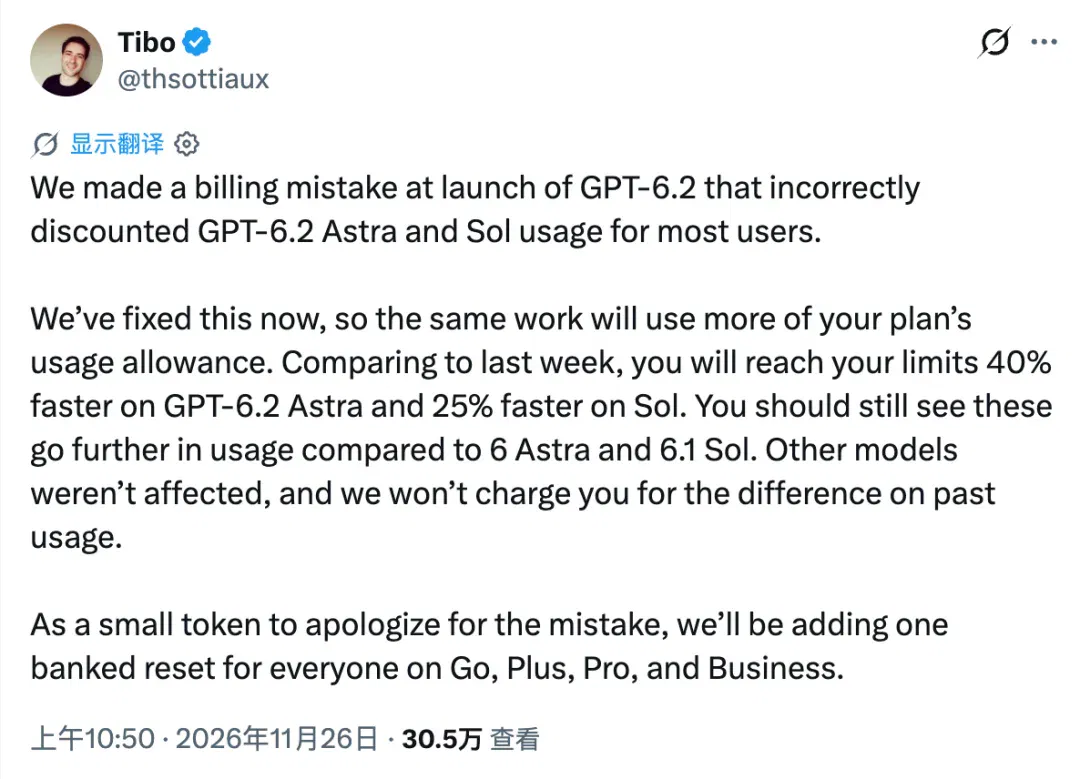
Zhidongxi reported on November 26 that Tibo, who leads ChatGPT and Codex at OpenAI, had just announced on social media that a usage-accounting error occurred when GPT-6.2 launched, causing most Codex users' actual allowance consumption to fall below OpenAI's expectations.
OpenAI has now fixed the error and announced that it is offering a one-time usage reset that users can choose when to apply as compensation.
According to Tibo, compared with last week, users of GPT-6.2 Astra and GPT-6.2 Sol will reach their limits 40% and 25% faster, respectively.
Before writing this article, I looked at the reset on my own account and paused to think. So the reason my allowance had felt so generous lately was that the accounting had been wrong...

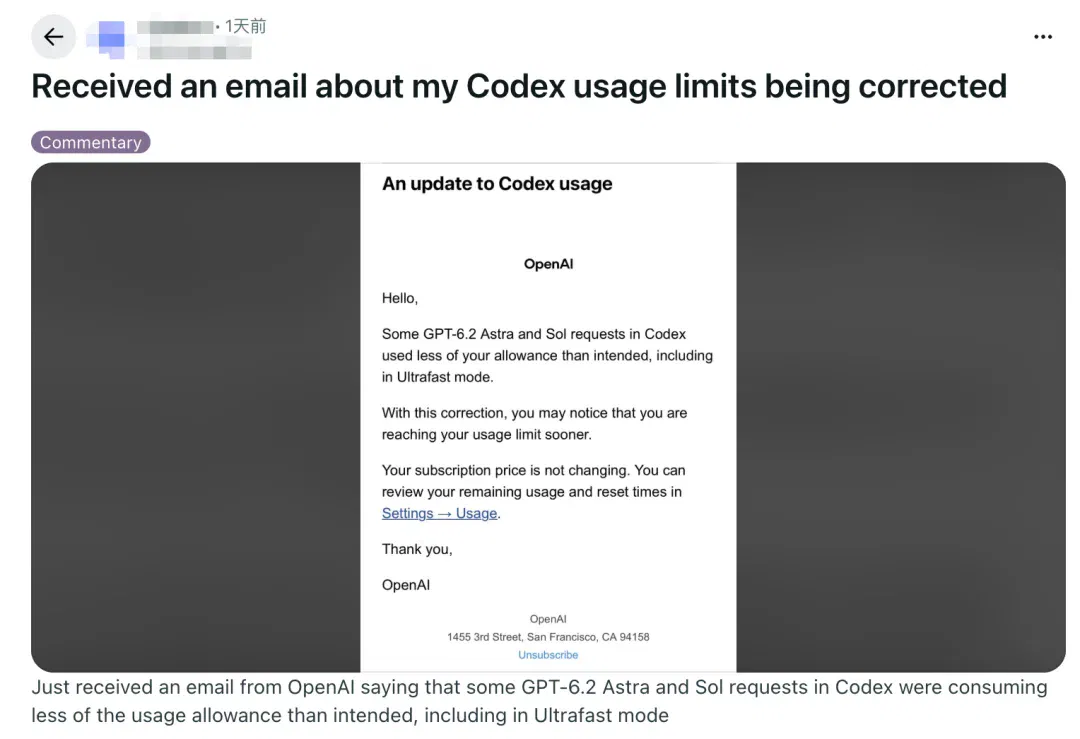
In fact, several Codex users had already received relevant notification emails from OpenAI yesterday.
In the email, OpenAI said some GPT-6.2 Astra and GPT-6.2 Sol requests in Codex had previously consumed less allowance than intended, including requests in Ultrafast mode.
With the problem fixed, users may exhaust their allowances sooner, but subscription prices will not change.

Many users are unhappy with the adjustment. In their view, with the models' capabilities not at the very top, one of GPT-6.2 Astra and Sol's advantages was their value for money. When releasing the models, OpenAI claimed both could complete complex tasks with fewer output tokens, allowing users to accomplish more within the same subscription allowance.
For API pricing, GPT-6.2 Astra's input and output token prices are both 20% lower than GPT-6 Astra's, while cached-input pricing is 60% lower. GPT-6.2 Sol retains GPT-6.1 Sol's API pricing.
On Reddit, some users argued that although OpenAI described the adjustment as a bug fix, for users the practical experience was still a de facto reduction in their allowance.
Although Tibo said in his latest statement that, even after the fix, users completing tasks with GPT-6.2 Astra and Sol would still find that the same usage allowance supported more work, that does not seem to be how it feels in practice.
Users reported that GPT-6.2 Astra and Sol were consuming their allowances decidedly faster than the older models had.
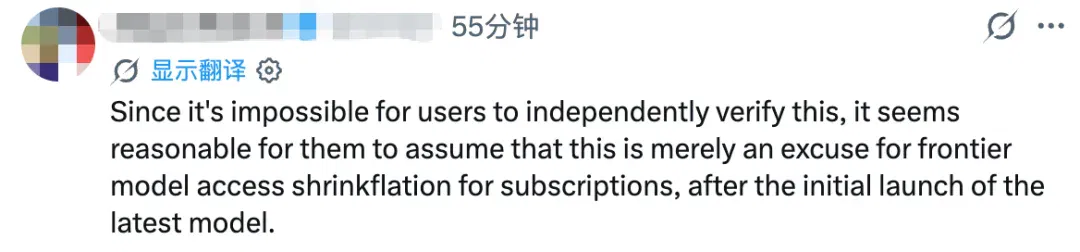
Some users speculated that this could be a marketing tactic by OpenAI. The signs do seem to make that plausible: if the two models cannot compete with Claude's new models on intelligence, their price advantage is their strongest attraction. Using incorrect accounting to double allowances, then removing that increase by some means, would be another of OpenAI's "bad moves."
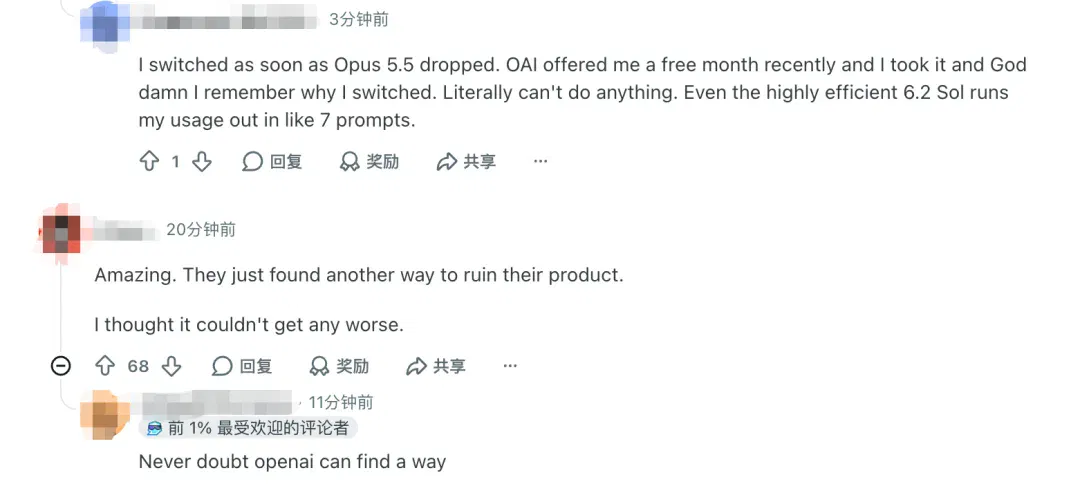
Many online commenters claimed OpenAI was undermining itself and said they were switching their subscriptions to Gemini and Claude.
Meanwhile, OpenAI is also working on changes to ChatGPT and Codex's allowance-management mechanisms.
According to OpenAI's official documentation cited in the reporting, starting in December this year, ChatGPT Plus, Pro and Business users will share their usage allowances between ChatGPT and Codex.
As ChatGPT Work's agent capabilities are integrated into ChatGPT's main interface, consumption will be calculated in tokens, with the amount depending on the selected model and task complexity. Instant conversation mode, however, will not consume this shared allowance.
OpenAI has already begun testing the adjustment with a small subset of users.
Conclusion: deliberate or accidental?
Usage transparency in AI subscriptions still needs improvement
As AI applications move from simple question-and-answer exchanges to long-running task execution, usage allowances are becoming a key factor in the user experience.
For heavy AI users, what may matter more than API prices and benchmark scores is how much work the same subscription payment actually supports.
Helping users understand their consumption more clearly and accurately, and establish stable expectations, is another issue AI providers need to address as they explore subscription business models.
OpenAI has plainly fallen short here. Frequent allowance changes inevitably make users question the product's stability, and user departures are a natural consequence.
This article comes from "AI Application Trends"; author: Bi Weihao.
Related topics
After reading
Join the AINRK community
Read how to join the community and connect with people working in AI.
Related articles
Continue reading related topics and articles in this category.
Oregon sues OpenAI for $2.035 billion over child-safety allegations (opens in a new tab)
On November 17, 2026, Oregon sued OpenAI for $2.035 billion, alleging inadequate protection of minors and misleading safety claims about ChatGPT. The allegations have not been established in court; the amount is a claim, not an awarded penalty.
OpenAI Explains Its Performance Factory: Codex Investigates, Engineers Approve Fixes (opens in a new tab)
OpenAI describes a pipeline linking alerts, Codex investigations and proposed fixes, adversarial review and post-deployment checks. It reports over 1,700 investigations and 600 root-cause cases in just over three months; engineers still approve deployment.

OpenAI Releases Nine Math Manuscripts on Matrix Multiplication and Strongly Polynomial Programming (opens in a new tab)
OpenAI added nine manuscripts in two families on November 24, claiming a 9/4 matrix multiplication exponent and strongly polynomial linear programming. Lean formalizes selected results; the repository treats the work as raw research data rather than completed academic review.

OpenAI Reportedly Developing Athena to Help Agents Understand Business Metrics (opens in a new tab)
The Information reports that OpenAI is developing Athena, a semantic-layer-like platform for business rules and metrics. It remains at an early stage, with no announced release date or pricing; accuracy gains and competitive effects are goals and analysis rather than verified product results.

GPT-6.2 Sol rolls out to Chat; report says some GPT-5.6 access will end in December (opens in a new tab)
OpenAI's release notes confirm that chat-optimized GPT-6.2 Sol began rolling out to paid plans on November 23. Citing official X posts, the report says some GPT-5.6 models in Chat, Work and Codex will retire on December 23; this does not establish a simultaneous API shutdown.