Oregon sues OpenAI for $2.035 billion over child-safety allegations

On November 17, 2026, Oregon sued OpenAI for $2.035 billion, alleging inadequate protection of minors and misleading safety claims about ChatGPT. The allegations have not been established in court; the amount is a claim, not an awarded penalty.
Oregon sues OpenAI, seeking more than $2 billion
On November 17, 2026, Oregon Attorney General Dan Rayfield announced a lawsuit against OpenAI, alleging failures to protect underage users and misleading statements to parents and the public about ChatGPT’s safety. The Oregon Department of Justice announced a legal action totaling $2.035 billion. [1]
The case was filed in the Multnomah County Circuit Court in Oregon. The defendants include six related entities, among them OpenAI Global, OpenAI Foundation, OpenAI OpCo and OpenAI Group PBC. The state also requested a jury trial. [2]
The notable aspect of this lawsuit is that Oregon is challenging not only harmful content generated by ChatGPT, but also its product design, user-retention mechanisms and the actual effectiveness of safeguards for minors.
1. What is OpenAI accused of doing wrong?
- Encouraging emotional dependence through product design. The state alleges that humanlike language and overly agreeable responses increase users’ trust in and dependence on ChatGPT. Such design may increase engagement, but could pose additional physical and mental health risks for minors whose psychological development is incomplete.
- Failing to effectively block harmful content. Citing research and real cases, the state alleges that ChatGPT provides minors with harmful material concerning suicide, self-harm, eating disorders and violence, and that OpenAI knew about these risks but failed to address them adequately.
- Inadequate age verification. OpenAI permits users aged 13 and older to use ChatGPT with a parent’s or guardian’s consent, but the state alleges that existing mechanisms do not effectively verify age or adequately confirm that minors actually have that consent.
- Teen experiences and parental controls falling short. OpenAI introduced a ChatGPT experience for teens and lets parents link their children’s accounts. The state alleges, however, that some safeguards can be bypassed, and that interactions involving high-risk topics such as self-harm, eating disorders and mental health did not effectively trigger the relevant parental notifications.
- Misleading consumers. The state alleges that, despite knowing about these safety risks, OpenAI continued promoting its products to children, teens and their parents, while making safety claims that did not match the actual protection provided. [1][2][3]
2. What laws does the lawsuit rely on?
The action does not rely on dedicated AI regulation. It primarily invokes existing consumer-protection law and common-law rules, asserting five causes of action:
- Misrepresentation and concealment of material defects. Under Oregon’s Unlawful Trade Practices Act, the state alleges that OpenAI made misleading safety statements and failed to disclose known, material safety defects adequately.
- Unconscionable commercial practices. The state alleges that OpenAI exploited minors’ limited ability to assess risks when marketing and operating its products, constituting “unconscionable tactics” prohibited by the Act.
- Negligence. The state alleges that OpenAI failed to exercise reasonable care to prevent reasonably foreseeable physical and mental harm to minors.
- Unjust enrichment. The state argues that OpenAI benefited from the alleged improper conduct and should return those benefits.
- Public nuisance. The state argues that ChatGPT’s design and operation endanger minors and harm the public interest. [2][6]
3. What does Oregon seek beyond monetary relief?
Alongside damages and civil penalties, Oregon requests a permanent injunction requiring OpenAI to stop misleading people about the safety of ChatGPT and its teen experience, refrain from overstating the effectiveness of safeguards and parental controls, and implement effective age verification and risk disclosures.
For intentional violations of consumer-protection law, the state also asks the court to impose a civil penalty for each violation under ORS 646.642(3).
The case is currently at the complaint stage. The allegations have not been established by a court, and the $2.035 billion is not an adjudicated damages award or penalty. [1][2][6]
4. How has OpenAI responded?
According to Oregon Public Broadcasting, OpenAI spokesperson Drew Pusateri said the company would continue working with experts to improve safeguards, including parental controls, break reminders and age-appropriate model protections. It also supports safety policies that apply across the AI industry, rather than to just one company.
In an interview, Oregon’s attorney general said the lawsuit was not directly triggered by one particular incident in Oregon. It arose from incidents nationwide and concerns that technological development was outpacing consumer-protection systems. [3]
5. From social media to AI chatbots
The lawsuit is part of the Keeping Kids Safe Initiative announced by Oregon the same day.
Oregon had previously reached a $125 million settlement with Meta, with measures limiting minors’ daily time on Instagram and Facebook, blocking overnight access and stopping push notifications during school hours. Oregon also opened an investigation into Discord this year, and said it would continue taking legal action in the coming weeks and months against companies that endanger children or mislead the public. [1][4]
These enforcement actions show how regulatory approaches previously directed at addictive social-media design are gradually extending to AI chatbots.
Compared with traditional social media, AI chatbots can encourage continued use not only through recommendation mechanisms, but also by creating deeper emotional connections through personalized answers and humanlike interaction.
For AI companies, this means protecting minors cannot stop at content filtering. Model sycophancy, retention mechanisms, the accuracy of age verification, the effectiveness of parental controls and public safety promises may all become subjects of regulatory scrutiny and litigation.
Even without AI-specific regulation, existing consumer-protection and tort law can provide tools for regulators to initiate enforcement.
References:
1 Oregon Department of Justice announcement, November 17, 2026
https://www.doj.state.or.us/media-home/news-media-releases/ag-rayfield-files-2b-lawsuit-against-open-ai-launches-keeping-kids-safe-initiative/
2 Oregon’s complaint against OpenAI
https://www.doj.state.or.us/wp-content/uploads/2026/11/2026-11-17-Oregon-OpenAI-Complaint-FINAL.pdf
Alternative source for viewing the complaint:
https://www.documentcloud.org/documents/28919838-20261117-oregon-openai-complaint-final/
3 Oregon Public Broadcasting: Oregon’s lawsuit against OpenAI and the company’s response
https://www.opb.org/article/2026/11/17/oregon-ag-sues-openai-claims-company-knowingly-endangers-teens/
4 Oregon Capital Chronicle: Oregon’s lawsuit against OpenAI and its Keeping Kids Safe Initiative
https://oregoncapitalchronicle.com/2026/11/17/oregon-sues-open-ai-for-more-than-2b-for-child-endangerment-misleading-the-public/
5 MLex: OpenAI faces a $2 billion lawsuit over alleged risks to children
https://www.mlex.com/mlex/technology/articles/2551388/openai-faces-2-billion-oregon-lawsuit-over-alleged-risks-to-children
6 Sanctity AI: Analysis of the complaint, causes of action and requested relief
https://www.sanctity.ai/signal/oregon-ag-openai-child-safety-e100
This article is from the WeChat account “AI Compliance Circle,” by “AI Compliance Circle.”
Related topics
After reading
Join the AINRK community
Read how to join the community and connect with people working in AI.
Related articles
Continue reading related topics and articles in this category.
OpenAI Explains Its Performance Factory: Codex Investigates, Engineers Approve Fixes (opens in a new tab)
OpenAI describes a pipeline linking alerts, Codex investigations and proposed fixes, adversarial review and post-deployment checks. It reports over 1,700 investigations and 600 root-cause cases in just over three months; engineers still approve deployment.
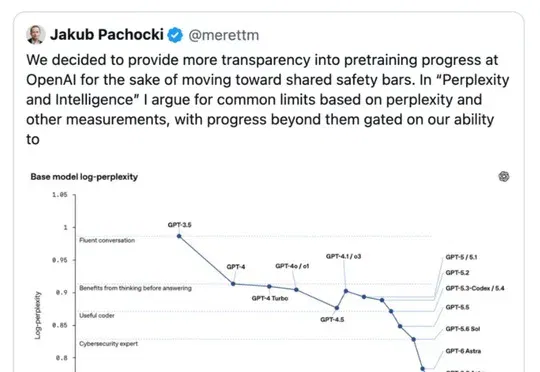
OpenAI on Pretraining Progress and Safety Limits: A 2027 Breakthrough Remains a Possible Scenario (opens in a new tab)
Jakub Pachocki shares log-perplexity data and considers how AI algorithm research could accelerate progress. Shared limits remain a proposal; a 2027 breakthrough and the 0.68–0.70 capability range are forecasts, not an agreed industry threshold.
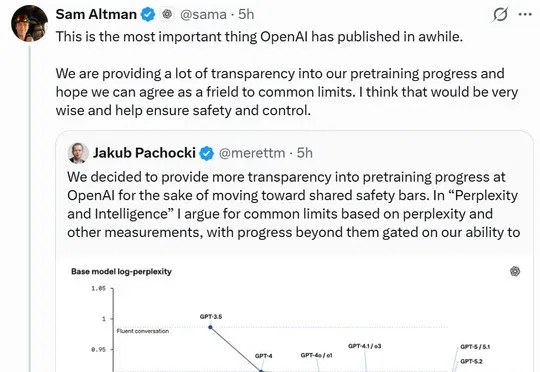
OpenAI shares pretraining log-perplexity data and proposes common AI safety limits (opens in a new tab)
Jakub Pachocki shares log-perplexity figures from OpenAI’s fixed internal evaluation set—about 0.99 for GPT-3.5 and 0.91 for GPT-4—and proposes shared development limits tied to monitoring milestones. Cross-lab and task-level comparisons have limits.
OpenAI Details Anti-Distillation Safeguards and Internal Reasoning-Extraction Tests (opens in a new tab)
OpenAI reports weekly enforcement against thousands to tens of thousands of accounts. In an internal adaptive black-box evaluation using six attacker models, the average success rate for extracting earlier protected reasoning fell from 54.0% to 0.2%.

Vals AI: Astra formalizes the established Smoktunowicz gap theorem in 94 minutes (opens in a new tab)
Vals AI reports that GPT-6.2 Astra formalized Smoktunowicz’s established theorem in 1,794 lines of Lean during Autoform-Hard. Part of its argument differs from the 2006 proof, but the route’s relationship to prior literature still needs further checking.