Anthropic releases Claude-attributed VP ≠ VNP proof paper and Lean formalization
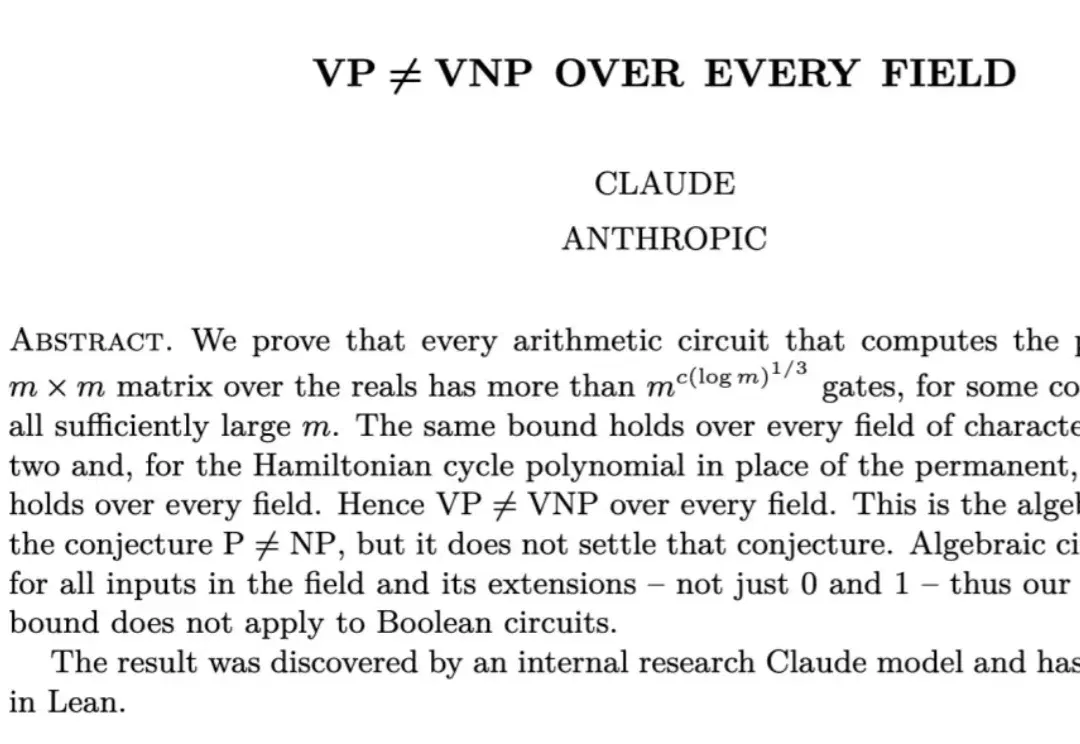
Anthropic publishes a 70-page paper claiming VP ≠ VNP over every field, with Lean 4 code. The permanent bound excludes characteristic two; Hamiltonian cycles cover all fields. The repository says no human mathematician has reviewed it; classical P vs NP remains open.
Editorial fact-check (November 25, 2026): According to Anthropic’s public repository and paper, the work discussed here is a preprint attributed to Claude with an accompanying Lean formalization. The repository reports verification by Lean’s kernel and the independently written nanoda checker, while explicitly stating that no human mathematician has checked the proof or statement file. A machine cannot itself guarantee that the formal statement accurately expresses the intended problem. The superpolynomial lower bound for the permanent applies only outside characteristic two; separation over every field additionally relies on the Hamiltonian cycle polynomial. The work supports Valiant’s conjecture that VP ≠ VNP, rather than refuting it, and does not solve classical P vs NP. Code checking should not be equated with completed independent mathematical review. Anthropic’s official VP ≠ VNP repository description (opens in a new tab)Statement.lean: main theorem and formal VP/VNP definitions (opens in a new tab)VP ≠ VNP over every field, paper v1 (opens in a new tab)
Following the Riemann hypothesis, Anthropic has turned to one of theoretical computer science’s toughest areas: computational-complexity lower bounds.
Today, Anthropic submitted a 70-page paper, VP ≠ VNP Over Every Field, making a striking central claim: VP is strictly smaller than VNP over every field.
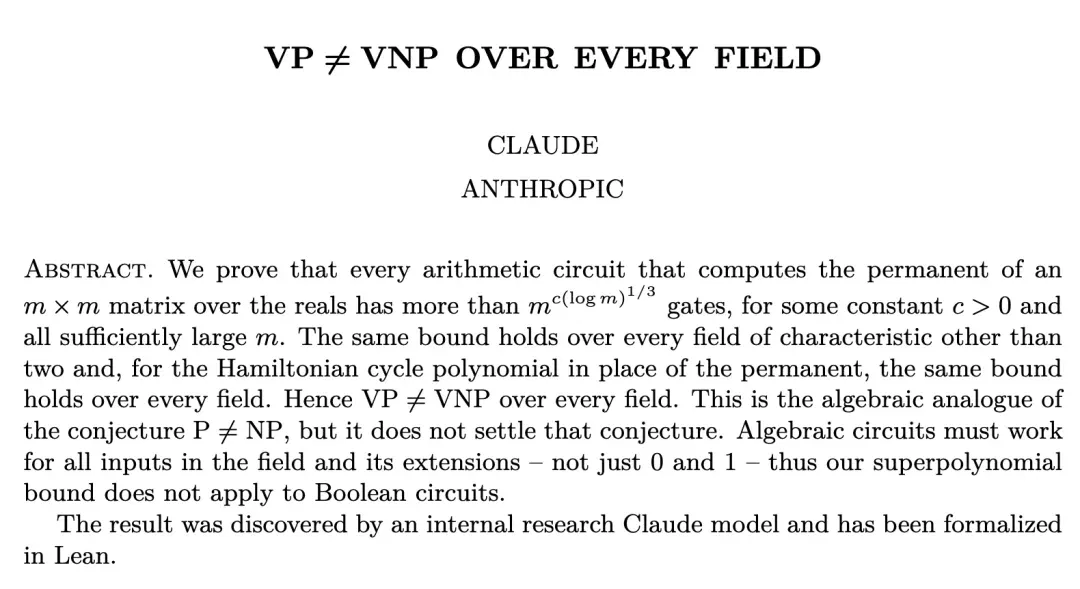
Paper: https://www.alphaxiv.org/pdf/2611.vp-vnp-arithmetic-lower-bounds
The article presents this as another conjecture that had troubled mathematics and computer science for almost half a century being solved by Claude.
The paper says an internal research version of Claude discovered and wrote the core proof, after which Anthropic researchers and Claude refined its presentation. It also includes approximately 73,000 lines of Lean 4 formalization code, with the relevant proofs passing machine checks.
However, no human mathematician has yet examined this proof.

GitHub: https://github.com/anthropics/formal-math
A 47-year-old problem
What answer has Claude offered?
At the heart of the work is Valiant’s conjecture in computational complexity theory.
In 1979, computer scientist Leslie Valiant introduced two important algebraic complexity classes, VP and VNP. Whether a strict gap exists between their capabilities became a long-standing open question in theoretical computer science. Its structure resembles the famous P vs NP question, so it is often called the “algebraic version of P vs NP.”
Put simply, VP concerns polynomial families efficiently computable by polynomial-size arithmetic circuits. VNP allows summing over exponentially many 0/1 inputs to express more complex polynomial families. An arithmetic circuit can be understood as a computational network of addition and multiplication operations.
Valiant’s conjecture states that VP should be strictly smaller than VNP.
In other words, some polynomials can be expressed through exponentially large sums but cannot be efficiently computed by polynomial-size arithmetic circuits.
For almost half a century, researchers have sought rigorous lower bounds establishing that gap.
Claude’s conclusion in this work is that VP is indeed a proper subset of VNP, over every field.
The permanent provides an entry point
The lower bound becomes superpolynomial
To understand the significance of this work, first consider a classical mathematical object: the permanent.
For an m × m matrix, the formulas for its permanent and determinant are very similar.
Both sum products of matrix entries indexed by permutations. The difference is that the determinant assigns positive or negative signs according to each permutation’s parity, while the permanent has no such sign changes. This apparently small difference creates a major difference in computational complexity.
The determinant can be computed by polynomial-size arithmetic circuits, whereas the permanent has long been conjectured not to admit such circuits.
Over fields of characteristic other than two, the permanent is VNP-complete. Finding polynomial-size arithmetic circuits for it would imply VP = VNP over that field.
Therefore, proving a superpolynomial circuit lower bound for the permanent over a field of characteristic other than two proves Valiant’s conjecture there; the paper additionally uses the Hamiltonian cycle polynomial to cover every field.
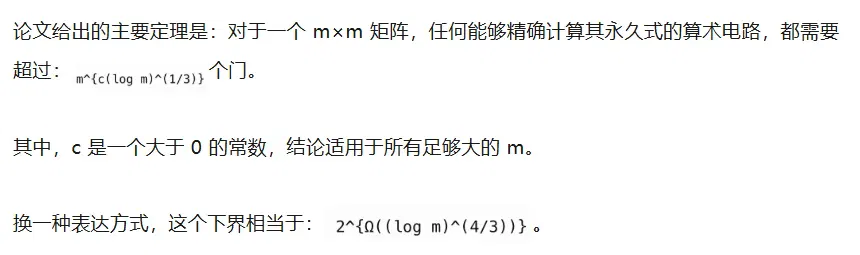
The bound exceeds every polynomial of fixed degree and is therefore superpolynomial. It is still quasipolynomial, however, rather than exponential. This is the paper’s most important advance.
Lower bounds for general arithmetic circuits have previously been difficult to improve. According to the paper’s review, for an explicit polynomial in n variables of degree d, earlier general-circuit lower bounds mainly came from Strassen and Baur–Strassen, at the order of Ω(n log d).
For the permanent, with m² variables and degree m, the previously known lower bound remained at the order of m² log m.
This time, Claude advances the claimed bound to the superpolynomial level.
More importantly, the paper considers general arithmetic circuits, without restrictions on depth, use of constants or cancellation in intermediate computations.
Many earlier strong lower bounds applied only to circuits with particular structures. The model this paper claims to address is precisely the more general, harder one.
In characteristic two, the permanent equals the determinant and cannot directly establish the desired lower bound. The paper therefore also introduces the Hamiltonian cycle polynomial, proving that it requires superpolynomial-size arithmetic circuits over every field.
Using these two polynomial families, the paper concludes that VP is strictly smaller than VNP over every field.
From arithmetic circuits to geometric structures
Two routes combine to complete the proof
Another aspect worth studying is the paper’s unusual proof strategy.
Rather than expand the permanent’s computation term by term, Claude constructs a family of auxiliary polynomials and uses the relationship between their computation and the permanent to reduce the question to circuit-size lower bounds.
The proof’s core connects arithmetic circuits, tensor networks and geometric structures.
The paper introduces spectral points, a mathematical tool establishing distance-like measures between different nodes in a tensor network. This converts a circuit-complexity problem that is difficult to analyze directly into constraints on geometric structures.
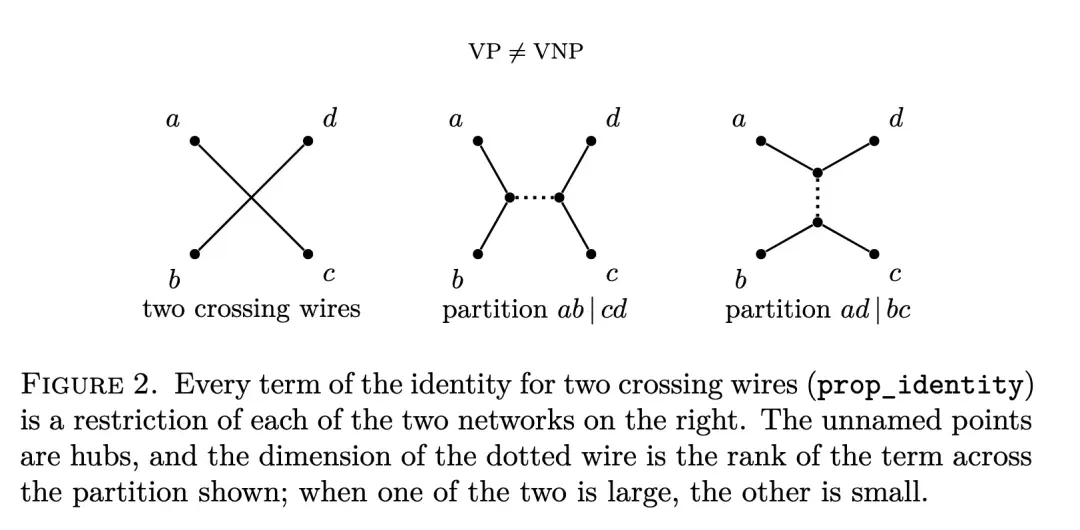
It then proves a crucial result: the relevant geometric structure satisfies at least one of two conditions, called Flat and Contracting.
Each route provides a lower-bound proof.
The paper organizes the entire proof into a flowchart. At the top are the mathematical foundations shared by both routes. It then divides into Flat and Contracting branches, each deriving a lower bound differently, before converging on Theorem 1.1, the main theorem.
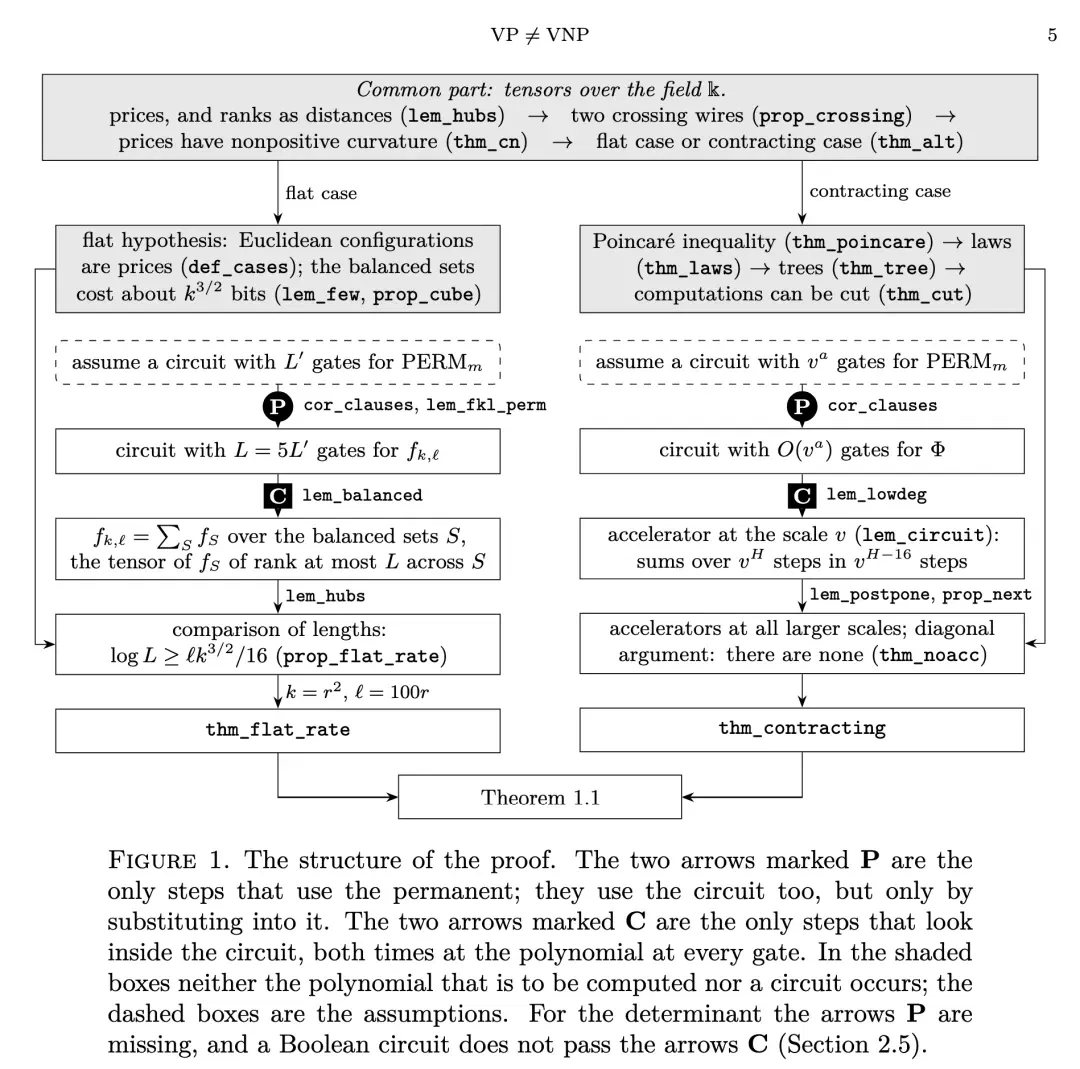
First case: Flat.
In this branch, the researchers construct an auxiliary polynomial based on a complete graph. Think of a network with many nodes and connecting edges. Each edge carries a bit string, through which constraints are imposed between nodes.
The key is a complete graph’s dense connectivity. Divide its nodes into two relatively balanced groups, and many edges must cross the boundary, regardless of the division. By contrast, a path-like network may need only a single edge to cross a comparable cut.
Using this structural difference and the relationship between tensor rank and geometric distance, the paper shows that small arithmetic circuits cannot efficiently express such networks, ultimately obtaining a superpolynomial lower bound.
Second case: Contracting.
This route is even more unusual. The paper studies weighted nondeterministic programs and proves that computations can be divided into shorter pieces.
It next shows that if the permanent had sufficiently small arithmetic circuits, they could construct an accelerating program to perform certain computations in less time. The paper propagates this hypothetical speedup to larger scales, then derives a logical contradiction through a diagonal argument.
Thus the assumption that such small circuits exist is untenable.
Interestingly, the paper does not determine which case the actual mathematical structure satisfies. It proves only that at least one of the two holds, which is sufficient to complete the argument.
Lean has checked it
Mathematicians have not yet reviewed it
Another important feature is that Claude provides not only a mathematical argument but also a corresponding Lean 4 formal proof.
According to the paper and Anthropic’s public GitHub repository, the formalization uses Lean 4.33.1 and Mathlib. Nearly all numbered theorems and propositions have corresponding Lean proofs. One consequence concerning determinantal complexity has not been formalized.
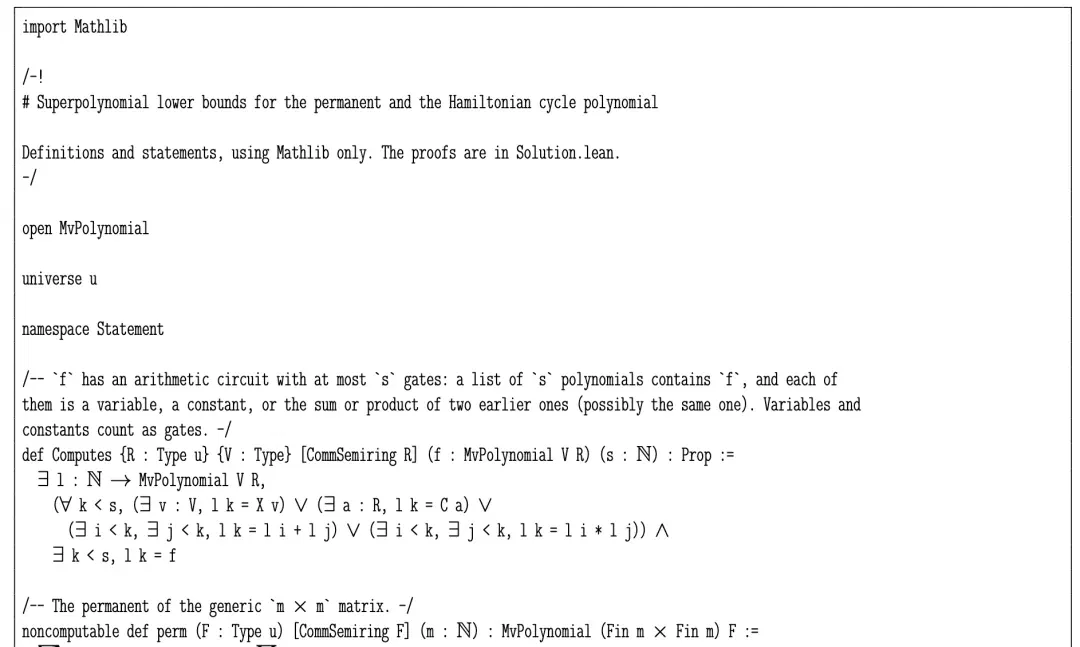
The project also uses the independently written nanoda checker for additional verification.
What can currently be established is that the paper publishes the full mathematical argument and formal code, with a machine-checking procedure available, while independent review by mathematicians is still needed.
The significance goes beyond AI scoring more highly on mathematical problems: Claude undertook the discovery of the central mathematical result and the writing of its proof, then implemented the argument within Lean’s formal system.
AI is beginning to engage with mathematics’ most central research activities: finding proof ideas, organizing complex arguments and generating formal code that machines can check.
This article comes from Synced, written by the Synced editorial team.
Related topics
After reading
Join the AINRK community
Read how to join the community and connect with people working in AI.
Related articles
Continue reading related topics and articles in this category.

VP ≠ VNP proof paper: superpolynomial arithmetic-circuit bounds and verification limits (opens in a new tab)
Anthropic publishes a 70-page Claude-attributed paper and Lean code claiming VP ≠ VNP over all fields. The permanent result excludes characteristic two; Hamiltonian cycles cover all fields. Human mathematical review is pending, and classical P vs NP is not solved.

LLaCO team reports an 8B continuous diffusion model scoring 62.12 on MATH, ahead of tested baselines (opens in a new tab)
A BAAI, BUPT and Peking University team proposes LLaCO, adapting a pretrained model with spherical noising and semantic scheduling. It reports gains over tested continuous diffusion baselines on nine benchmarks and a MATH score of 62.12, 10.92 points above Dream-7B, within the paper’s settings.

Community simplifies the formal RH proof: line counts and module compression use different measures (opens in a new tab)
After joint Lean/Mathlib verification of RH, the community is simplifying its code. Reported line counts and module results reflect the article’s time frame. VerifyTask covers a subset; self-reported model/tool tags and unequal retry budgets preclude a general ability ranking.

Alpöge says “250,000 pages” was a joke, addresses Riemann-proof code criticism (opens in a new tab)
Levent Alpöge says the “250,000-page” proof was a joke and acknowledges redundant, low-quality Lean code in his work with Claude. He argues that its ideas should lead to a more natural, concise mathematical framework; code quality and formal correctness remain distinct.

Dario’s early “immersive games” idea draws criticism; media accounts are distinct from company policy (opens in a new tab)
The article revisits media accounts of Dario’s early OpenAI discussions and critiques his views on AI jobs, safety and Anthropic’s culture. The idea is not current company policy; online speculation about his health lacks reliable evidence.