HFM Launches Autonomous Research Plan, Sharing Weather, Materials and Lung Cell Research Records
Xinzhiyuan reports on Human Frontier Mission's expert-led challenges and autonomous research agents, including weather, steel and lung cell studies. Resource usage and progress figures come from project records, not independent replication, peer review or deployment.
Editorial check (2026-11-25): The experiment counts, compute and token usage, and metrics for the three examples in this article come from HFM project records and historical snapshots cited in the report. The experiments were not independently reproduced in this review. Improved platform scores do not establish peer review, engineering deployment or clinical validation. Committee members' university and corporate backgrounds also do not mean those institutions jointly initiated or endorsed the project. In the steel example, the change in score and the error reduction relative to an ideal elastoplastic baseline are different measures and cannot substitute for each other. Official HFM website | (opens in a new tab)HFM public programme dossier (working draft of 2026-11-01) | (opens in a new tab)HFM Mission Records (opens in a new tab) | U.S. Department of Energy announcement launching Genesis Mission (opens in a new tab)
On this day last year, the United States launched Genesis Mission, bringing together the supercomputers, scientific data and experimental facilities of the Department of Energy's 17 national laboratories under a mission of AI-driven scientific discovery.
According to this report, on the first anniversary of Genesis Mission, Human Frontier Mission (HFM) was launched globally.
HFM is initiated and advanced by the HFM Committee, bringing together expertise from the frontiers of global research and the technology industry. Its members have backgrounds at universities or organizations including Imperial College London, the University of Hong Kong, Oxford, Cambridge, Stanford, ETH Zurich, Carnegie Mellon, Peking University, Google, Microsoft, Novix Lab and Apple.
They have come together around one mission: accelerating the conversion of model intelligence into scientific results for humanity.
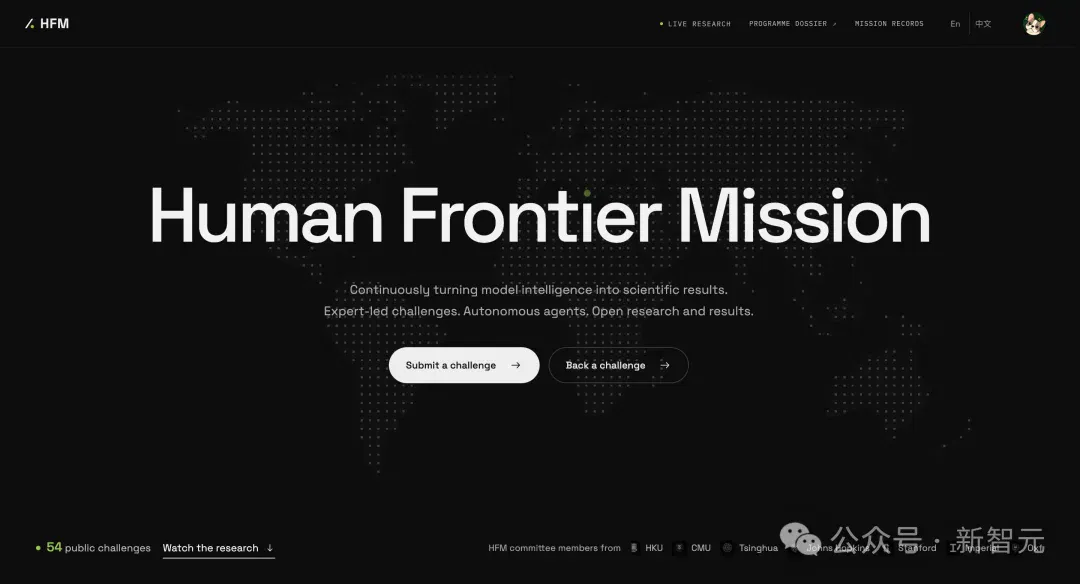
Human Frontier Mission puts that shared mission into practice. As a global programme for scientific breakthroughs aimed at humanity's shared future, HFM connects domain experts, autonomous research agents, industry capabilities and innovation resources to pursue major scientific and engineering challenges continuously. It seeks to give expert judgment experimental support and produce research that peers can examine and build upon.
From identifying cancer subtypes in pathology images to configuring complex communications networks and forecasting fluid behavior over long horizons, HFM has begun sustained research in multiple directions. Related results and experimental records have gradually been made public. The expedition is starting to show progress that can be seen and examined.
These public studies have also begun attracting attention overseas. Announcements of the programme have appeared in major overseas media, while social platform discussions are more specific: some analyze the weather forecasting results, some focus on cloud resource scheduling methods, and others propose new ways to validate optical extrapolation.
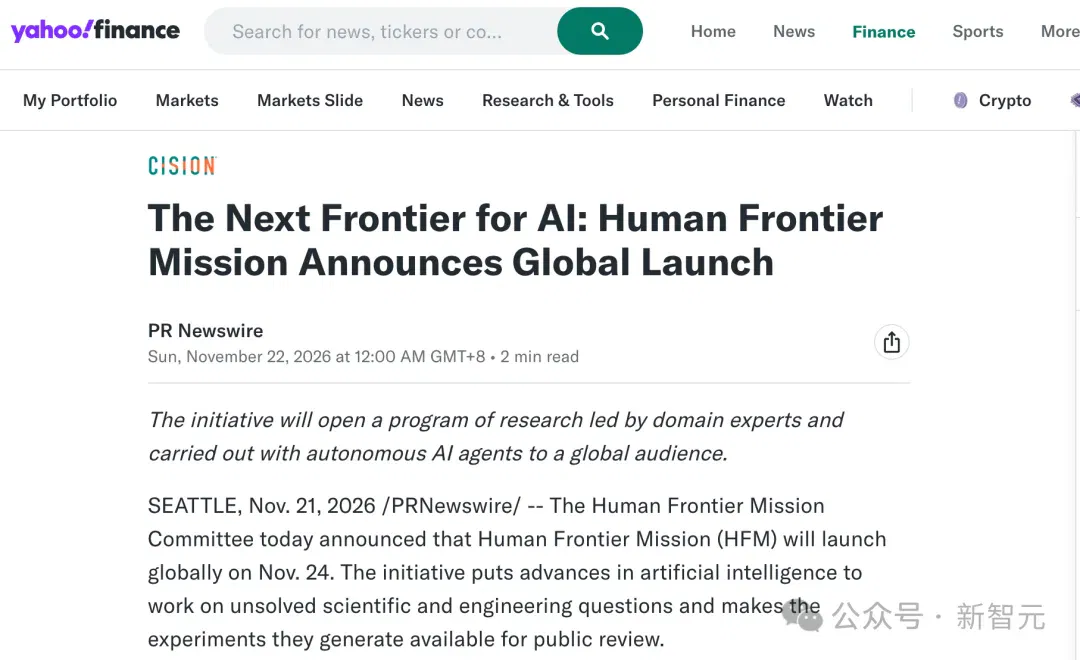
A publication page in a major overseas media outlet.
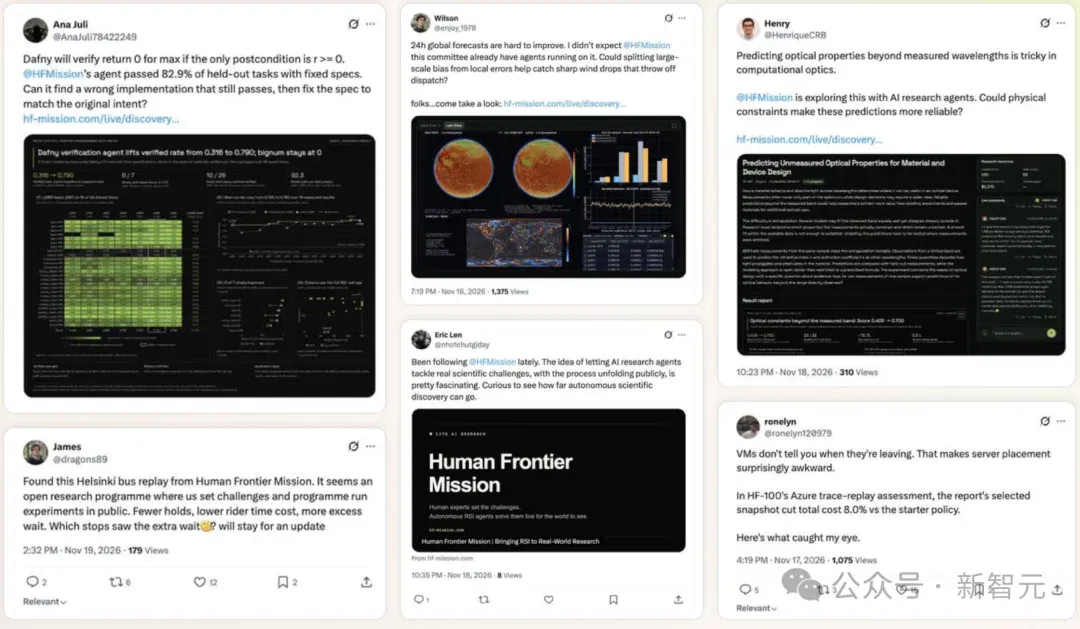
Screenshots of some public discussions on overseas social platforms.
01. Humanity's Challenges, Tackled Globally in Real Time
A Scientific Expedition Open to the Public
These responses across disciplines capture why HFM chose to make its research public: so an exploration can be understood and questioned by more people, while gaining additional expert perspectives.

HFM was initiated to make advanced intelligence a shared force for human discovery and to bring global research support to major challenges that concern the future. Knowledge and experience from different regions and disciplines can meet around a single problem and jointly seek promising new directions.
Human experts pose challenges, autonomous RSI agents tackle them in real time, and the research process is open to the public. Through the public record, people can see how an idea develops and what progress an experiment brings. Domain experts also have opportunities to join the discussion with new hypotheses, engineering constraints and practical experience. What HFM hopes to expand is the intelligence that major challenges can draw upon, and the room for exploration to keep deepening.
According to HFM platform records, its research landscape already spans 12 fields and 54 challenges. The platform snapshot of November 18, 2026 cited in the report recorded a cumulative 2,391 experiments and 1,342 research nodes, with recorded GPU usage reaching 5,476 GPU-hours, a total of 862,912 agent tool calls and 71.4 billion tokens processed. In the same snapshot, 23 studies were running.

This research landscape brings together challenge projects from expert teams across disciplines around the world.
A materials research team in Tokyo is exploring steel's stress and energy-absorption behavior under repeated earthquake loading, seeking a more reliable basis for seismic structural analysis;
Energy experts in Berlin are studying how to coordinate generation and storage amid wind-power fluctuations, hoping to integrate more clean electricity reliably into the grid;
A transport research team in Toronto is focusing on coordinating signals at consecutive intersections to reduce repeated stops, starts and waiting on roads;
Fluid physicists in Zurich are trying to forecast thermal convection over longer periods, deepening understanding of complex fluid motion and heat transfer;
An environmental monitoring team in Hangzhou is focusing on reliable calibration of low-cost air sensors, providing more trustworthy data for pollution measurement and health assessments.
02. Every Challenge
Is Open to New Exploration
From forecasting global weather and understanding how steel withstands earthquakes to identifying millions of lung cells, HFM is pushing autonomous research toward the frontiers of how humanity responds to nature, builds cities and understands life. The significance of this scientific expedition is emerging through these concrete challenges.
001. Weather Crosses Borders; Reliable Forecasts Should Too
Seeing the weather clearly 24 hours ahead buys a city time to prepare. How a power grid schedules generation and load, when a port adjusts operations, and how rescue teams deploy in advance all depend on reliable weather information. Progress in global forecasting ultimately enters the decision chains of energy, transport, agriculture and disaster prevention, shaping how different regions can prepare for changes in nature.
This capability must withstand a planet-wide test. Different latitudes, seasons and weather processes place different demands on a model. After learning patterns from historical data, it must keep predicting temperature, wind and pressure throughout a full year outside its training data. The distance between understanding past weather and reliably forecasting the next 24 hours is exactly what this challenge seeks to bridge.
HF-154 aims to make global weather forecasts for the next 24 hours more reliable. Building on the existing ArchesWeather model, it uses historical meteorological data to continually improve forecasting and error-correction methods. According to platform records as of November 19, after 34 hours and 26 minutes of exploration, the agent's best global aggregate forecast error fell from 0.098226 to 0.097805, about 0.4% below the starting point.
002. For Cities to Withstand Earthquakes, Engineering Judgments Must Withstand Testing
A city's seismic analysis must answer a question at the material level: under each cycle of repeated loading, how much stress can steel still bear, and how much energy can it absorb? Those judgments feed into structural calculations for buildings and infrastructure. A firmer understanding of material responses provides a more reliable basis for comparing designs and analyzing structural behavior.
The material data available to engineers often come from "one pull in one direction," whereas steel structures in earthquakes undergo repeated reversals of loading. Earlier deformation changes the next response, and the loading sequence leaves its mark too. Moving from a single tensile test to a complete process of repeated loading is the gulf that a steel model must cross.
HF-127 tests models on previously unseen loading histories, evaluating both stress prediction and energy-absorption behavior. The agent continuously explores material plasticity responses and calibration under different loading conditions, then compares approaches against measured data, subjecting material hypotheses to successive rounds of experimental testing. According to the platform's research records, after seven days and two hours of exploration, the agent had launched 84 experiments and set new best results 23 times, raising the prediction score from 0.580 in the first round to 0.665. The platform reports that, compared with the initial ideal elastoplastic model, the best approach reduced the combined prediction error by about 66.5% on average. This baseline comparison differs from the previously described change between the first-round and best scores.
003. Protecting Every Breath Starts with Knowing the Cells in the Lungs
Placing millions of cells on one atlas is a foundational undertaking in humanity's understanding of lung disease. To know which cells sustain normal breathing, which change in disease, and what clues subsequent research should follow, we first have to identify them. Cell atlases spanning laboratories allow observations accumulated by different teams to connect and jointly map the changes between health and disease.
A key hurdle stands in the way: the same cell type may receive different classifications simply because the sequencing protocol, instrument or donor differs. Can a high score in one dataset hold up in another study? Reliably identifying the same cell type across laboratories determines how far this atlas of life can extend.
HF-150 studies the human lung cell atlas, encompassing about 2.3 million cells and 35 studies. The agent explores more reliable methods for annotating cell types across studies. According to the platform's research records, after 44 hours and 12 minutes of exploration, it had set new best results five times, improving the score from 0.7812 to 0.8531.
Give every independent observation a chance to become part of humanity's shared understanding of life.
03. From Each Exploration
Toward a Scientific Expedition for More People
Leafing through the research topics and challenge statements on HFM's website often brings a quiet sense of awe: as though standing at night in a wilderness stretching in every direction, beneath a sky of stars accumulated over thousands of years of human civilization, with each individual's creation and discovery breaking through the ground underfoot.
We tend to assume that the frontiers of science belong only to a chosen few: Newton's apple, Einstein's pen and paper, or a starship bound for Mars.
HFM is rewriting that answer, letting countless passionate people shoulder their packs of exploration with the help of AI.
Humanity's questions about the outside world and the future have continued unbroken from ancient gazing at the stars to today, across mountains and seas. In a scientific epic measured in millennia, HFM may be only a brand-new footnote, a node still growing.
Yet we can already sense this moment's powerful promise: when exploration is no longer the privilege of a few, when every spark of curiosity gains a foothold for reaching the frontier, that scientific expedition stretching over thousands of years is, in this moment, born anew.
References:
HFM website: hf-mission.com
Email: hi@hf-mission.com
This article is from Xinzhiyuan, by Solomon.
Related topics
After reading
Join the AINRK community
Read how to join the community and connect with people working in AI.
Related articles
Continue reading related topics and articles in this category.

Qianyi Zhigan Raises Over 10 Million Yuan in Seed Funding for North American Pet Health Collars (opens in a new tab)
Z Potentials reports seed funding led by Shuimu Venture Capital with GHIC participation. Qianyi Zhigan is preparing a pet collar for North America using hardware sales and subscriptions. Reported errors and user alerts are team tests and anecdotes, not canine clinical validation.
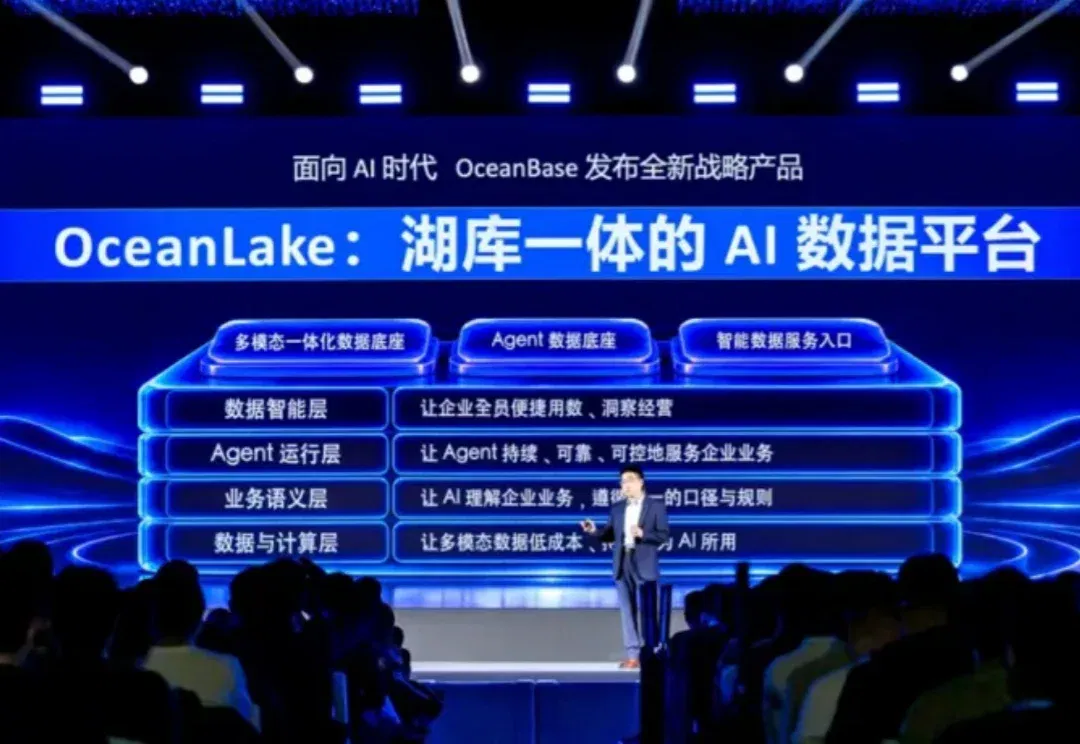
OceanBase Launches OceanLake, Open-Sources OceanSeek and Reports AI Revenue over RMB 100 Million (opens in a new tab)
At its November 24 conference, OceanBase unveiled OceanLake, announced open-sourcing OceanSeek and said 2026 AI revenue had topped RMB 100 million. The platform combines transactions, analytics and multimodal data; performance, customer gains and rankings reflect company tests and cases.

Simmir Proposes Edge SuperPOD, Claiming 270% Higher Effective Throughput on the Same Hardware and Models (opens in a new tab)
Edge SuperPOD coordinates dispersed edge devices through sensor fusion, elastic scheduling and heterogeneous interconnects. Simmir reports a 270% effective-task-throughput gain on the same hardware and models; missing workload, baseline and reproduction details limit broader conclusions.
Jensen Huang Returns to NVIDIA as Independent Investigation Continues (opens in a new tab)
NVIDIA restored Jensen Huang as president, CEO and director on November 23 while keeping its independent investigation open. Zhidongxi reviews the market and industry response; accounts of the board's rapid decision are attributed to Bloomberg's sources.
Community simplifies the formal RH proof: line counts and module compression use different measures (opens in a new tab)
After joint Lean/Mathlib verification of RH, the community is simplifying its code. Reported line counts and module results reflect the article’s time frame. VerifyTask covers a subset; self-reported model/tool tags and unequal retry budgets preclude a general ability ranking.