Simmir Proposes Edge SuperPOD, Claiming 270% Higher Effective Throughput on the Same Hardware and Models
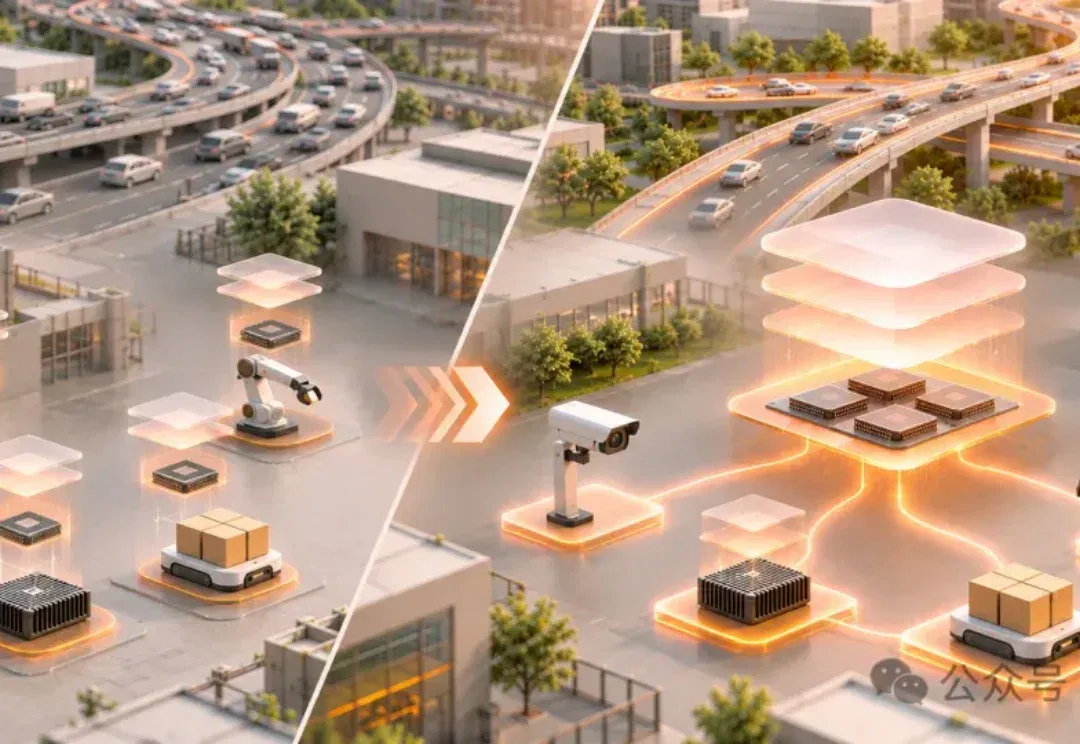
Edge SuperPOD coordinates dispersed edge devices through sensor fusion, elastic scheduling and heterogeneous interconnects. Simmir reports a 270% effective-task-throughput gain on the same hardware and models; missing workload, baseline and reproduction details limit broader conclusions.
Editor's fact check (2026-11-25): The 270% figure follows Simmir's company test as cited in the report, measuring effective task throughput under particular settings. The report states only that the hardware and models are the same; it does not provide complete equipment, workload, baseline, latency and accuracy constraints, or reproduction methods. The result cannot be generalized to all edge tasks or treated as an independent evaluation. Sufficient evidence of comparable scope and timing was not obtained for the "industry-first" claim, so the body now introduces the proposal itself; adaptation counts also do not mean every hardware/software combination has been validated. Simmir's official site: edge AI infrastructure and product positioning (not independent evidence for the 270% test) (opens in a new tab)
With the same chips and the same models, how much can AI's effective task throughput improve simply by changing how the system organizes computational tasks?
A Chinese technology company with longstanding experience in edge AI infrastructure measured an increase in effective throughput of 270%.
The reasoning behind this can begin with a city's transportation system.
A car's engine determines that vehicle's performance, while the road network and traffic scheduling determine the whole city's traffic capacity. Even without changing vehicle performance, optimizing routes and traffic scheduling can improve the efficiency of the entire transportation system under existing conditions.
The same principle applies to edge AI.
As AI enters the physical world, smart cameras, robots, sensors and edge-computing boxes are multiplying, with computing resources deployed across factories, campuses and other settings.
They contain chips with different architectures and run their own models, but often complete computational tasks independently, making cross-device coordination difficult.

△Image generated by AI
Powerful chips alone are therefore not enough. Getting these devices to work together is a complex discipline in its own right.
Building on years of hardware/software expertise and engineering practice in edge AI, Simmir proposes an edge supernode (Edge SuperPOD), building a coordinated "road network" for dispersed AI devices
Simmir tells QbitAI:
Changing how computational tasks are organized is becoming a new route to unlocking the potential of edge computing resources.
Dispersed Edge AI Compute and Three Obstacles That Must Be Faced
Over the past few years, competition in cloud AI compute has gradually expanded from individual-chip performance to system-level coordination.
As model sizes and compute needs grow, more GPUs are organized into supernodes, using high-speed interconnects and parallel computing to jointly handle large-scale training and inference.
Similar computing needs are now emerging in the physical world, but conditions at the edge are much more complex.
Smart cameras, robots, sensors and edge-computing boxes are distributed across real-world settings, running different models with widely varying chip architectures and performance.
For them to coordinate genuinely, three obstacles must first be overcome.
The first is dispersed compute and uneven resource utilization.
Devices run models separately without unified task orchestration, easily leaving some GPUs idle while some NPUs are fully loaded. Different models may also repeat the same preprocessing, with raw data moving back and forth between devices and substantial resources consumed by redundant computation and data exchange.
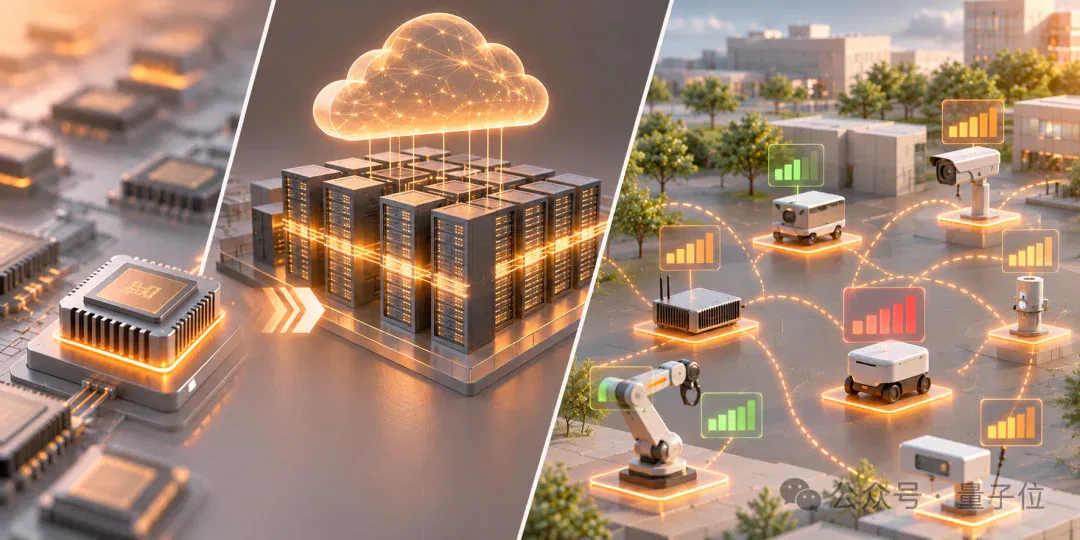
△Image generated by AI
The second is fragmented perceptual information.
Cameras capture an object's appearance, 3D sensors provide spatial geometry, and audio and device-status signals record what is happening on site. Each sensing unit captures only part of a scene, without an effective mechanism for integrating information among them.
Fusing signals from multiple sources into a complete understanding of a scene requires breaking down the isolation between devices and models.
The third is complex task deployment.
A complete physical-AI task often combines multiple sensors, models and computing devices, while chip architectures and development ecosystems differ markedly. Algorithm adaptation, data integration and system integration alone require substantial engineering resources.
These three difficulties are intertwined. The larger the device deployment and the more complex the task logic, the more important system-level organization and scheduling become.
Simmir recognized this area of computing capacity that had yet to be fully unlocked.
Different devices have different strengths. If they can divide work and cooperate on one AI task, fragmented sensing capabilities and computing resources have an opportunity to form a unified whole.
Edge SuperPOD Organizes Dispersed Compute into a Team
The idea of an edge supernode emerged from this.
As a further evolution of Simmir's edge AI infrastructure toward system-level collaborative computing, the proposal moves beyond a single device's computing limits, coordinating heterogeneous devices scattered through physical settings to jointly undertake AI tasks as one unified system.

As is well known, cloud AI has moved beyond simply competing on chip performance. With growing compute demand, organizing many GPUs to complete tasks together has gradually become a new focus of competition.
Simmir wants to bring this system-level computing approach to the edge.
The physical world, however, is far more complex than a data center.
Cloud supernodes rely on relatively concentrated computing resources and high-speed interconnects, focusing on aggregating and scheduling large-scale compute.
Edge supernodes face devices in different locations with different chip architectures, and must simultaneously handle perceptual-information fusion, heterogeneous-compute scheduling and cross-device communication.
To make such a team truly cooperate, Simmir has developed technology around three areas.
First, perception fusion.
In conventional approaches, cameras see images, 3D sensors capture space and audio devices record sound. Devices collect data and run models separately, then pass their results to a higher-level system for integration.
Through cross-modal feature encoding, spatiotemporal association and unified scene representations, Simmir attempts to bring visual, 3D and audio information from different sensing nodes into the same task context.
Previously separate sensing results can thus contribute to a more complete scene understanding.
The system can also exchange structured events, features or compact multimodal tokens between nodes according to task needs, reducing repeated transmission of raw data such as complete videos and point clouds.
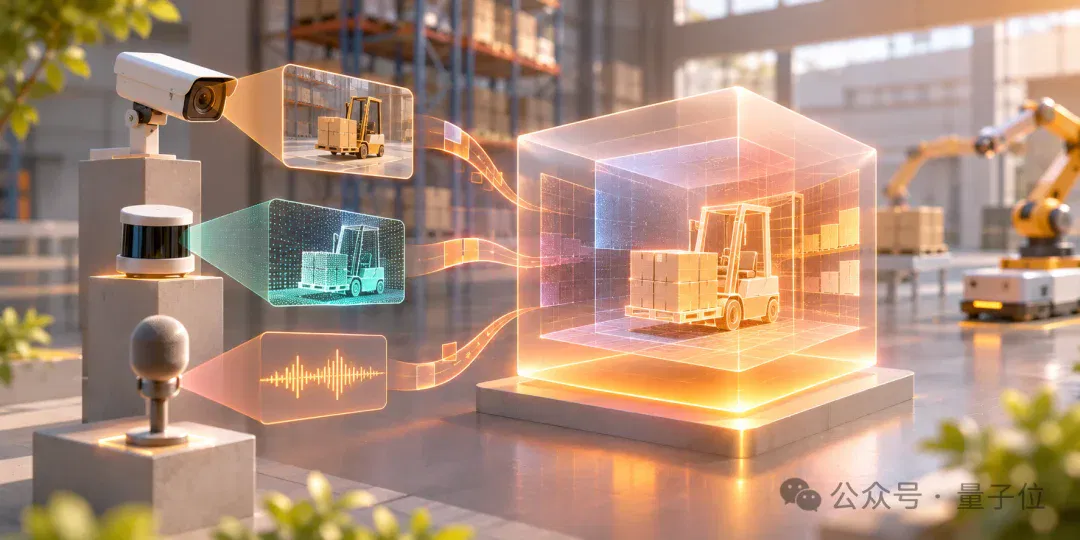
△Image generated by AI
Second, elastic scheduling.
A complex physical-AI task often contains many computational stages. Which require millisecond responses, which need stronger reasoning, and which can run on low-power devices must all be arranged according to the task.
Simmir breaks complex tasks into computation graphs with dependencies, then considers device resources, live workloads, data locations and communication costs together to dynamically decide who executes each stage.
For example, low-power NPUs can handle high-frequency perception and real-time judgments, CPUs communication and business logic, and GPUs complex multimodal understanding. Higher-compute nodes can participate as needed in task planning, large-model inference and learning optimization.
Different chips can thus perform their respective roles, rather than forcing all tasks onto a few high-performance devices.
Third, heterogeneous interconnection.
Once devices have divided the work, communication mechanisms are still needed to support cooperation.
From on-chip connections and board-level buses to Ethernet between devices, communication links vary greatly in bandwidth and latency. Simply connecting devices to the same network does not mean they can perform distributed AI computation smoothly.
Simmir is therefore building a unified mechanism for cross-node task communication and data exchange, using task dependencies, data locations and network conditions to decide what computation stays local, what results must be sent to other nodes, and when to invoke higher-performance computing resources.
Perception fusion, elastic scheduling and heterogeneous interconnection together form Edge SuperPOD's collaborative-computing system.
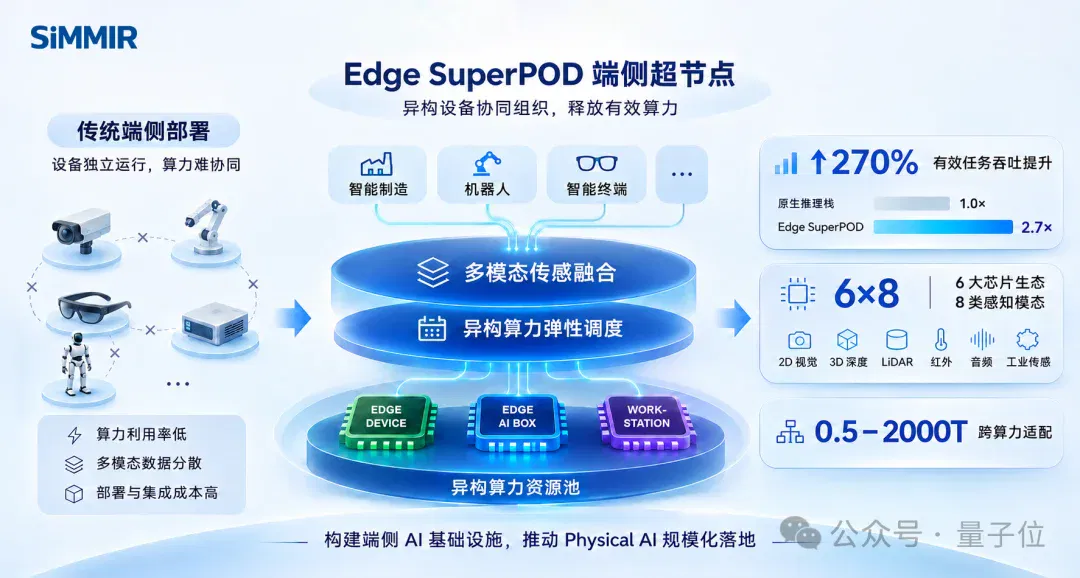
The effect ultimately appears as a change in effective task throughput.
With the same hardware and models, Simmir increased effective task throughput by 270% through system optimization—meaning there is room to unlock edge AI performance beyond chips and models themselves.
By reorganizing perceptual information and computational tasks and coordinating devices, existing hardware resources can handle more useful tasks too.
After Compute Teams Up, Edge AI Still Faces Engineering Challenges
Although compute coordination addresses how devices complete tasks together, large-scale physical-AI deployment still faces challenges such as high model-adaptation costs and retraining and debugging when scenarios change.
Physical environments and task requirements keep changing. Specialized models often require new data collection, annotation, training and adaptation for new devices and scenarios.
For physical AI entering many real-world settings, such repeated engineering effort gradually becomes a cost burden on deployment at scale.
Reducing this effort takes more than a collaborative-computing architecture. Hardware adaptation, model execution, device management and related capabilities also need to become part of a reusable product system.
To this end, Simmir has built a product system around hardware and software.
On the hardware side, the company combines different levels of AI compute with vision, 3D, infrared, audio and other sensing capabilities in modular form, creating a product range from real-time sensing-and-computing terminals and multimodal collaborative terminals to high-compute workstations.
Different settings can choose appropriate compute and sensing modules according to task needs.
On the software side, the edge AI operating system EdgeFlowOS connects different chips and devices, providing model execution, task orchestration, cross-node cooperation and unified management. Standardized software interfaces and deployment tools reduce system-adaptation and integration costs across settings.

Through long-term technical development and industry practice, Simmir has accumulated adaptations covering over 200 chip platforms and over 100 general-purpose and specialized models.
Drawing on an R&D team spanning large-model pretraining, chip-architecture design and autonomous driving, the company has built full-stack capabilities across models, compute, software and devices.
This cross-platform, cross-model technical and engineering expertise also lays the foundation for building Edge SuperPOD and deploying it at scale.
Ultimately, bringing physical AI to scale still requires reckoning with engineering costs.
Chips, models and sensors keep improving, but if each new scenario requires hardware adaptation, model deployment and system integration all over again, technical progress will struggle to translate into deployment at scale.
As heterogeneous-device cooperation and hardware/software adaptation systems mature, more capabilities can be accumulated and reused in new scenarios.
This is the longer-term value of edge supernodes.
Individual capabilities ultimately have limits. As more devices gain sensing and computing abilities, the physical world is quietly becoming a vast intelligent network.
When perception from different devices blends and computing resources are scheduled collaboratively, previously dispersed intelligence can coalesce into greater overall capabilities.
This article comes from "QbitAI," written by "Heng Yu."
Related topics
After reading
Join the AINRK community
Read how to join the community and connect with people working in AI.
Related articles
Continue reading related topics and articles in this category.

Qianyi Zhigan Raises Over 10 Million Yuan in Seed Funding for North American Pet Health Collars (opens in a new tab)
Z Potentials reports seed funding led by Shuimu Venture Capital with GHIC participation. Qianyi Zhigan is preparing a pet collar for North America using hardware sales and subscriptions. Reported errors and user alerts are team tests and anecdotes, not canine clinical validation.

OceanBase Launches OceanLake, Open-Sources OceanSeek and Reports AI Revenue over RMB 100 Million (opens in a new tab)
At its November 24 conference, OceanBase unveiled OceanLake, announced open-sourcing OceanSeek and said 2026 AI revenue had topped RMB 100 million. The platform combines transactions, analytics and multimodal data; performance, customer gains and rankings reflect company tests and cases.
Jensen Huang Returns to NVIDIA as Independent Investigation Continues (opens in a new tab)
NVIDIA restored Jensen Huang as president, CEO and director on November 23 while keeping its independent investigation open. Zhidongxi reviews the market and industry response; accounts of the board's rapid decision are attributed to Bloomberg's sources.
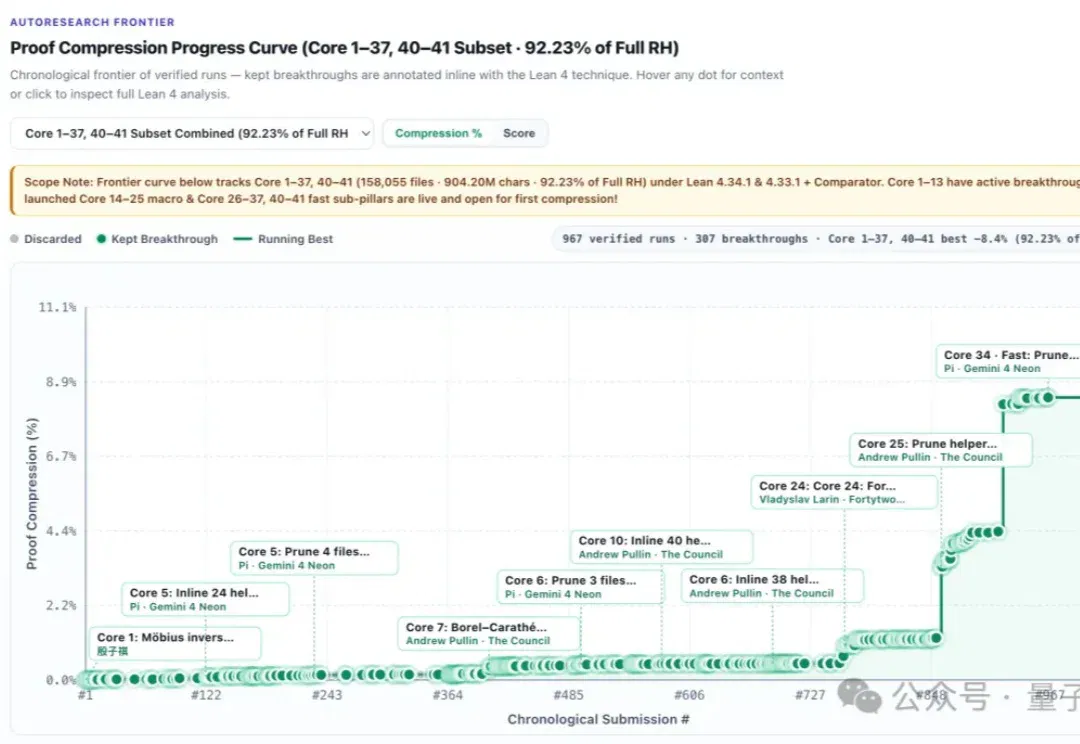
Community simplifies the formal RH proof: line counts and module compression use different measures (opens in a new tab)
After joint Lean/Mathlib verification of RH, the community is simplifying its code. Reported line counts and module results reflect the article’s time frame. VerifyTask covers a subset; self-reported model/tool tags and unequal retry budgets preclude a general ability ranking.
I Use AI in My Love Life (opens in a new tab)
Y, the narrator of this personal essay, compares some people to trees that flourish naturally and others to trees that need supports. The latter need psychology, philosophy and other knowledge to help them correct course and live their lives.