OceanBase Launches OceanLake, Open-Sources OceanSeek and Reports AI Revenue over RMB 100 Million
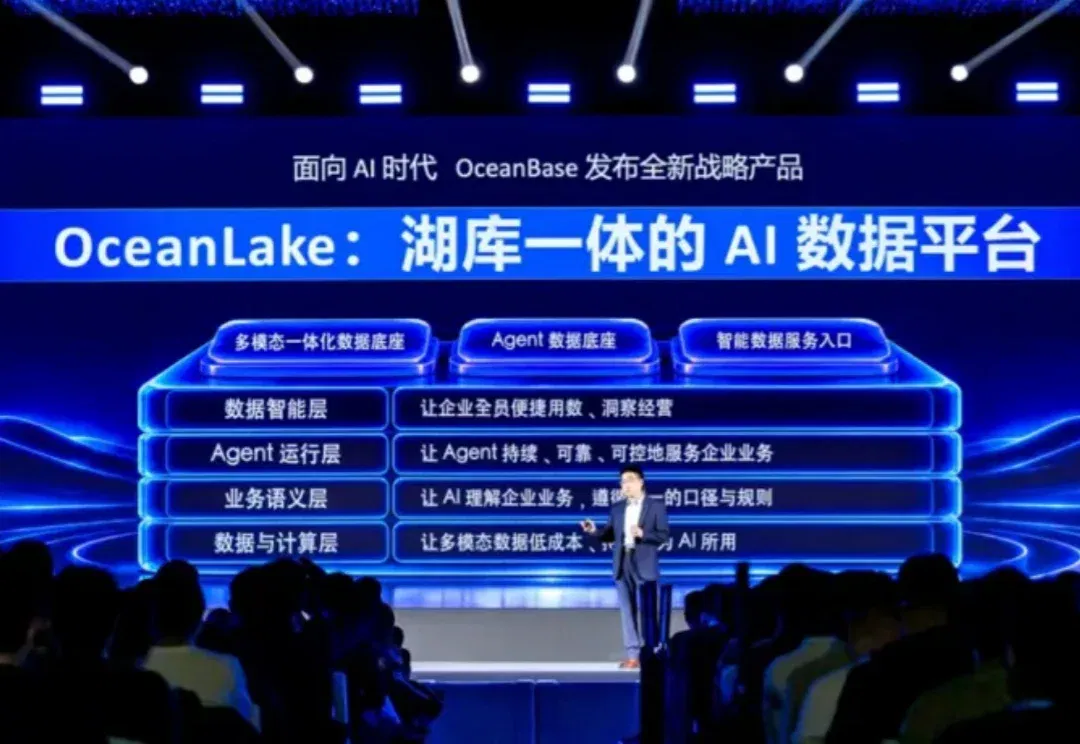
At its November 24 conference, OceanBase unveiled OceanLake, announced open-sourcing OceanSeek and said 2026 AI revenue had topped RMB 100 million. The platform combines transactions, analytics and multimodal data; performance, customer gains and rankings reflect company tests and cases.
Editor's fact check (2026-11-25): The revenue, growth, coverage, market-share and performance data in this article mainly come from OceanBase's conference disclosures. References to 2026 revenue describe progress as of this disclosure and should not directly be treated as audited full-year results. The 17.3-fold throughput, 1.345-second branch creation and customer cost/efficiency figures each correspond to the listed tests or cases, not a uniform guarantee for arbitrary workloads. "Industry-first" claims and comparisons of ontology-building approaches are company or speaker judgments; the report provides no independent, like-for-like verification covering all comparable offerings. Cloud-version and feature availability should be understood according to each product's release stage. OceanBase's official site: the OceanLake integrated lakebase AI data platform; (opens in a new tab)OceanBase's company-issued press release for its November 24, 2026 conference; (opens in a new tab)Palantir's official Ontology product page: verification of the company spelling (opens in a new tab)
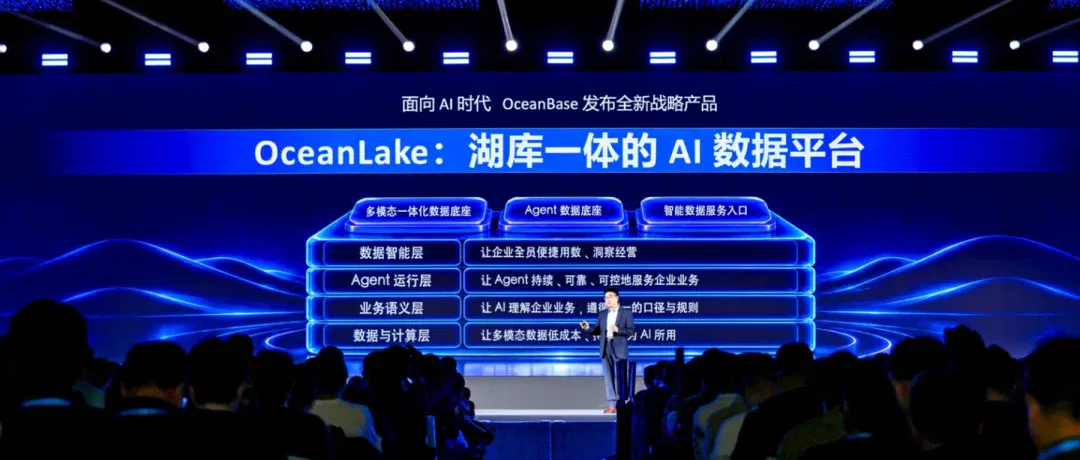
Building a foundation for agents: room to experiment, economical operation and multi-model hybrid search.
Zhidx reported on November 24 that, at the Ant OceanBase AI Data Conference, OceanBase had just officially unveiled its strategic AI product—OceanLake, an integrated lakebase AI data platform—and announced that it would globally open-source its core engine, the OceanSeek AI database.
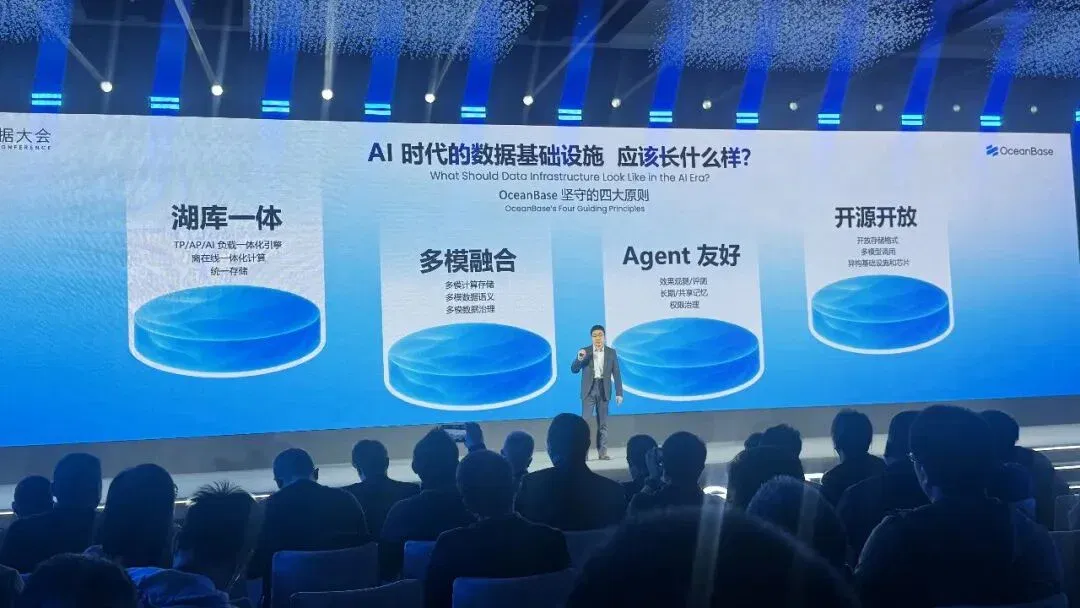
OceanBase CEO Evan Yang said data infrastructure in the AI era should follow four principles: "lakebase integration, multimodal fusion, agent-friendliness, and open source and openness."
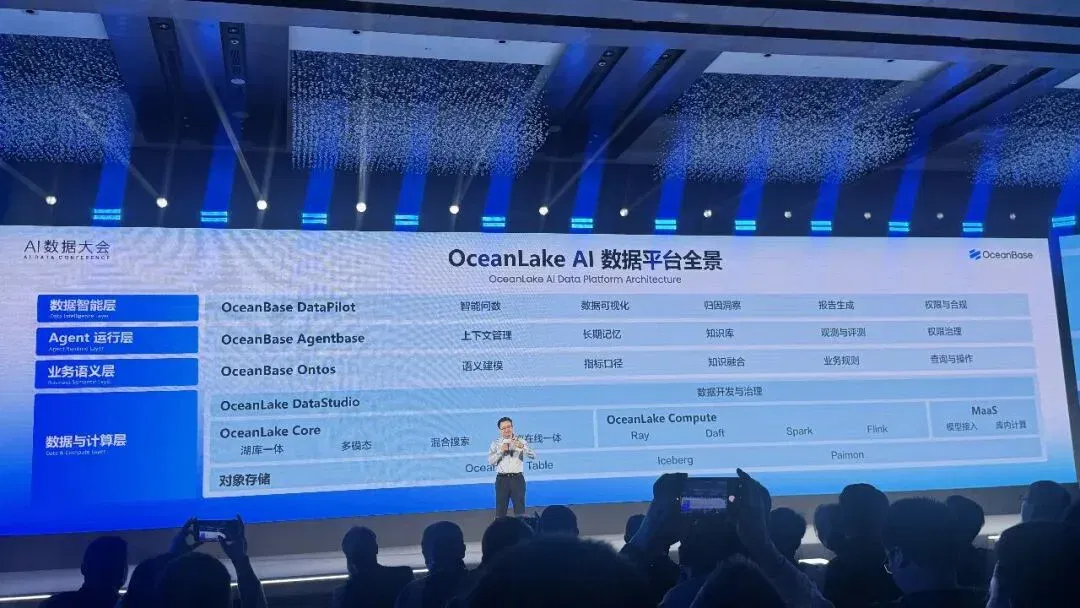
Based on this view, OceanLake uses an integrated lakebase architecture combining real-time database transactions, data-warehouse analytics and open data-lake storage to manage multimodal data in a unified way, supporting offline processing, online analytics and retrieval, and agent applications to integrate offline and online operations. An overview of the OceanLake platform is shown below, covering multiple architectural layers: data and compute, business semantics, agent runtime and data intelligence.
At the conference, OceanBase also announced that its OceanSeek AI database would be open-sourced. Evan Yang said this should be the industry's first open-source AI database supporting production-grade AI deployment on an integrated lakebase architecture with storage-compute separation.
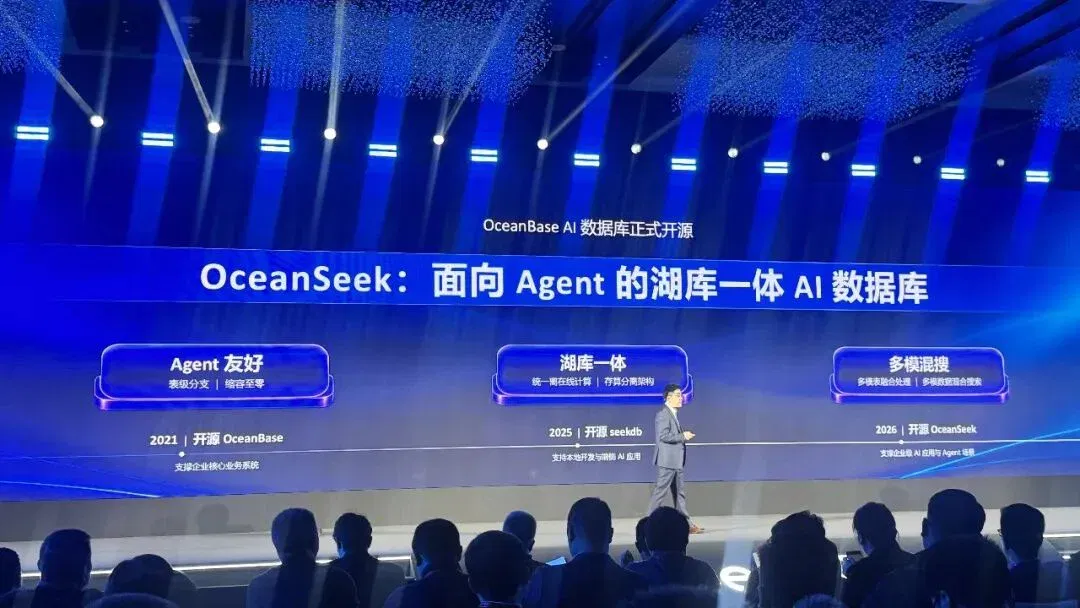
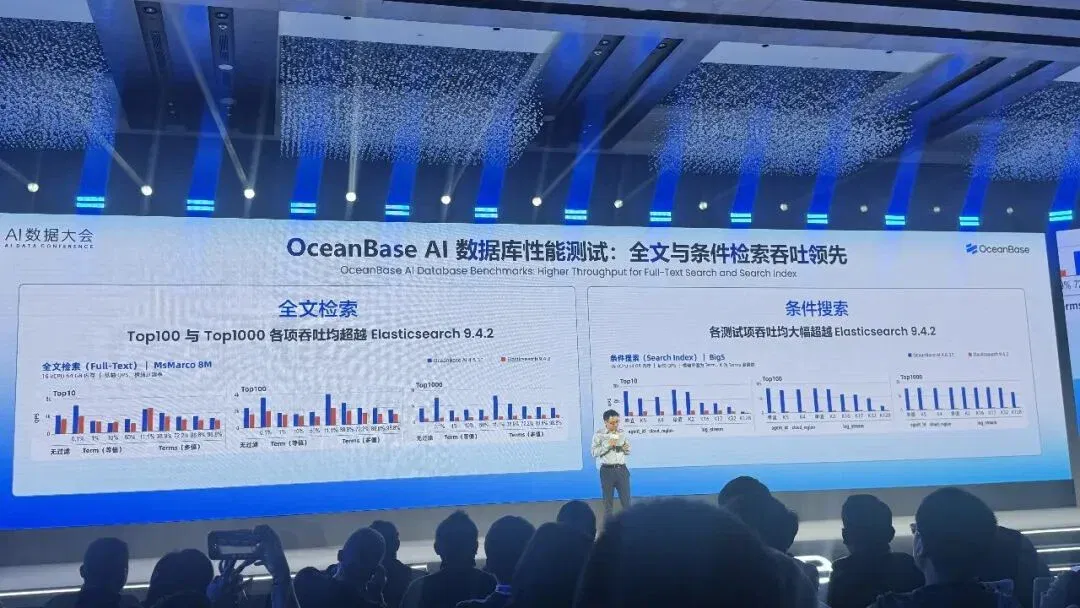
OceanBase CTO Chuanhui Yang said that, beyond achieving world-first TPC-DS and TPC-H results in its established OLTP and OLAP scenarios, OceanBase had also achieved hybrid-search performance at the industry's mainstream open-source state of the art (the industry's best level) for this third workload category.
In the evaluation, the OceanBase AI database's throughput across full-text search Top100 and Top1000 tests, and across all conditional-search test items, substantially exceeded that of Elasticsearch 9.4.2.
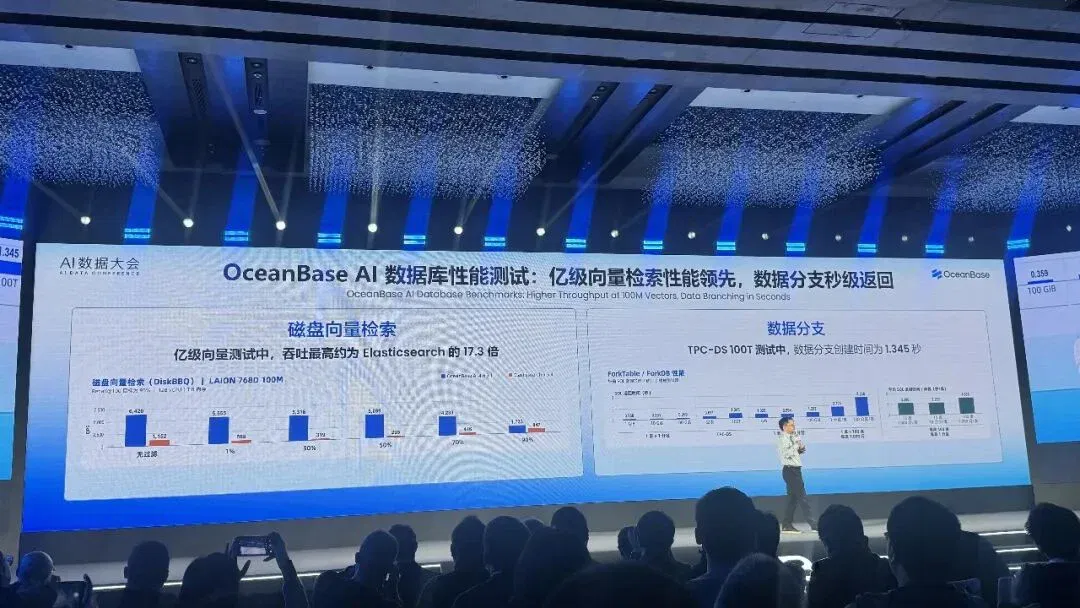
In hundred-million-scale vector tests, OceanBase AI database throughput reached approximately 17.3 times that of Elasticsearch at its peak. In the TPC-DS 100T test, data-branch creation took 1.345 seconds, enabling data branches to return in seconds.
OceanLake capabilities have been deployed across several industry scenarios. For example, they connect multimodal data processing with model training for Robbyant, LinkerBot and others, and help Ping An Life use AI to "understand" insurance, shortening typical data-retrieval delivery from two to five days to about 15 minutes.
01.
Facing Data's "Three Icebergs":
OceanLake's Four Characteristics Define an AI Data Foundation
In recent years, real AI demand has surged, and government and enterprise customers' actual needs for AI data infrastructure have gradually become clear.
In his speech, Evan Yang used Ant's internal applications as examples. Through deployments in four businesses—Ant Lingguang, Ant Afu, Merchant Xiaoyu and Robbyant—OceanBase identified three areas of demand: a unified multimodal data foundation, an agent data foundation and data intelligence.
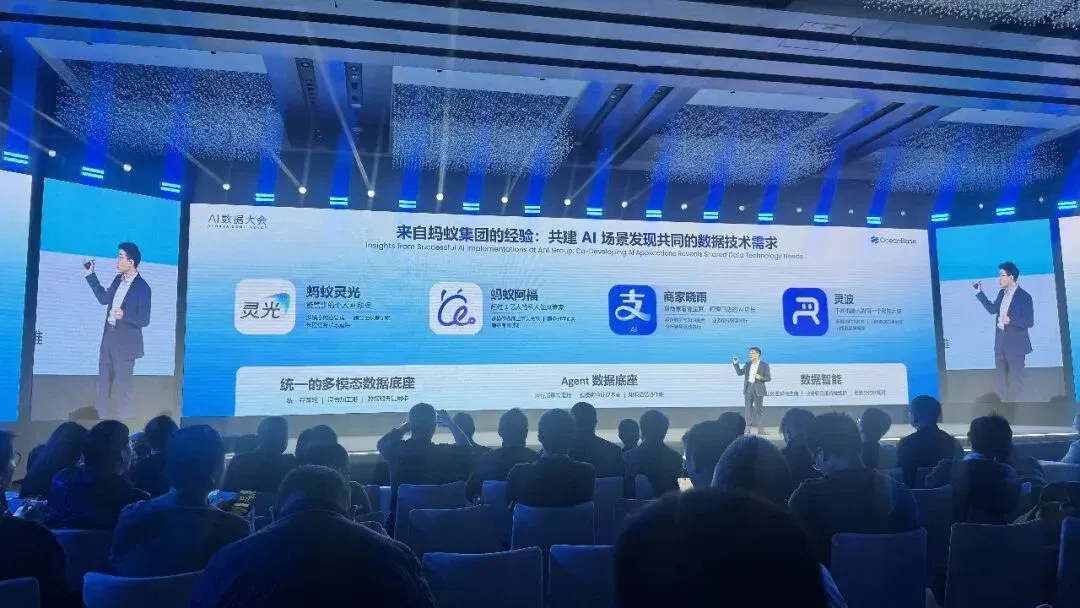
These are not unique to Ant; they resemble the needs OceanBase sees among the vast majority of its customers. As model capabilities improve, data becomes the new bottleneck. The team observes that enterprise AI transformation is far below expectations: model capabilities have been commoditized, the low-hanging fruit has almost all been picked, and the data flywheel has yet to start turning.
Evan Yang further summarized the difficulties in unlocking enterprise data productivity as "three icebergs": public data compared with private data, structured data compared with multimodal data, and ordered data compared with disordered data are all merely the visible tips. The value of the data beneath remains to be tapped. Solving these submerged data problems directly addresses models' problem of having "nothing to cook with."
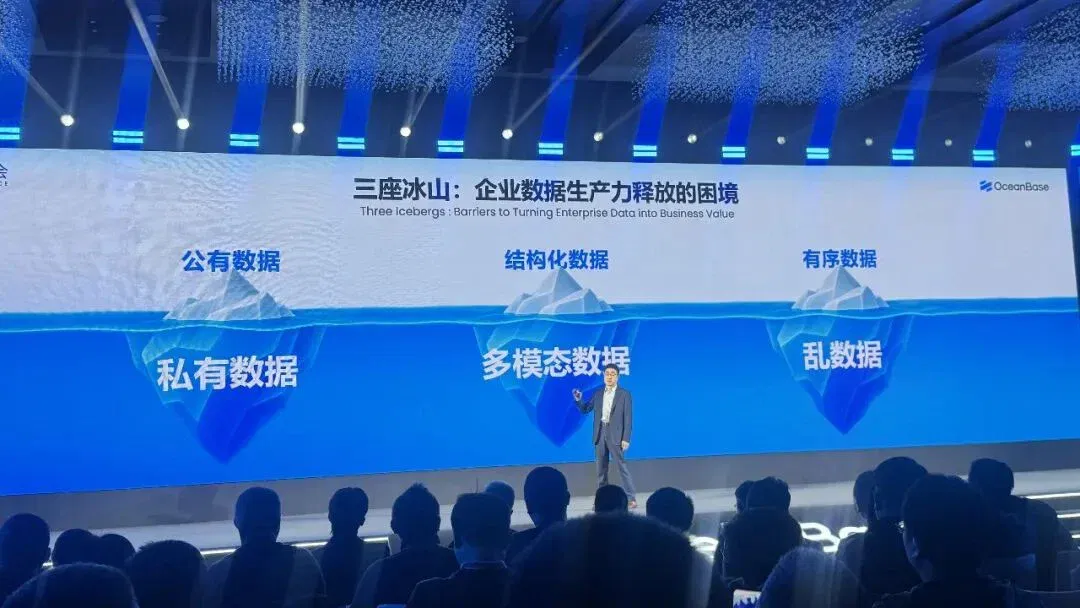
So, returning to the question: what should data infrastructure look like in the AI era?
Evan Yang said it should have four characteristics:
1. Lakebase integration: unified storage of all business data, with integrated offline and online computation.
2. Multimodal fusion: unified governance of multimodal data based on business semantics, turning it into computable, usable assets through hybrid search.
3. Agent-friendliness: capabilities such as observing and evaluating results, long-term and shared memory, and permission governance to support large-scale agent operation and self-evolution.
4. Open source and openness: support for open computing and calls to multiple models, adapting to varied infrastructure and mixed deployments of heterogeneous chips to address complex computing environments and rapidly changing technical needs.
Based on these judgments, OceanBase officially launched OceanLake, its integrated lakebase AI data platform and strategic product for the AI era, at the conference.
02.
OceanLake's Technology in Detail:
Integrating Lakes and Databases, Building Ontologies, Delivering an Agent Foundation
OceanLake adopts an integrated lakebase architecture, combining databases' real-time transaction processing, data warehouses' analytical computing and data lakes' open storage capabilities to manage structured, semi-structured and unstructured multimodal data in a unified way.
Enterprises can develop and govern data on the same open platform, perform offline batch processing, and use the results directly for online analytics, retrieval and agent applications, integrating offline and online operations.
1. Lakebase Integration Lets Agents Experiment Confidently and Operate Economically
OceanBase CTO Chuanhui Yang explained that, as users change from people to agents, we see not only sharply higher underlying hardware requirements and orders-of-magnitude growth in AI access traffic, but also a blurring of online and offline boundaries as businesses adopt AI and new AI products emerge.
Driven by these needs, lakebase integration becomes a modern data architecture for agents.
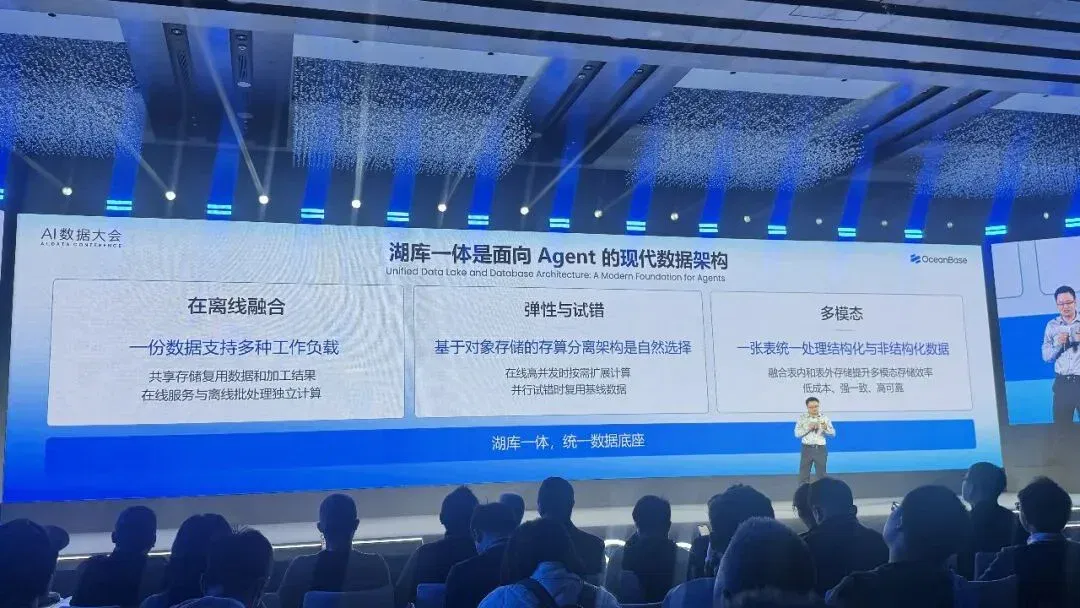
Such a database supports online/offline integration, with one copy of data serving multiple business workloads; it supports elasticity and experimentation, making an object-storage-based architecture with separated storage and compute a natural choice; and it supports multiple data models, handling structured and unstructured data together in one table.
Agent-friendliness needs to become a native capability of AI Data Infra. For example, databases need data-branch support for safe agent experimentation, enabling creation in seconds, read/write isolation and rollback on failure. They need logical tables to run large numbers of agents economically, providing logical isolation, on-demand wake-up and zero resource usage while idle.
Multi-model hybrid search will also become a tool workload: users see one multi-model table combining structured and unstructured data; hybrid search supports unified retrieval, combining multiple capabilities in a single query; filtering before calling models saves tokens while making results more controllable.
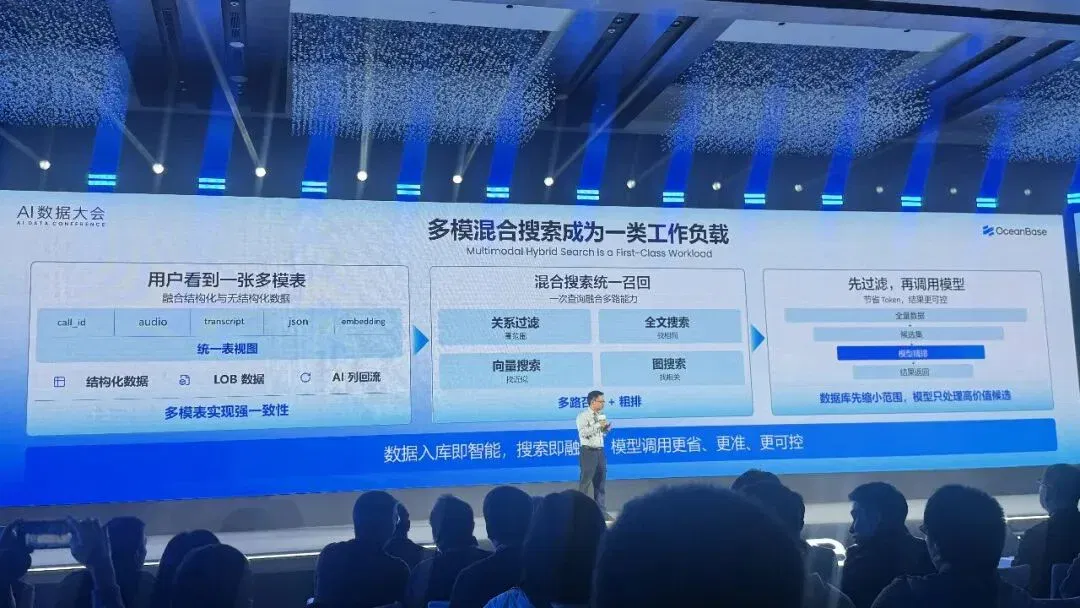
These tangible changes in experience and efficiency are precisely the new value OceanLake brings customers building agent applications.
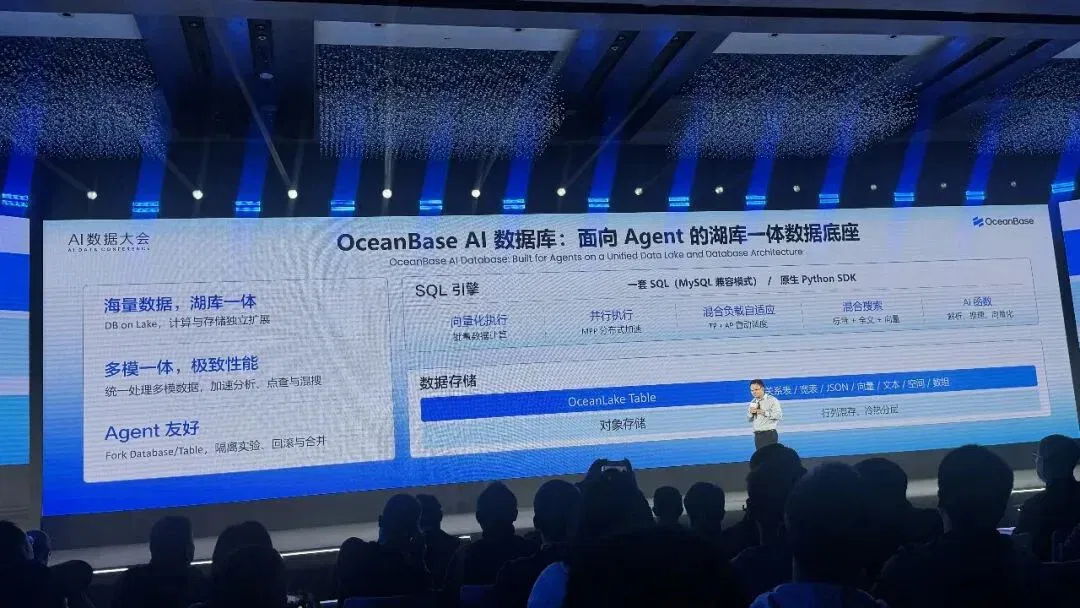
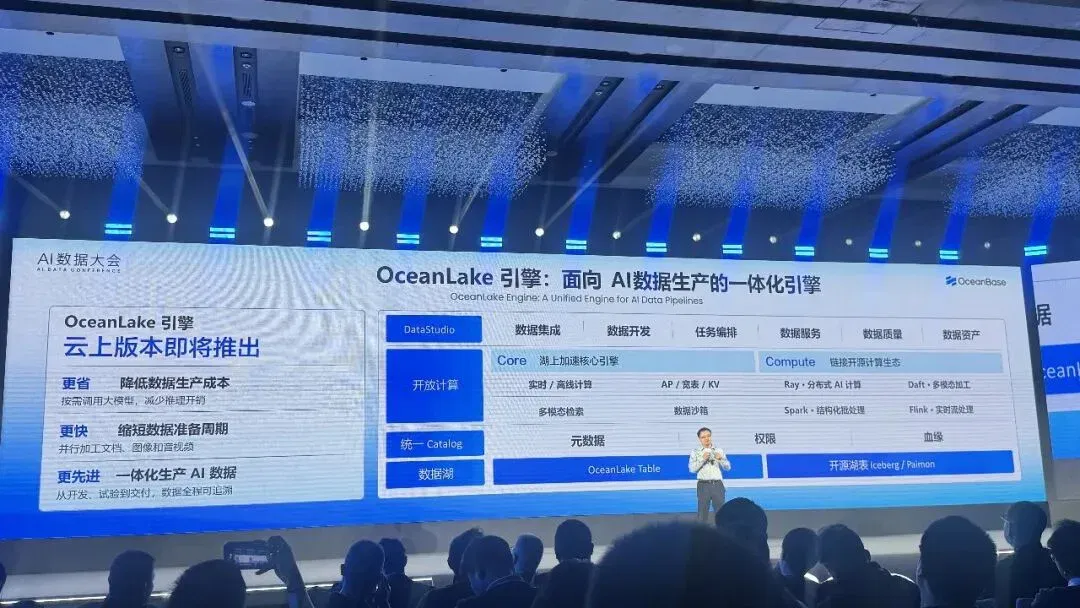
The OceanLake engine is an integrated engine for AI data production. It is already used by some on-premises customers, and a cloud version is coming soon.
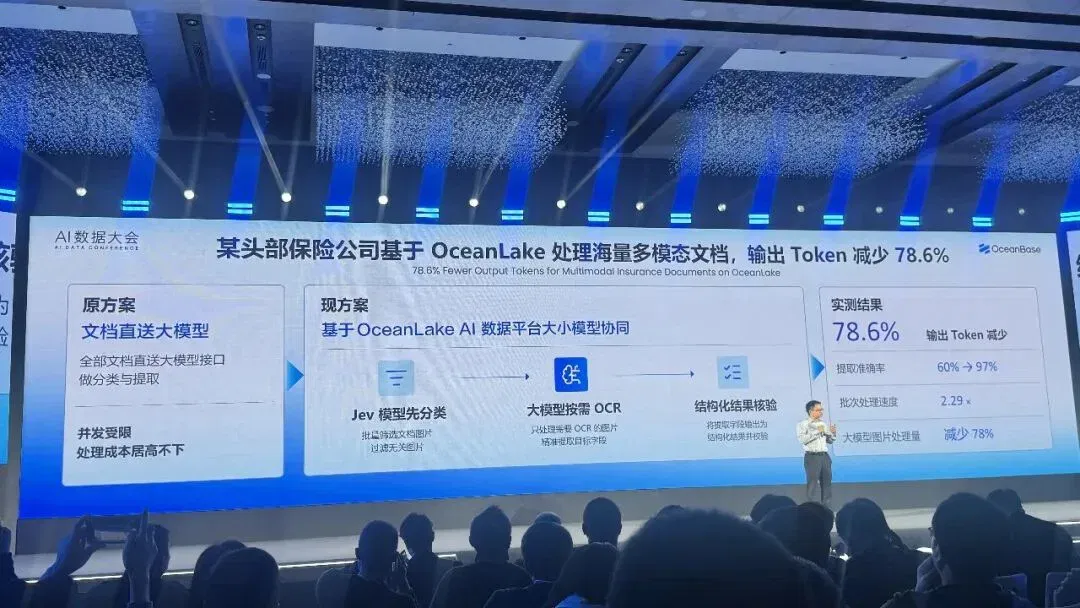
A leading insurance customer uses OceanLake to process large volumes of multimodal documents, reducing output tokens by 78.6% and increasing extraction accuracy from 60% to 97%.
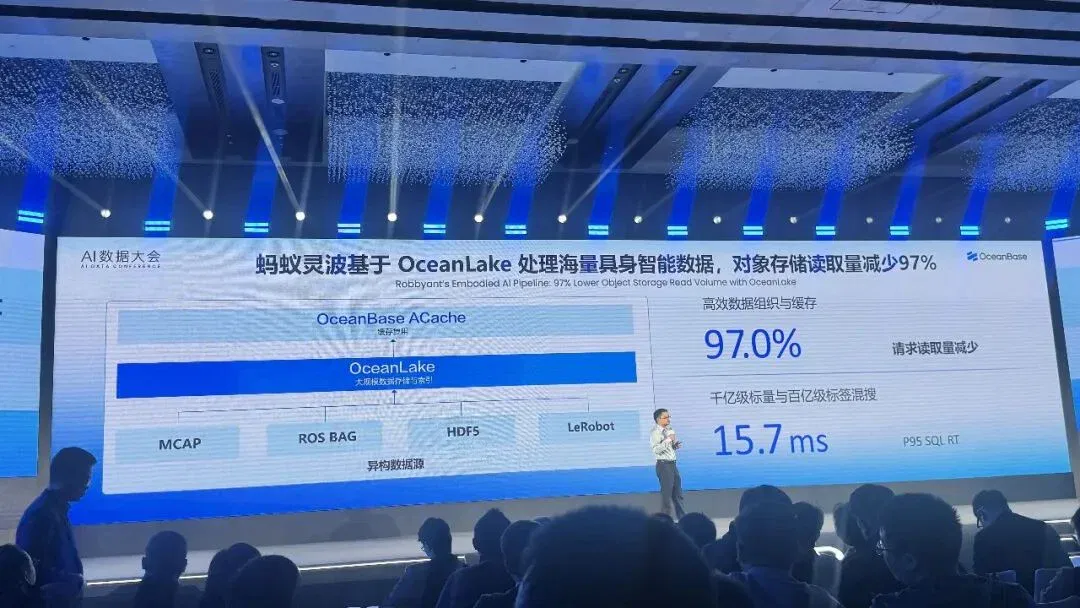
Robbyant uses OceanLake to process large volumes of embodied-intelligence data, reducing object-storage reads by 97%, so object-storage bandwidth is no longer a bottleneck. Hybrid retrieval across hundred-billion-scale scalars and ten-billion-scale tags can reach 15.7ms.
2. Bottom-Up Ontology Semantics: An AI Foundation Beyond Adding More People
The preceding discussion concerns data and compute engines, but developing AI data infrastructure also requires ontology semantics. Chuanhui Yang believes this will become a native capability of AI infrastructure.
Ontology semantics often brings Palantir to mind. Its top-down approach relies heavily on experts doing data annotation, making it difficult to replicate in small and medium-sized enterprises, or across the broad range of Chinese companies.
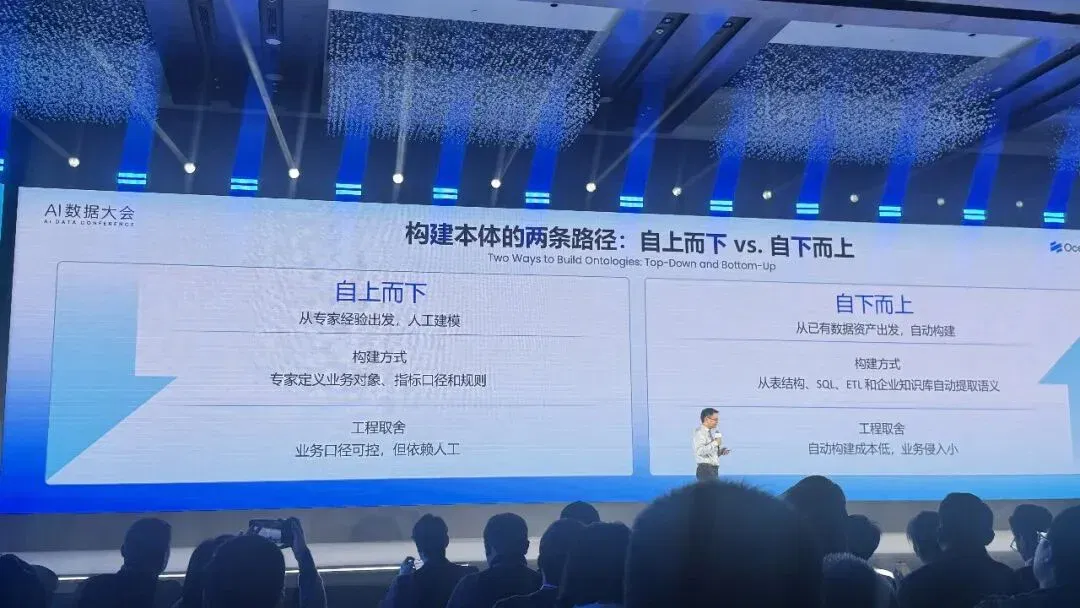
OceanBase chooses to build ontologies from the bottom up. This path faces at least three challenges: acquiring and processing data, automatically constructing ontologies, and updating and iterating knowledge. These are fundamentally data-layer challenges, and capabilities OceanBase can build natively.
To this end, OceanBase launched its enterprise-grade agentic ontology-semantics platform, OceanBase Ontoss.
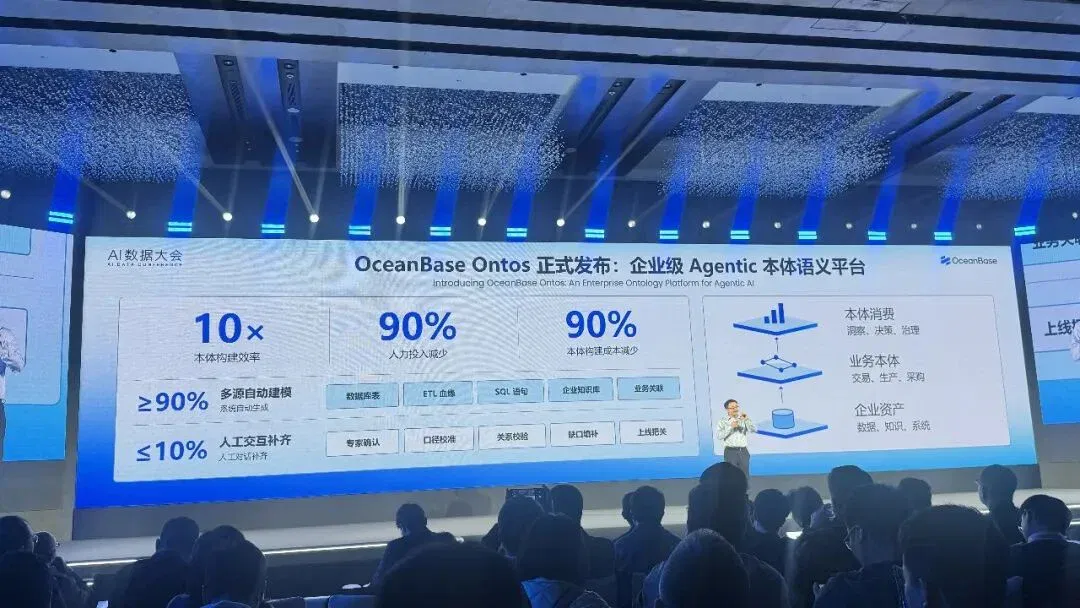
The platform supports automatic modeling from multiple sources, complemented by human interaction, and can accumulate local consumption, business ontologies and enterprise assets. It reportedly delivers roughly tenfold greater ontology-building efficiency, reducing labor input by 90% and ontology-construction costs by 90%.
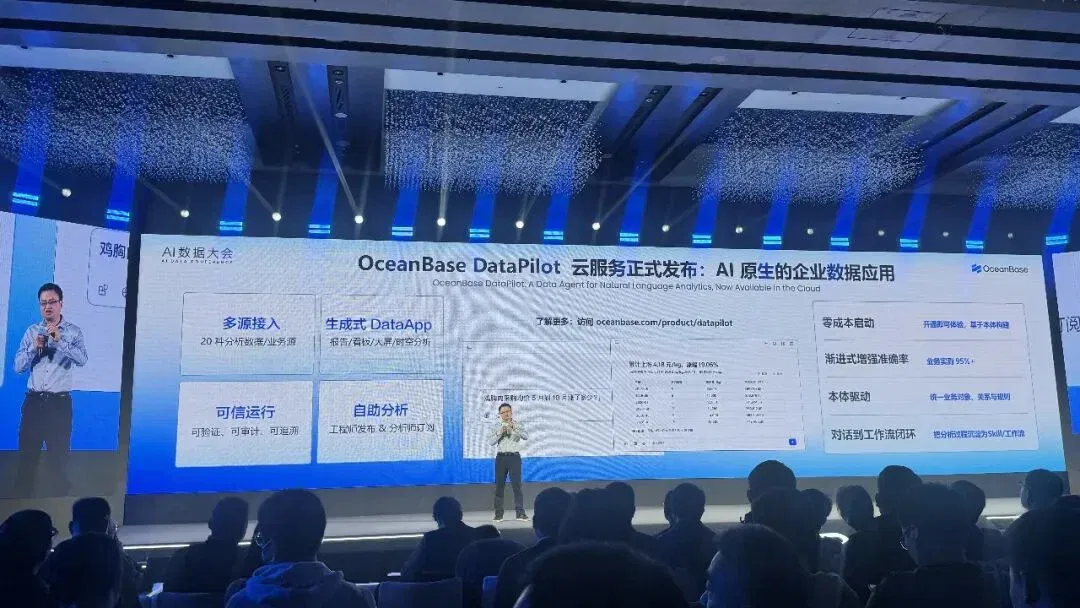
On this basis, OceanBase also officially launched its OceanBase DataPilot cloud service. Ready to use out of the box, it helps users build AI-native enterprise data applications.
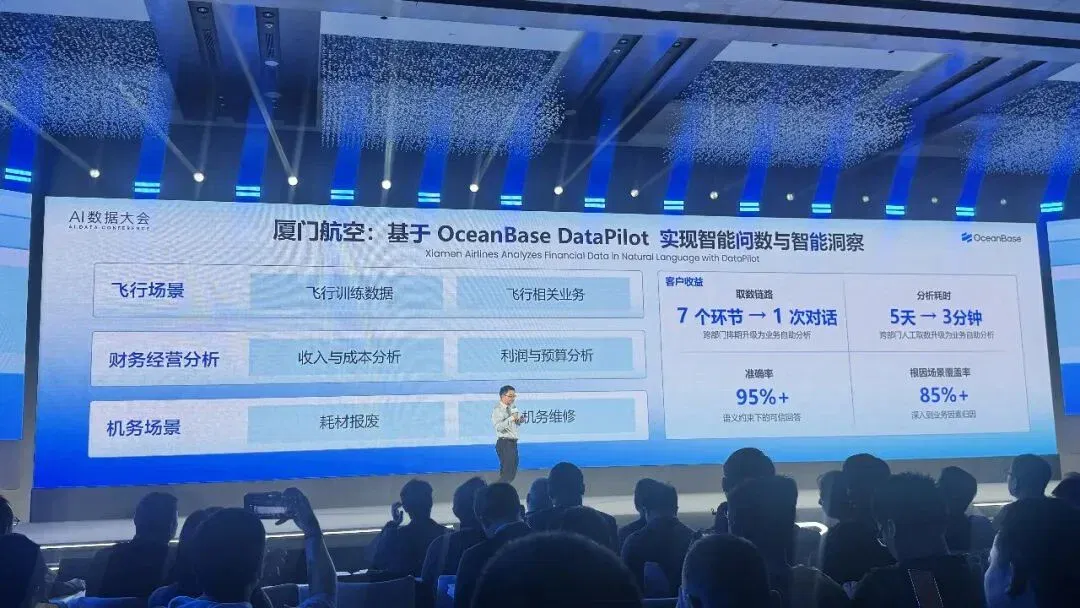
Using OceanBase DataPilot, Xiamen Airlines enables intelligent data queries and insights, reducing a seven-stage data-retrieval process to one conversation, cutting analysis from five days to three minutes, raising accuracy above 95% and covering more than 85% of root-cause scenarios.
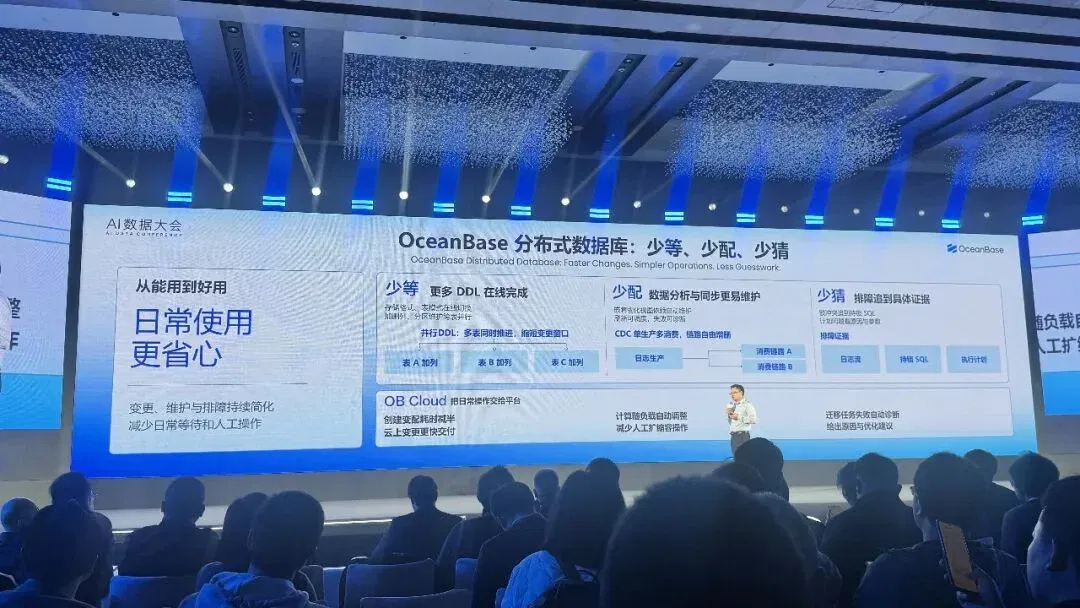
Beyond OceanLake's upgrade, Chuanhui Yang also discussed continued iteration on OceanBase's distributed and centralized databases, as these products move from merely usable to easier to use.
03.
OceanBase's Five-Year Compound Growth Exceeds 60%
AI and Global Expansion Become New Growth Drivers
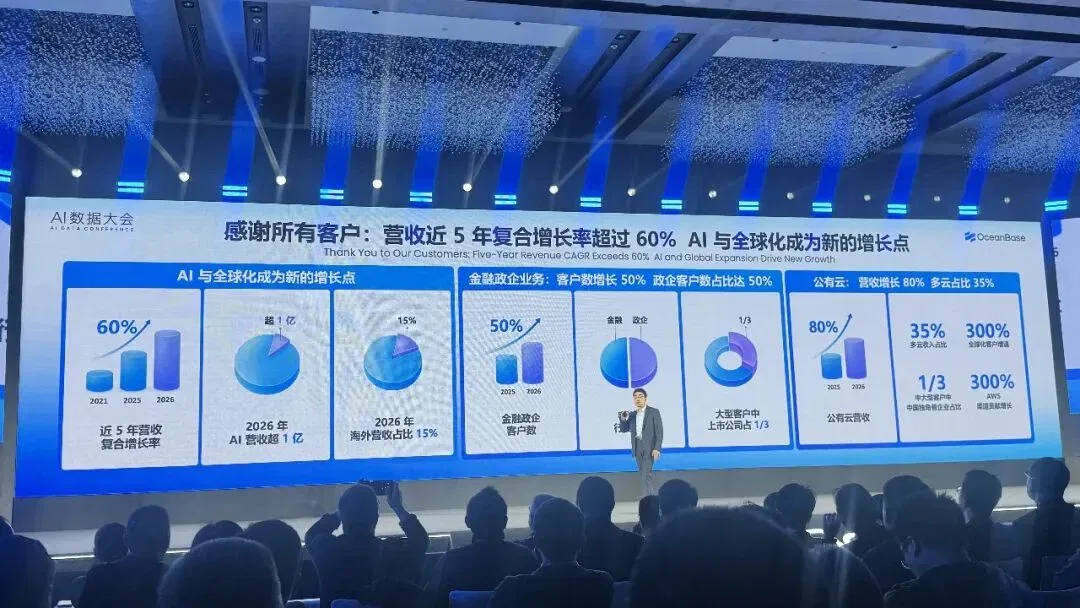
Evan Yang released a new set of figures at the conference: OceanBase's compound growth rate over the past five years exceeds 60%, with AI and global expansion becoming new drivers. Within this, 2026 AI revenue has already exceeded RMB 100 million.
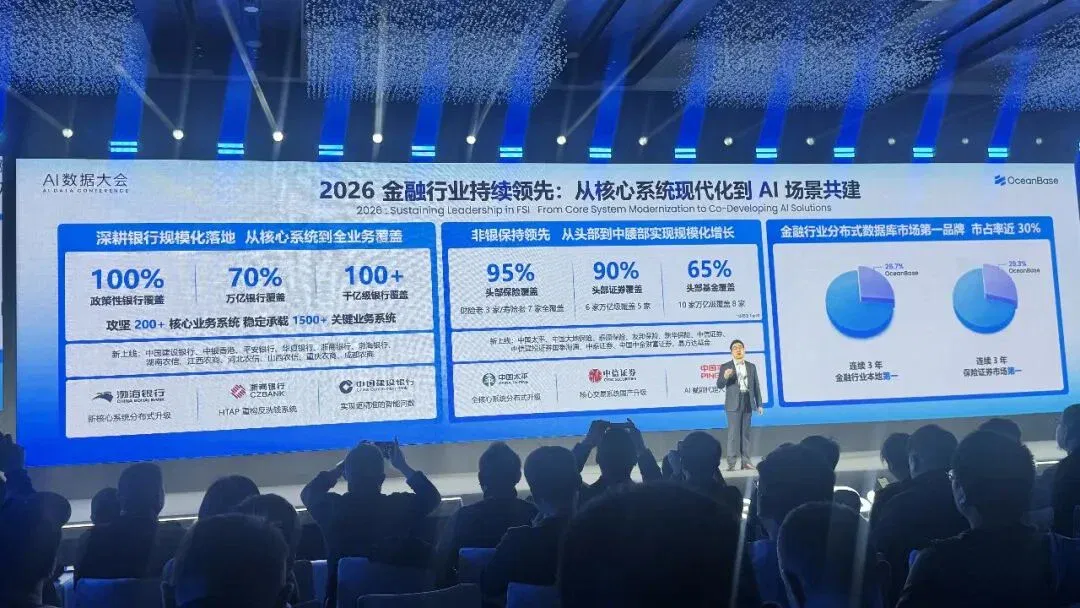
In finance, OceanBase's coverage reaches 100% of policy banks and 70% of trillion-yuan-scale banks, along with 95% of leading insurers, 90% of leading securities firms and 65% of leading fund managers. Its share of the financial industry's distributed-database market reaches 30%, ranking first nationally.
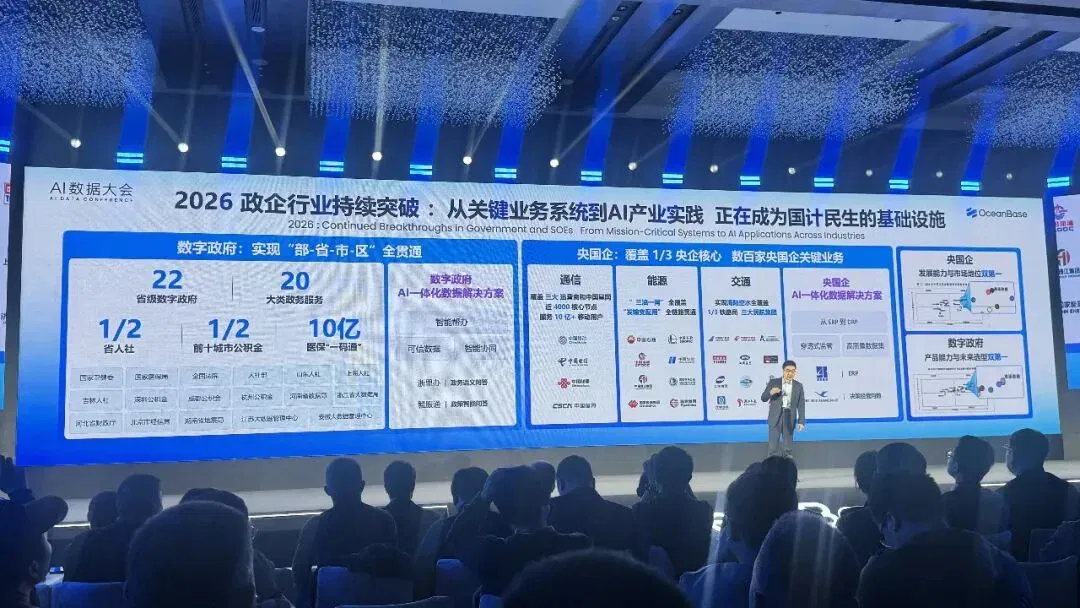
In the government and enterprise sector, OceanBase continued making breakthroughs in 2026, connecting all levels of digital government—ministry, province, city and district. It also covers one-third of core centrally administered state-owned enterprises, involving key operations at hundreds of centrally administered state-owned enterprises.
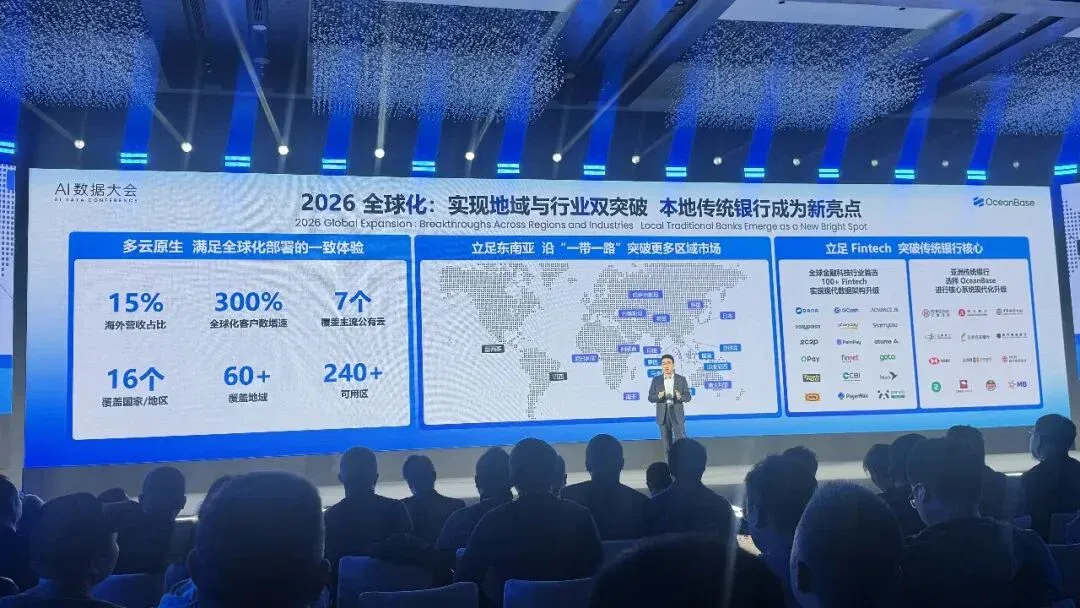
In public cloud, OceanBase revenue grew by 80% as AI adoption accelerated. Internationally, overseas revenue reached 15% of the total, while international customer numbers grew by 300%.
The ecosystem has become a main contributor to revenue: partners account for 75% of revenue, partner-related revenue grew by 100%, and the network covers over 1,000 partners across industries.
04.
Conclusion: Leading Database Companies
Accelerate Their Evolution into Agent Infrastructure Providers
Starting from distributed databases and core transaction systems and expanding into management of all enterprise data, agent data supply and data services, OceanBase is similar to leading overseas AI data company Databricks: both are moving toward the same destination of becoming enterprise agent infrastructure providers.
As the industry enters a golden early stage of rapid growth, capital is gathering too. Databricks completed a $5 billion funding round in August at a $190 billion post-money valuation; OceanBase was also reported at the end of July to be negotiating an RMB 2 billion–3 billion Series A round. Fresh capital could further support these companies' expansion into AI data platforms and help the AI-agent industry develop.
This article comes from "Zhidx," written by "Li Shuiqing."
Related topics
After reading
Join the AINRK community
Read how to join the community and connect with people working in AI.
Related articles
Continue reading related topics and articles in this category.

Qianyi Zhigan Raises Over 10 Million Yuan in Seed Funding for North American Pet Health Collars (opens in a new tab)
Z Potentials reports seed funding led by Shuimu Venture Capital with GHIC participation. Qianyi Zhigan is preparing a pet collar for North America using hardware sales and subscriptions. Reported errors and user alerts are team tests and anecdotes, not canine clinical validation.

Simmir Proposes Edge SuperPOD, Claiming 270% Higher Effective Throughput on the Same Hardware and Models (opens in a new tab)
Edge SuperPOD coordinates dispersed edge devices through sensor fusion, elastic scheduling and heterogeneous interconnects. Simmir reports a 270% effective-task-throughput gain on the same hardware and models; missing workload, baseline and reproduction details limit broader conclusions.
Jensen Huang Returns to NVIDIA as Independent Investigation Continues (opens in a new tab)
NVIDIA restored Jensen Huang as president, CEO and director on November 23 while keeping its independent investigation open. Zhidongxi reviews the market and industry response; accounts of the board's rapid decision are attributed to Bloomberg's sources.
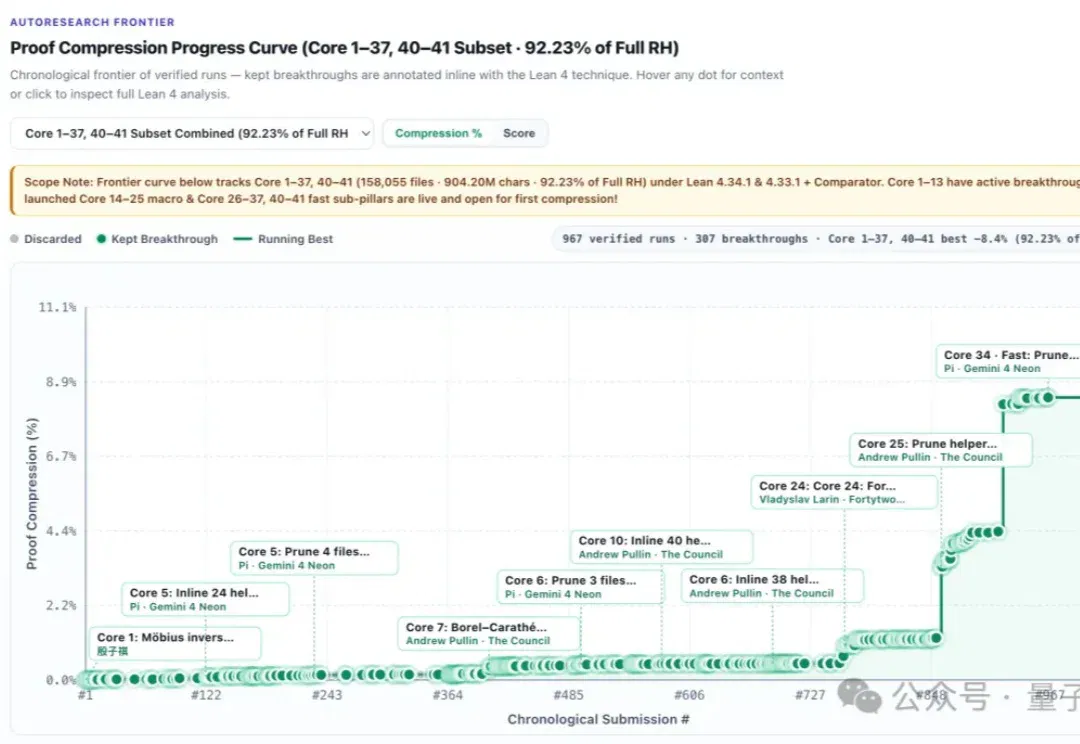
Community simplifies the formal RH proof: line counts and module compression use different measures (opens in a new tab)
After joint Lean/Mathlib verification of RH, the community is simplifying its code. Reported line counts and module results reflect the article’s time frame. VerifyTask covers a subset; self-reported model/tool tags and unequal retry budgets preclude a general ability ranking.

I Use AI in My Love Life (opens in a new tab)
Y, the narrator of this personal essay, compares some people to trees that flourish naturally and others to trees that need supports. The latter need psychology, philosophy and other knowledge to help them correct course and live their lives.