Anthropic’s internal models: METR reports faster R&D; unreleased products remain unconfirmed
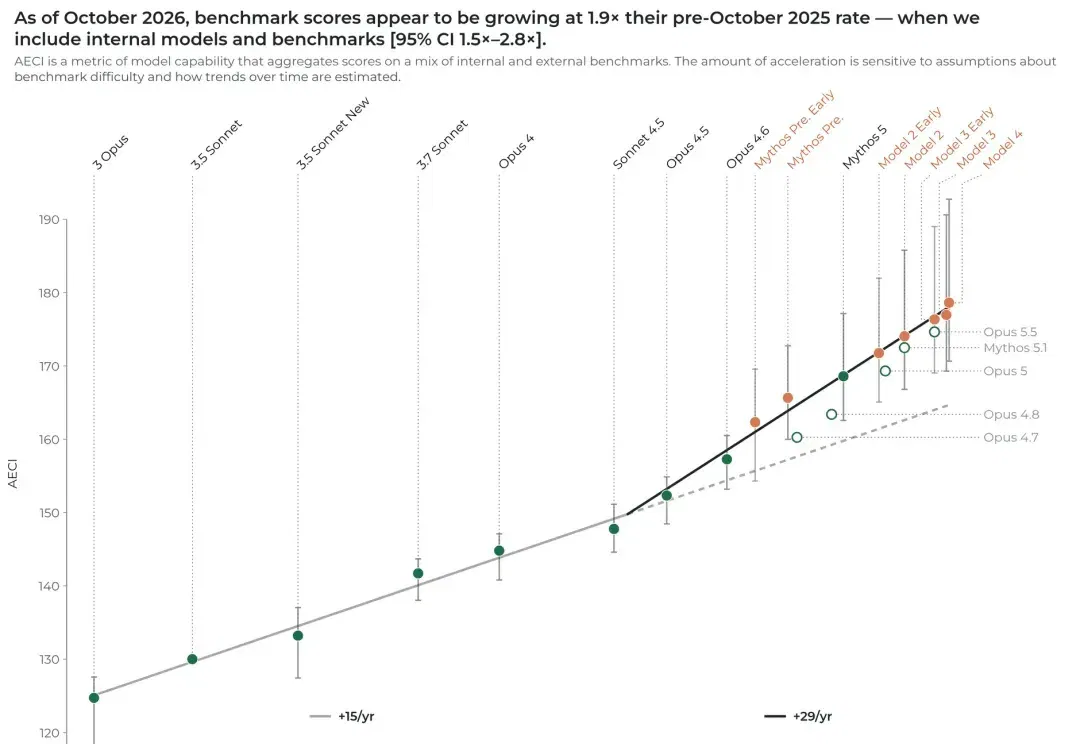
METR estimates Anthropic’s AECI progress at about 1.9× its previous pace, with uncertainty over causes and broader applicability. Reports of stronger internal models, Model 5 or future leaps are not confirmed product or release announcements.
Editorial check (2026-11-24): This article combines an observer’s claims, METR’s assessment and the author’s speculation. METR’s public report provides internal codenames and training windows, but does not itself map all codenames to commercial products. A removed forecast for a future model does not directly prove that Model 5 exists or will definitely be released. The 1.9× figure estimates the AECI trend, with a 95% confidence interval of 1.5–2.8×; extrapolation to broader, less clearly defined tasks remains uncertain. Roughly 80% is METR’s guess about the causes of current acceleration, explicitly subject to substantial uncertainty. The 12× figure is employees’ self-assessed productivity improvement, not the overall rate of progress. Reaching an R&D capability threshold does not automatically mean all researchers have actually been replaced or a fully autonomous development loop has been achieved. METR’s independent assessment of Anthropic’s R&D acceleration (opens in a new tab)
“By the way, Fable 5.2 is already very old.”
According to claims from AI industry observer Chris, Anthropic currently has two stronger internal models and could see a major capability leap over the next six months.
“This improvement could far exceed the earlier jumps from GPT-5.3 to GPT-6 and from Claude Opus 4.5 to Fable 5.2.”
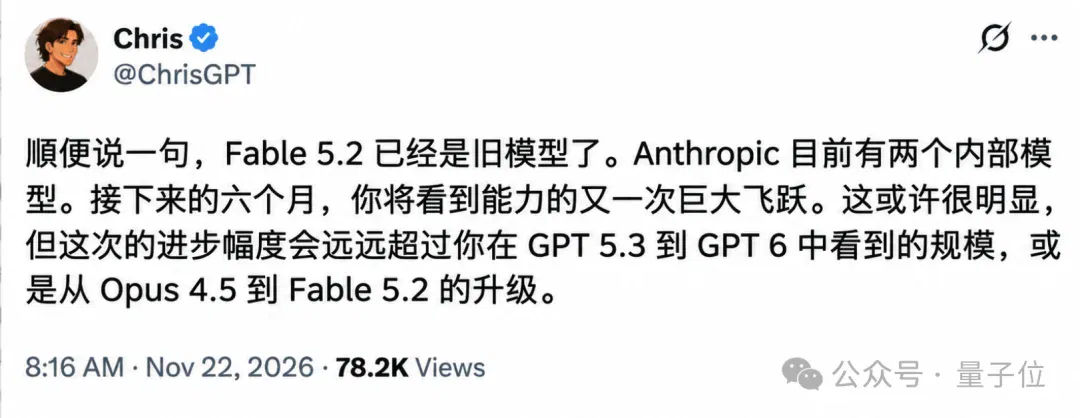
Hold on—does that mean Fable 5.2, released only two weeks ago, is already about to become yesterday’s news?
People responded:
“In AI time, two weeks ago is basically ancient history.”
“Fable 5.2 only came out two weeks ago, but in AI time that is practically retirement age.”
How many models does Anthropic have behind the scenes?
There are, in fact, clues to the development of Anthropic’s internal models.
Earlier this month, independent AI evaluation organization METR (Model Evaluation & Threat Research) released a report specifically examining progress in AI-assisted R&D within Anthropic.
METR is a nonprofit focused on frontier AI capabilities and safety risks. Founded by former OpenAI researcher Beth Barnes, it has worked with companies including OpenAI and Google DeepMind.
Between August and October this year, METR worked inside Anthropic, gaining access to some internal model evaluations, training and R&D-efficiency data, and interviewing approximately 15 employees.
Its report disclosed three internal models whose identities had not been fully made public:
Model 2, training completed in July 2026.
Model 3, training completed between August and September 2026.
Model 4, training completed between September and October 2026.
Model 2 is described as an internal model more capable than the then-flagship Mythos 5. It has been used extensively for internal coding, agent tasks and data generation, but the company currently has no plan to release it publicly.
The article links Model 3’s identity to the November 9 release of Fable 5.2 and Mythos 5.2.
According to METR’s testing of Model 3, its AI R&D capabilities were stronger than those of the final released version. Anthropic also acknowledged in its system card that it deliberately restricted Fable 5.2 and Mythos 5.2 on some AI R&D tasks, including GPU-kernel optimization and improvements to large-language-model architectures.
What about the later-trained Model 4? The data put its internal aggregate capability index, AECI, at 178.6. For comparison, the figures were 172.62 for Mythos 5.1, 174.78 for Opus 5.5 and 177.12 for Mythos 5.2.
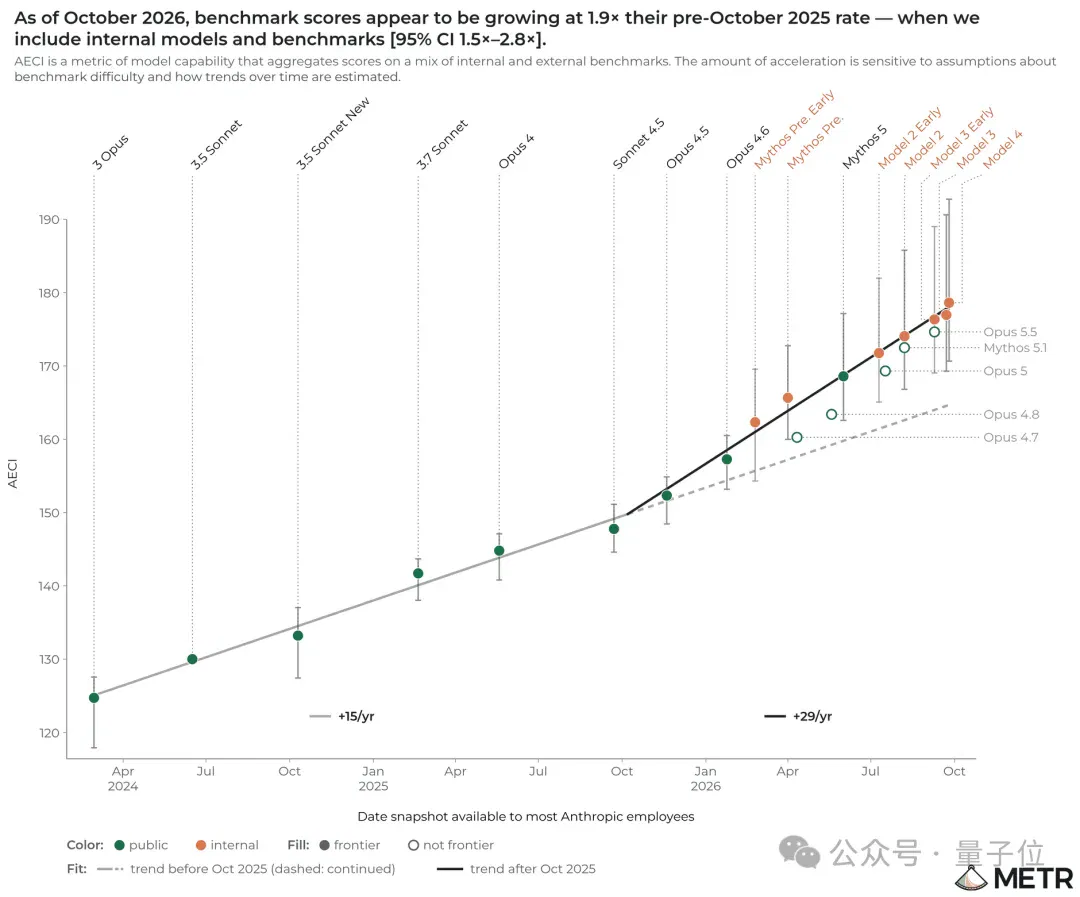
△Anthropic model AECI scores
Looking only at those numbers, however, the leap does not seem particularly large.
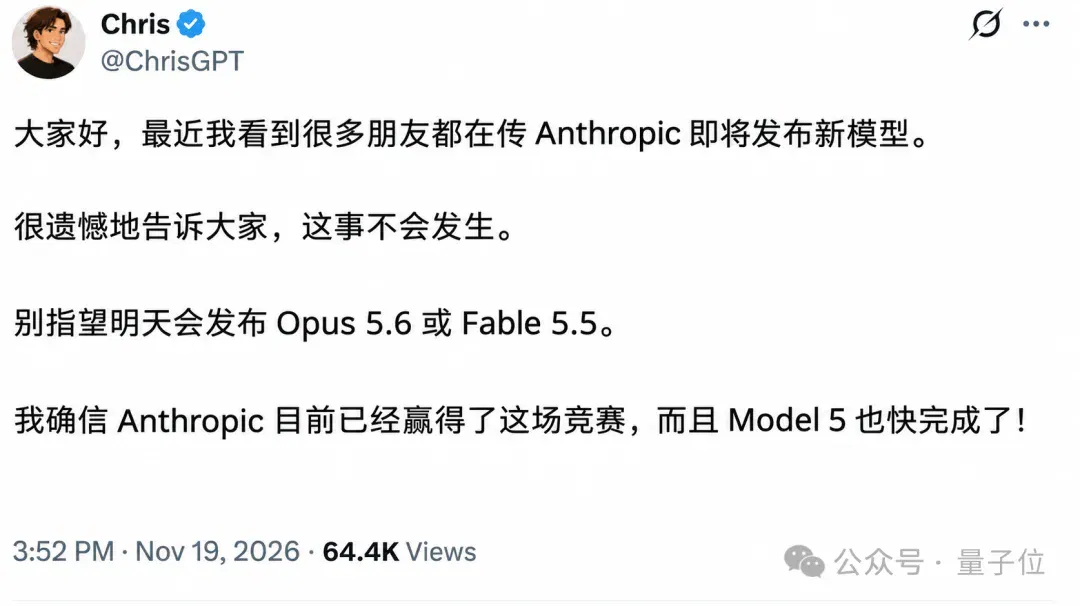
Then again, Model 5 seems to be on the horizon too.
METR also said it had seen a forecast for a future Anthropic model, but Anthropic removed it for various reasons.
Anthropic also removed most of the nonpublic evidence from the final report.
The reason given was that “this information could help other AI developers accelerate their R&D.”
Anthropic’s model progress continues to accelerate
The key question METR entered Anthropic to investigate was “How much is Claude accelerating development of the next generation of Claude?”
Its estimates put the growth rate of Anthropic’s aggregate AECI capability index since October 2025 at approximately 1.9 times its previous rate.
At the earlier pace, the progress made in one year would have taken two years.
METR believes the acceleration cannot simply be explained by adding compute. In its estimate, AI-assisted R&D may have contributed most of the current acceleration—perhaps around 80%, METR guesses, while explicitly noting substantial uncertainty.
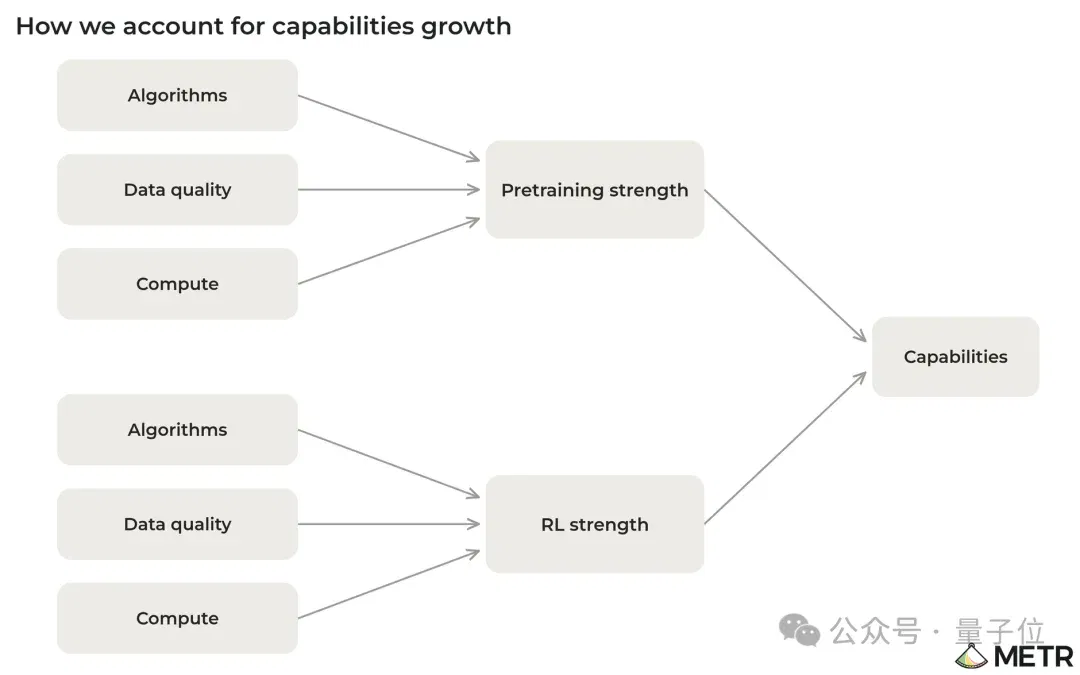
△METR’s framework for analyzing sources of model-capability growth
One Anthropic researcher interviewed by METR said that doing research now felt like having a group of postdoctoral researchers.
He estimated his productivity had increased to roughly three times its previous level.
When Anthropic released Fable 5.2 on November 9, it also disclosed that Claude now wrote more than 90% of code changes merged into the company’s core codebase.
An earlier generation of Claude helps Anthropic develop the next. Anthropic calls this “Closing the Loop.”
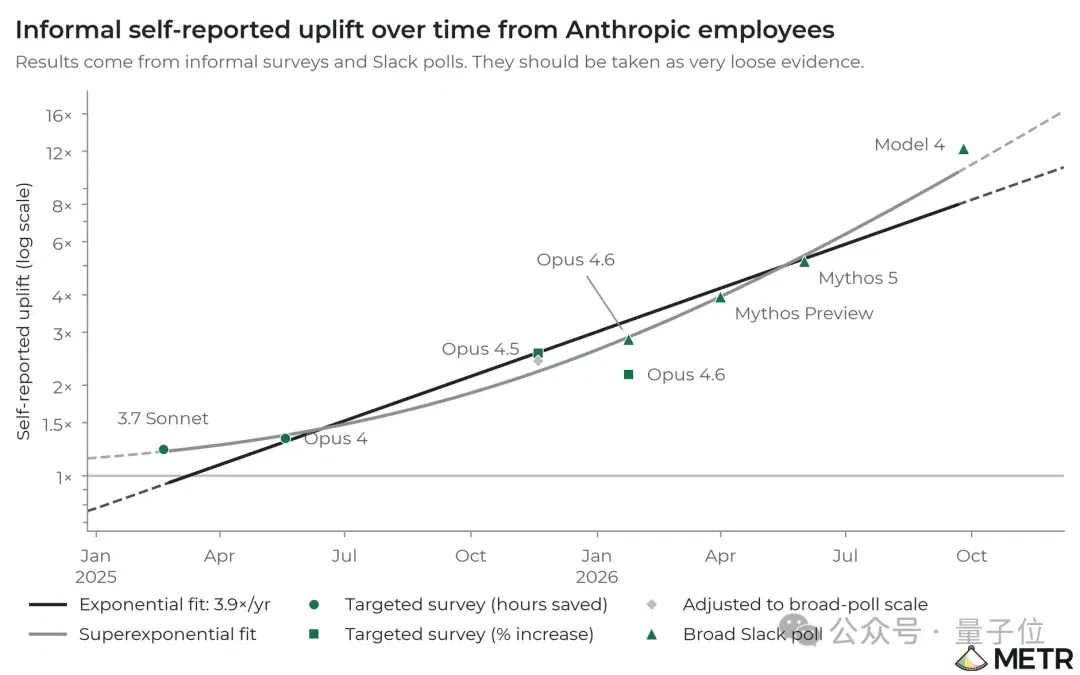
△Employees’ self-assessed productivity gains from Claude: approximately 12× for Model 4
In its November 17 IPO filing, Anthropic said it had determined that it had reached its Responsible Scaling Policy (RSP) AI R&D capability threshold.
There are two principal ways to trigger that threshold.
First, an AI model can, at competitive cost, substantially replace the work of all the company’s AI research scientists and research engineers.
Second, AI-automated R&D produces enough acceleration that overall AI capability progress reaches approximately twice the rate that would occur without significant AI R&D contributions.
What the report says is known so far is that Mythos 5.2 was not the model that triggered this threshold.
One More Thing
Coming back to the present.
On Anthropic’s second trading day after its IPO, the share price fell 8.5%, touching an intraday low of $83.05.
That was just five cents above the $83 offer price.
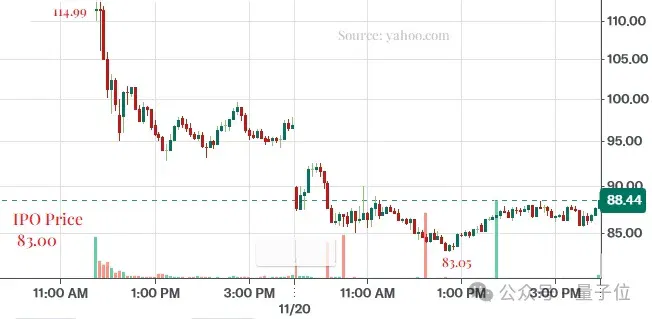
△Anthropic’s share price falls
To steady Wall Street’s nerves, might Anthropic consider serving up these two big offerings sooner and letting everyone try them out?
This article is from “QbitAI,” by “Cheng Qian.”
Related topics
After reading
Join the AINRK community
Read how to join the community and connect with people working in AI.
Related articles
Continue reading related topics and articles in this category.

Report revisits Dario Amodei’s early AGI risk estimate and Anthropic’s safety culture (opens in a new tab)
A commentary citing a Washington Post investigation and social-media accounts examines Amodei’s 2022 memo, Anthropic’s culture and IPO pressures. The 20%–30% figure was his subjective estimate of human destruction or permanent stagnation, not an objective probability.

Anthropic after its IPO: APPSO on enterprise growth, compute commitments and governance (opens in a new tab)
APPSO examines employee and investor paper holdings, Claude Code and enterprise growth, and tensions among Anthropic's long-term compute commitments, financing needs and safety mission after its IPO. Equity values, company proceeds, cash reserves and realized personal gains are distinct.
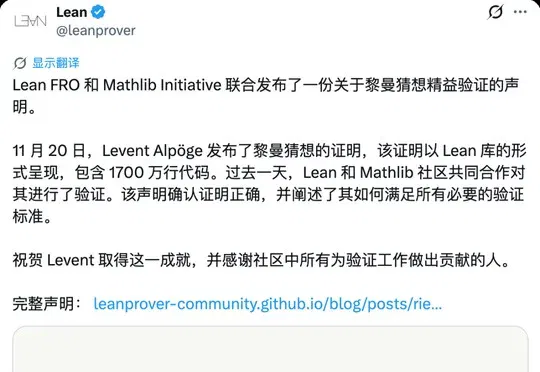
Alpöge says “250,000 pages” was a joke, addresses Riemann-proof code criticism (opens in a new tab)
Levent Alpöge says the “250,000-page” proof was a joke and acknowledges redundant, low-quality Lean code in his work with Claude. He argues that its ideas should lead to a more natural, concise mathematical framework; code quality and formal correctness remain distinct.

Dario’s early “immersive games” idea draws criticism; media accounts are distinct from company policy (opens in a new tab)
The article revisits media accounts of Dario’s early OpenAI discussions and critiques his views on AI jobs, safety and Anthropic’s culture. The idea is not current company policy; online speculation about his health lacks reliable evidence.
Podcast recounts Anthropic equity offer as AI talent competition meets model criticism (opens in a new tab)
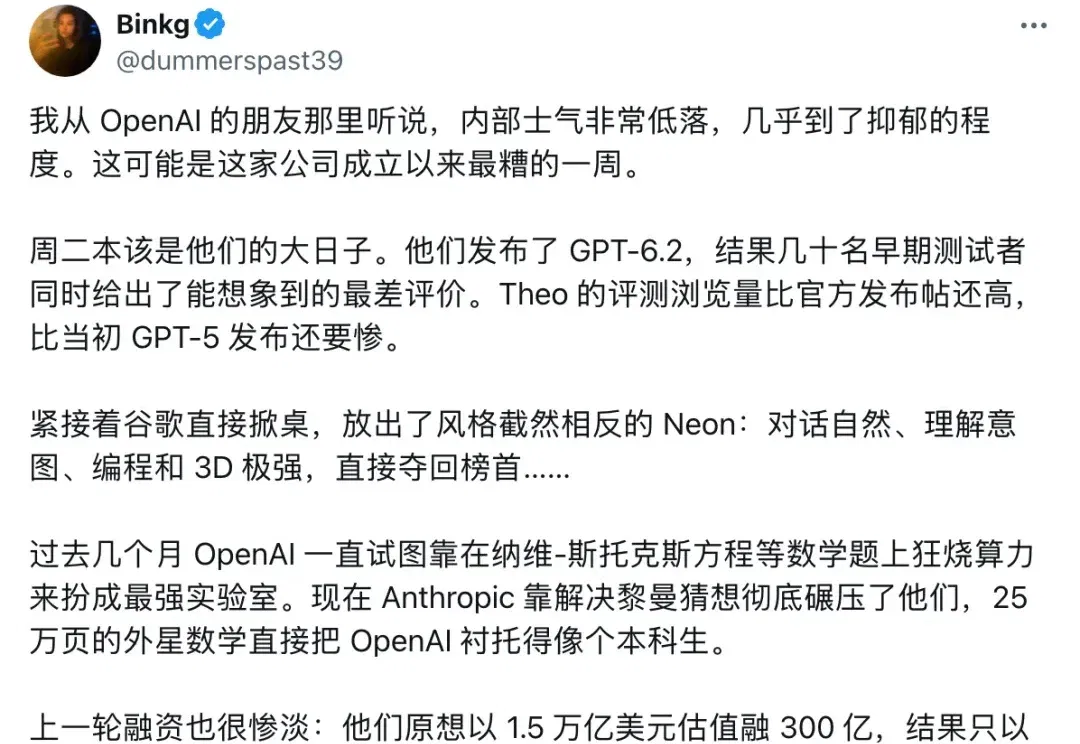
On All-In, Calacanis recounted a reported US$40 million four-year equity offer to a new CS graduate. The article also reviews GPT-6.2 Astra criticism, rankings and financing reports. The offer is not a verified cash salary; morale claims are secondhand.