Memory Tax study compares 11 agent-memory systems with naive RAG on net value
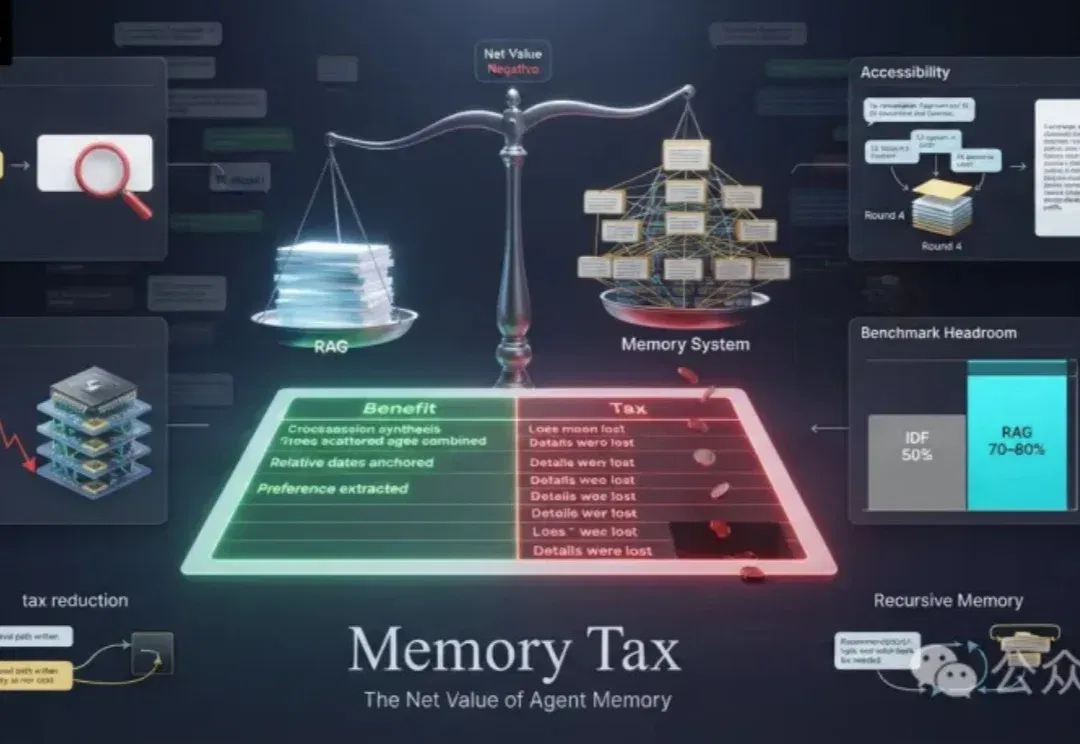
Researchers compare 11 memory systems with naive RAG across three main benchmarks and three backbone models. Benefits and memory tax depend on configuration, retrieval scope and tasks; the findings do not imply long-term memory is universally useless.
Editorial fact-check (November 24, 2026): “Memory tax” means the loss from additional queries answered incorrectly relative to naive RAG, not token charges, and does not imply that all long-term memory is useless. The paper calibrates Retrieval Scope by the share of tokens in the retrievable store, rather than giving every system identical absolute inference-token or end-to-end cost budgets. Conclusions are limited to the tested models, configurations and benchmarks. The hundred-hour figures concern offline processing of specific data subsets, normalized to single concurrency. The authors also observe memory benefits and some web workflows that outperform RAG. Memory Tax paper and configuration appendix (opens in a new tab)Authors’ project page (opens in a new tab)
Memory is a biased reconstruction of history.
Whether in the human brain or a long-running agent, once “memory” begins to form, raw interaction records undergo distillation, merging, updating and forgetting, and are rewoven into different levels and forms.
Designers hope these operations will reorganize information and clarify it, but once information leaves its original form, deviation occurs.
That deviation is inherently double-edged. Scattered facts are gathered and implicit preferences extracted, making information better suited to downstream tasks—the benefit designers seek. But compression and rewriting can inadvertently flatten subtle facts or bury evidence that was previously easy to retrieve.
This inherently double-edged deviation is also why “memory benefit” and “memory tax” coexist within each memory system.
Over the past two years, agent-memory systems have developed rapidly, moving from flat fact stores, through human-inspired hierarchies and lifecycle management and graph-based structures, to trained policies that use reinforcement learning to learn how to read and write memory.
While reviewing papers in this field, researchers noticed a frequent but odd pattern: many compared their systems only against other memory systems, rarely including the most basic naive RAG in the same table. Even papers with RAG baselines often gave vague accounts of chunking and retrieval budgets, making it impossible to establish whether their RAG baselines had been optimized.
That led us to revisit a simple question: if we skip complex offline processing, merely chunk the original conversations and run standard hybrid retrieval, how much “net value” do existing memory systems actually add?
A team from UIUC, Tsinghua University and other institutions conducted a large-scale test and introduced the concept of “memory tax.”

Paper: https://arxiv.org/abs/2610.34073
Paper website: https://hexuan21.github.io/MemoryTax/
Results data: https://huggingface.co/datasets/hexuan21/MemoryTax-Res
Alongside the evaluation code, the authors released intermediate experimental results as comprehensively as possible, enabling the community to inspect and reproduce the work directly.
Baseline comparison
Sophisticated memory versus raw RAG
The experiments begin with the familiar setting of personal-agent memory. On LongMemEval-s, PersonaMem-v2 and MINT-Eval, the team tested 11 open-source memory systems in four categories: A-Mem, MemOS, SimpleMem, MemoryOS, LightMem, OpenViking, HippoRAG2, PlugMem, MAGMA, Mem-T and Memory-R2. The backbone models were Qwen3.5-4B, Qwen3.6-27B and GPT-5.6-luna, spanning different capability levels and model families.
To put structurally different systems on the same starting line, the retrieval budget first needs alignment. Memory units differ greatly in size: some are a short sentence, others a long summary. Mechanically using default retrieval settings can produce differences of more than tenfold in the proportion of content each system sees per query.
The authors therefore define Retrieval Scope (RS), the fraction of the system’s total retrievable-store tokens that a model actually encounters as memory tokens during one question-answering interaction. They deliberately calibrate top-k for most memory systems so that their RS is no lower than the single-round RAG baseline and does not differ greatly from one another. The underlying embedding and judging standards are also unified.
The reference naive RAG uses only conventional operations: split raw text by conversation turns, combine BM25 with vector retrieval for hybrid recall, then apply a lightweight reranker. Appendix ablations replace chunk granularity, embedding models and reranker models, confirming that RAG performs robustly rather than depending on one specially tuned parameter combination.
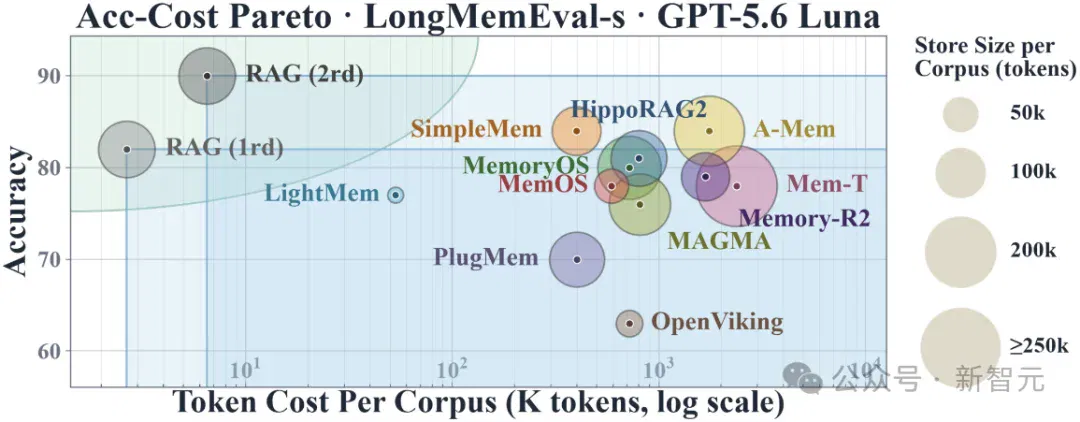
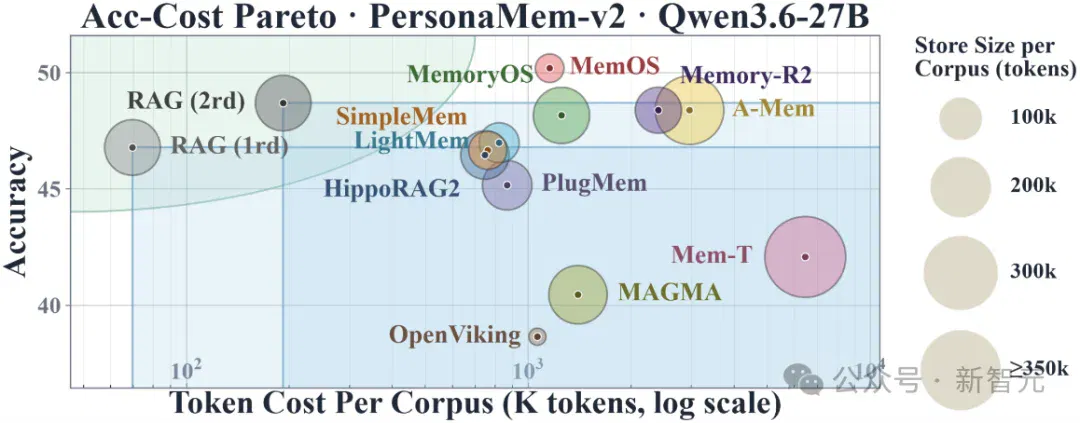
After the full experimental matrix, the figures were more straightforward than expected: in most test settings, purpose-built memory systems failed to beat single-round naive RAG on accuracy. Compared with two-round RAG with supplementary retrieval, the gap was larger still.
Plotting cost against performance on a Pareto chart sharpens the contrast. On LongMemEval-s with GPT-5.6-luna, for example, single-round RAG requires seven minutes of offline processing. Some complex memory systems require more than 100 hours for offline construction and maintenance when normalized to single concurrency, nearly 100,000 LLM calls and over 100 million tokens. Yet their end-to-end accuracy is lower than directly retrieving the raw records, a clear case of “negative net value.”
A tug-of-war between “benefit” and “tax”
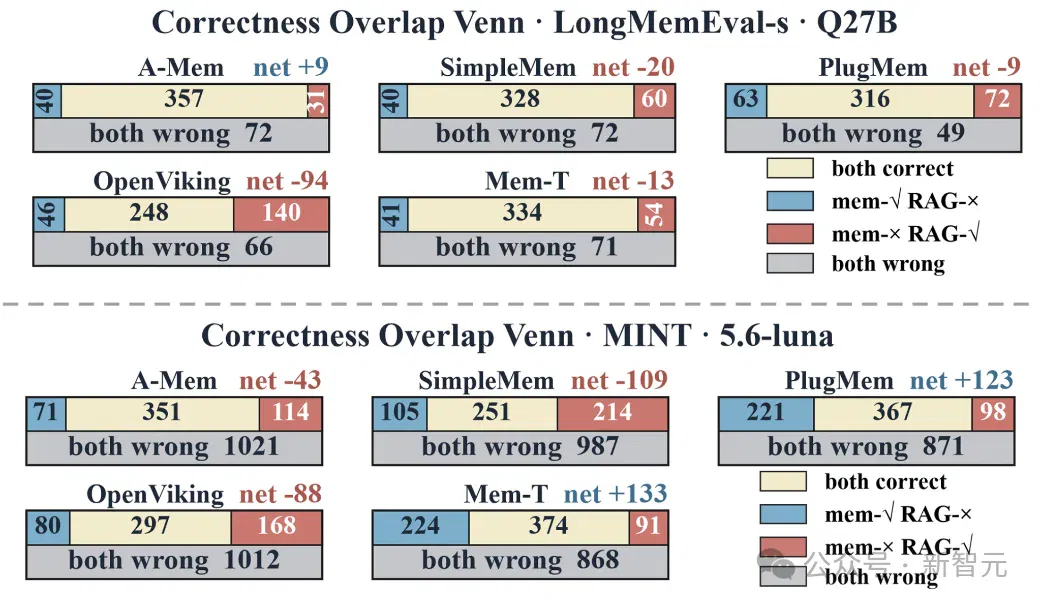
An overall score cannot explain what happens inside a memory system. The authors compare correctness query by query against single-round RAG. The systems are in fact experiencing offsetting gains and losses: they solve some queries that genuinely require distillation and integration, while losing others that simple RAG can answer.
The former is the intended “memory benefit.” For example, the user’s age and the ages of their parents and grandparents may be scattered across three conversations on different dates, requiring cross-session integration to calculate an average age. Or the original wording may say only “fixed the fence three weeks ago” and “trimmed the goats’ hooves two weeks ago,” requiring those relative times to be anchored to specific dates during memory construction to establish their order. Or a user may casually mention an old knee injury in a translation request, which needs to be extracted as a separate preference record. Reconstruction and distillation genuinely help in these cases.
On the other side, however, a larger set of questions answerable by directly searching the original conversations becomes incorrectly answered after memory processing. The authors introduce a concept for this additional cost: “memory tax.” Many systems fall behind on external net value because the tax incurred during memory processing exceeds the memory benefit they earn.
A closer look: where does the “memory tax” come from?
The natural next question is where this tax arises. The authors isolate intermediate states across four aspects: construction, retrieval, model switching and benchmarks.
1. Faithfulness.
The most direct loss occurs before retrieval: construction itself can reduce faithfulness.
Summarization and extraction can readily discard critical details along the way. The authors map original gold conversations to the gold memory units generated by each system and answer questions directly from those units. Even after completely removing retrieval errors as a factor, many systems still score substantially below reading the original passages directly.
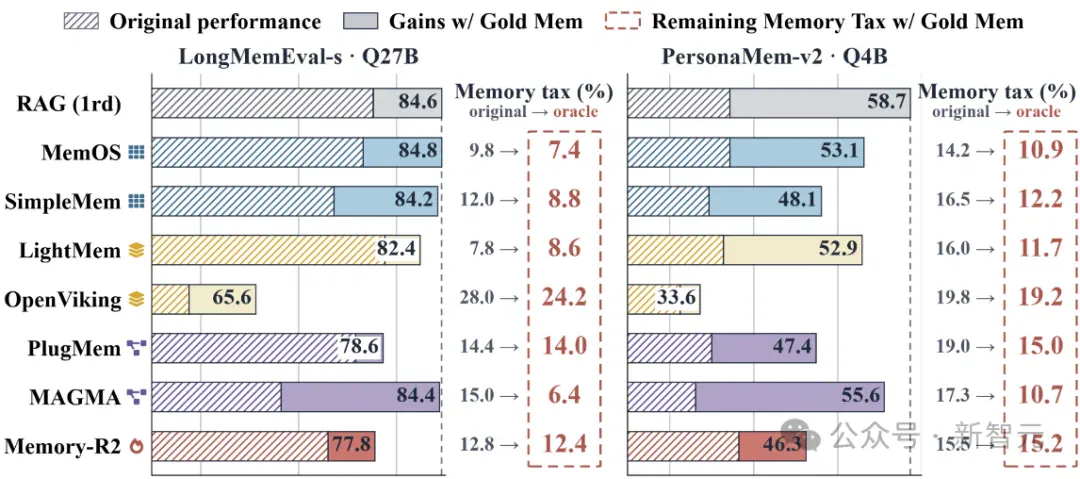
Several typical distortions appear in hundreds of manually sampled and annotated cases. A user originally says, “Once I collect 500 points at FreshMart, I can get US$5 off my next purchase.” After Memory-R2 splits this into a single-line fact, it becomes “frequently shops at FreshMart because of its 500-point discount offer.” The crucial US$5 has disappeared.
In another example, a user complains, “I heard a taxi from the airport to the hotel costs US$60; that is a bit expensive.” OpenViking summarizes this as a profile preference for “cost-effective transportation for budget reasons.” When later asked how much taking the train saves compared with a taxi, the US$60 figure is no longer recoverable.
When given an explicit forgetting request such as “Please forget that pressure from my family to get married keeps me from concentrating on art,” MAGMA rewrites it into a new stored fact: “The user instructs the assistant to ignore family pressure to marry and prioritize art and career.” The information meant to be erased instead takes root in the store.
2. Accessibility.
The second source of loss is reduced accessibility during retrieval.
In the preceding section’s figure, systems such as MAGMA and LightMem score highly when given gold units directly, almost matching the original context. This indicates the information remains intact in their stores. But scores fall sharply when returning to their own retrieval pipelines.
Replaying multi-round iterative retrieval shows that memory systems generally retrieve all the necessary evidence less often in the first round than RAG searching raw chunks directly.

Examining specific cases reveals three common changes when raw conversations enter a memory store:
(1) Fragmenting: a user says in the same passage that replacing a bicycle chain cost US$25 and installing lights cost US$40. LightMem splits it into three independent memory units. During question answering, the US$40 is retrieved in the first round, but the US$25 does not appear until round four, causing an incorrect total;
(2) Diluting: the simple statement “My daily commute takes 45 minutes each way” is merged by OpenViking into a 59-line user-profile document, mixed with dozens of unrelated records about foot pain, resoling leather boots and other topics, reducing its match to commuting questions;
(3) Rephrasing: summarization changes the emphasis of the original wording, shifting the overall similarity distribution between queries and memory units downward relative to the raw text.
3. Robustness.
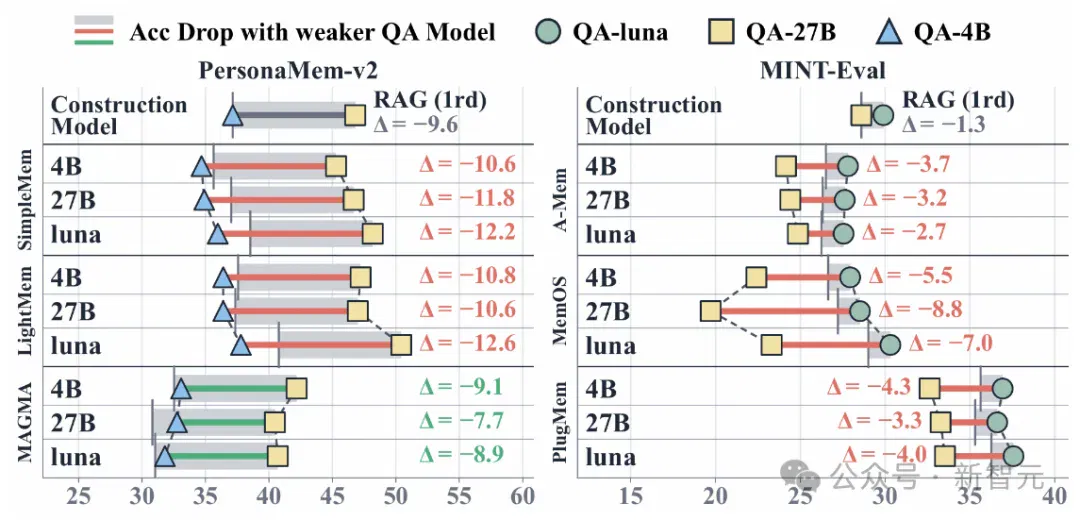
The third source of loss is reduced robustness when switching models. Long-running agents often undergo backbone upgrades or mix models, building memory offline with one model and answering questions online with another.
Cross-model tests show that because memory construction contains many intermediate operations dependent on a particular model’s generation habits, switching the construction model, or keeping memory fixed and changing only the downstream answering model, produces significantly larger score fluctuations and drops in many memory systems than in naive RAG. This introduces additional fragility on top of the original records.
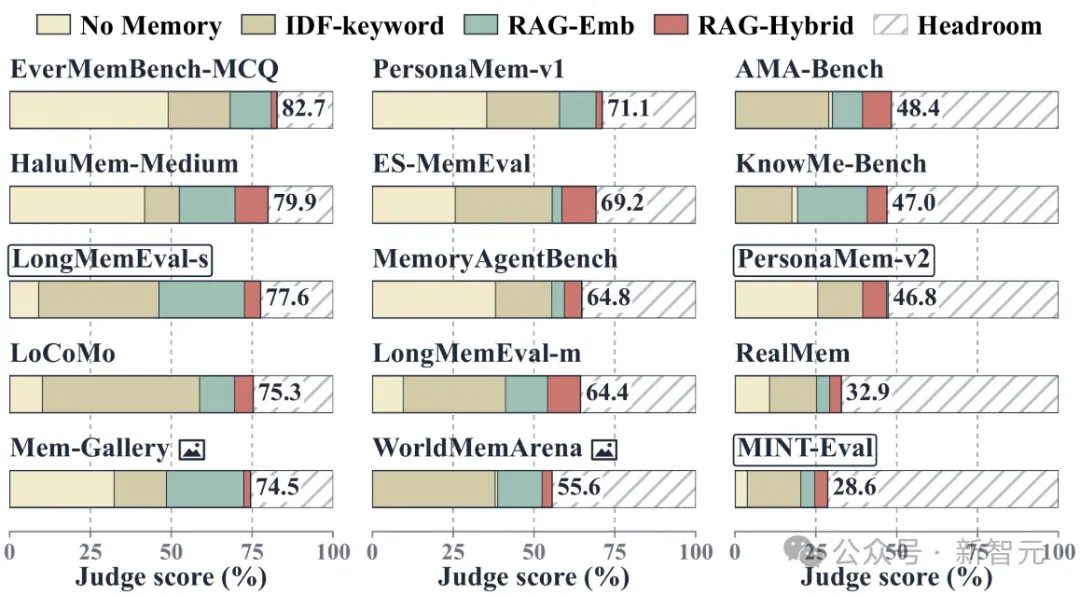
4. Benchmark headroom.
Outside the systems, limited headroom in existing benchmarks further amplifies memory tax. The final balance between memory benefit and tax depends heavily on the task itself. The team expanded testing to 15 major long- and short-term memory benchmarks, including LoCoMo, EverMemBench and HaluMem. Many widely used datasets proved very “retrieval-friendly”: even simple IDF keyword-rarity matching achieved absolute scores above 50% on several benchmarks, while standard hybrid-retrieval RAG reached 70%–80%.
When naive retrieval already captures most available baseline points, little headroom remains for memory systems to add benefits. Any tax incurred in construction or retrieval is then clearly exposed in the overall score.
This also helps explain why some recent lightweight approaches that reduce or even abandon explicit memory construction perform so well. On benchmarks with limited headroom, they inherit naive retrieval’s high starting point while avoiding a heavy memory tax.

“Memory tax” appears across settings
Looking beyond conversation, the pattern of biased reconstruction producing both benefits and taxes persists.
The authors ran parallel tests on experiential memory, which reuses historical task trajectories, and on world-model memory for long-video generation. In web tasks such as WebShop and Mind2Web, distilled workflows genuinely outperform RAG. But in code generation (BigCodeBench) and complex tool use (AppWorld and τ²-Bench), several methods that abstract experience into skills or reasoning strategies still trail naive RAG retrieving raw trajectories from similar tasks;
in long-horizon scene-consistency tests for world models, directly retrieving and reinjecting historical raw frames, as in I3DM, likewise maintains an advantage in visual consistency over compressing past frames into visual latents, KV caches or memory tokens.
Ideas for “tax reduction”
If reconstructing raw information always involves deviation, how can system design control the memory tax? At the end of the paper, the authors focus on directly improving existing systems while avoiding yet another complex architecture.
Idea one: make deviations recoverable during construction.
Since lossless distillation is hard to guarantee, the most grounded approach is to retain a route back to the original history. Retrieve raw records alongside the memory store, jointly rerank both sets of results and then give them to the answering model. This simple change nearly halves memory tax in SimpleMem, MemoryOS and Mem-T, substantially recovering overall scores.
Idea two: introduce recursive memory at access time.
The system best understands which evidence reconstruction has buried when, during actual question answering, it must struggle through multiple retrieval rounds to recover it.
In recent years, recursive self-improvement (RSI) has sought to let systems “improve how they improve”. Inspired by that idea, the authors believe memory systems could likewise “remember how they remember.”
Write past queries, successfully recovered evidence and the retrieval paths themselves back to memory as new source material. Evidence previously found only through several rounds of digging can then be recalled in one step for a similar later request, enabling inter-query test-time scaling.
Idea three: model future needs as an implicit “recommender system.”
Most current systems perform full ahead-of-time (AoT) construction before questions arrive. Since they do not know what will be asked, they heavily process all history indiscriminately, at high cost and with a risk of losing details. At the opposite extreme, just-in-time (JiT) memory, which organizes information only once a question arrives, puts all computational latency on the online user-facing path.
But in personal-assistant settings, users’ questioning habits and evolving interests have recognizable patterns. A worthwhile middle ground is therefore to model future access needs in advance, treating memory as an implicit recommender system that predicts which historical information is most likely to be useful. Selectively allocating processing budgets could perhaps reduce unnecessary memory tax at its source.
Conclusion
Long-horizon tasks involving cross-session associations and state updates still need support from long-term memory. The Memory Tax paper, together with its released code and intermediate evaluation data, offers the community a more realistic perspective:
When designing or evaluating a new memory mechanism and watching leaderboard scores rise and fall, researchers might first place a solidly configured naive RAG baseline alongside it. This makes it easier to see how much net value memory delivers and where it pays a “memory tax” in less obvious corners.
References:
https://arxiv.org/abs/2610.34073
This article comes from Xinzhiyuan, written by LRST.
Related topics
After reading
Join the AINRK community
Read how to join the community and connect with people working in AI.
Related articles
Continue reading related topics and articles in this category.

RUC open-sources AutoMaster: Skill guidance and trajectory selection for agent post-training (opens in a new tab)
RUC introduces Skill-FT and AutoMaster. Across six settings with a fixed teacher, task pool, 512 selected trajectories per round and SFT recipe, gains over Vanilla SFT are 1.42–8.99 percentage points. Multiple rounds require extra sampling, training and evaluation.
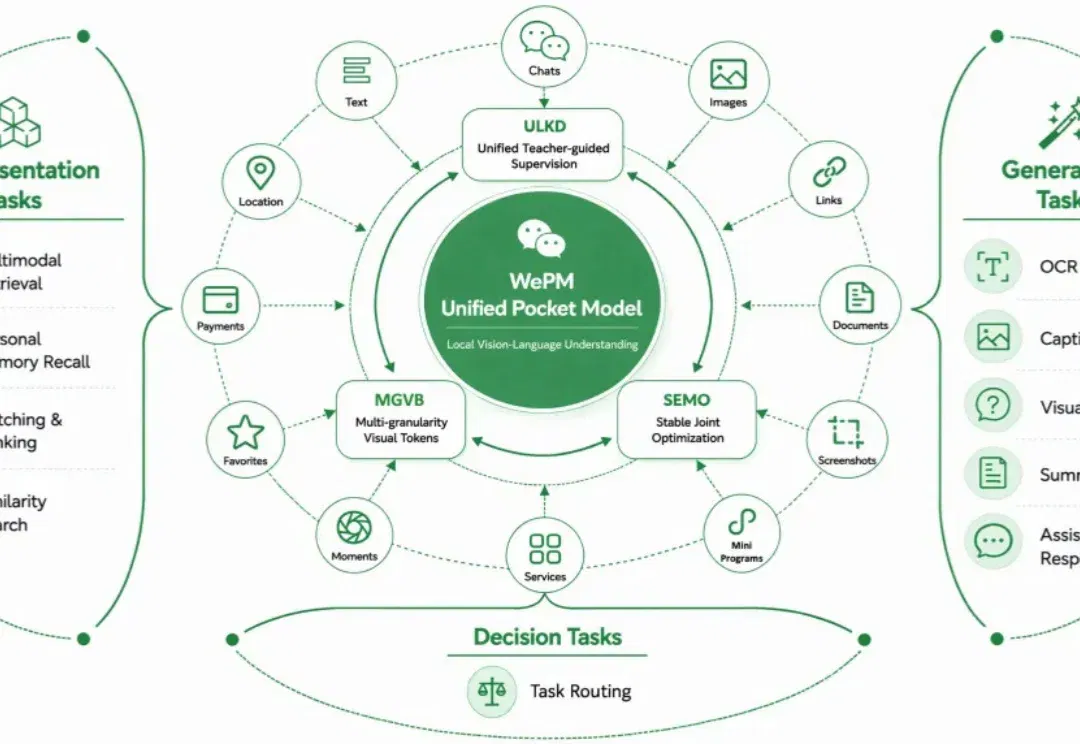
WeChat open-sources WePocketModel, unifying representation, generation and decision with one backbone (opens in a new tab)
Tencent's WeChat team releases WePocketModel, sharing one backbone across representation, generation and decision. WePM-4B uses 61.9% less resident weight memory than the selected specialist stack. Its roughly 8GB is BF16 weights, not total runtime memory; demos use an M5 Mac.
PEEK cuts FID by 49.3% in a specified ImageNet-EDM diffusion-sampling experiment (opens in a new tab)
NUS’s training-free PEEK adjusts deterministic diffusion sampling with look-ahead predictions. At an equal denoising-call budget, one ImageNet-EDM experiment lowers FID from 19.71 to 9.99. Results and one-time search costs depend on the setup.
Peking University Open-Sources PipeLink to Make GPU Kernel Optimizations Reusable (opens in a new tab)
Peking University's PipeLink declares interfaces, synchronization and resource needs for GPU stages, checks contracts and links stages into fused kernels. Examples span toolchains, attention variants and communication-compute fusion; gains depend on components, workloads and hardware.
Can Discrete Codes Become a General Visual Representation? Meituan LongCat Open-Sources dNaViT (opens in a new tab)
Meituan LongCat's dNaViT combines a frozen visual encoder, residual modulation and grouped quantization to retain semantics and pixel detail. The team reports reconstruction, understanding, generation and editing through one encoding interface, with task-specific models and decoding branches.